Introduction
Executive functions (EFs) are a collection of higher-order capacities that enable flexible goal-directed behavior (Welsh & Pennington, Reference Welsh and Pennington1988). They have been linked to functioning of the prefrontal cortex and through it to parietal, temporal and limbic lobe structures and the striatum (Roth & Saykin, Reference Roth and Saykin2004). A primary weakness in EFs has been proposed to underlie the symptoms of attention deficit hyperactivity disorder (ADHD) because ADHD children appear to lack attentional and strategic flexibility, often fail to monitor behavior effectively, and tend to display poor planning and working memory (WM) (Barkley, Reference Barkley1997; Castellanos & Tannock, Reference Castellanos and Tannock2002).
Research with children with ADHD has focused on the more purely cognitive or ‘cool’ EFs such as response inhibition and WM, associated with the dorsolateral prefrontal cortex, because some authors view ADHD as primarily a cool EF disorder (Zelazo & Müller, Reference Zelazo, Müller and Goswami2002). Recently, ‘hot’ EFs, those involving emotional and motivational processes, such as measured by affective decision-making tasks (e.g. delayed aversion) and thought to be dependent on the ventromedial prefrontal cortex, have received more attention (Kerr & Zelazo, Reference Kerr and Zelazo2004). However, to date, only one study (Solanto et al. Reference Solanto, Abikoff, Sonuga-Barke, Schachar, Logan, Wigal, Hechtman, Hinshaw and Turkel2001) has examined both cool and hot EF differences between ADHD children and normal controls.
Cool EFs
The ability to inhibit a pre-potent response in favor of another response is one of the most studied EFs in ADHD (Castellanos & Tannock, Reference Castellanos and Tannock2002). Barkley (Reference Barkley1997) posited that response inhibition is the primary deficit in ADHD and this in turn disrupts other EFs. Studies have consistently found that children with ADHD display slower inhibition of pre-potent responses than controls (Oosterlaan et al. Reference Oosterlaan, Logan and Sergeant1998; Nigg, Reference Nigg2000), a finding that cannot be accounted for by the presence of co-morbidities in ADHD children (Barkley et al. Reference Barkley, Edwards, Laneri, Fletcher and Metevia2001).
Evidence for Barkley's hypothesis comes from research using Go/No-Go tasks and the Stop-Signal paradigm. A deficit in response inhibition is supported by a meta-analysis of 17 studies that used the Stop-Signal paradigm, which yielded a moderate overall effect size [Cohen's d for Stop-Signal Reaction Time (SSRT)=0.58; Lijffijt et al. Reference Lijffijt, Kenemans, Verbaten and van Engeland2005]. Despite these findings, there are still doubts as to whether response inhibition is the primary deficit in ADHD (Castellanos et al. Reference Castellanos, Sonuga-Barke, Milham and Tannock2006), particularly in view of the results of a study of stimulant-naive boys with ADHD. In that study (Rhodes et al. Reference Rhodes, Coghill and Matthews2005), reaction time (RT) on Go/No-Go tasks for these boys was similar to that for matched controls, suggesting that there is not a general deficit in inhibition in EF tasks in ADHD.
Research on response inhibition deficits may be useful in delineating genes related to risk for a neuropsychologically distinct subtype of ADHD (Schachar et al. Reference Schachar, Crosbie, Barr, Ornstein, Kennedy, Malone, Roberts, Ickowicz, Tannock and Chen2005). Crosbie & Schachar (Reference Crosbie and Schachar2001), for example, found that children who displayed poor stop-task inhibition were significantly more likely to have a first-degree relative with ADHD than those children who exhibited good inhibition.
WM is a second EF studied extensively in ADHD and one that has been proposed as a potential neurocognitive endophenotype for the disorder (Castellanos & Tannock, Reference Castellanos and Tannock2002). WM refers to the online storage and processing of information over short periods of time (Smith & Jonides, Reference Smith and Jonides1999). In their 2005 meta-analysis, Martinussen et al. (Reference Martinussen, Hayden, Hogg-Johnson and Tannock2005) identified 26 studies and found deficits in both verbal and spatial WM for participants with ADHD that were independent of co-morbidity. They also found that spatial storage and spatial central executive tasks to have larger effect sizes than their verbal counterparts.
Despite these results, findings of WM deficits in ADHD remain inconclusive and this has led Pennington & Ozonoff (Reference Pennington and Ozonoff1996) to question the validity of a WM deficit associated with ADHD. Furthermore, it remains unclear whether response inhibition and WM impairments represent distinct ADHD deficits or whether both are manifestations of a common underlying dysfunction (Castellanos & Tannock, Reference Castellanos and Tannock2002).
Hot EFs
One view of impulsive behavior in ADHD is that it is not a result of an inability to inhibit a response, but of a rational preference to avoid delay, which an individual with ADHD finds aversive (Sonuga-Barke et al. Reference Sonuga-Barke, Taylor, Sembi and Smith1992). When allowed to choose between smaller-sooner rewards and larger long-term rewards, children with ADHD choose the former more often than controls (Marco et al. Reference Marco, Miranda, Schlotz, Melia, Mulligan, Muller, Andreou, Butler, Christiansen, Gabriels, Medad, Albrecht, Uebel, Asherson, Banaschewski, Gill, Kuntsi, Mulas, Oades, Roeyers, Steinhausen, Rothenberger, Faraone and Sonuga-Barke2009; Scheres et al. Reference Scheres, Tontsch, Thoeny and Kaczkurkin2010). Also, compared with controls, adults with ADHD showed hypo-responsiveness of the ventral-striatal reward system for both immediate and delayed rewards, suggesting a diminished neural processing of reward (Plichta et al. Reference Plichta, Vasic, Wolf, Lesch, Brummer, Jacob, Fallgatter and Grön2010). In addition, these adults showed hyper-activation in the dorsal caudate nucleus and amygdale, suggesting a preference for immediate rather than delayed rewards even though the intrinsic value of the latter was smaller. Given the possibility that impulsive behavior in ADHD children might be due to their tendency for delay aversion, it is important to clarify this issue by including both cool and hot EFs measures in the one study.
According to Bitsakou et al. (Reference Bitsakou, Psychogiou, Thompson and Sonuga-Barke2009), delay aversion may have a family etiology (biological and social). A twin study by Kuntsi et al. (Reference Kuntsi, Oosterlaan and Stevenson2001) found low-level heritability and significant effects for shared environment, consistent with a family etiology. Other studies, however, have failed to find familial influences (Andreou et al. Reference Andreou, Neale, Chen, Christiansen, Gabriels, Heise, Meidad, Muller, Uebel and Banaschewski2007; Bidwell et al. Reference Bidwell, Willcutt, DeFries and Pennington2007).
Rationale and aims of study
In the one study to date that compared both cool and hot EFs in ADHD children and controls, Solanto et al. (Reference Solanto, Abikoff, Sonuga-Barke, Schachar, Logan, Wigal, Hechtman, Hinshaw and Turkel2001) tested participants on both delay aversion and response inhibition tasks. They reported deficits for ADHD children on both tasks, but the differences were more pronounced on delay aversion.
The present study sought to extend the comparison of hot and cool EF differences between children with and without ADHD by including a more extensive battery of response inhibition and WM tasks, as well as SST and delay version tasks used by Solanto et al. (Reference Solanto, Abikoff, Sonuga-Barke, Schachar, Logan, Wigal, Hechtman, Hinshaw and Turkel2001). Because previous studies of EFs and ADHD had shown small effects, a large sample size was employed and an attempt was made to eliminate the possible confounding in some previous studies of ADHD status with other disorders by statistically controlling for co-morbidities. Importantly, the present study was able to include only medication-naive ADHD children in the study and so control for possible confounding of comparisons arising from drug effects. Given that results of some previous studies have provided evidence to suggest that EF impairments might have a family etiology, a secondary aim of the present study was to explore this possibility in our sample.
It was hypothesized that (1) compared with controls, children with ADHD would show significantly poorer performance on measures of response inhibition, WM and delay aversion; (2) children with ADHD and a family history of disorder would perform significantly more poorly on measures of response inhibition, WM and delay aversion than children with ADHD without a family history.
Method
Participants
Participants in the study comprised 100 children with ADHD and 100 healthy controls. There were 90 boys and 10 girls in the ADHD group (mean age 8.42 years, s.d.=1.59 years) with a mean estimated IQ based on four subtests from the Chinese Revised Wechsler Intelligence Scale for Children (C-WISC; Gong & Cai, Reference Gong and Cai1993) of 99.32 (s.d.=12.1). There were 89 boys and 11 girls in the control group (mean age 8.49 years, s.d.=1.58 years) with a mean estimated IQ of 106.82 (s.d.=11.12). Children with ADHD were recruited from consecutive referrals to three child behavioral clinics that serve large urban populations in the Guangdong Province, China. The controls were recruited from a primary school in the same province. All participants had to meet the following criteria: (1) age between 6 to 12 years; (2) estimated IQ >75; (3) normal auditory and normal or corrected to normal visual acuity; (4) no nervous system diseases and other medical problems which would make an impact on mental functions; (5) no developmental language problems; (6) having never received psychoactive medications; and (7) for participants in the control group not diagnosed with autism or other mental disorders.
Inclusion in the ADHD group required a diagnosis of ADHD based on semi-structured parent and child interviews with a consultant pediatrician. Additional inclusion criteria for this group were: (1) parent and/or teacher complaints of inattention, poor impulse control, and over-activity; (2) at least six of the 18 inattention or hyperactivity–impulsive symptoms on the ADHD checklist or scores by informant at or above the clinical cut-off on the Conners' Rating Scale (CRS-48; Conners, Reference Conners1989) or the Child Behavioral Checklist (CBCL; Achenbach, Reference Achenbach1978); (3) met all the Diagnostic and Statistical Manual of Mental Disorders, Fourth Edition (DSM-IV; APA, 1994) criteria for ADHD during the clinical interview; and (4) never received psychoactive medications or other psychological therapies.
Among the children with ADHD, 45 had a family history of ADHD and 55 had no family history of ADHD. Given the exploratory nature of this research question, data on family history of ADHD were collected from parents using two questions: whether either parent or any of either parent's siblings had displayed symptoms of ADHD during childhood. A positive family history was recorded if one or both parents answered yes to either or both of the two questions asked.
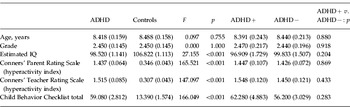
Table 1 presents the demographic and clinical characteristics of the two ADHD groups and the controls. Among the 100 children with ADHD, 36 had a co-morbid diagnosis of some form: 22 had had co-morbid oppositional defiant disorder or conduct disorder, 11 had learning disability, and three had tic disorder.
Demographic and clinical characteristics of children with ADHD and controls

Data are given as mean (standard error).
ADHD, Attention deficit hyperactivity disorder; ADHD+, ADHD children with a family history of the disorder; ADHD−, ADHD children without a history of the disorder.
Measures
Response inhibition was assessed using the Go/No-Go Task (van der Meere & Stemerdink, Reference van der Meere and Stemerdink1999), the Stop-Signal Task (SST; McInerney & Kerns, Reference McInerney and Kerns2003) and a Chinese version of the Stroop Test (CST; Lee & Chan, Reference Lee and Chan2000).
The Go/No-Go Task comprised a total of 200 stimuli, 80% being ‘Go’ (letter ‘R’ displayed) and 20% ‘No-Go’ trials (‘P’ displayed). Participants were presented with a ‘+’ at the centre of the computer screen for 400 ms, followed by either a Go or No-Go stimulus for 200 ms. This was followed by an interstimulus interval that randomly varied between 600 to 1200 ms. Measures obtained for this task were number of commission errors, and mean RT.
The SST (Logan et al. Reference Logan, Schachar and Tannock1997) comprised two trial blocks with 48 trials in each: 32 response signal trials without stop signals and 16 with stop signals. The response signal stimulus was either an ‘X’ or ‘O’, each with an equal chance of being presented in a block. In the SST, children were given two concurrent tasks, a Go task requiring them to discriminate between the two response signal stimuli (by pushing their corresponding buttons), and a Stop task requiring them to inhibit their Go task responses when a white frame appeared around the response stimulus. Difficulty of the task was varied by adjusting the speed at which the frame appeared (increasing or decreasing by 50 ms steps) to ensure that the success rate of all participants was approximately 50%. The measure obtained for this task was the mean SSRT.
The CST was based on the Stroop Test – Victoria Version (Regard, Reference Regard1981), except that the common words (part W) and color words (part C) were replaced by Chinese characters. Common words are written in colored ink but have no semantic connection to the color, whereas color words are semantically related to the color but are written in an unrelated colored ink. The color dots (part D) of the Victorian version remained the same. The participants were asked to read the color of dots or words, not the words themselves. The measure obtained for this test was the error for the interference trial.
WM was assessed verbally and visually. The Digits backward condition of the Digit Span subtest of the C-WISC (Gong & Cai, Reference Gong and Cai1993) was used for assessing verbal WM. The total number of correctly recalled trials was the measure taken. The backward condition of the Corsi Blocks Task (CBT; Vandierendonck et al. Reference Vandierendonck, Kemps, Fastame and Szmalec2004) was used for assessing visual WM. Verbal and visuospatial n-back tasks were also administered to the participants as measures of WM. However, measures of these tasks were not used in the data analyses because there were too many missing data. For the CBT, nine identical cubes were positioned irregularly on a board. During testing, the examiner pointed to a series of blocks at a rate of one per s with children required to point to the blocks in the reverse order presented. The total number of correct trials was the measure taken.
Delay aversion was assessed using two versions of the Choice-Delay Task (CDT). CDT-1 was modified from Solanto et al. (Reference Solanto, Abikoff, Sonuga-Barke, Schachar, Logan, Wigal, Hechtman, Hinshaw and Turkel2001). Children were told that they would take part in a game and the higher their score, the better. Using a computer mouse they were asked to choose between two circles (one is associated with a 1-point reward and the other a 2-point reward) presented in the centre of the screen. After selecting one of the two circles, there was a delay of either 2 s or 30 s before the number of points was posted on the screen. Before the task, children were told that: (a) there was no time limit; (b) there would be 10 ‘tries’ to earn points; and (c) one chip would be placed on a grid for each try so that they could keep track of how many tries were left. The total number of 2-point rewards chosen and the RT for each choice were recorded as measures of delay aversion.
To improve the ecological validity of delay aversion, this study also included CDT-2, as suggested by van Goozen et al. (Reference van Goozen, Cohen-Kettenis, Snoek, Matthys, Swaab-Barneveld and van Engeland2004). In this task children were asked to make a choice between two circles, one marked ‘40%’ which had a 40% chance of receiving 1 point immediately if chosen, and the other marked ‘80%’ which had an 80% chance of receiving 1 point in 12 s. In total, 20 test trials were administered, with no time limit set for the task. The total number of choices for the circles marked ‘80%’ and the choice RT were recorded as measures of delay aversion.
Procedure
The Sun Yat-Sen University human research ethics committee granted approval for the project and written consent was provided by each child's guardian. Children were tested in a quiet room either in a clinic or at their school and administered the battery of neurocognitive tests in a fixed order designed to minimize boredom.
Statistical analysis
Demographic and clinical characteristics of groups were compared using χ2 analysis for categorical variables and analysis of variance for continuous scores. Differences between means for groups were tested using univariate analysis of covariance. Comparisons involved the total patient group with the control group (to test for the effect of patient status) and then the positive family history patient group with the negative family history patient group (to test for the effect of family history) and each with the control group. Co-morbidity and IQ were used as covariates and comparisons were made on the means following adjustment for the covariates.
The relative contribution of EF variables to the prediction of patient status and family history was assessed using stepwise logistic regressions. Co-morbidity and IQ were entered at the first step to adjust for differences in these and then WM, response inhibition, and delay aversion measures were entered sequentially in blocks. Collinearity was checked in terms of bivariate and multivariate correlations in the predictor set and residuals were checked using standard regression diagnostics for poor model fit and points of undue influence. Departures were minor. Where tests of significance were made, an α of p<0.05 (two tailed) was employed.
Results
Demographic and clinical characteristics
As can be seen from Table 1, the ADHD children and controls were not significantly different on age and grade. The estimated IQ of the former group was found to be significantly lower than that of the latter group but the scores of the former group on the Conners' Rating Scale (both parent and teacher) and the CBCL were found be significantly higher than those of the latter group. In addition, the two groups of participants were not significantly different in gender and handedness (p>0.05). The two ADHD groups were not found to be significantly different on any of the demographic and clinical characteristics.
Hot and cool EFs
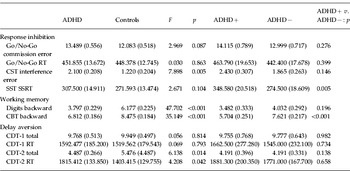
Table 2 presents a summary of comparisons on each of the EF measures for the effects of patient status and family history. Inspection of the table shows the following measures discriminated the patient and control groups at the nominated α level: the two WM measures (Digits backward and CBT backward), one response inhibition measure (Stroop interference error score) and two delayed aversion measures (CDT-2 number and CDT-2 RT). For family history, only CBT backward and SST SSRT measures significantly discriminated the patient group with a positive family history of ADHD from the patient group with no family history of ADHD.
Comparisons of EF performance based on patient status and family history with co-morbidities and IQ controlled

Data are given as mean (standard error).
EF, Executive function; ADHD, attention deficit hyperactivity disorder; ADHD+, ADHD children with a family history of the disorder; ADHD−, ADHD children without a history of the disorder; RT, reaction time; CST, Chinese version of the Stroop Test; SST, Stop-Signal Task; SSRT, Stop-Signal reaction time; CBT, Corsi Blocks Task; CDT, Choice-Delay Task.
Stepwise logistic regression was used to predict patient status and then family history from the following blocks of predictors: WM (Digits backward and CBT backward), response inhibition (Stroop interference error score, Go/No-Go RT, Go/No-Go commission error, and SST SSRT) and delayed aversion (CDT-1 total, CDT-1 RT, CDT-2 total and CDT-2 RT). This set of predictors covered the three domains of EF of interest and included the measures found to separate the groups in the univariate analyses. The covariates of co-morbidity and IQ were entered in the first block.
The logistic regression with patient status (0=control, 1=patient) as the criterion indicated a reduction in the –2LL (log-likelihood) with the addition of the two covariates at the first step [Δ=61.330, degrees of freedom (df)=2, p<0.001] and with the WM measures at the second step (Δ=53.703, df=2, p<0.001). The reduction at the third step, the introduction of the response inhibition measures, was not statistically significant (Δ=6.671, df=4, p=0.154), but the reduction at the fourth step with the introduction of the hot EF measures was (Δ=11.363, df=4, p=0.023). Model fit for the final model was satisfactory (Hosmer & Lemeshow χ2=10.127, df=8, p=0.256, Cox & Snell R 2=0.539, Neagelkerke R 2=0.720). However, the best fit in terms of the Hosmer and Lemeshow χ2 was obtained with the covariates and the WM measures in the model (χ2=1.937, p=0.983, Cox & Snell R 2=0.488, Nagelkerke R 2=0.652).
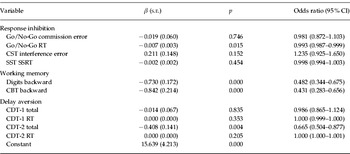
The β weights and odds ratios for each of the predictors in the final model predicting patient status are shown in Table 3. The β weights for Digits backward, CBT backward, Go/No-Go RT, and CDT-2 total were statistically significant and the confidence intervals on the odds ratios for these variables do not include 1, although in the case of Go/No-Go RT the upper bound is close to 1. The negative signs and the odds ratios less than 1 indicate that high scores on these variables increase the likelihood of being in the control rather than the patient group.
Regression coefficients for the prediction of patient status

s.e., Standard error; CI, confidence interval; RT, reaction time; CST, Chinese version of the Stroop Test; SST, Stop-Signal Task; SSRT, Stop-Signal reaction time; CBT, Corsi Blocks Task; CDT, Choice-Delay Task.
The logistic regression with family history (0=ADHD–, 1=ADHD+) as the criterion showed a statistically significant reduction in –2LL with the introduction of WM measures over the covariates alone in the model (Δ=44.306, df=2, p<0.001) but the reductions for no other steps were statistically significant. The final model with the covariates and all measures was a marginally better fit (Hosmer & Lemeshow χ2=5.709, df=8, p=0.680, Cox & Snell R 2=0.468, Nagelkerke R 2=0.626) than the model with only the covariates and the WM measures (Hosmer & Lemeshow χ2=7.024, df=8, p=0.534, Cox & Snell R 2=0.438, Nagelkerke R 2=0.586).
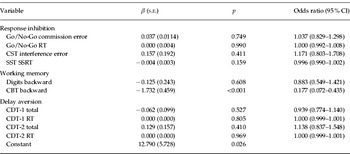
The β weights and odds ratios for each of the predictors in the final model predicting family history are shown in Table 4. Only the β weight for CBT backward was statistically significant and the confidence intervals for the odds ratio in this case do not include 1. The negative sign for the β weight and the odds ratio less than 1 indicate that high scores on the block recall test mean that the participant is less likely to belong to the group with the positive family history of ADHD.
Regression coefficients for the prediction of family history

s.e., Standard error; CI, confidence interval; RT, reaction time; CST, Chinese version of the Stroop Test; SST, Stop-Signal Task; SSRT, Stop-Signal reaction time; CBT, Corsi Blocks Task; CDT, Choice-Delay Task.
Discussion
This study compared a relatively large group of medication-naive children with ADHD with healthy controls using a number of cool and hot EF tasks. It also compared ADHD children with and without a family history of the disorder on these measures. For cool EFs, results revealed response inhibition and WM deficits in children with ADHD. Among the response inhibition tasks, children with ADHD were found to perform significantly worse than the controls on the Stroop. In addition, the Go/No-Go task was found to be a significant predictor in discriminating the ADHD and control groups. The only task that was not found to be impaired in the ADHD children was the Stop-Signal paradigm. This is surprising given that Lijffijt et al. (Reference Lijffijt, Kenemans, Verbaten and van Engeland2005) reported a moderate effect for this task in their meta-analysis of 17 studies. Given the size of our sample, this difference in results is not likely to be due to insufficient power. Two probable reasons are: only medication-naive participants were included in the current study and the study statistically controlled co-morbidities in the between-group analyses. More research is needed to clarify this issue. As hypothesized, evidence for familial effects on response inhibition was also found. This was evident from the poorer performance on those with a family history of ADHD compared with those without a family history on the SST SSRT. This finding is similar to that reported by Crosbie & Schachar (Reference Crosbie and Schachar2001) who found that ADHD children who showed poorer response inhibition (as measured by SST SSRT) were more likely to have a first-degree relative with ADHD than ADHD children who showed good response inhibition. It lends support to suggestions that a response inhibition deficit is affected by genetic factors.
Children with ADHD were also found to be impaired on the other type of cool EF, namely, WM. Specifically, differences were found on Digits backward and CBT backward, with the ADHD group showing significantly poorer performance on these measures compared with the controls. This finding is further supported by the results of a logistic regression which found these two measures to significantly discriminate the ADHD and control groups. The finding is consistent with the conclusion of the meta-analysis reported by Martinussen et al. (Reference Martinussen, Hayden, Hogg-Johnson and Tannock2005). Similar to the findings for response inhibition, results of the WM analyses also lend support to the hypothesis that family predisposition may be involved in ADHD. Specifically, comparisons revealed poorer performance on the CBT backward for those with a family history of ADHD compared with those without such a history. This finding is supported by the results of the logistic regression analysis that showed that CBT backward significantly discriminated ADHD children with and without a family history of the disorder.
Overall, among the results of cool EF measures, those associated with WM seem to be more robust and consistent than those associated with response inhibition. Although this points to the possibility that WM impairment might be a primary deficit, more research is needed before a firm conclusion can be drawn.
For the hot EFs of delay aversion, the results of this study found significant differences on the two measures of CDT-2 but not the two measures of CDT-1 between the ADHD and control groups. Specifically, children with ADHD were found to prefer stimuli that have a short delay in providing outcome or feedback even though these stimuli might be associated with a lower score. This finding is consistent with the results of the logistic regression that found that total score on CDT-2 significantly discriminated the ADHD children and controls. Unlike Solanto et al. (Reference Solanto, Abikoff, Sonuga-Barke, Schachar, Logan, Wigal, Hechtman, Hinshaw and Turkel2001), the current study did not find ADHD children to be impaired on measures of CDT-1. This difference in results is difficult to explain because the two studies are similar in many ways: mean age of participants, ADHD children were medication naive at the time of the study, and effects of co-morbidities taken into consideration during data analyses. One probable reason for the difference could be the smaller number of CDT-1 trials included in this study than the Solanto et al. (Reference Solanto, Abikoff, Sonuga-Barke, Schachar, Logan, Wigal, Hechtman, Hinshaw and Turkel2001) study. So far, the CDT-2 has rarely been used in studies of children with ADHD, with the exception of van Goozen et al. (Reference van Goozen, Cohen-Kettenis, Snoek, Matthys, Swaab-Barneveld and van Engeland2004). As mentioned, the CDT-2 is more ecologically valid and as such it might be a more sensitive measure of delay aversion for participants in this study. Measures of hot EFs were not found to differ significantly between ADHD children with and without a family history of the disorder. This is similar to the findings reported by Andreou et al. (Reference Andreou, Neale, Chen, Christiansen, Gabriels, Heise, Meidad, Muller, Uebel and Banaschewski2007) and Bidwell et al. (Reference Bidwell, Willcutt, DeFries and Pennington2007). Thus, unlike response inhibition and WM, the role of family disposition of this type of EF is not strong.
Overall, results of this study indicate that ADHD children are impaired on both cool and hot EFs. Although impairments of cool EFs such as response inhibition and WM in these children have been found in previous studies (e.g. Nigg, Reference Nigg2000; Castellanos & Tannock, Reference Castellanos and Tannock2002), the finding that these children are also impaired on hot EFs such as delay aversion is much needed evidence for this research area because few studies have examined both hot and cool EFs together. Together these results suggest that children with ADHD are impaired in the ability to inhibit a pre-potent response, the ability to actively process information in short-term storage, and the ability to delay a more advantageous response. In addition, to the extent that different areas of the prefrontal cortex are involved in cool and hot EFs, these present results suggest that ADHD children may suffer from irregularities in the dorsolateral and ventromedial prefrontal areas of the brain.
By including a relatively large group of medication-naive ADHD children in our study and by controlling for co-morbidities, we have also avoided the confounding effects of medication history and provided a more rigorous evaluation of EF deficits in these children. By comparing ADHD children with and without a family history on cool and hot EF measures and by finding significant results for two types of cool EF (WM and response inhibition), findings of this study provide initial support for a genetic influence on these EFs. However, it should be noted that the family history data of this study were collected by questioning parents of the children with ADHD on the presence of ADHD symptoms during both their and their siblings' childhood. Because no formal diagnostic testing or interview was conducted on other family members, it is difficult to rule out the impact of under- or over-reporting of childhood symptoms. Nonetheless, given that ADHD symptoms are easily observed by parents, any bias might be minimal, particularly in view of the fact that the incidence of ADHD with a family history of the disorder in this study was similar to that reported in North American populations (Buitelaar et al. Reference Buitelaar, Barton, Danckaerts, Friedrichs, Gillberg, Hazell, Hellemans, Johnson, Kalverdijk and Masi2006).
Acknowledgements
This study was supported partially by the Research Initiation Fund of the Hundred Talents Programme (16000-3253182) from the Sun Yat-Sen University, the key Laboratory of Mental Health, Institute of Psychology, Chinese Academy of Sciences, Project-Oriented Hundred Talents Programme (O7CX031003) of the Institute of Psychology, and the Knowledge Innovation Project of the Chinese Academy of Sciences (KSCX2-YW-R-131 and KSCX2-EW-J-8). Also, R.C.K.C. received an Outstanding Young Investigator Award of the National Science Foundation China (81088001) and D.S. received grants from the Australian Academy of Science Scientific Visit to China. These funding agents had no role in the study design, collection, analysis and interpretation of the data, writing of the manuscript, or decision to submit the paper for publication. The authors thank Professor John O'Gorman for his invaluable feedback and assistance on various versions of the manuscript.
Declaration of Interest
None.