Introduction
The development of Hong Kong English (henceforth HKE) has triggered a number of concerns amongst the local population with respect to its status (Joseph, Reference Joseph1996; Luk, Reference Luk1998; Bolton & Lim, Reference Bolton and Lim2000; Pang, Reference Pang2003; Stibbard, Reference Stibbard2004). However, despite the prominence of research into attitudes towards language variation within sociolinguistics, very few studies focus on Hong Kong English (Bolton & Kwok, Reference Bolton and Kwok1990; Candler, Reference Candler2001; S. Poon, Reference Poon2007) or Mandarin-accented English (He & Li, Reference He and Li2009; Hu, Reference Hu2004; F. Poon, Reference Poon2006). The aim of this study is to uncover language attitudes towards HKE and Mandarin-accented English (henceforth ME) in the Hong Kong region through the application of the verbal-guise technique.
The research methods
The research instrument employed in the study involved three main parts: 1) the verbal-guise technique; 2) perceptions of HKE; and 3) the social-demographic backgrounds of informants. The current paper demonstrates the design and results of the first part only, due to the word limit.
The verbal-guise technique, which is a variant form of the matched-guisetechnique (Lambert et al., Reference Lambert, Hodgson, Gardner and Fillenbaum1960), is employed in this section to examine informants' attitudes towards varieties of English speech. It involves informants listening to recordings from a series of different speakers and then being requested to evaluate each speaker on a bipolar semantic-differential scale (e.g., friendly/unfriendly, highly educated/poorly educated).
Although the matched-guise technique is recognised as useful and consequently has been employed in language attitude studies in a range of different community settings (Lyczak et al., Reference Lyczak, Fu and Ho1976; Genesee & Holobow, Reference Genesee and Holobow1989; Bayard et al., Reference Bayard, Weatherall, Gallois and Pittam2001; Dailey et al., Reference Dailey, Giles and Jansma2005), it has also been criticised for its use of non-authentic guises (Dailey et al., Reference Dailey, Giles and Jansma2005), more specifically for the use of one multilingual individual to represent different varieties of English. For example, a speaker may inaccurately mimic, e.g., exaggerate vocal variations (Lee, Reference Lee1971), an accent or a language in order to achieve that accent guise as effectively as he/she can. It is doubtful whether one could claim that speech produced in such circumstances is ever truly authentic (McKenzie, Reference McKenzie2008). In addition, if a study aims to explore people's reactions to two or more varieties of a language, the researchers are unlikely to find speakers who are fully balanced bi/multilingual and are thus able to produce all the varieties under investigation (Campbell-Kibler, Reference Campbell-Kibler2006: 63). It is very rare to find one speaker who can produce two or more language guises, for example, who – even with considerable dialect coaching – can do so fairly consistently (Giles, Reference Giles1970; Cooper, Reference Cooper1975; Bayard et al., Reference Bayard, Weatherall, Gallois and Pittam2001; Garrett et al., Reference Garrett, Coupland and Williams2003; Dailey et al., Reference Dailey, Giles and Jansma2005; Hiraga, Reference Hiraga2005; Campbell-Kibler, Reference Campbell-Kibler2006).
Therefore, the verbal-guise technique is employed to investigate attitudes in the study. It has been claimed that the use of a verbal-guise technique has the risk of introducing more paralinguistic variables (e.g., pitch height, loudness, breathiness: see Kerswill, Reference Kerswill, Long and Preston2002; Buchstaller, Reference Buchstaller2006), because the employment of various speakers inevitably includes speaker differences. Nonetheless, I would argue that a more realistic technique would be to rely on authentic speakers and, obviously, such a research design requires carefully selected speakers and properly recorded stimuli in order to minimise the potential influence of speaker differences on listeners' perceptions (as discussed in the next section).Footnote 1
The selection of varieties of English speech and speakers
There were eight English varieties that were selected: two local Hong Kong varieties of English, one with a broad accent (HKbr) and the other with an educated one (HKed), Mandarin-accented English (ME), RP, General American English (AmE), Australian English (AusE), Tyneside English (TynE), and Philippine English (PE). This paper mainly reports the results regarding HKbr, HKed and ME.
Previous research has shown different attitudes towards HKed and HKbr (Bolton & Kwok, Reference Bolton and Kwok1990; S. Poon, Reference Poon2007). Bolton and Kwok (Reference Bolton and Kwok1990: 149–50) were the first to subdivide HKE into the two varieties, HKbr and HKed, and these key distinctions will be a central issue here. HKbr refers to the accent of speakers who have a lower proficiency of English. Thus, HKbr, similar to the mesolect in a continuum, refers to a variety with a strong Hong Kong accent; it is marked by a high frequency of HKE features. By contrast, HKed, similar to the acrolect, refers to the accent of speakers who are moving towards the exonormativity of a native-speaker accent; these speakers are proficient in Chinese and English and still retain many localised features of speech (Bolton & Kwok, Reference Bolton and Kwok1990: 149).
HKbr and HKed seem to represent two developmental stages in the cline of proficiency. It would be difficult to find a clear-cut point at which to divide these two varieties. Hung (Reference Hung and Bolton2002: 122) points out that ‘the internalized phonological system of an individual speaker of HKE is, like any interlanguage system, dynamic and evolving rather than static’. It is thus possible to perceive this dynamic as a continuum with an ‘idealised’ HKE phonology (which consists of all the HKE phonological features) at one end and standard British or American English phonology (whichever happens to serve as the speaker's model) at the other. I have thus chosen to conceptualise HKbr and HKed as two general notions which are located at certain points along a continuum (see Figure 1). HKbr is usually seen as being close to ‘the idealised HKE phonology’ end of the continuum. It is thus likely to possess almost all the features of the idealised HKE phonology. In contrast, HKed is generally seen as being close to the native norm at the other end of the continuum and manifests fewer idealised HKE features. The main difference between the two varieties seems to lie in the frequency of occurrence of these features. Individual HKE speakers differ from each other in how many features of the idealised HKE phonology they exhibit and thus in which points they occupy on this continuum, as shown in Figure 1.
The continuum of HKE phonology (HKed and HKbr)

Therefore, HKed and HKbr are, at least from a phonological perspective, considered to be two varieties positioned along a scale of accentedness (i.e., from mild to broad). Previous attitudes research has demonstrated that respondents from the Inner Circle with no linguistic training were able to pick up on even small differences in the amount of accentedness and that the degree of accentedness may indeed be a factor that influences listeners' evaluations (Giles, Reference Giles1972; Ryan, Reference Ryan, Shuy and Fasold1973; Brennan et al., Reference Brennan, Ryan and Dawson1975; Giles & Powesland, Reference Giles and Powesland1975; Giles & Coupland, Reference Giles and Coupland1991: 39). Usually, the more heavily-accented a speaker's voice is, the less positively he/she is evaluated by native speakers of English in terms of status, especially when the variety is spoken by a non-native speaker of the language in question (Ryan et al., Reference Ryan, Carranza and Moffie1977; Cargile, Reference Cargile1997; Dalton-Puffer et al., Reference Dalton-Puffer, Kaltenboeck and Smit1997). It is therefore worthwhile investigating whether the degree of accentedness also affects the evaluations of non-native speakers of English in the context of Hong Kong, especially when compared with native and non-native accents.
ME was selected in this study because Mandarin became one of the official languages in Hong Kong after sovereignty changed in 1997. Indeed, increasing numbers of people have emigrated from mainland China to Hong Kong every year.Footnote 2 Most are highly skilled and talented immigrants who have entered Hong Kong through the Quality Migrant Admission Scheme (QMAS),Footnote 3 and they play important roles in Hong Kong's political, cultural and economic domains. However, it takes time for Mandarin speakers from Mainland China to learn Cantonese, which is the dialect spoken in Hong Kong. Consequently, these highly skilled immigrants tend to use ME as their medium of communication.
The inclusion of ME also allowed me to explore Hong Kong people's attitudes towards a distinctive Chinese variety of English which is often dubbed ‘China English’. While there are numerous works on its salient linguistic features (e.g., Jiang, Reference Jiang1995; Kirkpatrick & Xu, Reference Kirkpatrick and Xu2002; Hung, Reference Hung2005; Xu, Reference Xu2005; Deterding, Reference Deterding2006: 179–94; F. Poon, Reference Poon2006; He & Li, Reference He and Li2009: 72), the range of accents and dialects subsumed under this umbrella makes it very difficult to generalise about the phonological features of China English (Zhou & Feng, Reference Zhou and Feng1987; Cheng, Reference Cheng and Kachru1992; F. Poon, Reference Poon2006: 24; Deterding, Reference Deterding2006: 176) or to argue that certain features are common to all speakers of this variety, which is more accurately described as a bundle of related varieties (Kirkpatrick, Reference Kirkpatrick2007: 146; He & Li, Reference He and Li2009: 72). Hence, in the current study, the term ‘Mandarin-accented English’ is instead used to refer to the Chinese variety of English spoken by Mandarin speakers, thus avoiding the problem of generalisation.Footnote 4 Indeed, owing to the fact that China has the largest population in the whole world and the largest number of English learners, it is quite possible that ‘China English’ might become the variety of English spoken by the largest number of people in the world (Hu, Reference Hu2004: 31). An investigation of Hong Kong people's attitudes towards this variety might thus provide valuable indications of people's perceptions of its speakers.
The choice of RP (Received Pronunciation) and AmE (General American) is supported by the fact that these two accents tend to be included in most attitude studies as reference varieties, since they are usually rated highly in terms of status.
Since gender and age are two factors which affect voice quality and may therefore have an influence on informants' attitudes, the current study kept the gender of speakers constant and only used females. It also controlled for age, choosing an age range between 26 and 55 years with a mean age of 39 (SD = 12). All speakers' voices were listened to by a number of judges, including two professional linguists and two Hong Kong research students specialising in linguistics, who unanimously agreed that all speakers were authentic representations of the varieties of English in question and that it was difficult to identify the speakers' ages as none of the voices sounded particularly young or old. All speakers were asked to read a pre-selected factually neutral text (see Appendix A).
According to Brown et al. (Reference Brown, Strong and Rencher1973), speeding up or slowing down one's voice can lead to a change in people's perceptions of speakers' personalities. In accordance with other studies (Ladegaard, Reference Ladegaard1998; McKenzie, Reference McKenzie2008), the present study took great care to minimise the effect of paralinguistic factors such as speaking speed or pitch by recording a number of stimuli and choosing speakers with comparable rates of speech. The stimuli were randomised when they were played to the informants in order to minimise the potential effect of ordering the presentation of the recordings (Bezooijen & Boves, Reference Bezooijen and Boves1986).
The selection of informants
The sample of the population chosen for this study consists entirely of local Hong Kong students who were studying at a university in Hong Kong. The first reason for choosing this population was that they belong to the generation that has grown up during a period of dramatic socio-historical transformation culminating with the handover and who have therefore experienced the radical changes in language policy which Hong Kong has witnessed in recent times.Footnote 5 According to Lee and Collins (Reference Lee and Collins2006), younger Hongkongers are more tolerant of HKE usages, whereas older generations tend to prefer the prescribed varieties of English. Hence, the choice of relatively young and well-educated informants was thought to be likely to lead to eliciting those responses that are the most accepting of HKE within the population of Hong Kong as a whole. This being the case, a study that draws on these young educated subjects might allow us to see whether, and to what extent, they accept HKE, which is in turn likely to help us predict the future development of this variety.
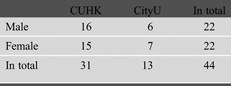
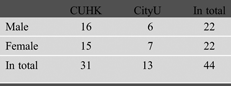
The informants, aged between 19 and 29, came from two universities in Hong Kong: The Chinese University of Hong Kong (CUHK) and The City University of Hong Kong (CityU). For the actual survey, the informants were divided into four groups of 13 or fewer. This was done so that I would be better able to observe how each informant completed the tasks. Moreover, the small group size ensured that everyone would be able to hear the recordings clearly and complete the questionnaires without too many distractions. Before the informants started to answer the survey, a briefing session informed them of the general procedure for completing the questionnaires. After completion, informants were told in a debriefing session that the purpose of the survey was to investigate people's attitudes towards different English accents. In total, 44 valid questionnaires were returned from the two universities with an equal number of male and female informants. Table 1 depicts the distribution of informants.
The informants who participated in the current study
Results and discussion
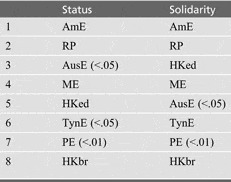
This section examines the informants' attitudes towards each variety of English speech from the perspective of status and solidarity. RP, AmE, ME, HKed, and HKbr are demonstrated in descending order of evaluation in terms of status and solidarity, as shown in Table 2. The presence of a line indicates that there is a significant difference using the paired-samples t-test (p < 0.05 or p < 0.01) in the informants' evaluations.
Rankings of eight varieties of English speech (status and solidarity)

Note: AusE – Australian English
TynE – Tyneside English
PE – Philippine English
Within the overall differences between the eight varieties of English speech, the three standard varieties of English from the Inner Circle and two from Asia (ME and HKed) were usually rated highly. In the next level, similar ratings are given to TynE (Tyneside English), an alien variety for the Hong Kong informants, and PE (Philippine English), a variety with which they are familiar and which is easily stereotyped with negative connotations given the social roles Filipinos play locally. HKbr is rated significantly lower than the other varieties and thus it is perceived most negatively by the informants. The results are consistent with those of previous studies that have focused on social evaluations of English in Hong Kong, and which also demonstrate that Hong Kong people favour Inner circle varieties of English over HKE (Bolton & Kwok, Reference Bolton and Kwok1990; Luk, Reference Luk1998; Candler, Reference Candler2001; S. Poon, Reference Poon2007).
However, the higher rating of HKed in terms of solidarity to some extent confirms the results reported widely in the literature, namely that non-standard varieties are usually favoured in terms of solidarity, especially when the evaluators are speakers of that variety (e.g., Giles, Reference Giles1970; Stewart et al., Reference Stewart, Ryan and Giles1985; Bayard et al., Reference Bayard, Weatherall, Gallois and Pittam2001; Hiraga, Reference Hiraga2005). Moreover, this result leads me to suggest that HKed is perceived almost as positively as standard varieties of English. At least on the basis of these results, it seems possible to claim that HKed has the potential to develop into a standard variety of English in Hong Kong and it might be perceived as a marker of the Hong Kong identity; I return to this point later.
A more unexpected finding, however, is that HKbr received even more negative evaluations than PE. It has been repeatedly claimed that Hong Kong people have a stereotypical perception of HKE as a poor and non-standard variety of English (Luk, Reference Luk1998; Bolton & Lim, Reference Bolton and Lim2000; Pang, Reference Pang2003; Stibbard, Reference Stibbard2004), which means that this local variety is held in very low esteem. Indeed, their internalised negative attitudes towards their own variety are likely to be the reason why Hong Kong people rate HKbr even lower than a variety of English that is ostensibly rated negatively within their community, PE. The initial explanation for this result might be that Hong Kong informants suffer from the ‘linguistic self-hatred’ observed amongst speakers of English with a New York accent (Labov et al., Reference Labov, Ash, Ravindranath, Weldon, Baranowski and Nagy2006: 329), as well as in other studies of, for instance, the speech in Montreal (Lambert, Reference Lambert1967), Glasgow (Macaulay, Reference Macaulay1975), and Dublin (Edwards, Reference Edwards1977). The same kind of self-hatred has also been reported for another South-east Asian variety of English – Colloquial Singapore English (Wee, Reference Wee, Kortmann and Schneider2004: 1023; Lim, Reference Lim2009: 57, Cavallaro & Chin, Reference Cavallaro and Chin2009).
Labov et al. (Reference Labov, Ash, Ravindranath, Weldon, Baranowski and Nagy2006) point out that an important reason for this phenomenon in New York is the strong pressure ‘towards conformity with middle class norms of speech’ (Labov et al., Reference Labov, Ash, Ravindranath, Weldon, Baranowski and Nagy2006: 331). In the case of Hong Kong, it seems likely that the strong inclination to model native English accents – such as RP and AmE – and pressure towards conformity with such varieties are a reflection of the negative attitudes towards HKE. Hong Kong is still a mainly exonormative territory where Inner Circle varieties of English are preferred and encouraged. Other researchers (e.g., Luk, Reference Luk1998; Lam, Reference Lam2007) echo this opinion by pointing out that Hong Kong students prefer a standard accent since it has enjoyed prestige for a long time in Hong Kong. The pressure to conform to Inner Circle English is reflected both in their preference for such accents as well as their dislike of their own variety.
However, the situation in Hong Kong seems to be more complex. The findings presented here indicate an obvious preference for at least one variety of HKE, namely HKed. This is especially true with respect to solidarity since HKed was upgraded from fifth to third place on these traits, ranking even higher than AusE (Australian English). HKbr, however, stays at the bottom of the ranking. In other words, the self-loathing that is apparent in certain responses needs to be seen in the context of other attitudes towards the two varieties of HKE examined here: the higher rating for HKed and the most negative attitudes towards HKbr demonstrate that the extent to which each variety incorporates indigenous accentual features plays an important role in the attitudes attached to this variety, a finding which is confirmed by previous studies (e.g., Giles, Reference Giles1972; Ryan, Reference Ryan, Shuy and Fasold1973; Brennan et al., Reference Brennan, Ryan and Dawson1975; Giles & Powesland, Reference Giles and Powesland1975; Giles & Coupland, Reference Giles and Coupland1991: 39). Indeed, the fact that HKbr is evaluated lower than TynE further proves that a heavily-accented variety spoken by a non-native speaker is evaluated less positively than an Inner Circle variety (e.g., Ryan et al., Reference Ryan, Carranza and Moffie1977; Cargile, Reference Cargile1997; Dalton-Puffer et al., Reference Dalton-Puffer, Kaltenboeck and Smit1997).
This study is the first one to compare attitudes towards ME with those towards a range of other varieties of English. Note that this variety is rated relatively highly in terms of both status and solidarity, providing strong evidence for the likelihood that ME will develop as a distinct variety of Chinese English. Interestingly, ME is rated consistently highly, being placed fourth for status and solidarity traits. This result is especially interesting, since it shows little support for previous findings. Lindemann (Reference Lindemann2003) has shown that native English speakers such as Americans evaluated ‘Chinese’ English negatively when it was used in the classroom. He and Li (Reference He and Li2009) found that Chinese subjects rated ‘China English’ lower than ‘Standard English’. Similarly, previous research suggests that Hong Kong people's attitudes towards Mandarin are relatively negative (Lai, Reference Lai2005 & Reference Lai2007). My findings, however, indicate that this negative attitude is not transferred to ME.
On the contrary, the current study provides some evidence for the positive attitudes of Hong Kong people towards ME, which might suggest a relatively prosperous future for ‘China English’. One of the explanations for this result, especially in a Hong Kong context, is the fact that Hong Kong people might associate ME with speakers of relatively high socio-economic status, especially those emigrating to Hong Kong through the Admission Scheme for Mainland Talents and Professionals and the Admission of Mainland Students Graduated from the University Grants Committee (UGC)-Funded Institutions in Hong Kong after 1997, under which a number of mainland Chinese emigrate to Hong Kong every year. As shown in the names of the schemes, these new emigrants are professionals or elite personnel working in Hong Kong.
In addition, Hong Kong educational institutions compete fiercely with their mainland counterparts for high quality university students, which is rapidly increasing the number of mainland Chinese students in Hong Kong: ‘In 2006 Hong Kong (…) recruited 1,300 (…) mainland undergraduate students (…) and most are fee-paying ones’ (Li, Reference Li2007: 16). Considering the University of Hong Kong alone, 10,230 and 12,000 mainland Chinese students applied for around 300 undergraduate places in 2006 (Gao, Reference Gao2008) and 2008 (Gao & Trent, Reference Gao and Trent2009: 145), respectively, and most successful applicants are self-financing. The number of research postgraduates from mainland China holding scholarships at this university increased from 893 to 1,455 in 2000/01 (Li & Bray, Reference Li and Bray2007: 798). There are eight universities in Hong Kong: two of them have policies of English as the medium of instruction, while the others use a mix of English and Cantonese (Li & Bray, Reference Li and Bray2007: 798). It is very likely that these Mandarin-speaking students have to use English (normally ME) to communicate with Hong Kong people, at least in the early days after their arrival. Since neither mainland Chinese emigrants nor university students are stereotyped negatively, it is unsurprising to observe that Hong Kong people have more tolerance towards ME.
Conclusion
To sum up, the Hong Kong informants evaluated prestige varieties such as RP and AmE more positively than HKE. However, when HKE was further classified into HKed and HKbr, HKed was found not only to be rated much higher than HKbr, which always came last in the ranking, but also to be evaluated as favourably as Inner Circle English varieties in terms of solidarity. These results demonstrate the possibility that this variety might in fact have reached a stage of relative acceptance amongst an elite group in Hong Kong, which is suggestive of the possibility that it might therefore develop into a standard local variety in the not-too-distant future.
In addition, the informants' evaluations of ME are broadly parallel with those of HKed in the current study. Previous research has reported that Mandarin was not, in fact, perceived positively by Hong Kong subjects in general (e.g., Lai, Reference Lai2001, Reference Lai2005 & Reference Lai2007). My study reveals, however, that this negative attitude towards Mandarin is not simply or directly transferred onto Mandarin-accented English. As discussed previously, the relatively positive attitude found towards ME might be due to the socio-economic status of the ME speakers, who tend to be professionals or people working in professional-related positions in Hong Kong. However, Zhang (Reference Zhang2005) showed that the Mandarin spoken by Mainland Chinese people working in foreign businesses was influenced by the Mandarin used by people from Hong Kong or Taiwan. It might be interesting to find out if this influence is extended to English accents, namely, if the group of Mainland Chinese professionals who have frequent contact with Hong Kong or a foreign country would like to follow the model of HKE instead of ME and whether they also have a positive attitude towards ME.
In Reference Bolton2003, Bolton employed the term ‘Chinese Englishes’ rather than ‘China English’ to indicate that there should be more than one variety of English in China. If, however, we were to refer to a variety spoken by the majority of Chinese people, ME would be the best choice for the following reason: even though every Chinese person might speak a local dialect or accent of the Chinese language, Mandarin is the only official Chinese language in P. R. China. Nearly all Chinese people can speak Mandarin and ME is thus likely to be the best concrete example of what might constitute a generic China English.
Appendix A: Factual neutral text
The North Wind and the Sun were disputing which was the stronger, when a traveller came along wrapped in a warm cloak. They agreed that the one who first succeeded in making the traveller take his cloak off should be considered stronger than the other. Then the North Wind blew as hard as he could, but the more he blew the more closely did the traveller fold his cloak around him; and at last the North Wind gave up the attempt. Then the Sun shined out warmly, and immediately the traveller took off his cloak. And so the North Wind was obliged to confess that the Sun was the stronger of the two.
 QI ZHANG received her PhD from Newcastle University. She joined Dublin City University in 2011 as the coordinator of Chinese Language and Culture. Her main research interests are sociolinguistics, language attitudes and intercultural communication. She is currently working on a project exploring Internet language in China. Her work on Hong Kong English and China Englishes will be published in 2014 by Peter Lang (book working title Attitudes Beyond the Inner Circle: Investigating Hong Kong English). Email: qi.zhang@dcu.ie