Introduction
Today, an unprecedented number of public-health events (PHEs), such as tornados, epidemic outbreaks, and acts of terrorism, are occurring around the world. Over the past 30 years, there has been a 4-fold increase in the number of reported PHEs.Reference Guha-Sapir, Hargitt and Hoyois 1 , Reference Gutierrez 2 Evidence indicates that global climate change appeared to contribute to the increase in the number and severity of natural disasters.Reference Miller 3 Additionally, changing political climates along with shifts in populations are expected to increase the number of people who are vulnerable to PHEs.Reference Guha-Sapir, Hargitt and Hoyois 1
Given the current fiscal pressures and staffing issues, finding and coordinating the health care resources needed to provide appropriate physical, psychological, and ethical care during a PHE is challenging. Sufficient staffing of health care facilities is necessary to support the health care needs of the community. Yet, researchers worldwide have reported that 25% to 80% of health care personnel (HCP) intend to respond during a PHE.Reference Chaffee 4 - Reference Connor 14 The goal of this cross-sectional study was to explore the factors associated with the intention of HCP to respond to a future PHE.
Methods
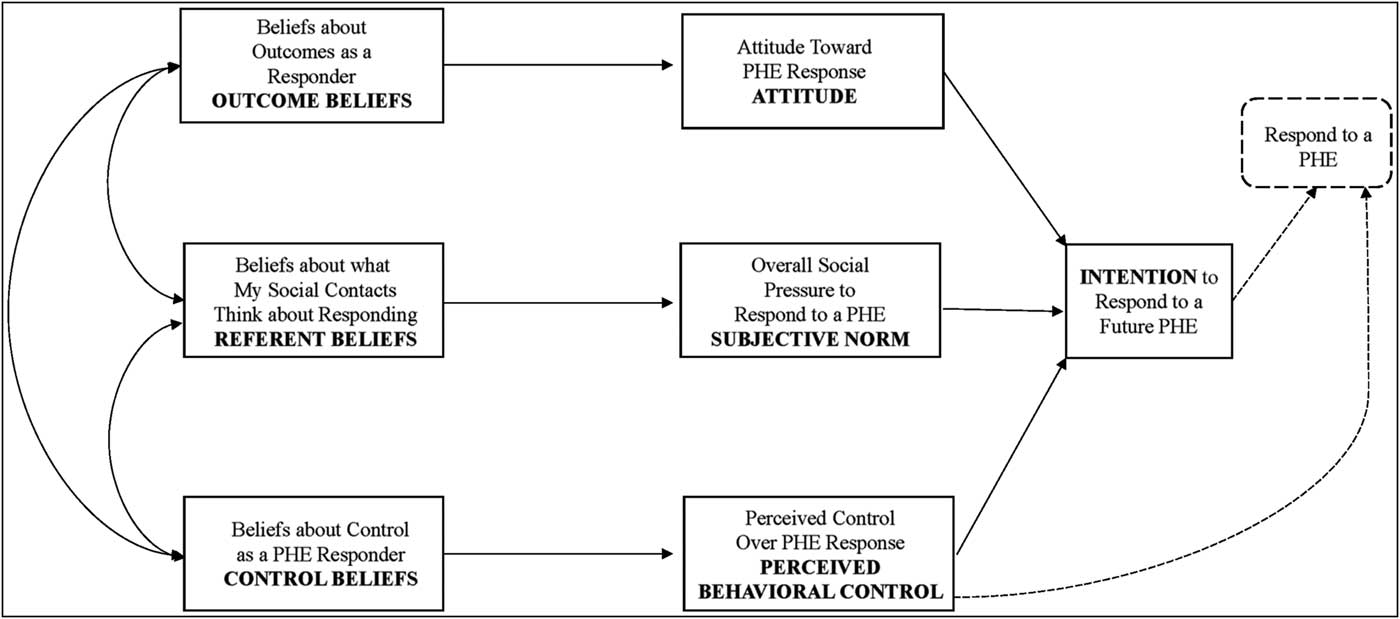
The theory of planned behavior (TPB) guided the development of a web-based survey instrument (Figure 1).Reference Ajzen 15 - Reference Ajzen 19 According to this theory, the intent to act (ie, responding to a PHE) is steered by the person's beliefs about: (a) the probable outcomes of their actions; (b) what their social contacts think about their actions; and (c) whether there are any significant barriers that might hinder their actions. These three beliefs, or indirect predictors, are mediated respectively by the person's: (a) attitude toward responding to a future PHE; (b) overall perception of social pressure (subjective norm) to respond to a PHE; and (c) a sense whether or not they have the skills, knowledge, time, or supplies needed to respond to a PHE (perceived behavior control). In general, a person will most likely respond to a future PHE if they have a positive attitude toward PHE response, their social network supports PHE response activities, and they believe they can control the situation.
The Theory of Planned Behavior for PHE Response. This schematic represents how the intention to respond to a future PHE is influenced by the beliefs and attitudes toward PHE response as posited by the TPB. According to this theory, intention is the immediate antecedent of behavior. Intention is influenced by attitude toward the behavior, subjective norm, and perceived behavioral control. These direct predictors are themselves a function of the underlying behavioral outcome, normative, and control beliefs, respectively. The curved double arrow lines are correlations. The solid arrow lines show the predicted paths between observed constructs. The dashed arrow indicates a possible path between perceived behavioral control and PHE response.Reference Ajzen 19 Abbreviations: PHE, public-health event; TPB, theory of planned behavior.

Because there is no universal TPB questionnaire, a 31-question survey was carefully crafted to suit HCP in the United States and the target behavior (PHE response).Reference DeVellis 20 - Reference Sidani and Braden 24 Following the University of Minnesota (Minnesota USA) Institutional Review Board approval (0910E73094), a convenience sample of 305 HCP completed the web-based survey and all data were imported from a protected university server into the Statistical Package for the Social Sciences version 18 (SPSS Inc., Chicago, Illinois USA) and Analysis of a Moment Structures version 7.0 (SPSS Inc., Chicago, Illinois USA) for analyses.
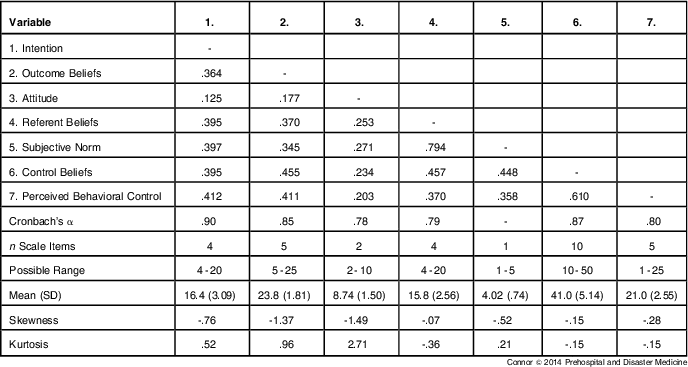
Classical test-theory-based statistics were used to evaluate the psychometric properties and response patterns of the survey that was designed to measure the intent of HCP to respond to a future PHE. Responses to the 31 TPB-based Likert-type and semantic differential survey items were analyzed using corrected item total correlations. Those items that contributed to a measure of the TPB constructs were summed to create scales that represented each of the TPB constructs and the outcome variable, intention (Figure 1). Cronbach's alpha provided an indicator of scale quality; Cronbach's alpha ranged from .78 to .90 for the seven composite scales (Table 1).Reference Cronbach 25 , Reference Cronbach and Shavelson 26
Correlations, Reliability Estimates, and Psychometric Properties of the PHE Survey Scales (Note: Scores on Likert-type and semantic differential items range from 1 (unfavorable belief or attitude toward PHE response) to 5 (favorable belief or attitude toward PHE response). N = 303. The correlation between attitude and intention was significant at the .05 level (2-tailed). All other scales were significantly correlated at the .01 level (2-tailed)).

Abbreviation: PHE, public-health event.
Inspection of the Pearson's correlations was used to examine linear associations between the six predictor variables and the outcome variable (Table 1). Independent t tests were calculated to assess the differences between the responses of Registered Nurses (RNs) and other HCP (eg, physicians and pharmacists).
A model-generating approach was used to develop and assess a series of TPB-based observed variable structural equation models for prediction of intent to respond to a future PHE and to explore moderating and mediating effects.Reference Bollen 27 - Reference Byrne 29 The model was limited to the seven TPB variables shown in Figure 1. Model fit was determined using the Likelihood Ratio Test (X 2), the Relative Fit Index (RFI; >.95), the Tucker-Lewis Index (TLI; >.95), and the root mean square error of approximation (RMSEA; <.05 with 90% confidence intervals).
Post hoc model modifications were based on fit, parsimony, and theoretical interpretability. Mediation effects posited by the TPB were assessed using Baron and Kenny's causal step tests and the Sobel test.Reference Baron and Kenny 30 , Reference Preacher and Leonardelli 31 Possible moderating effects were assessed through examination of changes in the relationships between predictors and intention through a series of estimated TPB-based models using subsets of the sample (ie, professional affiliation).
Results
Prior to analysis, the data were inspected visually. No items or cases stood out as having a large amount (greater than five percent) of missing or incomplete data. Missing values did not exceed three percent of all possible responses and appeared to be distributed sporadically among the items and the individual cases. Missing values were replaced with the scale mean for all cases. Two cases appeared to be univariate and multivariate outliers and were not included in the analyses. Assumptions for bivariate and multivariate analyses were met.
Sample Characteristics
The analytic sample consisted of 303 cases. The majority of respondents were RNs (80%). The preponderance of the survey participants worked in civilian health care settings (90%), were female (83%), and Caucasian (91%). Age of the participants ranged between 22 and 67 years with a mean age of 43 years. Sixty-six percent practiced in a health care profession for over ten years; three percent had less than one year of professional experience. The sample varied on PHE experiences. Forty-five (15%) indicated they were members of an emergency response team, 301 (99%) had received some type of PHE-related education, and 59 (19%) had actual PHE response experience.
Relationships
The strength of the relationships between the indirect (beliefs), direct (attitudes), and outcome (intention) variables suggested the seven scales derived from the survey items measured the TPB constructs. Pearson's correlations between each pair of the seven variables were statistically significant, with stronger associations seen between the related measures (ie, referent beliefs and subjective norm) as posited by the theory (Table 1).
A series of independent sample t tests determined whether the RNs and other HCP mean scores on the seven TPB-based scales differed significantly. The nominal Type I error rate was set at <.05 and the critical value at which a plausible significant result was considered was set at P <.05. Findings of these nondirectional t tests suggested that a possible difference between these groups was in how RNs (M = 21.14, SD = 2.56) seemed to have a more positive perception of behavior control compared to other HCP (M = 20.43, SD = 2.43), t (301) = 1.9, P = .05. However, findings suggested that RNs and other HCP did not differ in their willingness to respond to a future PHE. Because the type of a PHE might affect the intention of HCP to respond to a PHE, a chi-squared test for independence was calculated for each type of event.Reference Smith, Burkle and Archer 32 Findings suggested that RNs and other HCP did not differ in their intention to respond to any of the event types (eg, severe weather, pandemic, and terrorist attack).
The initial postulated PHE response model (Figure 1) did not fit the data, X 2 (12, N = 303) = 56.168, P = <.001; RFI = .87; TLI = .89; RMSEA = .11, 90% CI (.08-.14). Therefore, additional steps were taken to modify the model. Parameters that were constrained in the initial model were estimated freely in subsequent models, based on the modification index (Lagrange Multiplier Test).Reference Arbuckle 28 , Reference Byrne 29 Modifications were made until the X 2 and model fit statistics indicated a fit between the data and the model that was theoretically interpretable with respect to the TPB.
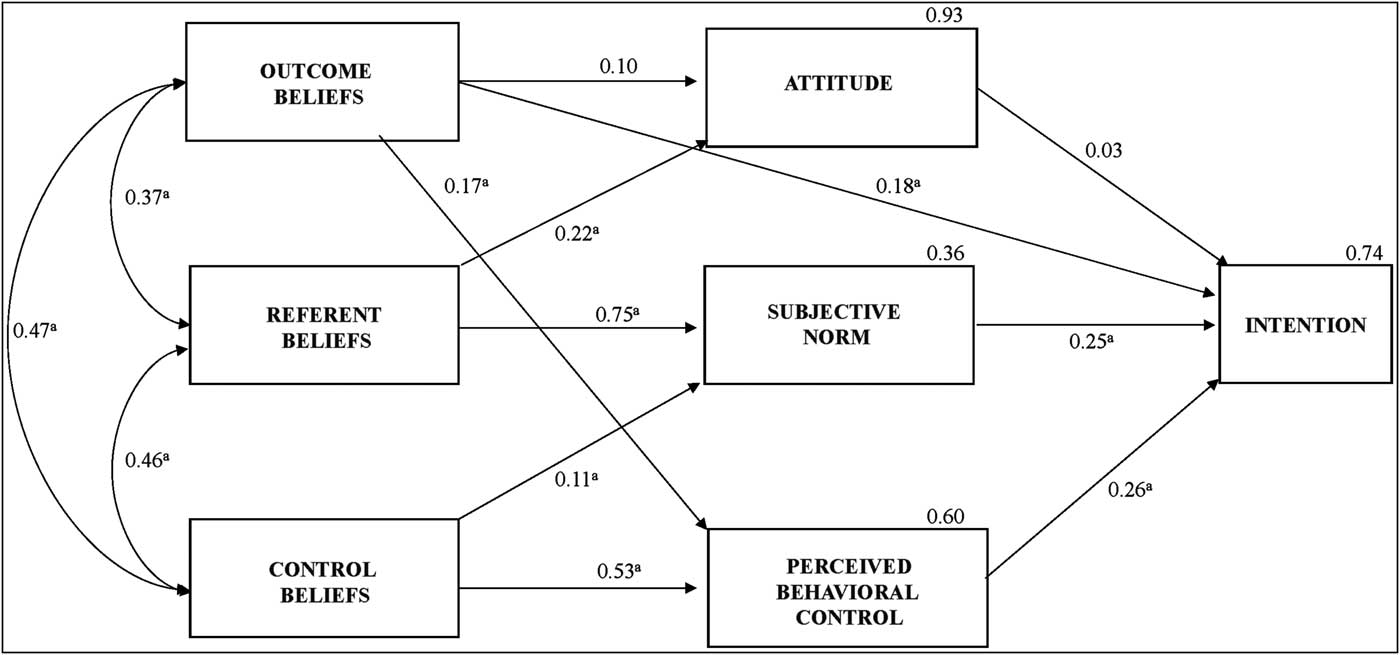
These data fit the final PHE response model (Figure 2) X 2 (8, N = 303) = 14.70, P = .065; RFI = .95; TLI = .98; RMSEA = .053, 90% CI (.0-.094), AIC = 68.70. All parameter estimates were significant (P < .05) except for the relationships between outcome beliefs and attitude (b = .097, P = .105) and between attitude and intention (b = .027, P = .600). Twenty-six percent of the variance in intention was explained by outcome beliefs, attitude, subjective norm, and perceived behavioral control. Sixty-four percent of the variance in subjective norm was explained by referent beliefs and control beliefs. Forty percent of the variance in perceived behavioral control was explained by outcome beliefs and control beliefs.
The PHE Response Model. Standardized path coefficients between the observed variables are shown. The unexplained variance (1 - R 2) for attitude, subjective norm, perceived behavioral control, and intention are displayed above the respective box. The correlations between the three belief scales (curved double-headed arrows) are shown; all correlations are significant (P = .01 level (2-tailed)). Abbreviation: PHE, public-health event. aPath parameter was significant at P < .05.

Results of the Sobel test indicated that the effect of outcome beliefs on intention was significantly mediated by perceived behavioral control (z’ = 2.02, P = .04) and the influence of control beliefs on intention was significantly mediated by perceived behavioral control (z’ = 3.67, P < .001).Reference Preacher and Leonardelli 31
To determine if the PHE response path model shown in Figure 2 was consistent across different subsets of the sample, the sample was divided into subgroups based on professional affiliation: RNs and other HCP. The model was limited to the observed TPB variables obtained in the survey. Because the subgroups are actual levels of a possible moderator (eg, professional affiliation), the goal of these analyses was to determine whether the mediational patterns, identified in the final PHE model, were moderated by the RN and other HCP subgroups of the sample. If the mediational patterns identified in the PHE model (Figure 2) remained the same across the subgroups, but the magnitude of the relationships between the variables changed, there was evidence of a moderating effect.
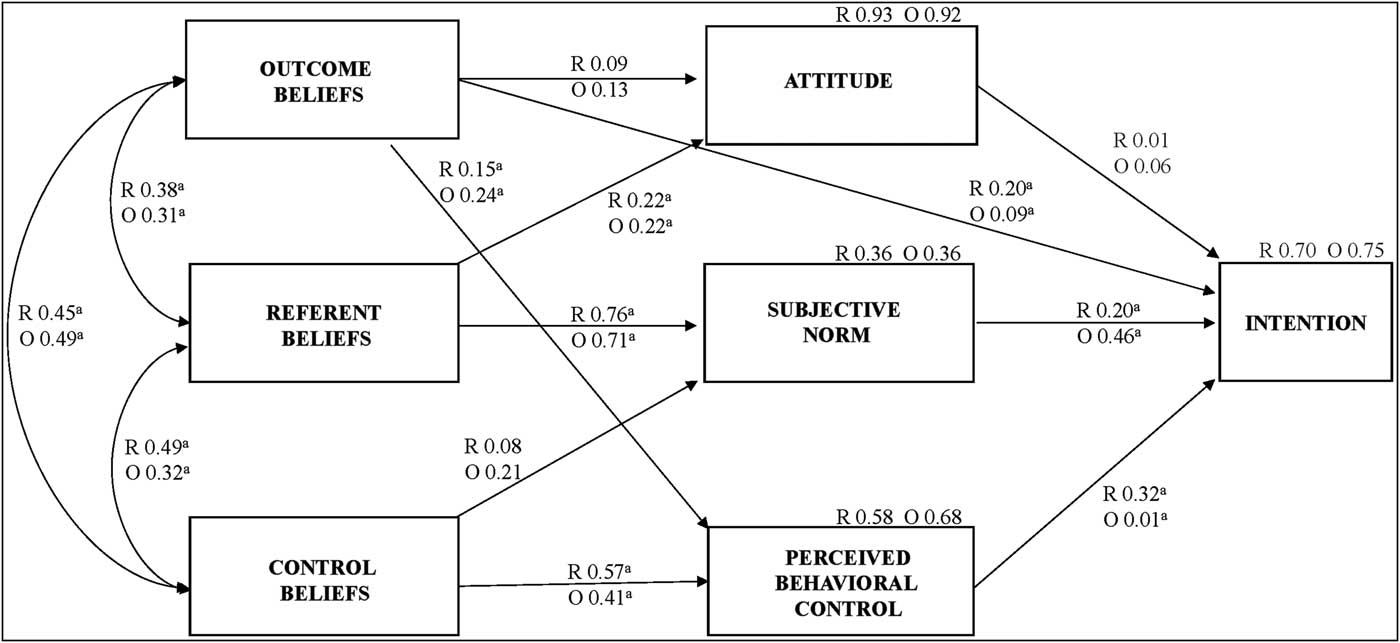
The graphic representations of inter-variable relationships identified through simultaneous modeling of the RN and other HCP groups were the same as those depicted in the final PHE model for all 303 participants combined (Figure 2). However, comparison of the pairwise parameter calculations identified a significant path difference between the two groups (Figure 3). The relationship between subjective norm and intention in the RN group (b = .20, P < .05) was significantly different from the path estimates in the other HCP group (b = .46, P < .05).
PHE Response Moderated by Professional Affiliations. The standardized path coefficients for the RN (R, n = 242) and other HCP group (O, n = 61) showed that the two groups differed in the magnitude of the relationships among the indirect and direct predictors of intention. Pairwise parameter comparisons of the two models identified a statistically significant path difference between subjective norm and intention. The unexplained variance (1 - R 2) for attitude, subjective norm, perceived behavioral control, and intention are displayed above the respective boxes. The correlations between the three belief scales are shown; all correlations were significant. Model fit was adequate X 2(16) = 21.989, P = .144; TLI = .978; RFI = .925; RMSEA = .035; 90% CI (.00-.068). Abbreviations: HCP, health care personnel; PHE, public-health event; RFI, Relative Fit Index; RMSEA, root mean square error of approximation; RN, Registered Nurse; TLI, Tucker-Lewis Index. aPath coefficients significant at P < .05.

Discussion
The patterns of prediction were somewhat different from those posited by the TPB.Reference Ajzen 15 , Reference Ajzen 18 , Reference Ajzen 19 The concept of attitude did not significantly contribute to intention. The attitude measures did not seem to provide a complete assessment of the attitude construct. Instead of assessing an attitude related to the intent to respond to a specific PHE, these items might have actually assessed an affective component that measured the person's general attitude toward PHEs.
However, outcome beliefs did have a significant, direct effect on intention and an indirect effect on intention that was mediated by perceived behavioral control. Control beliefs appeared to influence intention through perceived behavioral control as posited by the TPB and unexpectedly through a new path to subjective norm. Subjective norm mediated the relationship between referent beliefs and intention as theorized by the TPB and mediated the relationship between control beliefs and intention.
Professional affiliation appeared to have a moderating effect on PHE response. A significant difference between the PHE response models of the professional subgroups (RN and other HCP) was observed in the effect subjective norm had on intention. In the other HCP subgroup, the intent to respond to a future PHE was influenced mostly by subjective norm. However, RNs’ intent to respond was influenced primarily by perceived behavioral control.
The intention to respond was influenced significantly, directly by subjective norm, perceived behavioral control, and, to a lesser extent, outcome beliefs. Although subjective norm contributed to the prediction of intention to respond, perceived behavioral control exerted the greatest influence on intention. This echoed the findings reported by two groups of authors who reported that perceived behavioral control exerted more influence than attitude and subjective norm on the intent of health care workers to volunteer to care for infected patients.Reference Grimes and Mendias 33 , Reference Ko, Feng, Chiu, Wu, Feng and Pan 34
These findings suggested that the intention to respond was influenced by primarily normative and control factors. In general, the willingness of nurses to respond was influenced by mostly the control factors, whereas the other HCP group's intention to respond was shaped by primarily the normative factors.
Responses to the survey items and the patterns of relationships identified in the correlation matrix and the final PHE response model implied that this sample of HCP possessed and had control over a valuable set of skills and abilities that could be used to provide tangible help to PHE victims, which might result in a positive outcome. Yet, answers to individual items in the scales suggested that some participants were concerned that access to resources could hinder their response to a future PHE. This concern was one of the primary findings of a group of researchers who studied infection control intention and behavior among intensive care nurses.Reference O'Boyle, Robertson and Secor-Turner 35 However, many of the participants endorsed control belief items indicating they perceived that they had the interpersonal, team building, and leadership skills that could help them garner support from their referents and collaborate with organizations capable of providing the needed resources in order to bring about a positive outcome. The combination of these factors appeared to bolster the intent of HCP to respond to a PHE. Future research into the willingness of home health, extended care, and hospice worker's intention to work during PHEs and how response team membership influences PHE response may help organizations prepare staff, clients, and the client's families for PHEs.
The willingness of HCP to respond to a PHE might reflect how they themselves prepare for potential PHEs (ie, vaccinations, supplies, evacuation, and contact plans). This personal preparedness might extend to clients who are vulnerable to PHEs. Future research into how HCP and health care organizations translate PHE preparedness into patient treatment and education planning could supplement best practices useful to providers whose vulnerable patients might require additional preparedness planning in order to meet their health care needs during a PHE (ie, dialysis, medications, continued treatment options, and sheltering).
Limitations
Even though this study extended previous research on the intention of HCP to respond to a future PHE and echoed many of the conclusions of other groups of researchers, any generalizations about the relationships presented in the study should be interpreted cautiously, as this study had several limitations.
The sample was a convenience sample of HCP. Nurses were anticipated to be the largest respondent group because they are also the largest group of employed HCP. However, physicians and pharmacists were under-represented, as were HCP who worked in community or private practice settings. Minorities were also under-represented in this sample.
Biases might have existed due to the retrospective cross-sectional design. The participants self-selected and provided data at a single point in time. It is not known how many eligible individuals who were aware of the study elected not to complete this online survey. The context, in which this sample of HCP worked and lived, presumably influenced their self-reported responses to the PHE survey items. Information regarding regional and institutional variations in emergency response education and types of local PHEs was lacking, which could have influenced participant answers on the instrument. In addition, during the year preceding this study, several large natural disasters and the H1N1 pandemic occurred, which could have influenced some of the participants’ responses.
Although most of the scales appeared to have adequate variability between participant responses to individual items and the scale created from each set of items, a ceiling or floor effect was possible.
Conclusion
Even though the type, timing, and nature of PHEs are almost impossible to predict, health care administrators and educators can build on the professional qualities of their staff and bolster the control and normative factors that were discovered to be associated with the intention of HCP to respond to a future PHE. Realistic, well-timed education focused on internal (eg, knowledge and skill) and external (eg, supplies) control factors, and normative factors (eg, team building and family support) relevant to the practical and ethical dilemmas related to surges in patients can help HCP navigate a possibly difficult transition between a robust system to one of austerity and back again. Bolstering teamwork through simulated events that replicate potential PHEs might increase HCP's perceptions of controllability, a sense of collegial support, and confidence in their organization.