Introduction
Public perceptions of welfare rights constitute a crucial socio-psychological foundation for shaping the inclusiveness of social welfare systems. Grounded in van Oorschot’s (Reference van Oorschot2000) deservingness criteria, which include the dimensions of control, attitude, reciprocity, identity and need (CARIN), many studies have documented that the public in Western developed countries generally adopts a more restrictive stance toward the welfare rights of international migrants and ethnic minorities, giving rise to the phenomenon of ‘welfare chauvinism’ (Careja & Harris, Reference Careja and Harris2022). However, the applicability of the CARIN criteria in non-Western contexts, particularly in societies like China characterised by significant internal institutional divisions, remains to be examined.
In China, the household registration (hukou) system has erected a profound welfare barrier between urban and rural areas, fostering the world’s largest migrant population, namely rural-to-urban migrants. Originally designed to regulate internal migration and resource allocation, the hukou system classifies citizens by both geographic location (local versus non-local) and residency type (agricultural versus non-agricultural). However, changing one’s hukou status along either geographic location or residency type is not easily accomplished, as any alteration requires formal approval from government authorities. For decades, this system has created a deep institutional divide between urban locals and rural-to-urban migrants, systematically tying access to high-quality urban services to citizens with urban hukou. Although reforms over the past decade have relaxed hukou restrictions in small and medium-sized cities, mega-cities like Shanghai continue to maintain stringent controls (Zhang & Li, Reference Zhang and Li2016, Reference Zhang and Li2018). In these large metropolises, obtaining a local hukou remains highly difficult for rural-to-urban migrants.
The number of rural-to-urban migrants in China was over 178 million in 2024 (National Bureau of Statistics of China, 2025). Unlike immigrants or ethnic minorities in Western countries, China’s rural-to-urban migrants share the same nationality as urban locals, yet their welfare entitlements are systematically constrained by the urban welfare system. The welfare conditions of rural-to-urban migrants in urban China are widely documented as relatively low (Chindarkar et al., Reference Chindarkar, Nakajima and Wu2024; Xie et al., Reference Xie, Chen, Ritakallio and Leng2021; Zhang & Li, Reference Zhang and Li2018). This poses an important question: when the identity of ‘outsiders’ is rooted in domestic institutional arrangements instead of nationality or ethnicity, what influences the public’s judgement of welfare entitlement?
Investigating perceived welfare deservingness of rural-to-urban migrants in China carries distinct theoretical implications. First, it helps exclude the interference of regime types to test the core universal mechanisms of welfare attitude theories. Do the public’s judgements of welfare rights in China, deemed authoritarian, share similarities with the Western democratic systems? This study can provide a crucial comparative perspective. Second, public policy preferences serve as a critical underpinning for the stability of welfare expenditure levels in industrialised democratic countries (Brooks & Manza, Reference Brooks and Manza2006, Reference Brooks and Manza2007). It is well-known that China is not a Western democratic welfare state. Whether public welfare attitudes still form the social foundation of welfare policy in China deserves in-depth exploration. Third, rural-to-urban migrants are a direct result of China’s unique hukou system, reflecting the population’s duality across urban and rural areas. They are ideal subjects for testing public attitudes towards welfare deservingness for a country’s disadvantaged group.
This study designed a survey experiment to explore the determinants of perceived welfare deservingness of rural-to-urban migrants. Drawing on the theory of deservingness criteria, this study constructs an analytical framework around five key factors: hukou status, length of urban stay, employment status, migration patterns and homeownership. This study constructed thirty-two vignettes, collected experimental data through an online survey and used multilevel modelling for analysis. The results showed that hukou status is the most significant determinant of perceived welfare deservingness of rural-to-urban migrants. In addition, there are significant differences between locals and non-locals with respect to identity, need and attitude, but not in reciprocity and control. Moreover, the five deservingness criteria have no significant differences in their impact on the various dimensions of welfare deservingness. This study contributes to an understanding of the social underpinnings of the welfare system in China and has significant implications for the further advancement of welfare rights for rural-to-urban migrants.
Literature review
Welfare deservingness of migrants
Migrants’ welfare deservingness refers to societal judgements about who qualifies for social support, under what conditions and to what degree. These judgements are guided by the CARIN framework, comprising control, attitude, reciprocity, identity, and need (van Oorschot, Reference van Oorschot2000), which has been widely applied across social contexts (Gniza & Wrede, Reference Gniza and Wrede2024; Herke & Janky, Reference Herke and Janky2023; Theiss, Reference Theiss2023).
Identity and reciprocity are key determinants of public support. Regarding identity, immigrants face restrictions owing to outsider status: non-US citizens and their children are less likely to enjoy medical services than native-born Americans (Derose et al., Reference Derose, Bahney, Lurie and Escarce2009), and non-citizens and ethnic minorities are perceived as less entitled, a phenomenon termed ‘welfare chauvinism’ (Careja & Harris, Reference Careja and Harris2022; Reeskens & van der Meer, Reference Reeskens and van der Meer2019). Regarding reciprocity, entitlement centres on societal contributions: highly skilled immigrants enjoy more welfare because they meet labor market needs (Helbling & Kriesi, Reference Helbling and Kriesi2014; Koning & Banting, Reference Koning and Banting2013; Tzeng & Tsai, Reference Tzeng and Tsai2020). These contribution standards are reflected in policies of the UK and Denmark (Albrekt Larsen, Reference Albrekt Larsen2020; Lindner et al., Reference Lindner, Daenekindt, de Koster and van der Waal2024; Römer, Reference Römer2017).
The welfare predicament of rural-to-urban migrants in China
In China, rural-to-urban migrants are legally citizens in cities, yet their access to urban welfare, including healthcare, education and pensions, is systematically constrained by their non-local hukou status. Without urban hukou, they are largely excluded from the publicly funded social services that urban locals take for granted (Chindarkar et al., Reference Chindarkar, Nakajima and Wu2024; Zhang & Li, Reference Zhang and Li2018). This institutional exclusion has profound consequences for migrants’ long-term life chances, as studies show that access to urban welfare is crucial for their permanent settlement and sustainable livelihoods (Xie et al., Reference Xie, Chen, Ritakallio and Leng2021; Zhang & Li, Reference Zhang and Li2018).
In recent years, mega-cities like Shanghai have introduced selective point-based systems to regulate welfare access. Points are awarded based on a range of factors such as educational attainment, professional skills and tax payments. Only when an applicant accumulates sufficient points do they become eligible for certain local welfare benefits, such as their children’s access to public school education. However, these reforms do not eliminate the structural barrier. Instead, they create a tiered system where only migrants who meet a stringent combination of qualifications can gradually gain eligibility. While these policies have been analysed from the perspectives of fiscal capacity and institutional design (Zhang & Li, Reference Zhang and Li2016), far less attention has been paid to how the public perceives the legitimacy of these welfare exclusions. This institutional reality makes rural-to-urban migrants in China an ideal case for examining the social underpinnings of welfare attitudes in a non-Western, non-immigration context.
Public perceptions of migrants’ welfare deservingness
Research on public attitudes toward the welfare deservingness of migrants can be broadly grouped into two streams. The first examines comparative deservingness across groups, consistently showing that immigrants are ranked among the least deserving compared to the elderly, sick and unemployed (Dhaliwal & Forkert, Reference Dhaliwal and Forkert2015; Reeskens & van der Meer, Reference Reeskens and van der Meer2019; van Oorschot, Reference van Oorschot2006). The second explores within-group variation, documenting that even among migrants, perceptions differ based on legal status, skill level and other individual attributes (Aalberg et al., Reference Aalberg, Iyengar and Messing2012; Gil-Salmerón et al., Reference Gil-Salmerón, Katsas, Riza, Karnaki and Linos2021).
Three sets of factors shape these deservingness perceptions: ideological orientations, respondent attributes and immigrant characteristics. Ideologically, welfare chauvinism assumes immigrants are ‘free riders’ (Careja & Harris, Reference Careja and Harris2022; Heizmann et al., Reference Heizmann, Jedinger and Perry2018), leading to the view that welfare should be restricted to natives (Andersen & Bjørklund, Reference Andersen and Bjørklund1990). This extends to policy: immigrants receive lower pensions than locals with identical contributions (Naumann et al., Reference Naumann, Brinkmann and Möhring2024). At the respondent level, self-interest shapes welfare attitudes; support for immigrant welfare declines when income is weakened by transfers (Cavaille, Reference Cavaille2015; Degen et al., Reference Degen, Kuhn and van der Brug2019). Cultural values also matter; those advocating equality and trust are more supportive of welfare rights (Appelbaum, Reference Appelbaum2002; Gielens et al., Reference Gielens, Roosma and Achterberg2019). Finally, regarding immigrant characteristics, a negative public image harms welfare entitlement (van Oorschot, Reference van Oorschot2008), while individual attributes such as age, gender, race and skin color also shape perceived deservingness (Aarøe & Petersen, Reference Aarøe and Petersen2014; Chauvin & Garcés-Mascareñas, Reference Chauvin and Garcés-Mascareñas2014; Lutz & Palenga-Mollenbeck, Reference Lutz and Palenga-Mollenbeck2012; Sainsbury, Reference Sainsbury2006).
In the Chinese context, however, systematic investigation remains scarce. A notable exception is Østerby-Jørgensen (Reference Østerby-Jørgensen2024), who qualitatively explored the welfare deservingness of rural-to-urban migrants and found that identity, particularly hukou, plays a central role in local residents’ judgements. However, this study relies on interview data and focuses primarily on the identity and reciprocity dimensions, leaving other CARIN criteria, namely need, attitude and control, under-examined. More importantly, prior work has largely been descriptive and lacks causal identification. It remains unclear what factors cause the public to view rural-to-urban migrants as more or less deserving. Furthermore, existing studies have not systematically tested whether the CARIN framework, which was developed in Western welfare states, can be meaningfully applied in the institutional context of urban China.
Theoretical framework and hypotheses
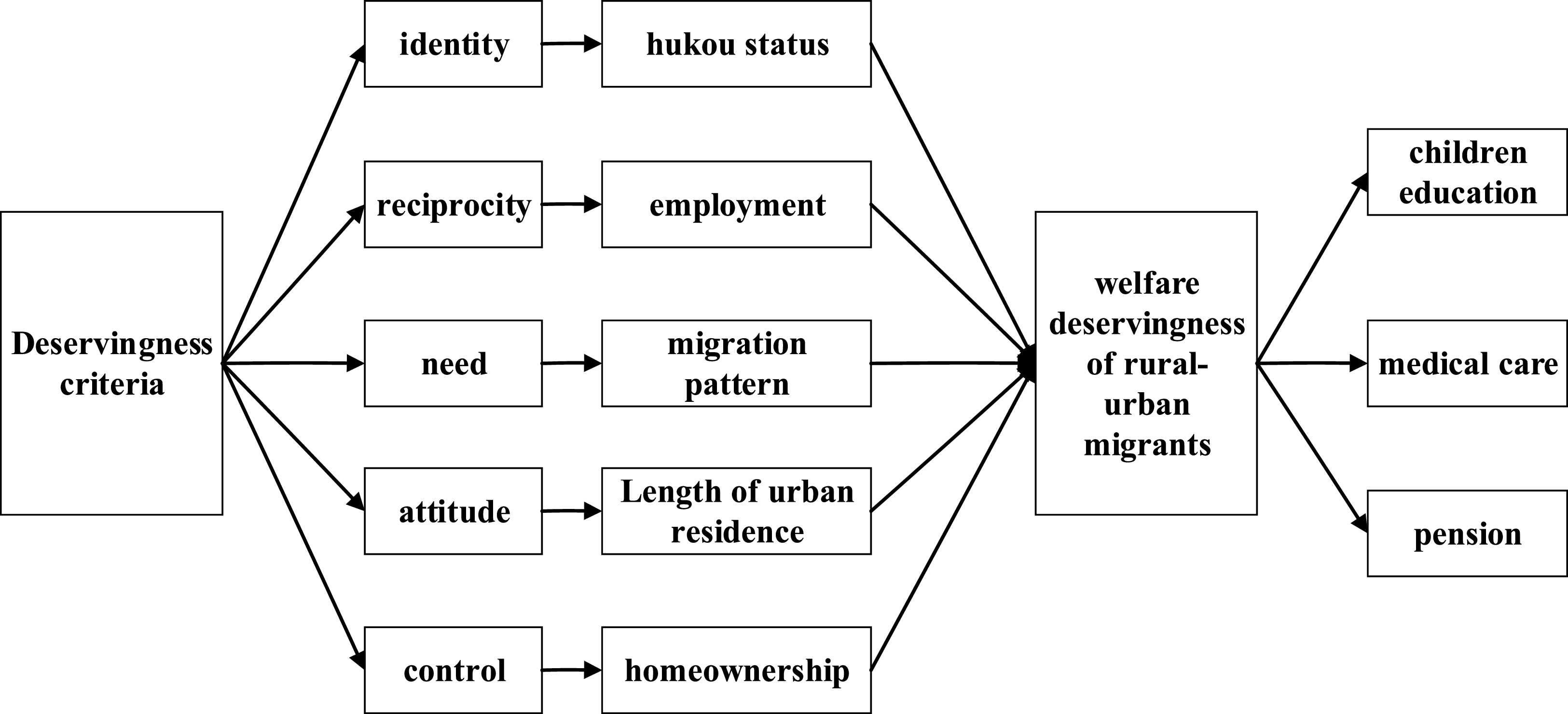
Guided by the CARIN criteria, this study constructed the theoretical framework shown in Figure 1. The framework operationalises the following five dimensions of deservingness: hukou status, homeownership, employment, length of urban stay and migration patterns. These factors together shape how the public perceives the welfare deservingness of rural-to-urban migrants in China.
Theoretical framework.

Figure 1. Long description
A flowchart illustrating the factors influencing the welfare deservingness of rural-urban migrants. The diagram starts with deservingness criteria, which include identity, reciprocity, need, attitude, and control. These criteria influence various factors such as hukou status, employment, migration pattern, length of urban residence, and homeownership. These factors collectively determine the welfare deservingness of rural-urban migrants, which in turn affects access to children’s education, medical care, and pension.
Identity strongly influences an individual’s attitude toward welfare. Generally, individuals tend to support those sharing their identity in obtaining welfare (Blomberg et al., Reference Blomberg, Kallio, Kangas, Kroll, Niemelä, Van Oorschot, Roosma, Meuleman and Reeskens2017; Li et al., Reference Li, Wang, Deng, Shi and Wang2019). Nielsen et al. (Reference Nielsen, Frederiksen and Larsen2020) indicate that the proportion of immigrants obtaining welfare is relatively low compared to natives because of their identity. Among the different social groups, immigrants are always regarded as the least entitled to welfare (Reeskens & van der Meer, Reference Reeskens and van der Meer2019). Even within immigrant groups, public perception of welfare deservingness varies with differences in residential status.
China’s hukou-based welfare distribution system has led to disparities in welfare rights between rural-to-urban migrants and urban locals. This disparity has evolved from an institutional to a conceptual level, leading to public beliefs that welfare entitlements of rural-to-urban migrants and urban residents should differ. Although the points-system policy provides a channel for rural-to-urban migrants to obtain urban welfare rights, an invisible boundary remains. As noted by Østerby-Jørgensen (Reference Østerby-Jørgensen2024), only those with hukou are considered eligible for welfare entitlement. Thus, this study uses hukou as a proxy variable for identity to explore whether the public perception of rural-to-urban migrants’ welfare deservingness varies with different hukou statuses.
Hypothesis 1: Rural-to-urban migrants with local urban hukou are more likely to be regarded as deserving of urban welfare.
The reciprocity criterion measures the extent to which an individual contributes to society. The logic of the reciprocity criterion is that an individual who contributes to society is more deserving of social welfare (van Oorschot, Reference van Oorschot2000). The reciprocity criterion dimensions are diverse, encompassing both material and non-material aspects. For instance, immigrants can contribute to society through economic, functional and behavioural means (Nielsen et al., Reference Nielsen, Frederiksen and Larsen2020). When the public emphasises different types of reciprocal behaviour, it affects the degree to which applicants are deserving of welfare (Lanford & Quadagno, Reference Lanford and Quadagno2022). Strong conditionality means that the public has specific expectations of reciprocity from welfare recipients, while weak conditionality implies the opposite (Mau, Reference Mau2004a, Reference Mau2004b).
In studies based on the deservingness criterion, the overlap between reciprocity and attitude means that the measurement of reciprocity mainly focuses on applicants’ contributions, including economic value through donations and tax payments and potential contributions like educational qualifications, achievements and professional skills (Knotz et al., Reference Knotz, Gandenberger, Fossati and Bonoli2022). For rural-to-urban migrants in urban China, stable employment most directly signals the level of contributions to society. Stable employment is a crucial foundation for rural-to-urban migrants to present their social status in urban societies and is thus more easily perceived by the public. In practice, the income of rural-to-urban migrants is mainly determined by employment, which most comprehensively reflects their contributions to the city over time. Therefore, this study operationalises employment stability as an indicator of reciprocity, aiming to capture the public’s assessment of the sustainable contribution potential of rural-to-urban migrants. Based on the above analysis, this study proposes the second hypothesis:
Hypothesis 2: Rural-to-urban migrants with stable jobs are more likely to be regarded as deserving high welfare.
Need can be understood as the gap between an individual’s living costs and available resources. In other words, when an individual’s living costs exceed their available resources, demand arises, reflecting the difficulties and pressures of their daily life. There is a general public perception that when welfare applicants are motivated to work but are constrained by objective reality, they should be granted social welfare (van Oorschot, Reference van Oorschot2000). Although need is the foundation of social welfare, who should receive welfare benefits is often relative. Research has shown that vulnerable groups such as children, pregnant women and the disabled are perceived as more deserving of welfare benefits (Lanford & Quadagno, Reference Lanford and Quadagno2022). In other words, whose needs are more urgent determines who should be given priority when welfare resources are limited.
In addition to individual living conditions, family circumstances are often regarded as important welfare criteria. For instance, family size, family income and number of children are used as references to assess the welfare needs of applicants (Jeene et al., Reference Jeene, van Oorschot and Uunk2013). This is particularly evident in the case of rural-to-urban migrants. Rural-to-urban migrants often face more welfare demands, such as children’s education, pension and medical care, when affected by family migration patterns. Their social support in the countryside is weakened, and their survival in the city relies more strongly on the urban social welfare system. Although stable employment may bring economic income and thus reduce their survival pressure, it cannot meet welfare demands like children’s education and medical care, as these aspects are regulated by the urban welfare system rather than determined by income. For instance, without permission, the children of rural-to-urban migrants may not be allowed to register and attend local schools in cities. Therefore, the public may perceive that those who move as families require more social welfare support. Based on the above analysis, this study proposes the third hypothesis:
Hypothesis 3: Rural-to-urban migrants who move in family patterns are more likely to be regarded as deserving of higher welfare benefits.
Attitude standards are defined as welfare applicants’ response to public support (Heuer & Zimmermann, Reference Heuer and Zimmermann2020). There is an overall perception that the more compliant and grateful a person is, the more deserving they are of welfare (van Oorschot, Reference van Oorschot2000). For instance, in the realm of unemployment benefits, the more effort an unemployed person exerts in job searching, the more likely they are to be considered deserving of unemployment assistance. To some extent, attitudes can also overlap with reciprocity, as when people express gratitude for public support through specific behaviours, attitudes essentially become indistinguishable from the reciprocity criteria (Meuleman et al., Reference Meuleman, Roosma and Abts2020). Therefore, the operationalisation of different dimensions of the welfare deservingness criteria often overlaps in empirical studies (Knotz et al., Reference Knotz, Gandenberger, Fossati and Bonoli2022).
As welfare providers, urban governments need to identify which rural-to-urban migrants will respond positively to welfare acquisition to ensure that the welfare system is not being exploited by opportunists. In this study, the long-term residence of rural-to-urban migrants was viewed as a signal of their loyalty to the host city. This is because, in the process of urbanisation in China, rural-to-urban migrants move between cities and rural areas like migratory birds, and long-term settlement is regarded as a sign of their willingness to take root in the host city (Xie et al., Reference Xie, Chen, Ritakallio and Leng2021). Thus, long-term settlement, which represents an expression of commitment to the host city, can be interpreted as a behavioural demonstration of gratitude and allegiance. In this sense, duration of residence serves as a visible, contextual proxy for the attitudinal loyalty that underpins perceived deservingness. Based on the above analysis, we propose the fourth hypothesis:
Hypothesis 4: The longer the urban residence period of rural-to-urban migrants, the more likely they are to be regarded as deserving higher welfare benefits.
The control criterion is defined as whether the current situation is caused by oneself (van Oorschot, Reference van Oorschot2000). This criterion focuses on the causes of welfare needs. If the causes are self-related, it is considered that one should not receive welfare. However, the measurement of control in empirical research is a concern in many studies, with scholars adopting different methods to measure control such as employment (Knotz et al., Reference Knotz, Gandenberger, Fossati and Bonoli2022; Kootstra, Reference Kootstra2016), age (Buss, Reference Buss2019), and so forth. Despite the lack of a unified standard to measure control, all these methods aim to examine whether the causes are controlled by the individual. Therefore, Knotz et al. (Reference Knotz, Gandenberger, Fossati and Bonoli2022) emphasised that the control criterion should only capture behaviours that cause needs and difficulties.
Accurately gauging whether migrants’ welfare needs stem from themselves is pivotal to applying control criteria to determine their entitlement to welfare. Owing to China’s distinctive welfare system, welfare rights are frequently linked to homeownership. For example, when enrolling in a public school, it may be necessary to prove that the parents possess housing within the school district. This welfare model is a classic embodiment of a development-oriented culture. If rural-to-urban migrants own housing, it means they have made great efforts to meet the welfare demands. Their need for welfare is no longer due to self-related reasons but rather structural causes. This provides a new interpretation of the control dimension in the Chinese context: whether the public supports the welfare demands of rural-to-urban migrants who have made tremendous efforts to overcome institutional obstacles. Based on the above analysis, this study proposes the fifth research hypothesis:
Hypothesis 5: Rural-to-urban migrants with self-owned housing are more likely to be regarded as deserving of welfare.
Research design
Data
An online survey was conducted to test our hypotheses. Shanghai was chosen as the research location because the city harbors many rural-to-urban migrants, and its welfare allocation exhibits highly selective characteristics. Shanghai serves as a crucial case for this study because, as a forerunner in welfare reform, its points system represents the frontier of how Chinese cities are managing rural-to-urban migrants through selective criteria. Understanding public opinion in this context provides a valuable benchmark for understanding that of other cities. Statistically, rural-to-urban migrants in Shanghai surpass ten million, and a substantial proportion of them are excluded from the city’s healthcare, education and pension systems. Data were gathered from Credamo (https://www.credamo.com/#/), a professional data collection platform in China.
To comprehensively understand public perspectives on welfare entitlement, this study targeted residents who were within the age range of 18 to 65 years and had resided in Shanghai for more than six months. The survey consisted of two parts: respondent characteristics and vignettes. Respondent characteristics include gender, age, ethnicity, educational attainment, marital status, hukou status, housing conditions and income. We determined the sample size according to the suggestion of Auspurg and Hinz (Reference Auspurg and Hinz2015a).
Data was collected from December 1–17, 2023. The original questionnaire was administered in Chinese. Detailed informed consent statements were provided to all potential participants, with explicit clarification that participation was entirely anonymous and voluntary. Participants were further informed of their right to withdraw from the survey unconditionally at any time without facing adverse consequences. During the survey, respondents were asked to complete an attention test. The attention test item is: This question is to detect whether you answer carefully. Please choose the option, ‘Strongly dissatisfied’. Participants who answered this question incorrectly were marked as invalid respondents. A total of 727 questionnaires were gathered, of which 439 were deemed valid, resulting in an effective response rate of 60.39 per cent. As each respondent answered four vignettes, a total of 1,748 pieces of data were collected. Due to the nature of online data collection, the sample comprises a disproportionately high share of younger and more educated respondents, whereas married individuals are underrepresented. The sample thus lacks representativeness. To address these discrepancies, we constructed post-stratification weights using the 2020 Shanghai Seventh National Census as the reference population. The weighting procedure aligned the sample to the population’s joint distribution of age, gender and educational attainment, with each variable categorised as shown in the census. We calculated weights through iterative proportional fitting. The resulting weights adjust for over- and under-represented groups. Descriptive statistics of the weights are provided in Supplementary Material Table S1.
Experimental design
This study adopted a factorial survey experimental design. The survey experiment required respondents to rate the welfare deservingness of rural-to-urban migrants in different scenarios based on the deserving criteria. We set two levels for each attribute and a total of 2 × 2 × 2 × 2 × 2 = 32 vignettes in the survey experiment. Owing to the relatively small number of vignettes, we chose a full factorial survey experimental design. We generated a random allocation list to ensure that the thirty-two vignettes were randomly and uniquely assigned to eight blocks, with four vignettes in each block. This random allocation process ensured that the distribution of the five attributes across each block was balanced to avoid systematic bias. Subsequently, we examined the attribute combinations of the vignettes within each block to confirm that there were no highly repetitive or obvious patterns, thereby minimising the potential contrast or fatigue effects within the blocks. After the respondents completed the demographic information section, the survey system randomly selected one of the eight blocks and presented it to the respondent. This allocation process was randomised for all respondents to ensure that there was no systematic association between the respondents’ characteristics and the attributes of the vignettes they evaluated (Hainmueller et al., Reference Hainmueller, Hangartner and Yamamoto2015). We achieved the random distribution of attribute levels, which is a prerequisite for identifying causal relationships (Auspurg & Hinz, Reference Auspurg, Hinz and Zimmermann2015b). Figure 2 shows an example of a vignette. Detailed information on the experimental design is provided in the Supplementary Material.
Example of a vignette.

Measures
The dependent variable was the deservingness of welfare rights. To avoid a situation in which the scope of welfare rights is too broad and difficult to judge, welfare rights were defined as rights to education, pension and medical care. This study defines educational welfare rights as the qualifications required for children to participate in Shanghai’s high school entrance examination. To safeguard the right of Shanghai locals to access higher education, children of non-hukou residents must accumulate points before they can obtain an application qualification. Therefore, the right to participate in high school entrance examinations can be regarded as a typical representation of educational welfare rights. Meanwhile, medical care and pension rights are defined as whether rural-to-urban migrants can enjoy the same medical insurance and retirement benefits as Shanghai locals. The dependent variable scale adopted a five-point Likert scale (1 = ‘completely disagree’, 5 = ‘completely agree’), and the respondents scored the extent to which rural-to-urban migrants can enjoy specific welfare based on vignettes.
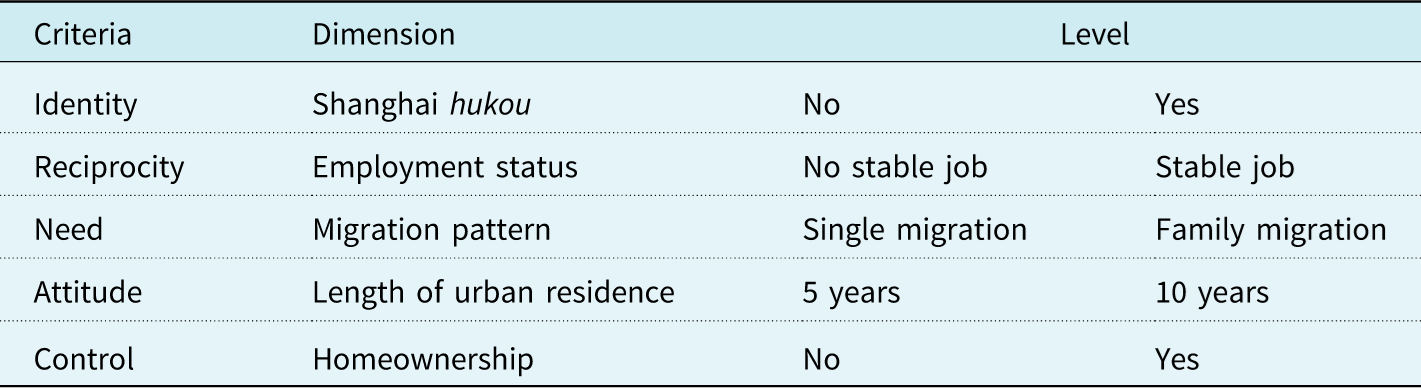
The independent variables in this study were the five criteria for welfare deservingness. As shown in Table 1, we set only two value levels for each variable to help make unbiased estimates of the variables’ effects with fewer experiments. The assessment burden on respondents was also minimised while ensuring the estimation efficiency of key parameters. Specifically, employment status included having or not having a stable job. Homeownership considered whether rural-to-urban migrants owned housing in Shanghai. Hukou status included two categories: having and not having Shanghai hukou. Migration pattern also had two types: family migration and single migration. The length of urban residence was set at two levels: five and ten years. This variable setting method resulted in a total of thirty-two vignettes for the survey experiment.
Dimensions and value levels for vignettes

Table 1. Long description
A table with five rows and three columns comparing criteria, dimensions, and levels for welfare deservingness. The columns are labeled Criteria, Dimension, and Level. Row 1: Criteria: Identity, Dimension: Shanghai hukou, Level: No, Yes. Row 2: Criteria: Reciprocity, Dimension: Employment status, Level: No stable job, Stable job. Row 3: Criteria: Need, Dimension: Migration pattern, Level: Single migration, Family migration. Row 4: Criteria: Attitude, Dimension: Length of urban residence, Level: 5 years, 10 years. Row 5: Criteria: Control, Dimension: Homeownership, Level: No, Yes.
Statistical strategies
This study employed multilevel modelling, which is often used for data analysis in factorial survey experiments. Since independent variables were classified into two levels, vignette and individual, this study treated the vignette as the first level and respondents as the second level. Multilevel modelling enables the exploration of any interaction effects between two level factors (Hox et al., Reference Hox, Kreft and Hermkens1991). All regression models reported are estimated using these post-stratification weights to improve the representativeness of our estimates. Before regression analysis, balance and manipulation tests were conducted. The balance test showed that the distribution of sample characteristics across the eight groups was well balanced (see Supplementary Material Table S1). The manipulation test showed that the manipulation of the independent variable activated the dependent variable, indicating a causal relationship between welfare criteria and the welfare deservingness of rural-to-urban migrants (see Supplementary Material Figure S2). Data analysis was performed in Stata 17.
Empirical results
Sample characteristics
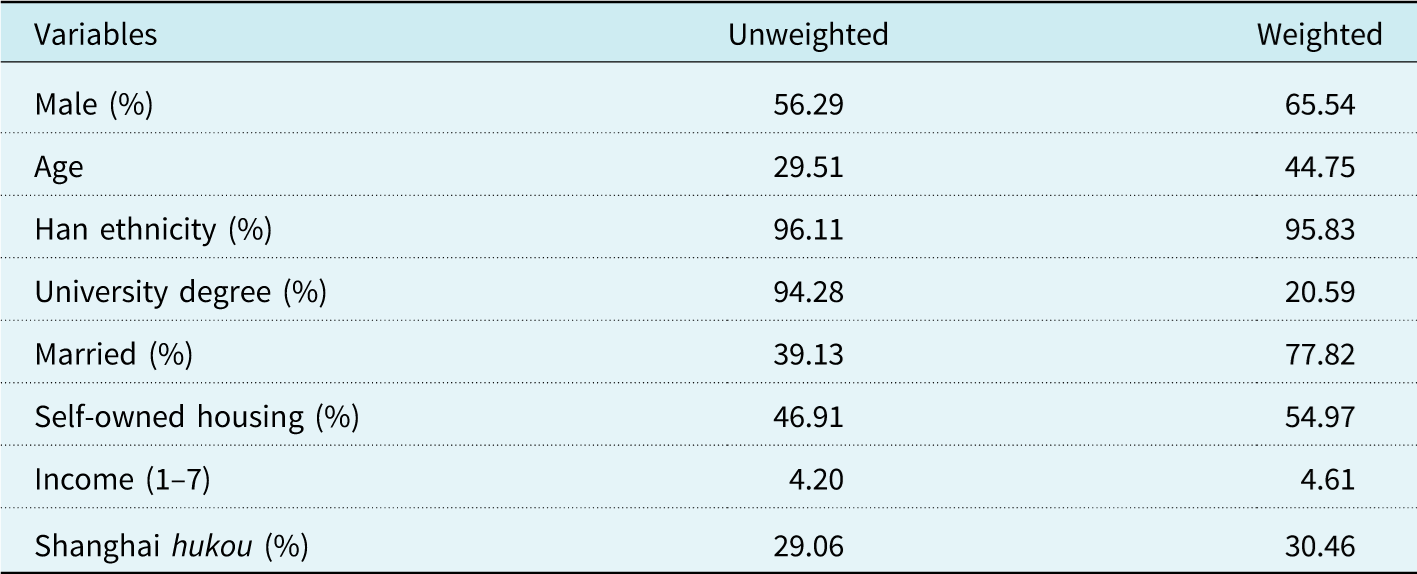
Table 2 presents the sample’s descriptive statistics. Approximately 66 per cent of the respondents were male, with an average age of 45. 96 per cent were of Han ethnicity, 78 per cent were married, 55 per cent were homeowners and the average income level was moderate. Thirty per cent had Shanghai hukou, and 21 per cent had a college degree. It can be seen that after weighting, the distribution of the sample in variables such as age, education, homeownership and marital status is closer to that of the overall population of Shanghai, which greatly enhances the representativeness of the sample. For instance, according to the Seventh National Census in Shanghai, the proportions of people with a university degree and self-owned housing are 33 per cent and 64 per cent, respectively. In our sample, after weighting, the proportions of the two indicators are 21 per cent and 55 per cent, respectively.
Sample characteristics

Table 2. Long description
The table presents descriptive statistics for various variables, comparing unweighted and weighted values. It has 8 rows and 3 columns. The columns are labeled ‘Variables’, ‘Unweighted’, and ‘Weighted’. The rows are labeled with different variables: Male (percent), Age, Han ethnicity (percent), University degree (percent), Married (percent), Self-owned housing (percent), Income (1-7), and Shanghai hukou (percent). Each row provides the unweighted and weighted values for the respective variable. For example, the percentage of males is 56.29 percent unweighted and 65.54 percent weighted. The average age is 29.51 years unweighted and 44.75 years weighted. The percentage of Han ethnicity is 96.11 percent unweighted and 95.83 percent weighted. The percentage of individuals with a university degree is 94.28 percent unweighted and 20.59 percent weighted. The percentage of married individuals is 39.13 percent unweighted and 77.82 percent weighted. The percentage of self-owned housing is 46.91 percent unweighted and 54.97 percent weighted. The average income level is 4.20 unweighted and 4.61 weighted. The percentage of individuals with Shanghai hukou is 29.06 percent unweighted and 30.46 percent weighted.
Regression results
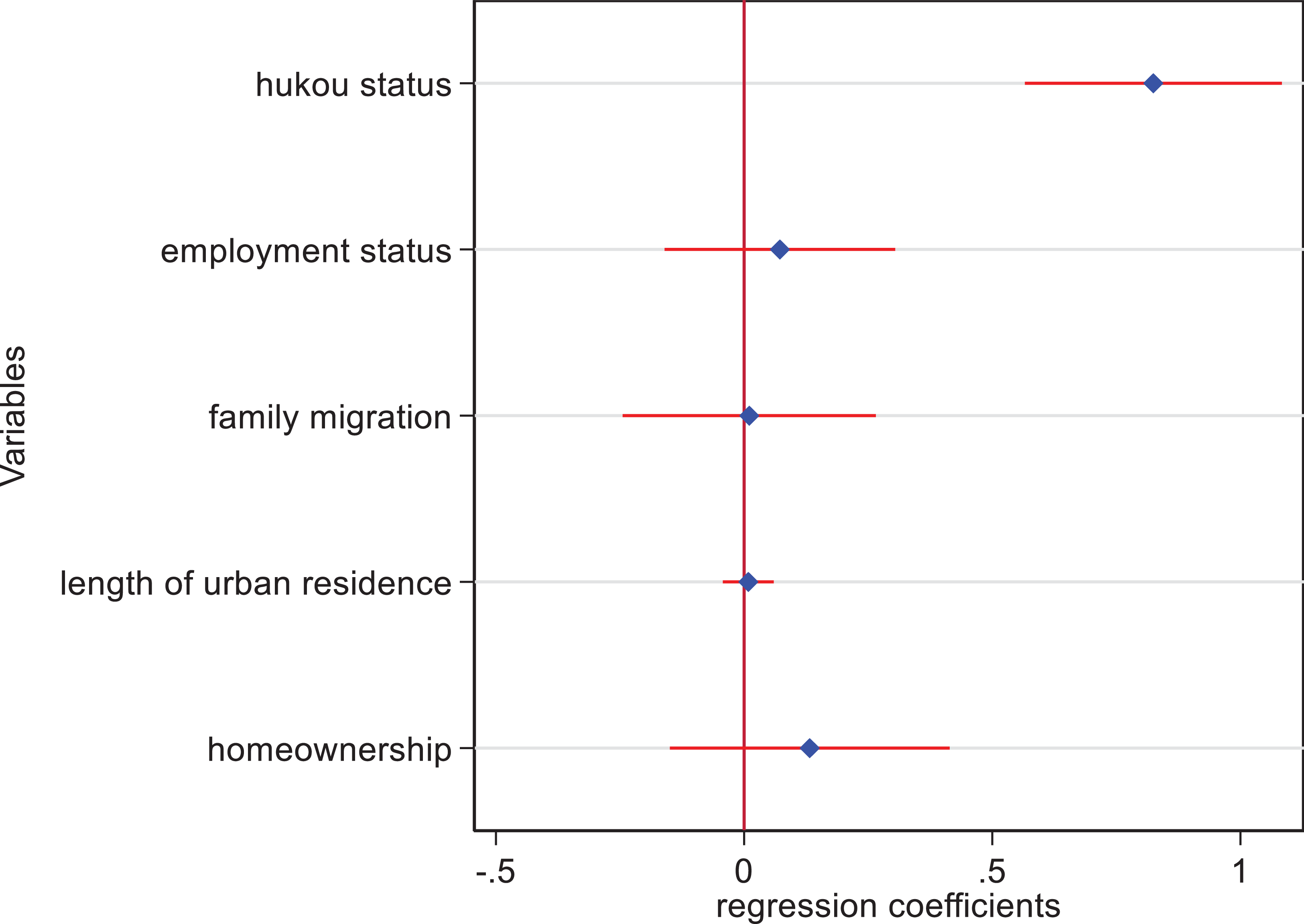
Figure 3 presents the results of the multilevel modelling. A null model was tested before running the full model. The ICC of the null model was 0.190, indicating that multilevel modelling is suitable for analysing the survey experimental data. The regression results showed that after controlling for demographic and socioeconomic factors, hukou is viewed as the most important criterion of welfare entitlement, which is consistent with Østerby-Jørgensen (Reference Østerby-Jørgensen2024). If a rural–urban migrant has Shanghai hukou, the welfare deservingness score increases by 0.82 points. On the other hand, the results showed that employment status, family migration, length of urban residence and homeownership are not significantly related to the perceived welfare deservingness, meaning that need, attitude, reciprocity and control are not important criteria affecting the perceived welfare deservingness of rural-to-urban migrants on a single dimension.
The results of multilevel modelling.

Robustness test
To enhance the robustness of data analysis results, we conducted the following additional analyses. First, for sample selection, we excluded those who do not plan to permanently settle in Shanghai, as this group may not be sensitive to Shanghai’s welfare policy or rural-to-urban migrants’ welfare rights. Specifically, we used the question ‘do you plan to permanently settle in Shanghai?’ to filter respondents. Results show that even after excluding the samples of those who do not plan to settle in Shanghai, hukou status remained the most significant variable influencing the perception of welfare deservingness for rural-to-urban migrants (see Supplementary Material Table S2).
Second, asking respondents about their general attitude towards welfare rights before the vignette design could have led to priming effects. Therefore, to minimise these effects, we divided the general attitude towards the welfare entitlements of rural-to-urban migrants into a high-score group (score > 3) and a low-score group (score ≤ 3). Results show that regardless of score, hukou status was still the most significant variable affecting the welfare entitlement of rural-to-urban migrants (see Supplementary Material Table S3). The above results indicate the robustness of the research findings.
Heterogeneity analysis
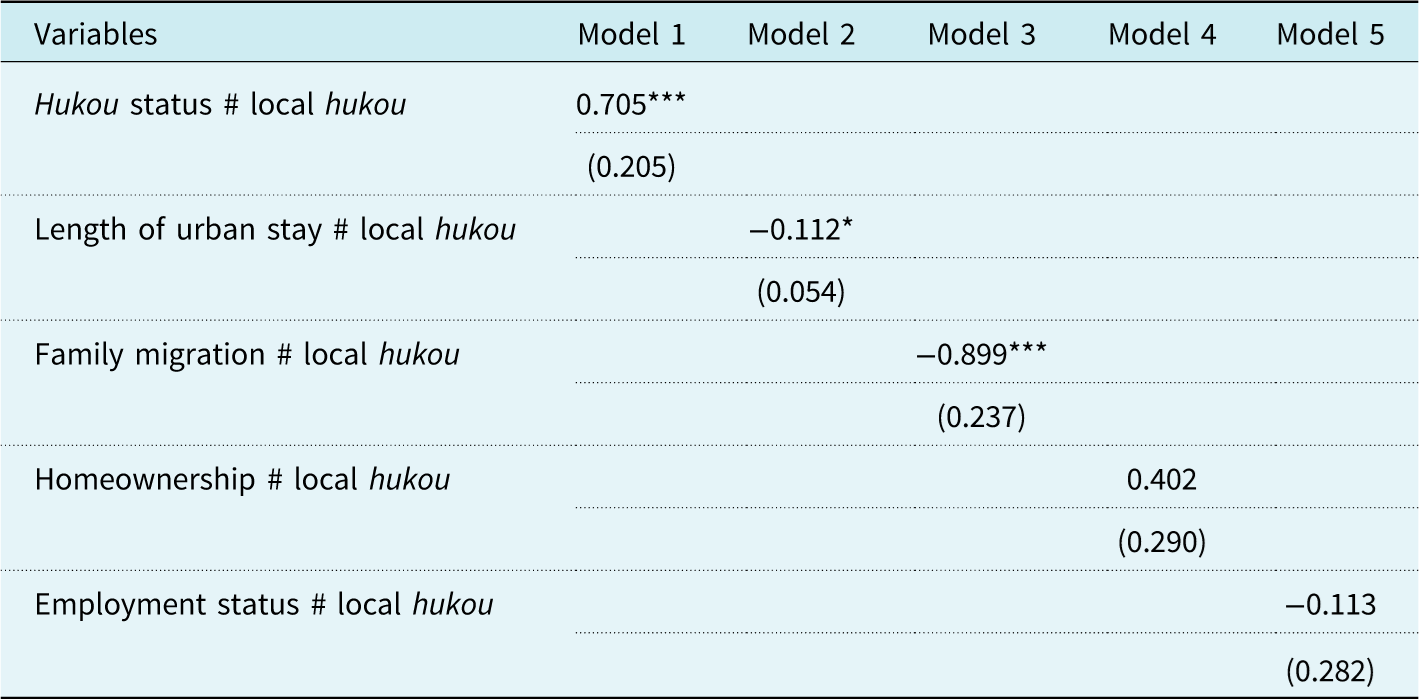
To further explore the differences in the perceived welfare deservingness of rural-to-urban migrants between urban locals and migrant groups, we introduced the interaction term of hukou and deservingness criteria in the regression models. This analysis aimed to identify the source of the differences in the social legitimacy of welfare policies. As shown in Table 3, significant differences were found in the attitudes towards welfare deservingness of rural-to-urban migrants between urban locals and migrant groups in identity, need and attitude, but not in reciprocity and control. Specifically, Model 1 shows that after controlling for demographic and socioeconomic factors, urban locals are more inclined to prohibit the welfare deservingness of non-local migrants. Meanwhile, urban locals are also more negative toward the welfare deservingness of rural-to-urban migrants with longer-term urban residence and family migration. Models 4 and 5 show no significant differences in the impact of the control and reciprocity on the perceived welfare deservingness of rural-to-urban migrants between urban locals and migrant groups.
Regression results on the differences in the perceived welfare deservingness of rural-to-urban migrants between urban locals and migrant groups

Table 3. Long description
The table presents regression results on the differences in the perceived welfare deservingness of rural-to-urban migrants between urban locals and migrant groups. It has five rows and five columns. The columns are labeled Model 1, Model 2, Model 3, Model 4, and Model 5. The rows are labeled Hukou status # local hukou, Length of urban stay # local hukou, Family migration # local hukou, Homeownership # local hukou, and Employment status # local hukou. Each cell contains a value and a standard error in parentheses. Notable trends include significant differences in identity, need, and attitude but not in reciprocity and control. Model 1 shows that urban locals are more inclined to prohibit the welfare deservingness of non-local migrants. Models 4 and 5 show no significant differences in the impact of control and reciprocity.
Notes: Robust standard errors in parentheses; ***P < 0.001, **P < 0.01, *P < 0.05
People with different educational backgrounds may have different views on welfare. For example, highly educated respondents may hold a more inclusive view of welfare. To test this point of view, we introduced the interaction effects between education and deservingness criteria in the regression models. The results show that highly educated respondents tended to express a more positive welfare attitude towards rural-to-urban migrants with stable jobs, but a more negative welfare attitude towards rural-to-urban migrants with homeownership (see Supplementary Material Table S4). In addition, no significant differences were observed in the impact of identity, attitude and need on the perceived welfare deservingness of rural-to-urban migrants between high- and low-educated groups.
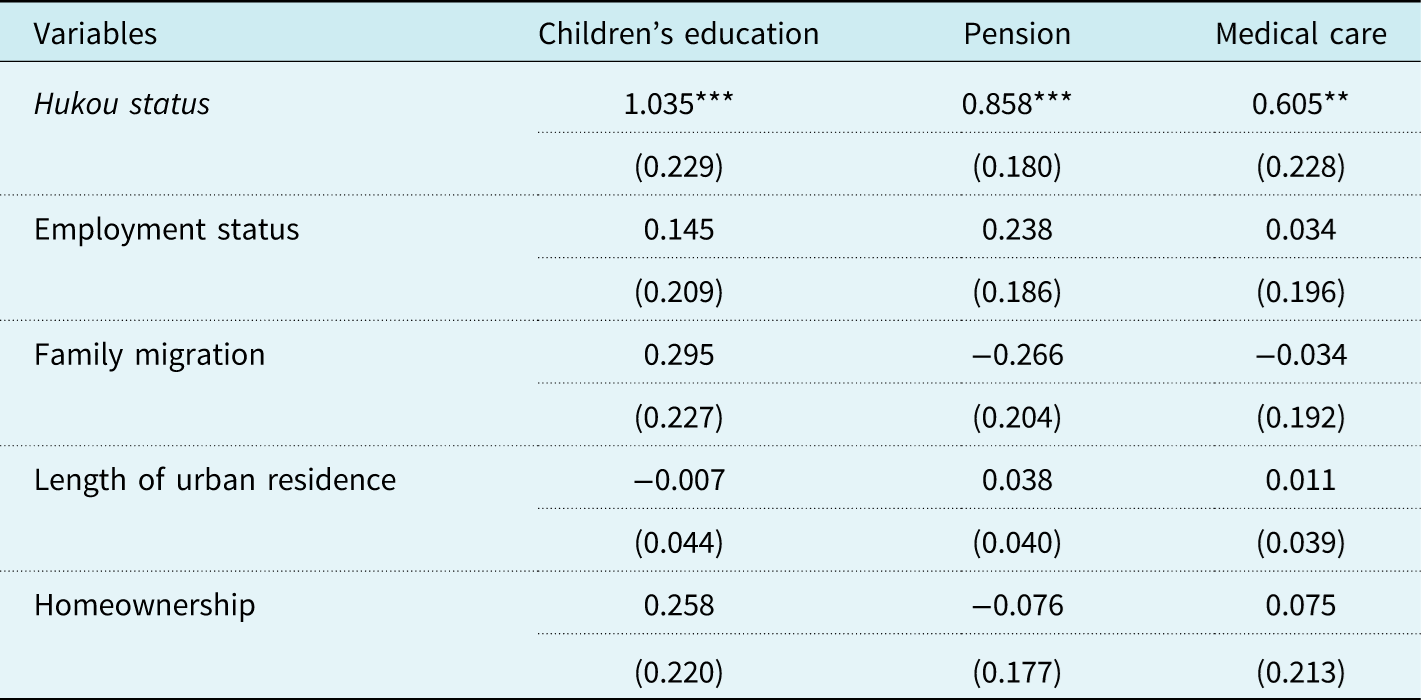
In the previous analysis, we treated welfare deservingness as a whole, ultimately obtaining the average impact of deservingness criteria on all welfare rights. However, different dimensions of deservingness criteria may have inconsistent effects on the different dimensions of the welfare deservingness of rural-to-urban migrants. Table 4 presents the regression analysis results of the impact of deservingness criteria on different dimensions of perceived welfare deservingness. The results show that after controlling for demographic and socioeconomic factors, the impact of deservingness criteria on the different dimensions of perceived welfare deservingness was highly consistent. Among all deservingness criteria, hukou status remained the most crucial factor. For example, when rural-to-urban migrants have Shanghai hukou, the perception that their children have a right to participate in the high school entrance examination in Shanghai increases by 1.04 points. The above results indicate that the legitimacy differences among the different dimensions of welfare for rural-to-urban migrants were not significant.
Regression results on the impact of different dimensions of deservingness criteria on different dimensions of perceived welfare deservingness

Table 4. Long description
A table with six rows and four columns comparing the impact of different deservingness criteria on children’s education, pension, and medical care. The columns are labeled Variables, Children’s education, Pension, and Medical care. The rows are labeled Hukou status, Employment status, Family migration, Length of urban residence, and Homeownership. Each cell contains a value and a standard error in parentheses. Notable values include Hukou status with 1.035 for Children’s education, 0.858 for Pension, and 0.605 for Medical care. Employment status shows 0.145 for Children’s education, 0.238 for Pension, and 0.034 for Medical care. Family migration has 0.295 for Children’s education, -0.266 for Pension, and -0.034 for Medical care. Length of urban residence shows -0.007 for Children’s education, 0.038 for Pension, and 0.011 for Medical care. Homeownership has 0.258 for Children’s education, -0.076 for Pension, and 0.075 for Medical care.
Notes: Robust standard errors in parentheses; ***P < 0.001, **P < 0.01, *P < 0.05.
Discussion and conclusion
Scant attention has been paid to the welfare deservingness of domestic migrants in developing countries. Based on the CARIN criteria, this study constructed a theoretical framework for understanding the perception of welfare deservingness among rural-to-urban migrants. Using the factorial survey experiment method, control, attitude, reciprocity, identity and need were operationalised as five variables: homeownership, length of urban residence, employment status, hukou status and migration pattern. A survey experiment with thirty-two vignettes was designed to identify the factors affecting perceived welfare deservingness of rural-to-urban migrants.
First, the primary finding of this study is that hukou plays the most important role in the judgement of welfare deservingness of rural-to-urban migrants. This is consistent with the welfare distribution system in China, where welfare is prioritised for those with a local identity (Østerby-Jørgensen, Reference Østerby-Jørgensen2024). This characteristic closely resembles welfare chauvinism, which reflects a differentiated welfare distribution view for insiders and outsiders (Andersen & Bjørklund, Reference Andersen and Bjørklund1990; Dhaliwal & Forkert, Reference Dhaliwal and Forkert2015; He, Reference He2022; Naumann et al., Reference Naumann, Brinkmann and Möhring2024). However, this finding also challenges existing literature. In Western contexts, multiple CARIN dimensions, particularly identity and reciprocity, jointly shape welfare deservingness (Careja & Harris, Reference Careja and Harris2022; Helbling & Kriesi, Reference Helbling and Kriesi2014; Reeskens & van der Meer, Reference Reeskens and van der Meer2019). By contrast, our findings show that identity dominates while reciprocity exerts no independent effect. This suggests that in the Chinese context, where the hukou system institutionalises a rigid insider-outsider boundary, the identity criterion overshadows other deservingness considerations, a pattern that diverges from the more pluralistic logic observed in Western welfare states.
Our finding that hukou dominates public judgements while other CARIN dimensions are insignificant calls for a policy feedback interpretation, which holds that current policies influence public political attitudes and subsequent policies (Mettler & Soss, Reference Mettler and Soss2004; Pierson, Reference Pierson1993). The Shanghai points system institutionalises a comprehensive deservingness evaluation mechanism that formally assigns scores to age, education, skills, tax contributions, social insurance and residence duration. If the public had fully internalised the policy’s pluralistic logic, we would expect multiple criteria, particularly employment, residence duration and homeownership, to significantly predict perceived deservingness. However, our findings do not bear this out.
We interpret this as evidence of selective policy feedback. While the points system sends multiple signals, only the most institutionally consequential one, the identity signal, is effectively internalised by the public. This is because the policy frames local hukou as the terminal threshold for full welfare membership. All other criteria are instrumental steps toward that final gate. Over time, through repeated policy exposure, the public learns that hukou is the master criterion, while other factors are merely stepping stones. The policy’s signaling effect is thus hierarchical: it conveys a clear priority order, with identity at the top, rather than an egalitarian set of equivalently weighted criteria.
This selective internalisation also explains why welfare policy reform for rural-to-urban migrants in China has been slow despite the introduction of point-based systems. When the public holds a clear, identity-based consensus on who deserves welfare, policy innovations that challenge this consensus, for instance by expanding access to non-hukou migrants who meet other criteria, face substantial attitudinal resistance. The policy feedback loop is thus self-reinforcing: the hukou system shaped public attitudes, and those attitudes in turn constrain the possibilities for institutional reform.
Second, this study also found that local residents show more negative views on rural-to-urban migrants who are from outside Shanghai, long-term residents and family migrants. This finding is in line with the self-interest perspective that local residents tend to protect their own welfare rights (Cavaille, Reference Cavaille2015; Degen et al., Reference Degen, Kuhn and van der Brug2019), but extends it by revealing how policy signals mediate the translation of self-interest into deservingness judgements. In Western contexts, self-interest operates through direct fiscal concerns, where citizens oppose immigrant welfare when they perceive it as threatening their own benefits (Cavaille, Reference Cavaille2015; Degen et al., Reference Degen, Kuhn and van der Brug2019). In Shanghai, the points system provides concrete policy standards, such as the discouragement of family migration, which local residents absorb and deploy as explicit criteria for judging deservingness. The self-interest mechanism is thus not purely psychological but institutionally mediated, a nuance that existing literature has not fully captured.
Third, highly educated people are more tolerant of migrants with stable jobs but more critical of those with homeownership. This resonates with the cultural values literature showing that citizens’ cultural orientations shape welfare attitudes (Appelbaum, Reference Appelbaum2002; Gielens et al., Reference Gielens, Roosma and Achterberg2019). Specifically, highly educated respondents apply a performance-oriented principle based on contribution, supporting those with stable jobs, while viewing homeowners, given Shanghai’s high housing prices, as wealthy and thus undeserving of public resources. This pattern reflects a Confucian moderate welfare view: welfare should support neither the lazy nor the rich, but the productive backbone of society, that is, hard-working and genuinely in-need individuals. This finding extends the cultural values literature by specifying how culturally rooted performance principles shape deservingness judgements in the Chinese context.
Fourth, this study found that the five deservingness criteria had no significant differences in their influence on different dimensions of perceived welfare deservingness, indicating a high degree of consistency in the legitimacy of the welfare systems for rural-to-urban migrants. Specifically, the public is united about the welfare benefits rural-to-urban migrants should enjoy and how they should enjoy them. This differs from the common finding in the West that welfare attitudes often have domain specificity. Since hukou status is still the only significant factor across different dimensions, this may mean that Chinese people have a unique welfare cognitive framework: the public first makes an overall qualification judgement, that is, whether rural-to-urban migrants have the right to enter the welfare system. The detailed consideration of specific welfare types is secondary. This finding means that the perception of welfare deservingness has a high degree of social consensus. It also explains why welfare policy reform for rural-to-urban migrants in China has been gradual and slow, because when welfare policies have a high degree of social consensus, it is a challenge to reform them.
The theoretical contributions of this study are threefold. First, it empirically tests the CARIN criteria in a non-Western context and reveals a contextual hierarchy within the framework: identity dominates while other criteria are marginalised, a finding that challenges the universal applicability of the CARIN model as originally conceived (van Oorschot, Reference van Oorschot2000). Second, through an analysis of intergroup differences via the policy feedback lens, this study advances understanding of the dynamic relationship between policies and public perceptions, demonstrating that welfare policies simultaneously emerge from and actively reshape prevailing social attitudes (Mettler & Soss, Reference Mettler and Soss2004). Third, by revealing cross-domain consistency in welfare attitudes, this study offers a plausible explanation for the relative stability of welfare policy, suggesting that reform faces not only fiscal and technical constraints but also deep-seated attitudinal resistance rooted in social consensus, a finding that echoes Brooks and Manza’s (Reference Brooks and Manza2006) argument that public attitudes provide a crucial foundation for welfare state persistence.
This study also has several limitations. First, the experimental design did not fully consider some key dimensions such as migrant skill. There could also be overlaps among some dimensions like attitude and reciprocity. Future research should operationalise them more precisely. Second, this study focused on rural-to-urban migrants in Shanghai, and it remains to be tested to what extent the conclusions are applicable to other types of cities. Comparative studies across cities can be conducted in the future. Finally, although we applied post-stratification weights to address sample imbalances, weighting cannot fully compensate for the limitations of non-probability sampling. Future research should focus on collecting more representative data to obtain more generalisable conclusions.
Supplementary material
The supplementary material for this article can be found at https://doi.org/10.1017/S0047279426101688
Funding statement
This work was supported by the Major Program of the National Social Science Fund of China (No. 26ZDA128) and the Fundamental Research Funds for Central Universities (No. CCNU25ZZ229).
Competing interests
The authors declare none.