1. INTRODUCTION
Electronic documents are one of the most common information sources in organizations, and approximately 90% of organizational memory exists in the form of text-based documents. It has been reported that 35% of users find it difficult to access information contained in these documents, and at least 60% of the information that is critical to these organizations is not accessible using typical search tools (80-20 Software, 2003). There are two main problems. The first is that there is simply too much information to be searched. The second is that differences exist between the indexing approaches used in search engines and the way people perceive and access the contents of documents. This means that most users find searching for relevant information difficult because it is not possible for them to enter keywords in a sufficiently precise form for them to be used effectively by current search engines.
Current retrieval systems accept queries from users in the form of a few keywords and retrieve a long list of matching documents. Users then have to sift through the documents to locate the information they are looking for. For simple fact-based queries, for example, What material should be used for this turbine blade?, most users can enter satisfactory keywords that rapidly find the required answers. However, keyword-based systems cannot cope with questions involving the following: (1) comparing, for example, What are the advantages and disadvantages of using aluminum compared with steel for this saucepan?; (2) reasoning, for example, How safe are commercial flights?; and (3) extracting answers from different documents and fusing them into a complete answer. To obtain useful answers to these types of question, users currently have to expend considerable time and effort.
In previous research in this domain, automatic query expansion and taxonomy-based searches have been proposed. Query expansion improves on keyword searching for short questions that require only a few documents to be located to provide the answers. Taxonomy-based searches require the hierarchical organization of domain concepts. This relieves the user of having to enter accurate keywords as information is searchable by selecting concepts. However, considerable effort is required to create the classifications and maintain the hierarchy. For example, Yahoo (http://www.yahoo.com) employs around 50 subject experts to maintain their directories and indexes. Not many organizations can afford to adopt such a strategy, and current automatic classifiers only achieve 60–80% accuracy (Mukherjee & Mao, 2004). This means that in automatic classification around a third of the documents will be missed or misclassified. Manual classifications are subjective, and often based on the few sentences that are deemed important for individual indexers. Clearly, when information is sought that does not match the indexing, such a taxonomy-based approach does not help.
Offering users the facility to enter their queries in natural language might greatly enhance current search engine interfaces and be particularly helpful for less experienced users who are not adept at advanced keyword searches. Recent research into natural language-based retrieval systems has mainly pursued a question–answering (QA) approach. QA systems have successfully retrieved short answers to natural language questions instead of directing users to a number of documents that might contain the answers. Typically, QA uses a combination of information retrieval (IR) and natural language processing (NLP) techniques. IR techniques are used to pinpoint a subset of documents and to locate parts of those documents that are related to the questions. NLP techniques are used for extracting brief answers. There is great interest in developing robust and reliable QA systems to exploit the enormous quantity of information available online to answer simple questions such as Who is the president of USA? This is relatively easy because straightforward NLP techniques, such as pattern matching, are sufficient to answer it. The numerous occurrences and multiple reformulations of the same information available on the Web greatly increase the chance of finding answers that are syntactically similar to the question (Brill et al., 2001). On the intranets run by organizations, the quantity of information, although large, is much less than on the Web, and the number of occurrences and reformulations is less exhaustive.
Unlike users searching on the Web, those in organizations are likely to ask questions that are not easily answered by simply looking up syntactic similarities in databases. Such answers can be considered complex, and may need to be inferred from different parts of a single text or from multiple texts. The initial question posed by a user may be ill formed, that is, too broad or too specific, making it difficult for the retrieval system to interpret, and hence, further interaction with the user is often necessary. Answering such complex questions has received little attention within QA research. To answer such questions, the issues of correctly interpreting the question and presenting the answer must both be addressed. When presenting answers to complex questions, it is not sufficient just to present the answer, that is, the user needs additional supporting information with which to assess the trustworthiness of the answer. For example, hemlock poisoning and drinking hemlock can both be considered correct answers to the question, How did Socrates die? (Burger et al., 2001). Users who have some background knowledge about poisoning might appreciate a brief answer, as they do not want to read through a long text to extract the answer themselves. Other users with less background knowledge might prefer to see where the answers came from and want to read more text explaining the answers before accepting them. Searching precisely for How did Socrates die? on the Web using Google produces around 748,000 results. It is clear that with a question such as this, answers with varying formulations were mentioned in numerous documents or in many parts of a single document. Answers appearing as multiple instances need to be fused efficiently to reduce repeated information. Apart from what is simply stated in the question, the user's real intention might have been to know the reason why Socrates chose to die by poisoning. For questions that are ill formed, it is important that answers are extended with related information that increases a user's understanding of the answers. It is therefore necessary to research suitable ways of presenting answers in a clear and coherent manner, and providing sufficient supporting information to allow users to decide whether or not to trust the answers.
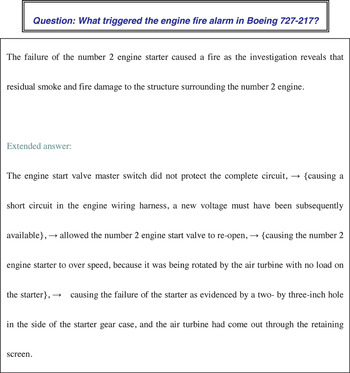
A combination of two approaches, both using semantic relations, is therefore proposed for presenting clear and coherent answers. First, duplicate information is removed. Second, answers are synthesized from multiple occurrences, and then justified by adding supporting information. To achieve this, semantic analysis is necessary of both the questions and the texts from which the answers are to be extracted. Figure 1 shows an example of how these ideas might be implemented. An example text is from http://www.tsb.gc.ca/en/reports/air/1996/a96o0125/a96o0125.asp. The initial question posed by the user, that is, What triggered the engine fire alarm in Boeing 727-217?, was aimed at understanding the cause or causes of the fire alarm going off. The question itself is ambiguous, because it does not specify the engine or the date of the flight. Assuming that the system correctly understands the question, it can return the failure of the number 2 engine starter as the cause. However, for complex incidents such as this case, it is difficult to pinpoint particular causes and regard them as independent of the remaining information. That is, there might be more than one cause for a single incident, and some causes may depend on other causes. For example, in the example above there are other contributing causes, for example, the start valve had reopened because of a short circuit or the engine starter had failed because of overspeeding. There could also be consequent effects, for example, residual smoke and fire damage to the structure surrounding the number 2 engine. For presenting answers like this, it is necessary to consider the actual information needs of the user from a knowledge level. For example, when faced with an unexpected observation (problem), engineers first assess whether or not the problem is serious and requires diagnosis. Diagnosis normally proceeds by finding reasons or causes that impact on the observation. Once the causes are identified, then it is likely that solutions are required to prevent recurrences. The impact of making various hypothetical changes is likely to be assessed, along with the advantages and disadvantages of the various solutions proposed. This example demonstrates that the information needs for users in specific organizations are complex, requiring not only sophisticated retrieval processing but also the presentation of retrieval results in as natural a form as possible. Successful synthesis and presentation of such answers depend on the ability to compare information on a semantic level such that it produces a chain of semantic relations.

An example of generating a coherent and justified answer. [A color version of this figure can be viewed online at www.journals.cambridge.org]
A prototype of semantic-based QA system implementing these ideas has been developed. The underlying approach is based on identifying various discourse relationships between two spans, such as cause–effect and elaboration. These types of relationship are derived from a computational linguistic theory known as rhetorical structure theory (RST). This theory defines a set of rhetorical relations and uses them to describe how the sentences are combined to form a coherent text (Mann & Thompson, 1988). As such, RST analysis discovers relationships within a sentence or among sentences. Because sentences are not usually comprehensible when isolated, this approach provides a more sophisticated content analysis. These annotations are then used to remove duplicate information and synthesize answers from multiple occurrences. Finally, these answers are justified by adding supporting information. As information is compared at the semantic level rather than at the string level, it is possible to determine whether a causal link exists between two events. This paper mainly addresses questions related to causal inference and describes a prototype system to test the ideas. The proposed system is targeted at the engineering area; however, the methodology is generic and can be applied to other domains.
2. LITERATURE REVIEW
Users find QA systems helpful as they do not need to go through each retrieved document to extract the information they need. Until recently, most QA systems only functioned on specifically created collections and on limited types of questions, but some attempts have been made to scale systems to open domains like the Web (Kwok et al., 2001). Experiments show that in comparison to search engines, for example, Google, QA systems significantly reduce the effort to obtain answers. AskJeeves (http://www.ask.com) and Brainboost (http://www.brainboost.com) are the examples of Internet search engines with a QA interface, but neither provides full-fledged QA capabilities. AskJeeves relies on hand-crafted question templates that enable automatic answer searches, and returns lists of documents instead of intelligently extracting brief answers. Brainboost supplies answers in plain English, but the correctness of its answers is limited to specific questions only, and for many questions neither relevant texts nor exact answers are found.
Currently, developments in QA have focused on improving system performance through more advanced algorithms for extracting exact answers (Voorhess, 2002). A project organized by the US National Institute of Standards and Technology has established benchmarks for evaluating QA systems. Two new QA system response requirements were introduced in 2002: to return an exact answer and to return only one answer. Previous requirements had allowed systems to return five candidate answers, and the answers could be between 50 and 250 bytes in length. This demonstrates that current QA systems are focusing on retrieving exact answers to factual questions. For these systems, performances of over 80% correct answers have been reported. However, user evaluations consistently highlight the fact that the usability is hindered by the absence of context information that would allow them to evaluate the trustworthiness of an answer. For example, user studies conducted by Lin et al. (2003) suggest that users prefer to see the answer in a paragraph rather than as an exact answer, even for a simple question like, Who was the first man on the Moon?
In comparison to open-domain QA systems, for example, Web, domain-specific QA systems have the following additional characteristics (Diekema et al., 2004; Hickl et al., 2004; Nyberg et al., 2005):
- a limited amount of data are available in most cases,
- domain-specific terminologies have to be dealt with, and
- user questions are complex.
Shallow text processing methods are mostly used for QA systems on the Web because of Web redundancy, which means that similar information is stated in a variety of ways and repeated in different locations.
However, in the engineering domain, suitable data can be scarce, and answers to some questions might only be found in a few documents, and these may exhibit linguistic variations from the questions. Therefore, intensive NLP techniques that can analyze unstructured texts using semantics and domain models are more appropriate. Domain ontologies and thesauri are required to define domain-specific terminologies. Hai and Kosseim (2004) used information in a manually created thesaurus to rank candidate answers by annotating the special terms occurring both in the queries and candidate answers. They also used a concept hierarchy for measuring similarities between a document and a query. Ontologies have also been used for expanding terms in the questions and clarifying ambiguous terms (Nyberg et al., 2005). Because ontologies can be regarded as storing information as triples, for example, person–work-for–organization, users can submit questions linked to such classes and relations in natural language (Lopez et al., 2005). For example, the question, Is John an employee of IBM?, can be answered by recognizing that John is a person, IBM is an organization, and employee is inferred from “someone who works for an organization.” Questions other than factual ones need special attention, and a profile of the user can help to improve system performance (Diekema et al., 2004). Suitable ways of presenting answers and how much information should be provided must also be determined. To address these problems, some researchers proposed interactive QA. To that end, some QA systems rephrase the questions submitted to confirm whether or not users' information needs have been correctly identified (Lin et al., 2003). Advanced dialog implementations have also been suggested. However, Hickl et al. (2004) argue that the decomposition of user questions into simpler ones with which answer types are associated could be a more practical solution than a dialog interaction.
Generally, semantic annotations are treated as a similar task to named-entity (NE) recognition, which identifies domain concepts and their associations in a single sentence (Aunimo & Kuuskoski, 2005). This paper extends the notion of semantic annotation to include discourse relations that identify what information is generated from the extended sequences of sentences. This goes beyond the meanings of individual sentences by using their context to explain how the meaning conveyed by one sentence relates to the meaning conveyed by another. A discourse model is essential for constructing computer systems capable of interpreting and generating natural language texts. Such models have been used to assess student essays with respect to their writing skills, to summarize scientific papers, to extend the answers to a user' question with important sentences, and to generate personalized texts customized for individual reading abilities (Teufel, 2001; Williams & Reiter, 2003; Burstein et al., 2003; Bosma, 2005).
3. ENGINEERING TAXONOMY
Retrieval systems in engineering need to employ domain-specific terminologies that differentiate between specific and general terms. Specific terms are essential to understand users' questions and characterize documents in relation to those questions. Some general terms have specific meanings in engineering. For example, the term shoulder has multiple meanings in a dictionary, and in most cases, it means the part of the body between the neck and the upper arm. However, in engineering, it can refer to a locating upstand on a shaft. Domain taxonomies arrange such terms into a hierarchy. An example of an engineering taxonomy is the engineering design integrated taxonomy (EDIT), and this taxonomy is used throughout this paper. It consists of four root concepts (Ahmed, 2005):
- the design process, that is, a description of the different tasks undertaken at each stage of product development, for example, conceptual design, detail design, brainstorming;
- the physical product to be produced, for example, assemblies, subassemblies, and components, using part-of relations, for example, a motor and shaft of a motor;
- the functions that must be fulfilled by the particular component or assembly, for example, one of the functions of a compressor disk is to secure the compressor blade and one of the functions of a cup is to contain liquid; and
- the issues, namely, the considerations, that a designer must take into account when carrying out a design process, for example, considering the unit costs or production processes.
A detailed description of the development of a generic methodology to develop engineering design taxonomies that was used for EDIT can be found in Ahmed et al. (2005).
4. THE PROPOSED METHOD
In general, a document can be encoded with various semantics, for example, customer reviews or causal accounts of engineering failures, and accessed by users who have very different interests. For example, in the case of product reviews by customers, negative and positive customer opinions are the main messages for market researchers. Conversely, designers are more interested in design-related issues, comments, and problems associated with engineering failures. It would therefore be beneficial to include those semantics that facilitate searching for information in a way that reflects the interests of the users. For example, for a designer whose task is to reduce fan noise, guidance on how to minimize aerodynamic noise should be retrieved. In contrast, if that designer is more interested in using a specific method for noise reduction, then documents describing the methods along with their advantages or disadvantages are more useful. With keyword-based indexing, it is not feasible to extract such semantics because most natural language texts have annotations that are too basic and no explicit descriptions of the concepts are available. Annotations are formal notes attached to specific spans of text. Their complexity and representation depend on the mark-up language used.
The proposed method works as follows:
- a document is annotated with a set of relations derived from RST,
- the document is classified with EDIT indexes,
- the document is parsed using NLP indexing techniques,
- the RST-annotated document is converted into predicate–argument forms for effective answer extraction, and
- a user question is analyzed using the same NLP technique.
Steps 1, 2, and 3 can proceed independently, but step 1 must precede step 4.
4.1. Semantic annotations based on RST
Discourse analysis (DA) is crucial for constructing computer systems capable of interpreting and generating natural language texts. DA studies the structure of texts beyond sentence and clause levels, and structures the information extracted from the texts with semantic relations. It is based on the idea that well-formed texts exhibit some degree of coherence that can be demonstrated through discourse connectivity, that is, logical consistency and semantic continuity between events or concepts. This is in contrast with most keyword-based indexing that exclusively addresses the subsentence level, omitting the fact that sentences are interconnected to create a whole text. To establish a more robust and linguistically informed approach to identify important entities and their relations, a deeper understanding is necessary.
Annotating a text with a discourse structure requires advanced text processing, linguistic resources such as taxonomies, and possibly, manual intervention by experts. It certainly increases the work required to develop QA systems. However, if QA systems are only targeted at certain domains, where a limited number of texts has to be searched, and experts are available to assist, then detailed linguistic analysis is feasible. DA generates a discourse structure by defining discourse units, either at sentence or clause level, and assigning discourse relations between the units. Discourse structures can reveal various text features and attempts have been made to use them to identify important sentences that are key to understanding the contents of documents (Marcu, 1999; Kim et al., 2006b). Discourse structures can be used to compare units in multiple documents to evaluate similarities and differences in their meanings, as well as to detect anomalies, duplications, and contradictions.
Rhetorical relations are central constructs in RST and convey an author's intended meaning by presenting two text spans side by side. These relations are used to indicate why each of the spans was included by the author and to identify the nucleus spans that are central to the purpose of the communication. Satellite spans depend on the nucleus spans and provide supporting information. Nucleus spans are comprehensible independently of the satellites. For example, consider the following two text spans: given that the clutch was functional, and it is unlikely that the engine was driving the starter. A condition relation is identified, with span 2 being the nucleus. Satellite span 1 is only used to define the condition in which the situation in span 2 occurs. These two spans are coherent because the person who reads them can establish their relationship.
Rhetorical relations between spans are constrained in three ways: constraints on a nucleus, constraints on a satellite, and constraints on the link between a nucleus and a satellite. They are elaborated in terms of the intended effect on the text reader. If an author presents an argument in a text that is identified as an evidence relation, then it is clear that the author was intending to increase a reader's belief in the claim represented in a nucleus span by presenting supporting evidence in a satellite span. Such relations are identified by applying a recursive procedure to a text until all relevant units are represented in an RST structure (Taboada & Mann, 2006). The procedure has to be recursive because the intended communication effect may need to be expressed in a complex unit that includes other relations. The results of such analyzes are RST structures typically represented as trees, with one top-level relation encompassing other relations at lower levels.
It is difficult to determine the correct number of relations to be used and their types. In the simplest domains only two relation types may be required, whereas some complex domains may require over 400 (Hovy, 1993). Hovy argued that taxonomies with numerous relation types represent subtypes of taxonomies with fewer types. Some relation types are difficult to distinguish, for example, elaboration and example. If there are too many types, inconsistencies of annotation are likely. If there are too few, it may not be possible to capture all the different types of discourse. Mann and Thompson (1988), for example, listed 33 relation types to annotate a wide range of English texts. To reduce inconsistencies of annotation, our method combines similar relation types and eliminates those that do not appear frequently. A preliminary examination with sample engineering domain data from aircraft incident reports (see Section 5.1) resulted in the following nine types: background, cause–effect, condition, contrast, elaboration, evaluation, means, purpose, and solutionhood. Each of them is described below, along with an example taken from the sample domain data, that is, aircraft incident reports, using (N) to indicate a nucleus span and (S) a satellite span.
4.1.1. Background
This type of relation is used to increase a reader's background understanding (S) of the nucleus span (N).
(S) While the helicopter was approximately 25 feet above ground level en route to Tobin Lake, Saskatchewan, to pick up a bucket of water
(N) the engine fire warning light came on and the pilot saw smoke coming out of the engine cowling.
4.1.2. Cause–effect
This type of relation is used to link the cause in the nucleus span to the to the effect in the satellite span or vice versa.
(N–S) Analysis of the fuel hose indicates that the steel braid strands failed
(S–N) as a result of chafing.
4.1.3. Condition
This type of relation is used to show the condition (S) under which a hypothetical situation (N) might be realized.
(S) Given that the clutch was functional,
(N) it is unlikely that the engine was driving the starter.
4.1.4. Contrast
This type of relation is used to contrast incompatibilities between situations, opinions, or events, and there is no distinction between (N) and (S).
(N–S) It is considered likely that the fire was momentarily suppressed
(N–S) but because of the constant supply of fuel and ignition, it reignited after the retardant was spent.
4.1.5. Elaboration
This type of relation is used to elaborate (S) on the situation in (N).
(N) The variable inlet guide vane actuator (VIGVA) hose, which provides fuel pressure to open the variable guide vanes, was found pinched between the top of the starter/generator and the impeller housing assembly.
(S) Further inspection of the pinched fuel hose revealed a hole through the steel braiding and inner lining.
4.1.6. Evaluation
This type of relation is used to provide an evaluation (S) of the statement in (N).
(N) The second option, the engine start valve master switch,
(S) does not provide a positive indication to the flight crew of the start valve operation.
4.1.7. Means
This type of relation is used to explain the means (S) by which (N) is realized.
(N) The rest of the fire was extinguished
(S) using a fire truck that arrived on the site.
4.1.8. Purpose
This type of relation is used to describe the purpose (S) achieved through (N).
(N) At 13.5 flight hours prior to the occurrence, the starter/generator had been removed
(S) to accommodate the replacement of the starter/generator seal, then reinstalled.
4.1.9. Solutionhood
This type of relation is used to link the problem (S) with the solution (N).
(N) The number 2 engine start control valve and starter were replaced, and the aircraft was returned to service.
(S) It was determined that the number 2 engine starter had failed.
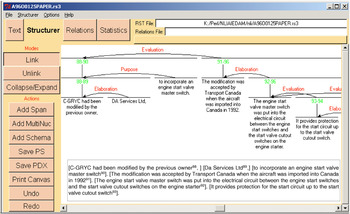
Figure 2 shows a screenshot of the RST annotation of the sample domain data. A software tool, RSTTool, is used to complete the annotation (O'Donnell, 2000). RSTTool offers a graphical interface with which annotators segment a given text into text spans and specify relation types between them. A computer program written in Perl by the first author has been developed to automatically extract the RST annotations stored by RSTTool. The box at the bottom of Figure 2 shows the decomposed text spans with the individual spans identified by brackets. The top shows the corresponding RST analysis tree.

A screenshot of the rhetorical structure theory (RST) analysis using RSTTool. [A color version of this figure can be viewed online at www.journals.cambridge.org]
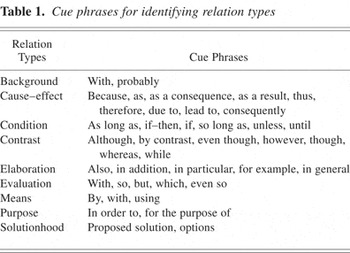
It is common to use discourse connectives (or cue phrases) for automatic discovery of discourse relations from texts. For example, by detecting the word but, a contrast relation between two adjacent texts can be identified. This approach is easy to implement but can lead to a low coverage, that is, the ratio of correctly discovered discourse relations to the total number of discourse relations. A study by Taboada and Mann (2006) showed that the levels of success using cue phrases ranged from 4% for the summary relation to over 90% for the concession relation. To improve the coverage, machine learning methods have been used. Marcu and Echihabi (2002) used Naive Bayesian probability to generate lexical pairs that can identify relation types without relying on cue phrases. For example, the approach can extract a contrast when one text contains good words and another bad words, even when but does not appear. Whereas this approach produces a good performance, the assumption that the lexical pairs are independent of each other can lead to a considerable number of training sentences being required, sometimes over 1,000,000. Although a low presence of cue phrases can lead to many undiscovered relations, they can serve as a reference for annotators. Discourse text spans are inserted at every period, semicolon, colon, or comma and at every cue phrase listed in Table 1. Annotators first refer to the cue phrases to test whether the corresponding relation types can be used for a given text. If no direct match is identified, then they select the closest one using their judgement. Table 1 summarizes cue phrases extracted from Knott and Dale (1995) and Williams and Reiter (2003).
Cue phrases for identifying relation types

RST-annotated texts are converted into a predicate–argument structure, that is, predicate (tag1:argument1,…, tagn:argumentn). Predicates represent the main verbs in sentences and tags include subjects, objects, and prepositions. For example, consider the following sentence: Analysis of the fuel hose indicates that the steel braid strands failed as a result of chafing. For this sentence the evidence relation type is used to annotate it as follows: evidence((indicate (subject:analysis of the fuel hose)), (fail(subject:the steel braid strand, pp:as a result of chafing))).
4.2. Semantic-based QA description
4.2.1. Term indexing
In general, it is difficult to extract good index terms because of inherent ambiguity in natural language texts. A term in a text, that is, an alphanumeric expression, can have different meanings depending on the domain in which it is being used, and a term can appear more frequently in one domain than in another. Publicly accessible dictionaries, for example, WordNet (Miller et al., 1993) are good resources for obtaining the meanings of the terms, both manually and automatically. For example, according to WordNet, blade has nine meanings. One definition is especially a leaf of grass or the broad portion of a leaf as distinct from the petiole. However, another in the engineering domain is flat surface that rotates and pushes against air or water. Terms can also be used in different domains with the same meaning. For example, certification does not have a different meaning in the engineering domain. Most keyword-based search systems index a document with a list of keywords ranked with relevance weightings. Whereas these keywords might be sufficient to describe superficially the contents of a document, it is difficult to interpret the true message if their precise meanings are not established.
In contrast, NLP produces a rich representation of a document at a conceptual level. To achieve humanlike language processing, NLP includes a range of computational techniques for analyzing and representing natural texts at one or more levels of linguistic analysis (Liddy, 1998). It is common to categorize such techniques into the six levels listed below, each of which has a different analysis capability and implementation complexity (Allen, 1987). The application of NLP on a text can be implemented at the simplest level, for example, morphological level and then extended into a full-fledged pragmatic analysis that shows a superior understanding, but requires large resources and extensive background information. In this paper, NLP processing includes the first five levels and excludes the pragmatic level:
- morphological level: component analysis of words, including prefixes, suffixes and roots, for example, using is stemmed into use;
- lexical level: word level analysis including a lexical meaning and a part of speech (POS) analysis, for example, apple is a kind of fruit and is tagged as noun;
- syntactic level: analysis of words in a sentence in order to determine the grammatical structure of the sentence;
- semantic level: interpretation of the possible meanings of a sentence, including the customization of the meanings for given domains;
- discourse level: interpretation of the structure and the meaning conveyed from a group of sentences; and
- pragmatic level: understanding the purposeful use of language in situations particularly those aspects of language, which require world knowledge.
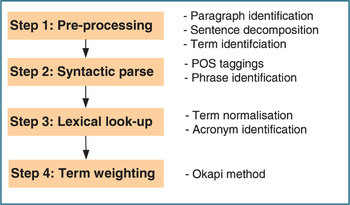
Figure 3 shows the steps of the indexing process. The text in the box at the bottom of Figure 2 is used as an example.

The steps of the indexing process. [A color version of this figure can be viewed online at www.journals.cambridge.org]
Step 1.
Preprocessing: One paragraph is identified in the example text, which is then decomposed into four sentences. The first sentence is the following:
C-GRYC had been modified by the previous owner, DA Services Ltd, to incorporate an engine start valve master switch.
Terms are identified as words lying between two spaces including a period.
Step 2.
Syntactic parse: The apple pie parser (Sekine & Grishman, 2001) is used for a syntactic parse that tags POS and identifies phrases. POS identifies not what a word is, but how it is used. It is useful to extract the meanings of words because the same word can be used as a verb or a noun in a single sentence or in different sentences. In a traditional grammar, POS classifies a word into eight categories: verb, noun, adjective, adverb, conjunctive, pronoun, preposition, and interjection. The apple pie parser refers to the grammars defined in the Penn Treebank to determine the POSs (Marcus et al., 1993). For example, the first word C-GRYC is tagged as NNPX, that is, proper single noun. The remain POSs for the sentence above are shown below:
POS taggings: C-GRYC/NNPX had/VBD been/VBN modified/VBN by/IN the/DT previous/JJ owner/NN DA/NNPX Services/NNPS Ltd/NNP to/TOINF incorporate/VB an/DT engine/NN start/NN valve/NN master/NN switch/NN.
Phrase identification groups words grammatically, for example, into noun phrases such as {the previous owner DA Services Ltd} and {an engine start valve master switch}.
Step 3.
Lexical look-up: Each POS-tagged word is compared with WordNet definitions to achieve term normalization. Acronym identification extends an acronym found in a text fragment with its full definition. An example of term normalization is

and an example of acronym identification is

Step 4.
Term weighting: Although it is possible to analyze the full contents of a document, this becomes computationally expensive when the documents are large. For an effective retrieval, it is desirable to extract only those portions of a document that are useful and to transform them into special formats. Text indexing determines the central properties of the content of a text to differentiate relevant portions of text from irrelevant ones. The quality of each index term is evaluated to determine if it is an effective identifier of the text content. A relative importance weighting is then assigned to each index term. A common approach is to index a document divided into paragraph-sized units. In this paper, the Okapi algorithm is used (Franz & Roukos, 1994; Robertson et al., 1995). It weights (wjk) a term (tk) in a paragraph (Pj) as follows:

where cjk is the frequency of the tk, N is the total number of paragraphs in a data set, n is the number of paragraphs that have contents containing the tk, len(Pj) is the total number of frequencies of all terms presented in a Pj, and ave_len is the average number of terms per paragraph. Using the term weighting method, the example sentence is stored into a vector model, that is, each term is associated with its calculated weighting.
4.2.2. Domain knowledge in QA
An engineering taxonomy such as EDIT is a useful means to identify domain-specific terms in a document. The successful extraction of domain-specific terms can improve the accuracy of QA. For example the answer to the question, What material should be used for this turbine blade?, is more easily identified if Titanium is marked up as a type of material. Among the four root concepts defined in EDIT, only two are used: issue and product. These two concepts exhibit different characteristics. According to Ahmed (2005), issue root concepts are considerations designers must take into account when carrying out a design process. These can be the descriptions of problems arising during a product's lifecycle or new design requirements to be satisfied. In contrast, product root concepts comprise a hierarchy list of product names, decomposing an overall technical product or system into smaller elements. Different techniques are therefore needed to handle them in the documents. For issue concepts, any technique that automatically classifies a document into predefined categories is suitable. For product concepts, the technique of NE recognition is used. In the QA method proposed in this paper, the techniques developed by Kim et al. (2006a, 2006b) are used. The technique for the classifying issue concepts is described in Kim et al. (2006b) and the one for classifying product concepts, using probability-based NE identifiers, is described in Kim et al. (2006a).
4.2.3. QA overview
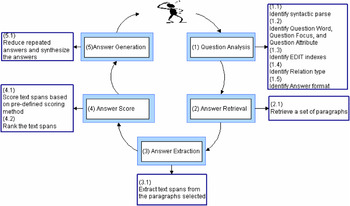
Figure 4 shows the overall architecture of the proposed QA system. State-of-the-art QA systems can achieve an accuracy of up to 80%, as demonstrated by recent tests undertaken using TREC data sets, which mainly consist of newspaper documents (Voorhess, 2002). However, this level of performance is not expected to be repeated in other environments. The questions in the above tests were carefully constructed, that is, no misspellings, and they were mostly factual and based on a single interaction with a user, so no dialogue.

The overall architecture of the proposed QA system. [A color version of this figure can be viewed online at www.journals.cambridge.org]
The prototype system proposed in this paper does not aim at achieving better accuracy in question analysis or in finding answers. Instead, its main objective is to demonstrate the efficiency of RST-based annotations for coherent answer generation (see step 5 in Figure 4). Each of the steps in Figure 4 are now described.
Step 1.
Question analysis: The question analysis module decomposes a question into three parts: question word, question focus, and question attribute. The question word indicates a potential answer type, for example, where, when, and so forth. The question focus is a word, or a sequence of words, that describe the user's information needs that are expressed in the question. The question attribute is the part of the question that remains after removing the question word and the question focus. It is used to rank candidate answers in a decreasing order of relevance. An example is given below.
Question: What were the consequences of the vibration of the starter/generator?

The question focus, that is, consequences, for the example question above is matched with the effect in the cause–effect relation type. Therefore, the possible answers should be the effects of the events described in the question attribute. For an automatic matching, a semantic similarity between the question focus and the relation type is computed using the method proposed by Resnik (1995). This method is based on the number of the edges in a semantic hierarchy, for example, WordNet, encounted between two terms when locating them in the hierarchy.
Step 2.
Answer retrieval: The answer retrieval module uses the question attribute identified by the question analysis module to select paragraphs that might contain candidate answers. A cosine-based similarity calculation is used for ranking the selected paragraphs in order of relevance to the keywords that appear in the question attribute (Salton, 1989).

where pj is a given paragraph, q is a question attribute, wij is the weight of the term ti in the pj. The similarity value is normalized by the total weights of common words.
Steps 3 and 4.
Answer extraction and answer scoring: The answer extraction module examines the paragraphs selected in the answer retrieval module in order to select text spans from which candidate answers can be extracted. The EDIT indexes, question focus, and question attribute are used to determine whether the text spans contain the answer. In doing so, it is necessary to measure how well they are related to the question. An overall similarity between the text spans and the question is computed by summing following three similarity scores: the score reflecting whether a given text span is classified with the EDIT indexes, the score reflecting whether a given text span contains the question focus, and the score reflecting the degree of similarity between a given text span and the question attribute. They are summed as follows:

where s(tsij) is the score of the text span tsi in the pj, α(0 ≤ α ≤ 1) and β(0 ≤ β ≤ 1) are used to normalize the score s(tsij) to lie between 0 and 1, and s_edit(tsi) is defined as

where s(indki) is a Boolean indicating whether a given text span is classified with an EDIT index number, indki, positions is the set of matches against the EDIT indexes returned by the question analysis module, N is the total number of elements in this set, s_rst(tsi) is a Boolean variable that is true if the RST annotation for the text span matches the annotation for the question, and s_attr(tsi) is defined as

where s(tmi) is a Boolean indicating whether or not a given term, tm in the text span, tsi is matched with a term in the question attribute tm, and M is the total number of terms in the question attribute. The scored text spans are sorted in decreasing order by value and those above a predefined threshold selected.
Step 5.
Answer generation: For coherent answer generation, duplicate sentences or clauses should be removed. Two sentences or clauses are recurrent if they are exactly equivalent or if they differ only in the level of generality. For example, the following two clauses are equivalent: the starter had failed and the failure of the number 2 engine starter. In contrast, sentence 1 below can be replaced by sentence 2 without loss of information because sentence 2 subsumes the information in sentence 1.
Sentence 1: It is probable that a short circuit in the engine wiring harness allowed the number 2 engine start valve to reopen, causing the number 2 engine starter to over speed and subsequently fail.
Sentence 2: It is probable that a short circuit in the engine wiring harness allowed the number 2 engine start valve to reopen, causing the number 2 engine starter to over speed and subsequently fail, resulting in an engine fire.
Automatic text summarization systems employ various approaches to compare similar sentences that have different wordings (Mani & Maybury, 1999). In general, these systems use the following two steps to produce summaries from a document:
Step 1 identifies and extracts important sentences to be included in a summary.
Step 2 synthesizes the extracted sentences to form a summary.
There are two common methods of synthesis in step 2. The nonextractive summary method suppresses repeated sentences either by extracting a subset of the repetitions or by selecting common terms. It then reformulates the reduced number of sentences to produce the summary (Barzilay et al., 1999; Jing & McKeown, 2000). The extractive summary method focuses on the extraction of important sentences and assembles them sequentially to produce the summary. The objective of these automatic summarization systems is to create a shortened version of an original text to reduce the time spent reading and comprehending it. In contrast, the objective of our proposed approach is to extend and synthesize text spans to allow the generation of coherent answers.
In the proposed approach, two text spans are compared to determine whether or not both are similar using Eq. (2). Text spans that have higher similarity values than the predefined threshold are excluded. The algorithm of the answer generation module is shown below as pseudocode.
Variable definition:
answerList: chains of “cause and effect” to be generated by the answer generation module
textspanList: a list of text spans returned by the answer scoring module
relationlinkedList: a list of text spans linked through the “cause and effect” relation obtained from the RST annotations.
t: one text span being examined and extracted from the textspanList
thresh: a predefined threshold used to compare similarity between two text spans
t1: temp variable, t2: temp variable

5. PILOT STUDY
This section presents a preliminary evaluation of the prototype QA system. The evaluation tests the following two hypotheses: the proposed system is efficient at extracting and presenting answers to causal questions using relation types, and the presentation of the synthesized answers helps users to understand the retrieved results. The first hypothesis was evaluated by comparing the performance of the prototype system against that of a standard QA system. The standard system is different from the prototype system in the following ways:
Step 1.
The answer format is revised as 〈Answer〉 question focus question attribute. This format indicates that the system should find text spans that have syntactic variations with the question focus and semantic similarities with the question attribute. Using the example question in Section 4.2.3, a potential answer text span can be 〈Answer〉 is the consequence of 〈Question Attribute〉.
Step 2.
Not revised.
Steps 3 and 4.
Equation (3) is revised as s(tsij) = s_attr(tsi).
Step 5.
Not used.
With the standard system, multiple instances were extracted without synthesizing them. This comparison examined whether the answer generation method described in Section 4.2 avoids repeated information and generates coherent answers. The second hypothesis was evaluated by measuring user performance in a simple trial.
5.1. Trial data set
For the trial, three official aircraft incident investigation reports were downloaded from the following websites:
- http://www.tsb.gc.ca/en/reports/air/1996/a96o0125/a96o0125.asp
- http://www.tsb.gc.ca/en/reports/air/2002/A02C0114/A02C0114.asp
- http://www.aaib.gov.uk/sites/aaib/cms_resources/dft_avsafety_pdf_029538.pdf
Although the incidents happened to three different aircraft types (Boeing 727-217, Bell 205A-1 helicopter, and Boeing 737-8AS), the incidents share a common cause, that is, an in-flight engine fire. Although the reports were written by different incident investigation teams, they share a broadly similar terminology, for example, emergency landing, engine starter valve, and so forth. After removing embedded HTML tags and images, the average document length was 1820 words, or 24 paragraphs. Each document was first indexed as described in Section 4.2.1, and RST annotations were applied by the first author using RSTTool. A total of 194 relations were annotated. The total numbers for each relation type were 20 background, 45 cause–effect, 16 condition, 30 contrast, 32 elaboration, 24 evaluation, 10 means, 12 purpose, and 5 solutionhood.
5.2. The trial
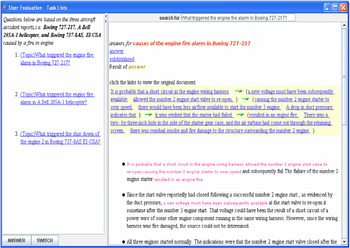
Six engineering graduate students and two members of the Engineering Department staff of the University of Cambridge participated in the trial. A brief introduction to the trial and trial data set was given to the participants. Each participant was asked to answer multiple questions and their performance and accuracy were measured. The trial consisted of reviewing the answers to three questions, that is, one for each incident report. These answers were split into two groups. The first group was extracted and synthesized using the prototype QA system and the second was extracted using a standard QA system. For a fixed period of time, the participants were instructed to read the answers on-line for both systems (see Fig. 5), and follow links to the original document if desired. After this, a further list of questions related to the answers the users had just read was given to the users. Their answers to these questions were used to test their understanding of the answers they had just seen. To avoid the evaluation problems caused by the inclusion of incorrect answers, both groups of answers were examined in order to verify that they were all true.

An example screenshot of the proposed system. [A color version of this figure can be viewed online at www.journals.cambridge.org]
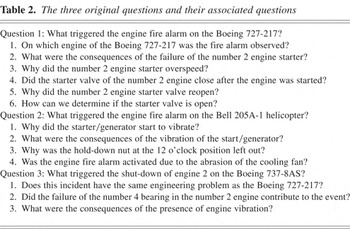
Table 2 shows the three initial questions, along with the associated questions that were used to test the users' understanding.
The three original questions and their associated questions

5.3. Trial results
Answers to the three original questions shown in Table 2 were extracted and synthesized using the method described in Section 4.2. The answers then were compared to the set of answers prepared in Section 5.2. The threshold for the answer retrieval module, that is, the value for Eq. (2), was set as 0.5, meaning that the paragraphs that had run s2 cosine similarity values over 0.5 were selected. The values for α and β specified in Eq. (3) were set as 0.3 and 0.2, respectively. The threshold for the answer scoring module, that is, the values for Eq. (3), was set as 0.2.
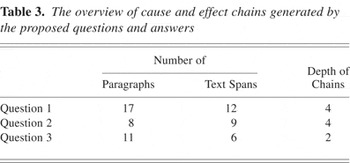
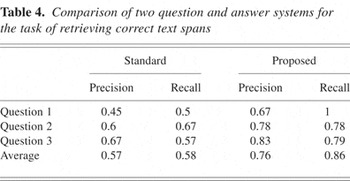
The results are shown using Table 3 and Table 4. Table 3 summarizes the results of the “cause and effect” chains generated by the proposed QA. Table 4 compares the performance of the proposed QA on retrieving correct text spans with that of the standard QA. Precision and recall were used to measure the performance. In this paper, precision is defined as the percentage of the retrieved text spans that are identified as right among the total number of retrieved text spans. Recall is the percentage of the retrieved right text spans among the total number of right text spans.
The overview of cause and effect chains generated by the proposed questions and answers

Comparison of two question and answer systems for the task of retrieving correct text spans

The second column in Table 3 specifies the number of paragraphs returned by the answer retrieval module and the third one specifies the number of text spans returned by the answer extraction and scoring modules. The fourth one specifies the depth of the chains, that is, the number of cause and effect nodes along the longest path from the root node down to the farthest leaf node in the chains. For example, for Question 1, one “cause and effect” chain with a depth of 4 was generated by synthesizing and extending the 12 text spans extracted from the 17 paragraphs.
The following are examples of correct and incorrect text spans for question 1.
5.3.1. Correct text spans
- The failure of the number 2 engine starter resulted in an engine fire.
- The hazard associated with an engine fire caused by a starter failure was recognized and addressed in AWD 83-01-05 R2.
- It is probable that a short circuit in the engine wiring harness allowed the number 2 engine start valve to reopen, causing the number 2 engine starter to over speed and subsequently fail, resulting in an engine fire.
5.3.2. Incorrect text spans
- Because of the engine's proximity to the elevator and rudder control systems, a severe in-flight fire in the number 2 engine is potentially more serious than a fire in either the number 1 or 3 engine.
- Fire damage to the engine component wiring precluded any significant testing of the wiring harness.
- Two fire bottles were discharged into the number 2 engine compartment; however, the fire warning light remained on.
As shown in Table 4, on average, the proposed QA achieved 76% precision and 86% recall when retrieving text spans for three questions. In contrast, the standard QA achieved 57% precision and 58% recall. This suggests that the proposed QA has considerable potential for extracting and synthesizing answers to causal questions. The task of retrieving text spans is similar to the sentence selection task in automatic text summarization systems.
The text summarization systems referred to earlier in this paper are by Barzilay et al. (1999) and by Jing and McKeown (2000). In the context of multidocument summarization, Barzilay et al. (1999) focused on the generation of paraphrasing rules that were used to compare semantic similarity between two sentences. They tested the rules for the task of identifying common phrases among multiple sentences. The automatically generated common phrases were then reviewed by human judges. The reviews identified 39 common phrases and among them the system correctly identified 29 of them. In addition, the identified phrases contained 69% of the correct subjects and 74% of the correct main verbs. On average, the system achieved 72% accuracy.
Jing and McKeown (2000) carried out three evaluations. The first tested whether the automatic summarization system could identify a phrase in the original text that corresponds to the selected phrase in a human–written abstract. When tested with 10 documents, the automatic system achieved 82% precision and 79% recall on average. The second evaluation tested whether the automatic system could remove extraneous sentences, that is, sentence reduction. The result showed that 81% of the reduction decisions made by the system agreed with those of humans. The third evaluation tested whether the automatic system could generate coherent summaries. The system achieved 6.1 points out of 10, that is, 61% accuracy for generating coherent summaries. Only the first evaluation focused on the sentence selection.
The performance of our proposed QA when retrieving correct text spans with 76% precision and 86% recall is slightly better than the work by Barzilay et al. (1999), which is 72% accuracy, and comparable to the work by Jing and McKeown (2000), which is 82% precision and 79% recall.
On average, out of 13 questions, the users in the first group, that is, those who read the answers given by the proposed QA, incorrectly answered two questions, whereas the users in the second group incorrectly answered five questions. On average, the users in the first group completed the trial within 19 min, and the users in the second group completed the trial within 25 min. Five of the 13 questions were correctly answered by all the users in the first group, whereas just one question was correctly answered by all the users in the second group. All users in the second group incorrectly answered question number 6: How can we determine if the starter valve is open?
Although the preliminary results are encouraging, it is difficult to draw firm conclusions from this trial for the following reasons: the low number of users in the two groups; and the number of causal relations in the trial data set were small. Users in the first group expressed the opinion that the synthesized chains of “cause and effect” description were helpful in understanding the causes of the three incidents.
6. CONCLUSION AND FURTHER WORK
Researchers in computational linguistics have speculated that the relation types defined in RST can improve the performance of QA systems when answering complex questions. The class of causal reasoning questions, either predictive or diagnostic, is one that we have shown might be better answered using these relation types. The reason for this is that the majority of causal questions can be answered in multiple ways, that is, it is difficult to pinpoint particular causes and regard them as independent of the remaining information. Generally, identifying the causes of a specific event involves creating chains of “cause and effect” relations. Without a deep understanding of all the relevant information contained in a document, it is not possible to derive such causal chains automatically. It is still not known how users would like such causal chains to be presented, and it is not suggested that the interface proposed in this paper is necessarily the best. The contribution of this paper is the demonstration of a method for synthesizing causal information into coherent answers. The source information can be scattered over different parts of a single document or over multiple documents. The pilot study indicated that the proposed QA was more efficient at extracting and synthesizing answers when compared with standard QA, that is, 19 percentage points increased precision and 28 percentage points increased recall. The pilot study also indicated that the synthesized chains of “cause and effect” descriptions were helpful not only for quickly understanding the direct causes of the three incidents but also for being aware of related contexts along with the rationales for the causes of the incidents.
The main objective is to improve the understanding of the answers generated by QA systems. An answer is considered to be coherent if duplicate expressions are eliminated and if it is appropriately extended with additional information. This additional information should help users verify the answers and increase their awareness of relevant domain information. Using RST annotations, it has been shown that it is feasible to compare and integrate the information at a semantic level. This leads to a way of presenting answers in a more natural manner. A pilot trial demonstrated that the answers generated by the prototype QA system led to more rapid and improved understanding of those answers.
Further work is planned with the aim of improving the performance of the prototype system in three ways. First, because engineers have varying levels of domain expertise, the system should consider the preferences and profiles of individuals. Inexperienced engineers might have very broad information requests and prefer to explore the domain, whereas experienced engineers might have detailed information requests aimed at refining their existing knowledge. Novice engineers require more background information, probably assembled using elaboration or background relation types.
Second, synthesizing sentences extracted from different documents is crucial to generate answers that are longer than one sentence. When writing a sequence of linked sentences, authors often replace noun phrases by pronouns, or shortened forms of the phrase, in subsequent sentences, for example, the number 2 engine starter is replaced by it or the starter. Coreference (anaphora) resolution is a process for determining the multiple representations of a noun phrase and is a key issue in computational sentence synthesis. However the main focus of research in this area has been on the resolution of personal pronouns, for example, he, him, his, and so forth. Various techniques have been proposed for automatic coreference identification, and it is planned to extend the prototype QA system by adapting these techniques.
Third, the crucial issue of automatic RST annotation will be addressed because this is essential for the practical application of the system. Kim et al. (2004) have applied a machine learning algorithm, that is, inductive logic programming, to analyze documents created using the design rationale editor (DRed). This enabled the automatic identification of the relation types (Bracewell & Wallace, 2003, Bracewell et al., 2004). Tests have demonstrated approximately 80% accuracy. This high figure can be attributed partly to the structure of the DRed documents in the data set. These documents are carefully structured using an argumentation model derived from that of IBIS (Kunz & Rittel, 1970). The documents comprise linked textual elements of a predefined set of types. These element types include “issue,” “answer,” and “argument.” The links between them are directed but untyped. This algorithm will be extended to deal with other types of documents, for example, Web pages and unstructured texts.
The main objective of this research was to answer more complex questions than current QA systems are capable of answering. There are five modules in the architecture of the proposed QA system: question analysis, answer retrieval, answer extraction, answer score, and answer generation. The question analysis module analyzes the question in terms of the question word, question focus and question attribute. The next three modules retrieve, extract, and score answers from documents that have been manually annotated and semiautomatically indexed. The manual annotation is based on nine of the 33 relation types defined in RST. The semiautomatic indexing uses the issue and product root concepts of the EDIT engineering taxonomy. The main contribution of this research lies in the fifth module. This module synthesises causal information into coherent answers, drawing information from both different parts of a single document and from multiple documents. A prototype implementation shows promise, but additional testing is required. Further developments are proposed that will allow the system to take into account the preferences and profiles of users, extend the system to include coreference identification, and eliminate the manual annotation of documents. As with all computer support systems, the interface is critical and here further empirical research is needed.
ACKNOWLEDGMENTS
This work was funded by the University Technology Partnership for Design, which is a collaboration between Rolls-Royce, BAE SYSTEMS, and the Universities of Cambridge, Sheffield, and Southampton. We thank S. Banerjee and T. Pedensen for the software implementing the similarity measurement method proposed by Resnik.