Introduction
More than 800 000 people die by suicide annually worldwide (World Health Organization, 2019). In Australia, suicide is the leading cause of death in the 15–44 years age group and the second leading cause of death in the 45–54 years age group. In 2018, it was estimated that there were 105 730 years of life lost to suicide (Australian Bureau of Statistics, 2019). In terms of suicide attempts, approximately 1 in 33 Australians (aged 16–85 years) make a suicide attempt during their lifetime and 1 in 13 young Australians (aged 12–17 years) had seriously considered attempting suicide in the previous 12 months (Lawrence et al., Reference Lawrence, Johnson, Hafekost, Boterhoven de Haan, Sawyer, Ainley and Zubrick2015; Slade et al., Reference Slade, Johnston, Teesson, Whiteford, Burgess and Pirkis2009). Suicide plans and attempts are associated with significant personal health care costs, lost productivity, emotional and psychosocial morbidity and additional burden and distress caused to family and friends (Johnston, Pirkis, & Burgess, Reference Johnston, Pirkis and Burgess2009; Kinchin & Doran, Reference Kinchin and Doran2017; Spillane, Matvienko-Sikar, Larkin, Corcoran, & Arensman, Reference Spillane, Matvienko-Sikar, Larkin, Corcoran and Arensman2018). Rarely do suicide plans or attempts occur without the presence of suicidal thoughts and ideation, which may occur sometime before any suicidal plans or behaviours are exhibited, yet not all those with suicidal ideation go on to develop suicidal plans or attempts (Klonsky & May, Reference Klonsky and May2014). As such, there is a critical need for new public health approaches to better assist the population with identifying and reducing suicidal ideation as well as recognising potentially differential risk factors associated with transitioning from ideation to plans and/or attempts as a mechanism of breaking down the path towards increased mortality.
Whilst there are a myriad of studies examining factors associated with suicidal plans, attempts and ideation, there are relatively few studies that have examined the key transitional period from thoughts to action, as well as identifying predictive factors associated with that transition. Existing theories of suicidal behaviour have placed the transition between ideation and plans/attempts as a critical period that could potentially reduce high rates of suicide. In particular, the integrated motivational-volitional, three-step theory and interpersonal theory (IPT) identify a range of factors such as the capability for suicide, access to means, psychopathology, past suicidal behaviours, exposure and impulsivity as playing a key role in the transition from suicidal ideation to plans/attempts (Klonsky & May, Reference Klonsky and May2015; O'Connor & Kirtley, Reference O'Connor and Kirtley2018; Van Orden et al., Reference Van Orden, Witte, Cukrowicz, Braithwaite, Selby and Joiner2010). Indeed, the IPT posits that suicidal ideation can develop with increased perceptions of thwarted belongingness (loneliness and absence of reciprocal care), high burdensomeness and hopelessness, which often presents as low social connectedness and increased rates of comorbid psychopathology such as depression, anxiety and substance use disorders.
The role of psychopathology on this transition has been most extensively studied. Batterham, Calear, Christensen, Carragher, and Sunderland (Reference Batterham, Calear, Christensen, Carragher and Sunderland2018) recently demonstrated multiple associations between mental and substance use disorders, particularly obsessive-compulsive disorder (OCD), post-traumatic stress disorder (PTSD), attention deficit hyper-activity disorder and alcohol use disorder (AUD) and suicidal behaviours among individuals with suicidal ideation. However, in adjusted models that accounted for the presence of all other disorder, only OCD and PTSD remained significant and there was no significant effect of major depressive disorder on suicide attempts among those with ideation. Very few studies have identified independent effects associated with OCD and suicidal plans and attempts among those with ideation, given that mood disorders are commonly the focus. These findings potentially suggest that people who find it difficult to escape suicidal thoughts or those who feel compelled to act on those thoughts would be at increased risk of making suicidal plans and/or attempts (Batterham et al., Reference Batterham, Calear, Christensen, Carragher and Sunderland2018). Other population-based studies have similarly suggested that the presence of anxiety and impulse control disorders might potentially have greater effects than mood disorders on transitions to suicidal plans/attempts (May & Klonsky, Reference May and Klonsky2016; Nock, Hwang, Sampson, & Kessler, Reference Nock, Hwang, Sampson and Kessler2010).
While these studies suggest novel targets to prevent suicide attempts among those with suicidal ideation, there is a lack of evidence informing the specific length of time between first experiencing suicidal ideation and first making suicide plans or a suicide attempt. Such evidence may be crucial for optimising access to treatment services and prevention programs. In addition, the factors associated with increased risk of suicide attempts among those with suicidal ideation may differ with respect to factors that are associated with the speeding up or slowing down the time from first ideation to first plans/attempts. More nuanced evidence regarding transition from ideation to plans/attempts is likely to lead to more tailored and better targeted interventions, increasing the effectiveness and efficiency of programs. Yet, risk factor research on suicidal thoughts and actions requires large samples with data on multiple mental and substance use disorders as well as the longitudinal or developmental nature of these disorders over the lifespan.
The current study utilises a large population-based survey of the Australian population with comprehensive data on multiple mental and substance use disorders assessed retrospectively over the lifespan. The study makes use of a novel cross-sectional design that obtained age of onset data from all individuals regarding suicidal ideation, plans and attempts as well as age of onset of multiple mental and substance use disorders. As such, this study uses discrete time survival analysis to model the estimated time (in years) from first experiencing suicidal ideation to first making a suicide plan and/or attempt. In addition, the study investigates important sociodemographic subgroups and social features that are related to either a faster or slower transition from first ideation to first suicidal behaviours. Previous studies have utilised similar data and techniques to determine associations between first use of alcohol and/or drugs and the onset of substance use disorders as well as the time taken to seek treatment (Chapman, Slade, Hunt, & Teesson, Reference Chapman, Slade, Hunt and Teesson2015; Marel et al., Reference Marel, Sunderland, Mills, Slade, Teesson and Chapman2019). However, to the best of our knowledge, we are not aware of any study that has utilised these techniques to investigate time from suicidal ideation to plans and attempts in the general population.
Methods
Sample
Data from the current study were from the 2007 Australian National Survey of Mental Health and Wellbeing (NSMHWB), a nationally representative population-based survey of Australians aged 16 to 85 years old. The survey comprised a stratified, multistage probability sample of households with one household member randomly selected to complete the survey. The survey oversampled (higher probability of selection) those who were younger or older to ensure representative estimates of these traditionally under-represented age groups. The survey was conducted by trained interviewers from the Australian Bureau of Statistics (the statutory body responsible for conducting Australian-based surveys and census taking using appropriate ethical standards and obtaining informed written consent). The total sample size is 8841 with an overall response rate of 60%, which is comparable to other national mental health surveys and reflective of declining global response rates to survey research (Slade, Johnston, Oakley Browne, Andrews, & Whiteford, Reference Slade, Johnston, Oakley Browne, Andrews and Whiteford2009). Given the focus of the current study was on the transition from suicidal ideation to plans and/or attempts, this necessitated the selection of a subsample of those respondents who experienced suicidal ideation at some point in their lives. Similarly, the method required that each person was accurately able to recall the age they first experienced suicidal ideation. Those who could not recall the age they first experienced ideation were excluded from the analysis. The total analysed sample n = 1237 or 13% (s.e. = 0.46) of the total population. The data were weighted according to the sex and age characteristics of the Australian population.
Measures
The lifetime presence of suicidal thoughts and plans/attempts and age of onset information were assessed in the survey using several related questions. For the current study, suicidal ideation and suicidal plans were considered distinct and measured separately. The two were differentiated by multiple questions and skip logic with suicidal ideation referred to as seriously thoughts about suicide v. plans referred to as actively making a suicidal plan. The first question was designed to assess whether the respondent had ever experienced suicidal thoughts or ideation over their lifetime (e.g. ‘You seriously thought about committing suicide’). If they said ‘yes’ then the interviewer asked how old they were the first time this happened. Respondents who indicated that they had experienced suicidal ideation were then asked if they had ever experienced (1) making a suicide plan (e.g. ‘You made a plan for committing suicide’) and how old they were the first time this happened, and (2) attempting suicide (e.g. ‘You attempted suicide’) and how old they were the first time this happened. If the participant did not indicate that they have had suicidal thoughts, then they were skipped from answering questions about suicidal plans and attempts. For the current study, respondents were coded as having attempted suicide regardless of the intention, method or outcome (e.g. hospitalisation) of the suicide attempt.
The lifetime occurrence of mental and substance use disorders was assessed using a modified version of the World Mental Health Composite International Diagnostic Interview (WMH-CIDI). This interview is considered a gold standard diagnostic instrument with strong psychometric properties and has been calibrated against a structured clinical interview (SCID-IV). The WMH-CIDI has been used extensively as part of the World Mental Health Survey initiative (Kessler, Ustun, & Üstün, Reference Kessler, Ustun and Üstün2004). All respondents were assessed according to the DSM-IV criteria for major depressive episode (MDE), generalised anxiety disorder (GAD), OCD, panic disorder, PTSD, social anxiety, AUD (abuse and/or dependence) and drug use disorder (abuse and/or dependence). Age of onset information for mental and substance use disorders was captured by asking the age they first experienced a core symptom set associated with each disorder. Using this information age of onset was then coded for those who met full diagnostic criteria for each disorder. To examine the impact of pre-existing mental and substance use disorders on transitioning from suicidal thoughts and behaviours, only mental and substance use disorders that specified an age of onset prior to the age of first experiencing suicidal ideation were coded as positive. If the age of onset occurred after the age of first experienced ideation, plans and attempts, the diagnosis was coded as negative.
Additional demographic and social information related to suicidality obtained from the survey were limited given the secondary use of data for the current analysis. However, a range of sociodemographic and social variables that have been previously implicated with suicidal ideation, plans and attempts were identified and examined as correlates of transitioning from suicidal ideation to plans and/or attempts. These variables included: sex, age at first experience of suicidal ideation, age at the time of the survey, sexual minority status (homosexual or bisexual), location (major urban, other urban, non-urban), presence of one or more family members to confide in, and presence of one or more friends to confide in.
Statistical analysis
Descriptive statistics and univariable and multivariable logistic regression among those who ever experienced suicidal ideation was used to examine frequencies, odds ratios and statistical significance between the demographic and clinical variables with suicidal plans and attempts. The data were weighted based on the sex and age distribution of the Australian population. Unconditional and conditional discrete time survival models were estimated to model the time in years from first experiencing suicidal ideation to plans and attempts, separately. Given that almost all respondents who experienced plans or attempts did so within 20 years from first experiencing suicidal ideation, the current analysis right-censored the data beyond the 20-year point. Respondents who did not make plans or attempts were either censored at their current age or after 20 years since first experiencing ideation. The data were coded using binary person time indicators with a value of zero assigned if the respondent did not first experience plans or attempts within that time or a value of one if they did experience plans or attempts within that time. Once a respondent experienced plans or attempts, the subsequent indicators for the time intervals were coded as missing. Given the relative rarity of plans and attempts within this population, the binary time indicators represented 2-year intervals with dummy codes (a total of 10 values representing the 20 years since first experiencing suicidal ideation) beginning at within the first 2 years, followed by within the first 4 years, then within the first 6 years and so on.
Model building commenced by first fitting unconditional discrete time survival models separately for plans and attempts. This was followed by fitting univariable models and testing the proportionality assumption for each covariate separately. Finally, multivariable models were estimated with all covariates included simultaneously (sex, age at first experience of suicidal ideation, age at the time of the survey, sexual minority status, location, presence of one or more family members to confide in, presence of one or more friends to confide in and psychopathology). Statistical significance was assumed by setting the alpha level at p < 0.05. Comparisons of model fit were achieved using Bayesian information criterion (BIC) where models with lower BIC values were deemed as providing better model fit. All models were estimated in Mplus version 8 using full information maximum likelihood with robust standard errors and a logit link.
Results
Descriptive statistics
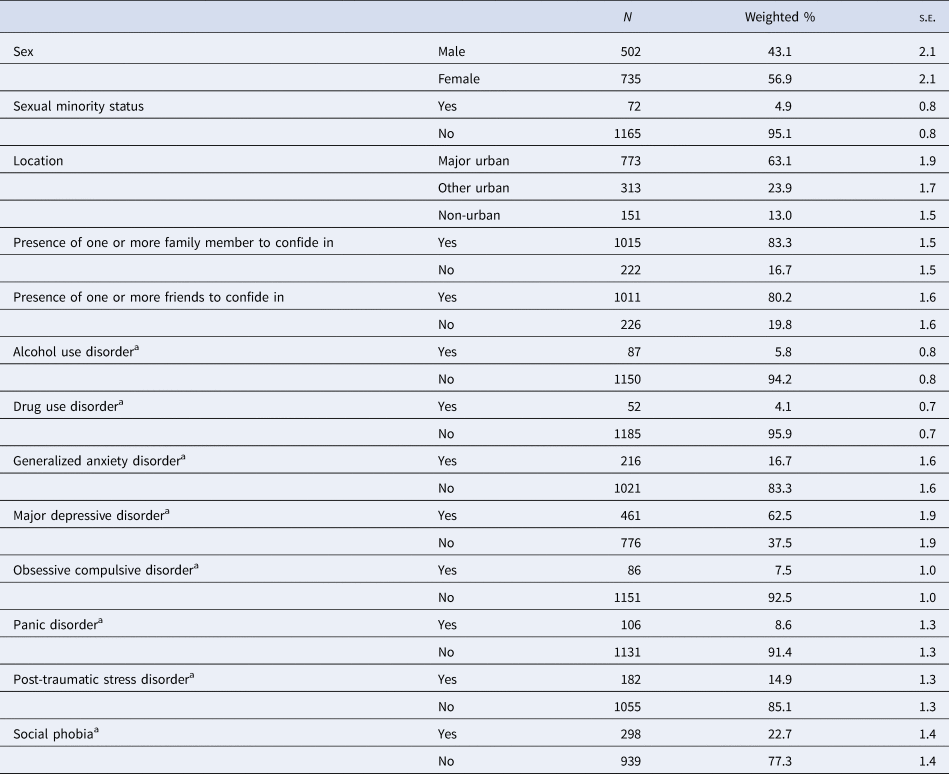
Of those with suicidal ideation, approximately 30% (s.e. = 1.99%) had reported making suicide plans, and 24% (s.e. = 1.15%) had reported a suicide attempt at some point in their life. Approximately 15% (s.e. = 1.25%) reported both making a suicide plan and suicide attempt, 15% (s.e. = 1.63%) reported making a plan but not attempt, 9% (s.e. = 1.14%) reported making a suicide attempt but no plans and 61% (s.e. = 2.22%) did not report making a plan or attempt despite experiencing suicidal ideation. The demographic and psychopathological characteristics of those with suicidal ideation are reported in Table 1. The sex distribution differed significantly between those with and without suicidal ideation with 57% male and 43% female in those with suicidal ideation v. 51% male and 49% female (f = 10.1, p < 0.01). The average age of those with suicidal ideation was 43 years (s.e. = 0.51), whereas the average age of first suicidal thoughts was 27 years (s.e. = 0.48). Among those with a suicide plan, the average age they first made a suicide plan was 27 years (s.e. = 0.87) and among those with a suicide attempt the average age they first made a suicide attempt was 24 years (s.e. = 0.97).
Sociodemographic and psychopathology characteristics of those with suicidal ideation (n = 1237)

a Diagnosis of disorder with an onset reported prior to the onset of suicidal ideation.
Unconditional discrete time survival models
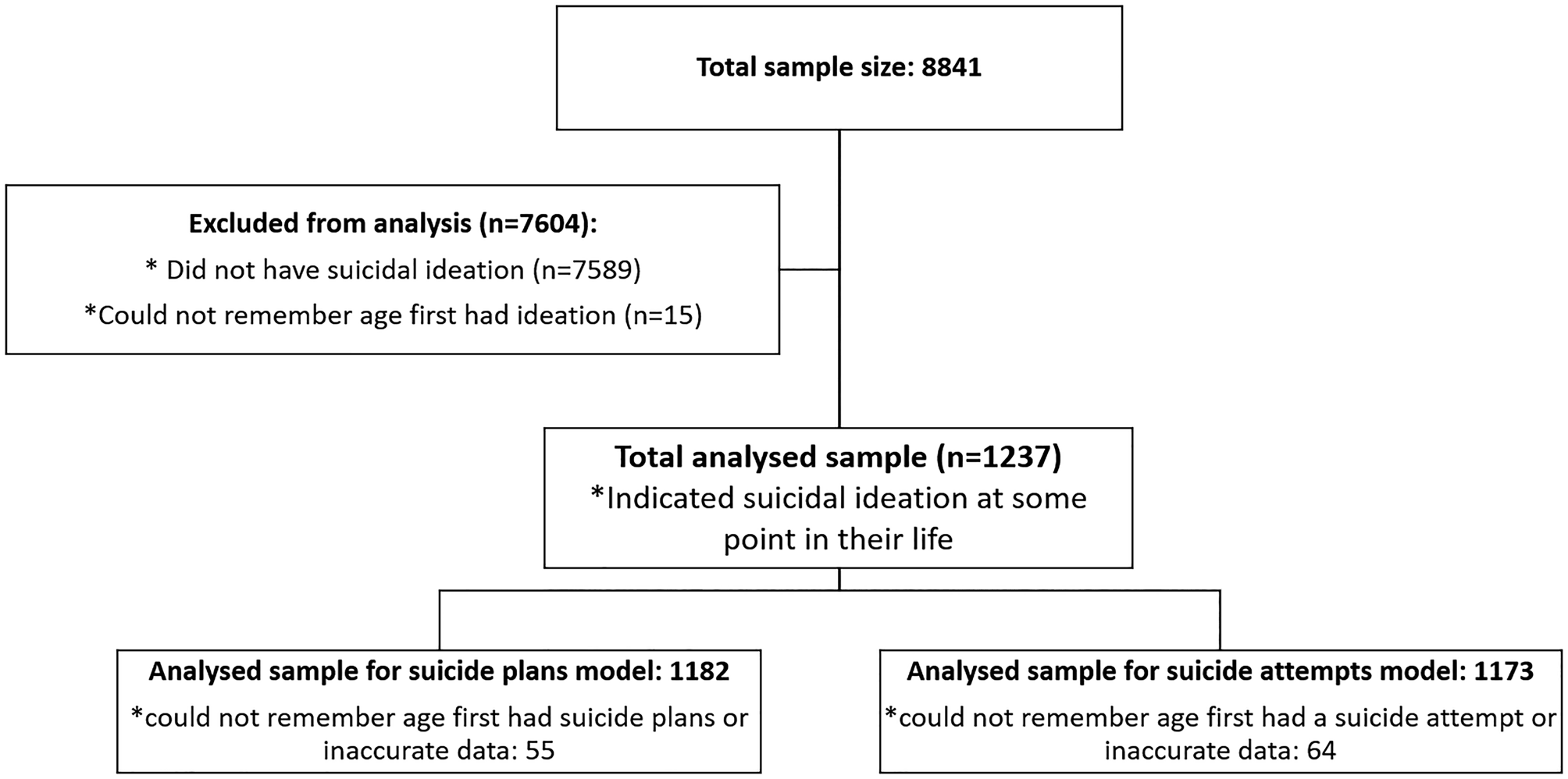
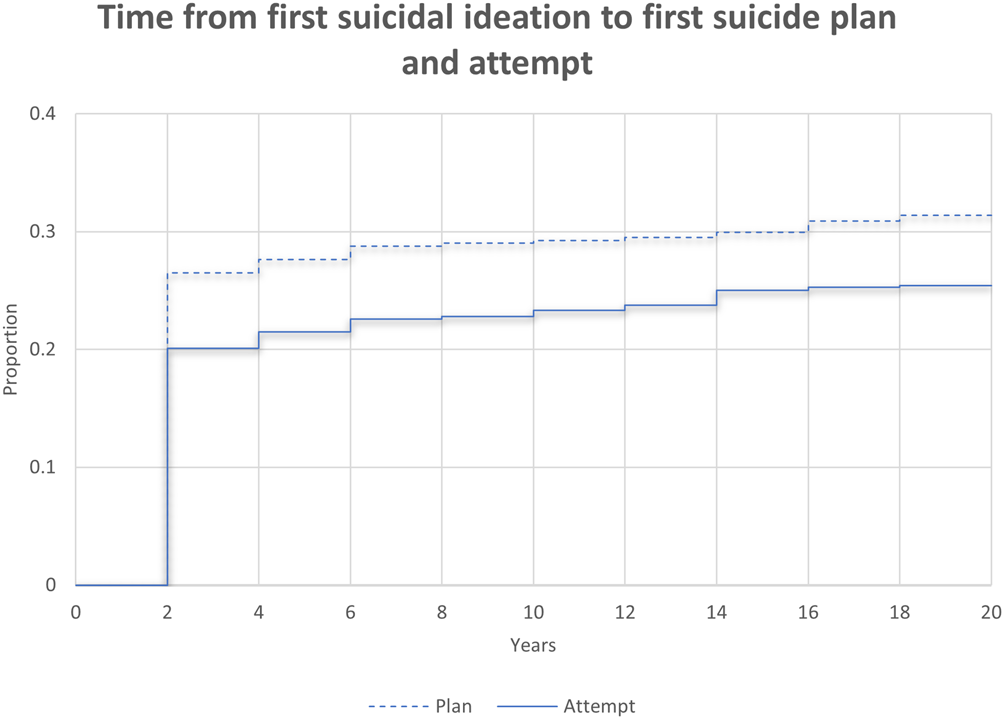
The final sample for the discrete time survival model for first suicidal thoughts to first plan was n = 1182 (after removal of those who could not remember the age that they first made a suicide plan or indicated that the age they first made a suicide plan was prior to the age they first had suicidal thoughts, see Fig. 1). Similarly, 46 respondents without suicide plans indicated that their current age was within 2 years from first having suicidal thoughts and were excluded. Of those with suicidal ideation, an estimated 31% made a suicide plan within 20 years from first experiencing ideation (the point at which the data was censored). An estimated 27% made a suicide plan within 2 years of first experiencing suicidal ideation (equating to approximately 87% of people who made a suicide plan within 20 years).
Flow diagram for participants selected and analysed from the National Survey of Mental Health and Wellbeing.

The final sample for the discrete time survival model for first suicidal thoughts to first attempt was n = 1173 (after removal of cases who could not remember their age of first attempt or indicated their age was prior to the age they first had ideation, see Fig. 1). In addition, 47 respondents without attempts were removed given their current age was within 2 years of having first experienced suicidal thoughts. An estimated 25% of those with suicidal ideation experienced a suicide attempt within 20 years with the vast majority (80%) experiencing their first attempt within 2 years of first ideation. The estimated hazard functions for both suicide plans and attempts are provided in Fig. 2.
Hazard curves for suicide plans and attempts in unconditional discrete time survival models.

Correlates of transitioning from first ideation to plans and/or attempts
Tests of the proportionality assumption for all covariates indicated that models that assumed proportional effects of the covariate across all time points evidenced better model fit in comparison to non-proportional effects according to the BIC values. Given the presence of zero cells (no plans/attempts) in some of the categorical covariates by time in the non-proportional models, the estimates for these time points were fixed at the extreme value to avoid singularity of the information matrix.
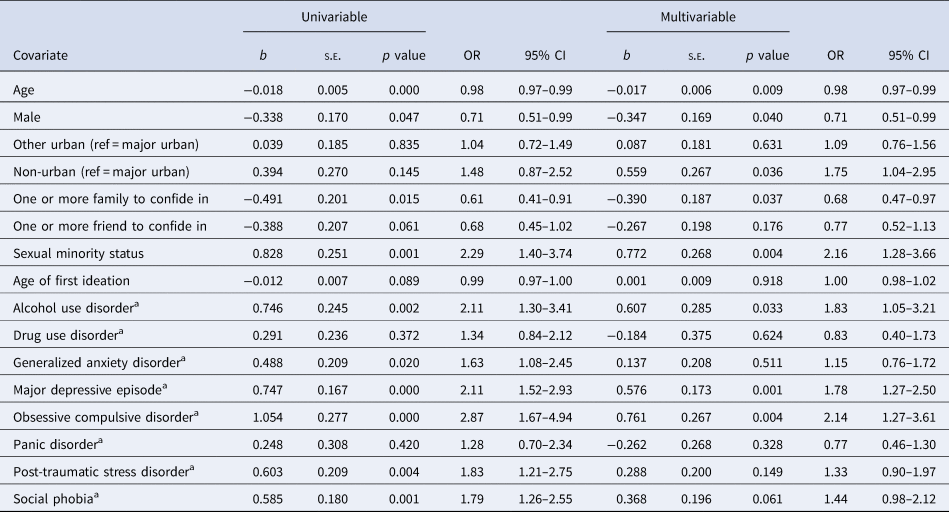
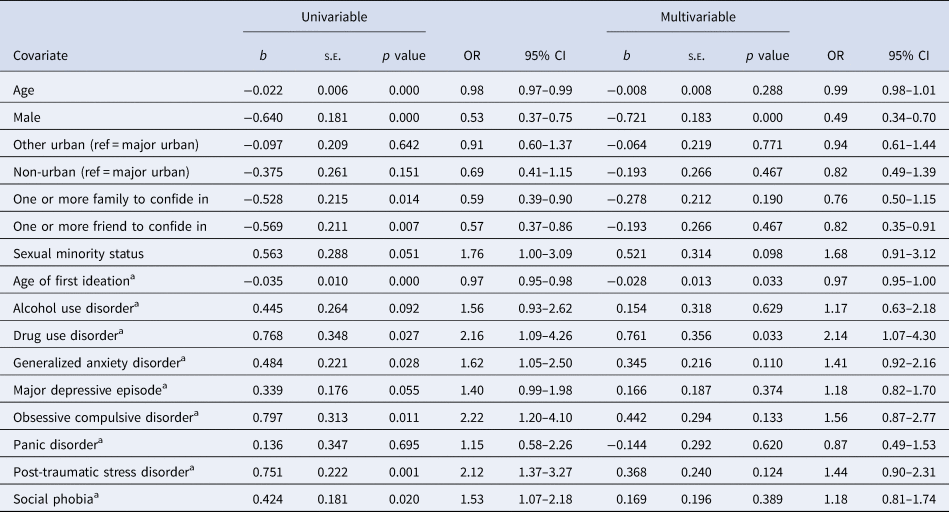
The results for the univariable and multivariable (inclusion of all other covariates) models for ideation to plans and ideation to attempts are provided in Tables 2 and 3, respectively. For suicidal ideation to first suicide plan, the univariable models indicated that AUD, GAD, MDE, OCD, PTSD, SMS and social anxiety were associated with a faster transition to first making a suicide plan. Having one or more family member to confide in, being male, and older age at the time of the interview were significantly associated with a slower transition. There was additional interest in examining the potential interaction between social connectedness (friends and family support) and sexual minority status however additional models that included these interaction terms provided no evidence for a statistically significant difference. When adjusting for all other covariates, AUD, one or more family members to confide in, being male, MDE, OCD, SMS, non-urban and age remained as significant covariates. For suicidal ideation to first suicide attempt, the univariable models indicated that PTSD, GAD, OCD, SAD and drug use disorder were significantly associated with faster transition to attempts, whereas older age at first ideation, older current age and being male were significantly associated with a slower transition. In the multivariable model, sex and age of first ideation remained significant, with male sex and older age associated with significantly slower transition from ideation to attempts. The presence of drug use disorder also remained significantly associated with a faster transition from ideation to attempts in the multivariate model. Again, interaction terms between social connectedness and sexual minority status were tested but provided no evidence for a statistically significant difference.
Discrete time survival analysis predicting time to transition from suicidal ideation to suicide plans (n = 1182)

a Diagnosis of disorder with an onset reported prior to the onset of suicidal ideation.
Discrete time survival analysis predicting time to transition from suicidal ideation to suicide attempts (n = 1173)

a Diagnosis of disorder with an onset reported prior to the onset of suicidal ideation.
Discussion
The current study utilised population-based age of onset data associated with suicidal ideation and suicidal plans and attempts to determine the time taken from first experiencing ideation to first experiencing plans and attempts. Moreover, conditional discrete time survival models examined a range of clinical and socio-demographic correlates of transitioning from suicidal thoughts to plans/attempts. The unconditional models indicate that the large majority of those who experience ideation and go on to experience plans or attempts will do so within 2 years from first experiencing ideation. These results provide an indication of the immediate seriousness of any suicidal ideation and the requirement that treatment and services should be sought rapidly rather than delayed for any significant period. Moreover, the findings indicate that there is a need for early recognition/detection and improved screening for suicidal ideation (including the use of novel highly efficient and accurate adaptive and static screening tools) particularly among high-risk subgroups (Calear, Batterham, Sunderland, & Carragher, Reference Calear, Batterham, Sunderland and Carragher2020). For instance, the transition from suicidal ideation to suicide plans is particularly rapid for those with AUD, OCD or MDE, and those identifying as belonging to a sexual minority, whereas those who are older at the time of the survey, male or have one or more family member to confide in had a significantly slower transition from ideation to plans. In terms of transitioning from suicidal ideation to attempts, the results were less consistent with multivariable models indicating that only those with drug use disorder have a statistically significant increase in the transition from ideation to attempt, whereas the age of first ideation and being male are associated with statistically significant slower transition.
The independent effects of mental disorders, such as major depression and OCD, on the transition from suicidal ideation to plans match results found in prior studies showing strong independent connections with suicidal behaviours (Batterham et al., Reference Batterham, Calear, Christensen, Carragher and Sunderland2018; May & Klonsky, Reference May and Klonsky2016; Nock et al., Reference Nock, Hwang, Sampson and Kessler2010). Interestingly, none of these disorders were independently associated with more rapid transition to suicide attempts – this may be due to multicollinearity or insufficient power to detect effects for some specific disorders, but it may also suggest that psychopathology does not play a critical role in the speed of transition to attempt – rather, it is hypothesized that other psychosocial factors such as relationship breakdown or financial problems may drive the transition.
With respect to substance use disorders, the results demonstrated an independent role of AUD on the speed of transition to suicidal plans, whereas drug use disorder was identified as significantly associated with the speed of transition to suicide attempts. These results offer an insight into the specificity of effects of different substances on the relationship with different suicidal behaviours. Indeed, a prior study that investigated the association between substance use patterns and attempted suicide in a cohort of people who inject drugs, found that chronic and occasional cocaine use, chronic amphetamine use and chronic sedative-hypnotics use were independently associated with suicide attempts, whereas no statistically significant effect was found for alcohol use (Artenie et al., Reference Artenie, Bruneau, Zang, Lespérance, Renaud, Tremblay and Jutras-Aswad2015). These findings might be accounted for by evidence suggesting that poorer levels of impulse control are associated with cocaine and amphetamine use as well as an increased anhedonia state that often is associated with stimulant use leading to heightened vulnerability to suicide attempts (Artenie et al., Reference Artenie, Bruneau, Zang, Lespérance, Renaud, Tremblay and Jutras-Aswad2015; Badiani, Belin, Epstein, Calu, & Shaham, Reference Badiani, Belin, Epstein, Calu and Shaham2011). Moreover, in line with the notion of increased capability accounting for suicidal behaviours posited by the IPT of suicidal behaviour, the findings may reflect increased access to means of attempting suicide as well as greater exposure to suicidal behaviours and traumatic events among those with drug use disorder (Darke et al., Reference Darke, Ross, Williamson, Mills, Havard and Teesson2007; Khoury, Tang, Bradley, Cubells, & Ressler, Reference Khoury, Tang, Bradley, Cubells and Ressler2010; Maloney, Degenhardt, Darke, Mattick, & Nelson, Reference Maloney, Degenhardt, Darke, Mattick and Nelson2007; Mills, Teesson, Ross, & Peters, Reference Mills, Teesson, Ross and Peters2006). Unfortunately, the current study was not sufficiently powered to examine differences across substances among those with drug use disorder, but the significant independent association found here warrants further exploration. It should be noted that these results are predominately focused on suicidal plans and attempts and may not generalise to the strong links previously found between those who had died by suicide and AUD (Edwards, Ohlsson, Sundquist, Sundquist, & Kendler, Reference Edwards, Ohlsson, Sundquist, Sundquist and Kendler2020).
The current study identified significant and independent associations between sex and the speed of transitioning from suicidal ideation to both suicide plans and attempts. Interestingly, the results demonstrate that males were slower to transition from ideation to plans and attempts in comparison to females. These findings align with the ‘gender paradox’ in suicide suggesting an overrepresentation of females in nonfatal suicidal behaviour relative to males (Schrijvers, Bollen, & Sabbe, Reference Schrijvers, Bollen and Sabbe2012). Moreover, there are notable sex differences in the reporting of suicide ideation, plans and attempts, differences in psychopathology (females more likely to experience internalizing disorders and males more likely to experience externalizing disorders) and differences in responses to psychosocial life stressors and other vulnerabilities that might be driving these findings (Boyd et al., Reference Boyd, Van De Velde, Vilagut, De Graaf, O'Neill, Florescu and Kovess-Masfety2015). For example, cultural differences and attitudes about masculinity as well as perceived gender roles may be driving responses to questions regarding suicide in survey research (Hunt, Sweeting, Keoghan, & Platt, Reference Hunt, Sweeting, Keoghan and Platt2006). Additional research has also demonstrated that these gender gaps might be closing and, in line with other research on the closing gender gap in substance use (Chapman et al., Reference Chapman, Slade, Swift, Keyes, Tonks and Teesson2017; Slade et al., Reference Slade, Chapman, Swift, Keyes, Tonks and Teesson2016), could be attributed to recent changes in culture and gender roles at the population level, which have substantial impacts on individual outcomes such as suicidality (Milner et al., Reference Milner, Scovelle, Hewitt, Maheen, Ruppanner and King2020). The current study did not examine rates of those who died by suicide, therefore it is unknown whether gender differences exist in the speed of transition from suicidal ideation to suicide or whether the direction is reversed.
Finally, the current study identified significant and independent associations between sexual minority status and a more rapid transition from suicidal ideation to plans. These findings demonstrate the importance of issues such as social connectedness, inclusion, acceptance and the experience of discrimination in the association between suicidal ideation and suicidal behaviours (Skerrett, Kõlves, & De Leo, Reference Skerrett, Kõlves and De Leo2017). As such, policy initiatives and social programs that aim to reduce discrimination and encourage equality and inclusion may have a significant impact of reducing suicidal plans and attempts among people who identify with a sexual minority. In addition, having a larger number of family members one can confide in was associated with a slower transition from suicidal ideation to plans. These findings speak to the importance of increasing social connectedness among those with suicidal ideation and facilitating help-seeking, communication and family support as a potential mechanism to prevent suicide (the Sources of Strength program is one key example) (Wyman et al., Reference Wyman, Brown, LoMurray, Schmeelk-Cone, Petrova, Yu and Wang2010).
The strengths of the current study include a nationally representative sample, use of structured diagnostic interviews to generate diagnoses of mental and substance use disorders, as well as comprehensive data on age of onset to model the temporal order between suicidality and the experience of mental and substance use disorders. However, the study utilised a cross-sectional retrospective design and the survival curves were based on quasi-person year variables that could be subject to participant recall bias and it is difficult to ascertain the temporal order for disorders occurring during the same year of a person's life. Moreover, the age of onset data could only differentiate between ideation and suicidal plans/attempts at yearly intervals and the study was unable to examine transitions that may have occurred at a more rapid rate, e.g. over weeks or months. Finally, the current study investigated a general population sample with relatively low rates of suicidal ideation, suicidal plans/attempts and additional psychopathology. The low number of people who reported suicide attempts may have restricted the power to detect independent effects of covariates in the multivariable models. Finally, whilst the sampling procedure of the survey was robust, the data are now over 10 years old and do not capture any potential changes that may have occurred at the population level in the time since. Additional replication of these results is required in more recent treatment seeking and clinical samples with higher rates of psychopathology.
The current study demonstrated the rapid transition from first reporting suicidal ideation to reporting suicidal plans and attempts in a population sample of Australian adults aged 16–85 years with the majority of those who go on to experience suicidal plans and attempts doing so within 2 years of first experiencing ideation. The rapid speed of transitioning from suicidal ideation to plans and/or attempts further highlights the need for improved detection of suicidal ideation and the potential benefit of early intervention in reducing suicide attempts. The transition from ideation to suicidal plans is particularly rapid for females, those with AUD, MDE, OCD, those who are younger at the time of the survey and who identify as a sexual minority. Having one or more family member to confide in was associated with a slower transition from ideation to plans. The transition from ideation to suicide attempts was particularly rapid for females, those with a drug use disorder and those who were younger when first experiencing suicidal ideation. Further research is required to investigate the mechanisms driving this transition, particularly among the identified subgroups, with the aim of informing targeted prevention and early intervention programs that could reduce the sizeable burden associated with suicide plans and attempts experienced in the general population.
Financial support
This work is supported by an NHMRC Centre for Research Excellence Grant (PREMISE APP1134909). PJB is supported by NHMRC Fellowship 1158707. ALC is supported by NHMRC Fellowships 1122544 and 1173146.
Conflict of interest
Conflicts of interest: None.
Ethical standards
The authors assert that all procedures contributing to this work comply with the ethical standards of the relevant national and institutional committees on human experimentation and with the Helsinki Declaration of 1975, as revised in 2008.