The great desideratum of every student of national finance and economy must be a thorough and trustworthy compilation of the respective statistics, that, embracing a long period, will afford a safe basis on which to found deductions, without which all conclusions are little better than mere speculations.
J. P. WilemanFootnote 1Brazil's export sector is the focal point of much of the country's economic historiography. It has been described as the motor of the Brazilian economy during the nineteenth century.Footnote 2 For better or for worse, the export sector was the principal source of the productivity growth of the Brazilian economy. It was the magnet for the first waves of foreign capital investment, the initiator of railway expansion, and an important contributor to the government's coffers.Footnote 3 Furthermore, it defined Brazil's role in the world economy as a member of the primary product producing periphery during the first globalisation. For these reasons, much of the economic history of the country has been dedicated to the export sector, covering almost every conceivable aspect of its development. The country's export performance is a defining aspect of this history. Much of the historiography of this export performance has been based on an analysis of official Brazilian export statistics. Until now, however, the accuracy of these statistics has not been verified to a satisfactory extent. The objective of this article is therefore to test the official Brazilian export statistics for their accuracy, utilising a methodology that has proven fruitful in other case studies. As we shall see, the official values of Brazilian export statistics demonstrate a bias that distorts our understanding of Brazil's export performance during the first half of the nineteenth century. When reappraised and put into comparative perspective, it becomes apparent that Brazilian export growth during the post-independence decades was more dynamic than any other period of the nineteenth century.Footnote 4
These conclusions do not sit well with the traditional narrative of this period. Traditionally, economic historians have focused on the second half of the century, when Brazil entered a ‘novo equilíbrio econômico’ in which coffee in the south-east was the principal protagonist in the growth of the quantum and value of the country's exports. During the period from independence to mid-century, according to the traditional narrative, Brazil remained a stagnant, ‘sleeping giant’.Footnote 5 Although the process of independence was not overwhelmingly detrimental to export growth, the first few decades of independence were described as being anything but dynamic. As classic studies by Caio Prado Júnior and Celso Furtado both indicated, this was largely due to the demise of the eighteenth-century gold rush and the stagnation and decadence of the previously dominant sugar and cotton export industries in the north-east of the country. Furthermore, according to this narrative, export growth was impeded by other factors including seemingly insurmountable internal trade costs, political and institutional instability, technological backwardness and the profound scarcity of factors of production.Footnote 6
This traditional narrative has been taken to task by much of the empirical work on the Brazilian economy during this period. Amongst the first scholars to seriously ‘check the relevance of the stylised facts’ was Nathaniel Leff, who argued that the second half of the century was not as dynamic as previous descriptive studies had claimed.Footnote 7 Furthermore, Leff's calculations revealed that export growth during the post-independence period was in fact more dynamic than the second half of the century.Footnote 8 Leff was primarily concerned with overall income growth, however, and his conclusions emphasised the importance of the regional disparity in export growth and its impact on the country's long-run income distribution.Footnote 9 What is more, his conclusions were based on the official trade statistics and, given Leff's recognition of the limitations of these statistics, were thus tentative. Leff's work has been complemented by a literature that, as we shall see in the following section, paints a more dynamic picture of the post-independence Brazilian economy.
While the traditional narrative has been thoroughly questioned by the subsequent work on Brazil's export economy, there still remains the problem of the accuracy of the official statistics which serve as the basis of much of this work. Here we seek to lend quantitative support to this literature through the reconstruction and analysis of the country's export series. The article is structured as follows. The next section outlines the literature on early Brazilian economic dynamism. The second section concerns the accuracy and reconstruction of Brazil's export statistics. The third section reappraises the country's export performance. Concentrating on the post-independence period, we then place this performance in comparative perspective and provide an empirical basis for the revisionist narrative. Based on an examination of the empirical evidence regarding comparative growth rates and export market shares in the tropical Americas, we posit that the abolition of slavery in the British West Indies provided Brazil a competitive advantage that incentivised producers to expand the country's factor endowment through the large-scale importation of slaves and the expansion of the agricultural frontier. The final section concludes.
The Literature on Early Brazilian Economic Dynamism
Our results notwithstanding, there are other indications that Brazil's post-independence economy was much more dynamic than traditionally thought. Using alternative indicators of economic dynamism, the literature on this period has recast the Brazilian experience in a more dynamic and geographically disparate light. To begin with, Brazil was exceptional in the sense that it was not subjected to the political and institutional instability conventionally associated with the process of independence in Spanish America. As Leandro Prados de la Escosura noted, in the context of Latin American independence, Brazil provided ‘a counterpoint of stability and gradual institutional transition while opening up to international commodity and factor markets’.Footnote 10 Unlike most of Spanish America, imperial collapse did not come with the baggage of balkanisation or anti-trade policy that characterised other countries of the region.Footnote 11 Furthermore, Brazil did not experience the institutional turmoil derived from slave abolition until much later in the century and only after suffering from a prolonged series of restrictions to its Atlantic slave trade.
While Brazil remained relatively free of the domestic institutional shocks associated with independence, institutional change plays an important role in the narrative of Brazil's early dynamism. As a number of scholars have argued, the aftermath of the Haitian Revolution and the institutional shock of slave emancipation in the British West Indies in 1833 effectively opened room for more competitive tropical agricultural producers.Footnote 12 The export economies of those countries that remained slave plantation economies, such as Brazil, Cuba, Puerto Rico, and the Southern slave plantations of the United States expanded rapidly during the same period. Thus, while Brazil was not affected directly by domestic institutional shocks until later in the century, it was affected indirectly by institutional changes in the region. This is an important point to which we will return in the fourth section.
Indications of Brazilian economic dynamism run parallel with the profound institutional changes taking place in the British West Indies. One such indicator is the prodigious number of slave arrivals during the post-independence period. The Atlantic slave trade, in the words of Herbert Klein and Francisco Vidal Luna, ‘reached its peak in the third decade of the nineteenth century’.Footnote 13 Brazil was at the centre of this trade, drawing the major part of slave importations during the period between independence and the abolition of the Brazilian slave trade in 1850.Footnote 14 During the period from 1821 to 1830, more slaves were imported into Brazilian ports than any other destination during any decade in the recorded history of the Atlantic slave trade.Footnote 15 While the anti-slave trade law of 1831, the product of unyielding political pressure from the British, curtailed importations for a number of years, the trade continued and expanded considerably after 1837 until final abolition in 1850.Footnote 16 Although the ports in the south-east received the largest share of imports, a similar trend is observed in the north-east, effectively feeding the expansion of sugar plantations.Footnote 17 The demand for labour was apparently so high that a considerable rise in slave prices, which began in the late 1820s, seemingly in anticipation of abolition, did not curtail importations.Footnote 18 After 1850 and the banning of the slave trade, an internal redistribution of the slave population from the north-east to the south-east took place, until eventual abolition and government subsidised immigration later in the century.Footnote 19
Another indicator concerns the expansion of the agricultural frontier. The years from 1830 to 1834 recorded the highest number of new sugar engenho registrations in Bahia during the nineteenth century.Footnote 20 There are also indications of a similar trend in the number of fazendas in the south-east.Footnote 21 Indeed, the country possessed a relatively superior endowment of fertile land in the south-east that, due to climatic conditions, favoured the cultivation of coffee.Footnote 22 In the north-eastern regions, particularly around the Recôncavo in Bahia but also in Pernambuco, large swathes of uncultivated land allowed for the gradual expansion of sugar, tobacco and cocoa plantations.Footnote 23 Moreover, from independence until 1850 the enforcement of property rights for land remained largely unregulated. Besides the pre-existing land titles (sesmarias) granted by the Crown before independence, the definition of property rights during the first three decades of the independent empire was achieved through informal occupation (posse). While the ambiguous nature of property rights frequently resulted in conflict, there were few legal impediments to the expansion of cultivation, particularly by the more powerful ‘large-scale squatters’.Footnote 24 The Land Law (Lei de Terras) of 1850 recognised all previously claimed posses and sesmarias but prohibited the informal occupation of land, instead only allowing for acquisition through purchase.Footnote 25
Furthermore, indicators of non-bank financial transactions show steady growth during the decades following independence despite the scarcity of private financial institutions and the high costs of borrowing.Footnote 26 This complements Zephyr Frank's work on wealth holding in the south-east, which has shown that, rather than remaining stagnant, mean wealth grew over the four decades after independence. Frank's examination of the credit market in São João del-Rei in the state of Minas Gerais during the post-independence period revealed a ‘vast informal credit market’ associated with the domestic and export economy.Footnote 27 Of course, the presence of an informal market implied higher borrowing costs. In the absence of regulated financial institutions, planters were in large part beholden to the services of intermediaries (comissarios) for credit.Footnote 28 Inheritance, marriage and personal loans from non-bank lenders were other informal ways of obtaining credit. Given the speculative nature of much of this borrowing and the lack of a regulatory framework, the cost of borrowing during this period was generally quite high.Footnote 29 Such conditions, however, did not seem to reduce the demand for credit.
An additional indicator of post-independence dynamism can be observed in the demand for traditional modes of transportation. It is certain that during this period infrastructure was rudimentary at best; before the introduction of rail, the common mode of transport was the mule. The high incidence of transport costs affected not only the profit margin of producers but also the productivity of plantations. In the case of coffee, Herbert Klein estimated that one-third of a fazenda's slave labour force was dedicated to the transportation of coffee sacks to market.Footnote 30 Thus the expansion of the agricultural frontier was limited until the development of the rail network that took place after the 1860s.Footnote 31 In fact, like many economies in Latin America, investment in transport infrastructure was largely driven by the demands of the planters.Footnote 32 Construction did not begin until 1852 and continued during the final half of the nineteenth century, effectively generating large social savings for freight services and providing an impetus to the development of the domestic market.Footnote 33 Despite the lack of infrastructure and associated transport costs, however, it is evident that the supply of traditional modes of transportation increased alongside the expansion of export industries. According to Klein's estimates, the average arrival of mules to the Sorocaba market in the state of São Paulo doubled during the 1830s and showed a steadily increasing trend until the 1870s.Footnote 34 Aida Lavalle and Carlos Suprinyak observed similar tendencies in Rio Negro and Itapetininga, respectively.Footnote 35
Here we seek to provide a solid empirical basis for the literature on Brazilian export dynamism during the post-independence decades. Before doing so, however, a thorough reconstruction and analysis of the Brazilian export series is necessary.
The Reconstruction of Brazil's Export Statistics
Foreign trade statistics are perhaps unique in the statistical universe for being a useful case of double accounting: the quantity and value of imported and exported commodities appear in records of differing nationalities. This allows for a comparison of these records in order to ascertain the accuracy of origin or destination statistical sources. Unfortunately, at least for the period under examination, there existed no homogeneous international classification system regulating foreign trade statistics. The absence of such regulation engendered a debate regarding the reliability of these statistics.Footnote 36 Oskar Morgenstern's observation that ‘Writers on all phases of foreign trade will have to assume the burden of proof that the figures on commodity movements are good enough’Footnote 37 has since led to a substantial amount of quantitative soul-searching by economic historians and students of international trade. Although D. C. M. Platt was slightly less pessimistic about Latin American trade statistics, his conclusions were still disheartening.Footnote 38 Over the last few years the countries of Latin America and the Caribbean have been subjected to an audit of their historical foreign trade statistics.Footnote 39 Much of this work has contradicted Morgenstern and Platt's pessimistic view of the reliability of these statistics.
The accuracy of Brazil's historical foreign trade statistics, while being included in a number of these studies, has not been conclusively evaluated. Certainly a number of scholars have recognised and attempted to correct the limitations of these statistics. This work includes the correction of the inclusion of bullion in the official series of exports and importsFootnote 40 and the examination of the accuracy of the official value of exports.Footnote 41 These studies, however, have only focused on later periods, and have not definitively addressed problems involving the value and destination of official export statistics. Here we focus primarily on the accuracy of the official values.
During the period under study, the official values of exports were fixed by the pauta semanal, a price schedule issued on a weekly basis by a government committee in consultation with local commodity brokers and commercial associations. The average weekly market prices of each commodity included in the nomenclature of the pauta were ‘verified’ in the market before being published and sent to the Ministry of Finance, provincial customs houses and major periodicals.Footnote 42 Export duties were collected at the port of shipment by applying the values listed in the pauta to the quantities given in the manifests of the ocean going vessels.Footnote 43 Until the end of the nineteenth century the values used to calculate export statistics were those fixed by the pauta.Footnote 44 Any bias in the official price schedule would thus be reflected in the statistics. In 1900, after publishing his landmark study of 1896, Brazilian Exchange: The Study of an Inconvertible Currency, the British civil engineer J. P. Wileman was contracted by the Brazilian Ministry of Finance to assist in the modernisation of the state's statistical apparatus and the creation of the Serviço de Estatística Comercial.Footnote 45 From 1901 onwards, the official trade statistics were published annually by the Serviço in a publication that would assume the title Comércio exterior do Brasil. The values listed in this publication were calculated using the market price given at the port of departure.Footnote 46 These values included export duties and other transaction costs (such as the cost of cartage, packing and loading) but not freight, insurance or landing costs.Footnote 47
Due to the reliance upon official values for the calculation of export statistics during the nineteenth century, the veracity of these values was sensitive to the fiscal exigencies of the government, the influence of the brokers and commercial associations and the competencies of the statistical apparatus of the state.Footnote 48 Apart from the recognition of the possible inaccuracy of the official values of Brazilian export statistics,Footnote 49 however, the veracity of these values has been the subject of little attention in the literature. Wileman included in Brazilian Exchange an examination of the accuracy of official valuations for the period 1861 to 1888. He concluded that the official statistics were marginally under-valued.Footnote 50 Wileman assumed somewhat arbitrarily that trade and transaction costs accounted for 15 per cent of the official value which included ‘all expenditure from date of purchase to delivery on board’ but excluded the cost of freight rates.Footnote 51 This assumption is difficult to sustain for the periods preceding (when freights weighed heavily on total export value) and succeeding (when export duties for certain commodities sometimes exceeded 15 per cent) Wileman's study.
Here we confirm and extend Wileman's findings by way of the construction of a price accuracy index for Brazilian exports during the period 1821 to 1913. Following the methodology commonly employed in the literature to test for price accuracy,Footnote 52 we collect the pricesFootnote 53 of a representative sample of export commodities including cacao, coffee, cotton, hides, rubber and sugar. These prices are then contrasted with their corresponding international prices.Footnote 54
As a proxy for the average level of international prices, we have used two sources. For the period 1854 to 1913, we use the prices derived from the United Kingdom's import statistics. We assume that the latter reflect the international price of these commodities, an assumption that is supported by a comparison of the UK data with Augustus Sauerbeck's series of international prices of selected commodities.Footnote 55 The period before 1854 is more problematic due to the absence of a common point of reference such as the Sauerbeck series.Footnote 56 In order to confirm the accuracy of this period and achieve the most representative series possible, we have constructed a weighted average of prices from different origins to the UK and Philadelphia for the commodities in the sample.Footnote 57 As weights we use the distribution of each origin in the sum of the quantum of exports of all origin countries for each commodity. An important consideration when choosing which price series to include in the weighted average is the quality of the commodity in question. Coffee is a particularly difficult commodity in this regard as quality is largely dependent upon the singular characteristics of each producer.Footnote 58 To account for this somewhat heterogeneous nature, we have included a wide range of series. Sugar, however, is a different story. The majority of Brazilian exports of cane sugar during this period were of the muscovado variety.Footnote 59 We have thus excluded other qualities, such as white or beet varieties, from the sugar series. While it is impossible to perfectly homogenise each weighted average by quality given the limited information available, we have taken the utmost care to include only the price series of certain qualities that, where possible, reflect those qualities exported from Brazil. Finally, we have taken the arithmetic average of each series and Sauerbeck's series during the period 1846–55 to ensure a smooth transition between the weighted average and UK series.Footnote 60 The resulting price series for each commodity can be found in online appendix 1A.
The international series represents the c.i.f. (cost, insurance and freight) values of Brazilian exports or their value at the Brazilian border plus insurance, freight and other associated trade costs. From 1821 to 1900 official Brazilian statistics are presented as f.o.b. (free on board) values, representing the value of exports at the Brazilian border and not including trade costs. As mentioned previously, from 1901 onwards these statistics include the value of export taxes but not freight or insurance costs. In order to make any meaningful comparison with the Brazilian data, the international series must therefore be converted to f.o.b. values. With this in mind, we have constructed a new series of freight rates and export taxes and we have used these costs, together with data on the insurance cost, to adjust the international series from the c.i.f. values to the f.o.b. values reflected in the Brazilian statistics.Footnote 61
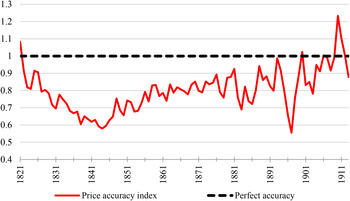
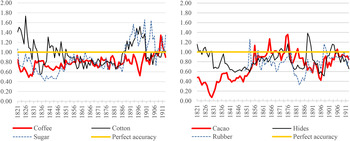
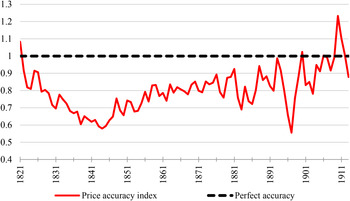
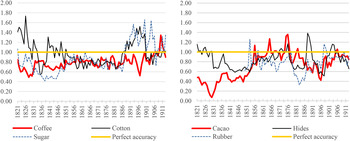
Figure 1 shows the general price accuracy index of the commodity sample for the years 1821 to 1913. If perfectly accurate, the adjusted international series should reflect the official Brazilian f.o.b. export values. However the index clearly confirms Wileman's findings of under-valuation. This under-valuation is particularly acute during the first half of the century. Furthermore, as predicted, the series tends towards perfect accuracy after the institution of the Serviço de Estatística Comercial in the early 1900s. Disaggregation by commodity reveals the trends underlying this general under-valuation. As Figure 2 shows, each commodity was consistently under-valued with the exception of a few notable periods. Most notably, cotton and sugar tended towards over-valuation immediately after the founding of the Republic in 1889, a tendency that continued into the twentieth century. Given the weight of coffee in the export economy, however, this over-valuation is not reflected in the general price accuracy index.
Price Accuracy Index, Brazil, 1821–1913
Price Accuracy Indices by Commodity, Brazil, 1821–1913
A Reappraisal of Brazilian Export Growth
In sum, an examination of the accuracy of the values of Brazil's export statistics reveals a clear bias towards under-valuation. In order to correct this bias, we reconstruct the series using international prices. During the period under consideration the commodity structure of Brazil's exports changed considerably. Although coffee played a leading role in the export sector from 1831 onwards, four other commodities also maintained substantial shares during different periods: cotton (1821–37, 1862–74), hides (1821–32, 1844–46), sugar (1821–85) and rubber (1886–1913).Footnote 62 Given the long-run nature of the study it is important to utilise a methodology that accounts for the changes in Brazil's composition of exports. We thus elaborate a Fisher export price index using the corrected prices of the commodities in the sample. This index is used to deflate the series from current to constant prices, from which the growth rates are calculated. We compare the new growth rates to those calculated using a number of other export price indices based on the official unit values. The first is a Fisher export price index for the period from 1850 to 1913 which was elaborated by Reinaldo Gonçalves using the unit values given in the official Brazilian statistics.Footnote 63 Furthermore, we compare the reconstructed series to a second export price index commonly used in the literature on export growth constructed by Christopher Blattman, Jason Hwang and Jeffrey Williamson (hereinafter BHW) using the same commodity sample and spanning the period from 1860 to 1913.Footnote 64
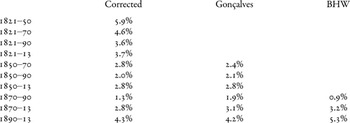
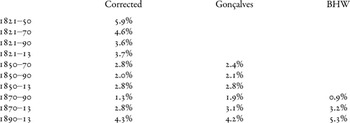
Table 1 displays the growth rates of exports derived from the new series at constant prices alongside the official, Gonçalves and BHW series. We present both medium- and long-term periods beginning from 1821, 1850, 1870 and 1890 in order to capture the changes in the composition of exports. The two decades prior to the series represented here were characterised by considerable price volatility, due in large part to the effect of the Napoleonic Wars. After 1818, however, the prices of Brazil's principal export commodities began a gradual descent that ended in the 1830s.Footnote 65 Although quantum data for Brazilian exports after the end of the Portuguese trade monopoly in 1808 are difficult to come by, descriptive evidence suggests that liberalisation had a positive impact on Brazil's export industries during the decade prior to independence despite falling international prices.Footnote 66 As can be seen in Table 1, the period from 1821 to 1913 is not particularly exceptional, with growth rates of the corrected series for the period from mid-century onwards lying between the Gonçalves series and the dynamism of the BHW series. The period from 1821 to 1850, however, reveals a much more dynamic panorama. Exports grew faster than any other period of the nineteenth century at a rate of 5.9 per cent per annum. Further disaggregation of this period into decades is even more revealing. The export growth of this period to a large degree took place during the decade immediately following independence.
Export Growth Rates, Brazil, 1821–1913
Sources: See online appendices 1 and 2.
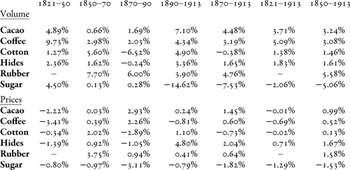
Disaggregation by commodity highlights a number of divergent tendencies. Table 2 displays the growth rates of the value of Brazil's principal export commodities in constant prices. Coffee was the principal protagonist of this period, exhibiting a growth rate in its sterling value of 9.7 per cent per annum. Sugar, although showing considerably less dynamism at 4.5 per cent per annum, was far from the stagnation and decadence that would characterise its experience in the latter half of the century. On the other hand, cotton, which had occupied such a central role in the export growth of the north-east during the late eighteenth century, was clearly showing signs of stagnation at 1.3 per cent per annum. It must be noted that the unparalleled growth of sugar and coffee occurred during a period in which international prices were generally declining. The decline of coffee prices is especially notable given the dynamism of the observed growth rates.
Volume and Prices Commodity Growth Rates, Brazil, 1821–1913

Sources: See online appendices 1 and 2.
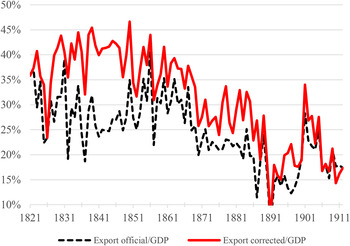
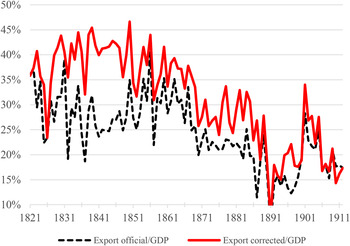
Finally, the corrected series allows for the calculation of the exports-to-GDP ratio. As can be seen in Figure 3, Brazil's degree of openness to the international economy was higher during the earlier period than previously thought. In previous work, Leff estimated an export-to-GDP ratio of 16 per cent for the period 1911–13. Given that the export sector was the fastest growing sector of the Brazilian economy, Leff argued that such a figure would suggest a much lower portion during most of the nineteenth century. This led Leff to the conclusion that the internal market was the principal driving force behind Brazil's economic growth, employing the majority of the country's economically active population. As can be seen in the figure, however, if we assume that the GDP estimation is reliable, the export sector accounted for a growing and much larger portion of the economy during the post-independence period, falling to Leff's predicted levels only after 1870.Footnote 67 Although this is certainly surprising, it serves as further evidence of the dynamism of the post-independence Brazilian export economy. In terms of income growth, however, Brazil's relatively positive export performance must be qualified. As can be seen by the commodity-level data, export growth was largely confined to a single sector: coffee. What is more, coffee production was highly concentrated in the south-eastern regions of the country, gradually diffusing from Rio de Janeiro to São Paulo.Footnote 68 So while export growth following independence and during the 1890s was more dynamic than previously appreciated, this growth was unequally distributed both in sectoral and geographic terms.Footnote 69
Exports/GDP (Current Prices) Brazil, 1821–1913
World Demand and Brazilian Competitiveness during the Post-independence Decades
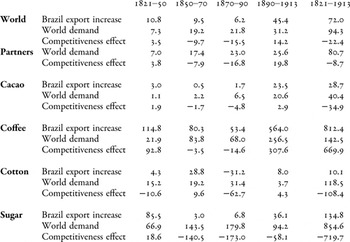
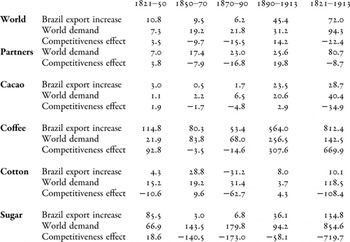
The corrected series effectively permits us to reappraise the traditional narrative of Brazilian export growth and to lend support to the literature on early Brazilian economic dynamism. Here we explore the conditions surrounding Brazil's dynamic export growth experience during the post-independence decades. The first step is to ascertain how much of this growth was attributable to factors related to Brazil's international competitiveness, and how much was due to the shift in world demand for Brazil's commodities. In order to untangle the effects of these determinants, we undertake a constant market share analysis of Brazilian export growth. The underlying assumption of constant market share analysis is essentially counter-factual; we assume that Brazil's export share in the world market remains unchanged over time. Any differentials that arise between our constant-share assumption and observed export performance are attributable to a residual factor, commonly interpreted as a competitiveness effect.Footnote 70 Here we perform a simple disaggregation of Brazil's export growth into two factors.Footnote 71 The first, the demand effect, uses the growth of world exports as a proxy for world demand, and reports how much of Brazil's market share is explained by the increase (or decrease) of this demand. The second, the competitiveness effect, reveals how much is explained by the increase (or decrease) of a country's competitiveness vis-à-vis other suppliers. We present an aggregate (which includes 55 countries) and disaggregate (which includes France, the Netherlands, Portugal, Sweden, the United Kingdom and the United States) world in order to control for the growth of world demand unrelated to Brazil's principal export markets. Table 3 displays the results.
Constant Market Share Analysis, 1821–1913 (Millions of 1913 pounds sterling)
Sources: see online appendix 3.
Constant market share analysis reveals that world demand was the principal determinant of Brazil's export growth during the post-independence decades and the first globalisation. The negative sign of the competitiveness effect indicates that Brazil's response to the expansion of world demand was negatively affected by the loss of competitiveness. This does not change when the world is reduced to its principal trading partners. The implication of these results is that, at least on an aggregate-level, Brazil consistently lost market share for its exports across the nineteenth century. As we have seen, however, the nuances of Brazil's long-run export performance were commodity-specific and thus will only be detected by way of a disaggregated analysis.
Indeed, such an analysis confirms our revision of Brazil's export growth performance. The initial dynamism was driven principally by the relative gains of competitiveness of the coffee sector. From mid-century this competitiveness disappeared only to return during the period 1890–1913.Footnote 72 In the case of Brazil's other principal export commodities, we observe a different tendency. Sugar expanded faster than world demand in the initial period, due in part to increased competitiveness. After 1850, however, Brazil's sugar export sector lost competitiveness and growing international demand for the commodity buoyed the observed export growth. Cacao evinced a similar tendency. While cotton gained a competitive advantage due to the shock of the American Civil War and its effect on Southern Big Cotton, this advantage was largely ephemeral, and in the long-run the sector lost competitiveness over the century. In short, the rapid expansion of world demand for Brazil's products, coupled with an increase in competitiveness for coffee and, initially, for sugar and cacao, determined the observed export growth pattern.
Brazilian Dynamism and Divergence in the Tropics
As the various indicators outlined in the literature demonstrate, the circumstances afforded Brazil by the turmoil of other tropical agricultural producers in the region stimulated a voracious appetite for slave labour which, when combined with the expansion of the agricultural frontier, drove the observed initial dynamism of export growth. Here we explore Brazil's export performance from a comparative perspective and examine the empirical evidence supporting this view.
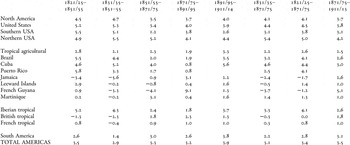
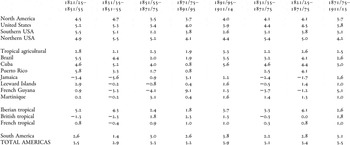
Such a comparison is offered in Table 4, showing the export growth rates for the Americas during the nineteenth century based on the World Trade series constructed by Giovanni Federico and Antonio Tena-Junguito.Footnote 73 These export growth figures confirm Brazil's dynamic export performance during the post-independence years. Brazilian export growth from independence to mid-century more than doubled the South American average and was comparable to that of the United States. Despite the regional disparities in export growth derived from the success of coffee in the south-east and the relative failure of cotton and, to a lesser extent, sugar in the north-east, it is clear that the country's overall rate of export growth was comparatively quite high. The table includes the British and French colonies of the West Indies and the Guianas, as well as the Spanish Caribbean (Santo Domingo, Puerto Rico and Cuba), Spanish Central America (Guatemala, Honduras, Costa Rica, Nicaragua y Panama) and, of course, Brazil. Amongst this group can be found most of Brazil's principal coffee- and sugar-producing competitors. Another Asian competitor and Dutch colony, Java, would also occupy a leading role in the international coffee (and later, rubber) market, although it is not included here for geographical reasons. While the export growth of this region generally stagnated over the century, disaggregation by country reveals a different trend in those economies which maintained slave (or coerced) labour. During the first half of the nineteenth century these tropical agricultural producers would be torn between countervailing tendencies. On the one hand, Cuba (which became increasingly specialised in sugar production), Puerto Rico and Brazil showed high export growth rates, comparable only to North America on a continental level. On the other hand, the other tropical agricultural producing countries experienced a (in some cases violent) contraction of exports. The British tropical colonies experienced the most severe contraction, Jamaica being the extreme case. The export economies of the French tropical colonies, particularly French Guyana, also contracted. It is clear, therefore, that there was considerable divergence in the export performance of the tropical agricultural producers during the post-independence decades and that this divergence corresponded with the profound institutional changes taking place in the labour markets of the British West Indies.
Export Growth Rates, the Americas, 1821–1913
Sources: Federico and Tena-Junguito, ‘World Trade’.
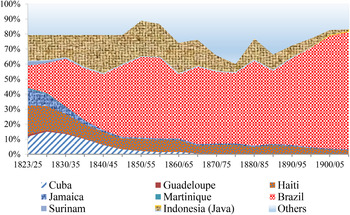
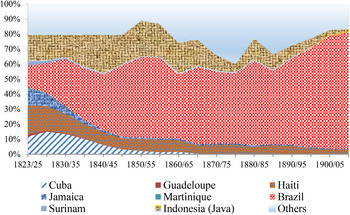
The effect of the slave emancipation shock is also discernible in the evolution of the relative export market shares of the tropical agricultural producers. Specifically, we examine the effect of this shock on Brazil's market share of coffee and sugar.Footnote 74 To ascertain the nature of the evolution of Brazil's market share of world coffee exports, we take a sample of the principal coffee-exporting countries for which there are data available from around the time of Brazil's independence, and calculate their relative shares of the world market.Footnote 75 The results can be seen in Figure 4. It is clear that Brazil's market share of coffee gradually widened over the nineteenth century at the expense of all of its major competitors. Furthermore, it is evident that most of this market share was gained before 1850. The effect of the slave abolition shock of the 1830s on the British colonies impacted considerably on their market shares. British Jamaica moved from being the fourth largest exporter to holding a relatively minuscule share by the end of the 1830s. After the Napoleonic Wars many French Caribbean coffee-exporting colonies suffered an involution. Indeed, many of the French colonies all but disappeared from the market by the 1850s. The only competitor that did not experience a considerable reduction of its market share during the post-independence decades was Java. Like certain Spanish colonies of the Caribbean, Java was not subjected to the institutional shocks associated with independence or slave abolition. In fact, Java was not a slave plantation economy, although coffee cultivation was imposed upon the peasantry by a strict system of state control.Footnote 76 Thus it also responded to the competitive advantage afforded by the slave abolition shock by expanding its market share of coffee during the post-independence decades. Javanese expansion was brought to a halt, however, by the spread of Hemileia vastatrix, a coffee-leaf blight that would devastate Javanese and other Asian and African producers late in the century, effectively permitting Brazil to consolidate its world market share.Footnote 77
Coffee Export Market Shares, 1823–1910
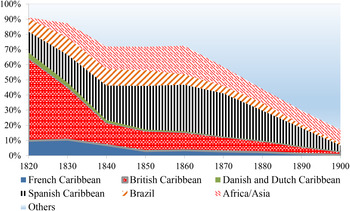
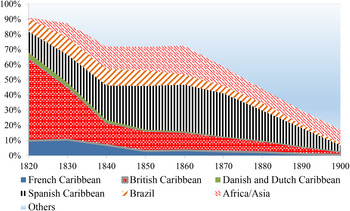
In the case of sugar, we obtain data on the world production of both cane and beet sugar and examine the market share of a sample of tropical agricultural countries for the period 1820–1900.Footnote 78 Figure 5 displays the results. It is clear that Cuba's market share of sugar expanded substantially during the first half of the nineteenth century. This expansion came at the expense of the British colonies and, to a lesser extent, Brazil. Unlike Brazil's hold over the international coffee market, however, the sugar market would remain sufficiently diversified to prevent Cuban supply from dictating the price trend of the market. Furthermore, the substitution of cane for beet sugar in Western Europe would serve to undermine the market power of tropical agricultural producers.Footnote 79 Still, as the export growth rates indicate, the export performance of both Brazil and Cuba diverged quite considerably from that of the other tropical agricultural producers.
Sugar Export Market Shares, 1820–1900
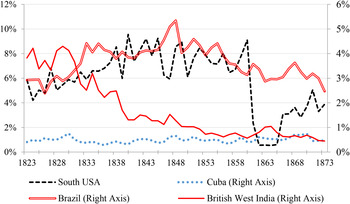
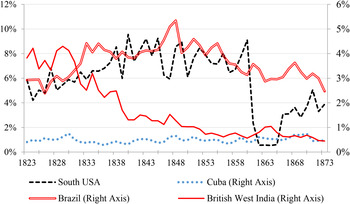
Further empirical evidence of the effect of the slave abolition shock is provided in Figure 6. We compare the shares of the Southern United States (separated from the north for comparative purposes),Footnote 80 Brazil, Cuba and the British West Indies in total world exports. The trend of the world export shares of Brazil and the Southern United States is positive until mid-century, when the abolition of the slave trade would affect Brazil's export industries and the Southern United States would be torn asunder by the effect of the Civil War. Cuba did not respond so positively, due principally to increased European beet sugar production, although it managed to maintain its share across the period.Footnote 81 The world export share of the British West Indies, however, declined steadily after abolition. The shock affected the British colonies in a number of ways. Those colonies with relatively small land to labour ratios were affected by the cost of the transition between labour regimes, but did not suffer the loss of much of the work force. Those countries with a greater and unexploited endowment of land suffered not only from an increase in the cost of labour, but also a reduction of supply as many former slaves moved to subsistence farming. A good example of the latter case is British Jamaica that, as we have seen, suffered a violent contraction of exports after abolition. Faced with an exodus of former slaves, the government was forced to source indentured labour from Asia.Footnote 82
World Export Market Share, 1820–70
The effect of the shock is also discernible in the trends of the international prices of these commodities as shown in Figure 7. It is evident that the commodity prices of all of the tropical agricultural producers included responded to the shock of emancipation. The degree of this shock, however, differed across producers. Thus, while British colonial exports (in this case Jamaican coffee and Guyanese cotton) clearly responded to the slave abolition shock, Brazilian and Cuban exports were buffered by the resilience of slavery. In the case of coffee, Jamaican exports were subjected to a threefold increase from 24.9 in 1830 to 72.1 and 80.6 in 1833 and 1839 respectively, while Brazilian exports demonstrated a more moderate increase from 46.9 to 51.9 and 40.9 in the same years. Similarly, the price of Jamaican sugar exports increased twofold from 18.8 in 1830 to 40.2 in 1840, whereas Cuban sugar prices showed a comparatively modest increase of 34.5 in 1831 and 48.2 in 1836. British Guyanese cotton prices also show a similar reaction to emancipation. Despite the convergence of trends in coffee and sugar prices during this decade, over the long-run these prices displayed very different tendencies. Unlike coffee, sugar prices showed a decreasing secular trend at least from the 1840s onwards, the result of increased competition in the international market and the expansion of European sugar beet production.Footnote 83 Coffee prices, on the other hand, after experiencing rather dramatic fluctuations following the Napoleonic Wars and the slave abolition shock, generally responded to Brazil's supply schedule until the crisis and government intervention of the 1890s, due largely to the strength of Brazil's market power.Footnote 84
Price of Coffee, Cotton and Sugar, Sounds Sterling Per Ton, 1821–50

Concluding Remarks
The objective of this article has been to re-evaluate both the statistical basis and narrative of Brazil's export performance during the nineteenth century. As we have seen, the official Brazilian export series was in fact under-valued, thus misrepresenting both the relative share of exports in GDP and the true dynamism of Brazil's export growth during the post-independence decades. Our conclusions lend empirical support not only to the literature on Brazilian economic dynamism during the post-independence period, but also to the comparative study of the export performance of the tropical agricultural producing periphery as a whole. A cross-country comparison shows that Brazil was one of the most dynamic countries in the region. Furthermore, there is clear evidence of divergence within the tropical agricultural producers of the Americas. The catalyst for this divergence was an institutional shock in the form of British West Indies slave emancipation that gave Brazil an initial competitive advantage vis-à-vis other producers of the region. Brazilian producers, both in the north-east and south-east, responded to the incentives provided by the shock by expanding both the agricultural frontier and imported slave labour. Output expanded rapidly and Brazil increased its market share.
Our findings also highlight the importance of a comparative perspective, even when examining individual case studies. Moreover, emphasis must be placed not only on the importance and relevance of a comparative perspective, but also upon the ways in which divergent economic experiences were interrelated. In the case of Brazil, the focus on the relatively smooth transition to an independent empire has overlooked the importance of the impact of exogenous institutional shocks on the country's export performance. Only by adopting a regional comparative perspective do we comprehend that the story of Brazil's exceptional post-independence export performance was a story of institutional shocks.
Together these conclusions indicate a direction for future research. To begin with, the divergence that took place in the tropics during the post-independence decades is deserving of more attention. Further study of the mechanisms underlying this divergence will surely help to understand not only the diversity of short-run economic outcomes but also the long-run development trends of these countries. In respect to Brazilian economic historiography, greater attention should be paid to the post-independence decades in order to further elucidate the drivers and subtleties of the country's dynamic export performance. Finally, an examination of the long-run impact of this period on both export performance and regional income growth would provide a greater understanding of Brazil's economic development during the nineteenth century.
Supplementary material
To view supplementary material for this article, please visit http://dx.doi.org/10.1017/S0022216X16000341.