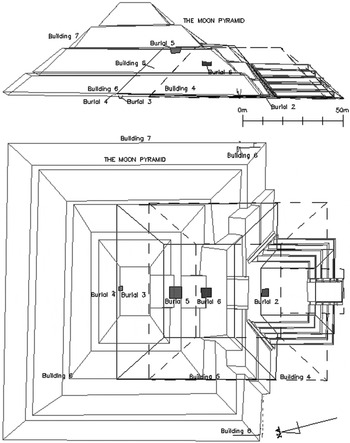
Since discovery of mass human sacrifices at the Feathered Serpent Pyramid, the idea that architectural monuments at Teotihuacan were associated with dedicatory burials has become more widely accepted (Cabrera Castro et al. Reference Cabrera Castro, Sugiyama and Cowgill1991; López Austin et al. Reference López Austin, Luján and Sugiyama1991). A century ago, remains of children, possibly sacrificial victims, were reported as buried at the corners of the Sun Pyramid (Batres Reference Batres1906). However, prior to our excavations, comparable information on the Moon Pyramid was lacking. The interior of the Moon Pyramid was systematically explored for the first time in 1998–2004 excavations via a 345 m long tunnel (see Sugiyama and Cabrera Castro Reference Sugiyama and Castro2007). As a result, seven superimposed structures, designated Buildings 1–7, numbered from the earliest to the latest, have been documented inside this pyramid. In association with Buildings 4, 5, and 6, five burial/offering complexes were discovered and explored in their entirety (Figure 1; see also Sugiyama and Cabrera Castro Reference Sugiyama and Castro2007:Figure 2); they were designated Burials 2, 3, 4, 5, and 6. (Burial 1 is not analyzed here; it corresponds to a contemporaneous neonate grave found near the northwestern corner of the Moon Pyramid.) The five complexes display variations in ritual program related to their associated monumental constructions; they also share certain characteristics. This article primarily provides descriptive information for each ritual context, presents some results of ongoing analyses, and provides a preliminary discussion of the functions and significance of these dedicatory complexes in association with the construction episodes (Cabrera Castro and Sugiyama Reference Cabrera Castro and Sugiyama1999; Sugiyama Reference Sugiyama2004; Sugiyama and Cabrera Castro Reference Sugiyama and Castro1999, Reference Sugiyama and Castro2000, Reference Sugiyama and Castro2003, Reference Sugiyama and Castro2005, Reference Sugiyama and Castro2007; Sugiyama and López Luján Reference Sugiyama, Luján, Luján, Carrasco and Cué2006; see also Spence and Pereira Reference Spence and Pereira2007, White et al. Reference White, Price and Longstaffe2007, in this volume).
General plan of the Moon Pyramid, indicating the location of Burials 2–6.

All of the burial/offering complexes described here were integrated into the nucleus of the monument during building activities. We did not encounter any evidence of reuse or later looting inside these ritual deposits. All were discovered along the north–south axis of the Moon Pyramid, which approximately coincides with that of the Avenue of the Dead. With the exception of Burial 5, for which we have yet to determine whether it was the result of a sacrificial event or a mortuary ceremony for one or more highly ranked individuals who died a natural death, all of the dedicatory complexes contained human skeletons of individuals who appear to have been sacrificed and buried in association with enlargement programs at the monument. Therefore, we believe that the burials were consecrated in conjunction with the erection of new phases of the pyramid, an interpretation that is consistent with the archaeological contexts described later.
Burial 2
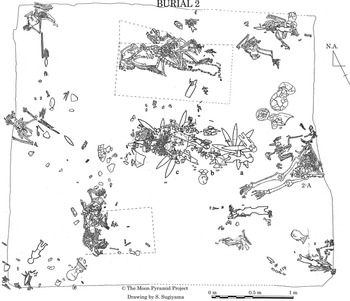
A dedicatory burial/offering complex was interred attached to the north facade of Building 3 when Building 4 was being constructed. This architectural program took place during the third century a.d. and represents a substantial enlargement—about nine times larger than the previous building (see Sugiyama and Cabrera Castro Reference Sugiyama and Castro2007 for chronological assessments cited for buildings). A chamber-like structure measuring 3.5 m (north–south) × 3.4 m (east–west) and about 1.5 m high was built approximately at the level of tepetate (subsoil andesitic tuff). During the course of our excavations, crudely made, unplastered stone walls were uncovered on four sides, without an entrance or roof. We believe that a complex ceremony must have taken place during and after the careful placement of the offerings and sacrificial victims on the compacted earth floor (Figure 2). Then the inner space of the chamber was completely filled to the top of the walls with a homogeneous material composed of earth and stones and was subsequently covered with the several layers of the same fill, forming the nucleus of Building 4. These data indicate Burial 2 was part of a foundation ritual for Building 4.
General plan of Burial 2.

The complex spatial distribution of burials and offerings was symbolic and meaningful. Rich objects of exceptional quality and quantity were found in association with skeletons of animals and one individual—an adult male age 40–50 at the time of death (see Spence and Pereira Reference Spence and Pereira2007). The individual was buried in a seated position facing west with a small number of high-quality ornaments, including two earspools, one cylindrical pendant, and five small hemispherical beads, all made of greenstone. He was found near the eastern edge of the chamber with his hands crossed at the wrists behind his back, as if they had been bound. Based on his position, we believe that this person was a sacrificial victim, although he could have been of high social status. The isotope analysis by Christine White and colleagues (Reference White, Price and Longstaffe2007) confirms the foreign origins of the victim, suggesting that he was a foreign antagonist or war captive. The archaeological context described later supports this interpretation.
Specific types of offerings were distributed in patterns that appear to have been intended to encode political and religious messages (Sugiyama and Cabrera Castro Reference Sugiyama and Castro2001; cf. López Luján Reference López Luján2005). To understand the meanings of their spatial distribution, we have divided the offerings into three groups based on their location and components. Group I consists of nine symbol sets distributed regularly in the chamber; Group II consists of a unique concentration of artifacts found in the central area; and Group III consists of single offerings that do not belong to Group I or II, including sacrificed animals. (The preliminary taxonomic identification of the animal remains recovered in Burials 2, 3, and 5 were made by Óscar J. Polaco of the Instituto Nacional de Antropología e Historia.)
Group I is distinguishable on the basis of its combination of offerings, which were distributed symmetrically along the east–west and north–south axes. Each of the seven peripheral sets of this group consists of an obsidian eccentric in the form of a human figurine, a bifacial knife, obsidian blades, shell pendants, and the remains of a golden eagle. Two other sets, tentatively included in this category, were found near the center and consist of similar components and a much larger obsidian figure. As detailed iconographic information is lacking for these sets, it is difficult to interpret their exact significance. Nevertheless, in most cases the knives were carefully placed to be oriented toward the heads of the obsidian figurines, as if they were symbolically being stuck into them. Therefore, we suspect that each figurine represented a sacrificial victim and that ultimately all nine sets, probably symbolizing human sacrifice, were associated with the central set described later.
Five Tlaloc (Storm God) vessels were regularly positioned at the four corners and the center of Burial 2, partially overlapping with some of the nine sets described earlier. They seem to have structured the ritual deposit conceptually as a replica of the earth's surface, with its navel and the cardinal directions. The same idea is represented in a large Teotihuacan cylinder tripod from the Tiquisate region of Gautemala illustrated by Nicholas Hellmuth (Reference Hellmuth1975:55), where four small lightning tlaloque surround a bigger Tlaloc enclosed in a mountain. The careful placement of these Tlaloc vessels seem to be an early manifestation of the later central Mexican conception of the five directional tlaloque pouring rain from big ceramic jars (Códice Borgia 1963:27–28; López Austin and López Luján Reference López Austin, Luján, Uriarte and Cicero2004; López Luján Reference López Luján and Aranda1997).
Group II is defined by the highly unusual symbolic objects it contained. These pieces were uncommon not only for Teotihuacan, but also for Mesoamerica as a whole. Group II consisted of three arrays of objects that seem to allude to sacrifice, militarism, and authority. A subsidiary array found to the east (Figure 2a) consisted of one greenstone male or asexual figurine, one obsidian figurine, and nine sacrificial knives laid out in a radial pattern beneath them. An intermediate array (Figure 2b), consisting of obsidian projectile points, one unworked shell, one slate disk, and one Tlaloc jar, was detected between the subsidiary and the main group. Finally, the main array (Figure 2c) contained a larger (possibly female) greenstone figurine standing almost vertically on a large pyrite disk, which was surrounded by symbolic objects, again connected to sacrificial and martial themes. These included nine obsidian knives following a radial pattern and many projectile points also made of obsidian. A shell necklace with imitations of human maxillae and possibly representing warrior insignia, similar to those found at the Feathered Serpent Pyramid, was carefully placed in front of the main greenstone figurine, apparently as its adornment. Three rattlesnakes were also set out in front of this figurine, and a golden eagle was placed beside the disk.
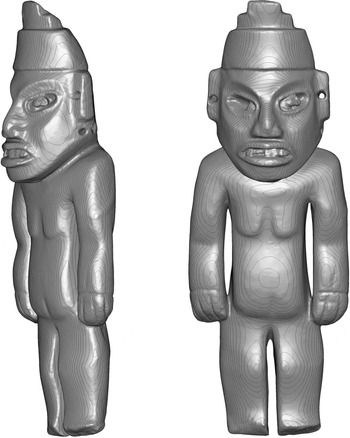
The main greenstone figurine shows scant iconographic features to facilitate its identification besides a relatively simple stepped headdress and carved-line representations of what Saburo Sugiyama (Sugiyama and Cabrera Castro Reference Sugiyama and Castro2001) interprets as breasts and a vaginal line, perhaps indicating that the figure represented a woman or a goddess (Figure 3). In this dedicatory complex, a total of eight jars representing the Storm God were present. However, the privileged location of the main greenstone figurine and the way in which the rest of the objects were spatially arranged around it suggest that the principal focus of Burial 2 would be this possibly female entity.
Main anthropomorphic figurine located on the central area of Burial 2. Scanned three-dimensional image by Accord Corporation, Japan (2006), Moon Pyramid Project.

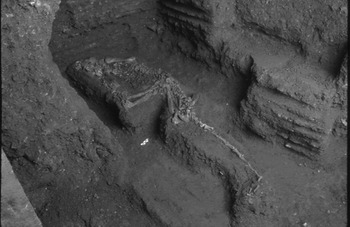
Group III consisted of single offerings reiterating ideas of militarism and sacrifice through their contents. They were arranged along the east–west axis, forming several discrete concentrations. The eastern array consists of the actual sacrificial victim mentioned earlier; three Tlaloc jars; fragmentary bones of an eagle, a falcon, and an incomplete horned owl; and a set of obsidian projectile points. To the north, two pumas originally shut in cages were placed on top of each other, with only the impressions of the cages remaining (Figure 4). A well-preserved and complete skeleton of a wolf, also inside a wooden cage, was laid to the southwest. These animals were probably buried alive, since it would not have been necessary to bring them in cages if they were already dead. Moreover, a coprolite was discovered with one of the pumas, indicating that it was still alive during the ceremony. The wolf's cage was deposited symmetrically with one of the sets of Group I, with respect to the north–south axis.
A complete puma skeleton found with the impression of a wooden cage in Burial 2. Photograph by Saburo Sugiyama, Moon Pyramid Project.
As corroborated by Teotihuacan iconography, the discoveries in Burial 2 include artifacts, animals, and an individual, which functioned as a leitmotif in the state ideology, making insistent reference to the ideas of sacrifice and military conquest. We believe that the martial-sacrifice institution, later depicted widely in mythical terms in murals (Millon Reference Millon and Berrin1988b), was materially and symbolically asserted in this offering when Building 4 was erected around a.d. 250, prior to its representation in pictorial form.
Burial 3
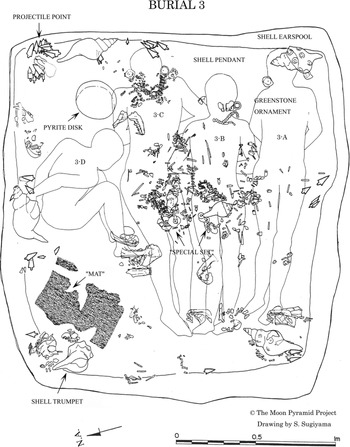
Burial 3 was deposited in a rectangular pit hollowed out 13 m north of Building 4 during the construction of the north facade of Building 5, around a.d. 300. The pit was dug in the tepetate bed under the north wall of Building 5 that was built in stepped talud form. Burial 3 was different in many respects from Burial 2, including in its form and contents. The pit measured 2.2 m (north–south) × 2.5 m (east–west) and 1.5 m deep. Four individuals (designated 3A–D, from the southernmost to northernmost one) were discovered with rich offerings inside this cavity (Figure 5). Three individuals (3A, 3B, and 3C) were interred in extended positions, face up, with heads oriented east, and parallel to one another. The fourth individual (3D) was deposited in a flexed position to the north of the other three. All four were discovered with their hands crossed behind their backs as if they had been bound; in fact, the fibers of possible ropes and gags were recovered around their extremities and mandibles. Therefore, we believe they were also buried alive to consecrate the new monument, although their ornaments of special quality may attest to their high social or religious status.
General plan of Burial 3.

The artifacts and animals from Burial 3 can be divided into two large groups based on their locations and components. Group I contains ornaments worn by the sacrificial victims; Group II contains general offerings. The different types of ornaments in Group I may express the individual identities of the victims. Individual 3A had only shell earspools, while 3B wore greenstone earspools, 20 beads, and a nose pendant identical to those we recovered in the 1980s at the Feathered Serpent Pyramid (Sugiyama Reference Sugiyama2005:145). Individual 3C also had two shell earspools and a shell necklace with imitations of human maxillae strikingly similar to those found at the Feathered Serpent Pyramid, as well as in Burial 2 of the Moon Pyramid. Individual 3D was not adorned. The four individuals were also distinct in terms of their physical features and bone isotope ratios. According to Michael Spence and Grégory Pereira (Reference Spence and Pereira2007), 3A, 3B, and 3C were males age 20–24, 18–20, and 40–44, respectively, while 3D was probably a male age 13–15 at the time of death. Isotope analysis indicates they were foreigners, perhaps immigrants to Teotihuacan or war captives (White et al. Reference White, Price and Longstaffe2007).
The general offerings of Group II were placed carefully between and above the bodies. Unworked and worked shell ornaments, shell “trumpets,” and several clusters of obsidian projectile points were distributed following symmetrical patterns, mainly along the periphery. Unique objects included a large pyrite disk (30 cm in diameter) and the remains of white interwoven fibers forming a square, possibly a mat that symbolized political authority, for either the sacrificed individuals or the sacrificers. Apparently, the presence of these items was the reason individual 3D had been placed in a flexed position.
In the central area, two other arrays of offerings that we call “special sets” were identified. They consisted of one greenstone figurine with small, removable earspools and inlaid eyes; greenstone earspools and beads of average dimensions; shells; and many small anthropomorphic figurines, miniature knives, and projectile points and blades made of obsidian. These had unquestionably been laid as sets on the genitals of individuals 3B and 3C, possibly to underscore their higher political or religious status.
However, the most intriguing offerings were the 18 heads of decapitated mammals (14 wolves and four pumas) and one incomplete skull of a young owl (taxonomic identifications by Oscar J. Polaco) that were scattered without clear spatial patterning. Iconographic analyses of Teotihuacan art have demonstrated that representations of wolf or coyote heads were often used to identify individuals or social groups associated with militarism and sacrifice (Millon Reference Millon1973, Reference Millon and Berrin1988b).
A ritual must have taken place during the deposition of this burial/offering complex. Immediately after this, the pit was totally filled with earth and stones, the nature of the fill adversely affecting the preservation of skeletal remains and artifacts. Then the nucleus of Building 5 was laid over it using the same material that covered the pit, so there was no clear distinction between the fill of the pit and that of Building 5. A plastered talud wall was uncovered just above the fill of this pit. Therefore, we can safely conclude Burial 3 was part of a dedicatory ritual to the erection of Building 5.
Burial 4
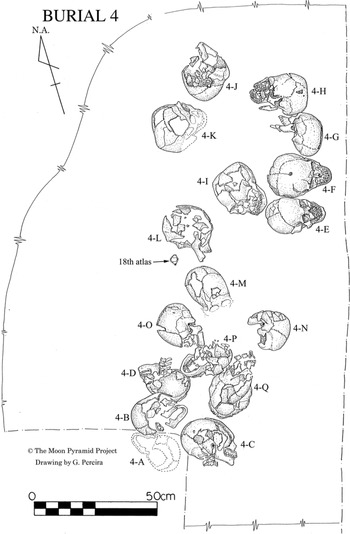
Burial 4 corresponds to the subsequent architectural phase (Building 6) dated to a.d. 350. This ritual deposit was quite distinct from Burials 2 and 3 in terms of context and contents. Seventeen severed human heads, identified in most cases as male, were set directly on and between rocks occupying an area of 3.8 m (north–south) × 1 m (east–west). They were buried 2 m north of the northern facade of Building 5 while Building 6 was being erected (Figure 6). No architectural features or artifacts were associated with them. Since all 17 skulls were associated with cervical vertebrae, and in some cases with hyoid bones, the heads evidently were fresh when they were interred. In addition, cut marks were noted during the osteological analysis conducted by Spence and Pereira (Reference Spence and Pereira2007), indicating ritual decapitation. No clear spatial patterns were detected in Burial 4 in terms of head placement, axes, and orientation; the large rocks interspersed among them seem to have impeded patterning, or the heads were simply thrown together with the rocks, without any obvious concern for their symbolic arrangement. The large diversity in age (young and middle aged), head deformation, and teeth inlay and modification styles characterizing these remains suggest that the sacrificed individuals may have been from different ethnic groups or social statuses. Isotope analysis (White et al. Reference White, Price and Longstaffe2007) also informs us that the individuals derived originally from a variety of regions; they seem to have been immigrants, merchants, diplomats, or war captives brought from distinct regions just before the sacrificial ritual took place.
General plan of Burial 4.

Because we have already observed that Teotihuacanos displayed a preference for sacred numbers related to the calendar for organizing collective burials within monuments (as in the Feathered Serpent Pyramid), the discovery of the 17 heads motivated us to widen the excavation area inside the construction fill. The excavation area was extended 3 m in all directions to look for an eighteenth cranium, without success. However, we discovered an eighteenth atlas without other human bones. It suggests that another head may have been left at a nearby, unknown, location. This case, as well as discrete groups of artifacts, animals, or human beings in other ritual deposits as described later (e.g., 18 large obsidian eccentrics from Burial 6), clearly confirms the importance of the number 18 since early periods in Teotihuacan. It is well known in Mesoamerican societies as a sacred number that represents the months of the 365 day cycle. We can therefore conclude that at least 18 individuals were involved in a dedicatory, sacrificial rite, probably to communicate sacred, cosmological, and calendrical meanings, made in conjunction with the enlargement of the pyramid designated Building 6.
Burial 5
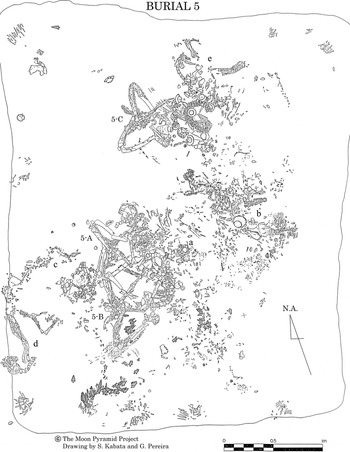
Burial 5 displayed a significantly different context (Figure 7) from all of the burials discussed so far. It is the first example of a grave complex located at the top, rather than at the base, of a major building in Teotihuacan. The deposit was found intact without any indication of later alteration or looting, mainly because it was covered by the thick fill of Building 6.
General plan of Burial 5.

The northern edge of the large pit for Burial 5 was discovered 2.8 m south of the upper north wall of Building 5. This grave pit measured 6 m (north–south) × 6 m (east–west) at its mouth and 3.5 m deep and was completely filled with earth, stones, and large rocks. It was delimited by talud walls crudely made of rocks and tepetate blocks on all four sides, without a roof. The upper floor of Building 5 was not plastered over again or repaired after the pit was excavated for this purpose, indicating that the pit was covered immediately to form the nucleus of Building 6. Burial 5, therefore, served as both a termination of Building 5 and a foundation ritual of Building 6. The fact that the burial was located in the three-dimensional heart of Building 6 also implies that its builders planned it as part of a new, substantial enlargement program carried out around a.d. 350.
Our excavations uncovered three individuals, designated 5A, 5B, and 5C, interred with exceptionally rich offerings under earth and stone fill. All of the individuals were seated facing west, but this time they had their legs crossed, a position associated with gods and with people of high political status in Mesoamerica. The fact that this posture has rarely been found in either central Mexican or Maya graves also indicates that these individuals were exceptional (Manzanilla and Serrano Reference Manzanilla and Serrano1999; Ruz Lhuillier Reference Ruz Lhuillier1968; Sempowski and Spence Reference Sempowski and Spence1994). The clearest instances of individuals with crossed legs in mortuary deposits were reported from Tomb A and B in Kaminaljuyu, which suggested a close connection with Teotihuacan (Kidder et al. Reference Kidder, Jennings and Shook1946:51–82). Two of the individuals, 5A and 5B, adorned in almost identical greenstone ornaments, were seated side by side near the west wall (Figure 8). Individual 5C was discovered significantly separated from them, near the north wall, and adorned differently. According to Spence and Pereira (Reference Spence and Pereira2007), individuals 5A, 5B, and 5C were males age 50–70, 40–50, and 40–45, respectively, at the time of death.
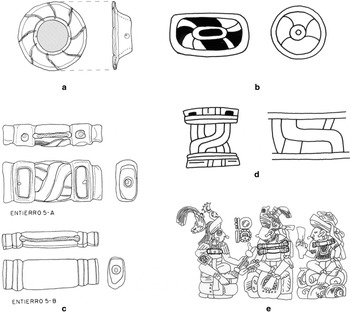
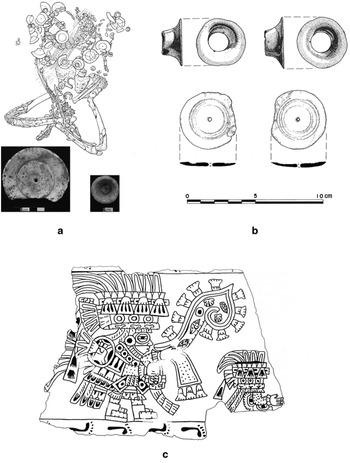
(a) Jadeite earspool found in association with Burial 5A; (b) representation of so-called pinwheel sign. Drawing by Kumiko Sugiyama (from Langley Reference Langley1986:278); (c) jadeite pectorals found in association with individuals 5A and 5B; (d) representations of “bundle C” sign (drawing from Langley Reference Langley1986: 239); (e) representations of rulers with similar pectorals depicted on Altar Q of Copan. Drawing by Kumiko Sugiyama (from Agurcia Fasquella and Valdés Reference Agurcia Fasquella and Valdés1994:28).

Unlike those of the sacrificial victims discovered in the burial/offering complexes found at the base of constructions, the hands of the individuals in Burial 5 were not crossed behind their backs; rather, they were crossed at the wrists over their feet in front of the body. However, no remains of fibers were encountered to indicate their hands had been tied with ropes; we located remains of other fibers away from the bodies, suggesting that poor preservation may not be to blame for their absence. The hands of individuals 5B and 5C rested atop animal heads, and the right arm of individual 5C was associated with a wooden stick, which will be described later. These data on the body position may reduce the likelihood that the individuals were unwillingly bound and buried. Nevertheless, since all three appear to have been interred at the same time, we must still consider the possibility that one, two, or all of the individuals were deposited as sacrifices. Another line of evidence supporting this interpretation is the unusual feature that all three individuals maintained identical arm positioning, even after their upper bodies had collapsed. As is often the case in depictions of Mesoamerican elites, the arms were set on the thighs, indicative of interment in a highly respected manner for individuals who died a natural death. Spence and Pereira (Reference Spence and Pereira2007) and White and colleagues (Reference White, Price and Longstaffe2007) incline toward this interpretation, mainly based on the results of isotope analysis.
The Burial 5 complex is quite different from all other burials excavated to date at Teotihuacan, not only in terms of the location and position of the individuals, but also in certain osteological features and associated offerings. In particular, the ornaments and other offerings of this deposit confirm the special status of the individuals. As a preliminary interpretation, we believe that the three individuals were foreigners of extremely high status (rulers, ambassadors, warriors, or merchants) who had direct connections with contemporaneous Maya dynasties or were members of the Maya elite who visited or were brought to Teotihuacan to be buried, willingly or unwillingly, at the Moon Pyramid for reasons that are as yet unknown.
The personal paraphernalia provide crucial information about the identities of these people. Individuals 5A and 5B both wore special ornaments, including 20–22 beads, two large earspools, and large rectangular pectorals, all of them made of jadeite. These objects are exceptionally well polished and of unusual size and luster for the city. The two earspools of individual 5A have incised “pinwheel” signs (Figure 8a–b), which are interpreted as a symbol of turquoise or movement and, in Postclassic times, of day and the 20-day period (Caso Reference Caso1967:151–153; Langley Reference Langley1986:278; Urcid Serrano Reference Urcid Serrano2001:138), while other authors prefer to decipher it as the day name Flower (Taube Reference Taube2000:43–44).
The form of the two rectangular pectorals is completely unfamiliar to Teotihuacan art and ornamentation, but several centuries later, these pectorals were frequently depicted as worn by Late Classic Maya rulers as a symbol of political authority (Figure 8c, e). The two pectorals in Burial 5 share this form and design with Maya pictorial representations. They have vertical and horizontal drill holes in the same way as their Maya counterparts, indicating that they hung across the body in the same fashion and were probably ornamented with tassels made of perishable materials.
The larger specimen, found with individual 5A, is decorated with an incised motif bearing some resemblance with the Maya pop sign, but with significant differences. It is composed of two bands crossing another pair of bands to form a sort of X and a rectangular panel with a trapeze on both sides (Figure 8c–d). James Langley (Reference Langley1986:238–239, Reference Langley and Berlo1992) classified this sign as “bundle C” (Figure 8d). Following Hasso von Winning (Reference von Winning1979), Langley identified this sign as the central Mexican year bundle, or xiuhmolpilli, the symbol of the 52 year cycle and the New Fire ceremony. Whether this pectoral was intended to evoke the pop sign or, more likely, a year bundle, its form and decoration evidently qualified its wearer as a sacred authority. The possible associations of the “pinwheel” and “bundle C” signs, such as turquoise, movement, flower, fire, calendar cycles, and the New Fire ceremony, form part of a complex concerning the integrated Mesoamerican concept of time and centrality and its social implications—namely, political office and kingship in central Mexico (Caso Reference Caso1967:130–138; Cowgill Reference Cowgill1997:150; Langley Reference Langley1986:151–153, 245, 332; López Austin et al. Reference López Austin, Luján and Sugiyama1991).
Individual 5B was adorned with a very similar, but smaller, pectoral and plain earspools. These discrepancies may signal the lower status of individual 5B relative to individual 5A. However, the form and material of his ornaments indicate that individual 5B was also of high status.
Both individuals were also encountered with wide areas of white fibers under their remains and with miniature eccentrics made of obsidian dispersed around them. The fibers may have been part of headdresses, wigs, mantas, or mats the individuals wore or sat on, again signifying their authority. In addition, incomplete cranial bones of a puma were discovered in front of individual 5B, by his hands, with one obsidian eccentric of uncertain significance (Carballo Reference Carballo2007:Figure 5k); David Carballo interprets this piece as conflating the attributes of a dart point, a serpent, and a trilobal blood droplet. These animals near the hands of the individuals may have symbolized their alter egos, or they may have been allusions to the religious, social, or political groups with which they were affiliated.
Individual 5C wore quite different ornaments (Figure 9a). He had two composite ear ornaments combining a large shell disk with a smaller greenstone earspool and an elaborate necklace composed of rectangular beads and large disks made of shell; each disk was also affixed with a small greenstone earspool. White fibers indicating the presence of a decayed headdress, wig, manta, or mat were found under the body, similar to those of individuals 5A and 5B. Individual 5C was associated with a heavily decomposed wooden stick or rod along his right arm, which may have been a baton, scepter, or spear-thrower symbolizing political authority or military power. It is noteworthy that his hands were also covering a puma mandible, perhaps a reference to his alter ego or his social identity.
(a) Plan of individual 5C, found in a seated position with crossed legs and adorned with shell, greenstone, wood, and other organic objects. Drawing by Grégory Pereira; (b) composite ear ornaments made of shell and greenstone used to adorn individual 5C. The same type of composite ear ornaments were also found in Altun Ha and other Early Classic Maya sites. Drawing by Hironori Fukuhara (from Pendergast Reference Pendergast1979–1990:17); (c) representation of a Teotihuacan dignitary adorned with similar ornaments. Drawing by Saburo Sugiyama (from the original mural; redrawing from Millon Reference Millon and Berrin1988a: 118).

Somewhat similar representations of the personal paraphernalia of individual 5C can be found in Teotihuacan iconography, such as those depicted in the Techinantitla mural paintings (Millon Reference Millon and Berrin1988a:114–121, 222–225). They are worn by personages identified as high-ranking warriors, priests, or members of the royal family (Figure 9c). Composite ear ornaments made of shell and greenstone were also common during Early Classic times in Dzibilchaltun (Taschek Reference Taschek1994:45–46, 68–69, Figures 14, 26), Altun Ha (Pendergast Reference Pendergast1979–1990:3:15–17, Figure 4c–f), Uaxactun (Kidder Reference Kidder1947:43–44, Figures 28, 79a–b), Piedras Negras (Escobedo and Houston Reference Escobedo and Houston2004:55), Kaminaljuyu (Kidder et al. Reference Kidder, Jennings and Shook1946:108–110, Figures 143f, 144b, 147 g), and Zaculeu (Woodbury and Trik Reference Woodbury and Trik1953:1:24, 246, Figure 139), once again supporting a Maya presence in Burial 5.
These data also indicate that all three individuals occupied an extremely high rank and displayed symbols of rulership, blending Maya and Teotihuacan conventions for authority. Among them, individual 5A must have stood out based on his carved earspools and enormous rectangular pectoral, which are the most explicit symbols of leadership excavated in any burials at Teotihuacan to date.
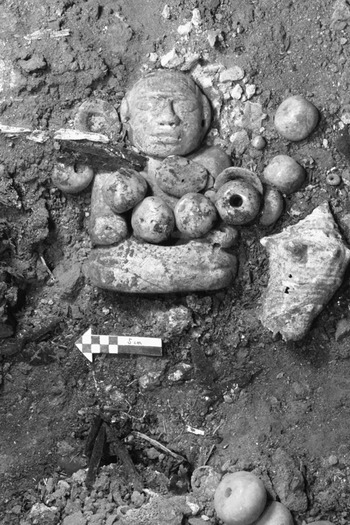
In addition, the three individuals were associated with a large quantity of unusual offerings distributed throughout the burial and organized into specific spatial patterns. One of the main ones is the greenstone figurine group located exactly in the central area (Figure 10). This figurine must have held special significance, as suggested by its location, quality of workmanship, and associated materials. It was completely covered with organic materials and adorned with its own personal greenstone ornaments. It was also surrounded by shells and numerous obsidian miniatures, including projectile points, knives, human figurines, and serpents, leitmotifs of military force and sacred authority.
Greenstone figurine found with greenstone earspools and beads at the center of Burial 5. Photograph by Saburo Sugiyama, Moon Pyramid Project.

Like the posture of the humans in Burial 5, the greenstone figurine was carved in a cross-legged seated position. It was discovered face up, just behind individuals 5A and 5B (Figure 7a). The spatial relationship among the three individuals and the central greenstone figurine may suggest the subordination of the individuals to the statue. Below the figurine we recovered a yellowish, disintegrated substance, which may have been a pyrite mirror. Rattlesnake bones were also discovered around the statue. The figurine was richly adorned with greenstone objects: two earspools, one oval pendant, and nine small and nine medium-size beads. These quantities suggest a calendrical and cosmological significance.
The physical traits and clothing carved on this sculpture allow us to say only that it depicts a male. Because it is deprived of other sorts of accoutrements, it is difficult to determine who exactly this figure may represent. It might once have been dressed with perishable materials that have disappeared with the passage of time. Consequently, we can merely presume one of three possible identities: god, divine ancestor, or legendary figure from Teotihuacan history. At any rate, its personal ornaments, central location, and body position, similar to those of individuals 5A and 5B, denote a special connection with the interred individuals.
Near the east wall, a second group of high-quality offerings was uncovered (Figure 7b). These include many objects common in Teotihuacan burials of high social status, as well as a small number of objects bearing stylistic similarities to Maya forms. They include a trumpet, beads, and earspools made of shell; obsidian human and serpent figurines, projectile points, and blades; greenstone beads, earspools, “resplandores”, (headdress-like plaques), and pendants of unusual forms; slate disks and an uncommon cylindrical stone object; decayed woven fibers; rattlesnake bones; and other items. The distribution of the greenstone objects indicated that they originally formed several sets of personal ornaments, although there were no individuals with whom they were associated. An obsidian human figurine found on the east–west axis may have a possible symbolic association with these greenstone ornaments. Their peripheral location also suggests they were in a symbolically subordinate position to the central greenstone figurine just described or to one (most likely 5A) or all three buried individuals.
Complete skeletons of a golden eagle (Figure 7c) and a puma (Figure 7d) were found near the west wall, while the complete skeleton of another puma was uncovered very close to the north wall (Figure 7e). Although they were placed at a certain distance from the individuals, it seems that 5A had one complete eagle in front of him, 5B had a complete puma in front of him, and 5C had a complete puma on his right side. The presence of these animals may have served to encode the sociopolitical status of the associated individuals.
Burial 6
The search for a burial/offering complex at the center of Building 4/5 began in 2003, as the exploration of Burial 5 in 2002 had provided a new understanding of the location of such complexes in the Moon Pyramid. As Burial 5 was placed on the top of Building 5, and at the three-dimensional heart of the structure it was consecrating (Building 6), we reasoned that earlier precedents for this pattern may exist. Since the top and the central sections of Buildings 1, 2, and 3 had been destroyed, most likely by looting, the central sections of Buildings 4 and 5 were all that remained to be explored in such a fashion—by tunneling within the center of the pyramid.
We first probed for burials and offerings in the central section of Building 4 without success, so we continued the excavation of the tunnel to the north, toward the center of Building 5. A dedicatory complex designated Burial 6 was discovered along the north–south axis but not exactly at the center of Building 5. The ritual deposit was located 9.6 m north of the center, if we consider the main platform and the Adosada without the staircase to calculate the center. However, the deposit was nearer the center (4.6 m south) of the main platform of Building 5. We do not know the reason for these significant deviations.
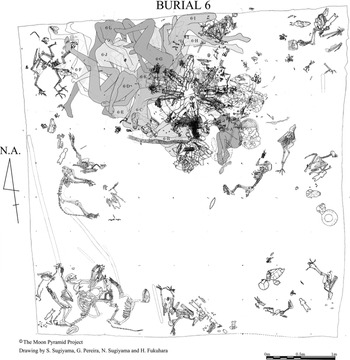
The chamber-like structure of Burial 6 was formed with vertical stone walls, without an entrance or roof. It measured 5 m (north–south) × 4.5 m (east–west) and 2 m high, and, as in the other burials, the inner space was completely filled with earth, but with a small quantity of stones and rocks. All of the artifacts and skeletal remains were uncovered directly on the compact earthen floor (Figure 11). This dedicatory complex was thus integrated apparently into the matrix of Building 5 rather than of Building 4. Therefore, Burial 6 should have corresponded to Building 5, dated tentatively around a.d. 300 and may have been contemporaneous with Burial 3, rather than Burial 2, although we do not know the time difference between these two proposed construction stages with precision (due to the complicated stratigraphic relations between Building 4 and 5; see Sugiyama and Cabrera Castro Reference Sugiyama and Castro2007). Analogies in contexts, contents, and ritual patterns, as described later, suggest that there was no major discrepancy between Burial 2 and Burials 3 and 6.
General plan of Burial 6.

Burial 6 provides abundant information about another type of consecration ritual that confirms a distinct type of dedicatory burial at Teotihuacan. Burial 6 proclaimed the political and religious power of the state by involving the sacrifice of 12 individuals, 10 of whom were decapitated and thrown in as headless bodies. Other offerings of exceptional quality and numerous complete and incomplete animals, associated with the sacred and martial underpinnings of state political authority, were also buried following certain spatial patterns.
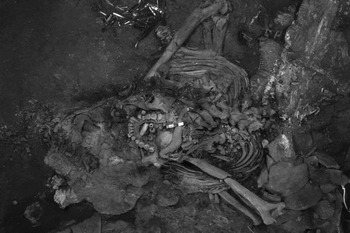
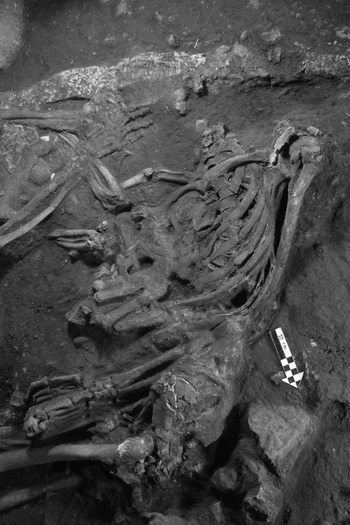
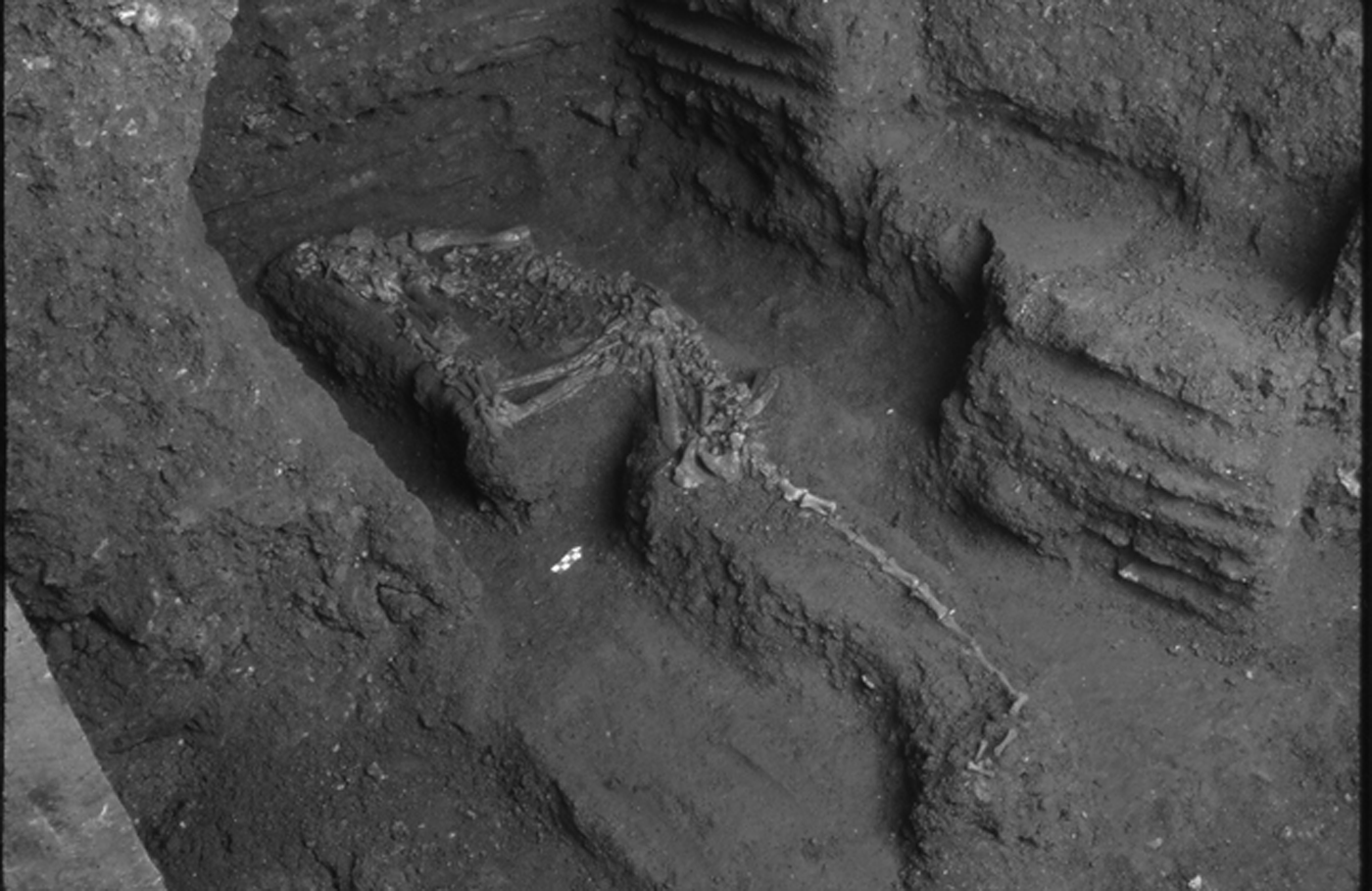
The 12 individuals, tentatively identified as adult males, were discovered mostly in the northern section of the chamber. Their torsos and legs were in varied positions, clearly with their arms tied behind their backs. However, two groups were clearly differentiated from each other: individuals designated 6A and 6B were located in the central area and had complete bodies (Figure 12), whereas the 10 people designated 6C–L were located in the northern area of the chamber and were missing their heads and first cervical vertebrae. We therefore interpret the 10 individuals as victims of a decapitation ritual carried out at a nearby site or inside the chamber (Figure 13). A clear difference in treatment of the bodies in the two groups is reinforced by their associated offerings.
Individual 6A placed near the central area of Burial 6. Photograph by Saburo Sugiyama, Moon Pyramid Project.

Individual 6C found without skull near the northern edge of Burial 6. Photograph by Saburo Sugiyama, Moon Pyramid Project.

Abundant animal remains were predominantly arranged along the four sides of the chamber, especially on the south side, which contained higher concentrations. According to preliminary observations made by Raúl Valadez and his associates in the field, the faunal remains consist of at least two complete canine skeletons, four complete feline skeletons, and 14 complete bird skeletons (many of them identified as golden eagles), in addition to numerous small fragmentary bird bones. Many of the animals appear to have been bound, as their legs or wings were discovered positioned closely together. This ritual deposit also contained assorted animal skulls and isolated body parts. Therefore, it is possible that many, if not all, of these animals were brought to the pyramid alive and sacrificed nearby or buried alive. As in the case of those animals found in other burials, described earlier, the carnivorous mammals and the birds of prey in Burial 6 most probably alluded to military orders or group affiliations associated with human sacrifice at Teotihuacan.
As in previous cases, the artifacts of Burial 6 can be divided into two large groups based on their locations and components: (I) ornaments worn by the two complete individuals; (II) general offerings. Group I consisted of personal objects, which were associated only with individual 6A, found in a seated position facing south near the center, and with individual 6B, discovered farther west, in a flexed, face-down position. Individual 6A had greenstone earspools and beads and a jadeite needle, possibly used for auto-sacrifice, placed behind him. Individual 6B was adorned with an elaborate shell necklace, identical to those recovered at the Feathered Serpent Pyramid, and a jadeite needle identical to that of Individual 6A that was standing on the left scapular, as if it had been stuck in the upper-left shoulder, among other objects. These offerings clearly differentiate the two complete individuals from the 10 decapitated ones lacking associated objects.
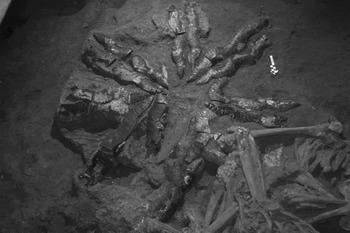
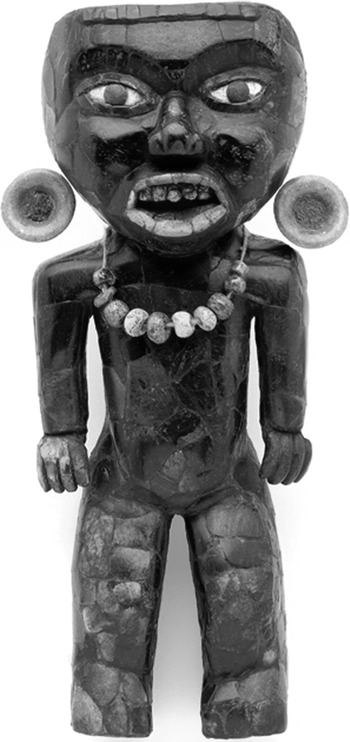
The general offerings of Group II were widely distributed but most densely concentrated in the central area. There we excavated one of the richest symbol concentrations yet discovered at Teotihuacan (Figure 14). This array was mainly composed of 18 large and skillfully knapped obsidian eccentrics, including nine undulating knives and nine feathered serpents. They were placed in a radial pattern, alternating to form nine pairs. A large pyrite disk, an obsidian human figurine, and another unique human figurine made of serpentine mosaic and dolomite, limestone, and obsidian inlays on a wooden support were laid directly over the 18 knives (Filloy et al. Reference Filloy Nadal, María, Watanabe, Sugiyama and Luján2006; Figure 15). The spatial distribution of this central array is somewhat similar to that of the main array (Group II) in Burial 2, described earlier. The symbolic messages encoded in the distribution of these items are difficult to decipher before their ongoing preservation and reconstruction have been completed. However, it is likely that the central human figurines represented gods or divine ancestors responsible for the sacrificial rituals undertaken in the dedication of the monument being constructed.
Main offering array uncovered near the central area of Burial 6. Photograph by Saburo Sugiyama, Moon Pyramid Project.

Serpentine mosaic figurine located near the central area of Burial 6. Photograph by Michel Zabé.

Preliminary Conclusions
Based on the excavation data and materials recovered from the burial/offering complexes found at the Moon Pyramid, we offer the following brief observations regarding their religious meanings and sociopolitical implications.
First, the Moon Pyramid was located in a central ritual place established since the time of Teotihuacan's inception as a planned city or even before, as indicated by the early dates of Building 1 (Sugiyama and Cabrera Castro Reference Sugiyama and Castro2007). Although we searched carefully for corresponding burial/offering complexes in Buildings 1, 2, and 3, we did not detect any archaeological evidence related to dedicatory rituals in these initial phases—at least, at the base level.
The practice of burying sacrificed animals and human beings accompanied by numerous offerings each time the pyramid was enlarged seems to have begun with the construction of Building 4, which was nine times bigger than its predecessor and appears to have coincided with the substantial growth of the political authority of the state, as well. The rich and varied content of Burial 2 confirms the existence of a powerful religious rulership responsible for this grand construction enterprise.
Second, one of the most significant insights generated by this archaeological project is a greater appreciation for burial/offering complexes as an ideological tool to bolster the political authority of the Teotihuacan state. Although the five complexes excavated at the Moon Pyramid correspond to different periods and present interesting variability in form and content, all of them included sacrificial victims consecrated to the monument. We cannot overlook the fact that the majority of these individuals were bound, perhaps gagged, and clearly treated with extreme violence during the consecration ceremonies. In many cases, the victims may have been war captives brought from different regions of Mesoamerica, as suggested by bone analyses. For this reason, it is important to emphasize that almost all of the individuals were adult or sub-adult males of foreign origins. Obviously, further comparative studies of the osteological features and isotopic and DNA information between these individuals and those excavated at the Feathered Serpent Pyramid will provide multiple lines of evidence to address this issue (López Austin et al. Reference López Austin, Luján and Sugiyama1991; Sugiyama Reference Sugiyama1989, Reference Sugiyama2005; White et al. Reference White, Spence, Longstaffe and Law2000; White et al. Reference White, Spence, Stuart-Williams and Schwarcz1998; White et al. Reference White, Spence, Longstaffe, Stuart-Williams and Law2002).
What is currently most evident from the archaeological contexts is the fact that the state's military might was symbolically expressed in ritual and mythical terms. Apart from bone evidence, the importance of warfare was consistently proclaimed in Burials 2, 3, 5, and 6 through weapons (e.g., abundant projectile points), possible warrior paraphernalia (e.g., pyrite disks), and conquest trophies (e.g., maxilla necklaces); instruments related to post-battle rituals (e.g., sacrificial knives); and tied or caged animals emblematic of military institutions (e.g., carnivorous mammals, birds of prey, and rattlesnakes). Almost all of the animals (except butterflies) depicted as symbols associated with warfare in Teotihuacan and later Aztec iconography were present in the dedicatory deposits from the time of Building 4, Burial 2 (around a.d. 250). In striking and highly revealing contrast, animals such as rabbits, deer, dogs, turkeys, geese, quails, and armadillos, so abundant in Teotihuacan apartment compounds, were not recovered at the Moon Pyramid or the Feathered Serpent Pyramid.
We still do not understand fully how frequently “real” military campaigns were carried out by Teotihuacan. Nevertheless, the simultaneous occurrence in Teotihuacan history of (1) dedicatory rituals involving sacrifices of foreigners; (2) monumental enlargement programs of the principal city structures; and (3) the indispensable, collateral expansion of state authority demonstrates the interdependence between that authority and actual, not merely symbolic, military institutions (for the Aztec case, see López Luján Reference López Luján2005). Although diverse interpretations have been mentioned for the large number of sacrificial victims of non-local origins, as immigrants, merchants, envoys, rulers, warriors, or war captives, we believe the last interpretation appears the most likely, given the clear evidence of growth of the Teotihuacan state. Even though no records of specific conquests have been discovered in the archaeological and iconographic record for Teotihuacan, the study of representations of human sacrifice (see López Luján et al. Reference López Luján, Nadal, Fash, Fash and Hernández2006), actual victims, their burial contexts, associated implements and symbols will provide crucial information concerning the hegemonic expansion of this civilization.
Third, the burial/offering complexes found in the Moon Pyramid present great variability in terms of location, forms of deposit, people buried, and associated offerings. These axes of variability seem to have reflected different religious meanings and changing sociopolitical dynamics through time. Burial 2, corresponding to Building 4, was fundamentally a dedicatory deposit of symbolic offerings and animals in which individual 2A was also a gift for the consecration ritual. The main focus of Burial 2 was clearly the two greenstone figurine sets, particularly that of the larger figurine standing on the pyrite disk at the center of the chamber. This possibly symbolized a goddess or female divine ancestor, surrounded by paraphernalia related to the state military apparatus, to which individual 2A would have been subordinated.
Burial 3 and Burial 6 should be contemporaneous to each other, corresponding to Building 5 constructed around a.d. 300. These complexes, as well as Burial 2 corresponding to Building 4, shared many features and contained similar objects, so they could be roughly from the same period; they may even have been integral components of a long-term monumental construction and modification process, as their striking analogies suggest. In Burial 3, the main component apparently consisted of the four individuals sacrificed and buried with their own ornaments and symbol sets placed around and upon them. Among the offerings, two small greenstone figurines, possibly representing individuals of high status, seem to have played a central role in the dedicatory deposit. The form of the pit resembled the larger ones excavated at the Feathered Serpent Pyramid (Sugiyama Reference Sugiyama2005: Figure 8); the objects included in Burial 3 were also similar, or identical, to those discovered at the Feathered Serpent Pyramid. These parallels and the approximate contemporaneousness may indicate that a citywide modification program, logically involving a state centralization campaign, was undertaken at the major monuments during the Early Tlamimilolpa phase.
Burial 6's chamber, located approximately in the central area of Building 5, seems to have been constructed mainly to contain 12 humiliated and sacrificed individuals with unusual symbolic artifacts and many animals related to divine military institutions. The unquestionably violent actions carried out during this mass-sacrificial ritual are evident in the remains of 10 individuals who were decapitated and apparently dumped in the deposit with their arms bound behind them. Two other individuals were placed complete near the center of the chamber, also with their arms tied, expressing subordination. They were associated with a sacrificial knife placed on the chest of individual 6B and two jadeite needles, perhaps implements for auto-sacrifice and symbols of rulership, behind them or stuck into their shoulders. The main offerings in the burial were a central array consisting of a large pyrite disk, 18 obsidian eccentrics depicting undulating knives and feathered serpents, and a serpentine mosaic figurine that apparently originally stood on the array to mark its preeminence. Thus, Burials 3 and 6 seem to have proclaimed state military force and divine authority by integrating sacrificial victims of varied social statuses and origins into the monumental construction. Most likely, they were war captives representing different ethnic groups and/or social classes.
Burials 4 and 5 corresponded to the subsequent construction episode (Building 6), which represented another major enlargement program and took place around a.d. 350. This new monumental construction began with dedication rituals at the tepetate level (Burial 4) and at the top of the earlier building just before it was covered over (Burial 5). Burial 4 consisted of 17 human skulls (plus one atlas belonging to an eighteenth individual) that apparently were thrown into the matrix of the building. Isotopic analyses indicate that they may have come from different regions (Spence and Pereira Reference Spence and Pereira2007; White et al. Reference White, Price and Longstaffe2007). They may have been war captives.
In contrast to Burial 4, which did not contain any animals or artifacts, Burial 5 contained abundant materials of specific symbolic significance. Burial 5 also displayed unique features in the context of dedicatory rituals conducted at Teotihuacan monuments. It contained three individuals with objects revealing previously unknown connections with contemporaneous Maya cities. The jadeite ornaments of individuals 5A and 5B in particular demonstrate the extremely high social status of both individuals, as well as some sort of interaction between the Teotihuacan state and Maya elites. A compositional analysis of the greenstone undertaken by Hector Neff at the Archaeometry Laboratory of California State University, Long Beach, has shown that greenstone samples from the Moon Pyramid are consistent with jadeite samples obtained from the Motagua sources in Guatemala. The fact that nine of the Moon Pyramid samples fall within the range of compositional variation of debitage and/or source sample groups from the Maya area confirms this linkage (Sugiyama et al. Reference Sugiyama, Luján and Neff2004).
We are currently uncertain about how to classify the different kinds of relations between these two societies. As discussed earlier, military conflict may have played a role to a certain degree. The issue is relevant to ongoing academic debates about Teotihuacan influence in the Maya area, particularly at contemporaneous Maya centers such as Kaminaljuyu, Tikal, and Copan (Bove and Medrano Busto Reference Bove, Medrano Busto and Braswell2003; Braswell Reference Braswell and Braswell2003; Clayton Reference Clayton2005; Fash and Fash Reference Fash, Fash, Davíd, Lindsay and Scott2000; Kidder et al. Reference Kidder, Jennings and Shook1946; Millon Reference Millon1973; Millon Reference Millon, Yoffee and Cowgill1988; Schele and Freidel Reference Schele and Freidel1990; Stuart Reference Stuart, Carrasco, Jones and Sessions2000; Taube Reference Taube and Braswell2003; among others). Future interpretations also depend fundamentally on further investigation into the identification of these individuals' proveniences and their causes of death. Although it will be difficult to determine conclusively whether they were sacrificed or died naturally, the issue of Teotihuacano political meddling in the Maya region should be seen in light of the fact that the individuals in Burial 5 were buried in a most respected manner and in one of the most important pyramids at Teotihuacan.
Fourth, individuality or sociopolitical differentiation among people buried at the monument has become partially discernable through analyses of the varied burial features and mortuary attributes. The 37 individuals discovered at the Moon Pyramid can be categorized in a preliminary fashion as follows:
1. Two individuals with exceptionally rich jadeite ornaments, one of them including symbols of political office and kingship (5A, 5B).
2. One individual with highly elaborate ear ornaments and necklace made of shell and greenstone (5C).
3. Three individuals with relatively small quantities of greenstone ornaments (2A, 3B, 6A).
4. Two individuals with shell maxillae pendants (3C, 6B).
5. One individual with shell earspools (3A).
6. One individual without ornaments (3D).
7. Twenty-seven decapitated individuals, without ornaments (4A–Q, 6C–L).
The extremely high political status of the three individuals in Burial 5 (5A–C; categories 1–2) is unquestionable and is easily demonstrable by the central location of the burial on the top of a monument; the individuals' crossed-legged sitting position; their identification as middle-age males; their elaborate jadeite ornaments; and the other objects of exceptional quality associated with them. Clearly, they are the highest-ranking individuals in all burials excavated to date in Teotihuacan (Sempowski and Spence Reference Agurcia Fasquella and Valdés1994). Individual 5C was also unique in terms of his ear and neck garments, which suggests that he could have been a Teotihuacano or a foreign dignitary. We do not yet know who these three individuals were or whether they died of natural causes or were sacrificed; it is also possible that one of them—most likely 5A, if any—died of natural causes, and the others may have been killed as his companions to the otherworld. Other hypothetical interpretations also remain valid and will be tested by ongoing analyses (see Sugiyama and López Luján Reference Sugiyama and Luján2006).
Three individuals (2A, 3B, 6A; category 2) had greenstone or jadeite ornaments of types commonly found among Burials 2, 3, and 6 and the same types of garment worn by a few sacrificial victims at the Feathered Serpent Pyramid. They can be categorized as people of high social status in Teotihuacan society.
Two individuals in Burials 3 and 6 (3C, 6B; category 4) were found with elaborate shell necklaces; the same type of necklace was also found in association with the main greenstone figurine in Burial 2. They were identical to those used by victims of mass-sacrifice buried at the Feathered Serpent Pyramid and have already been excavated in large quantities but exclusively from dedicatory deposits at the major monuments in Teotihuacan. The data therefore indicate direct analogues between individuals 3C and 6B and the greenstone figurine in Burial 2 with dedicatory deposits at the Feathered Serpent Pyramid. Such necklaces likely carried specific meanings in terms of religious significance, social status, and/or political roles. According to the archaeological contexts in which they have appeared, they were worn by members of military institutions and/or related with human sacrificial rituals.
Twenty-seven individuals (4A–Q, 6C–L; category 7) were beheaded and buried without particular care or any associated offerings. They can be categorized as those of the lowest social class, captives brought from other regions to be sacrificed, or naked victims stripped of any attire to humiliate them. The archaeological contexts in which they appear confirm a low social or religious status. They were presented anonymously in groups, as were other victims of decapitation found at Teotihuacan.
In sum, the burial/offering complexes excavated at the Moon Pyramid contained sacrificed individuals of extremely diverse social statuses: from extremely high-ranking dignitaries to those apparently representing the lowest social classes and/or antagonistic ethnic groups. The offerings associated with these individuals demonstrate their place in the social hierarchy; from top to bottom, the sequence is: Burial 5–Burial 2–Burial 3–Burial 6–Burial 4. These divisions, however, mask certain complexities, as other types of status variables may also have been operative. The individuals included in them may have represented different religious and/or sociopolitical groupings. Ongoing analytical studies will lead to greater insight into these fundamental themes regarding the nature of the Teotihuacan state and its foreign relations that could not have been broached in the past because of the absence of solid archaeological evidence.
Acknowledgments
The exploration of five burial/offering complexes at the Moon Pyramid was carried out during 1998–2004 with funding from Arizona State University, the Japan Society for the Promotion of Science, the National Geographic Society, and the National Science Foundation. The project, a joint endeavor of Aichi Prefectural University, Arizona State University, and the Instituto Nacional de Antropología e Historia, was authorized by Mexico's Consejo de Arqueología. We are particularly grateful to those who participated in the exploration of the burials, particularly to Martha Alfaro, David Andrade, Pedro Baños, Jorge Blancas, Alicia Blanco, Sonia Bracamontes, Diana Bustos, Teresa Cadiente, David Carballo, Jennifer Carballo, Matthew Chamberlin, Ximena Chávez, Roxana Enríquez, Guadalupe Espinoza, Laura Filloy, Hironori Fukuhara, José García, Claudia Garcia-Des Lauriers, Shigeru Kabata, Yuko Koga, Hirokazu Kotegawa, Hirotsugu Makimura, Jorge Martínez, Tatsuya Murakami, Luis Núñez, Yuko Ono, Zeferino Ortega, Grégory Pereira, Gilberto Pérez, Julia Pérez, Bernardo Rodríguez, Rebeca Rodríguez, Laura Roldán, Denis To, Raúl Valadez, Manuel Vera, Yuki Watanabe, and Osamu Yoshida and to those who analyzed the bones and offerings and provided information, including Laura Filloy, Emilio Ibarra, Shigeru Kabata, Kunihiko Kurosaki, Kimberley Law, Sandra López, Fred Longstaffe, Emily McClung de Tapia, Tatsuya Murakami, Hector Neff, William Parry, Clara Paz, Grégory Pereira, Óscar Polaco, Naruya Saito, Ricardo Sánchez, Etsuo Sato, Henry Schwarcz, Michael Spence, Hilary Stuart-Williams, Nawa Sugiyama, Shintaro Ueda, Raúl Valadez, Li Wang, and Christine White. We are also indebted to many others who shared their opinions on the discoveries, including Stephen D. Houston, or assisted in explorations in the field, including local workers without whose enthusiastic efforts we never would have obtained such valuable data. We also owe thanks to David Carballo, Claudia Garcia-Des Lauriers, and Debra Nagao for English corrections on the manuscript, and to Hironori Fukuhara and Nawa Sugiyama for preparing the figures in digital form. We are also very grateful to Michel Zabé and Accord Corporation for the photo and 3D scanned image, as cited. Finally, we thank the reviewers of Ancient Mesoamerica, Karl Taube, Annabeth Headrick, and an anonymous reviewer for their feedback.