INTRODUCTION
Common understanding of core terms among health care professionals is essential to achieve best clinical practice. The terms “terminal,” “terminally ill,” and “terminal care” are such important concepts widely used in everyday exchange of medical information as well as in medical research. To illustrate, a search in PubMed, using the terms “terminal care” and “terminally ill” gives 27,761 and 5388 hits, respectively. For “terminal care,” 994 of the hits are title words and for “terminally ill” 1129 are title words. Furthermore, both “terminal care” and “terminally ill” are MESH terms, the former introduced in the MESH database in 1968 and the latter in 1997. The topics in scientific papers using these terms vary from euthanasia and physician-assisted suicide (Emanuel et al., 2000) to the management of symptoms and problems experienced by patients with advanced life-threatening diseases (Hugel et al., 2004) and documents evaluating best practice and health care services (The SUPPORT Principal Investigators, 1995; Brandt et al., 2005).
Etymologically, the word “terminal” originates from Latin and means end, limit, or boundary (Simpson & Weiner, 2006). Historically it has been used in the medical literature to describe the final stage of a fatal disease, patients suffering from such a disease, and institutions in which such patients are cared for (Saunders, 1961). In spite of the frequent use of “terminal,” few researchers have suggested an exact definition of its prognostic meaning (Emanuel et al., 2000; Levorato et al., 2001; Hugel et al., 2004; Clayton et al., 2005) and those who do vary considerably. Some researchers define the “terminal phase” to be the last few days (Twycross & Lichter, 1998), whereas others have a much wider time frame in mind, such as the last 6 months (Vig & Pearlman, 2004; Okie, 2005). Some do not specify a time frame but define “terminal” according to a specified stage of a disease (Weeks et al. 1998), when treatment of the underlying condition is no longer feasible (Llobera et al. 2000), or according to a set of clinical signs and symptoms (Kutner et al., 1999; Ellershaw, 2002; Brandt et al., 2005).
The lack of a generally accepted definition of “terminal” is reflected in clinical practice. Thus experience from management of patients with cancer indicates that even on the same hospital ward, different members of the staff will use “terminal” differently. This clinical impression of variation has also been supported in a survey conducted among North American internists (Christakis & Iwashyna, 1998). In this study it was found that the physicians varied between 0 and 72 weeks in their expectation of a patient's remaining time to live when designated “terminal.” As “terminal” so often is used to categorise patients in the communication between health professionals, the clinical, practical, and emotional consequences of laxity in the definition may be sizable. An example is how the wording of a referral may be misleading because the referrer holds a wider time frame when referring a “terminal” patient than does the physician taking over the care of the patient. A gap in expected survival can range from months to a few days between the two physicians. Different understandings of “terminal” among the staff may result in ambiguous or even contradictory information to the patient and relatives. Such unsatisfactory communication is especially unfortunate, because of the vulnerability of the persons involved.
The aim of the present study was to examine how Norwegian physicians define “terminal” in terms of weeks left to live. We furthermore wanted to examine if demographic factors or work experience affected the physicians' interpretation of the term.
MATERIALS AND METHODS
An extensive research program on physicians' health and working conditions has been running in Norway over the last 10 years (Aasland et al., 1997). As part of this study a representative reference panel of Norwegian physicians has been surveyed on a regular basis. This group of 1605 Norwegian physicians was sent an 11-page questionnaire in June 2002 (with one reminder in August), including two questions regarding end of life. They were asked to indicate in weeks a response to the question: “When a patient is labeled “terminal,” approximately how many weeks should the patient have left to live, in your opinion?” On a 4-point scale (not at all, 1–4 times, 5–10 times, more than 10 times) they were asked to indicate how many times during the previous year they had answered the following question: “How long do I have left to live?”
The 43 specialties and subspecialties were merged into eight clinical relevant categories: general practice, laboratory medicine, internal medicine, surgical specialties, gynecology, anesthesiology, psychiatry, and public health. Specialists in training were categorized according to their future specialty. Some of the physicians did not give information regarding specialty and were not included in the analyses on specialties.
Statistical Analyses
Between-group differences were computed by using t tests or one-way analysis of variance (ANOVA) for continuous dependent variables and χ2 tests for categorical variables (analyses for comparison between responders and nonresponders). Where appropriate, differences between groups were further analyzed by post hoc analyses of the least significant differences. Because of skewed data, the dependent variable “weeks” was log-transformed to attain a normal distribution. Data were analyzed with the statistical package SPSS (version 12).
RESULTS
Respondents
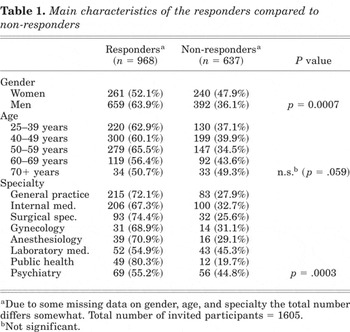
A total of 968 physicians responded to the question on the interpretation of “terminal,” yielding a response rate of 60.3%. The response rate was significantly lower among women (52.1%) and in the specialties of psychiatry (55.2%) and laboratory medicine (54.7%) compared to the respectively relevant subgroups, whereas the explanatory variable age showed no significant relation to nonresponse.
The distribution of responders and nonresponders according to gender, age, and specialty is shown in Table 1.
Main characteristics of the responders compared to non-responders

Mean (± SD) age of the respondents was 48.5 ± 10.9 years old, with a range from 28 to 78 years. The female physicians were significantly younger than their male colleagues (44.4 vs. 50.9 years old) t = −11.4, p < .0001. The mean age for the different specialties varied from 47.7 years old (anesthesiology) to 51.1 years old (public health). Gender was associated with specialty (χ2 = 43.3, df = 8, p = .0003), with pairwise comparisons showing significantly more male physicians among the surgeons whereas the female physicians more often were psychiatrists.
The Interpretation of Being “Terminal”
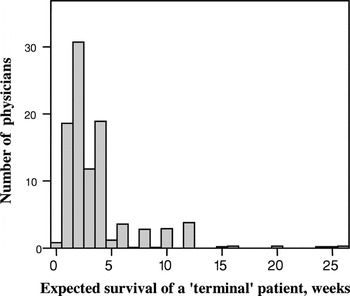
The distribution of “terminal” defined in weeks left to live is displayed in Figure 1. The answers ranged from 0 to 26 weeks with a mean (± SD) of 3.6 ± 3.5 weeks and a median equal to 2 weeks. Overall the physicians split into three groups, with considerable reduction in the number after 4 and 12 weeks. Thus 83.5% held the opinion that “terminal” means less than 5 weeks left to live, 15.0% that it means 5 to 12 weeks left to live, and 1.5% that is more than 12 weeks. The view that “terminal” designates a survival of less than 1 week to live was held by 8 (0.8%) physicians.

Norwegian physicians' interpretation of “terminal” in weeks left to live.
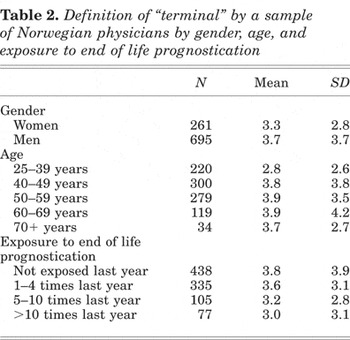
Table 2 displays how the physicians define “terminal,” taking gender, age, and exposure to end of life prognostication into account.
Definition of “terminal” by a sample of Norwegian physicians by gender, age, and exposure to end of life prognostication

Bivariate analysis showed no statistically significant effect of gender on the interpretation of “terminal” in weeks (F = 0.760, df = 1, p = .383), a finding that maintained when controlling for age and exposure to end of life prognostication (F = 0.054, df = 1, p = .816). Examining the effect of age (five subgroups) showed a statistically significant difference (F = 5.787, df = 4, p = .0001) that was unaffected when controlling for gender and exposure to end of life prognostication. A post hoc analysis revealed significant differences between the youngest physicians (25–39 years old) and all the other age subgroups, with the youngest applying a shorter time frame, whereas no significant differences were found among those other subgroups.
No statistically significant association was found between exposure to end of life prognostication and interpretation of “terminal” in weeks using analysis of variance (F = 2.208, df = 3, p = .086), either when controlling for age or gender.
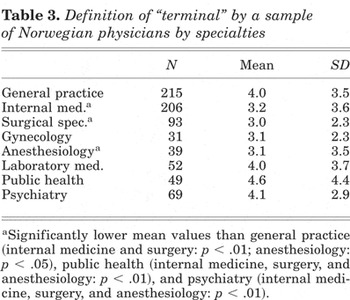
Table 3 displays how Norwegian physicians in different specialties define “terminal” in weeks left to live.
Definition of “terminal” by a sample of Norwegian physicians by specialties

Examining the effect of speciality on the definition of “terminal” in weeks showed a statistically significant difference (F = 4.168, df = 7, p = .0002) that was affected somewhat when controlling for exposure to end of life prognostication (F = 3.373, df = 7, p = .001), but not by gender and age. Post hoc analyses revealed significant differences between all three specialties, internal medicine, surgery, and anesthesiology, compared to general practice, public health, and psychiatry (Table 3), with the former applying a shorter definition than did the latter.
DISCUSSION
Norwegian physicians' definition of the term “terminal” ranged from 0 to 26 weeks survival, although the majority would define survival among “terminal” patients to be somewhere between 0 and 5 weeks. There were significant differences between specialties. However, the relative homogeneity in the use of the term among internists, surgeons, and gynecologists indicates that it is primarily a hospital jargon. Physicians under 40 held a shorter definition of survival length than older, whereas no difference between genders or according to experience with end-of-life prognostication were observed.
The present study investigated a large, representative sample of a country's physician population, which enabled us to examine different subgroups. There were, however, some weaknesses. We examined the term “terminal” using one item only, with response categories in number of weeks, leaving no room for alternative ways of defining “terminal” and without giving indications of chance of surviving for a certain amount of time (Lynn et al., 1996). The response rate obtained was 60.3%. This was approximately 10% lower than the response rate obtained on the rest of the questionnaire. One might assume that some of the nonresponders found this issue more irrelevant for their own practice. This is supported by the finding that a better response rate was obtained among physicians from specialties such as surgery, internal medicine, anesthesiology, and general practice (67–74%), where the term “terminal” is used in clinical practice.
To our knowledge, only one previous study has examined physicians' definition of the term “terminal” (Christakis & Iwashyna, 1998). The present study investigated a cross section of physicians across all medical specialties, compared to internists (generalists and specialists) only in the former study. We were therefore able to describe differences that might have implications for the communication between different specialties. Physicians in general practice, psychiatry, laboratory medicine, or public health held a definition of longer survival, whereas physicians in internal medicine, surgery, anesthesiology, or gynecology applied a narrower time frame. There are several possible explanations for this, the most obvious being that the term is a jargon, used primarily in hospitals. General practitioners, for instance, see a different patient population and hence may have other connotations linked to the term “terminal” than do internists and surgeons. However, in communication between primary and secondary health care practitioners, such a difference in understanding of the term “terminal” can lead to misunderstanding and reduced quality of care toward the end of life (Higginson, Wade & McCarthy, 1990; Lecouturier et al., 1999; Lynn & Forlini, 2001).
Compared to our findings, Christakis and Iwashyna eight years earlier observed a much wider range (0 to 76 weeks, the majority labeling a “terminal” patient as having 16 weeks or less left to live) in their study among North American internists. A possible explanation can be differences in fund systems of health care in the two countries, with less than 6 months survival as a criterion for obtaining Medicare benefits such as hospice care in the United States compared to no such time limiting criterion in the Norwegian health insurance system. Other explanations for the observed discrepancy can be cultural differences between the two countries and changes in use of the term due to increased awareness of end-of-life care during the years between the two studies.
In line with Christakis' findings, no gender difference was observed in this study. Contrary to the Christakis study, however, no effect of experience with queries regarding life expectancy was observed, whereas an opposite effect of age/years of practice was found.
As the terms “terminal” and “terminally ill” are used without clear definitions (Lynn et al., 1996), efforts have been made to replace them with others such as “serious and complex illness” (Lynn & Forlini, 2001). In end-of-life care there is a need to focus specifically on the very last days of a patient's life, as symptoms such as dyspnea, constipation, or anxiety are managed differently if the patient has a life expectancy of a few days compared to 4–5 weeks or more (Adam, 1997; Ellershaw, 2002; Furst & Doyle, 2004). Similarly, appropriate planning of a patient's last few days regarding whether to stay in hospital or at home with the necessary health care support are dependent on every one involved understanding what is at stake. Unambiguous language defining the clinical situation is necessary and has led to expressions such as “entering the actively dying phase of (a patient's) illness” (Bailey et al. 2005).
In conclusion, Norwegian physicians apply a narrower definition of the term “terminal” than do North American physicians, yet a substantially broader definition than recommended by experts in end-of-life care (Twycross & Lichter, 1998; Ellershaw & Ward, 2003). To reduce ambiguities in communication within the health care system we suggest that the term “terminal” should be used to describe a dying patient, with a short life expectancy of a few days to a week.
ACKNOWLEDGMENTS
The study was funded by Eastern Norway Health Authority and was supported practically by Olaf Aasland at The Norwegian Medical association.