Despite this journal's title, not every contribution to it deals head-on with ‘government and opposition’, but sometimes the topic cries out for analysis. That is certainly true of the interplay between ruling and opposition parties in India, a pivotal theme which has been largely ignored – for decades.
Classic works published in the 1950s and 1960s by the founding fathers of political studies of India examined government and opposition in some depth.Footnote 1 Even though much has changed since then – and ironically, even though the interactions between government and opposition have become more important and interesting – the topic has faded from view. Academic fashions changed, few studies of institutions have appeared, and analysts of interparty relations have focused on dynamics within multiparty ruling coalitions (which have lately loomed large) rather than between ruling and opposition forces. Recent studies of two individual states in this federal system focused intensely on the latter topic,Footnote 2 but they are rarities. In the other 26 states and at the national level it has been sorely neglected. It is touched upon only occasionally in one of two key recent books on India's political parties, and in the other it surfaces on only two pages.Footnote 3
This article is an attempt to redress that balance.Footnote 4 The topic, like Indian politics more generally, is so complex that this brief discussion is bound to be inadequate. Researchers should treat it as an invitation to delve more deeply.
BROAD TRENDS AND PATTERNS
We must recognize at the outset that we are dealing not with one political arena but with 29 – with India as a whole (and thus with events at the national level), but also with 28 states in this federal system.Footnote 5 This analysis addresses patterns, first in the states and then at the national level. The states are discussed at greater length – necessarily, because there are greater variations there – but the apex of the system is not ignored. Broadly speaking,Footnote 6 party systems have passed through three phases since Indian independence in 1947.
1947 to the Late 1960s
During this period the Congress Party exercised dominance at the national level and in nearly all states, thanks to its role in achieving independence, its leaders' prestige, and its strong party organization – a cluster of state-level political ‘machines’ that efficiently distributed patronage in exchange for electoral support from diverse interests. Congress occupied not just the centre ground but much of the left and right as well. Key debates and conflicts occurred not between Congress and the opposition but within Congress. Opposition parties were small and disunited, widely dispersed at various points on the margins, to the left or right of Congress.
The Late 1960s to 1989
For most of this period, Congress governed in New Delhi, but it no longer dominated. It remained pre-eminent despite two counter-trends: the emergence of Hindu nationalist and (especially) of regional partiesFootnote 7 as serious alternatives, and Indira Gandhi's assault on her own Congress Party organization – which she saw not as an instrument through which to govern but as a threat. Power was radically centralized in the prime minister's office under Mrs Gandhi (prime minister, 1966–77 and 1980–84) and her son Rajiv (1984–89). India's first non-Congress government, elected by a ferocious reaction to her state of emergency, held power between 1977 and 1979, but was plagued by disunity, which eventually undid it.
1989 to the Present
Since 1989, no single party has been able to win a majority in the dominant lower house of Parliament, despite some continuing strength for Congress, because regional parties and the Hindu nationalist Bharatiya Janata Party (BJP) have won large numbers of seats. In New Delhi, minority governments or (more often of late) large, motley coalitions have ruled.Footnote 8 Power has flowed very substantially away from the prime minister's office – horizontally to other institutions at the national level (Parliament, its committees, the courts, the Election Commission, political parties both in power and in opposition, etc.), and downwards to state governments and state-level partiesFootnote 9 (which are often partners in ruling coalitionsFootnote 10 at the national level).
The comments above refer mainly to the national level, but (as we shall see) party systems in the 28 states have also changed, especially since the 1980s, and have become extremely variegated.
Interactions and relations between governing and opposition parties changed as India passed through these three phases. During the first phase, Jawaharlal Nehru (prime minister, 1947–64) was committed to liberal values, and knew that other parties posed little threat to the dominant Congress. He therefore treated opposition parties generously, unlike many of his contemporaries elsewhere in the developing world. He and other ministers subjected themselves to questions from the opposition, and extended privileges to them in Parliament and state legislatures (by, for example, establishing the convention that opposition leaders should chair public accounts committees). Nehru also permitted the emergence of a free, often critical press – including newspapers and periodicals published by opposition parties – and he ensured that all parties could compete quite freely in fair elections.
During the second phase, Indira Gandhi adopted a markedly illiberal approach and treated opposition parties with hostility (and her son Rajiv followed suit), although elections remained free and fair. Leaders loyal to the Gandhis were named to supposedly neutral posts – India's presidency and state governorships (which are intended to play roles within legislative systems similar to the monarch in Britain), and the offices of speaker at both levels – and operated in highly partisan ways. Governments in New Delhi often abused powers to dismiss state governments headed by opposition parties, on flimsy grounds.
In the third phase, since 1989, immense changes have occurred and the picture has become extremely complicated. The rest of this article deals with that period.
One last thread that runs through India's recent history needs to be noted. It has to do with the ease or difficulty of winning re-election, and thus with alternations in power. During the era of Congress dominance, that party's governments at the national and state levels had a strong tendency to be re-elected. From the late 1960s, however, other parties began occasionally to defeat Congress in state (although not in national) elections. By the late 1970s, a new norm began to take hold: as governments suffered increasingly from demand overload, and as voters became more politically aware and assertive, ruling parties tended increasingly to be thrown out at both levels. Between 1980 and 2007, ruling parties at the state level were ousted by voters roughly 70 per cent of the time. If we set aside the state of West Bengal – where uniquely, a Left Front government was consistently re-elected – the figure approaches 90 per cent.Footnote 11 At seven of the nine national (parliamentary) elections held between 1977 and 2004, ruling parties or coalitions failed to win re-election. Since mid-2008, a new trend has emerged: most state governments have been re-elected, and the ruling Congress-led coalition at the national level was returned to power at the 2009 parliamentary election. This is explained in part by a surge in government revenues since 2003, which has made it possible for ruling parties at both national and state levels to spend lavishly on programmes that benefit diverse interest groups.Footnote 12 It remains to be seen whether this trend will be sustained over the longer term.
There is an easy way and a hard way to develop this analysis. The easy way is to focus almost entirely on the national level. The hard way is to include the 28 states in India's federal system, where we find a diversity of inter-relationships between governing and opposition parties. The easy approach would provide readers with a clear, intelligible and interesting picture, but it would be superficial. Most of the actual governing in India occurs at the state level and below. Evidence from the states demonstrates that many patterns seen at the national level are atypical; they are seldom found deeper down at the state level. A focus on New Delhi only would mean that some important trends in India's recent political history would remain obscure. So it is better to do this the hard way.
THE STATE LEVEL
Let us first consider the interactions between governing and opposition parties in the 28 states, each of which has its own Westminster-style system with legislators elected on a first-past-the-post basis. Party systems vary greatly across states. Table 1 gives a rather crude breakdown of the types of party systems found (in early 2011) in India's 18 major states – those which fill seven or more seats in Parliament. States' names and some details, which specialists may seek, are provided in the notes.
Types of Party Systems in 18 Major States

Table 1 understates the degree to which coherent governments can emerge at the state level. Five states have ‘fragmented’ party systems, but apart from chaotic Jharkhand, all of them have yielded reasonably coherent governments. Those states that have ‘bi-polar’ and ‘bi-polar plus’ party systems have provided quite stable governments, as have two of the four ‘three-party’ systems, most of the time. So in the main, state governments have been easy to assemble and have been somewhat authoritative.
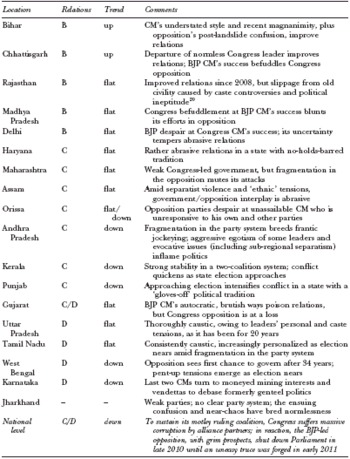
Relations between ruling and opposition parties at the state level vary greatly, ranging from acute hostility to wary accommodation, and such variations exist within each of the four types of party systems. This is illustrated below in two ways. We must eventually consider the patterns that emerge when governments alternate in power, but let us first examine Table 2, which sets out a rough guide (written in early 2011) to changes in relations between ruling and opposition parties in the 18 major Indian states (and at the national level) since 2000. Footnote 18
Recent Trends in Government–Opposition Relations

Notes: The abbreviation ‘CM’ refers to the chief minister, who heads the state government. The word ‘down’ in the trend column indicates the degeneration of government–opposition relations, while ‘up’ implies improvement. The letters that characterize ‘relations’ signify the following: A = congenial (of which there are no current examples); B = semi-civilized; C = somewhat abrasive; D = caustic.
Readers will have noted that in Table 2 no state has ‘congenial’ interparty relations; ‘semi-civilized’ is the best that they can do. This does not represent a marked degeneration since a decade ago, only Rajasthan had ‘congenial’ ties. Relations have deteriorated in several states in recent years, but an assessment of ‘trends’ suggests that, for the most part, this should not inspire acute concern.
Those ‘trends’ are seldom the result of deep structural changes or forces. The upward trends in two states (a very small number, of course) are explained by the actions of individuals: the exit of a wildly self-indulgent chief minister in Chhattisgarh, and magnanimous actions by the Bihar chief minister after he won a sweeping re-election victory in late 2010.Footnote 19 Something similar can be said of many of the downward trends in interparty relations. Most have to do either with individual leaders (and their enmity towards one another) or with the approach of state elections – which naturally sharpens government–opposition conflict, but usually only over the short term.
However, some trends are linked to deeper changes or forces. In some states, marked antagonism between social groups that provide major parties with distinct (barely overlapping) social bases inspires similar antagonism between those parties (see below). The surge in government revenues since 2003 has enabled ruling parties in many states and at the national level to spend heavily on programmes that have become popular – so that they are more likely to be re-elected. This has come as a severe shock to opposition parties, which for three decades could expect ruling parties to lose elections – so that the opposition only had to wait quietly for five years until power was handed back to them. This has persuaded some opposition parties to take extreme action. The cacophony within Parliament raised by the BJP during the winter of 2010–11, which shut down business, is an example. Opposition parties in several states have been further dismayed by the success of chief ministers at obtaining massive financial ‘contributions’ from industrialists, especially those in extractive industries (see below): funds that are used to undermine the opposition. The money is not used to buy votes. Indian voters are too shrewd for that; they take gifts and money from all parties and then cast their ballots as they please. Instead, the money tends to be used to bribe middle-level leaders of opposition parties to join the ruling party in the months just before a state election, when the grip of India's strong anti-defection law (also discussed below) loses much of its force.Footnote 21 This adds further to the demoralization and, at times, the near-desperation of opposition parties. In some states this has triggered a deterioration in government–opposition relations.
Let us now consider a second, closely related set of issues. To understand how the variations in state-level party systems play out in detail, and what causes them, we must ask several key questions. All of them focus on changes that ensue when political parties alternate in power at the state level – when government and opposition change places.
If India were a polity where ruling parties usually won re-election, this discussion would be ill advised, but for three decades the alternation of parties (or in some cases, of coalitions) has been the predominant norm at the state level. In only one state (West Bengal) has the ruling coalition been re-elected on every occasion since 1977.Footnote 22 In the other states, as was noted above, ruling parties have been ousted by voters with spectacular frequency. This pattern has been reversed since mid-2008, for complicated reasons,Footnote 23 with incumbent governments usually being re-elected, but this trend is very new and may not last. A preoccupation with alternations in power is thus justified. So, what happens when state governments change?
Let us first consider how vindictive or congenial ruling parties tend to be towards the main opposition party's leaders, legislators and activists. In a limited number of cases, things run to extremes – opposite extremes. For example, in December 2010, Mulayam Singh Yadav, the most prominent opposition leader in Uttar Pradesh (and a former chief minister of that state) accused the ruling party there of ‘terror’ tactics, of ‘torturing and threatening our supporters’.Footnote 24 We must allow for some hyperbole here, but his party's activists had clearly experienced rough treatment. Earlier, when the two parties' roles had been reversed, a similar pattern had prevailed, so that Mayawati, then the leading opposition figure (and in 2010, the chief minister), accused Yadav of endangering her life.
In radical contrast, when Bhairon Singh Shekhawat became the BJP chief minister of Rajasthan in 1993, he arranged individual interviews with every legislator from the main opposition party (Congress). He asked each to list ten things that were needed in his/her constituency. He then promised to deliver soon on some of these items (and duly followed through), and expressed the hope that he could go further during his five-year term, although that would depend upon how many problems the legislators caused his government. Shekhawat was not all sweetness and light. He was reputed to keep meticulously documented files on the foibles of every politician in the state (including his own party colleagues), which might be used against them if they became troublesome. But he mainly relied on congeniality – a strategy that he had learned during long years in opposition from a similarly courtly Congress predecessor.Footnote 25
Nearly all Indian states are much more ambiguous cases that fall far from these extremes. In a tiny number, we find poisonous interactions similar to those in Uttar Pradesh. As a state election was just months away in West Bengal, in late 2010 the ruling Left Front accused the main opposition leader of ‘creating an atmosphere of terror’ and of colluding with Maoist insurgents.Footnote 26 That leader responded with (similarly false) claims that the chief minister was himself ‘a Maoist leader’ who had unleashed ‘terrorism’.Footnote 27 Both the government and the opposition claimed (accurately) that the other had used gangs of ‘muscle men’ against their activists, amid what one reliable press report described as an ‘orgy of violence’ attended by ‘filthy language’. The mutual loathing was apparent from both sides' use of the Bengali term ‘birodhi dol’ to refer to their adversaries, which means not merely ‘opponents’ but ‘enemy party’.Footnote 28
In a somewhat larger minority of states, we see actions that are intended to promote genteel relations between parties. After winning a landslide election victory in Bihar in late 2010, Chief Minister Nitish Kumar agreed to designate his main opponent the official ‘leader of the opposition’, even though the latter's party had fallen just short of the 10 per cent minimum of seats required to qualify for that status (and the privileges that it carries). Both the vituperation and the magnanimity that are apparent from these examples, however, are exceptions to the more ambiguous norm.
It is worth noting three things that we do not see in India's states. We have yet to hear senior Indian politicians refer to the acts of their opponents as ‘treason’– a word that is used every week by the leaders of the two main parties in Bangladesh about one another. Nor have we seen murderous retribution against activists from a defeated party after an election triggers a change of government – as has sometimes occurred in Sri Lanka.Footnote 29 Nor do ruling parties ensure that those who have the temerity to stand as opposition candidates in elections face trumped-up charges before biased courts, so that they are ruined financially and sometimes imprisoned – standard practice in Singapore.
We must also consider how antagonistic or relaxed new ruling parties are towards civil servants and career government employees in specialized agencies who worked under the previous government. Here it is important to understand that these officials cannot be sacked, unless they are found guilty of gross misconduct. They can, however, be transferred, perhaps to undesirable posts and locations – and frequent transfers have long been common, for various reasons explained below.
In most states where interparty relations fall short of being caustic, newly elected governments usually make only limited changes in the assignments of such people. Officials are treated as relatively neutral professionals. Senior civil servants are often reshuffled when a government changes, mainly because the chief minister may wish to demonstrate that s/he is in charge, and because individual ministers may have great trust in the efficiency and/or the pliability of particular bureaucrats. This process tends not to run to excess. Government employees at lower levels may experience large-scale transfers because legislators demand it – since they want loyalists operating within their bailiwicks, and/or because they receive payments from high- and low-level government employees seeking more agreeable postings.Footnote 30 Senior politicians sometimes curtail mass transfers because they recognize that it can disrupt effective administration and that it increases corruption (which causes popular dismay) since the employees who have paid bribes for transfers then demand bribes from citizens to recover their ‘investments’.
In states with abrasive interparty relations, however, many more transfers occur. This is sometimes linked to organized efforts at illicit ‘fund-raising’ from employees who know that they will change posts, but the main cause is intense suspicion among leaders in the newly elected government that state employees – especially but not only at higher levels – have partisan attachments to the former ruling party. Those leaders may also seek to insert officials from certain castes or other social groups into key posts. Wholesale transfers occasionally take place. We saw this after the 2007 state election triggered a change of government in Uttar Pradesh; a state with toxic relations between major parties. The senior police officers in each of the hundreds of police outposts across the state were transferred.Footnote 31
Then there is the question of the extent to which various important social groups gravitate towards the new ruling party when a government changes. This varies and depends heavily on the relationship between the new ruling party and its social base. In some Indian states, major parties compete for support from identical or overlapping sets of social groups. The greater the overlap, the less abrasive party competition is likely to be, and the greater the tendency of many social groups to gravitate towards a new ruling party. In other states, major parties seek support from largely distinct sets of social groups. This produces more abrasive interparty relations and only minimal shifts in support towards the new ruling party. The degree to which those relations are downright caustic depends in large measure on the intensity of the antagonism between the social groups that provide different parties with support – and there are significant variations on that front.
A tiny number of Indian states represent extreme cases. In Karnataka, major parties have long tended strongly to seek votes from nearly every social group, so that the overlap between their preferred social bases is near total. This has been possible in part because that state has witnessed less antagonism between different castes, classes and religious groups, but peaceable social relations have in turn partly been sustained by the tendency of major parties to seek votes from nearly all groups because politicians have played down social cleavages as they build all-embracing social bases. The situation has changed somewhat in periods when certain leaders have appealed to their own caste fellows, but until very recently these episodes were short-lived and the system reverted to the normality of rainbow social coalitions.Footnote 32 Since 2008, the current chief minister has favoured his caste and stressed divisions between Hindus and minorities; actions that have helped to cause the degeneration of interparty relations. His surpassing ineptitude, though, is likely to ensure that his polarizing efforts once again fail to produce much lasting effect.
At the other extreme, interparty relations have been embittered in Uttar Pradesh for nearly 20 years because each major party appeals to a different bloc of caste groups. Acute antagonism (far more acute than in Karnataka) existed between those groups before politicians became systematically divisive, but it has grown much worse since then. Uttar Pradesh has thus been largely consumed by the politics of spite for a generation.
With one exception – GujaratFootnote 33 – other states fall somewhere between these extremes. Politicians tend to engage simultaneously both in dividing and in uniting social groups. The chief minister of Bihar won a resounding re-election victory in late 2010 after carefully weaning the most disadvantaged sub-divisions within the Muslim and Dalit (ex-untouchable) blocs away from his main opponents. He also took steps to unite his own supporters among lower-middle castes, and maintained an alliance with another party that appealed to high-caste voters. Such complex machinations to unite one's own broad social coalition while fragmenting that of one's rivals are the subtle stuff of state politics across most of India.
It should be stressed that nearly all parties in India have weak organizations – which limits their capacity to make their influence penetrate beyond urban centres and below the (high–intermediate) district levelFootnote 34 and thus restricts their ability to forge close ties to members of social groups at the grassroots in this predominantly rural country. This sometimes causes government–opposition relations to become more abrasive. Party leaders often make more strident attempts to catalyse antipathy between social groups in order to compensate for their inability to reach them through their organizations, and intense personal feuds between the leaders of different parties – who have kept their organizations weak in order to dominate them – often poison interactions between ruling and opposition forces.
For the most part, however, tension between social groups does not produce serious antagonism between major parties. The main reason for this is a persistent tendency among most Indians not to fix ferociously and permanently on one of the many identities available to them – caste, class, religious, linguistic, urban/rural, national, regional, sub-regional, etc. They tend instead to shift their preoccupations from one to another of these identities, and then to another – often and with great fluidity. As a result, tension and conflict tend not to build up along a single fault line in society, as has occurred with grotesque results in Sri Lanka. This fickleness of Indian voters creates great difficulties for parties on the Hindu right that seek to fix attention on religious divisions, and for parties on the left that stress the division between haves and have-nots. It also forces (and enables) parties to build broad social bases by transcending these various divisions.Footnote 35 A change of government usually facilitates shifts in social support towards new ruling parties.
How much policy continuity do we see when parties alternate in power? In a few states – those with bitter relations between major parties – newly elected governments tend to uproot most of their predecessors' policies and start afresh. In most, though, we encounter considerable policy continuity, for several reasons. Many programmes originate from (and are largely funded by) the central government in New Delhi, and even state governments that oppose the ruling party/coalition at the national level find it convenient to implement these (often well-funded) programmes since they can claim some of the credit. Newly elected state governments also often sustain popular, developmentally productive programmes that their predecessors had introduced, although they may ‘re-brand’ them by changing their names. There are seldom significant ideological disagreements between rival parties at the state level, or fundamental differences about strategies for governing. Indeed, there is a tendency in many states for new ruling parties and their leaders to model what Indians call their ‘style of functioning’ on their predecessors' – if the latter were reasonably successful.Footnote 36
It is also worth considering how immensely wealthy actors in the private sector interact with ruling and opposition parties – when governments change, and between elections – and how those interactions fit into broader patterns of corruption. Illicit ‘fund-raising’ by politicians used to consist partly of obtaining payments from industrialists, but other forms of corrupt profiteering also loomed large, usually much larger. Since the late 1990s, however, three things have changed that make ‘contributions’ from private sector figures predominant.
First, economic liberalization (which began in earnest in 1991) has enabled companies to flourish amid rapid economic growth, so that they now have more funds to pass to politicians (and thus more political leverage) than before. Second, industrialists can see that if politicians provide further openings in what is still a semi-liberalized economy, there are vastly greater profits to be made now (after a period of sustained growth) than a decade or more ago. These openings may take the form of generalized policy changes that are available to all firms, or of exceptional favours that are provided (sometimes illegally) to a single company. Finally, since the late 1990s, the international prices of many raw materials have soared as the result of rising demand from East and South-East Asia, and from India itself. This has enabled Indian entrepreneurs in extractive industries to make spectacular profits. These have often been used to provide massive bribes to senior politicians at the state level to persuade them either to provide permits for mining and other extractive activities, or to look the other way when laws and regulations are flouted.
Many entrepreneurs traditionally passed money both to ruling and to opposition parties. This still happens in many cases, but since politicians in power can now open the door to massive profiteering, they tend increasingly to receive the lion's share of these ‘contributions’. When parties alternate in power, the flow of funds tends naturally to shift to those in office. In very recent times, as ruling parties at the state level have been re-elected more often – thanks in part to the immense funds that entrepreneurs provide – the latter sometimes channel nearly all of their donations to politicians in power. In several states this has demoralized opposition parties, which despair at their financial troubles and at their chances of gaining power anytime soon. A few have felt compelled to adopt more confrontational tactics in their dealings with ruling parties, but most have (so far) remained befuddled and rather quiescent.
In most of the states where entrepreneurs provide enormous payoffs to ministers and ruling parties, the chief ministers have been adroit enough to maintain the upper hand in the relationship, but we have begun to see – especially in Karnataka where the chief minister since mid-2008 has been unusually inept – moneyed interests gain as much leverage as senior politicians, so that they are able to exercise a significant degree of control over politics. It remains to be seen whether this becomes a more widespread trend.
THE NATIONAL LEVEL
Since 1998–99, a ‘bi-polar plus’ party system has existed at the national level. Lest that suggest a close resemblance to some state-level party systems, it should be stressed that the ‘plus’ (and the two ‘poles’ which are coalitions of parties) at the national level contains far more parties than in any state, and their behaviour is less predictable. At times, especially as elections approach, some regional parties either join one of the two main multiparty alliances or enter a third (or, briefly in 2009, a fourth) front, but some remain aloof in the hope of bargaining with the leading alliance after results emerge.Footnote 37 Since 1999, one or the other main coalition has mustered a parliamentary majority and provided reasonably stable government, but this has occurred amid and despite considerable fragmentation and confusion, the like of which cannot be found in any state. Nor do we see in any state the internal incoherence inflicted upon both ruling and opposition coalitions at the national level by wilful, erratic, egocentric and corrupt leaders of regional parties.
So the party system at the national level is not a mere aggregation or replication of patterns in the various states. The number and diversity of (especially regional) interests at play in New Delhi are vastly greater than in any state. For this and several other reasons, interparty and government–opposition dynamics at the national level are distinctive. To understand both how they are distinctive and what makes them so, we must consider several important themes that are remarkably diverse. They concern socio-cultural features, the logic of coalition politics that has prevailed at the national level in recent years, the redistribution of power since 1989, and legal changes. As a result, the account that follows does not (and cannot) proceed in a seamless manner from topic to closely related topic.
Regional diversity breeds varied perceptions. India's regions have diverse political and socio-economic histories that cause people in different regions to have different perceptions of events at the national level. As a result, national leaders find that their actions do not produce the kind of consistent, relatively uncomplicated responses that usually greet leaders in individual states, where the responses are far more homogeneous than in India as a whole.
Two examples will illustrate this. In all of southern and in much of western India, political battles over the issue of reservations for disadvantaged castes in educational institutions and government employment were waged and resolved decades ago. These resulted in accommodations that entailed substantial gains for these castes. So in 1990, when Prime Minister V. P. Singh promised to ensure generous reservations for such groups, he triggered ferocious controversies between his government and opposition parties in northern and eastern India, but not in the south and parts of the west where the issue had been largely settled long ago. Singh was from the north, and his apparent expectation that this promise would win him greater nationwide support from ‘have-nots’ met with shrugs in the south and much of the west.
Varied, indeed contradictory perceptions in different regions also created problems for H. D. Deve Gowda when he became prime minister in 1996. He was known as a leader of ‘owner-cultivators’– that is, farmers who own parcels of land that are modest enough for the owners to do their own cultivating, so that they seldom employ agricultural labourers. In much of northern and eastern India, where larger landholdings are common, owner-cultivators stand on the middle or lower-middle rungs of the economic ladder in rural parts. Deve Gowda was thus seen there as a progressive, a champion of people who were in many ways ‘have-nots’. In southern India (from which he came) and in much of western India, however, land is much more equally distributed, so that owner-cultivators constitute the rural elite, the ‘haves’. As prime minister, he was thus caught between his traditional role as elite champion and the very different expectations of voters in the north and east. He (and his party) found it impossible to carve out a political persona that could produce consistent responses – and widespread advantages in the struggle with opposition parties – across varied regions.
Further complications afflict prime ministers and ruling parties in New Delhi when caste issues arise. To understand this, we must recognize that India has not one caste system but many. Each major linguistic region (of which there are many) possesses its own distinctive caste system, and the very composition of society varies from region to region, often markedly. For example, Brahmins represent around 20 per cent of the population in much of northern India and often own extensive lands, but across the south they make up just over 3 per cent of the population and own little land. So when Brahmins from north and south meet in Parliament, they find it impossible to operate as a political bloc that pursues coherent goals. Their interests differ too much. The same can be said of most other caste groups at the national level – except the Dalits (ex-untouchables), who experience similar disadvantages across most of India and make up roughly similar proportions of the population in most states. Within any single Indian state, caste is clearly understood and looms large in elections, political machinations, policy debates and the interplay between ruling and opposition parties. At the national level its meaning is so confusing that it plays a far less important role.Footnote 38
Let us now consider the role of ideology. It might appear likely to loom large in interparty relations at the national level because one of the two main national parties, the BJP, has a well-elaborated Hindu nationalist ideology. Its main rival, the Congress Party, has pursued enough high-profile poverty programmes since taking power in 2004, to appear more ideologically focused as a left of centre party. In practice there is less substance on either front than we might expect. To forge alliances with other parties – all but one of which are alienated by Hindu chauvinism – the BJP has played down its ideology. Heavy Congress spending on poor people has been matched by similar outlays to benefit prosperous groups, so it remains a party with a vague ideology that seeks support from every interest. The two communist parties are active at the national level, but they suffered serious setbacks at the national election in 2009, and they appear (at the time of writing) likely to face defeat in West Bengal, where they have exercised dominance since 1977. Their importance in New Delhi is waning. Ideology thus generates little tension between ruling and opposition parties/coalitions at the national level.
Indeed, we have actually seen considerable convergence between the two main coalitions at that level in recent years as a result of an intense preoccupation with gaining and retaining power. When leaders of the two national parties that lead those coalitions ask themselves what will get them elected or re-elected, they come up with rather similar answers. Cautious, incremental steps to liberalize the economy that do not result in destabilizing shocks to any important interest are seen by both blocs as desirable because they help to sustain or to increase rapid economic growth. Both understand the need to de-emphasize patronage distribution because it has long proved an inefficient means of attracting electoral support, but neither bloc will entirely abandon it, since that would alienate important sets of clients. Both see the need to supplement patronage politics with ‘post-clientelist’ initiativesFootnote 39 – which have increasingly taken the form of development programmes to benefit a broad array of interests, and which are partly or substantially insulated from corruption. The long-standing tradition of bi-partisanship on foreign policy and security issues may appear to have frayed in 2008. The BJP first opposed an agreement on civil nuclear policy that the ruling Congress-led coalition had signed with the USA, and then it criticized the government's restrained response to the Mumbai terrorist attacks of November 2008, but it was widely understood that the BJP would have been as eager as the Congress Party to complete the nuclear deal, and when its complaints in the wake of the Mumbai atrocities yielded no advantage in state elections conducted only days thereafter, it largely abandoned that line of attack.
So we are left with two main rival parties (and their respective coalitions) that resemble each other quite closely.Footnote 40 This is not surprising because each wishes to persuade regional parties to switch sides, and that is far easier if the differences between them are modest. We might expect the convergence of the two coalitions to ease conflict at the national level. That has indeed happened when we only consider conflicts that are rooted in ideology, but convergence has also caused increasingly abrasive disputation between ruling and opposition forces. Those in opposition feel impelled to mount stinging attacks at every opportunity in order to exaggerate the (quite limited) distance and contrast between themselves and the government. Two other things have also inflamed relations between ruling and opposition coalitions.
First, the most important debates between them have, in recent years, come to take place on 24-hour television news channels. The ‘moderators’ of nightly panel discussions on most of these outlets operate as agents provocateurs: hectoring, interrupting, often shouting, seeking heated (and thus more watchable) exchanges. To cope in these bear pits, the two coalitions often deploy combative spokespersons who slash away at their opponents defiantly, derisively, sarcastically. Despite attempts by senior leaders in both camps – who seldom appear on these telecasts – to behave in a dignified, statesmanlike manner, these clashes create a popular impression of politics with the gloves off. It must be stressed that the debates on channels with national coverage occur in only two languages: Hindi (spoken by only 41 per cent of the population) and English (spoken by fewer than 10 per cent). Most rural voters, who decide elections, have no direct access to them. While India's formidable and free vernacular media seldom mount raucous debates of this kind, they often report the more lurid comments made on national telecasts. So the result is a widespread perception that strident bickering is common.
Second – and more important – sharp conflicts arise from the frustrations of those in opposition, which in recent years have become quite excruciating. For most of the last two decades, opposition leaders could take comfort in the well-founded belief that at the next election they would be swept back to power. Re-election was so difficult to achieve that they could expect power to fall into their laps at the next time of asking. The wait was often quite brief. Between 1989 and 1999, only one of four Parliaments lived out its full five-year term; the others lasted, respectively, 19, 22 and 19 months. Three key things have changed since then. First, the governments elected in 1999 and 2004 each lasted five years, and the current government, elected in 2009, will probably do likewise. Second, re-election has become the norm at both national and state levels since mid-2008, so those who merely wait their turns may wait forever. A further potent irritant is the main reason that re-election is now more achievable: government revenues have surged since 2003, so those in power have far more money to spend on cultivating popularity. Acute pain is visible on the faces of politicians of diverse parties who governed at the national or state levels before 2003 when the massive new funds available to their successors are discussed. These things make opposition leaders more inclined to raise raucous protests against those in power.
We must also consider the redistribution of power that (as noted above) has occurred since 1989, and the resultant decline in abuses of power by prime ministers. Since that year, no single party has been able to win a parliamentary majority or to get anywhere close to that. Hence power has flowed very substantially away from the once dominant prime minister's office to other institutions at the national level, and to the state level and regional parties. This infusion of power had revived many national-level institutions,Footnote 41 so that they now restrain the power of the executive. As a result (in my view at least), on only one occasion since 1989 has a prime minister abused his power. That is far fewer abuses than India witnessed between 1971 and 1989, and fewer than Britain witnessed under either Margaret Thatcher or Tony Blair.
The redistribution of power at the national level has made government–opposition relations less abrasive in two main ways. First, parliamentary committees have gained greater influence and now often make non-trivial changes to bills before they are finally enacted into law. Ministers find it difficult to resist changes that are initiated by MPs from the ruling coalition, and as a spirit of accommodation develops, alterations suggested by the opposition are also sometimes accepted. This has eased tensions with opposition parties. Second, the Supreme Court has become much more assertive and influential since 1989, and one of its decisions (which are regarded as ‘law declared’) removed a major irritant between ruling parties in New Delhi and regional parties that are opposed to it. Before 1989, governments at the national level frequently used Article 356 of the constitution – which permits the imposition of direct rule from New Delhi in states where severe problems have arisen – to dismiss state governments headed by opposition parties. By requiring national governments to provide detailed justifications for such actions, the Supreme Court in 1994 effectively rendered that abuse nearly impossible.Footnote 42 This has further strengthened accommodative relations between ruling and opposition parties.
On yet another front, one striking aspect of political discourse and campaigning over the last generation needs to be noted. Both ruling and opposition parties live with the memory of two long ago landslides in national elections. Both occurred because the elections were fought on what the French call ‘issues of regime’: disputes about the fundamental principles on which a country should be governed. The first arose in 1971 when Indira Gandhi presented herself as a progressive who would ‘abolish poverty’, and characterized her opponents as reactionaries who had thwarted this noble goal. The great issue was whether the government should attack poverty. She won a stunning victory, although thereafter she did little to follow through on her promise. The second ‘issue of regime’ arose at the next election in 1977, after a 19-month state of emergency in which Mrs Gandhi had governed brutishly. On that occasion, the issue was whether India would remain a democracy or accept her autocratic ways. She suffered a humiliating defeat.Footnote 43
Since then, occasional attempts have been made to conjure up such an issue. The most striking examples occurred during 1990 when not one but two parties tried this. First, Prime Minister V. P. Singh, who headed a government with a precarious grip on power, sought to mobilize numerically powerful ‘have-nots’ by promising reservations in educational institutions and government employment for people from castes in the lower-middle reaches of the social hierarchy. The BJP swiftly responded with a strident campaign to foment anti-Muslim sentiment, in an effort to mobilize the Hindu majority. Neither theme, then or since, has attracted sufficient support to become an ‘issue of regime’; in recent years both have been played down by nearly all parties, including the BJP.Footnote 44 Party leaders retain an appetite for an issue of regime, but politics has become so complex and ambiguous that it has been impossible to identify even a semi-plausible theme. This has made government–opposition relations less abrasive since both successful and failed attempts to raise an issue of regime poison those relations.
Finally, a set of legal provisions influences government–opposition interactions: anti-defection legislation. In 1985, a constitutional amendment decreed that MPs and state legislators would lose their seats if they gave up membership in the party to which they belonged, or if they voted (or abstained) in defiance of instructions from that party unless at least one-third of party legislators took these actions collectively. In 2003, the law was toughened. The provision allowing one-third of a party's legislators to act en bloc was removed, so that all defectors (no matter how numerous) would lose their seats and be prevented from standing for re-election during the lifetime of the legislature to which they had been elected. This made it impossible for, say, three members of a party with nine seats to defect without penalty.
These changes have had an ambiguous impact on government–opposition relations. They have largely ended attempts by ruling parties to induce opposition legislators to cross the floor,Footnote 45 and thus eased the tensions between ruling and opposition parties that arise from such machinations. They have also strengthened party discipline, which had often been quite weak before 1985. They have, however, been criticized for turning legislators into mere ‘lobby fodder’, unable to speak their minds freely or to represent their constituents adequately. The changes are also said have unduly strengthened the influence of party leaders – which is already immense, especially within regional parties, which tend to be dominated by single leaders or cliques.Footnote 46 This last point has important implications for interparty dynamics both within ruling coalitions and between such coalitions and the opposition. Leaders of regional parties in ruling coalitions whose dominance has been strengthened by this law feel emboldened to make extreme demands upon prime ministers, to behave in embarrassing ways and to demand that their lieutenants who are ministers in the national government engage energetically in illicit ‘fund-raising’. All of these things create openings for the opposition to mount strident agitations against ruling coalitions. So the anti-defection law has mitigated some tensions and fuelled others.
CONCLUSIONS
The discussion above defies tidy summation. It is shot through with complications and ambiguities at both state and national levels. This will come as no surprise to connoisseurs of India's politics, but it may frustrate non-specialists. Some trends tend to mitigate conflicts between ruling and opposition parties while others have the opposite effect.
Consider key examples of the former. The federal system prevents sometimes acute interparty tensions in individual states – sometimes the products of distinctive social (often caste) conflicts not replicated elsewhere – from spilling over into other states and into national politics.Footnote 47 At the state level, social conflicts seldom inject great heat into government–opposition interactions because major parties usually seek support from at least partly overlapping clusters of social (and caste) groups. Ideology has little importance at the national level, and usually next to none at the state level. Especially since broad rival coalitions became the norm at the national level in 1999, we have seen considerable convergence on policy issues there and in many (but not all) states, although the shrinking distance between ruling and opposition parties has at times led to more combative rhetoric designed to disguise this reality. At the national level, both sides temper the stridency of their attacks on the other because they may need to wean regional parties away from rival alliances as they seek to construct large multiparty coalitions that will provide majority support in Parliament. The marked dispersal of power away from the once dominant prime minister's office has curbed abusive actions from the apex of the system that previously inspired bitterness in victimized opposition parties.
Other trends foment abrasive conflict, but they seldom run very deep. The prospect since mid-2008 that opposition parties may not return to power soon inspires aggressive agitations against governments in some cases, but opposition confusion in most. Interparty clashes in nightly debates on national television exaggerate the enmity between parties, but they occur less often at the state level. At that level, bitter personal resentments between party leaders – and not fundamental contradictions between parties or their social bases – are usually the main causes of antagonism. Issues of regime, which can poison relations between ruling and opposition parties, are nowhere to be found.
We need to bear this mixed picture in mind since this is being written in the wake of a serious crisis within India's Parliament. Its entire winter session in late 2010 was paralysed by raucous protests in the chamber by opposition parties. They were protesting both at an apparently monumental scam in the award of telecommunications licences, and at the government's refusal to permit a joint parliamentary committee to investigate it. As a former solicitor-general of India wrote, this was the ‘worst’ of the 82 sessions over half a century, ‘unseemly’, a ‘farce’, a ‘denigration of Parliament’. It set a ‘dangerous precedent’ for state legislatures,Footnote 48 a comment that events in one state (where the two main parties' roles were reversed) bore out shortly after his views were published.Footnote 49
This tactic might indeed become a habit, although when the crisis was resolved in early 2011 after the government agreed to convene a joint parliamentary committee, the opposition appeared mightily relieved, because they no longer had to face down damaging charges that they were paralysing and discrediting Parliament. If such protests were to become more common, interactions between ruling and opposition parties would surely deteriorate markedly. As many of the arguments here indicate, though, the overall trends in relations between governments and opposition parties at both state and national levels are decidedly ambiguous. So perhaps we should not expect a dramatic and lasting degeneration – or improvement – anytime soon.