Introduction
Changes in the scientific nomenclature of well-known pest species are always met with resistance by those involved in the detection, control, and management of those species. While laypersons and scientists alike invoke “nomenclatural stability” as the primary reason for their resistance, stability in nomenclature can only be achieved when nothing more can be learned about an organism and its relationship(s) to other organisms. Hence, names will continue to change concomitant with advances in our knowledge.
There currently is considerable confusion regarding the correct application of the name Choristoneura occidentalis Freeman (Lepidoptera: Tortricidae). This name has historically been applied to the western spruce budworm, a serious forest pest in western North America. However, Razowski (Reference Razowski2008) transferred the African species Archips occidentalis (Walsingham) to Choristoneura Lederer (Lepidoptera: Tortricidae) and proposed C. freemani Razowski as a replacement name for the western spruce budworm. These changes have been ignored or have gone unnoticed by most authors, likely due to the relatively limited distribution of the journal (Polish Journal of Entomology) in which they were published and/or scepticism as to their validity. The purposes of this article are to detail these nomenclatural changes and make them more widely known to North American researchers, comment on their validity, and discuss alternative solutions to resolve the confusion they have caused. We also provide illustrations of wing patterns and genitalia for the two species.
The African Choristoneura occidentalis
Choristoneura occidentalis Walsingham was described from six specimens (male and female syntypes) collected in Bathurst (today Banjul), Gambia. This species is widely distributed throughout Sub-Saharan Africa, as evident by records from Gambia, Sierra Leone, Kenya, Tanzania, Zambia, Zimbabwe, Mozambique, and South Africa (Gilligan and Epstein Reference Gilligan and Epstein2012). The larvae, which are considered pests in some locations, have been reported feeding on a variety of cultivated crops, including Allium Linnaeus (Liliaceae) (Harris Reference Harris1938), Citrus Linnaeus (Rutaceae) (Pinhey Reference Pinhey1975), Coffea Linnaeus (Rubiaceae) (Evans Reference Evans1968, Reference Evans1970; Evans et al. Reference Evans, Andrade and Mathenge1968; Pinhey Reference Pinhey1975), Glycine max (Linnaeus) Merrill (Fabaceae) (The Natural History Museum, London, United Kingdom; specimen labels), Persea Miller (Lauraceae) (de Villiers and van den Berg Reference de Villiers and van den Berg1988; Erichsen and Schoeman Reference Erichsen and Schoeman1994), Theobroma Linnaeus (Sterculiaceae) (Smith Reference Smith1965), and Cajanus Adanson (Fabaceae) (Meyrick Reference Meyrick1938), and native plants such as Acacia mearnsii De Wildeman (Fabaceae) (Swain and Prinsloo Reference Swain and Prinsloo1986) and Corchorus Linnaeus (Tiliaceae) (The Natural History Museum, specimen labels).
Cacoecia Hübner, the genus in which the African C. occidentalis was originally described, is now considered a synonym of Archips Hübner. Although we could find no formal proposal of a new combination, the species was treated as Archips occidentalis (Walsingham) as early as 1968 by Evans, and it has been treated as such by nearly all subsequent authors (e.g., Evans et al. Reference Evans, Andrade and Mathenge1968; Evans Reference Evans1970; Pinhey Reference Pinhey1975; Swain and Prinsloo Reference Swain and Prinsloo1986; de Villiers and van den Berg Reference de Villiers and van den Berg1988; Derwent Publications 1990; van der Geest et al. Reference van der Geest, Wearing and Dugdale1991; Brown Reference Brown2005; Waller et al. Reference Waller, Bigger and Hillocks2007). The synonymy of C. [Archips] heliaspis (Meyrick) (described from Natal, South Africa) with C. [Archips] occidentalis was mentioned by Pinhey (Reference Pinhey1975), and that treatment was followed by Brown (Reference Brown2005).
The North American Choristoneura occidentalis
The western spruce budworm, Choristoneura occidentalis Freeman, was described from Klickitat Co., Washington, United States of America (Freeman Reference Freeman1967). The complex of taxa referred to as “spruce budworms” consists of up to 15 species, subspecies, or biotypes and includes some of the most destructive forest pests in North America (Lumley and Sperling Reference Lumley and Sperling2011). This group has been the subject of thousands of studies detailing life histories, natural enemies, control methods, and taxonomy. Choristoneura occidentalis occurs in western North America, where its range extends from the Rocky Mountains to British Columbia, Canada and Washington and Oregon, United States of America (Powell and Opler Reference Powell and Opler2009). Its larvae feed primarily on Pseudotsuga Carrière (Pinaceae) but are also found on Tsuga Carrière (Pinaceae), Picea Dietrich (Pinaceae), Abies Miller (Pinaceae), and Larix Miller (Pinaceae) (Powell and Opler Reference Powell and Opler2009).
The problem
In 2008, Razowski transferred Archips occidentalis to Choristoneura, but provided limited discussion of the morphological characters upon which the decision was made. This action resulted in the new combination Choristoneura occidentalis for the African species and resulted in the homonomy of the name C. occidentalis (with the North American species). In order to resolve the homonomy, Razowski (Reference Razowski2008) proposed the replacement name C. freemani for the western spruce budworm. He provided illustrations of the male and female genitalia of the African C. occidentalis (Razowski Reference Razowski2008: Figs. 1, 2, 11), and he resurrected C. heliaspis from synonymy with C. occidentalis, recognising the two as distinct species.
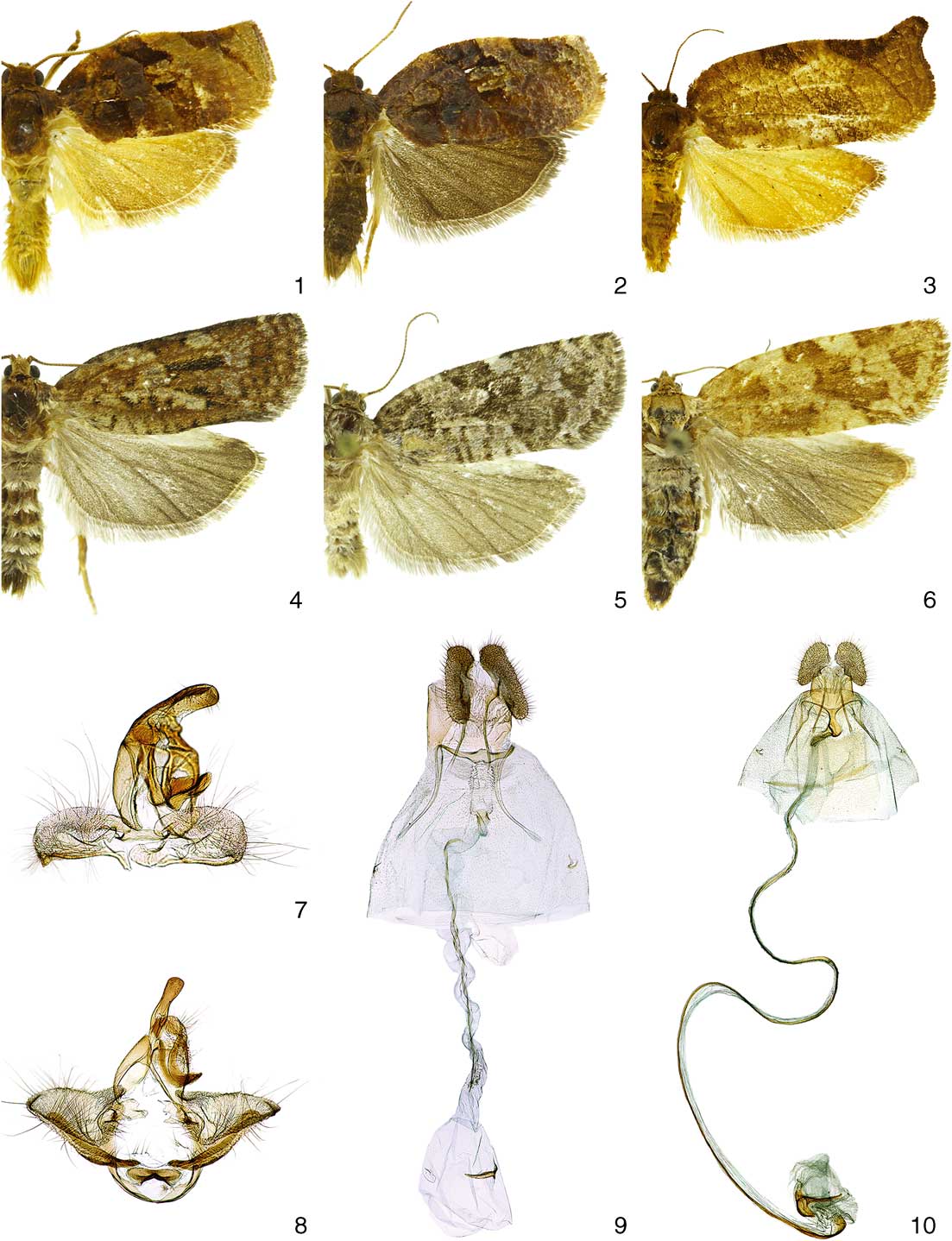
Choristoneura occidentalis (Walsingham); 1. male; 2. male; 3. female. Figs. 4–6. Choristoneura freemani Razowski; 4. male, 5. male, 6. female. Figs. 7–8. Male genitalia; 7. C. occidentalis; 8. C. freemani. Figs. 9–10. Female genitalia; 9. C. occidentalis; 10. C. freemani.
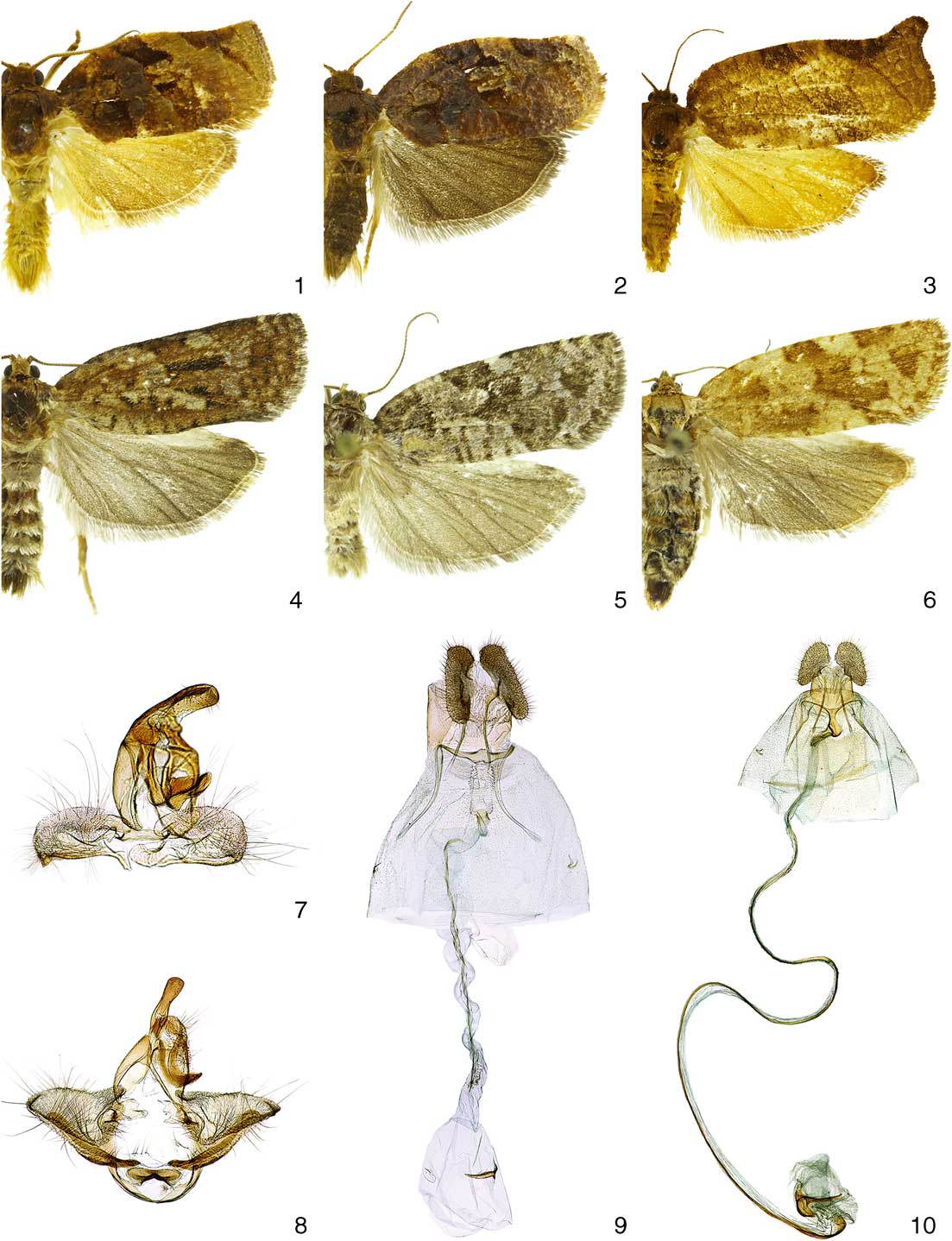
According to the International Code of Zoological Nomenclature (International Commission on Zoological Nomenclature 1999), no genus can have two species with the same name (a nomenclatural problem referred to as homonymy), and the older name takes priority. The Code also stipulates that a replacement name must be proposed for the more recent of the two names. Because the African C. occidentalis is older (described in 1891), it has priority and is appropriately referred to as Choristoneura occidentalis (Walsingham). The western spruce budworm is appropriately referred to as Choristoneura freemani Razowski, following the replacement name proposed by Razowski (Reference Razowski2008). Figures 1–10 illustrate the two species along with their male and female genitalia.
Within Archipini there are many genera whose limits are ill-defined, and among these are a group comprised of Archips, Homona Walker, Meridemis Diakonoff, and Choristoneura, all of which were reviewed by Razowski (Reference Razowski1987). In the latter paper, Razowski (Reference Razowski1987) redescribed Choristoneura and concluded that a synapomorphy for the genus is the position of the uncus, that is, “distinctly elevated above surface of its basal lobes”, a character state also found in Meridemis, which Razowski (Reference Razowski1992) considered a synonym of Choristoneura (along with Cudonigera Obraztsov and Powell), but did not formally synonymise. Razowski (Reference Razowski2002) later slightly modified his description of the putative synapomorphy for Choristoneura: “position of the uncus, which is convex, situated on tegumen dorsally”. Freeman (Reference Freeman1958) may have referred to the same character state as “Base of the uncus constricted to join the tegumen narrowly in the median line”. Powell (Reference Powell1964) provided the following comment regarding the uncus of Choristoneura: “uncus elongate, of various forms”. Despite the thousands of publications on the spruce budworm complex, no North American taxonomists have focused on the generic circumscription of Choristoneura, and hence, its definition remains somewhat ambiguous. Its type species, Tortrix diversana Hübner, is European, and the only worldwide review of the genus was provided by Razowski (Reference Razowski1992).
Based on a brief survey of genitalia slides and drawings, the uncus is somewhat confluent with the dorsum (posterior portion) of the tegumen in Archips, whereas in Choristoneura there is a conspicuous “junction”, with the uncus originating slightly more dorsad and anterad on the tegumen. The uncus in the African Choristoneura occidentalis is exceptionally broad, as in Cudonigera houstonana (Grote) (see Powell and Obraztsov Reference Powell and Obraztsov1977) or Choristoneura albaniana (Walker) (see Razowski Reference Razowski2002), and does not possess a particularly conspicuous “junction” with the tegumen. Hence, this character state does not provide particularly convincing evidence for the assignment of the African C. occidentalis to Choristoneura. However, the shape of the uncus and the arrangement of its attachment to the tegumen are similar to other Choristoneura (e.g., C. albaniana).
We performed a preliminary phylogenetic analysis (using parsimony) of the 658 bp region of COI referred to as the “DNA barcode region” from a sample of Nearctic Archipini (including Choristoneura, Archips, and Argyrotaenia Stephens). The African C. occidentalis forms a poorly supported clade that includes Choristoneura and two (of the four sampled) species of Archips; the base of this clade forms a polytomy (four branches) with one branch consisting of Argyrotaenia, one branch consisting of Clepsis, and the remaining branch comprised of two other species of Archips and one species of Argyrotaenia. Hence, the tree is not particularly consistent with our current generic framework for the included species, and it does not provide compelling evidence to support or refute the placement of African C. occidentalis in Choristoneura. Furthermore, it is widely accepted that a COI gene tree should not be used as the sole indicator of phylogenetic relationships because mitochondrial DNA data are subject to biases that may obscure true phylogenetic signal (e.g., Will and Rubinoff Reference Will and Rubinoff2004; Rubinoff et al. Reference Rubinoff, Cameron and Will2006).
Until a rigorous phylogenetic analysis is completed that includes many of these putatively related archipine genera, we are unlikely to have a convincing generic assignment for the African C. occidentalis. However, the lack of a phylogenetic analysis does not invalidate the placement of the African C. occidentalis in Choristoneura as proposed by Razowski (Reference Razowski2008) in the absence of convincing evidence that contradicts that transfer.
The solution
Potential solutions to help resolve this nomenclatural confusion include (1) rejecting Razowski’s (Reference Razowski2008) generic placement of the African C. occidentalis; (2) proposing a new genus for the African C. occidentalis; (3) petitioning the International Commission on Zoological Nomenclature to suppress C. occidentalis (Walsingham); or (4) conducting a comprehensive phylogenetic analysis to identify the position of African C. occidentalis.
All taxonomic acts are hypotheses to be supported or refuted by subsequent research. Razowski’s (Reference Razowski2008) placement of the African C. occidentalis in Choristoneura is based on very little supporting information. In the introduction of the paper, he simply states “now we are convinced that Choristoneura has more African representatives” and his description of C. occidentalis consists of only a brief comparison of its genitalia with that of C. heliaspis. It is possible to conclude that placement of the African C. occidentalis in Choristoneura is based on too little evidence, and that Razowski’s hypothesis should be refuted until further evidence as to the circumscription of Choristoneura can be provided.
Proposing a new genus for the African C. occidentalis is another option for solving this taxonomic problem. However, while it would maintain nomenclatural stability for the western spruce budworm, proposing a new genus for C. occidentalis (Walsingham) in the absence of convincing generic-level synapomorphies would be illogical and only cause problems for future taxonomists.
When attempting to suppress an older name, an important consideration is the number of times it has appeared in print. A search for “Choristoneura occidentalis” in Google Scholar for the past three years (2009–2012) returned 546 results, none of which we could determine as referring to the African species. Conversely, a search for “Choristoneura freemani”, Razowski’s replacement name for C. occidentalis, in Google Scholar for the same time period returned no results. Based on such widespread use of the North American name, it may be possible to petition the International Commission on Zoological Nomenclature (ICZN) to suppress the African name and propose a replacement for it. This would retain the name C. occidentalis for the western spruce budworm regardless of generic placement for the African species, and we believe this is the best long-term solution to the nomenclatural confusion.
The most compelling solution to the placement of this entire group of species would be a phylogenetic analysis of these putatively related Holarctic and African Archipini (i.e., Choristoneura, Archips, Meridemis, Cudonigera, Homona) using molecular data to test monophyly of the genera and infer their relationships. Because a preliminary COI gene tree produced ambiguous results regarding the placement and monophyly of several of these genera, it is unlikely that DNA barcode data alone would be sufficient to produce a well-supported phylogeny for this group. In addition, any phylogeny that does not include sufficient taxon sampling may be suspect, and proper sampling would likely require new collections of African specimens in these genera from which multiple genes can be obtained.
Conclusions
Although nomenclatural changes are now proposed in a more “formal” manner, many of our well-known common pest species such as the spruce budworm, Choristoneura fumiferana (Clemens), have chequered taxonomic pasts. This species was described in “Tortrix?” by Clemens (Reference Clemens1865) and treated as Tortrix Linnaeus by Robinson (Reference Robinson1869), Fernald (Reference Fernald1903), and others; it was later transferred to Archips (without comment) and treated as such by Graham (Reference Graham1929, Reference Graham1939), while simultaneously being referred to Cacoecia by Brown and MacKay (Reference Brown and MacKay1943) and Atwood (Reference Atwood1944); and eventually transferred to Choristoneura (without justification) by Freeman (Reference Freeman1947a, Reference Freeman1947b). Hence, the first half of the last century saw limited nomenclatural stability in the name of one of our most important forest pests – the spruce budworm. Nomenclatural instability and concomitant “taxonomic refinement” is not rare, even for important, well-known pest species.
The rejection of valid taxonomic work because it causes confusion for a well-known pest species is a dangerous path to follow. We consider Razowski’s work valid, not because we agree with his conclusions, but because we have found no convincing evidence to refute his placement of the African C. occidentalis and because his work is in conformance with the ICZN (1999). His taxonomic changes are published in a peer-reviewed journal and are consistent with the Code; therefore they are valid until challenged in a subsequent publication. The primary goal of the Code is to “to provide the maximum universality and continuity in the scientific names of animals compatible with the freedom of scientists to classify animals according to taxonomic judgments” (ICZN 1999). In the current case, Razowski’s “taxonomic judgment” is based on little evidence, but we can find, and have been presented with, no evidence that he is indeed wrong. Much (or all) of the controversy surrounding the taxonomic changes outlined here is because of the resulting change in the name of a well-known pest species. Had Razowski’s (Reference Razowski2008) changes not resulted in the homonomy of the name C. occidentalis, they would likely be accepted by the tortricid community just as every other valid Code-compliant publication (until challenged by further evidence).
Poorly studied tortricid faunas, such as those of Africa, Australia (at least Tortricinae), southeast Asia, and parts of the Neotropics, include many species that are still placed in older genera such as Cacoecia, Tortrix, Eulia Hübner, and others (many of which are currently incertae sedis). It is anticipated that increased knowledge of these faunas will result in the transfer of most of these species to more “contemporary” genera. Hence, the type of problem we are experiencing with Choristoneura occidentalis may occur again in the future. And whether we choose to accept these proposed nomenclatural changes, actively lobby for their rejection, or provide evidence to refute them, they cannot be merely ignored.
Acknowledgements
The authors thank Leif Aarvik, Jason Dombroskie, Chris Schmidt, and Felix Sperling for informative discussions on the morphology and placement of C. occidentalis, and three anonymous reviewers for insightful comments on the manuscript.