Organizational commitment and creativity are the two most important workplace outcomes of Social Identity Theory (SIT) that still continue to be major research endeavors for scholars and practitioners alike (e.g., Ashforth & Mael, Reference Ashforth and Mael1989; Bednar, Galvin, Ashforth, & Hafermalz, Reference Bednar, Galvin, Ashforth and Hafermalz2020; Lee, Rhee, & Park, Reference Lee, Rhee and Park2020; Zhou, Wang, Bavato, Tasselli, & Wu, Reference Zhou, Wang, Bavato, Tasselli and Wu2019). SIT has specifically emphasized the relevance of social identity or organizational identity (organizational belongingness) on employees' workplace outcomes (e.g., Ashforth & Mael, Reference Ashforth and Mael1989; Bednar et al., Reference Bednar, Galvin, Ashforth and Hafermalz2020; Ellemers, Spears, & Doosje, Reference Ellemers, Spears and Doosje2002; Lux, Grover, & Teo, Reference Lux, Grover and Teo2019). Research in this domain has focused mainly on organizational identity – the extent to which employees feel that they are important, valued, and respected by the organization they work for (Ashforth & Mael, Reference Ashforth and Mael1989; Godard, Reference Godard1991) – and had contended that employees who have high levels of organizational identity show workplace behaviors that are aligned with their social identity, that they prefer to work for organizations that integrate those identities, and that they are more cohesive, cooperative, altruistic, and loyal/committed (Ashforth & Mael, Reference Ashforth and Mael1989; Godard, Reference Godard1991; Van Knippenberg & Van Schie, Reference Van Knippenberg and Van Schie2000). Thus, social identity has been considered as an antecedent of organizational commitment (e.g., Ashforth & Mael, Reference Ashforth and Mael1989) and creativity (e.g., Madjar, Greenberg, & Chen, Reference Madjar, Greenberg and Chen2011; Randel et al., Reference Randel, Galvin, Shore, Ehrhart, Chung, Dean and Kedharnath2018; Rotondi, Reference Rotondi1975). Recent research has strongly recommended further research on the moderators of the association between social identity and employees' work-related attitudes and behaviors (e.g., Bednar et al., Reference Bednar, Galvin, Ashforth and Hafermalz2020; Van der Werff, Freeney, Lance, & Buckley, Reference Van der Werff, Freeney, Lance and Buckley2019; Zhou, Dou, & Wang, Reference Zhou, Dou and Wang2019).
Although scholars have studied the direct influence of social identity on employees' workplace outcomes, they have also indicated that personal identity – understanding how employees see themselves as to their psychological traits (employees' trust propensity in the present study), bodily attributes, interests, and abilities that make them unique as compared to other individuals – also influences employees' organizational commitment and creativity (e.g., Ashforth & Mael, Reference Ashforth and Mael1989; Charness & Chen, Reference Charness and Chen2020; Colquitt, Scott, & LePine, Reference Colquitt, Scott and LePine2007; Dirks & Ferrin, Reference Dirks and Ferrin2001; Haslam, Eggins, & Reynolds, Reference Haslam, Eggins and Reynolds2003; Tajfel & Turner, Reference Tajfel, Turner, Worchel and Austin1985; Tierney, Reference Tierney, Shalley, Zhou and Hitt2015; Zhou, Dou, & Wang, Reference Zhou, Dou and Wang2019). SIT provides an advanced theoretical base for the potential boundary conditions of the relationship between social identity and employees' workplace outcomes by clearly stating that employees' behaviors and workplace outcomes are the results of the interaction between employees' social identity and personal identity (Ashforth & Mael, Reference Ashforth and Mael1989; Conroy, Henle, Shore, & Stelman, Reference Conroy, Henle, Shore and Stelman2017; Ellemers, Spears, & Doosje, Reference Ellemers, Spears and Doosje2002; Tajfel, Reference Tajfel1981, Reference Tajfel1982; Tierney, Reference Tierney, Shalley, Zhou and Hitt2015) because identity-relevant knowledge is increased when two identities are at high levels (Ashforth & Mael, Reference Ashforth and Mael1989; Conroy et al., Reference Conroy, Henle, Shore and Stelman2017). However, scholars have only recently investigated a few of those possible boundary conditions (public self-awareness, leader prototypicality, inspirational motivation, national culture) of the relationship (e.g., Hirst, Van Dick, & Van Knippenberg, Reference Hirst, Van Dick and Van Knippenberg2009; Lee, Park, & Koo, Reference Lee, Park and Koo2015), neglecting the role personality traits (personal identity) played on the assumed relationship. Investigating the boundary conditions of social identity from personality traits (personal identity) point of view is meaningful and strongly suggested (e.g., Bednar et al., Reference Bednar, Galvin, Ashforth and Hafermalz2020; Van Knippenberg & Hogg, Reference Van Knippenberg, Hogg, Ferris, Johnson and Sedikides2018; Zhou, Dou, & Wang, Reference Zhou, Dou and Wang2019).
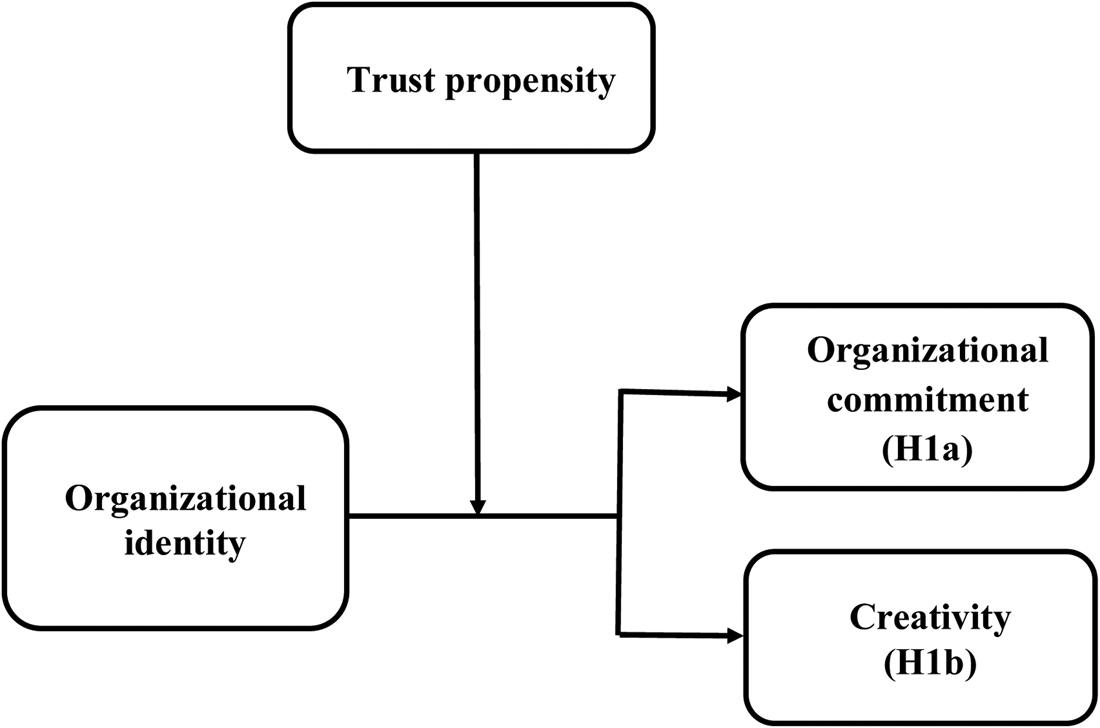
Based on SIT, we theorize that employees' social identity should be studied together with their personal identity to clearly understand the effect of social identity on employees' workplace outcomes. Particularly, we contend that personal identity or trust propensity will accentuate the positive relationship between social identity or organizational identity and employees' workplace outcomes (Figure 1). We chose creativity – the generation of useful and novel ideas to produce new goods, services, processes, and procedures (Oldham & Cummings, Reference Oldham and Cummings1996; Zhou & George, Reference Zhou and George2001) – and organizational commitment – ‘the employee's emotional attachment, identification with, and involvement in the organization’ (Meyer & Allen, Reference Meyer and Allen1991: 67) – as employees' workplace outcomes in our study because the two outcomes are the most studied outcomes of SIT (Ashforth & Mael, Reference Ashforth and Mael1989; Bednar et al., Reference Bednar, Galvin, Ashforth and Hafermalz2020; Nifadkar & Bauer, Reference Nifadkar and Bauer2016; Randel et al., Reference Randel, Galvin, Shore, Ehrhart, Chung, Dean and Kedharnath2018; Ravasi, Rindova, & Stigliani, Reference Ravasi, Rindova and Stigliani2019; Riketta, Reference Riketta2005; Zhou, Dou, & Wang, Reference Zhou, Dou and Wang2019).
Research model.

Our theoretical contributions to the associated literatures are twofold. First, we investigate the accentuating influence of personal identity (trust propensity) on the association between employees' social identity and their work-related attitudes and behaviors. Borrowing from SIT that contends that personal identity or personality traits such as trust propensity is a boundary setter in the association between organizational identity and employees' work-related attitudes and behaviors (e.g., Ashforth & Mael, Reference Ashforth and Mael1989; Tierney, Reference Tierney, Shalley, Zhou and Hitt2015), we merge SIT with personality theory (trust propensity as an indicator of personality traits) to identify the accentuating effect of personal identity on the relationship between social identity and employees' workplace outcomes. SIT has managed to show the pertinence of probing social identity as a self-concept construct to predict employees' creativity and organizational commitment (e.g., Ashforth & Mael, Reference Ashforth and Mael1989; Bednar et al., Reference Bednar, Galvin, Ashforth and Hafermalz2020; Riketta, Reference Riketta2005; Zhou, Dou, & Wang, Reference Zhou, Dou and Wang2019). But what we do not know yet is whether personal identity makes a difference in understanding this relationship and what difference it is if it makes a difference.
Second, we add to the personal identity literature where prior empirical studies have considered trust propensity primarily as a direct antecedent of employees' creativity and organizational commitment (Colquitt, Scott, & LePine, Reference Colquitt, Scott and LePine2007; Dirks & Ferrin, Reference Dirks and Ferrin2001; Meyer & Allen, Reference Meyer and Allen1997; Peralta & Saldanha, Reference Peralta and Saldanha2014). By investigating how trust propensity plays a role as a moderator of social identity, our research offers evidence to the theoretical studies (e.g., Ashforth & Mael, Reference Ashforth and Mael1989; Tierney, Reference Tierney, Shalley, Zhou and Hitt2015) advocating that trust propensity interacts with social identity to predict employees' workplace outcomes, a contention that previous studies have not empirically investigated. In this way, our study aims to contribute to the literature by investigating personal identity (trust propensity) as an accentuator of the influence of social identity on employees' workplace outcomes, as a contribution to prior research investigating its social identity value.
Specifically, prior studies have shown that social identity predicts organizational commitment and creativity, and that personal identity is a unique predictor of organizational commitment and creativity, insisting that social identity and personal identity individually affect organizational commitment and creativity. These direct effect models provide only a limited understanding of the identity effect on employees' workplace outcomes. Thus, based on SIT, our most unique theoretical contribution is that organizational commitment and creativity are predicted by social identity, personal identity, and social identity*personal identity (moderating effect), thus providing a more advanced understanding of identity effect on employees' workplace outcomes beyond the ones provided by the direct effect models of prior studies.
Theory and hypotheses
Social identity theory: The effect of social identity or organizational identity/organizational belongingness on employees' workplace outcomes
Social identity is defined as ‘the perception of oneness with or belongingness to some human aggregate’ and it is accepted that ‘organizational identification is a specific form of social identification’ (Ashforth & Mael, Reference Ashforth and Mael1989: 21 and 22, respectively). SIT accepts that individuals classify themselves and others into many social categories (Ashforth, Harrison, & Corley, Reference Ashforth, Harrison and Corley2008; Lee, Rhee, & Park, Reference Lee, Rhee and Park2020; Tajfel & Turner, Reference Tajfel, Turner, Worchel and Austin1985; Turner, Reference Turner and Tajfel1982) within which they may benefit from a unique categorical schema (Ashforth, Harrison, & Corley, Reference Ashforth, Harrison and Corley2008; Ashforth & Mael, Reference Ashforth and Mael1989; Turner & Onorato, Reference Turner, Onorato, Tyler, Kramer and John1999). Each unique schema shapes the self-concept of the individual (e.g. Ashforth, Harrison, & Corley, Reference Ashforth, Harrison and Corley2008). Therefore, understanding employees' workplace outcomes requires knowing the details of an employee's self-concept. SIT clarified that self-concept is composed of personal identity or psychological traits and social identity or salient group classifications (e.g., Ashforth, Harrison, & Corley, Reference Ashforth, Harrison and Corley2008; Ashforth & Mael, Reference Ashforth and Mael1989; Charness & Chen, Reference Charness and Chen2020: Tajfel & Turner, Reference Tajfel, Turner, Worchel and Austin1985). The self-concept is a ‘relatively enduring, stable cognitive structure’ (Turner & Onorato, Reference Turner, Onorato, Tyler, Kramer and John1999: 12) composed of varying levels of personal identity and social identity (Turner & Onorato, Reference Turner, Onorato, Tyler, Kramer and John1999). As it is discussed in identity-as-shared perceptions and identity-as-institutional claims literature, self-concept is the basic bone to understand social identity and personal identity (e.g., Ashforth, Harrison, & Corley, Reference Ashforth, Harrison and Corley2008; Whetten & Mackey, Reference Whetten and Mackey2002).
A form of social identity, organizational identification increases the internalization of organizational and group values, norms, attitudes, and behaviors (Ashforth & Mael, Reference Ashforth and Mael1989; Turner, Reference Turner and Lawler1985), making employees alike. Organizational identity is also an employee's response to the question of ‘who we are as an organization’ and ‘what values distinguish our organization from the rest of the organizations’ (Albert & Whetten, Reference Albert and Whetten1985). When employees share similar values about their organization, they are identified with their respective organizations. This leads them to sense belongingness within that organization and, thus, affectively commit to the organization. As a result, organizational identity encourages employees to show and enjoy identity-based activities, fostering their belongingness to their organization (Ashforth & Mael, Reference Ashforth and Mael1989).
SIT contends that cohesive, cooperative, altruistic, and loyal behaviors (Ashforth & Mael, Reference Ashforth and Mael1989; Godard, Reference Godard1991) are the expected behaviors from employees because of high social identity, leading to high organizational commitment (Ellemers, De Gilder, & Haslam, Reference Ellemers, De Gilder and Haslam2004). This is because the expected behaviors help employees to connect to and communicate with colleagues at a higher rate, leading employees to internalize the organization's values, norms, attitudes, and behaviors (Ashforth & Mael, Reference Ashforth and Mael1989; Turner, Reference Tajfel, Turner, Worchel and Austin1985). More specifically, ‘identification with an organization enhances support for and commitment to it’ (Ashforth & Mael, Reference Ashforth and Mael1989: 26). This theoretical stance has found wide empirical support even in meta-analytical studies (Haslam, Eggins, & Reynolds, Reference Haslam, Eggins and Reynolds2003; Lee, Park, & Koo, Reference Lee, Park and Koo2015; Riketta, Reference Riketta2005). Individuals who integrate social identity into their self-concept are intrinsically motivated, since organizational identity gives meaning to the resources gained through organizational membership (Haslam, Reference Haslam2004). Given the theoretical stance of SIT, we continue in the present study to add that the connection and communication among employees will be higher to the extent that the level of trust propensity of employees is higher, making employees internalize organizational values, norms, attitudes, and behaviors at a higher rate, thus, strengthening the relationship between social identity and organizational commitment.
SIT also posits that individuals with high social identity feel energized by different experiences (Ellemers, Spears, & Doosje, Reference Ellemers, Spears and Doosje2002), increasing the knowledge base of the individuals that constitutes the basic ingredient of creativity. More specifically, individuals with high organizational identity will invest in sustained efforts to reach organizational goals (Hirst, Van Dick, & Van Knippenberg, Reference Hirst, Van Dick and Van Knippenberg2009), will be persistent in encouraging knowledge acquisition and sharing among organizational members (Hirst, Van Dick, & Van Knippenberg, Reference Hirst, Van Dick and Van Knippenberg2009), and will be a catalyst to combine the unique knowledge from internal and external sources to address organizations' unique problems (Fisher & Ford, Reference Fisher and Ford1998; Karatepe, Reference Karatepe2016), thus leading to a high level of creativity (e.g., Farmer, Tierney, & Kung-McIntyre, Reference Farmer, Tierney and Kung-McIntyre2003; Haslam, Eggins, & Reynolds, Reference Haslam, Eggins and Reynolds2003; Randel et al., Reference Randel, Galvin, Shore, Ehrhart, Chung, Dean and Kedharnath2018). Contrarily, SIT posits that high social identity causes decreased creativity because employees become overdependent on organizational directions and the organizational past through path dependence (Hirst, Van Dick, & Van Knippenberg, Reference Hirst, Van Dick and Van Knippenberg2009; Ravasi, Rindova, & Stigliani, Reference Ravasi, Rindova and Stigliani2019; Rotondi, Reference Rotondi1975). Research has confirmed this negative relationship (Rotondi, Reference Rotondi1975), requiring further investigation of the boundary conditions.
Personal identity or trust propensity
Personal identity is ‘being unique or different’. Personal identity is an idiosyncratic characteristic of an employee at work including psychological traits (Ashforth & Mael, Reference Ashforth and Mael1989) such as trust propensity that distinguish one employee from another. Trust propensity is accepted as a personality trait, stable across situations (Mayer, Davis, & Schoorman, Reference Mayer, Davis and Schoorman1995). It is also named as dispositional trust (Kramer, Reference Kramer1999) and generalized trust (Stack, Reference Stack, London and Exner1978). Individuals with a high level of trust propensity will equally trust in-group and out-group members (Huff & Kelley, Reference Huff and Kelley2003). Therefore, trust propensity reflects a tendency of ‘general willingness to trust others’ (Mayer, Davis, & Schoorman, Reference Mayer, Davis and Schoorman1995). Individuals with a high level of trust propensity can build a high level of social exchange networks by following the rule of reciprocity that brings them the information and connections to develop the knowledge base via the knowledge sharing needed for creativity (Burt, Reference Burt1992; Colquitt, Scott, & LePine, Reference Colquitt, Scott and LePine2007). A low level of trust propensity restricts knowledge sharing (Peralta & Saldanha, Reference Peralta and Saldanha2014), causing a low level of creativity, because the low level of trust propensity restricts interaction required as opportunities for exchange of information. Studies, including meta-analytical ones, have shown that trust propensity predicts organizational commitment because trust propensity increases social exchange relationships at work (Colquitt, Scott, & LePine, Reference Colquitt, Scott and LePine2007; Nambudiri, Reference Nambudiri2012).
Trust propensity refers to an employee's tendency to think about others' important personal characteristics such as confidence, keeping promises, caring about others, honesty, and trustworthiness (Huff & Kelley, Reference Huff and Kelley2003). Individuals with high trust propensity will restrict dubious feelings about others' intentions and behaviors, be positive about organizational values, norms, attitudes, and behaviors. Thus, it increases their organizational commitment and creativity as compared to individuals having low trust propensity (Ashforth & Mael, Reference Ashforth and Mael1989; Haslam, Reference Haslam2004; Turner, Reference Tajfel, Turner, Worchel and Austin1985). Therefore, trust propensity facilitates the effect of employees' organizational identity on their creativity and organizational commitment through influencing how employees enact their identity, as trust propensity may help to reveal others' personal characteristics such as confidence, honesty, and trustworthiness.
Prior studies have shown that trust propensity, trust, and trustworthiness are different constructs (e.g., Burke, Sims, Lazzara, & Salas, Reference Burke, Sims, Lazzara and Salas2007; Colquitt, Scott, & LePine, Reference Colquitt, Scott and LePine2007; Dirks & Ferrin, Reference Dirks and Ferrin2002; Frazier, Johnson, & Fainshmidt, Reference Frazier, Johnson and Fainshmidt2013). Trust is defined as ‘the willingness of a party to be vulnerable to the actions of another party based on the expectation that the other party will perform a particular action important to the trustor, irrespective of the ability to monitor or control the other party’ whereas trust propensity is ‘the general willingness to trust others (Mayer, Davis, & Schoorman, Reference Mayer, Davis and Schoorman1995: 712 and 715, respectively). Trustworthiness is the characteristics of a trustee, consisting of ability, benevolence, and integrity (Mayer et al., 1995). Trust propensity is a ‘stable within-party factor that will affect the likelihood the party will trust’ (Mayer, Davis, & Schoorman, Reference Mayer, Davis and Schoorman1995: 715). Employees are different as to the level they trusted other individuals in general (Rotter, Reference Rotter1967). Trust propensity is ‘a generalized expectancy that the oral or written statement of other people can be relied upon’ (1967: 653). To be more specific, trust propensity and the factors of trustworthiness are the determinants of trust (e.g., Colquitt, Scott, & LePine, Reference Colquitt, Scott and LePine2007; Mayer et al., 1995). Trust is a willingness to take risks whereas trust propensity is a willingness to trust others (Mayer, Davis, & Schoorman, Reference Mayer, Davis and Schoorman1995). Theoretical and meta-analytical studies have also shown the differences of these three constructs (e.g., Burke et al., Reference Burke, Sims, Lazzara and Salas2007; Colquitt, Scott, & LePine, Reference Colquitt, Scott and LePine2007; Dirks & Ferrin, Reference Dirks and Ferrin2002; Huff & Kelley, Reference Huff and Kelley2003). Even studies that focus on the development of scales on trust propensity acknowledge the differences (e.g., Costa & Anderson, Reference Costa and Anderson2011; Frazier, Johnson, & Fainshmidt, Reference Frazier, Johnson and Fainshmidt2013). Trust propensity is a personality trait (Mayer et al., 1995), which makes it a unique element of personal identity as we have previously discussed (Ashforth & Mael, Reference Ashforth and Mael1989).
Trust propensity is relevant in novel situations (Ferguson & Peterson, Reference Ferguson and Peterson2015) such as creativity because trust propensity affects the extent to which individuals observe and interact with others (Dirks & Ferrin, Reference Dirks and Ferrin2001), and trust propensity influences employees’ formal and informal learning (Rotter, Reference Rotter1967). More specifically, a low level of trust propensity leads to poor group performance by lowering trust, increasing relationship conflict, and lowering experienced intragroup trust (Ferguson & Peterson, Reference Ferguson and Peterson2015). Learning for creativity depends on the verbal and written statements of other employees at work. What employees learn is affected by the extent to which they believe their colleagues at work without independent evidence (Rotter, Reference Rotter1967).
Trust propensity influences all human relationships (Rotter, Reference Rotter1980). Employees whose level of trust propensity is high will lie, cheat, or steal less; will give others a second chance required for creativity and innovation; and will respect the rights of others (Rotter, Reference Rotter1980) especially when employees have also high level of social identity (Zhou, Dou, & Wang, Reference Zhou, Dou and Wang2019). Therefore, they will have high organizational commitment (Colquitt, Scott, & LePine, Reference Colquitt, Scott and LePine2007). They are also happy, peaceful, and well-adjusted (Rotter, Reference Rotter1980). On the other hand, employees whose trust propensity is low will cheat more often than employees whose trust propensity is high (Rotter, Reference Rotter1980). Employees whose trust propensity is high are happier, more ethical, and more desirable as a close colleague than employees whose trust propensity is low (Rotter, Reference Rotter1980). High trust propensity leads employees to engage in trusting behaviors through learned expectations for desired behaviors, such as creativity and organizational commitment (Currall & Judge, Reference Currall and Judge1995).
Employees with high trust propensity believe that other organizational members keep their promises (Mayer, Davis, & Schoorman, Reference Mayer, Davis and Schoorman1995; Mayer & Gavin, Reference Mayer and Gavin2005); thus, they do not have to worry about ‘watching their backs’ (Baer, Matta, Kim, Welsh, & Garud, Reference Baer, Matta, Kim, Welsh and Garud2018; Mayer & Gavin, Reference Mayer and Gavin2005; Ozyilmaz, Erdogan, & Karaeminogullari, Reference Ozyilmaz, Erdogan and Karaeminogullari2018), causing employees to focus on activities corresponding with salient aspects of their organizational identity and to be more committed and cooperative (Yao, Zhang, & Brett, Reference Yao, Zhang and Brett2017). In contrast, employees with low trust propensity believe that others cannot be trusted; thus, they become skeptical about the organization and its members, restrict their activities aligned with salient aspects of their organization, become less committed and less cooperative, and, as a result, stay away from organizational activities to protect themselves from undesired consequences.
To advance the research above, we contend that a high level of trust propensity (being unique or different) will accentuate (moderate) the positive relationship between organizational identity (being similar or common) and employees' workplace outcomes because ‘social identity process are also motivated by a need to reduce subjective uncertainty about one's perceptions, attitudes, feelings, and behaviors and, ultimately, one's self-concept and place within the social world’ (Hogg & Terry, Reference Hogg and Terry2000: 124) and because high levels of trust propensity reduce subjective uncertainty, allowing employees' resources to concentrate on important work-related outcomes such as organizational commitment and creativity (Ashforth, Harrison, & Corley, Reference Ashforth, Harrison and Corley2008; Conroy et al., Reference Conroy, Henle, Shore and Stelman2017; Cooper & Thatcher, Reference Cooper and Thatcher2010) whereas low levels of trust propensity increase subjective uncertainty, restricting the effect of organizational identity on employees' workplace outcomes.
Trust propensity as a moderator of the relationship between social identity and affective organizational commitment
Social identity is considered as a precursor for developing organizational commitment (Ashforth & Mael, Reference Ashforth and Mael1989; Ellemers, Spears, & Doosje, Reference Ellemers, Spears and Doosje2002; Lux, Grover, & Teo, Reference Lux, Grover and Teo2019; Meyer, Becker, & Van Dick, Reference Meyer, Becker and Van Dick2006), a finding supported in meta-analytical studies (Lee, Park, & Koo, Reference Lee, Park and Koo2015). SIT has also indicated that ‘the relationship between identification and performance is moderated by and contingent on, a number of factors; … Indeed, both experimental and field research have painted a picture of the identification-performance relationship as moderated … Individual differences can also moderate’ (Van Knippenberg & Hogg, Reference Van Knippenberg, Hogg, Ferris, Johnson and Sedikides2018: 74). The basic reason is that ‘identification motivates organization-serving attitudes and behaviors’ and that the effect of social identity on employee attitudes and behaviors is based on ‘moderating factors that channel the identification-based motivation towards certain behaviors’ (Van Knippenberg & Hogg, Reference Van Knippenberg, Hogg, Ferris, Johnson and Sedikides2018: 75). SIT also contends that ‘the notion of motivation to serve the organization's interest cannot mechanically be applied to all positive organizational attitudes and behavior unconditionally’ (Van Knippenberg & Hogg, Reference Van Knippenberg, Hogg, Ferris, Johnson and Sedikides2018: 75).
SIT contends further that social identity decreases uncertainty, including subjective uncertainty about an individual's attitudes, feelings, perceptions, and behaviors, thus increasing human motivation to commit to an organization (Ashforth & Mael, Reference Ashforth and Mael1989; Hogg & Terry, Reference Hogg and Terry2000; Van Dick, Van Knippenberg, Kerschreiter, Hertel, & Wieseke, Reference Van Dick, Van Knippenberg, Kerschreiter, Hertel and Wieseke2008). Given that individuals high in trust propensity are confident about others' behavior and see others as promise keepers, they are more certain individuals and, as a result, are more motivated, thus showing more organizational commitment at work through persistence of effort due to their motivation (Albert, Ashforth, & Dutton, Reference Albert, Ashforth and Dutton2000). Contrarily, individuals low in trust propensity are less confident about others' behavior and see others less often as promise keepers, thus showing less commitment at work through restricted efforts as a result of demotivation that something unexpected would happen that would harm the individual. Prior research has indicated that in a social identity context, employees are more committed to the organization when they experience that the words and deeds of the organization are consistent and, as a result, feel that the organization is truthful when the organization communicates with its employees (Ellemers, Kingma, Van de Burgt, & Barreto, Reference Ellemers, Kingma, Van de Burgt and Barreto2011; Kane, Argote, & Levine, Reference Kane, Argote and Levine2005).
We contend further that personal identity recognizes personality traits as important to understand employee behavior in the workplace, and it acts as a boundary setter for the influence of social identity that recognizes social groups (e.g., organizations, groups) and their norms as important for employees' organizational commitment (Conroy et al., Reference Conroy, Henle, Shore and Stelman2017; Gaertner, Sedikides, & Graetz, Reference Gaertner, Sedikides and Graetz1999; Van Dick et al., Reference Van Dick, Van Knippenberg, Kerschreiter, Hertel and Wieseke2008; Van Knippenberg & Hogg, Reference Van Knippenberg, Hogg, Ferris, Johnson and Sedikides2018). This is because when employees' trust propensity is high, employees accept the norms, environment, attitudes, and behaviors in the organization as more legitimate, becoming less dubious about the normative behaviors, attitudes, intentions, and emotions of its members, thus making the influence of social identity on affective organizational commitment stronger (Ashforth & Mael, Reference Ashforth and Mael1989; Bouncken & Tiberius, Reference Bouncken and Tiberius2021; Fisher, Neubert, & Burnell, Reference Fisher, Neubert and Burnell2021; Turner, Reference Tajfel, Turner, Worchel and Austin1985). Contrarily, when employees' trust propensity is low, employees accept the norms, environment, intentions, attitudes, and behaviors in the organization unreasonable or illegitimate, becoming more dubious about the attitudes, normative behaviors, intentions, and emotions of its members, thus making the influence of social identity on affective organizational commitment weaker (e.g., Bouncken & Tiberius, Reference Bouncken and Tiberius2021; Fisher, Neubert, & Burnell, Reference Fisher, Neubert and Burnell2021; Navis & Glynn, Reference Navis and Glynn2011).
Trust propensity as a moderator of the relationship between social identity and creativity
SIT has posited and revealed that social identity leads to creativity positively because it creates impermeable boundaries that form secure relationships among organizational members (Audenaert & Decrames, Reference Audenaert and Decrames2018; Dukerich, Golden, & Shortell, Reference Dukerich, Golden and Shortell2002; Haslam, Reference Haslam2004; Piening, Salge, Antons, & Kreiner, Reference Piening, Salge, Antons and Kreiner2020); it leads to incremental creativity, but not radical creativity (Madjar, Greenberg, & Chen, Reference Madjar, Greenberg and Chen2011); and, finally, social identity leads to creativity negatively for scientists and engineers (Rotondi, Reference Rotondi1975) because categorization of one's self as identifying with an organization creates depersonalization that inhibits divergent thinking, leading to decreased creativity (Haslam, Ryan, Postmes, Spears, Jetten, & Webley, Reference Haslam, Ryan, Postmes, Spears, Jetten and Webley2006; Javed, Rawwas, Khandai, Shahid, & Tayyeb, Reference Javed, Rawwas, Khandai, Shahid and Tayyeb2018; Tajfel, Reference Tajfel1982; Turner & Reynolds, Reference Turner, Reynolds, Van Lange, Kruglanski and Higgins2012). In addition, employees with high organizational identity may view work-related information subjectively, leading to below-average decision quality and, as a result, poor creativity (Michel & Jehn, Reference Michel, Jehn and Polzer2003). Finally, Zhou and George (Reference Zhou and George2001) have clearly shown that creativity is increased when employees recommend new ways to attain goals and objectives and when employees are not scared to take risks. Preceding result indicates clearly that there are boundary conditions of the relationship between social identity and creativity.
We contend that when employees' trust propensity is high, those with high organizational identity see work-related information objectively rather than subjectively because high-trust propensity individuals are confident about others' behavior and believe that others' intentions and behaviors can be trusted (Huff & Kelley, Reference Huff and Kelley2003), increasing the motivation of employees to persist in their creativity efforts further, thus increasing their creativity. High trust propensity introduces high trust into the work environment to amplify the effect of organizational identity on creativity, because individuals with high organizational identity and high trust propensity know that their endeavors will be reciprocated by the other members of the organization in the form of cooperation (Conroy et al., Reference Conroy, Henle, Shore and Stelman2017; Kane, Argote, & Levine, Reference Kane, Argote and Levine2005; Ozyilmaz, Erdogan, & Karaeminogullari, Reference Ozyilmaz, Erdogan and Karaeminogullari2018), leading to a higher level of knowledge sharing and, as a result, to a higher level of creativity. Low trust propensity, on the other hand, creates a dubious work environment, which causes conflict and restricts cooperation among organizational members, leading to a lesser level of knowledge sharing and decision quality, and, as a result, making the influence of organizational identity on creativity weaker. Our thinking is well aligned with SIT's contention that ‘studying multiple identifications concurrently is a valuable step when considering well-being and performance outcomes’ (Conroy et al., Reference Conroy, Henle, Shore and Stelman2017: 197). Thus, we expect that the relation between organizational belongingness/identity and creativity will be more positive when trust propensity is high.
Hypothesis 1. Trust propensity will interact with organizational identity to influence (1a) organizational commitment and (1b) creativity such that the relationship between organizational identity and the outcomes will be more positive when trust propensity is high but less positive when trust propensity is low.
Study 1: methods
Sample and procedures
We collected our data from participants (employees and supervisors) of a state-supported development organization in Turkey. The organization aims to financially support projects that help develop regions. Our study took place in city/region offices of the organization throughout the country. The HR and information systems departments helped us to gather data through Survey Monkey after we gained the collaboration of the CEO of the organization. Participating employees are coordinators, experts (finance, accounting, investment, contract, etc.), and support personnel (interpreter, record-keeper, managerial assistant, etc.) who have to be creative and committed to find viable project.
We collected employee data using two surveys (T1 and T2) distributed one month apart, followed by a supervisor survey (T3) that was executed one month after the last employee survey was completed. The Time 1 (T1) survey collected data on many control variables including demographics (age, sex, marital status, education, and tenure with the current organization) and our moderating variable, trust propensity. The Time 2 (T2) survey included a measure of organizational belongingness/identity, our independent variable. Finally, the Time 3 (T3) survey included a supervisor measure of creativity and organizational commitment. We instructed respondents to complete the questionnaires in a place where they felt most comfortable to respond. We emphasized in our cover letter, endorsed by the president of the organization, that participation in the study was voluntary and that respondent anonymity would be protected.
We distributed 460 surveys and collected 441 completed surveys from employees in the first round of survey distribution and collection step (response rate [RR] = 96%). In the second survey, we submitted 441 surveys and collected 365 surveys (RR = 83%). We distributed the third survey questionnaires (the supervisor survey) to all 117 direct supervisors of 460 participating employees and collected 88 completed surveys from employees' supervisors (RR = 75%). After we dropped surveys with missing time periods, we kept 153 dyads (153 employees (RR = 33% for employees) and their 71 supervisors (RR = 75% for employees' supervisors)) to test our hypotheses. The 153 employees were 69.28% male, 65% married, 32.78 years of age (SD = 5.11), had 16.73 (SD = 1.62) years of education, and had 3.97 (SD = 1.42) years of experience.
Our final RR was 33% as we have discussed previously, requiring us to check the attrition bias in our sample. Because we collected our data on participating employees at T1 (trust propensity, age, sex, marital status, education, and tenure) and T2 (organizational belongingness), we followed Miller and Hollist (Reference Miller, Hollist and Salkind2007) procedure to create a binary dependent variable. Accordingly, we defined droppers = 0 (prematurely dropped out of the study) and stayers = 1 (remained in the sample, participated in all three questionnaires) to create a binary dependent variable. We included trust propensity, organizational belongingness, age, sex, marital status, education, and organizational tenure as independent variables to estimate the binary dependent variable in a logistic regression model. As a result, given that the coefficients of independent variables are nonsignificant for trust propensity (B = .291, SE = .196, Exp[B] = 1.338, p = .137), organizational belongingness (B = −.219, SE = .209, Exp[B] = .804, p = .296), age (B = .002, SE = .028, Exp[B] = 1.002, p = .944), gender (B = .033, SE = .282, Exp[B] = 1.033, p = .908), marital status (B = .306, SE = .281, Exp[B] = 1.359, p = .276), education (B = −.037, SE = .084, Exp[B] = .964, p = .658), and organizational tenure (B = .158 SE = .101, Exp[B] = 1.113, p = .294), we argue that there is no attrition bias in the study.
Measures
Brislin (Reference Brislin1970) set up a translation/back translation methodology for scholars to use a scale developed and tested in one language (English in our case) for use in a different language (Turkish in our case). What we did was to follow Brislin (Reference Brislin1970) methodology.
Organizational belongingness
To measure organizational belongingness, we used the four-item organizational belongingness scale by Godard (Reference Godard2001). We asked the respondents to report (using a five-point scale, ranging from 1 = ‘strongly disagree’ to 5 = ‘strongly agree’) the degree to which they agreed with each item. A sample item was ‘When at work, I really feel like I belong’ (α = .75).
Trust propensity
We assessed trust propensity using the five-item trust propensity scale by Huff and Kelley (Reference Huff and Kelley2003). We asked the respondents to report (using a five-point scale, ranging from 1 = ‘strongly disagree’ to 5 = ‘strongly agree’) the degree to which they agreed with each item. A sample item was ‘I believe that people usually keep their promises’ (α = .77).
Creativity
We measured creativity levels of employees via the employee creativity scale by Zhou and George (Reference Zhou and George2001). We furnished the supervisors a number of 13 items that pertain to different sides of employees' creativity. Supervisors answered the following question when they rate, on a five-point Likert scale, their subordinates' creativity: To what extent do you think the following statement is a characteristic of your subordinate? (1 = not at all characteristic, 2 = a little bit, 3 = neutral, 4 = characteristic, 5 = very characteristic). A sample item was ‘This employee is a good source of creative ideas’ (α = .97).
Organizational commitment
For the measurement of organizational commitment, we used the eight-item affective organizational commitment scale by Meyer and Allen (Reference Meyer and Allen1997). We gave the supervisors eight items related to different sides of employees' organizational commitment. Supervisors answered the following question when they rate, on a five-point Likert scale, their subordinates' organizational commitment: To what extent do you think the following statement is a characteristic of your subordinate? (1 = not at all characteristic, 2 = a little bit, 3 = neutral, 4 = characteristic, 5 = very characteristic). A sample item was ‘This employee would be very happy to spend the rest of his/her career with this organization’ (α = .87).
We chose supervisors as the source of data for affective organizational commitment for three reasons. First, affective organizational commitment is defined as ‘the employee's emotional attachment to, identification with, and involvement in the organization’ (Meyer & Allen, Reference Meyer and Allen1991: 67). One component of this definition is ‘identification with,’ which is the same with our independent variable (organizational identity) in the present study. Therefore, this situation would highly likely create a multicollinearity problem even when we introduced a time lag when we collected affective organizational commitment data from the same participants although Ashforth and Mael (Reference Ashforth and Mael1989) made it very clear that organizational identification and commitment are different constructs. Second, we wanted to control for common method variance (Podsakoff, MacKenzie, & Podsakoff, Reference Podsako, MacKenzie and Podsako2012) by collecting data on the dependent variable (affective organizational commitment) from a different source (supervisors). Third, affective organizational commitment has some items such as ‘This employee really feels as if this organization's problems are his/her own,’ which is visible by supervisors as shown in the behaviors and statements of the subordinates, making supervisors a legitimate source for collecting data on affective organizational commitment of their subordinates. Because the reliability of affective organizational commitment is high and the correlation between organizational identity and affective organizational commitment is positive, significant, but not very strong in the present study as one would find in other similar studies, we argue that the results regarding the relationships including affective organizational commitment in the present study can be compared to the results regarding the same relationships found in similar other studies that collected affective organizational commitment data directly from employees.
Control variables
Drawing from earlier theoretical work, we controlled education because researchers (Amabile, Barsade, Mueller, & Staw, Reference Amabile, Barsade, Mueller and Staw2005; Farmer, Tierney, & Kung-McIntyre, Reference Farmer, Tierney and Kung-McIntyre2003; Meyer & Allen, Reference Meyer and Allen1997; Riketta, Reference Riketta2005) showed that employees who have unique educational experiences may develop unique workplace outcomes and behaviors. We controlled tenure because experience, for example, increases the knowledge base of employees in a specific area that may increase their creativity (Oldham & Cummings, Reference Oldham and Cummings1996; Riketta, Reference Riketta2005). We controlled marital status because married couples carry unique duties at home, influencing the degree of their organizational commitment and creativity (Meyer & Allen, Reference Meyer and Allen1997). Finally, research advocated that gender and age may explain the differences in creativity and organizational commitment because older employees, for example, may have more positive work-related experiences than their younger counterparts (Amabile et al., Reference Amabile, Barsade, Mueller and Staw2005; Hirst, Van Dick, & Van Knippenberg, Reference Hirst, Van Dick and Van Knippenberg2009; Meyer & Allen, Reference Meyer and Allen1997; Riketta, Reference Riketta2005).
Study 1: results
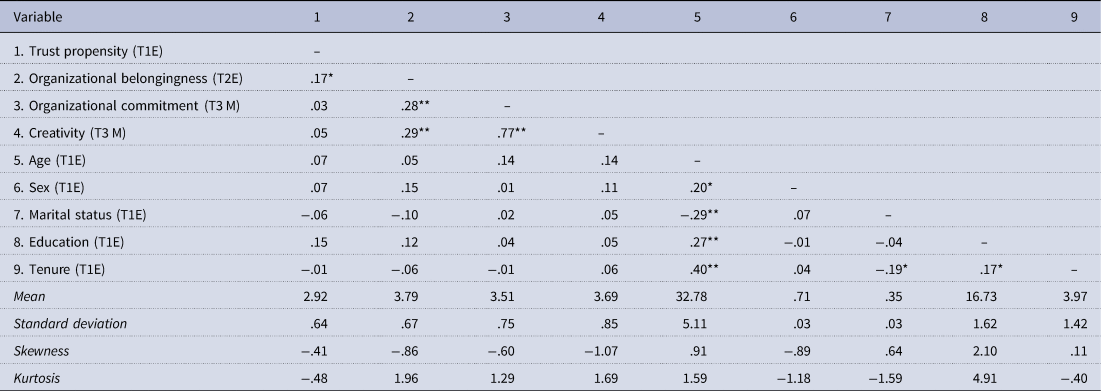
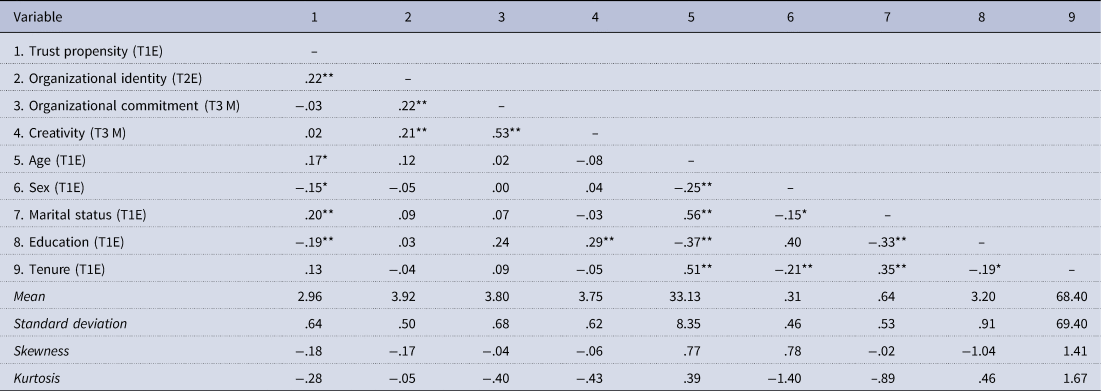
Table 1 shows means, standard deviations, and correlations. Before we tested the hypotheses, we probed discriminant and convergent validity of the study's measures by a sequence of confirmatory factor analysis (CFA) in the lavaan.survey (lavaan .6-3) (Oberski, Reference Oberski2014) in R (3.5.1). As an estimation method, we used robust maximum likelihood (RML). We used the lavaan.survey package in R because (1) we had clusters of employees reporting to the same manager (nested or dependent data), (2) all variables are at the within-level only, and (3) CFI, TLI, and RMSEA are insensitive to level-2 model misspecification, making fit indices less useful in a multilevel setting (Hsu, Kwok, Lin, & Acosta, Reference Hsu, Kwok, Lin and Acosta2015). In such circumstances, the lavaan.survey package handles data at within-level while considering the clustered or nested nature of data through the mean generalized design effect adjustment (Oberski, Reference Oberski2014). Due to the large number of items per scale and because parceling is suggested for unidimensional constructs, we created two parcels per latent variable, except for creativity, for which we used three parcels, in order to sustain a higher ratio of indicator to sample size (Williams, Vanderberg, & Edwards, Reference Williams, Vanderberg and Edwards2009). Following the item-to-construct balance approach (Little, Cunningham, Shahar, & Widaman, Reference Little, Cunningham, Shahar and Widaman2002), we began with the two indicators with the highest lambdas (λs = factor loadings) to anchor the two parcels. Later, the two indicators with the following highest-to-construct lambdas were added to the anchors in an inverted sequence to create balanced parcels. We repeated the same procedure by the time we distributed all remaining indicators to each parcel (Little et al., Reference Little, Cunningham, Shahar and Widaman2002). More specifically, we created 2 parcels/indicators for trust propensity as trust propensity 1 (λ = .717) and trust propensity 2 (λ = .951), which were originally 5 items/indicators. Trust propensity, as a result, has an average variance extracted value (AVE) of .709 and composite reliability (CR) of .827. In addition, we created 2 parcels for organizational belongingness as organizational belongingness 1 (λ = .715) and organizational belongingness 2 (λ = .983), which were originally 5 items. Organizational belongingness, as a result, has an AVE value of .739 and a CR of .847. Moreover, we created two parcels for organizational commitment as organizational commitment 1 (λ = .964) and organizational commitment 2 (λ = .767), which were originally 7 items. Organizational commitment has an AVE of .759 and a CR of .861. Finally, we created three parcels for creativity as creativity 1 (λ = .949), creativity 2 (λ = .963), and creativity 3 (λ = .978), which were originally 13 items. Creativity, as a result, has an AVE of .928 and a CR of .975. Each lambda is significant (p < .0001), positive, and bigger than .71. As an imputation method, we used a fully conditional specification method of the multiple imputation option in SPSS 25 so that we would not lose any data.
Means, Standard Deviations, and intercorrelations among variables
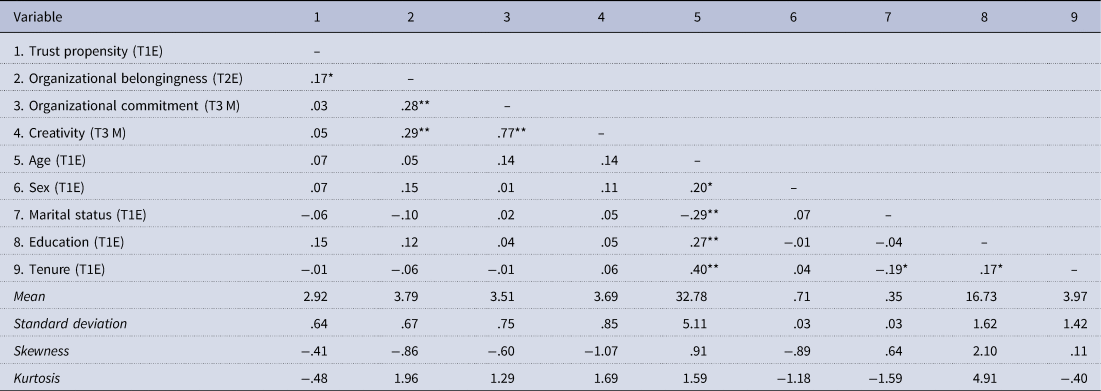
n = 153. * p < .05; ** p < .01. We coded marital status as follows: 1 = married, 0 = single. We coded sex to be 1 = male and 0 = female. We measured age, education, and organizational tenure in years. E = Employee and M = Manager in the table. Direct supervisors of the participating employees reported the data on the dependent variables, organizational commitment and creativity. T2 = 1 month after T1 and T3 = 1 month after T2, denoting the one-month time lag that we used to collect the data. T1 was Time 1, T2 was Time 2, and T3 was Time 3.
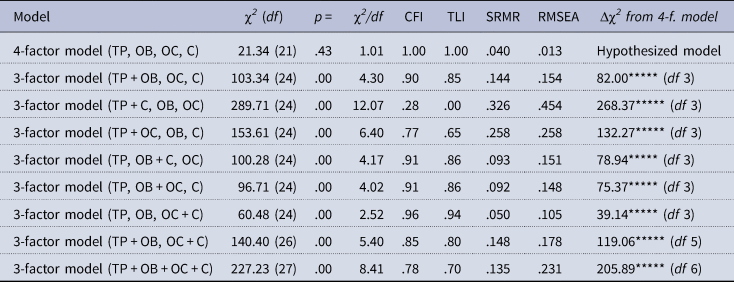
In order to investigate the convergent validity of our constructs, we loaded indicators for all four study variables on their associated latent factors that were allowed to co-vary. We examined model fit by means of χ2, standardized root-mean-square residual index (SRMR), comparative fit index (CFI), Tucker–Lewis index (TLI), and the root mean square error of approximation (RMSEA). More precisely, a good-fitting model is indicated by a nonsignificant χ2 (Kline, Reference Kline2016; Yuan, Bentler, & Zhang, Reference Yuan, Bentler and Zhang2005), has RMSEA values of less than .08 and CFI values of .90 or higher (Bentler & Bonett, Reference Bentler and Bonett1980; Browne & Cudeck, Reference Browne, Cudeck, Bollen and Long1993), and shows SRMR values close to .08 or below (Hu & Bentler, Reference Hu and Bentler1999). Correspondingly, the 4-factor model in Table 2 demonstrates a good fit of the study's data to the suggested measurement model (df = 21, χ2/df = 1.01, χ2 = 21.34, p = .43, CFI = 1.00, SRMR = .04. The good fit of our data to the measurement model along with the positive and significant (p < .00001) factor loadings larger than .71 (Table 2) suggest convergent validity (Bagozzi, Yi, & Phillips, Reference Bagozzi, Yi and Phillips1991). Following Fornell and Larcker (Reference Fornell and Larcker1981), we considered AVE values and composite reliabilities (CR) of our constructs to further investigate convergent validities of our constructs. Accordingly, AVE values are higher than .70 and CR values are higher than .82 for all of our constructs. These results are higher than minimum cut-off values of .50 for AVE and .60 for CR (Fornell & Larcker, Reference Fornell and Larcker1981), providing further evidence for convergent validity of our constructs.
Confirmatory factor analysis using lavaan.survey package in R
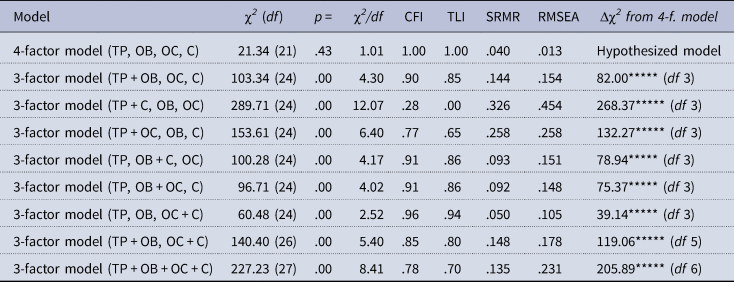
TP, trust propensity; OB, organizational belongingness; OC, organizational commitment; C, creativity.
n = 153 employees rated by their 71 direct supervisors on creativity and organizational commitment.
*****p < .00001.
We performed a series of nested model comparisons (three-factor models in Table 2) to investigate the discriminant validity of the study's constructs. The fit of our measurement model (4-factor model) to the study's data is much significantly better than the following alternative models in which two factors were combined to be one factor: (1) trust propensity-organizational belongingness (Δχ2 [Δdf] = 82.00(3), p < .00001), (2) trust propensity-creativity (Δχ2 [Δdf] = 268.37(3), p < .00001), (3) trust propensity-organizational commitment (Δχ2 [Δdf] = 132.27(3), p < .00001), (4) organizational belongingness-creativity (Δχ2 [Δdf] = 78.94(3), p < .00001), (5) organizational belongingness-organizational commitment (Δχ2 [Δdf] = 75.37(3), p < .00001), and (6) creativity-organizational commitment (Δχ2 [Δdf] = 39,14(3), p < .00001). Therefore, these results assure that discriminant validity is achieved in the present study. In addition, we used a more stringent test of Fornell and Larcker (Reference Fornell and Larcker1981) criterion to advance our investigation on discriminant validity of our constructs. Accordingly, given AVEs and correlations of the associated variables among the main variables of our study in Table 1, we are ensured that each AVE value is much higher than all of the r-square values of the associated variables in Table 1, providing further evidence for the discriminant validity of our constructs.
Given that we had nested data because 71 supervisors rated their 153 subordinates, we employed random coefficient regression procedures in GENLINMIXED (generalized linear mixed models) command in SPSS 25. The intraclass correlation coefficients (ICCs) for the study's variables were .36, .30, .08, and .00 for organizational commitment, creativity, trust propensity, and organizational belongingness, respectively. Given these ICCs, prior research suggest that observations are dependent, confirming our choice of multilevel modeling to deal with the data (Snijders & Bosker, Reference Snijders and Bosker2012). We specified our models with random intercepts and fixed slopes at the within-group level with dependent variables permitted to vary at within- and between-group levels. We used RML as our estimator. We grand-mean centered all independent variables and then created the interaction term using the grand-mean centered independent variables before the analyses. We investigated significant interactions using simple slope tests, with low and high values defined as one standard deviation below and above the mean (Aiken & West, Reference Aiken and West1991). We benefited from the Dawson (Reference Dawson2014) method and the related spreadsheet to interpret and plot all interactions.
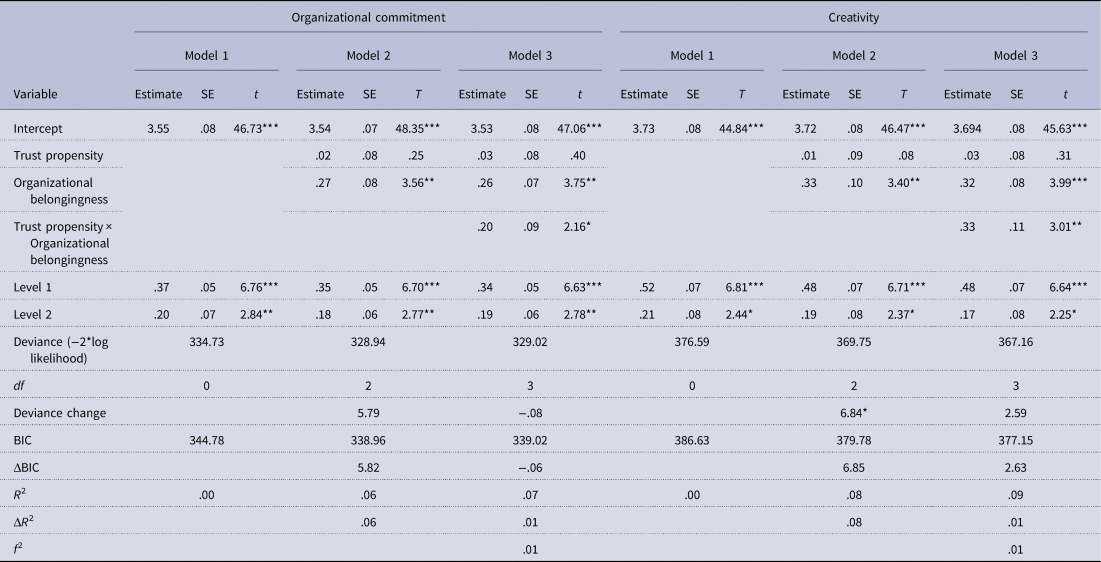
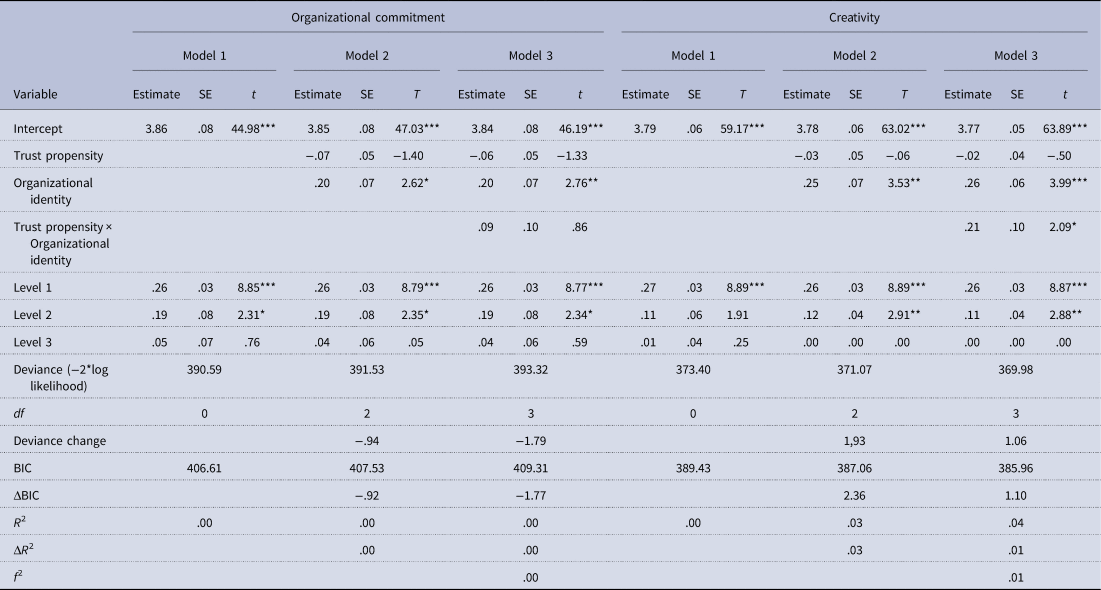
We constructed three models for each of our two dependent variables, organizational commitment and creativity, when we tested our hypotheses. In Model 1, we entered only the intercept as the predictor at within-level, given the fact that no control variable was associated with our moderator and dependent variables (Table 3). In Model 2, we added the grand-mean centered organizational belongingness and trust propensity as predictors of the intercept at the within-level. We eventually added our moderator in Model 3. As a decision rule, we decided that a hypothesis is supported whenever results revealed a significant coefficient for the interaction term in Model 3 (Dawson, Reference Dawson2014; Kline, Reference Kline2016; Williams, Vanderberg, & Edwards, Reference Williams, Vanderberg and Edwards2009).
Tests of Hypothesis 1a and Hypothesis 1b
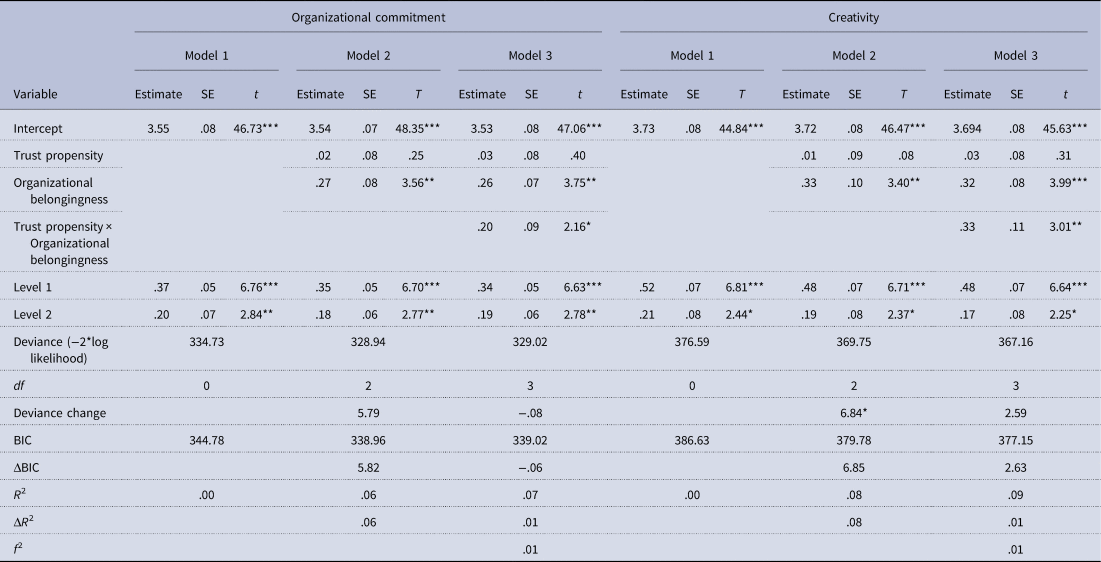
n = 153 employees, n = 71 supervisors rating employees' creativity and organizational commitment. * p < .05; ** p < .01; *** p < .001. Level 1 refers to residual effect variance. Level 2 refers to random effect variance due to supervisor rating differences.
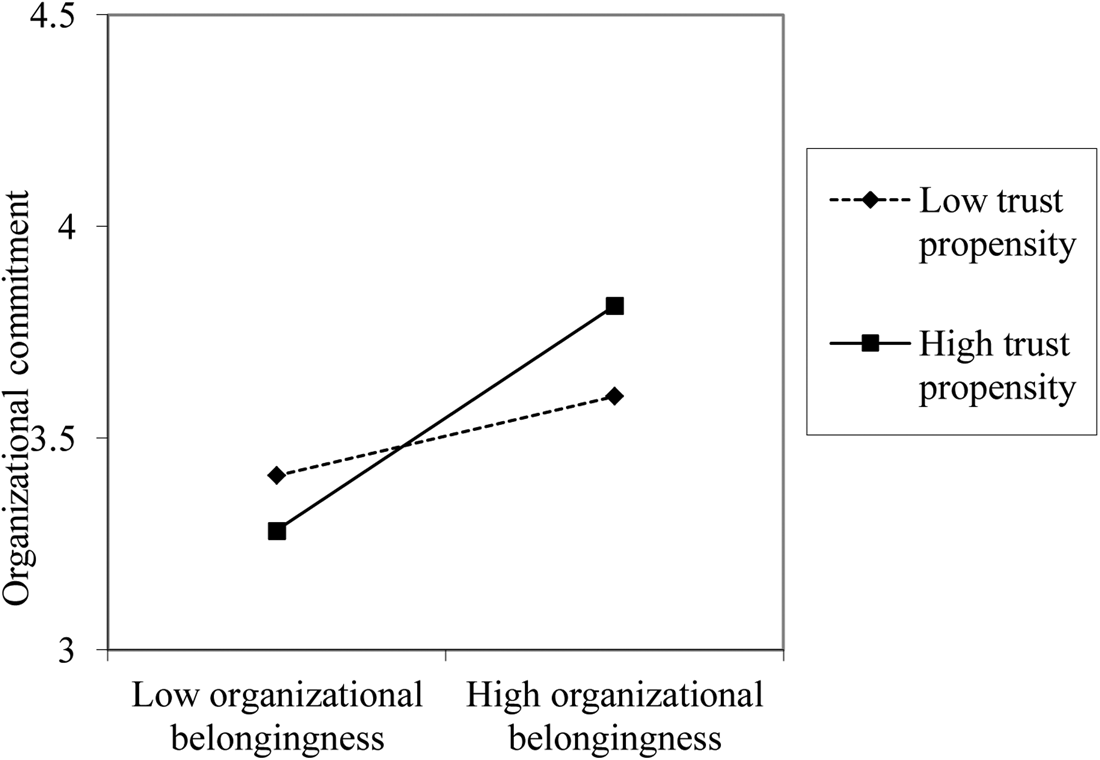
Our results support Hypothesis 1a (Table 3) (Estimate[E] = .20, SE = .09, t = 2.16, p < .05). Accordingly, organizational belongingness had a stronger positive effect on organizational commitment when participants possessed higher levels of trust propensity (Figure 2). Our simple slope analysis informed further that organizational belongingness showed a stronger positive association with organizational commitment when trust propensity was high (E = .39, SE = .09, t = 4.14, p < .01) whereas it was less strongly, but not significantly associated with organizational commitment when trust propensity was low (E = .14, SE = .08, t = 1.55, p > .05).
Interaction of organizational belongingness and trust propensity to predict organizational commitment.

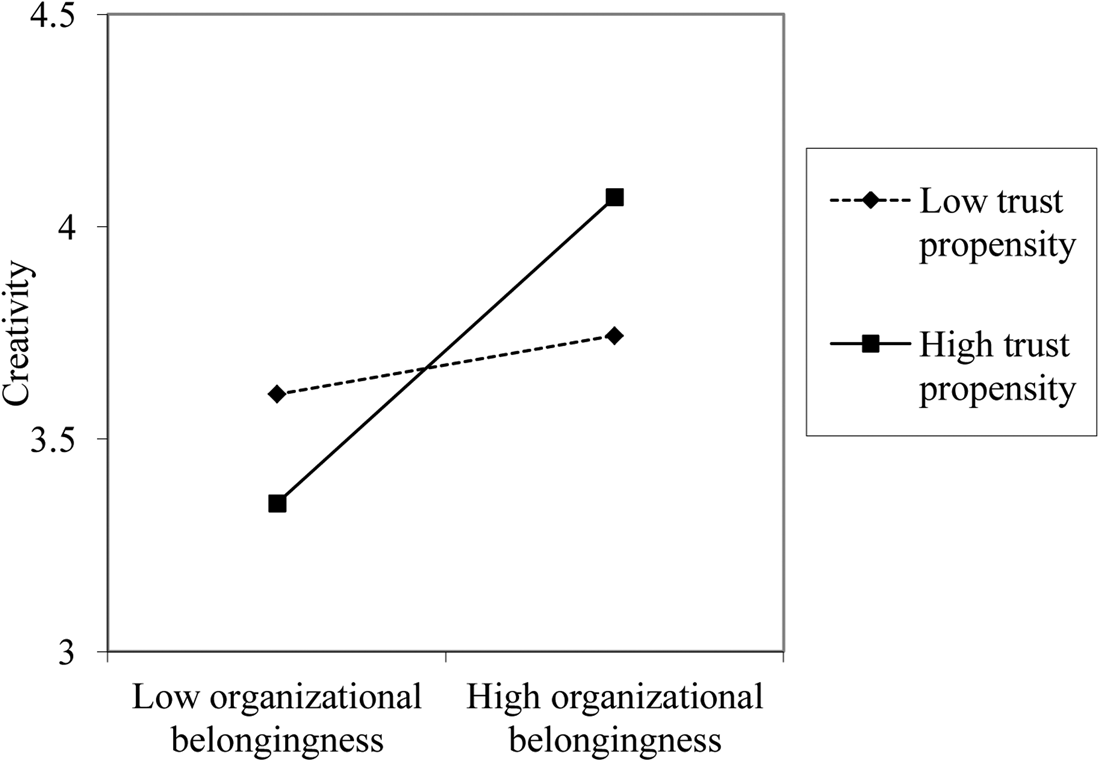
Our results also support Hypothesis 1b (Table 3) (E = .33, SE = .11, t = 3.01, p < .01). Accordingly, organizational belongingness had a stronger positive influence on creativity when participants possessed higher levels of trust propensity (Figure 3). Our simple slope analysis enlightened further that organizational belongingness showed a positive association with creativity when trust propensity was high (E = .53, SE = .09, t = 5.64, p < .01) whereas it was less strongly, but not significantly associated with creativity when trust propensity was low (E = .10, SE = .11, t = .85, p > .05). f 2 – the extent to which the unexplained variance in the whole model is explained by interaction term exclusively (Dawson, Reference Dawson2014) – clarifies that our interaction term explains 1% of the unexplained variance in the whole model (Model 3s in Table 3), which is a small effect size (Aiken & West, Reference Aiken and West1991).
Interaction of organizational belongingness and trust propensity to predict creativity.
Study 1: discussion
We found support for our two hypothesized moderating (accentuating) effects of trust propensity on the relationship between organizational belongingness and employees' workplace outcomes, affective organizational commitment and creativity. Accordingly, the relationship is stronger under the contingent effect of high trust propensity whereas the relationship is weaker under the contingent effect of low trust propensity. These results are well aligned with the theoretical tenets of social identity theory on the claim that social identity (organizational belongingness) and personal identity (trust propensity) interacts to influence employees' affective organizational commitment and creativity. Given that previous studies did not pay adequate attention to the interaction effect of social identity and personal identity on employees' workplace outcomes, our study strongly contributed to the social identity theory that personal identity is a boundary setter for organizational identity. Therefore, future studies should focus more on the moderating nature of personal identity on the relationship between social identity and employees' workplace outcomes. In this study, we revealed the accentuating effect of trust propensity. However, it is possible that personal identity constructs may also show violating, mitigating, substituting, and reversing effects (Gardner, Harris, Li, Kirkman, & Mathieu, Reference Gardner, Harris, Li, Kirkman and Mathieu2017) that future studies should severely focus on. Our Study 1 is not without limitations. For example, it is a single company study. In addition, there is another operational definition of social identity, organizational identity, that needs to be considered in investigating the moderating effects under study. We therefore designed Study 2 in the next section to address these limitations. Accordingly, we collected data from many business organizations and used organizational identity as another operational definition of social identity in Study 2 presented in the following section.
Study 2: methods
Sample and procedures
Two hundred and ten employees of 32 business organizations and 49 supervisors of those employees participated in this study. The business organizations were mainly located in the northeastern part of Turkey and operated in many diverse areas of manufacturing and service production such as communication, domestic appliances, furniture, car dealers, electricity, food, cargo agency, retails, paint, tourism, and construction. The participating employees performed many kinds of duties in their organizations such as technician, salesperson, secretary, accountant, customer service representative, financier, human resource personnel, mechanics, underwriter, foreman, security, store manager, delivery consultant, interior architect, cashier, interpreter, service consultant, foreign trade personnel, and operations manager among many others.
Employee data were collected through two surveys at Time 1 (T1) and Time 2 (T2) applied one month apart and supervisor data were collected through one survey at Time 3 (T3) after we employed the last employee survey. The T1 survey included demographics as control variables consisting of age, sex, marital status, education, and organizational tenure and trust propensity. The data on organizational identity was collected at T2. Supervisors rated the participating employees on creativity and affective organizational commitment at T3. We used a paper-and-pencil format, advised respondents to fill out the questionnaires wherever they are comfortable with, informed participants that the president of the organization permitted us to collect data from the voluntary employees of their organization, and promised the participants that we would protect employee anonymity. Each participant was assigned a unique code that was written on each survey to ease the matching process. Accordingly, we informed each supervisor about the unique code for each of their subordinates along with their names but asked each supervisor to write only the code on the survey for matching purposes. The second author distributed and collected the questionnaires in sealed envelopes.
At T1, we distributed 300 surveys and collected 270 surveys (RR = 90%). At T2, we submitted 270 surveys and collected 240 surveys (RR = 89%). At T3, we submitted 240 surveys and collected 210 surveys (RR = 88%). Our final 210 surveys (RR = 70%) are triple data (210 employees-31 companies-49 supervisors) collected from 32 business organizations and 49 supervisors (RR = 88%) to test the hypotheses of our study. The 210 employees were 69% male, 64% married, 33.13 (SD = 8.35) years of age, had an education level between high school and undergraduate education (3.20, SD = .91), and had 5.4 (SD = 5.73) years of experience in the organization.
Measures
In Study 2, we used the same measures of Study 1, except for organizational identity. In Study 1, we used organizational belongingness as the operational definition of our construct social identity because it aligned well with our theoretical definition of social identity as “perception of oneness with or belongingness to a group, involving direct or vicarious experience of its successes and failures (Ashforth & Mael, Reference Ashforth and Mael1989: 34). This definition is also well aligned with the earlier definition of social identity. For example, Turner (Reference Turner and Tajfel1982: 23) emphasized that social identity is “the mere perception of belonging to social category.” Much earlier, social identity was also defined similarly via belongingness as “the individual's knowledge that he belongs to certain social groups together with some emotional and value significance to him of the group membership” (Tajfel, Reference Tajfel, Isreal and Tajfel1972: 31). Even very recent studies defined social identity via organizational belongingness in studying “how it is possible to value individuals’ uniqueness within the group while simultaneously emphasizing the importance of belongingness in the overall group.” Belonging to a group is defined as social identity (Ellemers, Spears, & Doosje, Reference Ellemers, Spears and Doosje2002). Therefore, acknowledgement of belonging to an organization (organizational belongingness) is one of the ways to attain social identity (Bergami & Bagozzi, Reference Bergami and Bagozzi2000; Tajfel, Reference Tajfel and Tajfel1978). However, it is also accepted that “organizational identification is a specific form of social identification” (Ashforth & Mael, Reference Ashforth and Mael1989: 22) as we have previously discussed. Therefore, we chose organizational identity as our operational definition of social identity in Study 2, thus providing a more advanced approach to study social identity in organizational context through including two operational definitions of the same construct.
Organizational identity
To measure organizational identity, we used the seven-item organizational identity scale by Van Dick, Wagner, Stellmacher, and Ohrist (Reference Van Dick, Wagner, Stellmacher and Ohrist2004). We asked the respondents to report (using a five-point scale, ranging from 1 = ‘strongly disagree’ to 5 = ‘strongly agree’) the degree to which they agreed with each item. A sample item was ‘I identify myself as a member of this organization’ (α = .70).
Trust propensity, affective organizational commitment, and creativity have α values of .72, 91, and 94, respectively. As controls, we collected data on employees' age sex, marital status, education, and organizational tenure.
Study 2: results
Table 4 presents means, standard deviations, and correlations in Study 2. We used the lavaan.survey (lavaan .6-3) (Oberski, Reference Oberski2014) in R (3.5.1) to investigate discriminant and convergent validity of our study's measures by a sequence of CFAs because of the reasons we previously discussed in Study 1. The lavaan.survey performed a CFA analysis for our data given that one supervisor rated more than one subordinate. We used RML as our estimation method. As we did in Study 1, we used item-to-balance approach (Little et al., Reference Little, Cunningham, Shahar and Widaman2002) to create two parcels per latent variable, except for creativity for which we created three parcels, in order for us to attain a higher ratio of indicator to sample size (Williams, Vanderberg, & Edwards, Reference Williams, Vanderberg and Edwards2009). Accordingly, we created 2 parcels for trust propensity as trust propensity 1 (λ = .735) and trust propensity 2 (λ = .736), which were originally five items. Thus, trust propensity has an AVE of .541 and a CR of .702. We also created 2 parcels for organizational identity as organizational identity 1 (λ = .922) and organizational identity 2 (λ = .759), which was originally 7 items. Organizational identity has an AVE of .713 and a CR of .831. Moreover, we created two parcels for organizational commitment as organizational commitment 1 (λ = .865) and organizational commitment 2 (λ = .931), which were originally 7 items. Organizational commitment has an AVE of .807 and a CR of .893. Finally, we created three parcels for creativity as creativity 1 (λ = .944), creativity 2 (λ = .973), and creativity 3 (λ = .874), which was originally 13 items. Creativity, as a result, has an AVE of .867 and CR of .951. Each lambda is significant (p < .0001), positive, and bigger than .73. We used parceling because parceling is recommended for unidimensional constructs when there is a low ratio of indicator to samples size as it was the case in our study (Williams, Vanderberg, & Edwards, Reference Williams, Vanderberg and Edwards2009).
Means, Standard Deviations, and intercorrelations among variables
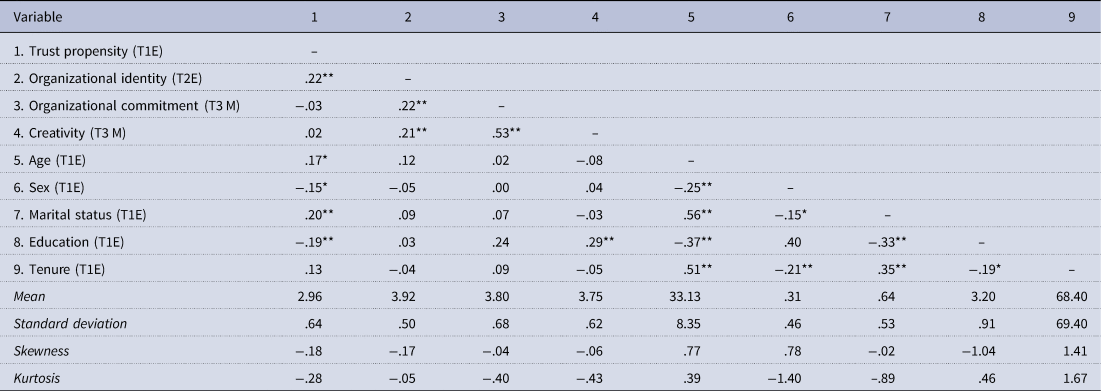
n = 210. * p < .05; ** p < .01. We coded marital status as follows: 1 = married, 0 = single. We coded sex to be 0 = male and 1 = female. We measured age in years. Education was codes as 1 = primary school-level degree, 2 = secondary school-level degree, 3 = high school-level degree, 4 = undergraduate-level degree, and 5 = master-level degree and Ph.D.-level degree. Organizational tenure was measured in months. E = Employee and M = Manager in the table. Direct supervisors of the participating employees reported the data on the dependent variables, organizational commitment and creativity. T2 = 1 month after T1 and T3 = 1 month after T2, denoting the one-month time lag that we used to collect the data. T1 was Time 1, T2 was Time 2, and T3 was Time 3.
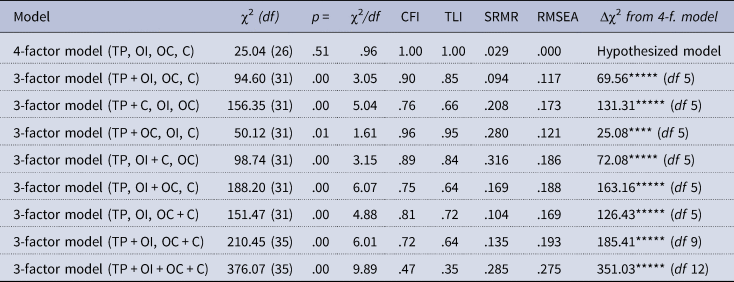
We followed the same procedure as we used in Study 1 to conduct CFA analysis and to decide whether the fit is good for hypothesized 5-factor measurement model (Table 5). Accordingly, the five-factor model in Table 5 shows a good fit of the study's data to the suggested measurement model (df = 26, χ2/df = .96, χ2 = 25.04, p = .51, CFI = 1.00, SRMR = .02, TLI = 1.00). The good fit of the data to our measurement model along with the positive and significant (p < .0001) factor loadings larger than .73 (Table 5) suggest convergent validity (Bagozzi, Yi, & Phillips, Reference Bagozzi, Yi and Phillips1991). We further investigated convergent validity by considering AVE and CR values of our constructs (Fornell & Larcker, Reference Fornell and Larcker1981). Accordingly, our constructs have AVE values higher than .54 and CR values higher than .70, exceeding the minimum cut-off criteria of .50 for AVE and .60 for CR (Fornell & Larcker, Reference Fornell and Larcker1981), thus, providing additional evidence for the convergent validity of our constructs.
Confirmatory factor analysis using lavaan.survey package in R
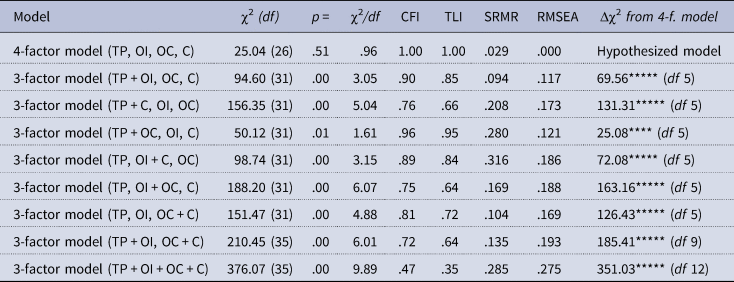
TP, trust propensity; OI, organizational identity; OC, organizational commitment; C, creativity.
n = 210 employees rated by their 49 direct supervisors on creativity and organizational commitment.
****p < .0001, *****p < .0000.
To investigate discriminant validity of our study's constructs, we conducted a series of nested model comparisons (4-factor models in Table 5). Accordingly, the fit of the five-factor model (hypothesized model) to our study's data is much significantly better than the following alternative four-factor models in which two factors were combined to be one factor: (1) trust propensity-organizational identity (Δχ2 [Δdf] = 69.56(5), p < .00001), (2) trust propensity-creativity (Δχ2 [Δdf] = 25.08(5), p < .0001), (3) trust propensity-organizational commitment (Δχ2 [Δdf] = 131.31(5), p < .00001), (4) organizational identity-creativity (Δχ2 (Δdf) = 72.08(5), p < .00001), (5) organizational identity-organizational commitment (Δχ2 [Δdf] = 163.16(5), p < .00001), and (6) creativity-organizational commitment (Δχ2 [Δdf] = 126.43(5), p < .00001). These results show discriminant validity of our constructs. We also considered AVEs and the correlations of the associated variables among our main variables in Table 4 to further investigate the discriminant validity of our constructs. Accordingly, we met a more conservative test of Fornell and Larcker (Reference Fornell and Larcker1981) criterion for discriminant validity by ensuring that each AVE is much larger than all r-square values of the associated main variables in Table 4, providing much stronger additional evidence for the discriminant validity of our constructs.
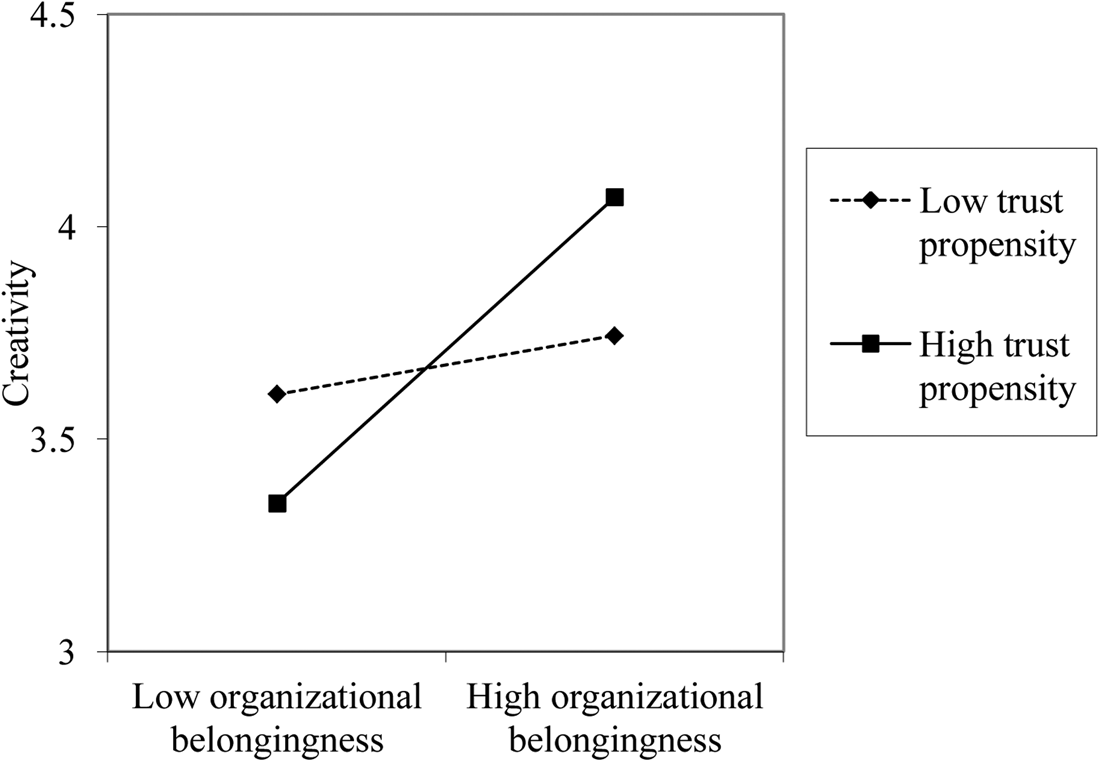
We used multilevel modeling through the GENLINMIXED command in SPSS 25 to account for the nested nature of our data gathered from 210 employees, 32 business organizations, and 49 direct supervisors. The GENLINMIXED command aided us to simultaneously account for the variation due to the differences among 32 business organizations and the variation due to the rating patterns among the supervisors because ICCs due to the variations among the business organizations were .11, .03, .16, and .20 for organizational commitment, creativity, trust propensity, and organizational identity, respectively and ICCs due to the variation among the supervisor ratings were .39, .22, .00, and .03 for organizational commitment, creativity, trust propensity, and organizational identity, respectively. Total simultaneous variation or ICCs both due to the differences among the 32 business organizations and due to the differences among the rating patterns of supervisors were .48, .25, .16, and .23 for organizational commitment, creativity, trust propensity, and organizational identity, respectively. These total ICCs are much larger than the minimum cut-off criteria of .05 (Snijders & Bosker, Reference Snijders and Bosker2012), requiring multilevel modeling procedures to account for the variation among both the 32 business organizations and 49 supervisors. We used RML as our estimation method. We used the same procedures that we followed in Study 1 to test our hypotheses in Study 2. The results of our hypotheses testing are presented in Table 6 and Figure 4. Accordingly, our results do not support Hypothesis 1a (Table 6) (E = .09, SE = .10, t = .86, p > .05).
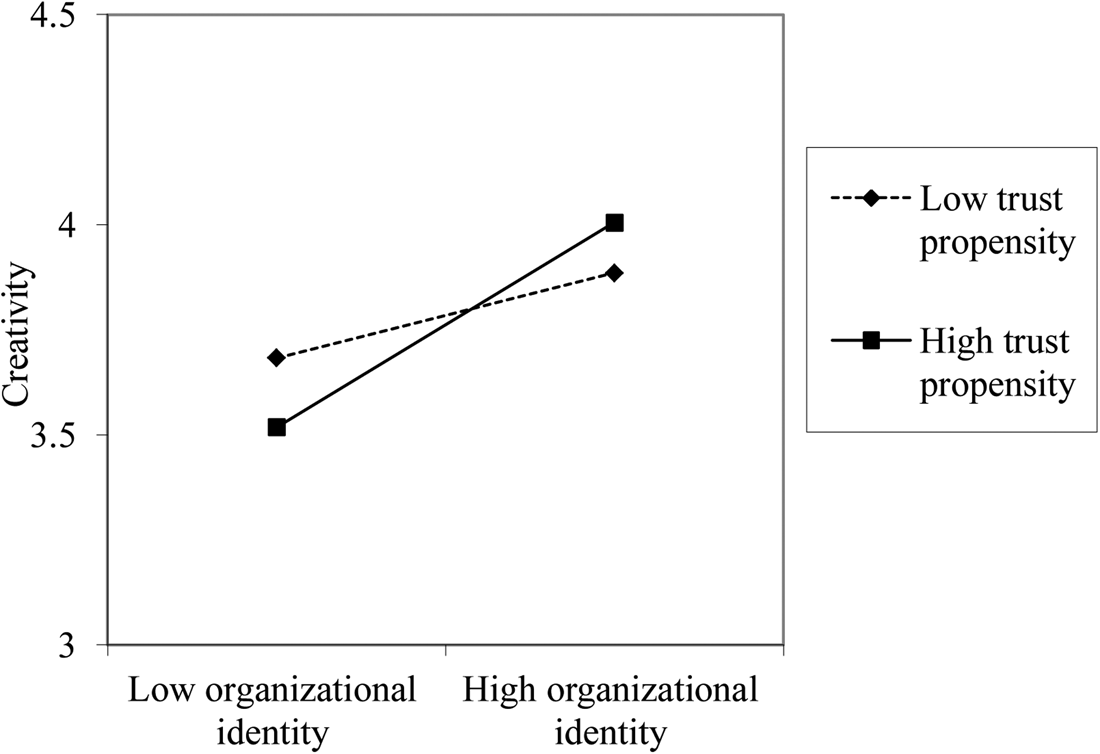
Interaction of organizational identity and trust propensity to predict creativity.

Tests of Hypothesis 1a and Hypothesis 1b
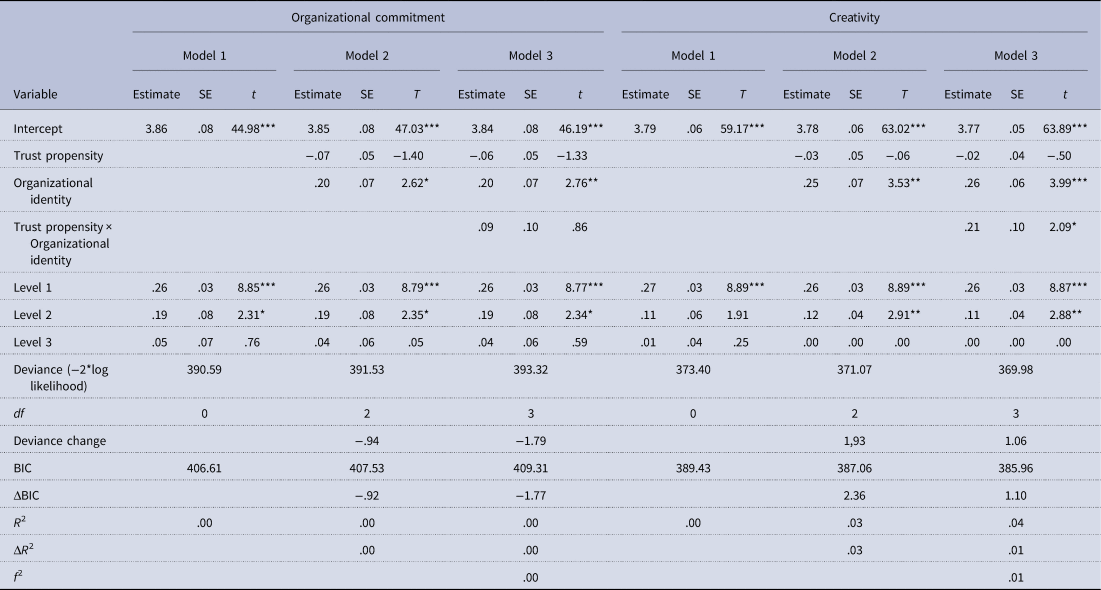
n = 210 employees, n = 32 business organizations of the participating employees, and n = 49 supervisors rating employees' creativity and organizational commitment. * p < .05; ** p < .01; *** p < .001. Level 1 refers to residual effect variance. Level 2 refers to random effect variance due to supervisor rating differences. Level 3 refers to random effect variance due to business organization differences.
Our results support Hypothesis 1b (Table 6) (E = .21, SE = .10, t = 2.01, p < .05). Accordingly, organizational identity had a stronger positive influence on creativity when participants possessed higher levels of trust propensity (Figure 4). Our simple slope analysis enlightened further that organizational identity showed a stronger positive association with creativity when trust propensity was high (E = .37, SE = .09, t = 3.81, p < .000) whereas it was less strongly associated with creativity when trust propensity was low (E = .15, SE = .06, t = 2.27, p < .05). f 2 is 1% for Model 3 for creativity in Table 6, showing a small effect size.
Study 2: discussion
These results show that employee trust propensity moderates (accentuates) the relationship between organizational identity and creativity, and the form of accentuating effect is consistent with social identity theory. These results are also consistent with earlier findings from Study 1. However, these results also show that the moderating effect of trust propensity on the relationship between organizational identity and organizational commitment was not supported in this study, which is contrary to expectations of social identity theory and contrary to the earlier findings from study 1. We attribute the nonsignificant effect of the interaction term on organizational commitment to the time when the data for Study 2 were collected. Accordingly, data for Study1 were collected before the coronavirus disease 2019 (Covid-19) pandemic whereas data for Study 2 were collected during the Covid-19 pandemic, affecting organizational commitment levels of the participants, thus, making the effect of interaction term on organizational commitment nonsignificant in Study 2. It did not affect creativity levels of the participants because the Covid-19 pandemic required creativity to deal with the unexpected consequences of the Covid-19 pandemic. Therefore, when the Covid-19 pandemic is over, this last hypothesis should be retested in future research studies. However, this result is also extremely instructive in itself in the sense that under unexpected conditions such as Covid-19 pandemic, we should expect employees to revise their attitudes such as affective organizational commitment, leading to unexpected consequences. The unexpected findings can also be attributed to the sample in Study 2 that included employees from different business organizations. We used multilevel modeling to account for the between-organization variance, as we described in the previous sections. However, there might be important differences between the samples collected in the two unique studies that cannot be in any way statistically accounted for.
General discussion and conclusion
Given the prevalence of theoretical arguments that the influence of social identity on employees' workplace attitudes and behaviors is conditioned by many factors (Bednar et al., Reference Bednar, Galvin, Ashforth and Hafermalz2020; Van Knippenberg & Hogg, Reference Van Knippenberg, Hogg, Ferris, Johnson and Sedikides2018; Zhou, Dou, & Wang, Reference Zhou, Dou and Wang2019), the restricted understanding of the moderators on the relationship between social identity and creativity and organizational commitment is astonishing. Up to now, SIT tended to concentrate mainly on the direct effects of social identity on employees' creativity and organizational commitment, revealing mixed results, for example, on the relationship between social identity and creativity (Dukerich, Golden, & Shortell, Reference Dukerich, Golden and Shortell2002; Haslam, Reference Haslam2004; Rotondi, Reference Rotondi1975). Adopting SIT, in addition to personality theory (Huff & Kelley, Reference Huff and Kelley2003; Mayer, Davis, & Schoorman, Reference Mayer, Davis and Schoorman1995), would suggest that we need more focused investigations on the contingencies of the relationship between social identity and employees' workplace attitudes and behaviors (Bednar et al., Reference Bednar, Galvin, Ashforth and Hafermalz2020; Van der Werff et al., Reference Van der Werff, Freeney, Lance and Buckley2019; Zhou, Dou, & Wang, Reference Zhou, Dou and Wang2019). Up to now, investigations have concentrated on inspirational motivation, perceived organizational support, and national culture (Hirst, Van Dick, & Van Knippenberg, Reference Hirst, Van Dick and Van Knippenberg2009; Lee, Park, & Koo, Reference Lee, Park and Koo2015) as moderators of the relationship between social identity and employees' workplace outcomes, but not personal identity even though personal identity and social identity constitute the self-concept of the individual (Ashforth & Mael, Reference Ashforth and Mael1989; Bednar et al., Reference Bednar, Galvin, Ashforth and Hafermalz2020; Riketta, Reference Riketta2005; Zhou, Dou, & Wang, Reference Zhou, Dou and Wang2019). The awareness of social identity and how social identity influences creativity and organizational commitment, and the personal identity-related contingencies under which these happen are understudied but consequential questions.
Drawing from SIT (Ashforth & Mael, Reference Ashforth and Mael1989; Lee, Rhee, & Park, Reference Lee, Rhee and Park2020; Tajfel, Reference Tajfel1981; Turner, Reference Turner and Tajfel1982), we investigated personal identity as a factor that could accentuate the positive inferences of social identity on organizational commitment and creativity as employees' workplace outcomes. Organizational belongingness/identity was positively associated with manager-rated organizational commitment and creativity (Bednar et al., Reference Bednar, Galvin, Ashforth and Hafermalz2020; Lee, Rhee, & Park, Reference Lee, Rhee and Park2020; Zhou, Dou, & Wang, Reference Zhou, Dou and Wang2019). Moreover, the relationship between organizational belongingness/identity and employees' workplace outcomes was conditional on trust propensity such that employees who have a high level of trust propensity responded to social identity issues in the form of a high level of creativity and organizational commitment. The results suggest that having a high level of social identity and personal identity was associated with a story where employees were more creative and committed to their organization; whereas, having a high level of social identity and a low level of personal identity was associated with a different story, where employees were less creative and committed to their organization. Therefore, our results suggest that personal identity (being unique or different) accentuates the positive influence of social identity (being similar or common) on creativity and organizational commitment.
Theoretical implications
Theoretically, the results of our study suggest that employees' workplace outcomes such as creativity and organizational commitment are the result of the interaction between social identity and personal identity. Prior work has predominantly concentrated on the main influence of social identity on participants' workplace-related attitudes and behaviors (Ashforth & Mael, Reference Ashforth and Mael1989; Charness & Chen, Reference Charness and Chen2020; Godard, Reference Godard1991; Lux, Grover, & Teo, Reference Lux, Grover and Teo2019; Van Knippenberg & Van Schie, Reference Van Knippenberg and Van Schie2000), although studies have also informed us that the self-concept of an individual consists of social identity and personal identity (Ashforth & Mael, Reference Ashforth and Mael1989), and the effect of social identity on the individual's workplace outcomes cannot be fully understood without considering personal identity along with social identity (Ashforth, Harrison, & Corley, Reference Ashforth, Harrison and Corley2008; Ashforth & Mael, Reference Ashforth and Mael1989; Turner, Reference Turner and Tajfel1982). Thus, our study purifies the personal identity effect of the self-concept on the relationship between social identity and employees' workplace outcomes. Particularly, we provide a strong extension and purification of SIT (Ashforth & Mael, Reference Ashforth and Mael1989) by showing that the personal identity or trust propensity of an individual regulates the influence of an individual's social identity or organizational belongingness/identity on the same individual's organizational commitment and creativity. On theoretical grounds, this signifies that organizational identity has stronger positive influence on participant or employee creativity and organizational commitment when the employee is more confident about others' behavior, is more trusting of others, and sees others more often as promise keepers, thus increasing the persistence of their efforts as a result of their increased motivation and leading to increased creativity and organizational commitment.
With regard to our contribution to trust propensity, a component of trust theory (Colquitt, Scott, & LePine, Reference Colquitt, Scott and LePine2007; Mayer, Davis, & Schoorman, Reference Mayer, Davis and Schoorman1995), trust theory (Ferguson & Peterson, Reference Ferguson and Peterson2015; Mayer, Davis, & Schoorman, Reference Mayer, Davis and Schoorman1995) has recently associated trust propensity with organizational commitment and creativity via a simple theoretical model where trust propensity is positively associated with organizational commitment and creativity (Dirks & Ferrin, Reference Dirks and Ferrin2001; Nambudiri, Reference Nambudiri2012). However, theoretical and empirical work on trust literature indicated that trust plays a moderating role in enacting an individual's self-efficacy, for example, on employees' workplace outcomes (Dirks & Ferrin, Reference Dirks and Ferrin2001; Ozyilmaz, Erdogan, & Karaeminogullari, Reference Ozyilmaz, Erdogan and Karaeminogullari2018). Therefore, the literature on both trust theory and SIT is not adequate individually to acknowledge the complicated nature of the relationship through direct effects. Grounded on trust theory, we add to SIT by embracing the trust propensity of individuals as a boundary conditioner of the association between organizational belongingness/identity and employees' workplace outcomes, therefore providing a more sophisticated comprehension of the association at hand. Particularly, our theoretical contribution to trust theory and SIT is therefore our ascertaining of the accentuating influence of trust propensity or personal identity, in which the positive association between organizational belongingness/identity and employees' workplace outcomes gets stronger for individuals who experienced higher levels of trust propensity.
Finally, by conjoining SIT with trust theory (Ashforth & Mael, Reference Ashforth and Mael1989; Ellemers, Spears, & Doosje, Reference Ellemers, Spears and Doosje2002; Huff & Kelley, Reference Huff and Kelley2003; Tajfel & Turner, Reference Tajfel, Turner, Worchel and Austin1985), we contribute to both of the theories via testing our research model with two studies, Study 1 and Study 2, in Turkey. Creativity is in every aspect of the Turkish economy (British Council, 2020; OECD (Organization for Economic Co-operation & Development), 2020). Therefore, our study must be elucidated in the context of Turkish culture within which we conducted our present study. Turkish culture is defined as a collectivist culture (Hofstede, Reference Hofstede1980) in which employees' trust propensity is lower than that of employees in an individualistic culture (Huff & Kelley, Reference Huff and Kelley2003), making the positive associations less strong in our study when trust propensity is high than what we would find in a study in an individualistic culture when trust propensity is high. Put another way, the moderating effect of trust propensity might provide stronger positive associations in an individualistic culture when trust propensity is high than what we found in the collectivist Turkish culture when trust propensity was high.
Our study has practical implications. Our results suggest that social identity influences employees' workplace outcomes to the extent to which employees' trust propensity or personal identity allows them to do so. In addition to important influences of social identity in the form of increased organizational commitment and creativity, social identity has the possibility to interact with the employees' personal identity. Employees' affective organizational commitment and creativity are still two of the most important workplace outcomes that practitioners should still pay high attention to get the most out of their human capital investments. Practitioners have already invested in activities to increase the organizational belongingness/organizational identity of their employees. As a result of our study, we recommend practitioners that they should invest in activities to hire individuals who are high in trust propensity in the hiring stage to get the most out of their investments because their investments in organizational belongingness/organizational identity will have a much stronger and more positive influence when the human capital in their organization is high in trust propensity. For the current employees, we suggest to those human resources managers and upper-level managers to invest in education programs to increase the level of trust propensity of their employees. All in all, we suggest practitioners that they should simultaneously invest in social identity (organizational belongingness/organizational identity) and personal identity (trust propensity) to increase affective organizational commitment and creativity in the workplace. Investing in social identity provides only incremental increases in affective organizational commitment and creativity.
Potential limitations and future research directions
Our study has a few limitations that future research should address. First, although we were able to investigate trust propensity as a moderator of the relationships between organizational belongingness/identity and employees' workplace outcomes, we did not investigate other personality traits such as big-five personality traits, self-efficacy, and proactive personality that might function as other moderators. Nor did we investigate other personality components such as employees' interests, abilities, and bodily attributes (Ashforth & Mael, Reference Ashforth and Mael1989) as the moderators of the relationships. It would be interesting if future research could investigate if these moderators affect the nature of the relationships, illuminating the nature of the associations at a further level. In this context, it would be useful for future research to investigate the effect of three-way moderators on the relationships (e.g., organizational belongingness/identity × trust propensity × abilities, organizational belongingness/identity × self-efficacy × interests). In addition, we collected our data from a support organization through its locations distributed to all cities of Turkey in Study 1 and from many business organizations in the northeastern of Turkey in Study 2, an understudied region and country in past social and personal identity studies. Although the logic behind the selection of the projects that will be successful requires creativity, and the continued success of the organization needs social identity and affective organizational commitment of its employees, there is a strong need to investigate generalizability to other contexts, especially to other cultures.
We collected our data in Study 1 and Study 2 longitudinally at three time periods, with one month apart, from different sources (indeed, the data on creativity and affective organizational commitment were collected from the supervisors of the participating employees). This method of data collection helped us to deal with common method variance (Podsako, MacKenzie, & Podsako, Reference Podsako, MacKenzie and Podsako2012). However, our method of data collection hurt for a true panel design to investigate causality and direction of the relationships at hand. Specifically, the direction of the social identity-personal identity association is highly relevant in this context to make accurate inferences. We also acknowledge that the observed correlation between organizational belongingness/identity and trust propensity is significant (r = .17, p < .05) in Study 1 and (r = .22, p < .01) in Study 2, thus, making our moderator associated with our independent variable. Although we suggest that personal identity functions as a moderator of social identity, it may initially help social identity to develop. Future research on how personal identity and social identity develop over time would help us to comprehend this issue at an advanced level.
Conclusion
In conclusion, we aimed to examine the effect of social identity on creativity and organizational commitment under the moderating effect of personal identity. Social identity has benefits for organizations in the form of creativity and commitment depending upon the contingent influence of trust propensity. High trust propensity accentuates the positive effect of organizational belongingness/identity on employees' creativity and organizational commitment. The results signify that the components of self-concept, social identity and personal identity, should be considered together to harvest the benefits of self-concept on employees' creativity and organizational commitment. In sum, trust propensity accentuates the positive influence of organizational belongingness/identity on employees' workplace outcomes.
Conflict of interest
The author(s) declare none.