In the letters he wrote from Aleppo in 1600, the British merchant William Biddulph described the daily life of this dynamic center of the East–West trade, the city where spices and silks from India and Iran were exchanged for English broadcloth and New World silver in one of the world's largest covered bazaars. He also presented Muslim practices and religious beliefs, emphasizing those features that seemed to him most unusual and reprehensible. His contempt fell firmly on a fixture of the early modern Islamic street, the ecstatic, antinomian Muslim saint:
They also account fooles, dumbe men, and mad men,…Saints. And whatsoever such mad men say or doe…or strike them, and wound them, yet they take it in good part, and say, that they shall have good lucke after it. And when such mad men die, they Canonize them for Saints, and erect stately Monuments over their graves, as we have here many examples, especially of one (who being mad) went always naked, whose name was Sheh Boubac…they…erected an house over his grave, where…they are Lampes burning night and day, and many idle fellows (whom they call Darvises) there maintained to looke unto his Sepulchre…1
William Biddulph, “Part of a Letter of Master William Biddulph from Aleppo,” in Hakluytus Posthumus, or, Purchas His Pilgrimes, ed. Samuel Purchas (Glasgow, 1905–1907), 8:263. The quote preserves the original's archaic language.
Biddulph was describing majdhūbs (those enraptured by God), a category of Muslim saints, or wāl
s (friends of God).
2 Some authors object to the term “saint” and prefer “friend of God.” I opt to use “saint” for convenience: Encyclopedia of Islam, 2nd ed. (hereafter, EI2) (Leiden, 1956–), s.v. “Wali. General Survey” (B. Radtke).
The unconventional, often offensive behavior of the
majdhūbs was taken as a sign of their closeness to God's truth, their ability to see hidden things and bestow
baraka, or blessing. While Islamic society generally revered individuals whose adherence to normative piety was exemplary, it also embraced certain exceptional beings who flaunted their rejection of those norms and called attention to their constructed and arbitrary nature. These “Bedlam saints,” as Biddulph called them,
3 Biddulph, “Part of Letter,” 264.
were revered in their lifetimes, subsisting on charity, and their graves became sites of popular devotion tended by dervishes, mendicant religious men.
4 Whereas “dervish” can mean broadly “a member of a religious brotherhood,” I use the word in its sense of a mendicant religious figure, whether related to Sufi brotherhoods or linked to “deviant” antinomian bands: EI2, s.v. “Darwish” (D. B. MacDonald).
As a stranger, Biddulph could not have known that the seemingly insane behavior of the saints he described fell into recognizable patterns of religious performance in urban Islam. The figure he knew only as Sheh Boubac was, in fact, Shaykh Abu Bakr ibn Abi al-Wafa
(1503–83), a personage emblematic of early modern antinomian piety.
Shaykh Abu Bakr and the dervishes who gathered around him in his lifetime and around his grave after his death illustrate the trajectory of a saint and his community and of their complex relationship to landscape and the built environment in the late 16th and 17th centuries. Abu Bakr shunned the city and conventional domesticity, living in the wilderness at its edge and inverting his society's rigid gender hierarchy. His followers formed a community of deviant dervishes whose antinomian asceticism rejected normative Islamic practice, risking persecution by the Ottoman state. However, a few years after Biddulph wrote his letter, these deviant dervishes adopted lawful behavior, metamorphosed into a respectable Sufi brotherhood, and received the patronage of powerful Ottoman officials. The tomb of Abu Bakr soon formed the nucleus of an architectural complex that served as one of Aleppo's most important Sufi institutions and spurred the development of a suburban neighborhood. The community of dervishes that shared the saint's antisocial ways mutated into the custodians of substantial properties and became salaried members of the central Ottoman religious hierarchy, accepting its norms along with its rewards. In other words, they allowed themselves to be co-opted into the urban religious hierarchy and in turn transformed their wilderness retreat into a settlement.
An unusually rich array of untapped sources on Shaykh Abu Bakr shed light on the urban and cultural life of the early modern Middle East. The Takiyya, or dervish lodge of Shaykh Abu Bakr, largely preserved, defines the spatial context of the community. In addition, hagiographies of the saint and successor leaders of the lodge from the late 16th to the early 20th centuries, combined with endowment documents, allow one to piece together the development of the lodge and the incorporation of the dervishes into a controllable bureaucratic order.5
Despite the importance of the saint and the lodge in the sources from the late 16th to the early 20th century, the site has never been the object of systematic study. A center of Islamist resistance to the Ba
thist rule in Syria in the early 1980s, the lodge was bombarded. Its importance is exemplified by the length of Abu Bakr's entry in al-Tabbakh's biographical dictionary: Raghib al-Tabbakh (d. 1951), I
lam al-nubala
bi-tarikh Halab al-shahba
, ed. Muhammad Kamal, 7 vols., 2nd ed. (Aleppo, 1988–92) [1923–26]. Jean Sauvaget published an elevation of the lodge's qā
a, or reception room, with a brief notice, in Alep: Essai sur le développement d'une grande ville syrienne, des origines au milieu du XIXe siècle, 2 vols. (Paris, 1941), 232, Figure 61, 235, n. 894. The lodge has escaped the notice of scholars of Sufism, except for a catalogue entry in Julia Gonnella, Islamische Heiligenverehrung im urbanen Kontext am Beispiel von Aleppo (Syrien) (Berlin, 1995), 236–39, cat. no. 152.
Likewise, the examination of the biographies of Abu Bakr demonstrates how the categories of space and gender intervened in the construction of the social persona of the saint. Despite the existence of an extensive scholarly literature on Sufism, the spatial dimension of mystical practice in Islam has attracted little attention beyond studies of the architecture of dervish lodges.6
Raymond Lifchez, ed., The Dervish Lodge: Architecture, Art and Sufism in Ottoman Turkey (Berkeley, Calif., 1992). For an anthropological analysis of saint's shrines, see Valerie J. Hoffman, Sufism, Mystics, and Saints in Modern Egypt (Columbia, S.C., 1995), 101–7.
The hagiographies indicate a conceptual demarcation between the built environment and the wilderness, each endowed with opposite social meaning yet dependent on each other. The wilderness was the domain of the antinomian saint, while the built environment was the domain of conventional Islam. In the absence of paintings that represent Abu Bakr, art-history inquiries must move beyond the study of architectural form to include an analysis of the use and reception of the built environment; they must show how the built environment intersects with discursive spaces. By mapping the spatial practice of a pious community, this essay contributes to the social history of space.
7 This approach, which maintains that space is not simply an environment in which social life takes place but, rather, a medium through which social life is produced and reproduced, is informed by Henri Lefebvre, The Production of Space, trans. Donald Nicholson Smith (Cambridge, Mass., 1991).
In addition, the hagiographies demonstrate that the inversion of gender hierarchies was an integral part of the construction of antinomian piety. By analyzing the performance and reception of this inversion, this essay contributes to an emerging literature on gender and transgression in early modern Islamic societies, which has tended not to focus on visual culture or space.
8 Two studies of antinomian piety in Islam inform this essay: Ahmet T. Karamustafa, God's Unruly Friends: Dervish Groups in the Islamic Later Middle Period, 1200–1550 (Salt Lake City, 1994); and Ahmet Yasar Ocak, Osmanlı İmparatorluǧunda Marjinal Sufilik: Kalenderiler (XIV–XVII. Yüzyillar) (Ankara, 1992). Neither probes issues of gender. See As'ad AbuKhalil, “Gender Boundaries and Sexual Categories in the Arab World,” Feminist Issues 15 (1997): 91–104.
Religious figures such as unconventional saints and deviant dervishes are notably difficult to document, and they are often relegated by scholarship to the category of “popular culture,” whereby they are described as vulgar, static, or self-evident. However, in their earlier manifestation as an antinomian group, Shaykh Abu Bakr and his community provide a unique opportunity to gain access to non-elite approaches to the production of space and the perception of architecture. Abu Bakr was illiterate and spoke the Aleppine vernacular rather than Arabic, Persian, or Ottoman, the literary languages practiced by the educated men of his society. His devotees included some powerful men, but they consisted mostly of middling and poor members of urban society. The dervish community engaged actively with the normative religious institutions and the high intellectual tradition that modern scholarship usually privileges. Most important, it emerges that the vernacular practice of the dervishes was understood by contemporary respectable Muslim scholars as a distinct and deviant—yet integral and, indeed, necessary—segment of religious life, prompting them to memorialize the saint in their writing.
The mystical biographies (manāqib) surface as a dynamic literary genre. The manāqib depicted the diverse range of mystical personalities, from the literate heads of Sufi brotherhoods in urban centers to the most outrageous wandering dervishes. By characterizing the dervishes' transgression as deviance, the writers created a pathologizing discourse around unconventional mystics, even as they venerated them.9
The pathologizing hegemonic discourse on Qalandar dervishes is particularly apparent in the work of Vahidi (fl. first half of 16th century): Ahmet T. Karamustafa, Vahidi's Menakib-i Hoca-i Cihan ve Netice-i Can: Critical Edition and Analysis (Cambridge, Mass., 1993).
By examining successive biographies of a single figure, one can track the changes in the presentation of that figure. As the deviant dervishes mutated into a brotherhood, so did the image of the founding saint, Abu Bakr, alter in the biographies. The texts depicted a progressively law-abiding
majdhūb, erasing some of his transgressive aspects. This gradual co-optation of the “wild” figure of the saint into a controllable order parallels a broader development in the period's religious life: the absorption of the itinerant deviant dervishes known as
qalandārs into settled Sufi brotherhoods, particularly the Bektashiyya, that could be centrally manipulated.
10 The term “Qalandar” refers to adherents to a specific strain of the mode of renunciatory piety, the Qalandariyya; it is also a topos in Persianate literature for a person who disregarded social convention Karamustafa, God's Friends, 32–37. I use “Qalandar” as a general term equivalent to “deviant dervish” rather than to refer to any specific dervish band.
In broad terms, this development ranged from violent suppression to co-optation and reward. Abu Bakr's community's co-optation was unique in that it also shows how architecture and urban growth, along with the key legal mechanism of patronage, the religious endowment (
waqf), functioned as processes to discipline and absorb antinomian groups into the normative structures of society.
11 On waqf, see EI2, s.v. “Wakf. I. In Classical Islamic Law” (R. Peters); and ibid., “Wakf. IV. In the Ottoman Empire” (Randi Deguilhem).
Ultimately, the life stories of antinomian saints and deviant dervish communities offer rare evidence of early modern non-elite resistance to authority and of the subversion of authoritative structures. This is especially critical because of the difficulty of gauging local responses to imperial orders prior to the 19th century. In this perspective, this essay introduces a case study from a non–Western early modern context to the broader scholarly literature on hierarchy inversion, or “world upside down,” where the key intervention is Mikhail Bakhtin's discussion of the carnivalesque in Rabelais and His World.12
Mikhail M. Bakhtin, Rabelais and his World, trans. H. Iswolsky (Cambridge, Mass., 1968). My discussion of the carnivalesque is informed by Peter Stallybrass and Allon White, The Politics and Poetics of Transgression (London, 1986).
For Bakhtin, the notion of the carnival constituted a utopian vision of the universe from a popular perspective, and it functioned as a critique of dominant culture through the alternative language of grotesque and through the instrument of the inversion of hierarchy. However, critics of the politics of Bakhtin's notion of the carnival cautioned against his nostalgic and populist depiction of it. The work of Max Gluckman and others argued that the carnival is in fact licensed by dominant culture and therefore complicit. Indeed, carnival's hierarchical inversions ultimately depend on and reinforce these very hierarchies.
13 Gluckman wrote that, even though the “rites of reversal obviously include a protest against the established order…they are intended to preserve and strengthen the established order”: Max Gluckman, Custom and Conflict in Africa (Oxford, 1965), 109. See also Stallybrass and White, Politics and Poetics, 12–16.
The “authorized” inversion of Abu Bakr and the antinomian dervishes ought not to be considered an instance of anti-imperialism; indeed, this term would have been meaningless in their universe. As the case of Abu Bakr illustrates the ultimate co-optation of antinomianism into structures of order and control, it shows how resistance should not be idealized or misconstrued. Rather, this example demonstrates the extraordinary ability of a hegemonic structure (the Ottoman state) to make a place for its critique and to co-opt and incorporate threats to its authority to strengthen centralized power. This in turn shows the interdependence of “high” and “low” cultural forms, and conveys a sense of the remarkable dynamism and diversity of early modern society.
CONTEXT OF CITY AND HISTORY
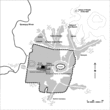
The urban context of our deviant dervish community, Aleppo, incorporated into the Ottoman Empire in 1516, was located at the nexus of the major trade routes of the Middle East (Figure 1). Connected to the caravan pathways in the desert as well as to the network of Mediterranean ports, Aleppo experienced extraordinary commercial prominence. Through the 16th century, Ottoman officials endowed great mosques modeled after those of Istanbul, as well as commercial structures along the spine of the central bazaar. These interventions constituted an effective Ottomanization of Aleppo, remaking it in the image of an Ottoman city like other provincial towns throughout the empire.14
This is one of the central arguments of my The Image of an Ottoman City: Imperial Architecture and Urban Practice in Aleppo in the Sixteenth and Seventeenth Centuries (Leiden, 2004). For an urban history of Aleppo, see Sauvaget, Alep; Jean-Caude David, “Domaines et limites de l'architecture d'empire dans une capitale provinciale,” Revue du monde musulman et de la Méditerranée 62 (1991): 4, 169–94; and Cigdem Kafescioglu, “In the Image of Rum:' Ottoman Architectural Patronage in Sixteenth-Century Aleppo and Damascus,” Muqarnas 16 (1999): 70–96.
Map of Aleppo in the early 17th century. After Sauvaget, Alep, plate 62. Redrawn by José Luis Argüello. Important City gates: (1) Bab Antakiyya, (2) Bab Qinnesrin, (3) Bab al-Maqam, (4) Bab al-Nayrab, (5) Bab al-Ahmar, (6) Bab al-Hadid, (7) Bab al-Nasr, (8) Bab al-Faraj, (9) Bab al-Jinan.
However, at the end of the 16th century, Aleppo and its hinterland were convulsed by the Jelali revolts (ca. 1590–1620),
15 William Griswold, The Great Anatolian Rebellion (Berlin, 1983); Karen Barkey, Bandits and Bureaucrats: The Ottoman Route to State Centralization (Ithaca, N.Y., 1994).
a series of small-scale rebellions that arose when loosely organized bands of landless peasants, deserters, and brigands resisted the imposition of centralized Ottoman authority. The most threatening revolt erupted in the hinterland of Aleppo, led by
Ali Pasha Janbulad, and was crushed in 1607. The resultant disruptions in trade and agriculture, and the depopulation of the countryside, left long-term scars. An intensification of mystical piety in Aleppo matches this upheaval. While the 17th century has been described as a period of decline, it was in fact one of reorientation and consolidation. In architectural patronage, the large, central monumental endowments gave way to smaller architectural complexes, which now emphasized dervish lodges. Marked urban growth took place at the northeastern edge of the walled city, near the terminus of caravan routes that stretched east into the desert
16 Sauvaget, Alep, chap. 10. This urbanization extended to the entire eastern edge of the city, where the industries related to the caravan trade were located.
and included the emerging neighborhoods of Aghyur and Turab al-Ghuraba
, in the urbanization of which the lodge of Shaykh Abu Bakr was to play a key role.
17 These neighborhoods, along with nearby Almaji,
Uryan, and Mar
ashli, had a heavily Turkic and Kurdish population: see Kamil al-Ghazzi, Kitab nahr al-dhahab fitarikh Halab, ed. Shawqi Sha
th and Mahmud Fakhuri, 2nd ed., 3 vols. (Aleppo, 1991–93) [1923–26], 2:324–27 (Aghyur), 328–29 (Almaji), 342–43 (Turab al-Ghuraba
), 344–45 (Mar
ashli), 346–47 (
Uryan, also called Juqur Qastal).
Aleppo's centrality in commercial flows was paralleled by its status as a religious crossing place. In addition to boasting sacred shrines, it was connected to religious networks in the Ottoman Empire and beyond as a station on the Istanbul–Mecca pilgrimage route.18
Suraiya Faroqhi, Pilgrims and Sultans: The Hajj under the Ottomans, 1517–1683 (London, 1994).
Alongside the venerable jurists, traditionists, and Sufi masters who received imperial appointments at its Ottoman-built madrasas and dervish lodges, Aleppo also attracted itinerant deviant dervishes. Thus, when Abu Bakr began his mystical career, focuses of devotional piety such as saints' tombs and dervish lodges were common urban sights.
THE FIELD OF MYSTICAL PATHS
The urban institution of the dervish lodge sustained the dominant mystical dimension of Islam, Sufism. Sufism was a diverse, yet institutionalized practice, divided into distinct brotherhoods or orders with an intellectual tradition.19
Annemarie Schimmel, Mystical Dimensions of Islam (Chapel Hill, N.C., 1976); Eric Geoffroy, Le soufisme en Egypte et en Syrie sous les derniers Mamelouks et les premiers Ottomans (Damascus, 1995); Paulo Pinto, “Mystical Bodies: Ritual, Experience and the Embodiment of Sufism in Syria” (Ph.D. diss., Boston University, 2002).
While well integrated into urban life, Sufism contains the potential for antinomianism. The rejection of society, a radical aspect of renunciation, has been an element of piety in many cultures. Islamic practice allows a range of renunciatory gestures. Within the broad category of Friends of God, the mystical type of the majdhūb shows the most antisocial aspects.20
Schimmel, Mystical Dimensions, 105; Geoffroy, Le soufisme, 309–33.
The “enraptured one” has been uprooted from his own consciousness by God's
jadhba (attraction), skipping several stages along the mystical path. Having experienced direct and sudden contact with God's truth (
ḥaqīqa), the
majdhūb has become aware of the arbitrariness of external reality (
ẓāhir). Due to the sudden rupture of normative space-time through which he has attained this knowledge, a
majdhūb may appear deranged or mad; he may adopt a mendicant life, violate social norms and the law. Antiauthoritarian behavior is one of the external signs by which his followers recognize his contact with
ḥaqīqa. To the uninitiated eye, such behavior appeared as madness.
21 Michael W. Dols, Majnun: The Madman in Medieval Islamic Society, ed. Diana E. Immisch (Oxford, 1992), 366–422.
However it had a pattern, a script: throughout the Islamic world, Friends of God expressed themselves through similar transgressions and miraculous deeds, including bestowing
baraka and demonstrating
kashf (the ability to see hidden things). Abu Bakr was this type of mystical figure.
While Abu Bakr's conduct broadly followed the script of the majdhūb, his excessive repertoire of transgression placed him near the category of the deviant dervish, who occupied the extreme end of a spectrum of anticonventional mystical behavior. The deviant dervishes, or Qalandars, emerged as a distinct movement of renunciatory piety in Central Asia and the Middle East by the 13th century and were all but eradicated by the 17th.22
This discussion is informed by Karamustafa, God's Friends, and Ocak, Osmanlı İmparatorluǧunda.
Having rejected settled life, they roamed the countryside and violated the space of the city to flaunt their outrageous behavior. This included an eccentric appearance in a society where self-presentation functioned as a marker of identity: they inverted social hierarchies and disregarded Islamic law, including famously the consumption of intoxicants. Indeed, the discovery of the use of cannabis as a hallucinogen was attributed to leading deviant dervishes. Their practice constituted an aggressive critique of society, and particularly of the Sufi brotherhoods, which they saw as having subverted the mystical path. The deviant dervishes around Abu Bakr, prior to their induction into normative Sufism, showed many traits characteristic of Qalandarism. The early modern sources in Aleppo eschew the term “Qalandar.” However, the fact that the sources never identify a specific Sufi brotherhood with either Abu Bakr or his successor Ahmad al-Qari supports the notion that the community rejected conventional Sufism until the early 17th century.
The majdhūb and the deviant dervish are conceptually related religious identities that shared a propensity for proscribed acts. The distinction between the two lies in the fact that the Qalandar purposefully chose deviant renunciation as a protest against society, while the majdhūb did not exert his own will but was overwhelmed by God's attraction.23
The relationship between these two categories is complex. In addition, the concept of wilāya and its relationship to jadhba require investigation. The Qalandars also adopted some of the teachings of the Malamatiyya, Muslims whose proscribed behavior was designed to attract blame (malām) but who blended into urban society while the Qalandars sought to stand out: Dols, Majnun, 380–82; Karamustafa, God's Friends, 30, 36. Karamustafa's chapter 7 analyzes the links between Sufi concepts and the manner in which the antinomian dervishes used them in unusual and radical ways.
Therefore, the
majdhūb did not feature the social activism of the Qalandars but, rather, represented an antiauthoritarian religious type within established Sufism and thus constituted a normative category. By contrast, Qalandarism stood as a radical critique of all that was canonical, even as it was informed by Sufi principles. Deviant dervishes faced the opprobrium of the Sufi establishment, persecution, and even massacre, while
majdhūbs were tolerated and revered.
THE CONSTRUCTION OF THE IMAGE OF AN UNRULY SAINT
The evolving construction of Abu Bakr's image can be discerned through his hagiographies preserved in biographical dictionaries and mystical treatises produced by eminent Aleppine scholars. My goal is not to ascertain the facts of the biographies but, rather, to trace the fluctuation of the saint's image, keeping in mind that representations of a mystical subject are codified productions that relate to a broader cultural field. These hagiographies do not reveal a single knowable subjectivity for Abu Bakr. Instead, they show just how his identity was constructed without ever accepting it as stable. An analysis of the construction of the persona of the saint is a critical step in mapping the spatial dimensions of sainthood as performed and understood in early modern society.
All the sources define Abu Bakr as a majdhūb. This is the case even in his earliest biography, a terse entry in Durr al-habab fi-ta
rikh ayan Halab (The Pearls of the Beloved in the History of the Notables of Aleppo), by Radi al-Din ibn al-Hanbali (1502–63), the Hanbali mufti of Aleppo, a Qadiri Sufi, and a professor at the newly constructed Mosque-Madrasa of Husrev Pasha (1545–46) who was acquainted with the saint.
24 Radi al-Din ibn al-Hanbali, Durr al-habab fi-tarikh a
yan Halab, ed. M. Fakhuri and Y.
Abbara, 4 vols. in 2 (Damascus, 1972–74), 1:1:394–95.
The son of the muezzin of the neighborhood of Suwayqat
Ali, Abu Bakr served an Ottoman official, a piece of information that later biographies never repeated. Having traveled to Damascus with his master, he met one of the Salihin (Righteous Ones)
25 Ibn al-Hanbali did not name this individual, whom later biographers identified as Muhammad al-Zughbi. The words wālī and ṣālīḥ are usually equivalent in the pre-modern texts. The ṣālīḥ is associated with adherence to normative Islam.
and was attracted by God. Returning to Aleppo as a
majdhūb, he lived in ruined places as well as in the extramural neighborhood of Turab al-Ghuraba
(Tombs of the Strangers) where deserted cemeteries abounded.
26 For a history of this neighborhood, see al-Ghazzi, Nahr al-dhahab, 2:342–43.
This constitutes the key spatial characteristic of the saint's life, typical of both
majdhūbs and deviant dervishes: he eschewed the city of the living in favor of the city of the dead. Ibn al-Hanbali admitted that Abu Bakr possessed
kashf. He “mixed up his words,” or spoke out of order, as part of his rejection of conventional social interaction and of its main instrument, language. Given a skullcap by someone, Abu Bakr wore it; upon receiving a second one, he put it on top of the first, and later was given a third skullcap, which he placed above the first two. Headgear was a key social marker in this society of sartorial laws and hierarchical ranks, denoting one's religion, brotherhood affiliation, rank in administration, military regiment, and so on. While many deviant dervishes rejected headgear, and thus social identification altogether, Abu Bakr performed an equivalent move: by multiplying and superimposing the
couvre-chefs, he was making visible the constructed nature of this accoutrement.
Ibn al-Hanbali's curt account, the only preserved biography by a contemporary of the saint, acknowledged Abu Bakr as a majdhūb and emphasized his link with the wilderness. Later biographies of Abu Bakr became progressively detailed and eulogistic.
27 The personal links between the biographers and the degree of intertextuality in their work reveal the closeness of the Sunni scholarly establishment of Aleppo: Abdullah al-Ghazali, “Al-
Urdi's Ma
adin al-dhahab and the Scholarly Life of Eleventh'Seventeenth Century Aleppo” (Ph.D. diss., Salt Lake City, University of Utah, 1982).
The second life story appeared in
Adhab al-masharib fi al-suluk wa-l-manaqib (The Most Pleasant Drinks of [Mystical] Paths and Virtues), by Ahmad al-Hamawi al-
Alwani (d. 1608), preserved as an excerpt in later texts.
28 As quoted in al-Tabbakh, I
lam al-nubala
, 6:110–29. Al-
Alwani, a Sufi of the Khalwatiyya, composed another book devoted solely to Abu Bakr, which has not been preserved. For biographies of al-
Alwani, see Abu al-Wafa
ibn
Umar al-
Urdi, Ma
adin al-dhahab fi al-a
yan al-musharrafa bi-him Halab, ed.
Abdullah al-Ghazali (Kuwait, 1987), 68–72; al-Tabbakh, I
lam al-nubala
, 6:176–79.
The next hagiography of the saint appeared in the lost history of Aleppo written by the city's Shafi
i mufti,
Umar al-
Urdi (d. 1615), a devotee of Abu Bakr who named his son after the saint's father. The son, Abu al-Wafa
al-
Urdi (1585–1660), in his turn, wrote a biographical dictionary of Aleppo, Ma
adin al-dhahab fi al-a
yan al-musharrafa bi-him Halab (Mines of Gold on the Notables by Whom Aleppo Is Honored), where
Umar al-
Urdi is extensively quoted.
29 There are three editions of this unfinished text. I use al-Ghazali's edition unless otherwise noted. The other two editions are by Muhammad Altunji (n.p., 1987) and
Isa Sulayman Abu Salim (Amman, 1992). The biography of Abu Bakr is in al-
Urdi, Ma
adin al-dhahab, 32–35. On
Umar al-
Urdi, see al-Tabbakh, I
lam al-nubala
, 6:191–200. On Abu al-Wafa
al-
Urdi, see al-Tabbakh, I
lam al-nubala
, 6:289–99.
The elder al-
Urdi's testimonial about the saint was also recorded by his student Salah al-Din al-Kurani (d. 1639), in Manhal al-safa
fi manaqib ibn Abi al-Wafa
(The Fountain of Purity in the Biography of ibn Abi al-Wafa
), quoted in later texts.
30 Al-Kurani was a littérateur and judge. His hagiography is excerpted in al-Tabbakh, I
lam al-nubala
. On al-Kurani, see ibid., 6:237–52.
The authoritative 18th-century version by Yusuf al-Husayni (1662–1740),
Mawrid al-safafi tarjamat al-Shaykh Abi Bakr ibn Abi al-Wafa
(The Well of Purity in the Biography of Shaykh Abu Bakr ibn Abi al-Wafa
), draws on the previous sources and is preserved as quotes in later sources.
31 Al-Husayni's text, quoted in ibid., included in addition to that of the saint a biography of successor shaykhs and of the putative ancestors of Abu Bakr. Al-Husayni was Naqib al-Ashraf and Hanafi Mufti of Aleppo: ibid., 6:479–84. His hagiography had become so authoritative that the shaykh of the Takiyya of Abu Bakr arranged for his heir to obtain an ijāza for it in the mid-18th century: ibid., 7:148–49.
No other Aleppine religious figure has attracted a comparable volume of literature by such distinguished members of the city's Muslim elite.
32 Abu Bakr also appeared in the biographical dictionary of the Damascene Najm al-Din al-Ghazzi (1570–1651), al-Kawakib al-sa
ira bi-a
yan al-mi
a al-
ashira, ed. Jibra
il Sulayman Jabbur (Beirut, 1979), 3:98.
Another text composed in Ottoman outside of the Arabic-language circles of Aleppo, by Ahmad al-Qari (d. 1632), is lost.
33 Information from this work is reproduced in al-Husayni, but not quoted. Two later sources include a poem by the Sufi shaykh Muhammad Abu al-Wafa
al-Rifa
i (1765–1847): Ferdinand Taoutel, Watha
iq tarikhiyya
an Halab, Vol. 2: Awliya
Halab fi manzumat al-Shaykh Wafa
(Beirut, 1941) (hereafter, Shaykh Wafa
, Awliya
Halab); and al-Tabbakh, I
lam al-nubala
, 6:110–29.
Perhaps these eulogies of Abu Bakr by eminent Sunnis of Aleppo were prompted by the need to explain away persistent reports about the dervish's antinomianism.
34 A critique of the dervishes' antinomianism is in al-
Urdi, Ma
adin al-dhahab, 47–51.
Each of these biographies rehearsed a mystical subjectivity for the saint. They depicted him as increasingly enmeshed in normative structures. He was legitimized through a distinguished genealogy, a spiritual silsila (chain of descent) and proofs of his religious knowledge—just as his attachment to Aleppo was emphasized. A more complete form of his name was given as Abu Bakr ibn Abi al-Wafa
.
35 Ibn al-Hanbali recorded the name as Abu Bakr ibn Wafa
. “Ibn” and “Abu” were sometimes dropped. Al-
Urdi (ibid., 35), relying on his father who knew the saint personally, does not mention an exalted genealogy.
The saint's genealogy was now traced back to a prominent Sufi, Abu al-Wafa
Taj al-
Arifin (1026–1107), “The Crown of the Gnostics.”
36 Shaykh Abu al-Wafa
Taj al-
Arifin was a founder of the Shunbukiyya-Wafa
iyya sub-brotherhood of the Rifa
iyya: J. Spencer Trimingham, The Sufi Orders in Islam, 2d ed. (London, 1998), 49–50, n. 6, 281.
Al-Husayni (d. 1740) presented him as a
sayyid descended from
Ali ibn Abi Talib (d. 661) himself.
37 Al-Husayni, in al-Tabbakh, I
lam al-nubala
, 6:111. Many Sufis trace their silsila (initiatory chain) back to
Ali, considered the first bearer of the hidden knowledge revealed to the Prophet: Schimmel, Mystical Dimensions, 27; Trimingham, Sufi Orders, 133–36.
This renaming, and the embroidering of the saint's genealogical heritage, represents the editing of the image of the antisocial saint into a redeemable figure whose legitimacy derived as much from birthright and initiation as from knowledge of
ḥaqīqa granted by God.
Another change consisted in relocating the “rapture” of the saint from Damascus to Aleppo. Abu al-Wafa
al-
Urdi reported that Abu Bakr experienced jadhba abruptly when, as a grocer, he was selling a jar of olive oil to a boy. The jar broke; the oil spilled and was wasted.
38 Al-
Urdi, Ma
adin al-dhahab, 32, is the only biography where the broken jar appears.
The metaphor of the shattered jar evokes a sudden rupture and is rife with mystical connotations: oil was a precious material used in lamps to illuminate—light being a key Sufi metaphor—and the jar spilling its contents represents Abu Bakr's
baraka spilled through God's will on humanity.
39 I thank Paulo Pinto for discussing this point with me.
The motif of the jar recurs in a rare convergence of written texts and locally preserved oral tradition. According to the folklore of the lodge's neighborhood, the agha of the citadel found buried treasure in the guise of a jug filled with gold coins. Shaykh Abu Bakr appeared to him in a dream and commanded him to bring water to his lodge. So the agha sponsored the waterworks of the Takiyya.
40 Khayr al-Din al-Asadi collected this oral tradition from the neighborhood's inhabitants in Ahya
Halab wa-aswaqiha (Damascus, 1990), 257.
Thus, to the broken jar whose contents were wasted corresponded the discovery of the unbroken jar whose contents benefited the community.
Abu Bakr's sojourn in Damascus now followed his rapture.41
Thus, Ibn al-Hanbali's statement that the saint had traveled to Damascus in the employ of the Ottoman official is not repeated, while travel to Damascus itself is reported in all the biographies using the word siyāha (wandering), which has mystical connotations. There Abu Bakr studied with the Sufi masters Muhammad al-Zughbi (d.1570) and Ahmad al-Manbawi: al-Tabbakh, I
lam al-nubala
, 6:112. On al-Zughbi, see N. al-Ghazzi, al-Kawakib al-Sa
ira, 3:32.
Travel endured as a narrative episode, possibly because of the prominence of wandering in Sufi hagiographies and because Damascus was associated with deviant piety, especially Jamal al-Din Savi (d. ca. 1232).
42 On Savi, see Karamustafa, God's Friends, 39–44. Damascus was a center for Qalandari piety.
The fact that Aleppo, not Damascus, had to be the site of rapture may be related to the importance of the sense of place displayed in this category of texts, all of which define themselves in relation to the city.
43 I discuss the genre of the biographical dictionary and its relationship to urban identity in Ottoman City, chap. 6.
Upon his return, Abu Bakr took to living in the northern cemeteries. As fame of his miraculous deeds spread, people flocked to him to receive baraka. At this point in the biographies, the narrative ceases to recount sequential events linked by causal relationships and turns instead into a loosely connected series of repetitive, wondrous anecdotes that demonstrate the power of the saint, often involving a protagonist who doubts at first but is then won over after witnessing a karāma (miraculous deed). That the biographies renounce conventional sequential narrative techniques meshes with the notion that the majdhūb, uprooted from his consciousness by God, lives in a privileged space-time where normal chains of cause and effect cease to hold meaning.44
Geoffroy, Le soufisme, 321, n. 93.
Abu Bakr's social persona suggests a socially deviant mode of renunciation that adhered to the recognizable “script” of a mystical personality.45
Karamustafa, God's Friends, chap. 2.
SPECTACULAR ASCETICISM
As reconstructed from his biographies, Abu Bakr adopted radically ascetic practices akin to the Qalandars. Foremost, he was poor: he never held gainful employment, surviving on donations. He practiced intense self-mortification. Shortly after his return from Damascus, he pulled out all of his own teeth in one day.
46 Al-
Urdi, Ma
adin al-dhahab, 33.
Self-inflicted pain relates to the Sufi principle that the deviant dervishes had taken to an extreme—the taming of one's animal soul (
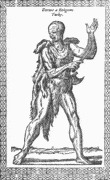
nafs), usually achieved by punishing the body. The Abdals of Rum, a group of Qalandars, inflicted wounds on their bodies, including cuts that spelled the name
Ali ibn Abi Talib (Figure 2).
47 Karamustafa, God's Friends, 71.
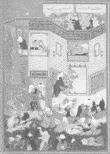
Such self-mortification left marks on the body that stood thereafter as visual reminders of the dervish's exertions. This spectacular asceticism highlights the theatricality of these actions, disseminated to wider audiences through verbal communications, very rare images, and written sources such as hagiographies. There are exceedingly few identified images of deviant dervishes and no visual representations of Abu Bakr. In an early-16th-century painting of a Sufi gathering that demonstrates stages of drunkenness among men and angels, three Qalandari dervishes play music and clap their hands at the bottom left (
Figure 3). Painted in a style distinct from the other figures, dressed in animal skins and barefoot, and wearing earrings, the dervishes crouch at the edge of the picture frame, outside the architectural setting that contains most other figures.
48 Sheila S. Blair and Jonathan M. Bloom, The Art and Architecture of Islam 1250–1800 (New Haven, Conn., 1994), 169, 324, n. 13.
A member of the Abdals of Rum group of deviant dervishes. From Nicolasde Nicolay Daulphinoys, The Navigations, Peregrinations, andVoyages, Made into Turkie by Nicholas Nicholay Daulphinois, trans. T.Washington the Younger (London: Thomas Dawson, 1585), 103 recto.
Sultan-Muhammad, Heavenly and Earthly Drunkenness, from adispersed Divan by Hafiz, copied at Tabriz, ca. 1525, fol.135r. Qalandar dervishes crouch at the bottom left. Courtesy of the ArthurM. Sackler Museum, Harvard University Art Museums, Cambridge, Mass. Promisedgift of Mr. and Mrs. Stuart Cary Welch, Jr. Partially owned by theMetropolitan Museum of Art and the Arthur M. Sackler Museum, HarvardUniversity, 1988. 1988. 460. 3. Photograph by Allan Macintyre.
To self-mutilation, Abu Bakr added the punishment of exposure. He avoided sleep,
49 Al-
Alwani, in al-Tabbakh, I
lam al-nubala
, 119.
lying on sheepskins spread on the ground.
50 Al-
Urdi, Ma
adin al-dhahab, 110.
He wore rags or went naked, nudity being a practice adopted by many mystics.
51 Only Biddulph, “Part of a Letter,” 263, mentions nudity. However, nudity for men as well as women is often mentioned in majādhīb accounts: Dols, Majnun, 407, 417; Karamustafa, God's Friends, 18, 41.
Most important Abu Bakr forsook life in a conventional home.
52 While many dervishes chose an itinerant life, another model may have inspired Abu Bakr. Qutb al-Din Haydar (d. ca. 1221–22) lived alone in the wilderness on a hill near his hometown of Zava, Iran: Karamustafa, God's Friends, 44–45.
Instead, he chose garbage heaps, cemeteries, and ruins as alternative dwellings. Reports also place him in or near the mosque of the neighborhood of Turab al-Ghuraba
or among the abandoned cemeteries to the north of the city, in an area known as the Middle Hill.
53 The texts refer to the Middle Hill as al-jabal al-awsaṭ or more often in Turkish orta tepe: al-Ghazzi, Nahr al-dhahab, 2:353–56.
By haunting the northern periphery, Abu Bakr distanced himself from the most important Muslim cemetery of Aleppo, Salihin, which featured the tombs of saints and dignitaries of Aleppo, representatives of normative Islam,
54 A study of the burial places of Aleppine notables in the 17th century suggests that the association of Salihin with normative Muslim figures with local roots endured, while many Ottoman dignitaries with Istanbul rather than local connections, as well as mystics, tended to be buried in the northern cemeteries: Watenpaugh, Ottoman City, 32, 137.
instead emulating Jamal al-Din Savi, who lived in a cemetery at the edge of Damascus.
55 Karamustafa, God's Friends, 40. Several Qalandarhanes were constructed near cemeteries, as in Jerusalem: ibid., 110.
The connection with cemeteries among deviant dervishes derives from the fact that they legitimized their mode of renunciation through the Prophetic injunction, “Die before you die.”
56 Schimmel, Mystical Dimensions, 135; Karamustafa, God's Friends, 21, 41.
Seeking a voluntary death, the dervish behaved like a cadaver, which included dwelling among tombs.
Celibacy is an additional feature of asceticism. Abu Bakr never married,57
Al-
Urdi, Ma
adin al-dhahab, ed. Abu Salim, 244.
and since the first two leaders of the dervish community after him, Ahmad al-Qari and Mustafa al-Qusayri (d. 1663), were not succeeded by sons, we can surmise that they renounced marriage, as well.
58 The biographies of neither men name wives or children. Al-Qari's biography is analyzed later in the current article. On al-Qusayri and al-Husayni, see al-Tabbakh, I
lam al-nubala
, 6:322–23.
Anecdotes with homoerotic overtones suggest that the concept of celibacy operative on the Middle Hill might have rejected productive modes of sexuality, not all forms of sexuality altogether. Thus, Abu Bakr groped the buttocks of a young and handsome Ottoman official who was visiting him, with a significant look and the statement, “You are good for such a thing.”
59 Al-
Urdi, ed. Abu Salim, 245. Elsewhere, a visitor to al-Qari's circle requested a kiss from a handsome young dervish, but al-Qari kissed him instead: ibid., 314.
Many deviant dervishes renounced gainful employment and sexual reproduction to avoid participation in the perpetuation of society.
60 Karamustafa, God's Friends, 20–21.
SPECTACULAR ANTINOMIANISM
In addition to asceticism, Abu Bakr violated social and legal norms. The thoroughness and permanence of his ascetic practices were themselves outside the norm, as most Sufis practiced asceticism at carefully timed and temporary intervals that ended with a return to productive life. Appearance and behavior made up the two broad arenas of antinomianism. Ottoman society carefully regulated hygiene61
For a discussion of pollution and piety in Islam that engages with Mary Douglas's study, Purity and Danger (London, 1966), see Kevin Reinhart, “Impurity/No Danger,” History of Religions 30 (1990): 1–23.
and sartorial conduct, partly on religious grounds and partly because one's external appearance and dress were controlled to convey social information: one's religion, regional or ethnic origin, profession, military rank, Sufi brotherhood, and wealth. Abu Bakr's adoption of nudity, discussed earlier as a sign of asceticism, also constituted an antinomian gesture when flaunted publicly. Wearing tattered clothes placed the dervishes beyond the realm of respectability, but it paled compared with the outrageous accoutrements of Qalandari groups, including begging bowls, iron rings, animal skins, buffalo horns, bells, and molar bones.
62 Karamustafa, God's Friends, chap. 2; Ocak, Osmanlı İmparatorluǧunda, 161–74.
The possibility remains that the Arabic sources kept silent on the most offensive aspects of the dervishes' appearance. By contrast, we can glean a sense of Abu Bakr's manipulation of elements of dress, such as the multiplication of the skullcap. In addition, the fact that the dervishes wore earrings is always cited along with the fact that they shaved their beards, both acts being described as reprehensible.
63 Abu Bakr shaved his beard and pierced his ears: al-
Urdi, Ma
adin al-dhahab, 33. His dervishes shaved their beards, wore earrings, and listened to music: ibid., 47. Abu Bakr sometimes carried a stick: al-Kurani in al-Tabbakh, I
lam al-nubala
, 6:120.
Wearing earrings was not unlawful, but as an act of self-ornamentation it could be considered incompatible with strict piety for men. The Haydari dervishes used iron rings as instruments of asceticism, wearing them around their ankles and arms and suspending them from their penises.
64 Karamustafa, God's Friends, 67–70. On dervishes suspending iron rings from their penises to aid in maintaining celibacy, see ibid., 16.
The grooming of facial hair was a highly socialized matter. In a society that regarded the beard as a necessary marker of an adult Muslim male,
65 On Islamic law's approach to facial and body hair, see EI2, s.v. “Sha
r” (Kevin Reinhart).
where the loss of hair signified the loss of honor, the deviant dervish's shaving of the beard participated in the rejection of his social position and an erasure of signs of civilization on the face. Deviant dervishes practiced the
chahar ḍarb, the “four blows”—that is, the fourfold shaving of the beard, mustache, eyebrows, and hair—that held multiple significations, including the removal of the veils between the self and God, the taking on of a resemblance to a cadaver, and asceticism insofar as a bare head constituted a form of exposure.
66 Karamustafa, God's Friends, 19.
The Ottoman writer
Ashiq Çelebi summarized the dervishes' antinomian behavior as “following one's back” rather than one's front—that is, doing everything in inverse order.
67Ashiq Çelebi, Mesa
ir us-su
ara or Tezkere of
Asik Çelebi, ed. G. Meredith-Owens (London, 1971), fol. 175a–b, as translated in Karamustafa, God's Friends, 76.
The early-16th-century observer of Ottoman dervish groups, Vahidi, reported that some deviant dervishes believed they functioned as mirrors to society, where people could see an inverted image of themselves.
68 Vahidi (fl. first half of sixteenth century), Menakib-i Hoca-i Cihan ve-Netice-i Can (written in 1522), as cited in Karamustafa, God's Friends, 81.
Abu Bakr and his followers adopted deviant and antisocial behaviors. Most prominently, they eschewed obedience to the ritual requirements of Islam. They neither prayed nor fasted.
69 Every biographer remarked on this except Ibn al-Hanbali.
They indulged in wine and
araq (an alcoholic beverage flavored with anise).
70 Al-
Urdi, Ma
adin al-dhahab, 110; al-Tabbakh, I
lam al-nubala
, 6:221.
They ate hashish, forbidden as an intoxicant.
71 On the consumption of hashish by Qari and the dervishes, see al-‘Urdi, Ma
adin al-dhahab, 110; al-
Urdi, Ma
adin al-dhahab, ed. Abu Salim, 313; al-Tabbakh, I
lam al-nubala
, 6:221. The discovery of hashish as a hallucinogen was attributed to deviant dervishes: Karamustafa, God's Friends, 19. See Franz Rosenthal, The Herb: Hashish versus Medieval Muslim Society (Leiden, 1971).
The consumption of unlawful foods took on the guise of a stylized performance. Every day in the morning, the dervishes passed around a cup of quicklime (
kalas), which they consumed, followed by coffee.
72 Al-
Urdi, Ma
adin al-dhahab, 112, is ambiguous as to whether the dervishes ingested lime; al-
Urdi (ibid., 110) explicitly states: “[the dervishes] ate hashish and kalas.” Shaykh Wafa
, Awliya
Halab, 48, verse 251, states that the dervishes “ate quicklime…to tame their nafs (animal self),” followed by coffee and water. During Evliya's visit to the Takiyya of Abu Bakr in 1671, the dervishes still assembled every morning for a formal meal: Evliya Çelebi (1611?–82?), Evliya Çelebi Seyahatnamesi (Istanbul, 1935), 9:379. Some Qalandars preferred eating foods available in nature and uncooked (berries, roots, herbs) to cooked foods: Karamustafa, God's Friends, 116, n. 5. Alcoholic beverages, hashish, and coffee are highly processed and socialized foods, but their illicit or semi-licit nature would have made them acceptable for the antinomians.
Quicklime was probably incorporated into the communal meal precisely because it was banned from the conventional table.
73 Quicklime was used locally to remove bitterness from some foods, but there is no evidence of it being eaten: Khayr al-Din al-Asadi, Mawsu
at Halab al-muqarina, ed. Muhammad Kamal (Aleppo, 1984). Quicklime was spread in cemeteries because of its capacity to change the acidity of the soil and may thus relate to the dervishes' notion of being already dead. I thank Steven Caton for this suggestion.
Coffee was widespread in the Ottoman Empire, though mired in controversy and occasionally prohibited by imperial decree. While coffee on its own was not always deemed illicit, its consumption by passing around a single cup placed its use in the same category as wine, which was usually consumed with a shared cup in company.
74 Ibn al-Hanbali, Durr al-habab, 1:2:1004–10. I am currently preparing a study on the architecture of Ottoman coffeehouses. On coffee, see Ralph Hattox, Coffee and Coffeehouses: The Origins of a Social Beverage in the Medieval Near East (Seattle, 1985); Hélène Desmet-Grégoire and François Georgeon, ed., Cafés d'Orient revisités (Paris, 1997); Michel Tuchscherer, ed., Le commerce du café avant l'ère des plantations coloniales (Cairo, 2001).
The dervish community's meal was held on schedule on the model of conventional social gatherings where lawful substances were enjoyed. They created “inverted” meals where they consumed forbidden substances in an objectionable manner. In addition, they made a mockery of conventional domesticity by flaunting the squalor of their dwelling and admitting into it unclean and despised animals, especially wild dogs.
75 Al-Kurani, in al-Tabbakh, I
lam al-nubala
, 6:116, 6:119, recounts the repulsion that the saint's squalid dwelling inspired in respectable Aleppines.
The hagiographies emphasized the saint's irreverence toward men of rank and power. In a provincial city within an empire at a time of centralization and consolidation, Abu Bakr combined the majdhūb's scorn of conventional hierarchies with the topos of the local saint who dominated Ottoman officials through the strength of his esoteric knowledge, reversing imperial hegemony. When Judge
Ali Efendi from Rumelia visited him, the saint attacked him with a cane.
76 Al-
Urdi, Ma
adin al-dhahab, ed. Abu Salim, 244. On Ali Efendi ibn Sinan Efendi (d. 1579), see N. al-Ghazzi, al-Kawakib, 3:60.
As mentioned earlier, Abu Bakr groped the buttocks of young Hasan Pasha (d. 1603), a well-connected Ottoman official from Istanbul who had just been posted in Aleppo, uttering an obscenity.
77 Al-
Urdi, Ma
adin al-dhahab, ed. Abu Salim, 245. On Hasan, see N. al-Ghazzi, al-Kawakib, 2:40.
The
majdhūb also infuriated Aleppo's governor,
Ali Pasha ibn Levend, who let loose on him a lion that he had starved for two days.
78Ali Pasha ibn Levend served as governor of Aleppo possibly around 1576. His son Hasan Pasha also was governor of Aleppo in 1601 and a patron of the Takiyya of Abu Bakr: al-
Urdi, Ma
adin al-dhahab, 195. The only extant biography of a member of this family is that of Hasan's brother Aslan Pasha (d. 1625): ibid., 157–58.
However, Abu Bakr, who like many saints could communicate with animals, subdued the lion: “[the lion] sat between [the shaykh's] hands, and the shaykh was smiling at him. He gave some of his dervishes dirhams for food and sweets. They brought the food…and he fed it to the lion.”
79 On the episode of
Ali Pasha's lion, see ibid., 33–34. Another lion kept as a performing animal in the bazaar escaped his cruel master to seek refuge near Abu Bakr: al-Kurani, as cited in al-Tabbakh, I
lam al-nubala
, 6:118.
The defiance of temporal authority also appears in the biographies of Ahmad al-Qari, the saint's successor. The governor, Nasuh Pasha, and an armed retinue rode out of Aleppo to exterminate the dervishes. At their sight, many ran away. Al-Qari confronted the governor, saying, “There are three things a pasha can do to us. He can kill us, in which case we will attain martyrdom; he can exile us…, in which case we will wander, or he can emprison us, in which case we will practice mystical discipline (
riyāḍa). Can you do anything more to us?” The pasha, disarmed and humbled by the mystic's fearlessness, asked for his blessing.
80 Al-
Urdi, Ma
adin al-dhahab, 111–12. This incident can be dated to between 1598 and 1605 on the basis of the dates of Nasuh's (d. 1614 or 1615) tenure as governor: Mustafa Na
ima, Tarih-i Na
ima (Istanbul, 1864), 2:122–30; al-
Urdi, Ma
adin al-dhahab, 59, n. 15; al-Tabbakh, I
lam al-nubala
, 3:178; Barkey, Bandits and Bureaucrats, 218.
The episodes of the inversion of power between the Ottoman officials and the saints always end with the official's recognition of the mystic's spiritual superiority. The same class of officials became the patrons of the Takiyya after its transformation into a conventional Sufi brotherhood.
As an illiterate saint who left no literary legacy, Abu Bakr nevertheless exercised his antinomianism prominently through the manipulation of language. He “mixed up his words”
81 Ibn al-Hanbali, Durr al-habab, 1:1:394.
and recited the
fātiḥa (the opening chapter of the Qur
an) out of order.
82 Al-
Urdi, Ma
adin al-dhahab, ed. Altunji, 50. Compare the Qalandars' substitution of the four takbīrs, usually pronounced at funerals, for regular prayer, reflecting the fact that the dervishes considered themselves already dead: Karamustafa, God's Friends, 18, 41.
The publicly performed mutilation of the word of God constituted the most transgressive of acts.
FEMINIZING THE MASCULINE
The inversion of gender hierarchies in Abu Bakr's transgressive use of language merits investigation. Using the Aleppine vernacular dialect only, rather than the literary Arabic or Ottoman used by the educated, the saint addressed male interlocutors in the feminine grammatical gender.83
The expressions describing this deviance are “yukhāṭibu al-rijāl bi-khiṭāb al-nisā
” (al-
Urdi, Ma
adin al-dhahab, 33) and “yukhāṭibu al-jāmi
bi-khiṭāb al-ta
nūth” (al-Husayni in al-Tabbakh, I
lam al-nubala
, 6:113). In addition, whenever the sources quote the saint, they record the grammatical inversion.
The highly complex grammar of Arabic requires one to adopt distinct pronouns and verbal endings when talking to female or male interlocutors. In effect, an Arabic speaker must always declare the sex of the person with whom she or he is conversing. By “feminizing the masculine,” as one biographer phrased it, Abu Bakr spurned grammar and its attendant social conventions.
84 “The Shaykh feminizes the masculine” (“al-shaykh yu
annith al-mudhakkar”): al-Tabbakh, I
lam al-nubala
, 6:221. Abu Bakr used the feminine gender to address even animals: al-Kurani in ibid., 6:118. We cannot know whether Abu Bakr used this inversion when speaking to women since, no women are mentioned in the biographies.
In a society predicated on the hierarchical construction of gender that placed males in a position superior to females, the
majdhūb wielded the incorrect use of grammatical gender as an antinomian gesture to demean those who dominated society: adult Muslim males like himself.
Any discussion of the formation of Abu Bakr's gendered self must take into account the field of gendered practices of his day. The saint's self-fashioning, including appearance, social behavior, and spatial movement, adhere to a scripted identity for antinomian piety. Performance—as recorded in the hagiographies—was instrumental to the construction of the social self. Judith Butler has argued that, rather than being essential and stable, gender is an identity that is tenuously constituted in time through the stylized repetition of acts.85
Judith Butler, “Subversive Bodily Acts,” in idem, Gender Trouble: Feminism and the Subversion of Identity (London, 1990), 139–41.
Her notion of a “citational self” maintains that the self performs social representations that are already partially scripted prior to each and every rehearsal.
86 Idem, “Performative Acts and Gender Construction: An Essay in Phenomenology and Feminist Theory,” Theatre Journal 40 (1988): 519–31.
Following this model, Abu Bakr's actions constituted a citational practice based on precedents of sainthood codified in the performance of other mystics as well as in hagiographies, which both positioned him as a
majdhūb and enabled others to recognize his behavior as such. The biographies do not condemn the linguistic transgression of the saint. In fact, they do not interpret it apart from recording it, which suggests that to the writers, this unique feature adhered to a mystical personality as they understood it.
To reconstruct how his contemporaries would have received Abu Bakr's actions—that is, to recapture the “citations” of his mystical self—I consider Sufi interpretations of gender norms. In her analysis of the pivotal master-and-disciple relationship as expressed in medieval Islamic texts, Margaret Malamud showed that gendered language and imagery frequently depicted a hierarchical relationship between men, predicated on authority and dominance on the one side and dependence and submission on the other. Normative relationships among Sufis reflected normative hierarchical relationships in the broader society. The depiction of the master–disciple dyad was quite complex, as the master took on both “male procreative and dominant powers” and “female generative and nurturing powers” vis-à-vis the disciple.
87 Margaret Malamud, “Gender and Spiritual Self-Fashioning: The Master–Disciple Relationship in Medieval Islam,” Journal of the American Academy of Religion 64 (1996): 89–117.
Thus, the Sufi shaykh frequently showed his superiority through metaphors of power sexually coded as masculine. The idea that the disciple (
murīd) gave absolute power to the shaykh over himself at initiation was often expressed in terms of the murid's adoption of the role of the inferior, passive female partner in normative sexual union.
88 Elsewhere, Ibn
Arabi (1165–1240) described disciples as the brides of ḥaqīqa (God's truth) and their shaykh as the person who combs the bride's hair and prepares her for marriage.
89 Muhyi al-Din Ibn
Arabi, al-Futuhat al-makkiyya (Beirut, 1966), 2:365; see Hoffman, Sufism, 240. The notion of the passivity of the murīd in the process of initiation is also compared to the passivity of the cadaver in the hands of the washer of the dead: Geoffroy, Le soufisme, 193; Valerie Hoffman, “Le soufisme, la femme et la sexualité,” in Les voies d'Allah, ed. Alexandre Popovic and Gilles Veinstein (Paris, 1996), 254–57; and idem, Sufism, 226–54. See also Annemarie Schimmel, My Soul Is a Woman: The Feminine in Islam (New York, 1997).
Consequently, one can suggest that Abu Bakr used the feminine gender in addressing male visitors to declare his dominance over them, to humiliate them; his assertion of superiority through sexually coded language meshes with a broader claim of domination by the shaykh over other men. Other contemporary religious figures also used sexually coded performative acts. As a comparison, consider Biddulph's account of another saint active in Aleppo around 1600: “[t]here is…[a] Bedlam Saint…whom they call Sheh Mahammet…who goeth alwaies naked, with a Spit on his shoulders; and as hee goeth thorow the streetes, the Shop-keepers will offer him their Rings; and if he thrust his Spit thorow their Rings, they take it as a favour and signe of good successe.”
90 Biddulph, “Part of a Letter,” 264.
The saint's public nudity suggests spectacular asceticism, while the insertion of the tip of a staff in rings held by the merchants casts him in the privileged, “active” sexual role and the recipients of his
baraka in the socially inferior, feminized, “passive” role. This phenomenon was not limited to Aleppo. In the early 18th century, a
majdhūb outside Nablus wandered from market to market brandishing a large gun and a sword, aggressively phallic accessories.
91Abd al-Ghani al-Nabulusi (1641–1731), al-Hadrat al-unsiyya fi al-rihlat al-Qudsiyya, ed. A.
Ulabi (Beirut, 1990), 87, 352; see Barbara von Schlegell, “Sufism in the Ottoman Arab World: Shaykh
Abd al- Ghani al-Nabulusi” (Ph. D. diss., University of California, Berkeley, 1997). There are numerous similar examples, though none is as well documented as Abu Bakr.
In short, the mystic asserted his superiority over regular townsfolk through the public performance of a sexual metaphor.
However, the master–disciple dyad also gave the master powers expressed in a feminine idiom.
92 “Gendered imagery…articulate[d] the intimate connection between authority and dependence….The use of feminine imagery…could signify both authority and dependence”: Malamud, “Gender,” 101–2. The hagiographies did not depict Abu Bakr in a nurturing feminine role except toward animals, since he was not a conventional shaykh; he used aspects of femininity for other ends.
Abu Bakr's linguistic transgression was not simply aimed at demeaning his interlocutors, as the saint referred to himself in the feminine gender, as well. Rather, it seems that Abu Bakr echoed another practice of transgressive piety of his period: the intentional inversion of the shaykh's authority. In non-normative piety, the self-demeaning of the mystic is an attested practice that is usually carefully circumscribed and temporary.
93 Deviant shaykhs staged public performances where the master espoused an inferior, feminized position—as, for example, the band of Barak Baba (d. 1307–8) in Syria, where the followers played music, and Barak “danced like a bear and sang like a monkey”: Karamustafa, God's Friends, 1–2, 62.
This momentary inversion of the hierarchical master–pupil relationship could be cast in sexual metaphors. Abu Bakr referred to himself as a woman, while other saints dressed as women or even temporarily
became women as part of their construction of a mystical subjectivity. The legend of the Moroccan saint Abu Ya
za echoes Abu Bakr. Illiterate and speaking only in the Berber vernacular, Abu Ya
za dressed and lived as a black female domestic slave until his secret was discovered.
94 Emile Dermenghem, Le culte des saints dans l'Islam maghrébin (Paris, 1954), chap. 2. For saints who can turn others, or themselves, temporarily into women, see ibid., 96.
The illiterate saint's assumption of authority over notable men, and his adoption of attributes of femininity, both performed in a stylized manner, constitute inversions of society's normative order. These performances disrupted social hierarchies of gender and, by doing so, called attention to their constructed, arbitrary nature, which is especially apparent to one who had access to
ḥaqīqa.
This is not to suggest in any way an incipient feminism or an awareness of gender inequalities on the part of Abu Bakr or, indeed, Sufism. The saint's ritualized taking on of feminine traits in no way meant to advocate empowerment for women or the permanent disruption of normative hierarchies. There is little evidence of transgressive women mystics' manipulation of gender hierarchies to the same extent as men. While our knowledge of female mysticism in the early modern period is limited, highly regarded female mystics have been described as “superior to men,” and evidence suggests that in Sufi circles exceptional female mystics also took on attributes of masculinity.95
See Schimmel, Soul. This assessment must be tempered with the caveat that more research is needed on the practices of all-female and mixed Sufi circles in the early modern period. By contrast, historical and ethnographic research on the modern and contemporary periods has uncovered many instances of women taking on attributes of masculinity. In baladī neighborhoods of Cairo, women who work outside the home in positions of authority wear men's clothing and behave like men: Sawsan el-Messiri, “Self-Images of Traditional Urban Women in Cairo,” in Women in the Muslim World, ed. L. Beck and N. Keddie (Cambridge, Mass., 1978), 527. A woman who serves as the head of a mixed-gender Sufi brotherhood in Egypt assumes masculine behavior and gives men orders: Hoffman, Sufism, 227, 249. On a female Sufi dressing as a man, complicated by her being a European convert to Islam in a context of colonialism, see Julia Clancy-Smith, “‘The Passionate Nomad’ Reconsidered: A European Woman in L'Algérie Française (Isabelle Eberhardt, 1877–1904),” in Western Women and Imperialism, ed. Nupur Chaudhuri (Bloomington, Ind., 1992). On female Sufism in contemporary Syria, see Annabelle Bottcher, “L'élite féminine Kurde de la Kaftariyya—Une confrérie Naqshbandi damascène,” in L'Islam des Kurdes, ed. Martin van Bruinessen (Paris, 1999); and Barbara von Schlegell, The Power of Concealment: Sufi Women in Damascus (Berkeley, Calif., forthcoming).
However, the fact that apparently no known female dervishes performed a similar inversion suggests that the gender hierarchies were so internalized that the superior party (male) could give up his superior position, albeit temporarily, but the inferior party could rarely aspire to claim superiority. Abu Bakr's stylized performance of a transgressive act was not directed at effecting permanent change in society. To the contrary, in either case—male mystics impersonating women and female mystics appropriating masculine behavior—the inversion of gender hierarchies was only shocking, and therefore effective, in a context in which the hierarchies were securely anchored and ultimately served to reinforce the gendered construction of society.
The majdhūb, like the antinomian dervish, did not work to alter society's hierarchical rigidity. Far from it. The antinomian dervish reminded society that salvation could be found not in obedience to the law but, rather, in the rejection of society and civilized life altogether. The movement's activism required the flaunting of the antinomian way in society rather than hermitic withdrawal, yet it lacked a progressivist ethic. Its transformative aims were focused on individual salvation, not on social reform.96
“The deviant dervish did not withdraw into the wild nature to lead a life of seclusion but created for himself a ‘social wilderness’ at the heart of society where his fiercely antisocial activity functioned as a sobering critique of society's failure to reach God”: Karamustafa, God's Friends, 13–14.
While this path to individual salvation included the questioning of the category of gender in Abu Bakr's case, it was implicitly limited to a body that was unquestionably male.
BETWEEN WILDERNESS AND ARCHITECTURE
Any discussion of a gendered body must consider the spatial practice adopted by that body. Abu Bakr's subjectivity involved a peculiar relationship to urban geography, one that oscillated between architecture and its reverse, wilderness. This section maps his spatial activity to evaluate its role in the construction of a mystical self.
Cities were central to Ottoman culture; they formed the nodes through which Istanbul's dominance was enforced. Ottomans reshaped cities; layered them with monuments and institutions; and described, categorized, and praised urban life.97
Irene Bierman, Rifa'at Abou-El-Haj, and Donald Preziosi, ed., The Ottoman City and Its Parts: Urban Structure and Social Order (New Rochelle, N.Y., 1991). I discuss Ottoman-period texts that represent cities produced in Istanbul and in provincial capitals in Watenpaugh, Ottoman City, chap. 6.
The built environment was the privileged marker of civilization beyond which lay vast agricultural areas and rural settlements connected by trade routes and divided by desert. The vast Ottoman bureaucracy surveyed it; quantified its population and production; assessed its potential for taxation; and assigned governors, janissaries, and judges to administer it.
98 Within the broad category of rural land, a culturally loaded division exists between productive, agricultural lands, and the desert. On Ottoman administration of land and labor resources, see Barkey, Bandits and Bureaucrats, 27–55; Halil İnalcık, “State, Land, and Peasant,” in An Economic and Social History of the Ottoman Empire, ed. Halil İnalcık and Donald Quataert (Cambridge, 1994), 1:103–78.
Landscape was deeply implicated in social and cultural values.99
J. M. Rogers, “Itineraries and Town Views in Ottoman Histories,” in The History of Cartography, ed. J. B. Harley and David Woodward, vol. 2, book 1, Cartography in the Traditional Islamic and South Asian Societies (Chicago, 1992), 228–55; Ralph Brauer, Boundaries and Frontiers in Medieval Muslim Geography: Transactions of the American Philosophical Society, vol. 85, pt. 6 (Philadelphia, 1995); Gülru Necipoglu, “The Suburban Landscape of Sixteenth-Century Istanbul as a Mirror of Classical Ottoman Garden Culture,” in Theory and Design of Gardens in the Time of the Great Muslim Empires, ed. Attilio Petruccioli (Leiden, 1996), 32–71.
The wilderness (
barriyya) occupied an interstitial category of landscape as the uncultivated, “unincorporated” land that lay at the edge of cities, beyond the purview of villages and of agricultural production. Occasionally littered with cemeteries or abandoned settlements (
kharab), overgrown with thorns and trees, this wilderness was accessible—indeed, the
makān of Abu Bakr lay only about three miles from the walled city. Like architecture, the wilderness was full of social meaning. Its features were named; the paths and trails that crisscrossed it were memorized. In the cemeteries, famous people's tombs were acknowledged. Sites were remembered because of important events or because of their former uses. The wilderness at the edge of the city was a key spatial category: it marked the boundary of civilization.
At a time of urban growth in Aleppo, the presence of Abu Bakr at the edge of the city is significant because sainthood was the pioneering element in the taming of the wilderness, followed by urbanization.
100 Ömer Lütfi Barkan's “colonizing dervishes” theory described the urbanization and Islamization of medieval Anatolia by Turkman groups spearheaded by Sufis and their instrumentalization of waqf, in Ömer Lütfi Barkan, “Osmanlı İmparatorluǧunda bir İskan ve Kolonizasyon Metodu Olarak Vakıflar ve Temlikler: İstila Devirlerinin Kolonizatör Dervişleri ve Zaviyeler,” Vakıflar Dergisi 2 (1942): 279–362. This theory bears out in the urbanization of Ottoman Aleppo, with the caveat that it had been an Islamic city since the 7th century. I hope to address this point in a future study of urbanization in Ottoman Aleppo.
Given the ambiguity of the wilderness as a spatial category, it is not surprising that an antinomian community would elect to establish an alternative settlement there. As outlined earlier, the community of Abu Bakr staged an upside-down version of conventional domesticity. Rather than the living, the dervishes cohabitated with the dead; instead of extended biological families and retainers, they adopted a homosocial grouping of unrelated men. According to one hagiography, Abu Bakr sought out the abandoned tombs of the Middle Hill because one of his ancestors was buried there.
101 Al-sayyid
Abd al-Hafiz, an ancestor of Abu Bakr, was buried on the Middle Hill: al-Husayni in al-Tabbakh, I
lam al-nubala
, 6:112.
Thus, instead of joining the household of his living kin in the neighborhood of Suwayqat
Ali, Abu Bakr preferred his dead kin on the Middle Hill. Occasionally he lingered in the mosque of Turab al-Ghuraba
, adjacent to a cemetery.
102 Al-Ghazzi, Nahr al-dhahab, 2:342–43. In the late 16th–early 17th century, a mosque known as Masjid al-Shaykh Wafa
was established, with an endowment to benefit the dervishes of Abu Bakr.
The saint's dwelling was not a home. The sources always referred to it as his “place” (makān), never using words that denote a domestic arrangement (dār, bayt).103
One anecdote suggests that the saint's place had a door that could be locked: al-Kurani in al-Tabbakh, I
lam al-nubala
, 6:117.
The dervishes' communal repasts featured forbidden or proscribed foods rather than licit cooked meals. Visitors often sat in a circle around the saint and were offered coffee and sherbet in a ritual that mimicked civilized codes of hospitality out of context.
Combing the hagiographies allows one to map Abu Bakr's spatial activity and to discern in them an alternative mystical geography, one that eschewed the well-known venerable Muslim shrines of the city in favor of an idiosyncratic list of nondominant mystical sites. During a particularly harsh drought, Abu Bakr performed a visitation (ziyāra) to the tomb of Baba Bayram (d. 1362), to the north of Turab al-Ghuraba
,
104 Al-
Urdi, Ma
adin al-dhahab, ed. Altunji, 50.
inside a dervish lodge along the White Road.
105 On the neighborhood along the White Road (al-darb al-abyad in Arabic; aq yul in Turkish), pronounced “Aghyur” locally, see al-Ghazzi, Nahr al-dhahab, 2:324–27.
There Abu Bakr declaimed the
fātiḥa correctly, contrary to his usual habit of reciting it out of order, thereby causing a torrential rain. This anecdote reflects the spiritual power of mystical sites: the tomb of Bayram, like those of all saints, embodied the
baraka that had emanated from him in life. While the proximity of Abu Bakr's
makān to the tomb of Bayram explains his choice, an additional link was the Qalandari association of Bayram's lodge.
106 Ibid., 2:325–26; al-Tabbakh, I
lam al-nubala
, 7:388–89; Çelebi, Seyahatname, 380; Watenpaugh, Ottoman City, 128–30.
Abu Bakr's choice of Baba Bayram makes salient his disregard for the relics of prophets (Muhammad, Zakariyya, Abraham) and the venerated tombs of Salihin to Aleppo's south. By singling out an unconventional saint in his wilderness, Abu Bakr highlighted an alternative mystical geography.
Unlike Bayram, however, Abu Bakr did not choose a hermitic life. While the saint elected to live in the wilderness, he interacted with the built environment in ritualized events that reinforced the distinction between the wilderness, nature, and antinomian piety, on the one hand, and architecture, civilization, and normative Islam, on the other. Anecdotes present these interactions both negatively and positively. A biographer disapprovingly stated that the saint's incursions into the city included frequenting the coffeehouse of Aslan Dada to listen to music.107
Al-
Urdi, Ma
adin al-dhahab, 47.
This cafe, located in the central covered market, was the place of predilection of another
majdhūb, Aslan Dada (1538?–1638), who secluded himself there.
108 Biographies of Aslan Dada are in ibid., 159–62; al-Tabbakh, I
lam al-nubala
, 6:234–37. On sites associated with Aslan Dada, see Watenpaugh, Ottoman City, 151–55. Aslan Dada showed eccentricities typical of a majdhūb, but neither he nor his followers had the extreme Qalandari tendencies of Abu Bakr's community.
Although in 16th-century Aleppo, as elsewhere in the Ottoman Empire, coffeehouses had become ubiquitous public spaces, they were nevertheless not considered entirely respectable. Indeed, the narrative context of this anecdote is pejorative: visiting the coffeehouse at night and listening to music are presented as reprehensible.
109 Al-
Urdi, Ma
adin al-dhahab, 47.
By contrast, Abu Bakr is never reported as visiting the most important religious site of the old city, the Great Mosque of Aleppo, located about thirty meters from the cafe. For Abu Bakr, then, this incursion into the city to partake of a risque activity associated with another
majdhūb may have signaled the saint's partiality for an unconventional mystical geography of the city.
Two additional anecdotes cast the saint's interaction with urban space in a positive light. During the construction of the Mosque of Husrev Pasha (completed in 1545–46)
110 The mosque complex of Husrev Pasha was the first major Ottoman architectural project in Aleppo: André Raymond, “Les grands waqfs et l'organisation de l'espace urbain à Alep et au Caire à l'époque ottomane,” Bulletin d'Études Orientales 31 (1979): 113–32; Watenpaugh, Ottoman City, 60–77.
at the center of the city, Abu Bakr cheered on the workers, taking a wheelbarrow to the Middle Hill to bring back cut stones. Lit up by the saint's
baraka, the resultant mosque is more radiant than others.
111 Abu Bakr predicted that one of his companions would be the mosque's muezzin: al-Kurani in al-Tabbakh, I
lam al-nubala
, 6:116–17.
This narrative brings the
baraka of the saint from the wilderness to the heart of the city, linking the two spatial categories of wilderness and architecture through the labor of the
majdhūb. This episode also links the saint's unconventional mysticism to conventional learned Islamic practice, as Husrev Pasha's endowment included a Friday mosque as well as a madrasa, still today the preeminent school of Sunni Muslim law in the city.
112 The endowment deed stipulated that the Hanafi madhhab, favored by the Ottoman state, be taught in the madrasa: Vakıflar Genel Müdürlügü (Directorate of Religious Endowments), “Endowment Deed of Husrev Pasha, Aleppo, 969/1561,” Ankara, notebook 583, 149–50.
In another anecdote,
113 Al-
Urdi, Ma
adin al-dhahab, 34.
one night, two brothers, one dissolute and one virtuous, went to a “Christian house” (
dār nasrānī), that is, a tavern, probably in the neighborhoods of Judayda and Saliba.
114 Jean-Claude David, “L'espace des chrétiens à Alep: Ségrégation et mixité, stratégies communautaires,” Revue du monde musulman et de la Méditerranée 55–56 (1990): 150–70.
The dissolute brother drank wine, encouraging his sibling to do the same, yet the latter hesitated to violate the Islamic prohibition against alcohol. Stepping outside, the virtuous young man saw Shaykh Abu Bakr on the wall of the “Christian” house, which was too high to climb—only a bird, it seemed to him, could do it. He ran inside to get his brother, whom the saint rebuked. The latter repented, and gave up his vice. Spatially, the appearance of the saint on a wall places this miraculous deed in an architectural context. The motif of the wall is rife with mystical associations that will be discussed below. Nonetheless, the apparition of a saint who encourages young men to uphold the Shari
a certainly jars with the same biography's depiction of Abu Bakr's own impenitent consumption of alcohol, hashish, and coffee.
Even though he was intimately linked to the Middle Hill, Abu Bakr was not confined to it. The construction of his mystical self was predicated upon a practice of space where engagement with the built environment and with the spheres of other religious figures took place in a highly stylized manner. In this section I mapped the spatial topography of sainthood, but the saint's spatial practice, like other aspects of the construction of his persona, such as his name and genealogy, may have been subjected to certain shifts. Indeed, the last two anecdotes, the saint engaged in the act of building a mosque-madrasa and the saint perched on a wall exhorting youth to lawful behavior, are possibly part of the redaction of the saint's persona into a normative mode. This transformation in the representation of the saint was on par with other mutations of the antinomian into the normative.
FROM WILDERNESS TO ARCHITECTURE
The image of the unconventional mystic was transformed to such an extent that by the early 1600s, the Shafi
i mufti of Aleppo could opine, “[Any] supplication at the tomb of Shaykh Abu Bakr will be answered.”
115 Stated by
Umar al-
Urdi (d. 1615): al-
Urdi, Ma
adin al-dhahab, 35. I thank Nasser Rabbat and Peri Bearman for advising me on this translation.
This statement marks the final co-optation of the memory of the saint and of the community of deviant dervishes into canonical Sufism, accompanied by the transformation of their wilderness retreat into a wealthy dervish lodge, which in turn stimulated the growth of a neighborhood. Normative Islam appropriated deviant piety as the city absorbed the wilderness.
This appropriation participated in a broader movement in Ottoman society to neutralize, eliminate, or incorporate antinomian religious groups in the 16th and 17th centuries. Remnants of deviant dervishes were absorbed by institutionalized Sufi orders, especially the Bektashiyya. The story of the repression and forced transformation of these groups is largely suppressed in the original sources, which merely speak of a wayward “before” and a reformed “after,” without revealing how the change was negotiated. Martin van Bruinessen analyzed the story of a miracle contest opposing two powerful religious figures that seemed to retain a memory of this suppressed transformation (Figure 4).116
Martin van Bruinessen, “Haji Bektash, Sultan Sahak, Shah Mina Sahib and Various Avatars of a Running Wall,” in idem, Mullahs, Sufis and Heretics: The Role of Religion in Kurdish Society (Istanbul, 2000), 271– 94.
A saint riding a lion or a tiger, using a venomous snake as a whip, was defeated by a newcomer mounted on a wall that he could move at will. The newcomer also had mastery over rivers. Bruinessen showed that the lion-riding saint was associated with itinerant, antisocial, threatening forms of mysticism, while the saint on the wall seemed to index settled, orthodox, less threatening forms of piety.
117
Artist unknown. The Miracle Contest. Haji Bektash seated on a wall meets a challenger riding a lion. Photograph of a glass painting of unknown origin. Acquired in Haji Bektash Köyü, Turkey, in 1979. Collection of Martin van Bruinessen
The wall, an emblem of architecture, signaled the settled type of sainthood, of “civilization.” Likewise, wild animals stood as a sign for “wilderness.” Bruinessen linked the miracle contest in which the vagrant saint loses to the settled Sufi to the decline of itinerant Qalandarism, seeing in the defeat of the mendicant and wild saint a memory of the absorption of the Qalandari dervishes into settled orders, particularly the Bektashiyya, the most esoteric of the “authorized” Ottoman Sufi orders.118
At first glance Abu Bakr's hagiographies appear to cast him as the “wild” dervish of the miracle contest, as shown by his predilection for the non-urban; his mastery over wild animals, including lions; and his contraventions of normative behavior. Yet the biographies beginning in the 17th century superimpose the “wild” attributes with the iconography of the “settled” saint. This is reflected in his mastery over water, as in the miracle of the rain, and in the fact that he is frequently compared to bodies of water: “[t]o the dervishes…he was as a sea of joy, a Euphrates that welcomed all travelers.”
119 Al-
Alwani in al-Tabbakh, I
lam al-nubala
, 6:119. The titles of the 17th-century hagiographies all feature the word “fountain” or “drink.”
The attributes of “orthodoxy” appear most clearly in the two stories that dramatize his positive engagement with architecture: in the act of building the Husrev Pasha mosque and particularly in the anecdote of the tavern, where the saint mounted on the wall dominates it spatially and defies the rules of gravity. Both stories ally the saint with architecture and Shari
a, belying the rest of the biography. This combination of “opposite” markers may seem contradictory; nevertheless, it echoes another aspect of Bruinessen's argument. He linked the gradual incorporation of Qalandars into the Sufi orders with the mutation of the miracle contest into a narrative where both types of sainthood are presented in harmony.
120 Bruinessen, “Haji Bektash,” 273.
Clearly, the accumulation of attributes of both types in Abu Bakr reflects precisely the process of transformation of the antinomian saint into a socially redeemable figure.
While the biographies of Abu Bakr juxtapose opposite attributes without illustrating a transformation, the biography of his khalīfa, Ahmad al-Qari (d. 1632), centers on a narrative of change.
121 Al-Qari's preserved biographies are in al-
Urdi, Ma
adin al-dhahab, 110–13; a eulogy by the Aleppine poet Sayyid Ahmad al-Naqib (d. 1646) in al-Tabbakh, I
lam al-nubala
, 6:223; Muhammad Amin al-Muhibbi (1651–99), Khulasat al-athar fi-a
yan al-qarn al-hadi
ashara (Cairo, 1868–74), 1:259; al-Husayni in al-Tabbakh, I
lam al-nubala
, 6:110–29; Shaykh Wafa
, Awliya
Halab; and al-Tabbakh, I
lam al-nubala
, 6:221–23.
After the saint's death, Ahmad led the dervishes in their antinomian lifestyle, shaving his beard, wearing rags, sleeping on sheepskins, eating hashish and quicklime, and drinking wine and
araq. Then, seemingly abruptly, the dervishes gathered around. “‘Our wish is to have a shaykh who can bring about some order (niẓām) among us.’ So they appointed [al-Qari].”
122 Al-
Urdi, Ma
adin al-dhahab, 110–11.
As it is written, this passage insinuates that the transformation of the community was entirely an internal, spontaneous, and unanimous decision. That this transformation excluded any form of state intervention, coercion, or incentive contradicts the facts presented in the rest of the biography. This in turn implies that the band of dervishes was being rewritten into a conventional Sufi brotherhood. Al-Qari's first act in the era of “order” was to buy the domestic furnishings of mats and pots and pans. This reveals the abandonment of the ascetic habit of sleeping on a sheepskin spread on the ground in favor of the more genteel mat and the adoption of cooked food. From this point onward, the biography intercalates episodes in the construction of the dervish lodge through the patronage of Ottomans with instances of adoption of lawful behavior by al-Qari. For example, after Isma
il Agha, the leader of the military garrison at the citadel, sponsored the water supply to the dervishes' area, al-Qari's men began to observe the five daily prayers.
123 However, al-Qari continued to shave until his death: “this is how we saw our teacher [Abu Bakr].…[W]e will not take the path of the beard”: ibid., 111.
A building chronology of the lodge can be derived from piecing together the biography with epigraphic and archival records.
124 For an architectural study of the lodge of Abu Bakr, see Watenpaugh, Ottoman City, 141–48. Directorate of Religious Endowments, “Endowment Deed of Öküz Mehmed Pasha, Aleppo, 1610,” Ankara, notebook 573, 31–34.
The biography catalogued how the dervish community entered the structures of “order”: officials built in an accretive manner; al-Qari bought orchards and houses as rental properties and established a religious endowment, effectively becoming the administrator of a Sufi lodge. The biography presents this development as a progressive improvement to the point that the resultant structure “did not have an equal in the world among sites of visitation [
mazārāt].”
125 Al-
Urdi, Ma
adin al-dhahab, 111.
Thus, the causal link between the dervishes' obedience to the law and the officials' patronage of the lodge is absolutely unmistakable.
The intrusion of writing and structures of textuality followed the adoption of lawful behavior and the enmeshment in architecture. Al-Qari set up an endowed library
126 Ibid., 112. See also al-Ghazali, “Al-
Urdi's Ma
adin al-dhahab,” 122.
and wrote a biography of his master.
127 Al-Tabbakh, I
lam al-nubala
, 6:111.
The succession struggle following his death in 1632 reveals how deeply the former Qalandari community had become implicated in centralized Ottoman bureaucracy. Two dervishes produced documents in al-Qari's hand, appointing each as his successor. The matter was resolved with the arrival of a decree from the sultan.
128 Al-
Urdi, Ma
adin al-dhahab, 112; al-Tabbakh, I
lam al-nubala
, 6:323–24. Al-Husayni's biography of the successful rival, Mustafa al-Qusayri (d. 1663), is silent on the controversy but details the legitimizing document: al-Tabbakh, I
lam al-nubala
, 6:322–23.
Biographies of later shaykhs often explicitly emphasized control. “In his [Muhammad Dada al-Wafa
i (d. 1707)] time the Lodge was organized in the most perfect order [akmal al-niẓām].”
129 Al-Tabbakh, I
lam al-nubala
, 6:401–2.
On the model of conventional Sufi orders, sons of shaykhs succeeded their fathers at the head of the lodge, abandoning the tradition of celibacy.
130 After Mustafa al-Qusayri, who had no sons, sons succeeded fathers at the head of the lodge until 1798 as follows: Husayn Dada (d. 1687), Muhammad Dada (d. 1707),
Ali Dada (d. 1722), Husayn (1700–43), Mustafa Dada (1727–98), who had only daughters. For their biographies, see ibid., 6:323, 6:401–2, 6:432–33, 6:484–85, 7:148–49. The last biography lists subsequent shaykhs until 1904.
Yet traces of the peculiar spatial practice of the founding saint remained.
Ali Dada (d. 1722) never entered the city and rarely left the lodge except to attend Friday prayers at the al-Bakhti Mosque in the wilderness.
131 Ibid., 6:432–33. The al-Bakhti mosque, just outside the door of Aghyur, was built in 1247 by the Mamluk Sultan Baybars: al-Ghazzi, Nahr al-dhahab, 2:327.
Seen from afar, on the Middle Hill, the lodge of Abu Bakr in the late 17th century appeared as a series of cascading domes (Figure 5). The monumental structures of the complex stood along a courtyard, showing a mixture of Istanbul-inspired trends and the distinctive local decorative techniques (Figure 6). The most remarkable building of the complex, the mausoleum of Shaykh Abu Bakr, comprised a façade graced by striped masonry and ornamental relief bands that led into a small domed mosque and a handsome chamber, also domed, that contained the cenotaph of Abu Bakr. In a garden cemetery nearby, shaykhs of the lodge and Ottoman officials were buried.
The Takiyya (Dervish Lodge) of Shaykh Abu Bakr, Aleppo, viewed from the south. Postcard by Wattar Frères, Aleppo, ca. 1930s. Collection of the author
The Dervish Lodge viewed from the courtyard. The domed Tomb of Shaykh Abu Bakr is on the right. Photo: Author
From the 17th to the 19th century, the Ottoman governors of Aleppo used the lodge as an occasional residence, administrative center, and burial ground. While Ottoman officials were frequently interred in mosques they patronized in the provinces, they did not often choose to live in a Sufi lodge. The retreat of Ottoman officialdom from the heart of the city to a defensible location at its edge coincided with the Jelali revolts. At a time of instability, the lodge's isolated, elevated site allowed its surroundings to be easily surveyed. Indeed, from there “all of Aleppo lying at one's feet can be contemplated with relish,”132
“Cümle Haleb ziri payde temasa olunur”: Çelebi, Seyahatname, 9:378.
noted Evliya Çelebi (1611?–82?), whose travelogue reflects the perceptions of the Ottoman elite.
133 There is a substantial literature on Evliya's work: see EI2, s.v. “Awliya Celebi” (Irène Mélikoff); Robert Dankoff, “Evliya Çelebi's Book of Travels as a Source for the Visual Arts,” Turkish Studies Association Bulletin 16 (1992): 39–50.
This statement echoes the Ottoman predilection for staging privileged viewpoints.
134 Gülru Necipoglu, “Framing the Gaze in Ottoman, Safavid and Mughal Palaces,” Ars Orientalis 23 (1993): 303–42; Lucienne Thys-Senocak, “Gender and Vision in Ottoman Architecture,” in Women, Patronage and Self-Representation in Islamic Societies, ed. D. Ruggles (Albany, N.Y., 2000), 69–89.
In 1671, at the time of Evliya's visit, those admitted into the enclosure of the lodge could view an Aleppo transformed after almost 180 years of imperial rule from Istanbul. From this perspective, the distinctive domes and pencil-shaped minarets crowning the great 16th-century Ottoman mosques appeared perfectly aligned (
Figure 7). Evliya's statement, then, reveals an ideal of Ottoman urban order.
Aleppo seen from the Takiyya of Shaykh Abu Bakr. From Sauvaget, Alep, plate 4
Evliya's testimonial signals that the lodge, from being an antinomian outpost for the staging of a world-upside-down, had become a privileged viewpoint through which the powerful could gaze on a conquered city. In other words, the deviant dervishes' retreat had been thoroughly incorporated into an Ottoman visual grammar of power.
It is perhaps not surprising that hegemonic structures in society would co-opt and instrumentalize the most radical and threatening aspects of piety. It is tempting to speculate that Abu Bakr was aware of the possibility of appropriation; perhaps he had already subverted it. Seventeenth-century hagiographers reported that when Ibn al-Hanbali hesitated to include Abu Bakr's biography in his compendium, he presented his conundrum to the Friend of God himself. Abu Bakr chided him, using the feminine gender for both his interlocutor and himself and referring to himself in the third-person feminine, “Why should you not mention her? Isn't she a Muslim [woman] among Muslims?”
135 Al-
Alwani in al-Tabbakh, I
lam al-nubala
, 6:113.
So Ibn al-Hanbali included Abu Bakr alongside his biographies of sultans, governors, janissaries, merchants, poets, Sufis, judges, grammarians, and Qur
an reciters. He memorialized the unruly saint as a Muslim among other Muslims. Did this amount to an appropriate response to the majdhūb's statement? Or was Abu Bakr's utterance another mystical riddle whose true inner sense initiates would have caught, while the respectable mufti (and, by extension, we the uninitiated) could only absorb its external, semantic meaning?
Author's note: This article is based on fieldwork in Syria and Turkey conducted in 1995–97 with the support of a Social Science Research Council Fellowship and a Fulbright-Hays Fellowship, and in 1999 with a Faculty Research Grant from Rice University. Further support was provided by the Aga Khan Career Development Professorship in the Department of Architecture at the Massachusetts Institute of Technology. I thank Nasser Rabbat, Erika Naginski, Keith Watenpaugh, and Paulo Pinto, as well as the participants in the workshop “Challenges in Sexuality Studies in and of the Middle East” at Harvard University, spring 2004. All translations are my own, unless otherwise noted.