INTRODUCTION
Molecular genetic techniques such as multilocus enzyme electrophoresis (MEE) (reviewed by Andrews and Chilton, Reference Andrews and Chilton1999) and DNA sequencing provide useful tools for exploring the existence of cryptic or sibling species in tapeworms (cestodes). The existence of such species appears to be relatively common, with examples elucidated to date utilizing MEE including the fish cestode genera Bothriocephalus (see Renaud et al. Reference Renaud, Gabrion and Pasteur1983, Reference Renaud, Gabrion and Pasteur1986; Renaud and Gabrion, Reference Renaud and Gabrion1984) and Proteocephalus (see Hanselová et al. Reference Hanselová, Šnabel, Spakulová, Králová and Fagerholm1995; Šnabel et al. Reference Šnabel, Hanselová, Matiucci, D'Amelio and Paggi1996) as well as the ruminant cestodes Moniezia expansa and M. benedeni (see Ba et al. Reference Ba, Wang, Renaud, Euzet, Marchand and De Meeüs1993; Chilton et al. Reference Chilton, O'Callaghan, Beveridge and Andrews2007). In the economically important taeniid cestode Echinococcus granulosus (summarized by Thompson and McManus, Reference Thompson and McManus2002) and the anoplocephalid cestodes of holarctic rodents belonging to the genera Anoplocephaloides and Paranoplocephala, sibling species have also been identified using DNA sequence data (summarized by Wickström et al. Reference Wickström, Haukisalmi, Varis, Hantula and Henttonen2005).
The anoplocephalid cestodes occurring in the bile duct of Australian marsupials have been investigated using MEE (Baverstock et al. Reference Baverstock, Adams and Beveridge1985). Three species of Progamotaenia occur in the bile ducts of kangaroos, wallabies and wombats (families Macropodidae and Vombatidae, respectively) (Beveridge, Reference Beveridge1976, Reference Beveridge1980), but they differ markedly in their host ranges. Progamotaenia diaphana is restricted to the southern hairy nosed wombat, Lasiorhinus latifrons, P. effigia to the western grey kangaroo, Macropus fuliginosus, whereas P. festiva occurs in 14 species of kangaroos and wallabies as well as one species of wombat (Spratt et al. Reference Spratt, Beveridge and Walter1991). The wide host range of P. festiva, together with considerable morphological variation within the species, led to the speculation that it was a complex of sibling species (Beveridge, Reference Beveridge1976). An MEE study (Baverstock et al. Reference Baverstock, Adams and Beveridge1985) supported this hypothesis, with evidence that up to 12 genetically distinct groups existed within the taxon. However, this study was limited by relatively small sample sizes, and apparent instances of host switching complicated the interpretation of the findings. In addition, not all hosts of P. festiva were included.
In the present study, the hypothesis that P. festiva is a species complex is tested using a much larger number of samples of cestodes from a broad range of host species. The study was also designed to assess the extent of host switching suggested in the earlier study (Baverstock et al. Reference Baverstock, Adams and Beveridge1985). Since recent genetic or phylogenetic studies of other species of Progamotaenia (see Hu et al. Reference Hu, Gasser, Chilton and Beveridge2005) and of other anoplocephalid genera, Anoplocephaloides and Paranoplocephala, from rodents (e.g. Wickström et al. Reference Wickström, Haukisalmi, Varis, Hantula and Henttonen2005) have demonstrated the usefulness of sequence data sets of the mitochondrial cytochrome c oxidase subunit 1 (cox1), this gene was chosen for the analyses herein.
MATERIALS AND METHODS
Collection of cestodes
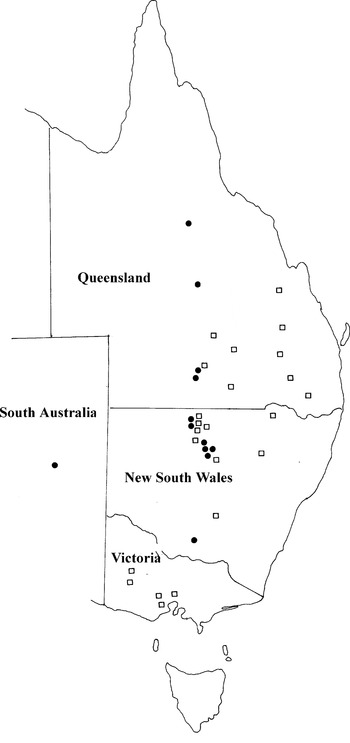
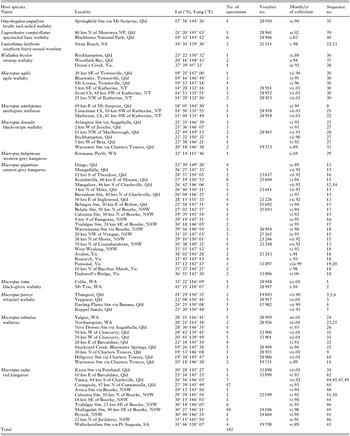
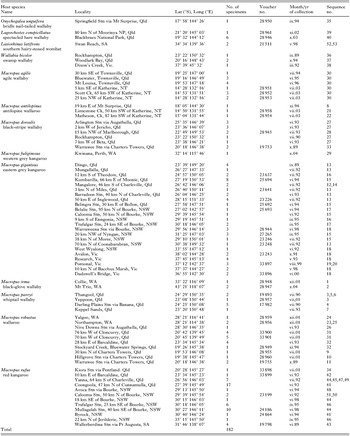
Cestodes were collected opportunistically from fresh, road-killed kangaroos and wallabies, from road-killed animals which had been frozen before examination for parasites or from animals shot commercially. Cestodes from freshly killed animals or from defrosted carcasses were washed in distilled water or saline and frozen either at −20°C or in liquid nitrogen. They were subsequently stored at −70°C until used. Parts of most of the cestodes used for molecular analysis were also fixed in AFA (alcohol, formalin, acetic acid) (Pritchard and Kruse, Reference Pritchard and Kruse1982), stained with Celestine blue and mounted in Canada balsam. Voucher slides have been deposited in the South Australian Museum, Adelaide (SAM). Liver samples from each host examined were also frozen in liquid nitrogen. Although not used in the present study, the host tissues have been deposited in the collections of the Evolutionary Biology Unit of SAM. Collection localities, hosts and registration numbers are given in Table 1 and in Figs 1 and 2. The following abbreviations or contractions have been used for Australian States and territories: NSW: New South Wales; NT: Northern Territory; Qld: Queensland; SA: South Australia; Vic: Victoria; WA: Western Australia.
Localities at which hosts of specimens of Progamotaenia diaphana, P. effigia and P. festiva were collected. Key: +, Lagorchestes conspicillatus; inverted open triangle, Lasiorhinus latifrons; solid triangles, Macropus agilis; open squares, M. antilopinus; closed circles, M. dorsalis; 5 pointed star, M. fuliginosus; inverted solid triangles, M. irma; asterisks, M. parryi; open triangles, M. robustus; open circle, Onychogalea unguifera; closed squares, Wallabia bicolor.

Localities at which hosts of specimens of Progamotaenia festiva were collected from Macropus giganteus and M. rufus. Key: open squares, M. giganteus; closed circles, M. rufus.

Origin of specimens used in the study of pcox1 of Progamotaenia festiva, P. diaphana and P. effigia from kangaroos, wallabies and wombats
Isolation of genomic DNA and enzymatic amplification
Total genomic DNA was isolated from individual worms by sodium dodecyl-sulphate/proteinase K digestion (37°C for 12 h) (Gasser et al. Reference Gasser, Chilton, Hoste and Beveridge1993), purified over a spin column (Wizard™ DNA CleanUp, Promega) and eluted in 30 μl of H20. From 5–20 ng of genomic DNA, a portion of the cox1 (∼450 bp; pcox1) was amplified by PCR from 10–20 ng of genomic DNA using primers JB3 (forward: 5′-TTTTTTGGGCATCCTGAGGTTTAT-3′) and JB4.5 (reverse: 5′-TAAAGAAAGAACATAATGAAAATG-3′) (Bowles et al. Reference Bowles, Blair and McManus1992), known to be conserved for platyhelminths (Garey and Wolstenholme, Reference Garey and Walstenholme1989). The PCR was performed in 50 μl using 50 pmol of each primer, 250 μm of each dNTP, 4 mm MgCl2 and 1 U Taq polymerase (Promega) under the following cycling conditions. After an initial denaturation at 94°C for 5 min, reactions were subjected to 30 cycles of 94°C for 30 sec (denaturation), 50°C for 30 sec (annealing) and 72°C for 30 sec (extension), followed by a final extension at 72°C for 5 min in a 480 thermocycler (Perkin Elmer Cetus). Control samples without DNA were included in each PCR run.
Single-strand conformation polymorphism (SSCP) analysis
After thermocycling, 10 μl of individual amplicons (∼100–200 ng of DNA) were mixed with an equal volume of loading buffer (10 mm NaOH, 95% formamide, 0·05% of both bromophenol blue and xylene cyanole) and shown to represent single bands on ethidium bromide-stained 2% (w/v) agarose gels. After denaturation at 94°C for 15 min and snap cooling on a freeze block (−20°C), individual samples (10 μl) were loaded into the wells of precast GMA™ gels (96×261 mm; S-2×25; product no. 3548; Elchrom Scientific AG) and subjected to electrophoresis for 14 h at 72 V and 7·2°C (constant) in a horizontal SEA2000 apparatus (Elchrom Scientific) connected to a MultiTemp III (Pharmacia) cooling system. After electrophoresis, gels were stained for 15 min with ethidium bromide (5 mg/ml), destained in H20 for the same time and then photographed upon ultraviolet transillumination.
Sequencing and phylogenetic analyses
For each species of host and each geographical locality, amplicons representing each distinct SSCP profile were selected and purified over spin-columns (Wizard™ PCR Prep, Promega), eluted in 30 μl of H2O and subjected to automated sequencing (from both strands) employing BigDye® Chemistry (Applied Biosystems) and primers JB# and JB4.5, and 2 internal primers (CoX1F 5′-GGTTTAGATGTTAAGACTGC-3′ and CoX1R 5′-CCAATAATCATAGTAACAGA-3′). In order to exclude the possibility that any of the sequences obtained represented pseudogenes and to demonstrate an open reading frame, each cox1 sequence was conceptually translated into an amino acid sequence. The cox1 sequence data have been deposited in the EMBL, GenBankTM and DDJB databases under the Accession numbers AM495418-70. Pairwise comparisons of sequence differences (D) of particular interest were determined using the formula D=1−(M/L), where M is the number of alignment positions at which the 2 sequences have a base in common, and L is the total number of alignment positions over which the 2 sequences are compared (Chilton et al. Reference Chilton, Gasser and Beveridge1995).
Phylogenetic analyses were conducted using the nucleotide and amino acid sequence data sets. A maximum parsimony (MP) analysis was conducted using PAUP* 4.0b10 (Swofford, Reference Swofford1999). Characters were treated as unordered and were equally weighted; alignment gaps were treated as ‘missing’ in all analyses. Exhaustive searches with TBR branch-swapping were used to infer the shortest trees. The length, consistency index, excluding uninformative characters, and the retention indices of each most parsimonious tree were recorded. Bootstrap analyses (1000 replicates) were conducted using heuristic searches and tree bisection–reconnection (TBR) branch-swapping, with the MulTrees option, to determine the relative support for clades in the consensus trees. Sequence data were also analysed using the neighbour-joining (NJ) method in PAUP. Progamotaenia ewersi and P. macropodis were used as outgroups.
RESULTS
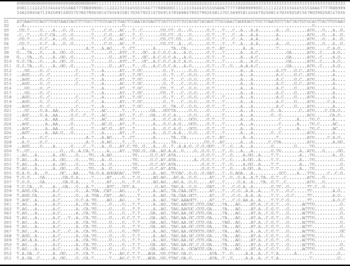
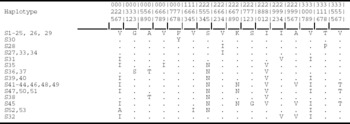
DNA was extracted from each of 182 specimens of P. diaphana, P. effigia and P. festiva from 13 host species (Table 1) and subjected to PCR-based SSCP analysis of pcox1. Fifty-three different SSCP profiles were recorded, representing the entire spectrum of variation among all 182 amplicons. Aliquots of the amplicons representing the 53 profiles were subjected to sequencing, and 53 distinct pcox1 sequences (haplotypes) were obtained (Table 2). Alignment of the 53 sequences (all 396 bp) revealed nucleotide variations at 129 alignment positions (Table 2).
Nucleotide variation among 53 pcox1 haplotypes (S1–S53) of the bile duct cestodes, Progamotaenia diaphana, P. effigia and P. festiva from Australian marsupials (dot indicates identical base compared with S1)

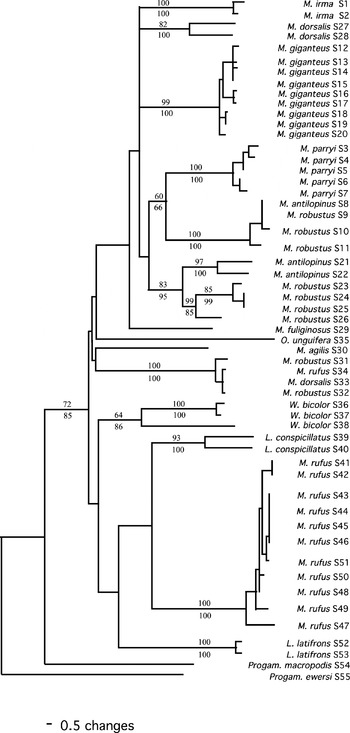
Analyses using both neighbour-joining (Fig. 3) and parsimony methods (not shown) produced trees of essentially the same topology. In the parsimony tree, 109 characters were informative. The tree length was 443, the consistency index 0·433 and the retention index 0·805. Using bootstrap values >85% in the maximum parsimony tree as the criterion for identifying distinct clades in the parsimony tree, 14 clades were resolved (Fig. 3). For 13 of these clades, the bootstrap values exceeded 83% for the neighbour-joining tree and 95% for the maximum parsimony tree. In only 1 instance, the clade containing specimens from W. bicolor, were the values lower, namely 64% for the neighbour-joining tree and 86% for the maximum parsimony tree. P. diaphana in Lasiorhinus latifrons and P. effigia in Macropus fuliginosus occurred in distinct clades, while specimens currently identified as P. festiva were distributed among 12 clades. In 9 of these clades, the cestodes occurred in a single species of host (Lagorchestes conspicillatus, Macropus irma. Macropus parryi, Macropus giganteus, Macropus dorsalis, Macropus agilis, Macropus rufus, Onychogalea unguifera or Wallabia bicolor). Representing the remaining clades, 2 cestode clades were found in the closely related host species M. robustus and M. antilopinus, whereas the third clade was found primarily in M. robustus, but occurred also in both M. rufus and M. dorsalis.
Neighbour-joining tree depicting the relationships between the specimens of Progamotaenia festiva, P. diaphana (S52–53) and P. effigia (S29), based on analyses of the pcox1 nucleotide sequence and with Progamotaenia ewersi and P. macropodis used as outgroups. Numerals above branches represent bootstrap values in the neighbour-joining analysis, those below branches bootstrap values in the maximum parsimony analysis.

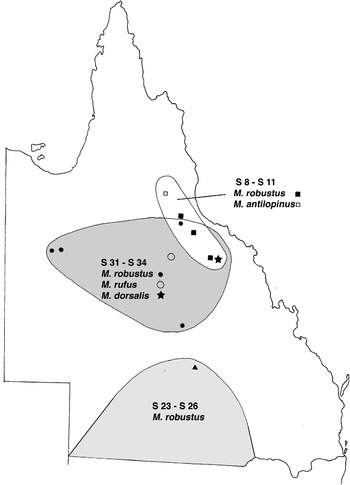
Macropus robustus was the only host species with multiple clades of cestode. One clade was found in south-western Queensland and Western Australia, a second occurred in north-eastern Queensland, from Mount Surprise to Charters Towers, and a third extended from north-western Queensland (Mount Isa) to north-eastern Queensland, overlapping with the second clade in the region of Charters Towers, Queensland (Fig. 4).
Distribution of three genetic groups of Progamotaenia festiva found primarily in Macropus robustus in Queensland. Group 1: from M. robustus (triangle); group 2: closed circles, M. robustus, open circle, M. rufus, star, M. dorsalis; group 3: squares: closed squares, M. robustus, open squares, M. antilopinus.

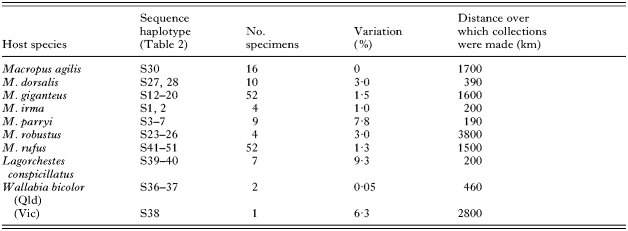
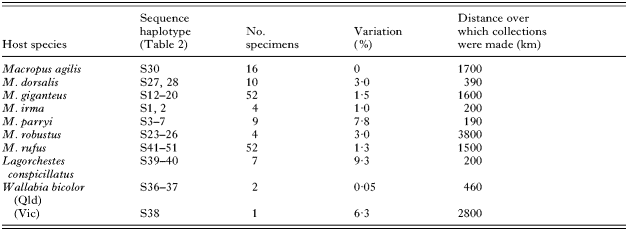
Nucleotide variation was low (0–3·0%) within clades containing specimens from M. agilis, M. dorsalis, M. giganteus, M. irma, M. robustus and M. rufus (Table 3). Within clades containing specimens from M. parryi and L. conspicillatus, the extent of variation was greater (7–10%), even though these samples were collected over relatively small geographical ranges (Table 3). In the case of specimens collected from W. bicolor, the differences found between specimens collected in Queensland were 0·05%, whereas those collected in Victoria, 2800 km to the south, differed by 6·3% (Table 3).
Nucleotide variation (%) within clades of cestodes, collected from a single host species, compared with the geographical ranges over which specimens were collected
The analysis of the amino acid sequences (Table 4) produced a neighbour-joining tree similar in topology to that produced by the nucleotide sequences (not shown), except that specimens from M. irma, M. giganteus, M. parryi, M. fuliginosus, M. antilopinus and M. robustus (S9–S11, S23–S26) were not resolved because of their identical amino acid sequences.
Amino acid variation among 53 pcox1 haplotypes of Progamotaenia species from the bile ducts of marsupials (Dot indicates identical amino acid compared with S1.)

DISCUSSION
The phylogenetic trees constructed based on the cox1 sequence data were generally well resolved, with high bootstrap support for most of the clades. In addition, samples within most clades were obtained from a single host species, and there was relatively little nucleotide variation within a clade. Specimens collected from M. agilis over a geographical range of over 1700 km exhibited no nucleotide variation, whereas specimens collected from M. giganteus between Queensland and Victoria, a geographical range of 1600 km, exhibited nucleotide variation of 1·5% among specimens from this host species and 0·8% variation among 52 specimens from M. rufus collected over a geographic range of 1500 km. For most collections from the same host species over a wide geographical range, nucleotide variation was limited. In the case of worms from Wallabia bicolor, specimens collected in Queensland exhibited very limited (0·05%) nucleotide variation but differed at 6·3% of nucleotides when compared with those collected in Victoria. This difference may be due to geographical variation. By contrast, specimens from M. parryi and L. conspicillatus, collected within a relatively limited geographical area in central Queensland varied at up to 7·8 and 9·3% of nucleotide positions, respectively, indicating that low levels of variation within specimens from a single host species were not recorded in all cases.
Genetically distinct groups of cestodes, currently identified as P. festiva, exhibited a high degree of host specificity, with a single, distinct clade of cestodes usually occurring in each individual host species examined. In addition, the morphologically distinct species, P. diaphana in Lasiorhinus latifrons and P. effigia in Macropus fuliginosus also occurred in distinct genetic clades. In M. robustus, cestodes representing 3 distinct genetic groups were recorded, and host switches were inferred in 2 of these clades. In spite of these exceptions, the level of host specificity was usually high. Additional evidence of host specificity is provided by the extensive series of specimens collected from M. giganteus and M. rufus in north-western New South Wales and south-western Queensland where the two species occur in broad sympatry. In this area, no evidence of host switching was detected.
By contrast, host switching was detected in 2 cases. In north-eastern Queensland, 1 clade of cestodes (S8–S11), occurring in M. robustus in the Charters Towers region, was also found in M. antilopinus. In the area in which the specimens were collected from M. antilopinus, M. robustus is also abundant (Beveridge et al. Reference Beveridge, Chilton, Johnson, Smales, Speare and Spratt1998) and the 2 host species are closely related phylogenetically (Flannery, Reference Flannery, Grigg, Jarman and Hume1989). At this collection site, many nematode parasites are also shared between these 2 host species (Beveridge et al. Reference Beveridge, Chilton, Johnson, Smales, Speare and Spratt1998), and the sequences from the specimens from the 2 hosts (S8 and S9) were identical. Consequently, these findings were interpreted as a case of host switching.
In a second clade (S31–34), cestodes presumed to be parasitic primarily in M. robustus, since they are found only in this host in the Mount Isa region of north-western Queensland (unpublished observations), were also found in both M. rufus and M. dorsalis in the Charters Towers region. The host distributions of these cestodes are complicated by the occurrence of the 2 genetic groups of cestode in the same principal host, M. robustus, in the same region. The existence of different genetic groups of cestode in M. robustus in this region was first observed in the MEE study of Baverstock et al. (Reference Baverstock, Adams and Beveridge1985). The results of the MEE study also provided evidence that one of the genetic groups identified in the MEE study was capable of host switching into W. bicolor. It seems likely that the same genetic group identified as switching hosts between M. robustus and W. bicolor in the latter study is the same taxon that switches from M. robustus to sympatric M. rufus and M. dorsalis in the present study. Therefore, the present results confirm and extend the findings of the earlier MEE study.
A third clade included specimens from M. robustus from south-western Queensland, southern Western Australia and M. antilopinus from the Northern Territory. In this case, the clade was subdivided into specimens from the 2 host species, with high bootstrap support for the subdivision. In this instance, the cestodes in M. robustus and M. antilopinus represent distinct genetic groups. Within the clade representing specimens from M. robustus, the cestodes from central Queensland (S26) differed genetically from those collected in Western Australia (S23–S25). There was insufficient cestode material to determine whether specimens S23–S26 represented 2 distinct genetic populations, and additional collecting is required in central Queensland to define the distribution of this genetic population, particularly in the area to the north of current collection sites, to establish whether all 3 genetic groups co-occur in some regions of Queensland. Although 3 distinct genetic groups of P. festiva were found in M. robustus in Queensland, the available evidence points towards allopatric speciation rather than speciation within a host, as has been inferred for some monogeneans (Littlewood et al. Reference Littlewood, Rohde and Clough1997; Simková et al. Reference Simková, Morand, Jobet, Gelnar and Verneau2004).
The findings from the present analysis of the cox1 data sets confirm and expand the earlier MEE studies of P. festiva (see Baverstock et al. Reference Baverstock, Adams and Beveridge1985), but the pectinate nature of the phylogenetic tree provides little insight into the evolution of members of the P. festiva complex. Wickström et al. (Reference Wickström, Haukisalmi, Varis, Hantula and Henttonen2005), also working with anoplocephalid cestodes, showed that addition of data from the first internal transcribed spacer (ITS 1) and the large subunit of nuclear ribosomal DNA genes did not provide increased resolution of clades compared with an analysis of the data derived from the cox1 gene alone. Further studies on the phylogeny of this cestode complex may therefore require the examination of genes other than those examined to date.
This simplest explanation of the results presented herein would be a virtually simultaneous colonization of the bile ducts of a wide range of marsupial hosts by a common but as yet unidentified ancestor. The other possible explanation of a co-evolutionary expansion can be eliminated, since the data include P. diaphana, a parasite of vombatid marsupials, which evolved much earlier than the macropodids (Archer, Reference Archer, Archer and Clayton1984). The MEE study by Baverstock et al. (Reference Baverstock, Adams and Beveridge1985) also included cestodes from the common wombat, Vombatus ursinus, which are closely related to P. diaphana from the hairy-nosed wombat, Lasiorhinus latifrons, and which clustered within the P. festiva complex. Thus the MEE and cox 1 sequence data from cestodes from the 2 genera of wombats, Vombatus and Lasiorhinus, preclude an hypothesis of coevolution between cestodes and their hosts, because wombats are only distantly related to the kangaroos and wallabies (Archer, Reference Andrews and Chilton1984).
The distinct clades resolved in trees constructed in this study (based on genetic differences) probably represent distinct species. The basis for this proposal is 3-fold. Firstly, the level of genetic diffences between clades is high. Second, if a phylogenetic approach is taken (Nadler, Reference Nadler2002), each clade can be considered to represent a distinct species. Third, many of the genetic groups of cestode occur in broad sympatry, with the potential for transfer among host species, yet retaining their genetic differences. Not only do the morphologically distinct species P. diaphana and P. effigia occur in sympatry with P. festiva found in M. giganteus, M. robustus and M. rufus, but the differentiation maintained between specimens from M. giganteus and M. rufus in areas of close sympatry is striking. In addition, cestodes from M. agilis, M. dorsalis, M. parryi and M. robustus in north-eastern Queensland retain their genetic identities, in spite of the fact that all host species are broadly sympatric.
In the case of M. robustus, three clades of cestodes were identified in a single host species and at least two of them can occur in sympatry. This provides compelling evidence that the relevant clades identified herein represent distinct species. Based on these arguments, it appears that the clades identified within P. festiva, based on genetic data, represent distinct species. The results presented here need to be compared with morphological data before any definitive conclusions can be drawn. Beveridge (Reference Beveridge1976) recognized 2 broad morphological groups within the complex, but more detailed morphological studies are clearly required to determine whether morphological characteristics are present to support the genetic data.
The present results suggest that P. festiva, as currently recognized morphologically, may represent at least 12 genetically distinct species. In the MEE study by Baverstock et al. (Reference Baverstock, Adams and Beveridge1985), additional samples were studied from the common wombat, Vombatus ursinus, and the quokka, Setonix brachyurus. No samples from either host were available for the current study, but the extent of genetic differences in the MEE data suggested that the cestodes from these hosts represented 2 additional species of Progamotaenia within the complex. The P. festiva complex is therefore potentially one of the largest complexes of sibling cestode species known. In addition, observations of host specificity suggest that, while most of these sibling species are highly host specific, some may exhibit relatively little host specificity. This range of host specificity among members of a sibling species complex indicates caution in any generalizations concerning host specificity in species of anoplocephalid cestodes.
We wish to thank P. M. Johnson, H. Hoste, R. Hobbs, L. Smales, P. Holz, S. Middleton, R. Andrews, D. M. Spratt, R. Speare, S. C. Barker and D. Banks for help in collecting specimens. This study was supported financially by the Australian Biological Resources Study. Marsupials were collected under the following state-issued research permits: Northern Territory: 15747; Queensland: T436, T759, T934, T1131; New South Wales A2336; Victoria: 91-022, 10000019,10000936.