The Dysregulation Profile (DP) can be characterized as a broad syndrome of dysregulation in childhood and adolescence, measuring a relatively stable pattern of difficulties in regulating affect (emotion), behavior, and cognition (Boomsma et al., Reference Boomsma, Rebollo, Derks, van Beijsterveldt, Althoff, Rettew and Hudziak2006; Caro-Cañizares, García-Nieto, & Carballo, Reference Caro-Cañizares, García-Nieto and Carballo2015; Deutz, Geeraerts, van Baar, Deković, & Prinzie, Reference Deutz, Geeraerts, van Baar, Deković and Prinzie2016; Geeraerts et al., Reference Geeraerts, Deutz, Deković, Bunte, Schoemaker, Espy and Matthys2015). The DP predicts a variety of negative outcomes, such as psychosocial impairment, substance use, suicidality, and a range of psychiatric disorders in young adulthood, including personality disorders, mood disorders, and anxiety disorders (e.g., Althoff, Verhulst, Rettew, Hudziak, & van der Ende, Reference Althoff, Verhulst, Rettew, Hudziak and van der Ende2010; Halperin, Rucklidge, Powers, Miller, & Newcorn, Reference Halperin, Rucklidge, Powers, Miller and Newcorn2011; Holtmann et al., Reference Holtmann, Buchmann, Esser, Schmidt, Banaschewski and Laucht2011; Jucksch et al., Reference Jucksch, Salbach-Andrae, Lenz, Goth, Döpfner, Poustka and Holtmann2011).
A reliable and valid approach to measure the DP is with the anxious/depressed, aggressive behavior, and attention problems scales (AAA scales) of the well-established parent-report Child Behavior Checklist (CBCL; Achenbach & Rescorla, Reference Achenbach and Rescorla2001). The DP is different from a high CBCL total problems score, in that having a high total problems score but not belonging to the DP class was associated with different adult outcomes (Althoff et al., Reference Althoff, Verhulst, Rettew, Hudziak and van der Ende2010). Furthermore, behavioral–genetic studies have shown that different genetic markers are associated with the DP than with bipolar disorder, depression, and attention problems (McGough et al., Reference McGough, Loo, McCracken, Dang, Clark, Nelson and Smalley2008), or with anxiety/depression, aggression, and attention problems alone (Boomsma et al., Reference Boomsma, Rebollo, Derks, van Beijsterveldt, Althoff, Rettew and Hudziak2006; Hudziak, Althoff, Derks, Faraone, & Boomsma, Reference Hudziak, Althoff, Derks, Faraone and Boomsma2005), showing that the DP is not linked to one specific disorder and that the DP is more than the sum of its components. Therefore, the robustness of the DP has been demonstrated, and the DP has been signified as a potential developmental profile indicating major psychopathology (Bellani, Negri, & Brambilla, Reference Bellani, Negri and Brambilla2012), and as an “antecedent and a vulnerability profile of a persisting and transdiagnostic emotional and behavioral dysregulations” (Masi, Muratori, Manfredi, Pisano, & Milone, Reference Masi, Muratori, Manfredi, Pisano and Milone2015, p. 192).
Despite a vastly expanding body of research on the DP, we know very little about its normative development from early childhood to adolescence. With the establishment of a normative developmental course of the DP, a baseline would be provided that can be used to indicate potentially important clinical deviations warranting attention. Furthermore, not only initial levels but also the rate of change of the DP might predict negative outcomes. Therefore, the aim of the present study was twofold: (a) to examine the normative developmental course of the DP from age 4 to age 17 in the general population, and (b) to examine whether and to what extent the developmental course (both the initial level and the rate of change) of the DP predicted personality pathology in late adolescence.
Normative Development of the DP
Whereas research examining the course of development of the DP from childhood to adolescence is lacking, medium to high (rank-order) stability of the DP between two time points has been reported. For example, within-person stability coefficient correlations from age 7 to 12 were r = .66 in a population-based twin study (Boomsma et al., Reference Boomsma, Rebollo, Derks, van Beijsterveldt, Althoff, Rettew and Hudziak2006) and r = .33 across a 9-year period from childhood to late adolescence (Halperin et al., Reference Halperin, Rucklidge, Powers, Miller and Newcorn2011).
Notwithstanding high relative stability, that is, rank-order consistency, a group as a whole can still change. Such mean-level changes of the DP have been reported: the DP was found to decrease from early to late adolescence (Nobile et al., Reference Nobile, Bianchi, Monzani, Beri, Bellina, Greco and Molteni2016) and from childhood to late adolescence (Halperin et al., Reference Halperin, Rucklidge, Powers, Miller and Newcorn2011). These findings fit with the notion that children's ability to self-regulate generally increases across development (e.g., Gestsdottir & Lerner, Reference Gestsdottir and Lerner2008; Raffaelli, Crockett, & Shen, Reference Raffaelli, Crockett and Shen2005).
The development of dysregulation from early childhood to late adolescence might, however, be nonlinear, as the turmoil period of early adolescence is known for a diminished ability of self-control (Casey, Reference Casey2015), a peak in emotional instability (van den Akker, Deković, Asscher, & Prinzie, Reference van den Akker, Deković, Asscher and Prinzie2014), as well as a smaller repertoire of emotion regulation strategies (Zimmermann & Iwanski, Reference Zimmermann and Iwanski2014). If development of the DP is nonlinear, then a sufficient number of assessments is needed to detect such a developmental course. Because in the current study a cohort-sequential design was employed in which children were assessed at six measurement occasions, both the form of change (mean-level decrease or increase) and the shape of change (linear or nonlinear) in DP from ages 4 to 17 years could be examined.
Predictive Validity of the DP for Personality Pathology
The DP has been found to predict a wide range of categorical personality disorders (e.g., Althoff et al., Reference Althoff, Verhulst, Rettew, Hudziak and van der Ende2010; Halperin et al., Reference Halperin, Rucklidge, Powers, Miller and Newcorn2011; Meyer et al., Reference Meyer, Carlson, Youngstrom, Ronsaville, Martinez, Gold and Radke-Yarrow2009), but fewer studies have examined associations between the DP and dimensional personality pathology. The numerous limitations of the categorical approach such as excessive co-occurrence and heterogeneity within personality disorders are well recognized (Widiger & Simonsen, Reference Widiger and Simonsen2005), and a dimensional approach in which symptoms of personality dysfunction can vary along a gradient of severity has gained more interest (Oldham, Reference Oldham2015). These limitations have led to the development of a dimensional empirically based model of maladaptive personality traits. In this alternative dimensional model for personality pathology, which has been added as an addendum to the DSM-5 (American Psychiatric Association, 2013), personality pathology dimensions are grouped into five domains: negative affectivity (frequent and intense experiences of negative emotions), antagonism (exaggerated sense of self-importance and callous antipathy toward others), disinhibition (impulsive behavior), detachment (avoidance of socioemotional experience), and psychoticism (odd, eccentric, or unusual behaviors and cognitions).
The Personality Inventory for DSM-5 (Krueger, Derringer, Markon, Watson, & Skodol, Reference Krueger, Derringer, Markon, Watson and Skodol2012) has been developed as a measure for the alternative dimensional DSM-5 model of personality pathology. The Personality Inventory for DSM-5 has been used to compare a group with no psychopathology symptoms and groups of children with different combinations of psychopathology (i.e., dysregulated and mild internalizing), on personality pathology dimensions (De Caluwé, Decuyper, & De Clercq, Reference De Caluwé, Decuyper and De Clercq2013). The results indicated that, compared to the “no symptoms” group, dysregulated children scored higher on dimensions from the negative affect (e.g., emotional lability), antagonism (e.g., callousness), disinhibition (e.g., impulsivity), and psychoticism (e.g., suspiciousness) domains. Children with a dysregulated profile also showed higher levels of personality pathology in comparison to groups of children with different psychopathology profiles, namely, “moderate attention problems with anxious-depressed and social problems,” “mild internalizing,” and “severe anxious-depressed and thought problems.”
These findings are in line with other studies demonstrating associations between the DP and self-harm and suicidality (e.g., Deutz et al., Reference Deutz, Geeraerts, van Baar, Deković and Prinzie2016; Holtmann et al., Reference Holtmann, Buchmann, Esser, Schmidt, Banaschewski and Laucht2011), mood disorders (e.g., Holtmann et al., Reference Holtmann, Buchmann, Esser, Schmidt, Banaschewski and Laucht2011; Masi et al., Reference Masi, Muratori, Manfredi, Pisano and Milone2015), narcissism (Masi et al., Reference Masi, Muratori, Manfredi, Pisano and Milone2015), impulsivity (Masi et al., Reference Masi, Muratori, Manfredi, Pisano and Milone2015), sensation seeking (Althoff et al., Reference Althoff, Ayer, Crehan, Rettew, Baer and Hudziak2012), and thought problems (e.g., Althoff et al., Reference Althoff, Verhulst, Rettew, Hudziak and van der Ende2010; Biederman et al., Reference Biederman, Petty, Day, Goldin, Spencer, Faraone and Wozniak2012; Diler et al., Reference Diler, Birmaher, Axelson, Goldstein, Gill, Strober and Keller2009). However, while De Caluwé et al. (Reference De Caluwé, Decuyper and De Clercq2013) did not find associations between the DP and dimensions of the detachment domain (e.g., intimacy avoidance), other studies have documented links between the DP and psychosocial dysfunction and social anxiety (Biederman et al., Reference Biederman, Petty, Day, Goldin, Spencer, Faraone and Wozniak2012; Jucksch et al., Reference Jucksch, Salbach-Andrae, Lenz, Goth, Döpfner, Poustka and Holtmann2011), and poorer socialization skills in preschoolers (Kim et al., Reference Kim, Carlson, Meyer, Bufferd, Dougherty, Dyson and Klein2012). Furthermore, children with dysregulation were found to be more harm avoidant, which contains elements of shyness and reluctance to engage with peers (Althoff et al., Reference Althoff, Ayer, Crehan, Rettew, Baer and Hudziak2012). Generally, parent–adolescent agreement is low on the less visible internalizing behaviors such as withdrawn behavior (Rescorla et al., Reference Rescorla, Bochicchio, Achenbach, Ivanova, Almqvist, Begovac and Verhilst2014; Rubin, Althoff, Walkup, & Hudziak, Reference Rubin, Althoff, Walkup and Hudziak2013), and intimacy problems (Tromp & Koot, Reference Tromp and Koot2012), and therefore detachment features should also be examined using adolescent self-report.
Furthermore, all previous research has focused on assessment of the DP at one time point, and therefore knowledge about how developmental changes in the DP affect personality pathology is still lacking. However, not only the initial level but also the developmental course of the DP itself might be important for personality pathology. For example, children who decrease in DP more slowly might experience more negative outcomes later on. It is important to examine such associations in order to improve our understanding of how the DP is associated with personality pathology, and what deviations from a normative developmental course could warrant treatment.
The current study is based on several important characteristics that distinguishes it from previous research. First, a categorical (or cutoff) approach has often been used to define the DP and/or personality dysfunction. For example, in several studies children were classified as either having dysregulation problems or not having such problems, and consequently groups were compared on personality disorders or dimensions (e.g., Althoff et al., Reference Althoff, Ayer, Crehan, Rettew, Baer and Hudziak2012; De Caluwé et al., Reference De Caluwé, Decuyper and De Clercq2013). These studies have shown that dysregulation is uniquely related to personality pathology and temperamental dimensions relative to other psychopathology profiles. However, such an approach does not inform us on relationships that might exist between the severity of the DP and the severity of personality pathology. We therefore adopt a dimensional perspective in this study, by using a latent variable approach to define the DP in combination with the dimensional model for personality pathology of the DSM-5 (American Psychiatric Association, 2013). Second, nearly all the discussed studies were conducted using selected samples such as children with attention-deficit/hyperactivity disorder (Halperin et al., Reference Halperin, Rucklidge, Powers, Miller and Newcorn2011), disruptive behavior disorders (Masi et al., Reference Masi, Muratori, Manfredi, Pisano and Milone2015), children oversampled on externalizing behavior (Althoff et al., Reference Althoff, Ayer, Crehan, Rettew, Baer and Hudziak2012), and children from mothers with depression and bipolar illness (Meyer et al., Reference Meyer, Carlson, Youngstrom, Ronsaville, Martinez, Gold and Radke-Yarrow2009). However, these very different and specific samples might have contributed to inconsistent patterns of findings. Replication in population-based samples is needed to elaborate existing theory on the DP and to generate findings that are generalizable to the wider population. Furthermore, examining associations between the DP and personality pathology in a population-based sample will better inform policymakers on whether it might be important to screen for dysregulation in the general population. In sum, the main question in our study concerned the normative developmental course of mother-reported DP from ages 4 to 17 years in a population-based sample, and its associations with a wide range of adolescent-reported personality pathology dimensions.
Method
Procedure and participants
This study is part of the longitudinal Flemish Study of Parenting, Personality and Development (Prinzie, Onghena, & Hellinckx, Reference Prinzie, Onghena and Hellinckx2005; Prinzie et al., Reference Prinzie, Onghena, Hellinckx, Grietens, Ghesquière and Colpin2003). In 1999, a proportional stratified sample was randomly selected from children attending regular primary schools in Flanders (Belgium). Strata were based on geographical location (province), sex, and age. For each classroom, children whose birthday was before March 31 were arranged alphabetically, and the second and the next to last child were selected. Parents of the selected children received an invitation to participate in a study concerning child development. Of the 800 invited families, 682 (85.3%) families agreed to participate. In this study, only participants for whom mother-reported CBCL data was available for at least one of the six measurement waves used to assess the DP were included, resulting in a total sample of 668 children.
All parents signed informed consent, and confidentiality was guaranteed. All parents had the Belgian nationality. Educational levels for mothers and fathers respectively were as follows: 1.4%/2.8% elementary school, 42.6%/43.3% secondary education, 43.8%/35.3% nonuniversity higher education, and 12.2%/18.4% university education.
A cohort-sequential, or accelerated longitudinal, design was employed (Nesselroade & Baltes, Reference Nesselroade and Baltes1979, Prinzie & Onghena, Reference Prinzie, Onghena, Everitt and Howell2005), in which four independent age cohorts were examined, who were aged 4 (N = 162), 5 (N = 172), 6 (N = 167), and 7 (N = 167) years at Time 1 (50.5% girls). See Table 1 for an overview of the ages at which the cohorts were assessed.
Overview of ages (years) at which the four cohorts were assessed

By combining partly age-overlapping cohorts, we were able to approximate a longitudinal study in which development of the DP could be modeled from age 4 to age 17. Data of six measurement waves were used to assess the DP: Time 1 (1999; N = 663, 0.7% missing), Time 2 (2000; N = 601, 10% missing), Time 3 (2001; N = 581, 13% missing), Time 4 (2004; N = 506, 24.3% missing), Time 5 (2007; N = 467, 30.3% missing), Time 6 (2009; N = 426, 36.2% missing); numbers indicating participants for whom mother-reported CBCL data were present. Data of the seventh measurement wave (2012; M age = 18.48, SD = 1.11, range = 17–20 years) was used to assess adolescent personality pathology. At Time 7, 416 adolescents (51.9% girls) participated (62.3% of the total study sample).
Participants for whom mother-reported CBCL data was available at all waves did not statistically differ from participants who had missing data on any of the waves on sex, age, or mother-reported Time 1 scores on the anxious/depressed, aggressive behavior, and attention problem CBCL scales. They differed only in maternal education level, t (658) = –3.661, p < .001, with mothers who participated at each wave of data collection being slightly higher educated than mother who did not participate at all waves of data collection (3.56 vs. 3.88 on a 6-point scale).
Measures
DP
Mothers completed the CBCL (Achenbach, Reference Achenbach1991) from Time 1 to Time 6. The three AAA syndrome scales according to the 1991 profile were used to assess the DP: anxious/depressed (14 items; mean α = 0.81; e.g., “Cries a lot”), aggressive behavior (20 items; mean α = 0.88; e.g., “Argues a lot”), and attention problems (10 items; mean α = 0.71; e.g., “Can't sit still, restless, or hyperactive”). Mothers were asked to rate to what extent each statement described their child's behavior in the past 6 months. Items were rated on a 3-point scale (0 = not true, 1 = somewhat or sometimes true, 2 = very true or often true). To acknowledge potential unequal contributions of the AAA scales, a (latent) DP factor was estimated underlain by the mean observed scores of the three AAA scales. The factor loadings of the AAA scales onto the DP factor were significant at all time points (all p < .001). Factor loadings were highest for aggressive behavior (mean loading over six time points = 0.84, range = 0.76–0.92), then attention problems (mean loading = 0.72, range = 0.72–0.73), and lowest for anxiety/depression (mean loading = 0.62, range = 0.60–0.65).
Personality pathology
At Time 7, adolescents filled out the Dutch translation of the adolescent self-report version of the Dimensional Assessment of Personality Pathology—Short Form for Adolescents (DAPP-SF-A; Tromp & Koot, Reference Tromp and Koot2012), which is derived from the Dimensional Assessment of Personality Pathology—Basic Questionnaire (Livesley & Jackson, Reference Livesley and Jackson2009). The DAPP-SF-A is designed for youth from 12 to 23 years of age and consists of 136 items asking adolescents to what extent a statement described them in general, for example, “I am constantly looking for adventure.” Answer categories ranged from 1 (very unlike me or not applicable) to 5 (very like me). The 136 items measure 18 lower order dimensions of personality pathology that are comparable to personality traits facets of the five DSM-5 personality pathology domains. The following DAPP dimensions are in line with the DSM-5 negative affectivity domain: affective instability (8 items, α = 0.87), anxiety/worry (6 items, α = 0.86), identity problems (6 items, α = 0.86), insecure attachment (6 items, α = 0.86), intimacy problems (8 items, α = 0.80), oppositionality (10 items, α = 0.85), self-harm (6 items, α = 0.87), and submissiveness (8 items, α = 0.84). The DAPP dimensions callousness (10 items, α = 0.83), conduct problems (8 items, α = 0.71), narcissism (8 items, α = 0.80), and rejection (8 items, α = 0.81) were consistent with the DSM-5 antagonism domain. The DSM-5 domain detachment best described the DAPP dimensions restricted expression of emotion (8 items, α = 0.87) and social avoidance (6 items, α = 0.86). Disinhibition best described the dimensions compulsivity (8 items, α = 0.84) and stimulus seeking (8 items, α = 0.83). Finally, the DAPP dimensions cognitive distortion (6 items, α = 0.78) and suspiciousness (8 items, α = 0.86) were most in line with the DSM-5 psychoticism domain.
Statistical analyses
As Little's missing completely at random test indicated that data was missing completely at random, χ2 (766) = 819.470, p = .088, missing values were imputed at scale level (to keep the number of variables <100) using expectation maximization to maximize sample size (Graham, Reference Graham2009; Schafer & Graham, Reference Schafer and Graham2002).
Cohort-sequential latent growth modeling (LGM) was used to examine the developmental course of the DP from age 4 to 17 years. All analyses were performed in Mplus version 7.4 (Muthén & Muthén, Reference Muthén and Muthén2012), using full-information maximum likelihood estimation with robust standard errors, which is robust to nonnormality. Model fit was evaluated with three primary indices, the root mean square error of approximation (RMSEA), the comparative fit index (CFI), and the Tucker–Lewis index (TLI). RMSEA values of ≤0.08 indicate acceptable fit while values of ≤0.05 indicate good fit. Values of CFI and TLI between 0.90 and 0.95 indicate acceptable fit, and values ≥0.95 indicate good fit (Cheung & Rensvold, Reference Cheung and Rensvold2002; Hu & Bentler, Reference Hu and Bentler1999). Although chi-square is reported, it is not interpreted, as it is nearly always significant in larger samples and/or complex models (Kline, Reference Kline2006).
A prerequisite to examining developmental changes in DP is measurement invariance of the dysregulation latent factor model across cohorts, and across measurement waves. Measurement invariance was examined by increasingly constraining parameters to be equal across cohorts and consequently across measurement waves (e.g., factor loadings, intercepts, and residual variances; see van de Schoot, Lugtig, & Hox, Reference van de Schoot, Lugtig and Hox.2012). To compare nested models for measurement invariance, changes in CFI (ΔCFI) and RMSEA (ΔRMSEA) were used as indicators for measurement invariance, as they are independent of both model complexity and sample size (Cheung & Rensvold, Reference Cheung and Rensvold2002). Values of ΔCFI of ≤0.01 and ΔRMSEA of ≤0.015 indicate that the invariance hypothesis should not be rejected (Chen, Reference Chen2007; Cheung & Rensvold, Reference Cheung and Rensvold2002). Details and fit statistics of these analyses can be obtained from the first author.
To determine the developmental course of the DP, LGMs were tested. Unequal distances between measurement waves (e.g., 1 year between Time 1 and Time 2, and 3 years between Time 3 and Time 4) were accounted for by setting time scores as the difference in years between measurement waves divided by 10. This procedure for cohort-sequential LGM is recommended to avoid large time scores that can lead to convergence problems (Muthén & Muthén, Reference Muthén and Muthén2012, p. 145). Running the models without dividing the time scores by 10, however, led to identical conclusions regarding the shape of the growth and associations with personality pathology dimensions. The first model was a “no-growth” or strict-stability model, which specified that no growth occurred over the course of the study (i.e., only an intercept factor was estimated). The second model was a linear trajectory model, in which a linear slope was estimated in addition to the intercept. In the third model, we examined whether adding a quadratic slope, indicating nonlinear changes (U-shaped or inverse U-shaped), significantly improved model fit. All models included covariances between intercept and slope factors. Satorra–Bentler scaled chi-square difference testing for full-information maximum likelihood with robust standard errors estimation was used to compare nested models, with the intercept-only model being the most restricted model nested under the other models in Table 2. Significant chi-square difference values indicate that the less restricted model provided significant incremental fit over the more restricted model (Satorra, & Bentler, Reference Satorra and Bentler2001). To determine relations between the DP and personality pathology, the lower-order DAPP-SF-A dimensions were successively entered and regressed simultaneously on both the latent growth factors (intercept and slope(s)) for the latent dysregulation factor.
Model fit statistics of the intercept-only, linear, and quadratic growth models of the Dysregulation Profile

Note: RMSEA, root mean square error of approximation; CFI, comparative fit index.
aSatorra–Bentler adjusted chi-square difference testing for MLR was used.
Results
Preliminary analyses
Measurement invariance analyses indicated that full uniqueness (strong) measurement invariance held across cohorts and partial scalar invariance across time. Furthermore, the latent factor variances could be constrained across cohorts. Thus, the DP could be measured similarly across measurement waves and cohorts. The final measurement model of the DP fitted well (χ2 = 803.935, RMSEA = 0.066, CFI = 0.955, TLI = 0.940).
Stability of the DP
The regression coefficients of the DP from wave to wave, indicating relative stability, were high. One-year stability was highest as expected: r = .88 from Wave 1 to 2 and from Wave 2 to 3. When time between measurement waves increased, stability decreased, although 10-year stability from Wave 1 to Wave 6 was still high at r = .67.
The normative developmental course of the DP
The first aim of the study was to investigate the developmental course of the DP from age 4 to age 17. Model comparisons using chi-square difference testing are presented in Table 2, and indicate that the linear model provided a better fit than the no-growth model, and that the quadratic model further improved model fit. This conclusion was supported by improvement in fit statistics and significant means of the quadratic slope factors. Therefore, the quadratic model was selected as the final model. Examination of the modification indices showed that the few across-cohort parameter estimates differences were trivial and would not result in a substantial improvement in model fit. Chi-square difference testing showed that imposing cross-cohort constraints did not significantly worsen fit, Δχ2 (27) = 36.310, p = .109, and only minimally affected model fit indices, which supports convergence as the more parsimonious model in which parameters are constrained to be equal across cohorts is to be preferred (Duncan, Duncan, & Strycker, Reference Duncan, Duncan and Strycker2006). Thus, the four cohorts could be staggered to examine one developmental quadratic trajectory from age 4 to age 17.
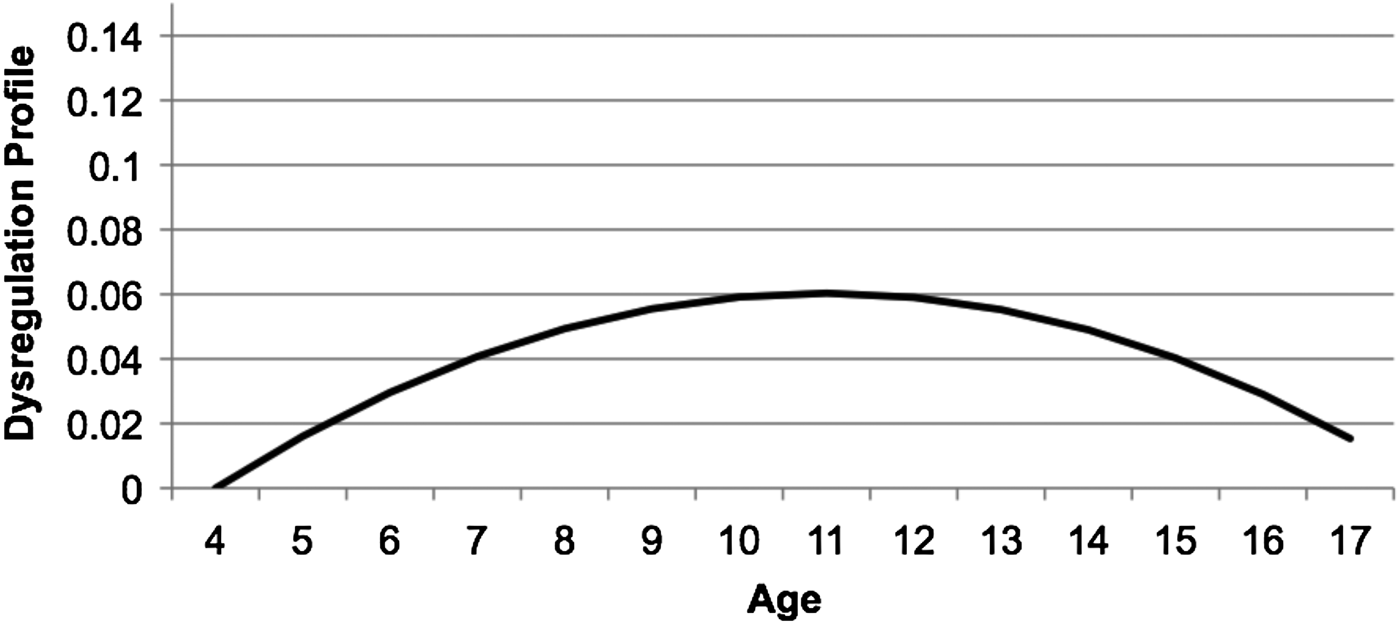
The mean intercept was fixed at 0 for all cohorts. The linear slope factor mean (M ls = 0.173, p < .001), and the quadratic slope mean (M qs = –0.124, p < .001) were significantly different from 0. The quadratic developmental course of the DP (see Figure 1) can be described as initially increasing from age 4 to age 11 (at which estimated means of the DP were highest) followed by a decrease from age 11 to age 17 (the final age measured in this study), until reaching a slightly higher level than the starting point. There were significant individual differences in the initial level, and change rate of DP, as indicated by significant variances around the intercept (D i = 0.034, p < .001), linear slope (D s = 0.101, p = .019), and quadratic slope (D s = 0.055, p = .031) factors. The intercept was not significantly related to either the linear slope (b = 0.003, p = .732) or the quadratic slope (b = –0.010, p = .182), which showed that the initial level of the DP was not related to the consequent developmental course of dysregulation.
Developmental nonlinear course of latent Dysregulation Profile scores from age 4 to age 17, drawn from unstandardized estimates.

The developmental course of dysregulation and personality pathology dimensions
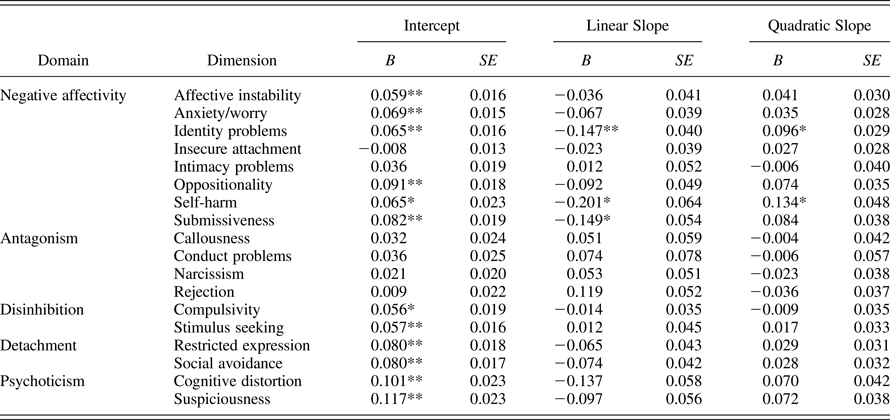
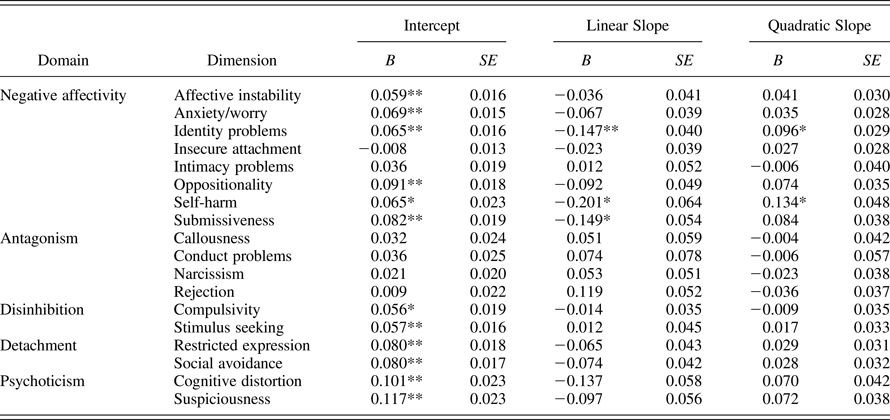
The second aim of the study was to examine whether the initial level and the rate of change in the latent DP factor from childhood to adolescence were associated with late adolescent personality pathology. Therefore, each of the DAPP-SF-A lower-order personality pathology dimensions was regressed onto the intercept and linear and quadratic slope of the DP. A conservative α level of 0.01 was adopted to correct for multiple testing and avoid Type I errors. Each of these 18 models showed adequate fit (χ2 range = 974.476–1,063.413, RMSEA range = 0.061–0.067, CFI range = 0.941–0.951, TLI range = 0.933–0.945). The results of these analyses are presented in Table 3.
Unstandardized regression coefficients of intercept, linear, and quadratic slope of the Dysregulation Profile on personality pathology dimensions
*p < .01. **p < .001.
Higher mother-reported initial levels on the DP in childhood predicted higher levels of 12 out of 18 adolescent-reported personality pathology dimensions. Specifically, a higher intercept of the DP predicted higher levels of affective instability, anxiety/worry, identity problems, oppositionality, self-harm, and submissiveness from the negative affectivity domain; restricted expression of emotion and social avoidance from the detachment domain; compulsivity and stimulus seeking from the disinhibition domain; and cognitive distortion and suspiciousness from the psychoticism domain. Initial DP did not predict any personality pathology dimensions from the antagonism domain (i.e., callousness, conduct problems, narcissism, and rejection), and did also not predict two of the dimensions from the negative affectivity domain (insecure attachment and intimacy problems).
Over and above associations between the intercept/initial level of DP and personality pathology dimensions, changes in DP were associated with three personality pathology dimensions of the negative affectivity domain. The linear slope was negatively related to identity problems, self-harm, and submissiveness, whereas the quadratic slope was positively related to identity problems and self-harm. As relations between the linear and quadratic factors and outcomes are to some extent confounded, relations between slope factors and outcomes should be interpreted in tandem. These results indicate that a slower (linear) increase of the DP, combined with a less pronounced (quadratic) decline of the DP, predicted higher levels of identity problems and self-harm. In other words, for late adolescents with higher scores on identity problems and self-harm, there was a slower growth in dysregulation and less of a peak of dysregulation in early adolescence (resulting in a less steep inverted U-shape). As the quadratic slope was not significant for submissiveness, this means that for submissiveness, primarily slower linear increases of the DP were predictive.
Discussion
Overall, the results demonstrate that the DP is highly stable over time, but also follows a nonlinear developmental course with a peak in early adolescence. The initial level of the DP at age 4 predicted a wide range of personality pathology dimensions in late adolescence of the negative affectivity, detachment, disinhibition, and psychoticism DSM-5 domains, but none from the antagonism domain. In addition, rates of change of the DP were also predictive for personality pathology albeit to a much lesser extent.
The DP followed a quadratic, inverse U-shaped, developmental course with, as expected, a peak in early adolescence. The DP increased from age 4 to around age 11, and then decreased, although at age 17 was still (slightly) higher than at age 4. This is in contrast with research showing a general decrease of the DP from childhood to adolescence (Halperin et al., Reference Halperin, Rucklidge, Powers, Miller and Newcorn2011), but in line with studies demonstrating a decrease of the DP from early to middle and late adolescence (Ayer et al., Reference Ayer, Greaves-Lord, Althoff, Hudziak, Dieleman, Verhulst and van der Ende2013; Nobile et al., Reference Nobile, Bianchi, Monzani, Beri, Bellina, Greco and Molteni2016). Perhaps, because Halperin et al. (Reference Halperin, Rucklidge, Powers, Miller and Newcorn2011) started with an older sample (7–11 years old at the first measurement), they were not able to detect the initial increase of dysregulation from age 4 to age 11 that we found.
The DP peaked in early adolescence, a time characterized by many changes in brain, behavioral, and cognitive systems at different maturity rates, resulting in increased vulnerability for emotional and behavioral problems (e.g., Becht, Prinzie, Deković, van den Akker, & Shiner, Reference Becht, Prinzie, Deković, van den Akker and Shiner2016; Prinzie, van Harten, Deković, van den Akker, & Shiner, Reference Prinzie, van Harten, Deković, van den Akker and Shiner2014; Steinberg, Reference Steinberg2005). Demands on children's impulse control and response inhibition grow in early adolescence. However, adequate regulatory competence is not yet completely developed, causing a disjuncture that has also been described as “starting an engine without yet having a skilled driver behind the wheel” (Steinberg, Reference Steinberg2005, p. 70). Taken together with findings that show a similar, but mirrored, developmental course of emotional stability (van den Akker et al., Reference van den Akker, Deković, Asscher and Prinzie2014), early adolescence might especially be a time in which children have trouble regulating affect, behavior, and cognition. Our, and other findings (Ayer et al., Reference Ayer, Greaves-Lord, Althoff, Hudziak, Dieleman, Verhulst and van der Ende2013; Nobile et al., Reference Nobile, Bianchi, Monzani, Beri, Bellina, Greco and Molteni2016), indicate that a decrease of the DP from early to late adolescence is normative. There were, however, significant interindividual differences in the rate of change, suggesting that some youngsters might remain high, or even increase, in dysregulation during this developmental period. These youngsters might warrant clinical attention. Future research in larger samples could aim to examine these interindividual differences.
The developmental course of the DP and personality pathology
In line with our expectations, higher initial levels of mother-reported DP at age 4 predicted 12 out of 18 adolescent-reported personality pathology dimensions from the negative affectivity, detachment, disinhibition, and psychoticism DSM-5 domains. In addition, the change of the DP over time predicted 3 negative affectivity personality pathology dimensions; therefore, both the initial levels as well as the patterns of change are important.
The wide range of personality pathology dimensions in late adolescence (17–21 years) predicted by initial levels of the DP at age 4 is especially significant given that different informants were used to report on the DP (mothers) as on personality pathology (adolescents), and the significant time span (13 years) between assessment of the initial level of the DP and personality pathology (vs. 4 years in De Caluwé et al., Reference De Caluwé, Decuyper and De Clercq2013). Our findings therefore strengthen the idea that childhood dysregulation is a developmental precursor for personality pathology.
When we look more closely at associations between the initial level of the DP at age 4 and the 18 lower order personality pathology dimensions measured in late adolescence, several findings are worth discussing in more detail. Although the initial level of the DP predicted 12 out of 18 lower order personality pathology dimensions, none from the antagonism domain were predicted by the DP. Although previous research had found links between the DP and antagonistic traits such as callousness and narcissism (De Caluwé et al., Reference De Caluwé, Decuyper and De Clercq2013; Masi et al., Reference Masi, Muratori, Manfredi, Pisano and Milone2015), other research had described the aggressive component of the DP to be mostly emotionally driven and reactive (Althoff et al., Reference Althoff, Ayer, Crehan, Rettew, Baer and Hudziak2012; Leibenluft, Reference Leibenluft2011). Given that the DP did predict dimensions such as anxiety, social avoidance, and sensation seeking, our findings are very much in line with the idea that children with dysregulation might enter new situations readily but once in them, feel frightened, shy, and uncomfortable (Althoff et al., Reference Althoff, Ayer, Crehan, Rettew, Baer and Hudziak2012), which might lead to aggressive outbursts. As our study used a population-based sample instead of (enriched) clinical samples (De Caluwé et al., Reference De Caluwé, Decuyper and De Clercq2013; Masi et al., Reference Masi, Muratori, Manfredi, Pisano and Milone2015), it might be that the predictive validity of the DP for antagonistic behaviors is limited to clinical samples focused on externalizing behaviors. Future research could further examine the distinction between reactive and proactive aggressive behavior in relation to the DP. Another potential explanation of the lack of associations between the DP and personality pathology dimensions from the antagonism domain might be that we used adolescents self-reports rather than parent reports (as in De Caluwe et al., 2013; Masi et al., Reference Masi, Muratori, Manfredi, Pisano and Milone2015), and social desirability might lead to underreporting of antagonistic traits. However, adolescents have been found to be reliable reporters of psychopathic-like traits (Vahl et al., Reference Vahl, Colins, Lodewijks, Markus, Doreleijers and Vermeiren2014), and self-reports of callous–unemotional traits have been found to show incremental value over maternal-rated callous–unemotional traits (Decuyper, De Caluwe, De Clercq, & De Fruyt, Reference Decuyper, De Caluwé, De Clercq and De Fruyt2014). Furthermore, parent and adolescents were not found to disagree more on the DAPP dimensions representing antagonism than on other dimensions (Trump & Koot, Reference Tromp and Koot2010).
Regarding the disinhibition domain, the DP predicted not only sensation seeking but also compulsivity, which can be explained through shared deficits in self-regulation of cognitions and behaviors. Previous research demonstrating links between the DP and obsessive–compulsive symptom severity (McGuire et al., Reference McGuire, Small, Lewin, Murphy, De Nadai, Phares and Storch2013), and the notion that children with dysregulation were more often diagnosed with obsessive–compulsive disorder (Caporino, Herres, Kendall, & Wolk, 2016), had suggested that engagement in compulsive rituals and obsessive thinking might increase frustration, attention problems, and anxiety when rituals cannot be executed. Future research could focus more specifically on the role of dysregulation in compulsivity.
Whereas previous research was inconclusive about whether the DP predicted personality pathology dimensions from the psychoticism domain, concerned with odd, eccentric, and unusual behaviors and cognitions, in our study initial levels of the DP actually most strongly predicted cognitive distortion and suspiciousness in late adolescence. These findings are interesting in the light of previous research on a general factor of psychopathology (“p factor”), that similar to the DP, can be seen as a vulnerability marker describing liability to developing psychopathology in general (e.g., Caspi et al., Reference Caspi, Houts, Belsky, Goldman-Mellor, Harrington, Israel and Moffitt2014). Thought problems appeared to be core symptoms of this general psychopathology factor (e.g., Laceulle, Vollebergh, & Ormel, Reference Laceulle, Vollebergh and Ormel2015), and previous research indicating links between the DP and thought problems (e.g., Biederman et al., Reference Biederman, Petty, Day, Goldin, Spencer, Faraone and Wozniak2012) suggests that the DP might be similarly constructed.
In line with previous research (De Caluwé et al., Reference De Caluwé, Decuyper and De Clercq2013), the DP did not predict intimacy problems and insecure attachment. These personality pathology dimensions, characterized by fear of losing significant others, fear for (sexual) intimacy, and avoidance of romantic relationships, might not have been fully developed yet in adolescence. Especially for intimacy problems, questions concerned romantic relationships and sexual experiences. The relative lack of experience of adolescents in these domains might have affected the assessment of intimacy problems. Psychometric analyses have furthermore shown that the intimacy problems scale had low test–retest reliability and poor accuracy (Tromp & Koot, Reference Tromp and Koot2012). Future research should examine DP in relation to these aspects of personality pathology in an adult sample and perhaps with different measures.
In addition to long-term predictive effects of initial levels of DP (at age 4 years) on personality pathology dimensions (measured more than 13 years later), rates of change in DP were also associated with personality pathology, although only with 3 out of 18 dimensions. Slower initial increases of the DP, combined with less pronounced declines in the DP, predicted higher levels of identity problems, self-harm, and submissiveness. This suggests that a flatter developmental course of dysregulation is associated with an increased risk for the development of identity problems (poorly developed sense of self), self-harm (deliberate self-injury and suicidal thoughts) and submissiveness (dependent and nonassertive behavior). These results give rise to the question whether a less distinct peak of dysregulation in early adolescence is related to avoidance of emotional experience, as links between emotional avoidance and self-harm, identity problems, and submissiveness have been reported before (e.g., Chapman, Gratz, & Brown, Reference Chapman, Gratz and Brown2006).
Although the sample as a whole showed a nonlinear developmental course of the DP, the relative ranking of the individuals remained fairly stable over time. That is in line with previous reports on the high stability of the DP, potentially due to its neurobiological and genetic underpinnings (e.g., Boomsma et al., Reference Boomsma, Rebollo, Derks, van Beijsterveldt, Althoff, Rettew and Hudziak2006). This might explain that when predicting personality pathology dimensions simultaneously from the initial level at age 4, and the rates of change, the initial level emerged as the strongest predictor. Another potential explanation is that because we used a community sample, clinical levels of dysregulation and personality pathology are expected to be relatively low. It might be that more extreme, clinical deviations of normative dysregulation are more predictive for long-lasting personality pathology. Deviations from the normative trajectory of dysregulation might also be impacted by proximal, contextual factors such as child maltreatment and victimization, which in turn might strengthen relations between the DP and personality pathology. Our findings, however, do indicate that it is informative to look beyond measuring DP at one time point and to consider change as well.
Clinical implications and suggestions for future research
Our findings indicate that child self-regulation difficulties in early childhood measured with the CBCL DP are a developmental precursor to personality pathology in late adolescence. Personality pathology, or enduring patterns of trouble regulating emotion, behavior, and cognition, already carries a considerable burden of disease in adolescence, reflected in high societal costs and lower quality of life (Feenstra et al., Reference Feenstra, Hutsebaut, Laurenssen, Verheul, Busschbach and Soeteman2012). Therefore, it is deemed highly important to help youth with dysregulation problems from developing enduring personality pathology. Given that the DP at age 4 already strongly predicted personality pathology in late adolescence, our findings underscore the clinical relevance of early screening and treatment of dysregulation. Early screening for dysregulation might inform early intervention and consequently help youth from developing maladaptive pathways of dysregulation and eventually personality pathology. Given that the DP can identify difficulties in self-regulation using only three scales of an established and often used instrument, this profile has much potential to be used as a screening instrument.
The heightened risk of engagement in alcohol, drug, cigarette, and marijuana use that has been reported for the DP (e.g., De Genna, Larkby, & Cornelius, Reference De Genna, Larkby and Cornelius2013; Wilens, Martelon, Anderson, Shelley-Abrahamson, & Biederman, Reference Wilens, Martelon, Anderson, Shelley-Abrahamson and Biederman2013) might be explained by the increased need for sensation seeking that was found in relation to the DP. Potential avenues for prevention of risk behavior resulting from dysregulation might therefore be to train inhibition capacities, or to redirect adolescents need for sensation seeking to less harmful behaviors such as sports.
To the best of our knowledge, no other studies have operationalized the DP as a latent variable underlying mother-reported anxiety/depression, aggressive behavior, and attention problems. However, there are many studies adopting a similar dimensional approach in which scale scores (either raw scores or T scores) of the anxious/depressed, aggressive behavior, and attention problems are summed (e.g., Holtmann et al., Reference Holtmann, Buchmann, Esser, Schmidt, Banaschewski and Laucht2011; Hudziak et al., Reference Hudziak, Althoff, Derks, Faraone and Boomsma2005; McGuire et al., Reference McGuire, Small, Lewin, Murphy, De Nadai, Phares and Storch2013). This is a comparable approach to modeling a latent variable underlying these scale scores, but our approach has the advantage of incorporating different weights of the scales into the dysregulation latent factor. Ideally, we would have used bifactor longitudinal modeling, as previous research showed that the bifactor DP model was to be preferred (Deutz et al., Reference Deutz, Geeraerts, van Baar, Deković and Prinzie2016; Geeraerts et al., Reference Geeraerts, Deutz, Deković, Bunte, Schoemaker, Espy and Matthys2015). Unfortunately, however, conducting longitudinal bifactor LGM of the 44-item CBCL-DP over six waves of data collection was not possible in our cohort-sequential design of four cohorts, as our sample size was too low for the number of parameters to be estimated with longitudinal bifactor modeling. Future research, in large longitudinal studies, which do not employ a cohort-sequential design, could use a bifactor approach to get the purest possible domain scores for dysregulation.
A potential important avenue for further research would be to examine whether training of young children's self-regulatory abilities or provision of more external regulatory guidance by parents and teachers for children with dysregulation problems could decrease dysregulation and subsequent risk of personality pathology later in life. In addition, examining potential moderators of the associations between the DP and personality pathology is necessary to identify potential targets for intervention.
As generally agreement between parents and teachers on children's emotional and behavioral problems is moderate, especially for less visible internalizing behaviors (e.g., Rescorla et al., Reference Rescorla, Bochicchio, Achenbach, Ivanova, Almqvist, Begovac and Verhilst2014), the developmental course of the DP should be replicated with other reporters. In addition, although our study examined the development of the DP across a considerable age span (4–17 years), future research could extend the age span to include toddlerhood and emerging adulthood as important developmental phases characterized by dysregulated behavior. The DP might have its roots in infant and toddler regulatory problems such as excessive crying and feeding problems (Winsper & Wolke, Reference Winsper and Wolke2012). It would be clinically relevant to explore if such regulatory problems in infancy and toddlerhood are predictive for personality pathology.
Conclusion
This study demonstrated that the normative development of the DP follows a nonlinear pattern in which the DP peaks in early adolescence. Initial levels of the DP at age 4, predicted over the period of 13 years a wide range of personality pathology dimensions, characterized by the regulation of affect (e.g., affective lability), behavior (e.g., oppositionality), and cognition (e.g., cognitive distortion). The lack of associations between the DP and antagonistic dimensions of personality pathology such as callousness contributes to the validation and understanding of the construct of DP. Our study furthermore confirms the notion that the DP is not a marker for a specific personality disorder (such as bipolar disorder), but is a vulnerability profile, that potentially is a broad developmental precursor of personality pathology. This study therefore contributes to the validity of the DP as a broad syndrome of not only emotional but also behavioral and cognitive dysregulation.