Introduction
Denmark, Finland and Sweden have experienced two major recessions during the last 25 years. While their reactions to the global economic crisis after 2008 seem to be based on somewhat milder austerity policies, their adjustments to the earlier crisis in the late 1980s (Denmark) and early 1990s (Finland and Sweden) resembled the policies in many European countries now.
Welfare states have generally proven to be resilient to changes in both substance and institutional structure (Pierson, Reference Pierson2000). This is true for welfare states in general and not least in highly institutionalised and technical sectors with strong professional groups such as health care (Wilsford, Reference Wilsford1994; Oliver and Mossialos, Reference Oliver and Mossialos2005). However, external shocks (such as the economic crisis of 2008) may lead to disruptions in societal and political conceptions of appropriate policies and to changes in institutionalised values, structures and processes in the sector (Selznick, Reference Selznick1957; Suchman, Reference Suchman1995; Alink et al., Reference Alink, Boin and ’t Hart2001). Political support for such radical solutions is linked to the general perception of crisis (Stone, Reference Stone1999). An economic crisis can be communicated as a ‘burning platform’ for change where key actors come to share the understanding that the status quo is unsustainable given external contingencies. The phrase ‘never waste a good crisis’ captures this logic whereby a crisis is used to facilitate changes.
The health policy response to an economic shock can take different forms. On the one hand, there may be a countercyclical bias in the response, as governments attempt to shelter important welfare sectors and maintain economic activity (Armingeon, Reference Armingeon2012). This may lead to expansion or at least status quo in the expenditure level in particular sectors. Alternatively, crisis responses may include more or less radical reductions in expenditure levels. This policy path is most likely if the crisis is perceived to be severe or the economy is weak at the outset. Crisis reactions can also be influenced by political/ideological preferences, which may translate into different attitudes towards pro- or counter-cyclical policies. Finally, policy responses are likely to be influenced by the capacity of the government to get adjustments through the parliamentary process. Weak governments may want to pursue expenditure reactions but find that they are unable to obtain sufficient support for such crisis reactions.
From an international perspective, Denmark, Finland and Sweden share many similarities in system design. They have public, integrated health systems, financed through taxation and managed through politically elected regional (DK and S) or municipal (FI) councils. The three countries also share a pragmatic policy tradition (Magnussen et al., Reference Magnussen, Vrangbaek and Saltman2009), and all three countries experienced major recessions in the 1980s/1990s. Yet, there are also differences in terms of reform histories, specific political configurations, timing and (perceived) severity of the economic crises that are likely to affect austerity measures in the three countries.
Our aim is to summarise the experiences of how the three countries have adjusted their health care policies over the earlier deep recession, the relative growth period after the recession and the post-2008 crisis. We therefore pose the following specific research questions, based on the theoretical discussion, below:
-
1. What are the major institutional and policy changes in the Danish, Finnish and Swedish health care systems, related to macro-economic crises from the late 1980s to 2012?
-
2. How can we characterise these changes from the perspective of a conservative–reformist distinction?
The economic crises in the studied countries
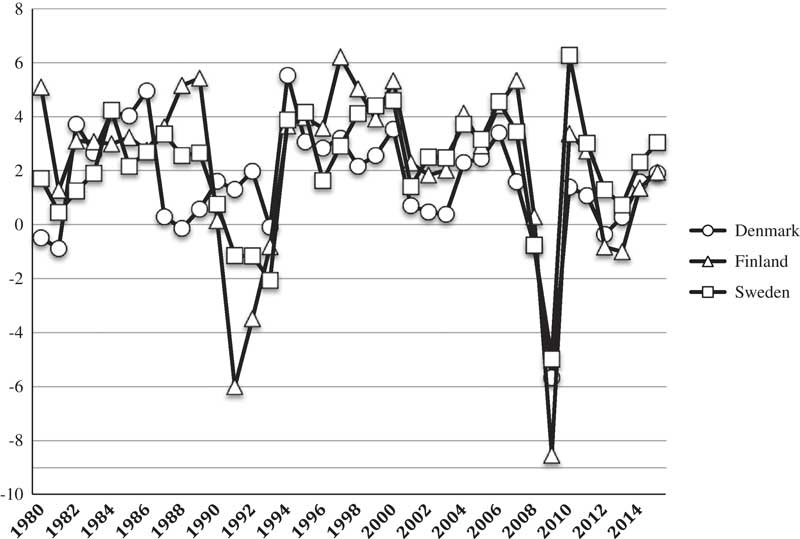
These three small, export-dependent countries have experienced rather similar gross domestic product (GDP) changes. The low growth period of the late 1980s in Denmark did not go as deep into the negative side as the recessions in Sweden and Finland did in the beginning of the 1990s, but the Danish downturn lasted longer. After 1995, the trends were quite similar, although Finland again experienced the deepest recession of the three in 2008–2009. In 2010, a recovery started, particularly in Sweden, with an almost 6% annual GDP growth. The recovery was only temporary, and in 2012–2013 GDP growth has been close to or even below 0% in all three countries (Eurostat, 2014) (Figure 1).
Annual growth of GDP (%) (OECD Economic Outlook 94, 2014)

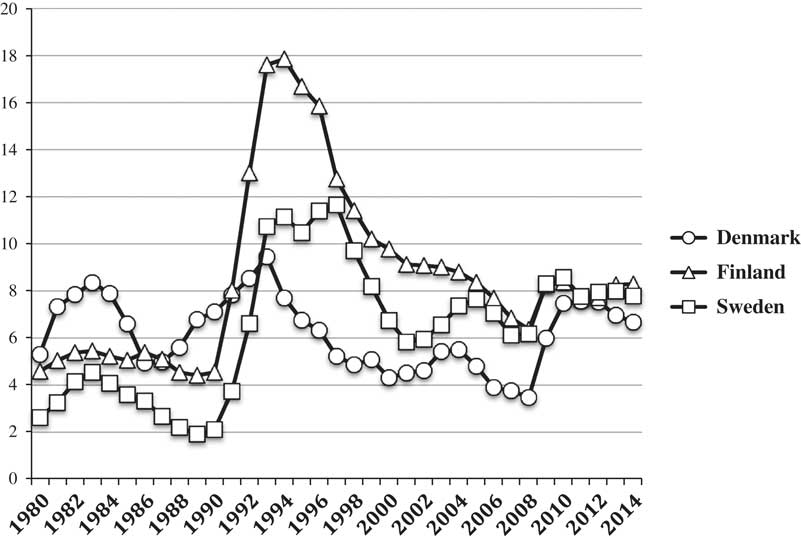
The countries have survived the post-2008 crisis with significantly lower unemployment increases than during the earlier crisis. However, in 2012–2013 unemployment has started to increase somewhat. There are also notable differences between the countries over time. Sweden has kept the unemployment rate at a lower level than its Nordic neighbours throughout the period. Denmark had the highest unemployment level of the three in the 1980s, but it has had the lowest level since the early 1990s when Sweden and Finland were hit by serious unemployment crises. Finland reached an extremely high level during the crisis of the 1990s, and although it recovered, its unemployment rate has never reached the earlier low level (Figure 2).
Annual unemployment rate (OECD Economic Outlook 94, 2014)

A core aspect of the macro-economic crisis of the early 1990s in Finland and Sweden was the crisis of their banking systems and the devaluation pressures against their national currencies. They had used devaluation rather often in the 1970s and early 1980s and introduced floating exchange rates as a reaction to the crisis in the early 1990s (Kiander, Reference Kiander2001). Later, Finland and Denmark linked their currencies to the ECU. Finland joined the euro zone in the early 2000s, whereas Sweden and Denmark refrained from joining. The Danish krone underwent several devaluations in the 1970s, but it has been pegged to the European currencies (ECU and Euro) since 1982. Denmark also experienced bank failures during the 1980s crisis, and the current crisis has seen several failures of smaller banks and downgrading of larger Danish banks, while failures of major banks have been avoided through government intervention.
A third aspect has been the development of public debt. The public debt levels, as measured by general government gross debt, were much lower than in many other EU member states in 2008. They had been at a much higher level immediately after the earlier crisis, in the 1990s and early 2000s. The rise in the public debt, after 2008, has also been more moderate than during the earlier crisis. All three countries have kept their gross public debt under the maximum 60% of GDP agreed upon but is not followed by all member states of the EU. In 2012, the Swedish figure was 38.4%, the Danish was 45.2% and the Finnish was 53.2% (Eurostat, 2014).
The macro-economic crisis in the whole OECD area, and almost globally, and the austerity policies chosen for adjusting to the macro-economic change have created new conditions for testing the resiliency of the health systems. There are studies on the immediate adjustments with regard to the health systems (e.g. Cylus et al., Reference Cylus, Mladovsky and McKee2012; Keegan et al., 2012; Mladovsky et al., Reference Mladovsky, Srivastava, Cylus, Karanikolos, Evetovits, Thomson and McKee2012). It is evident that major macro-economic crises tend to break the continuity of health expenditure growth, and that health policies have to react to this. However, a substantial literature emphasises the resiliency of health systems against ‘normal’ macro-economic pressures and structural reform policies. The path dependency of the systems seems to be strong (Pierson, Reference Pierson2001; Oliver and Mossialos, Reference Oliver and Mossialos2005). It appears that the picture of changes depends on the time perspective of the analysis. Thus, more longitudinal designs are needed.
Changes in the political environment in the Nordic region
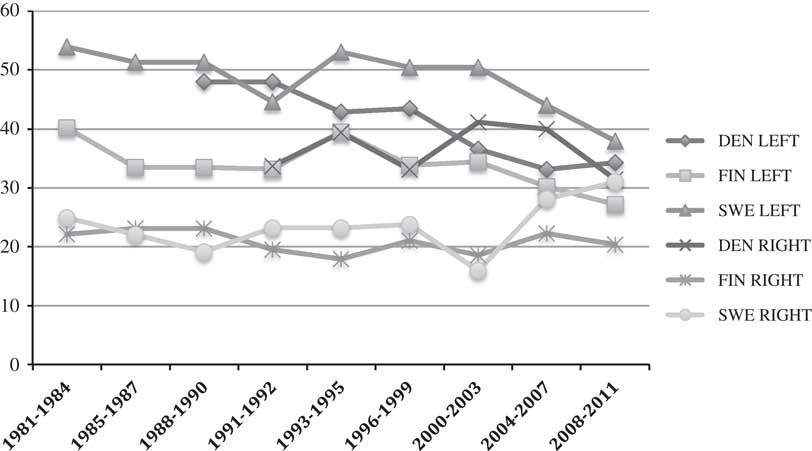
A trend in the past three decades has been a decrease in the support for traditional left parties. A second trend has been an increase in the support for new parties in the centre and on the right, such as green parties and populist parties, like the True Finns in Finland, Swedish Democrats in Sweden and Danish People’s Party in Denmark. The support for traditional, established right-wing parties has varied without a clear long-term trend (Figure 3).
The share (%) of established left parties (DEN: Social democrats and Socialist party; FIN: Social democrats and Left Union; SWE: Social democrats and Left party) and the leading right-wing parties [DEN: Liberals (Venstre) and Conservative party; FIN: Coalition party (Kokoomus); SWE: Moderate Party] of all votes (Finland) or seats (Sweden, Denmark) to the national parliament. (Statistics Denmark, 2012; Statistics Finland, 2012; Statistics Sweden, 2012)

Although Esping Andersen (1990) and many others have labelled the Nordic countries as “social-democratic Welfare States”, only Sweden has had periods of purely socio-democratic government during 1980–2012, and even these periods were mostly without a socio-democratic majority in the parliament. Coalition governments have been the norm in all three countries – centre–left coalitions in Denmark, 1993–2001 and from 2011 onwards, and in Finland, 1980–1987 and 2003–2007; centre–right coalitions in Denmark, 1982–1993 and 2001–2011, and in Finland, 1991–1995 and 2007–2011, also in Sweden, 1991–1994 and 2006 onwards, as well as left–right coalitions in Finland, 1987–1991, 1995–2003 and 2011 onwards.
A legacy from the previous macro-economic crises has been that all three countries, regardless of ideological orientation since the 1980s (DK) and 1990s (FI and S) have been committed to macro-economic policies rejecting devaluation and restricting the use of demand enhancement policies. Fiscal policies have generally emphasised debt reduction and tight budgets. Commitment to the EU stability and growth pact has further reinforced this policy orientation. During the present crisis, the different government coalitions have largely continued along the same lines rather than changing the basic macro-economic policy paradigms. However, there may still be scope for readjustment between policy areas and implementation of radical decisions that disrupt development paths in particular policy fields.
Characterising sector policy changes
Alink et al. (Reference Alink, Boin and ’t Hart2001) distinguish between ‘reformist’ and ‘conservative’ response approaches to external shocks. The former represent major disruptions of existing institutional structures while the latter signifies gradual and limited adjustments to restore order and rebalance or redesign in order to ensure a new ‘fit’ with the changing contingencies. A ‘conservative’ approach would thus seek to re-establish a pre-crisis status quo, or at least ensure that adjustments are minor or temporary, without challenging the existing path. A ‘reformist’ approach focuses on establishing a new institutional structure that is better in tune with external demands.
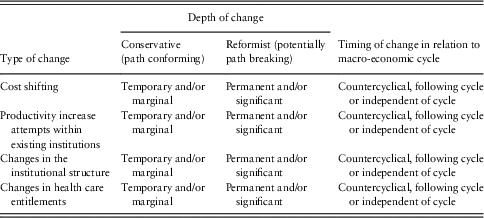
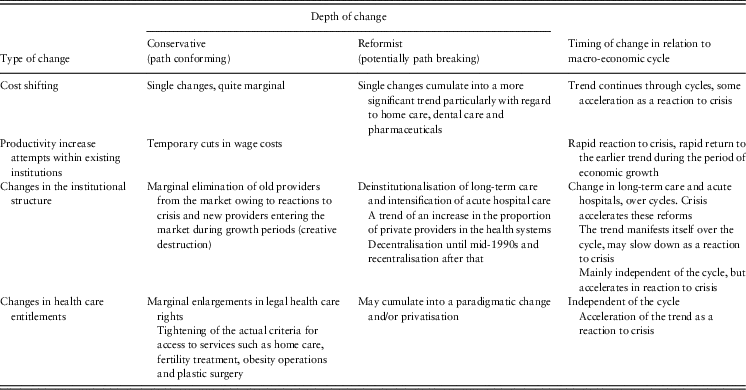
In order to describe and analyse the changes in the three national health care systems, we divided the potential changes into four types: cost shifting, productivity increasing attempts within the existing institutional structure, changes in the institutional structures and power relationships, and changes in entitlements (Boin et al., Reference Boin, ’t Hart, Stern and Sundelius2005). Each type of change may be categorised as conservative (path conforming) or reformist (potentially path breaking). We also asked whether the changes may be characterised as ‘Keynesian’, countercyclical or ‘Schumpeterian’, performing creative destruction during a downturn and innovative renewal during the growth periods (Freeman, Reference Freeman2008) (Table 1).
Categorisation of changes in health care systems

The criteria for such categorisation included the temporary/permanent nature of the changes, the extent of the change in terms of availability of health care for the inhabitants (marginal vs significant) and the extent of change in terms of its impact on the institutional structure of the health system (marginal vs significant). In addition, the timing of the changes was taken into consideration in assessing their relationship to the macro-economic cycle. This categorisation, particularly with regard to the conservative/reformist axis, could not be done without a risk of considerable subjectivity. We tried to reduce this risk by benefiting from the multinational and multidisciplinary background of the three authors and by referring to earlier studies about these changes.
Data and methods
In the analysis we use official statistics, previous research and core governmental documents. Official statistics on macro-economic and health system changes in 1980–2012 is analysed. The data are derived from OECD statistics. While there are a number of problems for cross-country comparisons by OECD Health Data (Cylus et al., Reference Cylus, Mladovsky and McKee2012), the comparability of data for a given country over years is assumed to be better. Thus, the comparison of the national trends over 30 years is done on a more secure basis. We also reviewed published analyses of the policy changes related to the crises 20–25 years ago in the three countries and interpreted the results and conclusions of the analyses applying the categorisation presented above. For analysing the ongoing adjustments to the recent crisis, we searched through core government documents such as budget and law proposals and programmatic documents for an analysis of the changes and proposed changes in health systems.
Health expenditure growth over economic cycle
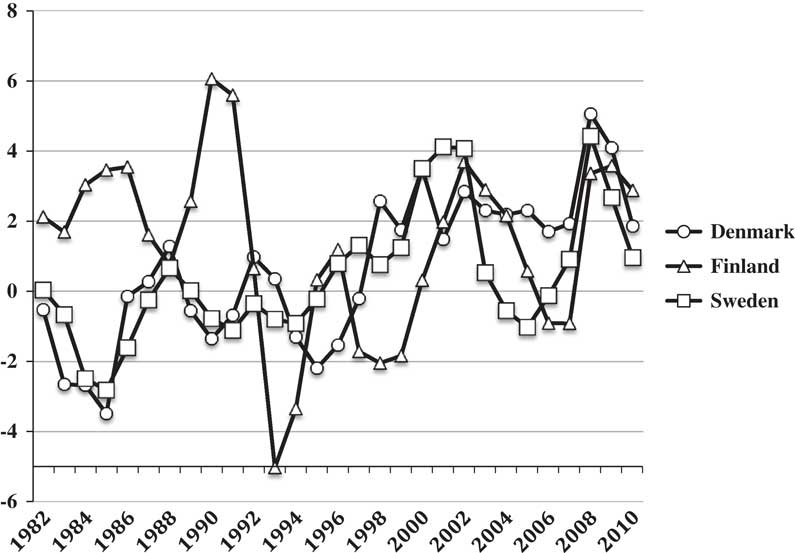
The total health expenditure of the countries, as a percentage of GDP, increased in 1981–2011. Finland, starting from a lower level, experienced the most significant increase. In all countries, the proportion of health expenditure of the total GDP rose during the first years of macro-economic recessions, both in the late 1980s/early 1990s and in 2008–2009. During the later years of recession, some years after the recession and in peak years of macro-economic growth, the proportion temporarily sunk. In the late 1990s in all the countries, and in Finland until 2002, there was a period of slow or no rise in the proportion, after the more turbulent period related to the crisis of late 1980s/early 1990s. After that, all three countries lived a period of rather steady increase in percentage of total health expenditure of the total GDP, until the crisis of 2008–2014.
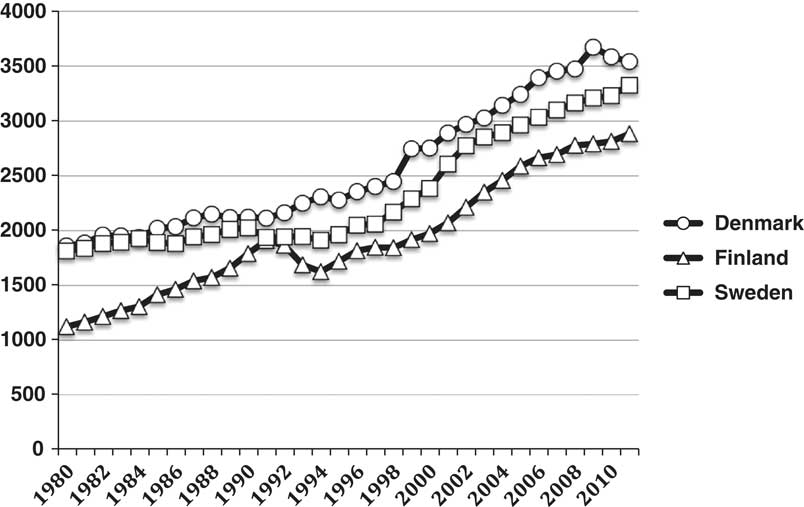
To summarise the information presented in Figures 4 and 5, total health expenditure seems to react to macro-economic recessions with a two- to three-year time lag. The general trend has been a long-term rise in the proportion of total health expenditure of the total GDP. Macro-economic recessions have broken this trend temporarily, but the health expenditure growth has returned to the earlier path. While the recovery of health expenditure growth was rapid following 2008, this was not the picture in the early 1990s, where it took about five years before health expenditure growth again exceeded the growth rate of GDP.
The full impact of the recent crisis cannot be assessed yet. During the first years after 2008–2009 the changes in health expenditure seem milder than after the earlier crisis, particularly in Finland and Sweden. They experienced slow health expenditure growth in 2010–2012, but not negative growth, which was the case in the early 1990s. The growth in Danish health expenditures remained positive in the 1990s, and while the reaction to the post-2008 crisis has been more severe, Denmark was alone among the three countries in actually realising negative growth rates in 2010–2011. The lengthening of the macro-economic crisis with a second negative GDP growth period in 2012–2013 gave reason for the governments to suggest negative (Finland) or close to zero growth in health expenditure in the next few years.
Cost shifting
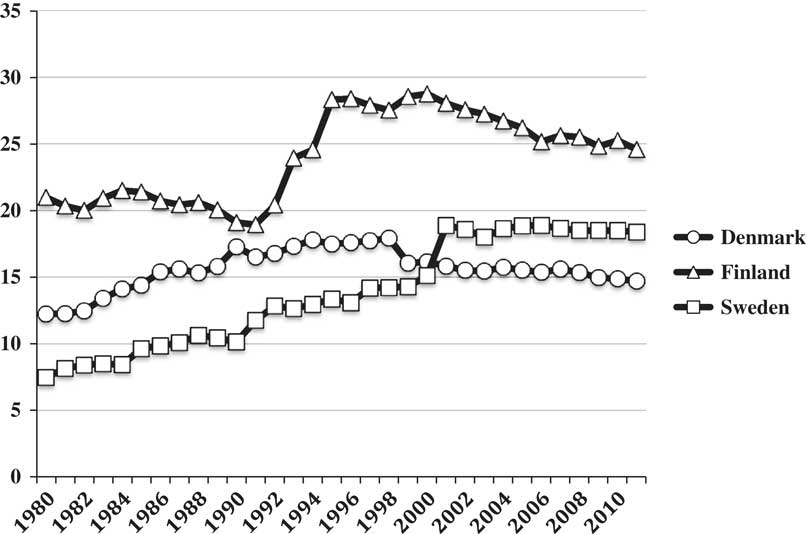
The proportion of public sector funding of total health expenditure has slowly decreased in the three countries over the studied period. The decrease accelerated in the years after the macro-economic crisis of early 1990s. Both in Denmark and Finland the proportion returned somewhat in the early 2000s. Sweden, which started from a higher proportion of public funding, has continued the decrease over the entire study period, with a second more rapid drop in the beginning of the 2000s. Significant changes in the health systems that have led to the overall trend include changes in co-payments, particularly for pharmaceuticals and dental care. They also include a shift in balance between inpatient and outpatient care. Co-payments as a proportion of total expenditure are often higher in outpatient care. Therefore, moving the emphasis of care from the institutions tends to increase the proportion of private funding of health care. A third aspect of the overall trend is the increase in the number of people who have private voluntary sickness insurance to cover payments to private providers (Rostgaard and Lehto, Reference Rostgaard and Lehto2001; Magnussen et al., Reference Magnussen, Vrangbaek and Saltman2009).
In Finland during the 1990s, co-payments for pharmaceutical drugs, dental care and long-term care of the elderly, as well as sickness insurance reimbursements for the use of private health services have been the major objects of crisis-induced cuts in health entitlement both in the 1990s (Rostgaard and Lehto, Reference Rostgaard and Lehto2001) and in the 2010s (Miettinen et al., Reference Miettinen, Jussi, Lauri, Hanna, Ulla, Timo and Hannamari2013). In Sweden, co-payments increased for dental care as well as for pharmaceuticals in the beginning of the 2000s and could therefore not be directly connected to any economic crises. Co-payments for drugs, dental care and some other services increased somewhat during the crisis in the 1980s in Denmark with further gradual policy adjustments during the following decades (Danish Ministry of Health, 2013) (Figure 6)
Total health expenditure per capita, in 2005 purchasing power parity US dollars (OECD Health Data, 2014)

The difference of total health expenditure (per capita) growth (%) and GDP (per capita) growth (%), both calculated on the basis of rolling three year averages in national currency units at 2005 prices (OECD Health Data, 2014)

Proportion of private financing (%) of total health expenditure (OECD Health Data, 2014)

Cost shifting by moving the border between formal (statistically visible) and informal (invisible in normal statistics) care should also be taken into consideration in this kind of research. The desirability of increasing input of family members and other informal carers is often expressed in policy rhetoric. Proponents argue that a stronger role for family and informal care givers can strengthen commitment and harness the potential for innovation in society. Critics argue that it is mostly a cost-cutting exercise, shifting the burden of care to unpaid or informal carers who may receive a low care allowance from the public purse (Anttonen and Häikiö, Reference Anttonen and Häikiö2011). The deinstitutionalisation processes in elderly and psychiatric care, described later in this article, may be understood as an indicator of this kind of cost shifting, at least in Finland and Sweden.
The recent 2008 crisis has been followed by further cost-shifting measures in all three countries. Increasing the co-payments for pharmaceuticals is decided or is under preparation in Sweden and in Finland and has been implemented stepwise in Denmark, with the latest increase in 2008. Unlike Sweden and Finland, Denmark does not have user charges on visits to general practitioners (GPs) or to hospitals. The Danish government has considered breaking this principle, but has refrained so far. There are also proposals or decisions to increase co-payments for certain other services in the three countries.
Productivity increasing attempts within existing institutions
Institutional changes usually take time and may require new investments before any expenditure cuts can be expected. That is why rapid adjustment policies are typically based on attempts to quickly reduce the prices of the main production factors, labour and capital, within the existing institutional structure.
The increase in health sector wages slowed down during both the earlier and the present crises. In addition, the increase in the total number of health care jobs, other than doctors and nurses, slowed down or even decreased for a couple of years following the onset of the current crisis (Lehto and Blomster, Reference Lehto and Blomster2000; Socialstyrelsen, 2012). The number of doctors has increased quite steadily over the whole study period in all three countries, from about 2.5/1000 inhabitants in the early 1980s to 3.5–4.5/1000 in 2010 (OECD Health Data, 2014). The number of highly educated nurses has increased similarly through the whole study period, while the number of staff with lower education has grown only moderately or has even fallen (Dubois et al., Reference Dubois, McKee and Nolte2006). Staff reduction in health policy administration is a favourite proposal by policymakers if some reductions have to be made. For instance, the Danish government decided in 2011 to reduce the number of employees at the central ministry and agency level, and the Finnish government decided in 2013 to reduce the budgets of governmental research and development agencies in the health sector. In addition, in Sweden, a national inquiry from 2012 suggested to cut the number of public authorities.
Rapid reactions to crises also included the rescheduling of investments in health care infrastructure, mainly in the form of postponement. However, some infrastructure building projects were also started as part of public employment policies to contain growing unemployment, or as part of renewal plans already decided before the crisis. It is noteworthy that all three countries are currently implementing exceptionally large investment plans for hospital infrastructures and the crisis has not significantly affected these plans.
Productivity increasing attempts through institutional changes in health care systems
Deinstitutionalisation
There has been a steady downward trend in the number of hospital beds over the study period (OECD, 2014). It appears that the downward trend in acute hospital beds accelerated slightly during the crisis of the 1990s, while that of psychiatric beds accelerated more, particularly in Finland (Lehto et al., Reference Lehto, Moss and Rostgaard1999). In Sweden, a considerable reduction of beds took place before the recent crisis; there was a 24% reduction of acute hospital beds in the period from 2000 to 2010 (Anell et al., Reference Anell, Glenngård and Merkus2012).
The smaller number of hospital beds are used for a greater number of treatment periods, day surgical procedures and outpatient services. An illustration of this trend is the Danish case, where the number of ambulatory visits to hospitals increased by 32% in 2003–2010, while the average bed days per admission were reduced by four days in the same period. The same trend can be noticed in Sweden and Finland. For a number of procedures, the countries have experienced a shift from inpatient to day-case surgery during the 2000s (OECD, 2014).
Sweden implemented a reform (Ädelreformen) of elderly care in the early 1990s by transforming the responsibility of long-term care from the regions and health administration to the municipalities and social welfare administration (Socialstyrelsen, 1996). The same type of reform took place within psychiatry in 1995. Danish municipalities had already assumed responsibility for elderly care by a reform in the early 1970s. A stop to building traditional nursing homes in 1987 further accelerated the transition towards home-based care (Rostgaard and Szebehely, Reference Rostgaard and Szebehely2012). In the 1990s, Finland implemented a concerted transfer (Palvelurakennemuutos) of long-term care from the regional somatic and psychiatric hospitals to municipal outpatient services, long-term institutions and more home-like residential services. A similar change was also implemented with regard to services for the disabled and for substance abusers (Lehto et al., Reference Lehto and Viialainen1998).
While the ideas and targets of these changes in all three countries were already on the agenda before the economic crises of the 1990s, the implementation of the policies accelerated in reaction to the crisis. The original proposals for these changes included, as compensation to the reduction of institutional care, a significant increase in less-intensive outpatient and home services. During and after the crises, however, the compensatory services were expanded much more slowly and less than originally planned, at least in Finland and Sweden. The coverage of these services has been and is still more extensive in Denmark (Rostgaard and Fridberg, Reference Rostgaard and Fridberg1998; Rostgaard and Szebehely, Reference Rostgaard and Szebehely2012).
Continuing deinstitutionalisation is also one of the adjustment policies proposed by the governments during the present crisis.
Changing the public–private relationship in service production
Both Sweden and Finland have experienced a slow privatisation of the production of publicly funded services such as primary health care and long-term elderly care, from the late 1980s onwards (Häkkinen and Lehto, Reference Häkkinen and Lehto2005; Stolt et al., Reference Stolt, Blomqvist and Winblad2011; Anell et al., Reference Anell, Glenngård and Merkus2012). However, in some of the Swedish regions, the number of private providers of primary health care is rapidly increasing. Within elderly care, the number of private providers is also increasing. Today, more than one-fifth of the providers are private. They are predominantly for-profit companies owned by international private equity firms (Stolt et al., Reference Stolt, Blomqvist and Winblad2011). Also in Finland, elderly care has been the area of most rapid privatisation (Stakes, 2009) and the proportion of large for-profit companies is growing (TEM, 2012). Private providers also play a stronger role in the provision of home care services for the elderly in Denmark after the reforms in 2003 and 2007 (Bertelsen and Rostgaard, Reference Bertelsen and Rostgaard2013). There has also been a growth in private hospital providers fuelled by a waiting time guarantee, which has provided publicly funded access to private hospitals and clinics since 2002 for patients facing expected waiting times of more than one month. In 2002, Denmark also implemented tax exemptions for employer contributions to voluntary health insurance (VHI) schemes. This has further fuelled the market for private health services. Unlike Sweden and Finland, Denmark has a long tradition of primary care delivery through privately practicing GPs and specialists. This tradition has been maintained throughout the period. From the early 1970s, Finland has had a public primary health centre system funded from taxation and a parallel private outpatient physician, dentist and physiotherapy service system, the use of which is partially reimbursed for all inhabitants by the mandatory public health insurance system. In 2009, Finland introduced a new law on social and health care vouchers to create more flexible conditions for local authorities to opt for private providers. Since 2010 the Finnish development seems inconsistent. At the same time, as many municipalities increase purchasing from private providers of primary care and elderly care, a number of other municipalities are disappointed by the high cost of private services and aim at reducing the role of private provision (Tynkkynen et al., Reference Tynkkynen, Lehto and Miettinen2011). In Sweden, the number of private providers within primary care has increased radically through the introduction of the primary care reform. The law, which came into force in 2010, stipulates that all county councils introduce so-called choice models, whereby private care providers are free to establish themselves wherever they want in the counties, if they fulfil certain basic requirements. They receive funding based on how many patients they manage to attract. So far more than 220 new primary health care centres have been established, increasing the proportion of private care extensively (Blomqvist and Winblad, Reference Blomqvist and Winblad2014).
Lehto and Blomster (Reference Lehto and Blomster2000) observed that during the earlier economic crisis, in Finland the proportion of private production in health care decreased. This ‘de-privatisation’ was explained both by a decrease in people’s willingness to pay the rather high co-payments for private health services and by the fact that it was easier for municipal and regional public organisations to end contracts with private providers than it was for them to reduce the number of public employees. However, an increase in private provision was observed later in late 1990s and early 2000s (Stakes, 2009). The situation in Denmark is similar, as the centre–left coalition government eliminated the tax exemption for VHI in 2011, reduced the rates paid to private hospitals and encouraged the regions to use public bids and contracting instead. These changes have reduced public payment for private providers considerably and have led to a reduction in the number of private hospitals.
The timing of the increase in the proportion of private providers of health care indicates that privatisation has been related to economic growth in addition to ideological changes, rather than to recession, at least in Denmark and Finland. Sweden was less severely affected by the crisis after 2008, and the conservative-led government has maintained an ideological commitment to choice policies and privatisation.
De- and re-centralisation of the health care system
The division of power and management authority between the different levels of government (national, regional and local) in the health systems in the three countries has been subject to debate and different reforms over the whole study period. The common trend was operational decentralisation to municipalities (Finland) and regions and municipalities (Denmark and Sweden) in the 1970s (Magnussen et al., Reference Magnussen, Vrangbaek and Saltman2009). This trend of operational (managerial) decentralisation continued in Finland and Sweden throughout the 1990s.
Particularly in the 2000s, there has been a tendency to tighten the national-level control with economic steering of health care, and also more recently through national standards, guidelines and quality control schemes (Saltman et al., Reference Saltman, Vrangbaek, Lehto and Winblad2012). Signs of this recentralisation trend have been observed in Denmark since the 1980s. Government control over the budgets of regions and municipalities were tightened, first through negotiations, then through a threat of the withdrawal of government block grants or legal sanctions, and since 2007, by removing the regions’ right to issue taxes altogether. A budget law in 2012 introduced sanctions on municipalities and regions that run over the budget limit set by the government. The Finnish government is proposing a public hospital, primary care and social care reform that should concentrate on decision-making on health and social care to five regional bodies, from the present 330 municipalities. In addition, in Sweden a merger of the county councils into larger regions has been decided on, although as of yet it is implemented only in some parts of the country. All three countries have introduced national guidelines, standards and regulations as well as budget controls to tighten national institutional control over their health systems (Magnussen et al., Reference Magnussen, Vrangbaek and Saltman2009; Fredriksson, Reference Fredriksson2012; Saltman et al., Reference Saltman, Vrangbaek, Lehto and Winblad2012). All three countries are also publishing service and quality data on the Internet; examples of these are The Danish Healthcare Quality Programme (2013) and Sundhed.dk in Denmark, in Sweden the so-called Open Comparison (SKL and SoS, 2012) and national and Nordic hospital benchmarks (Linna and Häkkinen, Reference Linna and Häkkinen2008) in Finland.
Cutting of health care entitlements
In the Nordic decentralised systems, the actual service availability consequences of budget cuts and institutional changes are often difficult to measure directly. Research conclusions about the consequences are often made on the basis of changes in the supply and use of services.
In terms of service use, in Finland and Sweden the most obvious impact of budget cuts in the early 1990s was the reduction in the number of elderly patients covered by home care services (Rostgaard and Lehto, Reference Rostgaard and Lehto2001; Erlandsson et al., Reference Erlandsson, Storm, Stranz, Szebehely and Trydegård2013). Preventive health services were affected by the cuts in Finland (Lehto and Blomster, Reference Lehto and Blomster2000). In Denmark, the waiting lists during the 1980s and the lack of investment in new facilities, e.g., for modern cancer treatment, have been seen as consequences of the tight fiscal climate of the time. In addition, Sweden and Finland had problems with long waiting times during their recession period in the 1990s (Magnussen et al., Reference Magnussen, Vrangbaek and Saltman2009). The overall picture is that overt cuts in particular programmes or benefits are rare, while general and gradual tightening of expenditure control is a pervasive instrument in all three countries.
While the examples above describe changes in practice, the legal rights of the inhabitants to health service benefits have mainly remained the same over the study period. The only exception is the increase in legal co-payment levels. The right to participate in treatment decisions has even been clarified by the introduction of legislation on patients’ rights, in Finland (1992) and in Denmark (1992). Rights in Denmark were put into the health law in 1998 and include the right to informed consent and the right to access personal medical records. Hospitalisation waiting guarantees were introduced in all three countries in the late 1990s or mid-2000s. There is so far no explicit patients’ rights law in Sweden. However, the present government has made substantial efforts to develop these rights by introducing a patient choice reform within primary care and a more explicit patient law is now under preparation and will be implemented from 1 January 2015 (Winblad and Ringard, Reference Winblad and Ringard2009; Blomqvist and Winblad, Reference Blomqvist and Winblad2014). In Finland, the legal right to public reimbursement of dental care was expanded at the beginning of the 2000s (Vuorenkoski et al., Reference Vuorenkoski, Mladovsky and Mossialos2008).
Conclusion
Denmark, Finland and Sweden have gone through a number of institutional changes in their health systems in 1980–2012. The list of changes such as deinstitutionalisation of long-term care, decreases in the numbers of acute hospital beds and increases in the numbers of physicians and highly educated nurses, and the slow increase in the proportion of private funding to total health expenditure are common to most mature welfare states. Even the fact that changes are not unidirectional, as the countries are moving between de- and re-centralisation, is not specific to these Nordic countries (e.g. Marmot and Wendt, Reference Marmot and Wendt2011). Our initial questions were whether the changes in these Nordic countries are related to macro-economic crises, and how they might be characterised on a conservative–reformist scale. Table 2 illustrates the specific flavour of changes in the three Nordic countries and their relationships to the crises.
Summary of the empirical results

The table illustrates that direct crisis reactions tend to be of a temporary nature and that health policy reactions in this sense have a conservative bias. The potentially path-breaking changes seem to be initiated, independently of the crises, and to last over the whole study period and over the economic cycles. This conclusion is further supported by the fact that Norway, which has been less affected by the international crisis, owing to its petroleum-based economic activities, has implemented many similar reforms (Magnussen et al., Reference Magnussen, Vrangbaek and Saltman2009).
However, these long-term trends are not totally independent of the cycle. Many of the long-term changes are accelerated by the reactions to the crises. Others seem to have slowed down during or immediately after the crises.
The observation that health care system changes do not follow the timing of macro-economic cycles is not a surprise. Health policy analysts often refer to a set of underlying pressures on health expenditure, including population ageing and increased expectations, changing health care technologies and growing differences between what kind of medical interventions are possible and what is economically feasible (Blank and Burau, Reference Blank and Burau2004; Buse et al., Reference Buse, Mays and Walt2005). At the same time, health system changes may, to varying degrees, be related to ideological, political and cultural changes, for instance, to a general shift towards ‘neo-liberalism’, ‘individualism’ or a decrease in the support for socialist and socio-democratic parties (Buse et al., Reference Buse, Mays and Walt2005). Many of the changes identified in the three Nordic countries seem to relate to long-term trends rather than short-term macro-economic crises. Arguably, this is the case for the observed changes in acute hospital care, which are related to the changes in health technology and the changes in long-term care to the ageing people. Privatisation of funding and provision of health care, in turn, are often assumed to be related to changes in the political and ideological climate (Blank and Burau, Reference Blank and Burau2004; Buse et al., Reference Buse, Mays and Walt2005), although there are also elements of pragmatism in the way these ideas are implemented in the Nordic countries.
Similarly, the trend towards deinstitutionalisation of services in elder care and moving services from hospitals to primary care and municipal home care can be seen as a result of long-term changes in health care needs (more elderly patients with chronic care needs) and changes in the cultural understanding of ‘optimal quality’ for such patients combined with changes in health technology that enable more home-based care.
Until 2014, the three Nordic health systems seem to have survived through the recent macro-economic crisis with fewer problems and changes than were experienced as consequences of the crises some 20–25 years ago. The countries have experienced less severe increases in unemployment, and they fell into recession with public debt levels among the lowest in the EU. The second wave of zero or negative growth in 2012–2013 may, however, change the overall picture. The governments in the three countries have already planned further adjustment policies for the next few years. The planned budget adjustments for 2014–2015 might result in very limited or negative growth in the three countries.
The legacy of the earlier crisis and the recovery policies after that crisis have probably had some impact on the policy reactions to the present crisis. The crises in the 1980s and early 1990s served as focusing events and became reference points for policy adjustments aimed to facilitate stronger control of health expenditures. This led to institutionalisation of stronger budget controls as well as a general emphasis on productivity increases in the three health care systems. The institutionalisation of health expenditure controls in the form of national-level agreements and legislation and DRG systems for monitoring activity and encouraging productivity increases through various types of incentives and sanctions imposed by the state on the regional- and local-level authorities enabled the countries to rather effectively reduce the growth rates of their health expenditures. Budget controls and incentives have also been used as part of policy agreements to facilitate the long-term transitions of the health care systems to handle the expected changes in demography and health care needs; examples include the support for transition from inpatient to ambulatory care and the introduction of municipal co-financing of hospital services. Yet, the picture remains that these changes are ongoing and linked to longer-term trends in health care. The first crises in the 1980s and early in the 1990s appear to have accelerated the developments and created a stronger platform for introducing institutional change policies. The general sentiment has therefore been that the need for radical policy reactions to the 2008 crises was less dramatic than in many other countries.
An alternative interpretation would be that the crises and, particularly, crisis awareness have not (yet) been deep enough for enabling more radical changes in health system policies until now.
Both of these interpretations may be identified in public policy debates in the three countries. The ‘conservative’ view, emphasising gradual adjustments, seems to dominate domestic political debates. There is significant support behind the public health systems and a willingness to prioritise health care over other welfare sectors. The ‘reformist’ view, calling for more radical changes, is mostly pushed by international and national consultancies and think tanks as well as some politicians, mostly from the liberal side of the political map.
From the perspective of the traditional characterisation of the Nordic health systems as tax funded, publicly provided, decentralised and based on solidarity and equity, the two economic crises and the strong growth period in between have not meant rapid revolutionary changes. However, many long-term trends over economic cycles tend to slowly affect all these characteristics. There is more private funding, more private provision, more centralisation and more risks to equity. This may in the long run amount to more paradigmatic changes.
Acknowledgements
The authors thank the European Health Policy Group for insightful comments on the first version of the paper and the editors and reviewers for significant and exact comments on the later versions of the text.