Shortly before C. R. Ashbee transplanted a hundred and fifty Cockneys to Chipping Campden, Gloucestershire, in 1902 to form a utopian arts-and-crafts community, two other back-to-the-land settlements were also established, one located outside the market town of Stroud, a mere bicycle ride away from Ashbee and his guild. These Tolstoyan colonies – Purleigh, founded in 1896 in Essex, and Whiteway, founded in 1898 in the Cotswolds – fostered goals of fellowship and the simplification of life, as had been modeled by Henry Thoreau, Ralph Waldo Emerson, and Walt Whitman in the United States and Edward Carpenter in Britain.Footnote 1 Yet, whereas Ashbee was inspired by the model of William Morris and nostalgia for a pre-industrial England, English Tolstoyans looked not to craft, but to a less Aesthetic “bread labor” as a respite from modernity's corruption. Visiting Whiteway in 1904, Ashbee observed the Tolstoyans’ struggles to live off the land and commented, “they hold the other end of the stick we are ourselves shaping at Campden” (qtd. in MacCarthy 100). As his metaphor implied, both groups shared utopian aspirations, but Whiteway's settlers had sought the perfection of life from another vantage point and through other means. Ashbee regarded the austerity of their lives with distance and, as we will see, even with some distaste. Nevertheless, some features of the guildsmen's lifestyle at Chipping Campden mirrored those at Whiteway. This essay uses memoirs and fictions by C. R. Ashbee, his spouse, Janet Ashbee, and the Tolstoyans to disentangle the threads of “Aestheticism” and “simplification,” and to mark places of their conflation.Footnote 2
Generally, many Aesthetes and Simple Lifers endorsed the same innovations, such as progressive dress reforms for women; culturally, there was a genuine intermingling and overlapping between the communities. Arts-and-crafts objects designed by Aesthetes like William Morris and Ernest Gimson, such as rough-hewn oak tables and rush-seated chairs, stood for an ideal simplicity of design, hearkening back to earlier English vernacular country furniture. But the groups also differed at points. Simplicity in high Aesthetic terms – Ashbee's elegant silverwork and E. W. Godwin's glossy white dining table, whose surface Oscar Wilde joked might be scratched by rose petals (Soros 37), for example – contrasted with the more clunky version proffered by the counterculture: Carpenter's homemade sandals, Shaw's Jaeger woolens.Footnote 3 At its own extreme, the Tolstoyan contingent seems to have opted for lifestyle without the Aestheticism, setting loveliness and delicacy aside to pursue a determinedly spartan ideal of fellowship – fulfilling ethical standards of simplicity but alienating craftsmen-Aesthetes like Ashbee.Footnote 4
The self-aware Janet Ashbee responded to and grappled with a popular and, by 1906, familiar version of the Simple Life as she encountered it. In that year she visited the home of the American-born architect Charley Holden and his wife Margaret, who had settled in rural Hertfordshire. The biographer Fiona MacCarthy records,
The house, with its lead glazed casements and white-washed walls, was a perfect example of the style, complete in every detail from the oak settle by the hearth to the bananas and brown bread on the table. Needless to say, there was no hot water, for the minds of the Holdens were on more important matters. Their philosophy was one of plain living and high thinking and strenuous activity for the improvement of society. (147)
As activists, the Holdens founded clubs and regularly clashed with the parish minister (147). It was perhaps ironic that Janet Ashbee should regard their lifestyle caustically. Despite its apparent austerity, it did parallel aspects of her and C. R. Ashbee's life with the Guild of Handicraft, now in their fifth year in Chipping Campden. In her journal, Janet Ashbee sought to unravel what the Simple Life really meant – that is, to sort out its more worthy goals from the programs and pronouncements of cranks. In 1906 she wrote in her memoirs:
Each year brings fresh attempts to attain the simple life; some think it can only be done within rough-cast and thatch in a field; others think a loose dress and a low collar will ensure it; again others believe an absence of servants makes for it; others again say “no home; give me a hotel.” Roger Fry 5 or 6 years ago told me he had tried the simple life, but had found it so complex that he had to give it up.
I think the answer to these puzzles is one with the locality of the Kingdom of Heaven. The Simple Life is within you. Not in organization of labour, not in abolition of class differences, not in cooking your own dinner or doing your own scrubbing; not in Morris hangings or white-washed walls any more than Victorian ribbons or horsehair sofas – but in the heart and mind. In fact, you cannot lead the simple life; it must take you by the hand. (1 June; qtd. in MacCarthy 147)
Janet Ashbee highlights a terrific tangle of ways that the simple life was being played out. Clearly, as the wife of C. R. Ashbee, she was herself complicit in the aesthetic of whitewashed walls and Morris hangings.
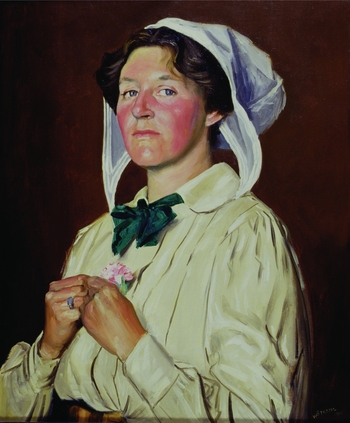
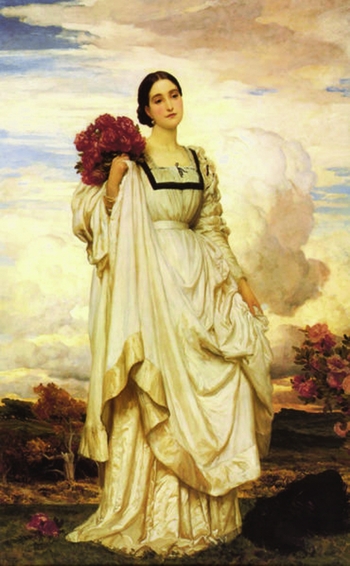
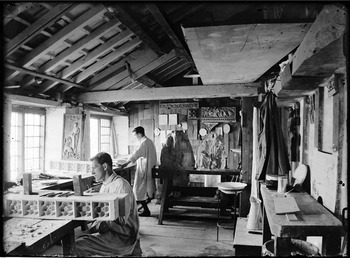
She also adopted countercultural dress reforms, the aforesaid “loose dress” and “low collar,” having famously abandoned her stays on a beach during her honeymoon in 1898 (Ashbee, Janet Ashbee 34).Footnote 5 She joined the Healthy and Artistic Dress Union (founded in 1890), even contributing articles to its journal and serving on its board along with Mary Watts and Walter Crane (40). The most famous portrait of her, painted in 1910 by William Strang, shows her in an artistically roomy shirtwaist and a Dutch cap (Figure 6); this seems a simplified form of the earlier mode of Aesthetic dress, as depicted in Lord Frederick Leighton's painting of Countess Brownlow in 1879 (Figure 7), sharing the loose bodice but not the excessive gathered sleeves. Ashbee's costume is also akin to the smocks donned by the craftsmen of the guild. In her fine study of the arts and crafts in the Cotswolds, Mary Greensted notes that shepherds and other workers on the land were still wearing smocks into the early twentieth century, and that they could be purchased ready-made at markets and shops (81). Progressive craftsmen-designers of Ashbee's guild recognized them as folk art (they had traditionally been embroidered) and so sought to reproduce them and perpetuate the custom, as evidenced in photos of the Guild of Handicraft (Figure 8). English followers of Tolstoy too adopted the smock, but in imitation of their hero and Russian peasants. It is worth noting that one of the earliest settlers at Whiteway, Nellie Shaw, had previously worked as a seamstress of “artistic and rational dress” for a cooperative shop in Croydon before taking to the land (Greensted 90), embodying the slippage not only between the two styles, artistic and rational, but the two groups, Aesthetic and socialist-anarchist.
William Strange, Janet Ashbee. Oil on canvas. 1910. Courtesy of the Cheltenham Art Gallery and Museum.

Frederic Leighton, Lady Brownlow. Oil on canvas. 1879. Brownlow Collection, Belton House, near Grantham, Lincolnshire. ©NTPL/John Hammond.

Carvers in the Guild of Handicraft. Photograph. Courtesy of Guild of Handicraft Trust, Ltd.

Still, despite the common adoption of loose, non-constricting garments, the more frugal lifestyle choices that Janet Ashbee enumerates – the abolition of servanthood, the redistribution of day-to-day labor, the working of rural small-holdings – were characterized less by aesthetic-crafts coteries and more by ethical-socialist and Tolstoyan communes in Britain. Janet Ashbee clearly alludes to such communities in her playful adoption and scrambling of the phrase “The Kingdom of God is within you.” This verse from Luke 17:21 had been the title of Tolstoy's famous 1893 pamphlet on Christian pacifism and non-resistance to evil. Such pamphlets, published cheaply by the New Age Press at Purleigh Colony in Essex, had a profound impact upon British readers. For instance, a chance purchase of Tolstoy's 64-page How I Came to Believe (1900) at the Oxford train station in 1902 led Stephen Hobhouse, the son of a wealthy Liberal political family, to renounce his inheritance, pursue a life of voluntary simplicity in a Hoxton slum, and adopt Quakerism and pacifism (a conscientious objector, he was later imprisoned during the First World War) (Hobhouse 59, 156–70). Hobhouse's story constituted a dramatic version of the spiritual awakening experienced by many others when reading Tolstoy. By the 1890s, Tolstoyism was popularly defined not merely by its pacifism and praise of physical labor and voluntary simplicity, but also by Tolstoy's increasingly strident proscriptions against smoking, the consumption of meat and alcohol, and sexual intercourse (he advocated celibacy, though himself failed to practice it). With its distinctions between higher life and lower life, Tolstoyism would be satirized in novels like H. G. Wells's Ann Veronica (1909) as the common refuge of the crank (see Wells 114, 116, 144).
The common denominator joining this disparate pairing of fine craftsmen and idealistic communal farmers was Edward Carpenter. Carpenter was a bit like a tree trunk out of which various permutations of late-Victorian subculture and counterculture grew or around which they sheltered themselves: rational dress, free love, animal rights, vegetarianism, educational reform, opposition to vaccination and to live-animal experimentation, as well as the embrace of a number of esoteric New Age religious faiths including spiritualism and Theosophy. In treatises such as England's Ideal and Other Papers on Social Subjects (1887) and Civilisation: Its Cause and Cure (1889), Carpenter pointed to the arbitrariness, wastefulness, and unhealthiness of middle-class values under capitalism and anticipated society's shedding them as a necessary, predictable part of natural progress. He proposed that people were evolving towards a cosmic empathy with one another and a renewal of a physical vitality once forfeited under industrial competition. “It is in these two movements – towards a complex human Communism and towards individual freedom and Savagery [– . . .] that we have fair grounds I think for looking forward to [civilization's] cure” (Civilisation 49). Newly self-conscious, each individual, he argued, was longing for and edging closer to “a better sort of morality” and “some better conception of human dignity” (England's Ideal 71–72). Carpenter looked to each person to drive this social progress on a small scale through mindful, independent effort.
In England's Ideal, Carpenter modeled his own efforts at liberating himself from the “cuff and collar cult” of respectability (126). He itemized the meager costs of his homegrown daily diet and extolled the freedoms inherent in an un-cluttered, un-carpeted, un-curtained home (95–97, 101, 106–10). He proclaimed the comfort of bare feet and clothes that breathed, the satisfactions of physical labor, and implicitly, the class redemption inherent in rural self-sufficiency (110–14, 124, 136). “For myself,” he wrote, “I confess to a great pleasure in witnessing the Economies of Life – and how seemingly nothing need be wasted; how the very stones that offend the spade in the garden become invaluable when footpaths have to be laid out or drains to be made” (115). He traced the uses of a once-mended garment as it devolved into bandage strips and then cleaning-rags and finally compost (116). Situating himself as a refugee from his privileged class, he both pitied and renounced the “St. Vitus’ dance” of “poor convulsed creatures, decked out in strange finery” – that is, of shareholders anxiously wondering if they could continue to live off their dividends and the labor of others (127).
Carpenter, who sustained a friendship with the Ashbees, visited the crafts guild at Chipping Campden in 1905 to popularize his lifestyle through a free lecture on “Small Holdings and Life on the Land” (Crawford 127). Both Ashbees appreciated Carpenter's ways. In an early holiday in America, where they visited Emerson's son and the Roycrofter colony, Janet Ashbee praised the simple meals of buckwheat pancakes and syrup and baked apples as “Carpenterian” fare: “Millthorpe again!” (Janet Ashbee 64). People took from Carpenter what they needed and blended it with other influences. C. R. Ashbee merged Carpenter's cross-class homosociality and idealism for the simple life with Morris's art socialism and Ruskin's paternalism to arrive at his form of guild socialism. He was determined to breach the class divide as Carpenter had; however it would not be through market gardening, but handicraft. Visiting Carpenter's home Millthorpe in Derbyshire, Janet Ashbee had been impressed by the absence of “Things” (Ashbee Journals, 1 October 1898, qtd. in MacCarthy 12; also Janet Ashbee 34). Yet, in Chipping Campden, where economic success relied on art metalwork, jewelry-making, and marquetry, the design and creation of “things” was paramount: decorativeness, not austerity, was the goal.
The Ashbees thus negotiated the sometimes-contradictory attractions of simplification and the crafts guild. Following Carpenter, C. R. Ashbee used his writings to decry the clutter of High Victorian interiors. There are few greater arguments for simplicity than the near-hallucinogenic chapter of his novel The Building of Thelema (1910), where the dreaming protagonist is bombarded by querulous useless objects (“inutilities”) competing for his attention (37–46). As advocates for the simple life, the Ashbees also pursued recreational camping, and early accounts of their marriage before the departure to Chipping Campden show them taking weekends in the countryside, pitching tents with the Guildsmen, rowing, hiking, and cooking over an open fire, Janet in her “shortest and most disreputable skirt” (Janet Ashbee 47).
Still, it is crucial to remember that their daily regular life included servants, and that, while the Guild later taught classes in gardening, this was thought a hobby, not a livelihood. Some craftsmen-designers in Ashbee's community eagerly embraced the cultural practices of the simple life, aspiring to make their own cider, wine, cheese, and bread. But again, their careers were with the Guild. It was only in 1911, long after the technical liquidation and gradual collapse of the Guild of Handicraft, that C. R. Ashbee proposed purchasing smallholdings for the remaining Guildsmen in the area to assure them of some economic security (Janet Ashbee 131–32).
Carpenter's brand of simplicity was better approximated by the Christian-anarchist followers of Tolstoy in Britain. They appreciated Carpenter in the total context of his engagement with a radical community, the Fellowship of the New Life.Footnote 6 Despite his reverence for Carpenter, Ashbee seems remote from the Fellowship and its spiritual preoccupations – at least according to the evidence available in Fiona MacCarthy's and Alan Crawford's biographies of him and the Guild. Ultimately Ashbee's “Simple Life,” a term frequently associated with him through MacCarthy's study of that name, was not exactly the same as the “New Life,” which carries connotations of its practitioners’ religious conviction and ethical self-reflexivity. In brief, New Lifers, anxious for self-renewal, mastered a Simple Life, but not all Simple Lifers pursued a New Life.
English Tolstoyans did. They originated from the community associated with the Fellowship of the New Life. Founded in the early 1880s, the Fellowship sought the moral regeneration of all society and determined that parliamentary change was only secondary to the reformation of the individual's conscience: “the cultivation of a perfect character in each and all.”Footnote 7 Thus, its members perceived individual introspection as a crucial precondition towards communal development. Living intensely and self-consciously meant living more beneficently, more kindheartedly. Hence their decision that the employment of servants to do one's dirty work was a sin, a desecration of Christian brotherhood. Associates in the FNL subscribed to an eclectic religion of socialism, that, as critic Ruth Livesey has noted, borrowed liberally from “spiritualism, Theosophy, Emersonian transcendentalism, Nietzschean notions of the will, Ruskinian medievalism, alongside the more material influences of Marx and Engels” (“Morris” 604).Footnote 8
The FNL fostered several Brotherhood Churches, and in 1890, the Croyden Brotherhood Church's charismatic leader, John C. Kenworthy, underwent a Tolstoyan conversion and thereafter preached a blend of Christian Socialism and Tolstoyan anarchism. By 1897, several followers had settled on a plot of land in Purleigh, Essex; the agricultural commune underwent fast expansion. Among the sympathizers who settled locally, Tolstoy's disciple, the political exile Vladimir Chertkov, established his New Age Press to produce affordable English translations of Tolstoy's works. At the height of its popularity, Purleigh Colony inspired similar experiments outside Blackburn, Sheffield, and Leeds. But the colonists’ decision to pledge nearly half of Purleigh's capital to the transport to Canada of a refugee Russian pacifist sect, the Doukhobors, precipitated the ultimate financial collapse of Purleigh in 1900 (Holman, “Purleigh” 173–74). Internal dissension had already spurred a splinter group to break away and found Whiteway Colony in the Cotswolds in 1898.Footnote 9
Although they donned Norfolk jackets, flannel shirts, and smocks like Ashbee's men, early Purleigh and Whiteway settlers, rather than pursue silversmithing and cabinetry, worked the land like Tolstoy among his peasantry at Yasnaya Polyana. In espousing his ideal of “bread labor” (based on Genesis 3:19, “In the sweat of thy face shalt thou eat bread”), Tolstoy preached that each man reduce his consumption to basic essentials and that which he produced on his own. By working their plots and pooling all into a communal harvest, these settlers sought to avoid exploitation and inequality. On visiting Whiteway in 1904, Ashbee wrote dryly,
We found here people who seem to be “back to the land” in grim earnest. I had long talks with some of them. They hold the other end of the stick we are ourselves shaping at Campden, but their problem, could they work it out, is a much more important one than ours. How to live by its produce on a given piece of English land. Treating their agriculture not as exchange but for the purpose of produce only, and paying their rates, for the 90 acres of land they farm, out of common pasturage and grass crop. They have little home-built cabins of wood and brick dotted about among their allotment patches. ‘Tis all very uncouth and experimental. In the cabins are pianos, books, machine made chairs and tables and other of the unearned incrementa of civilisation, protesting as it were against this half-hearted return to barbarism. (qtd. in MacCarthy 100)
One can perceive Ashbee's distaste here for the residue of conventional, bourgeois domesticity and the echoes of Morris in his disapproval of machine-made furnishings.
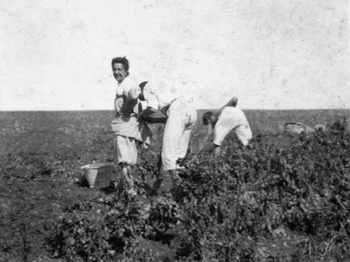
In terms of fashion, the colonists, often interviewed out in the fields hatless and barefoot (Figure 9), were the targets of satire even in forward-thinking papers such as Blatchford's Clarion. One journalist who had visited Purleigh wrote, “A few of them seem to wear trousers that have been plucked before they were ripe” (Holman, “Purleigh” 168). Though hardworking, they were not a joyless group: Ashbee's mention of a piano at Whiteway reminds us that Tolstoyans had not sworn off the pleasures of music. The first funeral at Whiteway was observed through a simple burial accompanied by Chopin's “Funeral March” on the piano (Thacker 30).
Settlers cultivating land, either Purleigh or Whiteway, late 1890s. Photograph. Courtesy of Joy Thacker.

While united by their desire to get back to the land, Ashbee and the Tolstoyan communities differed ideologically. Ashbee perceived his experiment as primarily a social one, inaugurating a kind of cultural regeneration through fresh air and the revival of archaic celebrations like masques and May Day fetes (MacCarthy 123; Crawford 89, 124–25). The challenge of the first years at Chipping Campden was to integrate guild members into the wider local community with as little friction as possible (MacCarthy 60–61; Crawford 113–14). Ashbee used local parliamentary politics to advocate for subsidizing an art school; Janet Ashbee ran unsuccessfully for the local council in 1905 (Crawford 126, 130). By contrast, the residents of Whiteway colony identified themselves as a separate entity from the nearest town, Stroud, and were so adamantly opposed to conventional government and private ownership that they festively burned the title deeds at the end of a pitchfork shortly after purchasing the colony's property (Armytage, “J. C. Kenworthy” 147; Thacker 17; Coates 206). If Ashbee was ultimately operating within a system of capitalist economics by pursuing handicrafts in Gloucestershire so that he could sell art objects in showrooms in London,Footnote 10 in contrast, Whiteway colonists renounced all literal complicity in monetary exchange: for a period of time, they practiced barter instead (Thacker 50).
The English Tolstoyan life is vividly recounted in one novel produced by an ally and associate, Salome Hocking, who, with her spouse, Arthur C. Fifield, had deliberately settled down the road from Purleigh Colony. As a publisher, Fifield was very much at the heart of the New Life vanguard. His press, run in collaboration with the Russian refugee, Chertkov, published works by Tolstoy and Henry Salt, a biography of Edward Carpenter, and in 1905, Hocking's novel, Belinda the Backward: A Romance of Modern Idealism. Here the eponymous protagonist, once orphaned, goes to live by the sea with her aunt and the aunt's Russian husband, Mr. Kovalevsky. Belinda finds herself in the midst of a disparate group: anarchists, Theosophists, evangelical Christian socialists, revolutionaries, and pacifists. She listens to the debates around her, but hesitates to adopt any radical ideologies outright (hence her nickname of Belinda the Backward). As time passes, she joins Kovalevsky's compatriots in the new venture of a neighboring colony.
Belinda enumerates her physical discomforts there. The fire from the insufficient wood stove leaves everything they eat and drink tasting of smoke, and the floor and ceiling beams of the cottage are black with it (104, 122). The windows are badly fitted, so she tries to stifle the drafts by placing her comb and brush against the gaps around the window frames (104, 123). There is a shortage of linen and space, so she sleeps on a mattress on the floor of the front room with a carriage rug and her coat as additional blankets (120). As the cottage is without cupboards or wardrobes, she is promised a few nails on which to hang her dresses (121). Most of all, it is the dark bread, baked from the grain that they have grown and harvested, that offends her: it is inedible, hard, saltless, and dry; and it constitutes much of the two-meal-a-day diet at the colony (121–22). Belinda allows herself and her friends small supplementary treats from the local shops, but since she is not earning pay, these purchases drain her savings (151, 158). Finally, Belinda, who had come ready to be converted to the pleasures of “digging,” finds gardening a back-breaking business (152).
Is there any beauty in this commune, and is it valued? To some degree, yes: given its rural setting, Belinda is later refreshed by daily life in the garden and on her bicycle rides. In terms of interiors, in a cottage occupied by her neighbor Alice Goodwin and her husband, “everything was beautifully neat and clean, and as there was nothing in the room save what was quite necessary, it was not crowded. It looked a cosy little place, and showed that everything had been arranged with an artistic eye” (111). So the simple life and the beautiful life are clearly not mutually exclusive. However, Belinda is not fully convinced: “I could not help wondering if she [Alice] were quite satisfied with what was only, in spite of the beautiful cleanliness and taste displayed, a tiny cottage meagrely furnished” (112). In answer, rather than praising the simple life for its inherent beauty, Alice and her husband emphasize its lack of waste and their happy forfeiture of the meaninglessness of the old life. Alice tartly recalls the fickleness of London fashion and the weariness of fittings at dressmakers and milliners.
Alice proudly conveys the history of each of her cottage's furnishings: “for they had either been gifts from friends or had been made by her or her husband's hands” (112). Yet pointedly, this is not a crafts colony like Ashbee's. Residents here identify as agricultural laborers, and they spend their days in the maintenance of the garden and in supplementary tasks such as laundry and cooking. The pamphlet that Alice lends Belinda quotes Emerson, Thoreau, Carpenter, and, of course, Tolstoy – their goal is not aesthetic living as much as it is classlessness. They even cite Thomas Carlyle: “It is only with renunciation that life properly speaking can be said to begin” (116).
What is interesting is that long after she has settled in and experienced a winter in the colony, Belinda reflects on the necessity of crafts as a means of sustaining both happiness and the fabric of the commune. Most of those who remain at the colony are, like her, bookish and city-bred. But she observes that “genuine” country people excel at skills of carpentry and shoe mending and that the winter is when farmers repair gates and doors and harnesses and replace hinges and fastenings. She argues that the colonist has to be as handy as a sailor and “be able to knock up a shed, make a table and bench, and, if possible, a chair for himself” (164). “For a colony to be successful some handicraft should be allied to agriculture” (163). Notice, however, that while she uses the term handicraft, there is no goal here of selling one's work or converting others’ tastes to more Aesthetic designs. In this Tolstoyan environment, one aims for self-sufficiency rather than market success.
One hesitates to call the novel a satire, because it does not parody crankish behavior. Belinda accepts and even admires the casual look – knickerbockers, vests, and long hair – of the men as they spade the ground. Alice Goodwin wears “a big print pinafore which was gathered into a yoke, and hung down in straight folds from the shoulders” (111). “I found,” Belinda reflects, “that this was the general indoor garment, and as it was simple and easily washed I adopted it myself” (111). Belinda's final role after leaving the colony is a missionary one: she is enlisted to edit a newspaper called “Our Women's Simplicity Crusade” for distribution among city women (186), and while this does not promote specific simplified dress designs, it is an effort to mediate public desire, to awaken fashionable middle-class women to their complicity in keeping husbands entrapped in commercial war.
Rhetorically, Belinda does not advertise the superior beauty of the smock or shortened skirt. Instead, she inveighs against present women's fashion for perpetuating class distinctions and critiques the furbelows that prevent it from being “easily washed.” In the eyes of Belinda and her community, ladies’ dress is a symbol of the greater problems of luxury and idleness. Without a long train, one can do real work. Without hours being ritually fitted at dressmakers, one can pursue a more meaningful use of one's day.
Nevertheless, because Belinda (and Hocking) use dress as a means of advancing their agenda, it is difficult to divorce their crusade from Aesthetic culture. Rational Dress and Aesthetic Dress overlapped in theory and in practice: a continuation of the Rational Dress movement, Aesthetic Dress adopted its central precepts of comfort and looseness while also adapting its styles to reflect Aestheticism's antiquarianism (Condra 82; Schaffer, Forgotten Female Aesthetes 106–07). The Wildes were vocal advocates of rational dress: besides editing issues of The Rational Dress Society's Gazette in 1888–89, Constance Wilde wrote columns on fashion for the journal Oscar Wilde edited, The Woman's World (Ellmann 284; Wilde, “Muffs”; Wilde, “Children's Dress”). Defending classically draped gowns for women against the charges that they were impractical for modern urban life and the English climate, Oscar Wilde suggested that women wear Jaeger woolens beneath them (Wilde, Art and Decoration 63, cited in Cunningham 119). As the name of the Healthy and Artistic Dress Union implied, progressive Victorians perceived common sense and Aesthetic style as going hand in hand. Supporters of the Union included artists in the Aesthetic milieu such as the stained-glass designer Henry Holiday (who served as the Union's president), the sculptor Hamo Thornycroft, the painter G. F. Watts, and the illustrator Walter Crane (who, with Holiday, contributed to its journal, Aglaia). That said, the “artistic dress” adopted by socialist women in the 1890s varied widely from empire-waists to no waists, from Liberty prints to homespun (Newton 161).
Conclusion
Given such overlaps, we can begin to see how simplification came to be regarded as a subset of Aestheticism. The heterogeneity of progressive culture and its social relations especially encouraged this slippage of concepts and defining terms. New Lifers such as Carpenter enjoyed friendships with aesthetes, so much that in 1896 Carpenter chose to submit his essay, “The Simplification of Life,” not to The Nineteenth Century or The Fortnightly Review but to The Savoy, which was second only to The Yellow Book in its Aesthetic and Decadent associations. Edited by Leonard Smithers, Arthur Symons, and Aubrey Beardsley, The Savoy's frequent contributors included Ernest Dowson, Max Beerbohm, Will Rothenstein, and Joseph Pennell. Not that Carpenter forswore the alternative community: that same year he placed his essay, “The Return to Nature,” in The Humanitarian, a journal advancing vegetarianism, animal rights, and other progressive causes, edited by his friend, the social activist Henry Salt. In some ways, Carpenter embodies the ambiguous relationship between simplification and Aestheticism. As Michael Hatt has argued in a recent work, Carpenter defied Aesthetes’ prescriptions for artistic décor by characterizing interiors as prisons and summoning his guests and readers outside (“Against Decadence”). Yet even as Carpenter donned his soft hat and sandals, he retained some self-consciousness about his appearance, wearing well-tailored clothes and, on various occasions, a velvet coat, a silken sash around his waist, and a long navy blue cloak (Rowbotham 7, 335–36). As Rowbotham observes, this was “simplification with style” (7).
The conflation of simplification and Aestheticism was further aided by William Morris and Oscar Wilde's earlier rhetorical advocacy of simplicity in the 1880s. Notwithstanding the busyness of his textile designs, Morris lectured at the London Institution in 1880 that “Simplicity of life, even the barest, is not misery, but the very foundation of refinement,” and cited “a sanded floor and whitewashed walls” as preferable to palatial grandeur (214). His country home, Kelmscott, was a testing ground for the arts and crafts, and it was sparsely decorated: the heavy simple wooden furniture that Morris designed for it anticipated that of Costwolds artists Ernest Gimson and Sidney Barnsley. Wilde, during his American lecture tour in 1882, prescribed “stately and simple architecture for your cities, bright and simple dress for your men and women” (“Art” 178). Generally, any ideology, once articulated by those figures, Morris and Wilde, was bound to be defined as belonging to Aestheticism. We can also note the Aesthetic marketing of rustic wood-hewn arts and crafts furniture by the end of the century, items such as those noted by Janet Ashbee at the Holdens’ house.
The problem, of course, is that there is not one aestheticism, but many. In the last decade, critics have begun interrogating aspects of lifestyle, or material, aestheticism (consumer goods marketed as art dress and art furniture).Footnote 11 Writing aesthetic theory, Pater had appealed to readers to burn with the hard gem-like flame of aesthetic attentiveness. This assertion should not necessarily have been interpreted as a recommendation to buy peacock's feathers and Liberty textiles, but it was so interpreted – an effect augmented by the fact that Pater displayed spindly-legged furniture, blue-and-white china, and Morris's chintzes at his rooms at Oxford (Pantazzi 115). Apart from the distinction between aesthetic theory and Aesthetic fashion, even within material Aestheticism, we see variety: Japonisme competed with Moroccan tables and Isnik tiles (Maltz, “Baffling Arrangements” 185). Morris hangings continued to be a staple in the homes of Cotswolds craftsmen even into the 1900s, but these self-conscious settlers, nostalgic for a Merrie England, dismissed the fragile ebonized Japanese tables of the 1870s, preferring to build their own massive oak dressers and trestle tables. It seems virtually impossible to extricate arts and crafts furniture from material Aestheticism (or vice versa) when we note how woodwork and Liberty/Morris draperies were displayed in homes together or that there was an overlap in communities producing them.Footnote 12
Regarding Wilde, we can see how pronouncements in “The Soul of Man under Socialism” in 1891 have been steered in the service of Wilde's dandyism and material Aestheticism, where they might instead represent broader aims. His essay argues that in order to realize one's own perfection, one must live a life in accordance with the demands of one's personality. Wilde is emphatic that one size does not fit all:
Father Damien was Christlike when he went out to live with the lepers, because in such service he realised fully what was best in him. But he was not more Christlike than Wagner when he realised his soul in music; or than Shelley, when he realised his soul in song. There is no one type for man. (Wilde, Complete 1087)
While Wilde personally found asceticism itself repugnant and counterintuitive, especially in a world of economic want, it is interesting that he cites Father Damien as an example. Fin-de-siècle literature frequently employs the figure of the lay priest who deliberately swears off comforts because the bare boards of a bed are what his body craves. In Walter Besant's The Alabaster Box (1899), the Anglo-Catholic slum settler Robbie explains his behavior:
“I was called. Indeed, sir, I was called. Day and night I was pulled as if with ropes. At first I came in the evening and offered my services for nothing. Mr. Crozier gave me charge of his doss house; then I found that I could no longer think of anything else; and so – so – they have all been kind to me. I was told to come and live here.” (94)
Robbie's asceticism is more than eccentricity; it's a necessity for him. As such, it complicates Wilde's notion of living in accordance with one's nature.
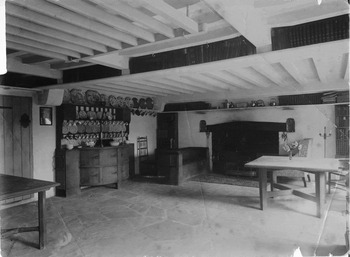
So then, can a room (or, for that matter, a person) be ascetic and Aesthetic at the same time? The answer might be yes under two provisions. First, with regard to interiors: as mentioned above, Pre-Raphaelite and Aesthetic homes had a history of featuring arts-and-crafts furniture, and therefore, the distinguishing lines between Aestheticism and arts and crafts do tend to blur. The oak settle in the Holdens’ home defines an Aesthetic interior as much as it does an arts-and-crafts one, even as the cottage's bare walls and the absence of signature decorative objects contest it. (For a representative simple interior, see Figure 10.) Second, Janet Ashbee's inclusion in her account of the telltale brown bread and bananas, with their countercultural, Simple-Life associations, points us to the more complex subject, the arena of lifestyle. A person might be aesthetic and ascetic only if we translate Wilde's idea of lifestyle choice beyond the parameters of more luxurious specimens of “material Aestheticism.” That is, while it may not be Aesthetic with a capital A, any lifestyle constitutes an aesthetic if it is deliberate and suits one's needs. The decision of one Whiteway settler, Francis Sedlak, to walk to London in the snow to deliver a pacifist manuscript rather than pay money into the government's postal system – and his choice to make the journey barefoot – comprised an aesthetic of his own, an earnest lifestyle choice (Thacker 49).
Sidney Barnsey's living room at Pinbury Park, Gloucestershire, c. 1897. Courtesy of the Edward Barnsley Educational Trust Archive.

This is a category of self-realization that Wilde suggested but never theorized on its own. Yet another resident of Whiteway did. Writing a diary entry in 1914, the Russian émigré Carmen Maurice recalled her time there as a small girl. In a broken English that both recalls and disrupts Morris's “lesser arts of life” and Wilde's “living one's life as art,” she wrote, “All [the] people were composed of most interesting personalities. . . . there were only no artist between them, well maybe there were some kind of artist of life, but what I mean, no artist of any beautiful art” (Thacker 24).