Worldwide, the incidence and impacts of disaster are growing. 1 , 2 Health system preparedness, especially in hospitals, is essential to manage the human impact of disasters.Reference Barbera, Yeatts and Macintyre 3 Hospitals are expected to deliver routine care while also adequately fulfilling the medical needs of casualties in the face of a disaster, both natural and man-made and which include social conflicts and riots.Reference Djalali, Castren and Khankeh 4 , Reference Lynn, Gurr and Memon 5
Evaluating hospital disaster preparedness is important in exposing potential gaps in the capability and capacity of health systems to guarantee a prompt, effective response during all crises.Reference Djalali, Castren and Khankeh 4 For this reason, the World Health Organization (WHO) has issued a standardized checklist for assessing the capacity of health facilities to respond during emergencies and disaster events.Reference Sorensen, Zane and Wante 6
The Republic of Yemen, covering an area of nearly 528,000 km2, is a lower middle income country with a population of about 22 million. 7 , 8 In 2012, Yemen was ranked 160th of 186 countries on the Human Development Index (HDI), a measure of national development based on several dimensions of human welfare, including health services. 9 Over the past several decades, the country has worked to strengthen and improve its health care system; 10 however, public health services reach only about 67% of the population, with 42% of physicians concentrated in 4 governorates.Reference Al Serouri, Øvretveit and Al-Mudhwahi 11 Furthermore, important issues such as disaster preparedness and disaster risk reduction are being grossly underestimated. 12
Over the past 3 decades, the human impact of disasters in Yemen has not been as high as in other disaster-prone countries such as China, Iran, and Pakistan; however, Yemen remains a disaster-prone country facing risks of floods, landslides, and earthquakes. Over a 30-year time frame, the most destructive natural disaster in Yemen was the 1996 flood, which affected more than 200,000 people. 13 , 14 The country also faced 2 prominent civil crises: a war in 1994 and a civil revolution in 2011. 15 , 16 The latter event was characterized by a series of major protests and armed clashes in which hundreds of demonstrators were killed and thousands more injured. 16 Local hospitals were overwhelmed with causalities, with media and various unpublished reports showing that the health care system, with massive gaps in hospital preparedness, was ill-equipped to cope with the surge of patients.
During the interim of these events, health authorities failed to take necessary action to identify potential areas of hospital underperformance and to address these deficiencies by building on experiences gained from the civil crisis mismanagement. The present study aimed to evaluate the impact of the 2011 Yemeni revolution on hospitals by comparing the level of hospital preparedness in 2011 with that in 2013.
Methods
This was a comparative study that was first performed in September 2011 and then repeated in September 2013. All of the hospitals surveyed were located in Sana’a city, the capital of Yemen. Sana’a city was chosen because it is where most of the mass gatherings and violence occurred and where the large majority of health care facilities services are concentrated.
The main investigator visited each chosen hospital and conducted a face-to-face interview with a representative (mostly heads of emergency departments). The interview focused on all aspects of hospital disaster preparedness. Hospital affiliation and total number of beds were registered as background information. In both evaluations, the following factors were considered critical to hospital preparedness:
-
∙ Development of plans or procedures for disaster management,
-
∙ Development of disaster management training courses,
-
∙ Development of disaster management drills or exercises,
-
∙ Availability of hospital funding for the implementation of disaster management plans, and
-
∙ Availability of national or regional protocols or guidelines on hospital disaster management.
Survey Tool
Hospital disaster preparedness was evaluated by using the hospital emergency response checklist published by the WHO in 2011.Reference Sorensen, Zane and Wante 6 This checklist consists of 92 items structured around 9 main components that include (1) command and control, (2) communication, (3) safety and security, (4) triage, (5) surge capacity, (6) continuity of essential services, (7) human resources, (8) logistics and supply management, and (9) post-disaster recovery.Reference Sorensen, Zane and Wante 6
For each item, there are 3 levels of preparedness actions: (1) due for review, (2) in progress, and (3) completed.Reference Sorensen, Zane and Wante 6 These items were scored, with the experts’ consensus, as 0, 1, and 2, respectively. Possible scores ranged from 0 to 184. Finally, based on the experts’ consensus, the overall level of hospital preparedness was classified as unacceptable (0-64), insufficient (65-129), or effective (130-184).
Ethical Issues
Permission to do this study was obtained from the authorities in charge of all selected health facilities. As recommended by WHO standards, the interviewees were assured confidentiality of their data, and all hospital names and data on safety and usage were kept confidential.
Results
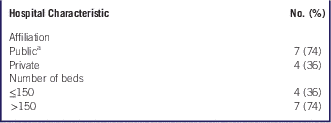
The evaluation checklist request was sent to 14 hospitals but only 11 hospitals (79%) agreed to participate. Of these, 7 were public hospitals, and 4 hospitals were categorized as small with hospital beds numbering less than 150 (Table 1).
Background of 11 Chosen Hospitals in Sana’a city, Yemen, Evaluated With Respect to Disaster Preparedness

a In this study, university and military hospitals were considered public hospitals.
In the period between the 2 evaluations, and despite having experienced a sudden surge of casualties during the revolution, none of the hospitals had implemented training courses on disaster management for managers, professional staff, or other essential personnel; none had performed disaster management drills or exercises; and none had received funding for disaster management planning, developed plans for disaster management, or been issued national or regional protocols or guidelines from the government or other relevant organizations.
At the first evaluation of the preparedness score, of 11 participating hospitals, 7 were rated “unacceptable” and 4 were rated “insufficient.” At the second evaluation, 5 hospitals were rated “unacceptable,” 3 “insufficient,” and only 1 “effective.”
On average, the mean (±SD) preparedness score of hospitals in Sana’a city was 52.46±28.01 (range, 10-98) at the first evaluation and 69.18±35.02 (range, 9-134) at the second evaluation (Figure 1).
Disaster Preparedness Scores of 11 Chosen Hospitals in Sana’a city, Yemen, Evaluated in September 2011 and September 2013. The reference hospital is a hospital that has completed all recommended actions (Hospital Emergency Response ChecklistReference Sorensen, Zane and Wante 6 ).

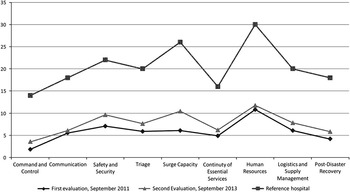
On both occasions, all preparedness elements in the checklist scored poorly and showed only minimal improvement in the second evaluation. The highest preparedness score was for Human Resources and Safety and Security in the first and second evaluations, respectively (Figure 2).
Average Score of Disaster Preparedness of 9 Essential Elements at 11 Chosen Hospitals in Sana’a city, Yemen, Evaluated in September 2011 and September 2013. The reference hospital is a hospital that has completed all recommended actions (Hospital Emergency Response ChecklistReference Sorensen, Zane and Wante 6 ).

Discussion
This study, which was based on the results of the WHO checklist evaluation, identifies that, despite the sudden surge of casualties during the 2011 revolution, hospitals in Sana’a city have remained ill-equipped to meet the challenges of unfolding disasters and crisis events. While Yemen is making some progress in this regard, it is slow-going and hard-coming. Unfortunately, the progress to date will not lead to appreciable changes in outcomes in casualty care.
Yemen is a disaster-prone country, with floods being the main natural hazard. 13 , 14 Over the past 3 decades, the human impact of disasters was estimated at less than 1000 deaths; 14 however, 2 huge civil conflicts left thousands killed or injured in this country. 15 , 16 In the 2 years after the revolution, all evaluated hospitals still had either an unacceptable or an insufficient level of preparedness. Other studies from disaster-prone countries also show a lack of hospital preparedness despite widespread disasters such as earthquakes and tsunamis.Reference Djalali, Castren and Khankeh 4 , Reference Fuady, Pakasi and Mansyur 17 - Reference Top, Gider and Tas 19 It is a tragic outcome that health systems in many disaster-prone countries, not just in Yemen, seem incapable of learning from past experiences, which suggests that a severe mismatch in the knowledge base of decision-makers exists in the relationship between the risk of disasters and prevention through improved hospital preparedness.Reference Djalali, Castren and Khankeh 4 , Reference Djalali, Ardalan and Ohlen 20 However, before we rush to place blame on any one factor, more concerted studies of the social and cultural anthropology, economics, and political governance, to name but a few, must be explored in depth to better understand the causality and motivations that have prevented the needed improvements, especially in developing countries.
For Yemen, recent events should sound an alarm for the health system and for hospitals in particular to think forward and implement a comprehensive disaster management plan. It is imperative that all hospitals in Sana’a city identify gaps and weaknesses in their response to the rapidly increasing influx of casualties and develop new strategies and actions to enhance the level of preparedness. Likewise, governmental health authorities must bear the responsibility of providing all the funding, guidelines, and training required to meet that demand.
A prompt and effective hospital response during disasters can only arise from a viable, well thought out disaster strategy, one that brings together all components of disaster planning (ie, command and control, operational plan, surge capacity, critical services, and essential resources).Reference Llanes-Burón, Rivada-Vazquez and Cruz-Vega 21 - Reference Djalali, Carenzo and Ragazzoni 23 Major civil unrest also requires that hospitals be able to carry out triage, trauma care, and decontamination of riot control agents.Reference Ballantyne 24 Careful attention should also be paid to command, coordination, communication, safety and security, and availability of required equipment and medications.Reference Ballantyne 24
The study results also expose the frailty of hospital preparedness in Sana’a city, especially with reference to command and control, which received the lowest scores in both evaluations. The command and control system of a hospital is key to timely and successful action, with overall emergency response performance and outcome depending on it.Reference Kaji, Langford and Lewis 25 , Reference Djalali, Castren and Hosseinijenab 26 Therefore, the first step should be to set up a disaster committee and incident command system aimed at enhancing the preparedness level of hospitals and facilitating all emergency management operations.Reference Keim 27 , Reference Arnold, Paturas and Rodoplu 28
Communication is another essential component in dire need of improvement. Communication breakdown is a major challenge during disasters and can seriously affect the capacity of the system to respond.Reference Keim 27 , Reference Matsumoto, Motomura and Hara 29 , Reference Ozoilo, Pam and Yiltok 30 Sana’a hospitals need to outline a communications plan, which should also include the availability of backup systems, and to enable a reliable exchange of information with internal and external partners during all disasters. These communications links are most vulnerable to fail when a collapse of governance occurs, which is more likely to happen in a major civil unrest. In planning for these potential events, it must be ensured that emergency health communications within the health system itself and between hospitals be kept intact.
Current data also show that the studied hospitals in the Yemeni capital failed to meet safety and security standards, and therefore are at a higher risk of poorer outcomes than what otherwise would be expected during any disaster. The ability to provide an effective response is largely dependent on hospital resiliency and overall level of safety (eg, structural, nonstructural, and functional).Reference Djalali, Castren and Khankeh 4 , Reference Djalali, Ardalan and Ohlen 20 , Reference Llanes-Burón, Rivada-Vazquez and Cruz-Vega 21 , Reference Achour 31 Security is also an essential part of the incident command system. 32 Hospital administrators must work to improve this aspect of emergency preparedness and benchmark current performance against existing standardized international guidelines.
Triage needs to be better organized, by individual hospitals in Sana’a and between them, to ensure adequate management of service demand when disaster strikes and the potential for transfer of patients from one hospital to another as part of a coordinated health system triage management process. In particular, each hospital should implement a triage plan with emphasis on providing triage space, trained medical personnel, and all necessary resources.Reference Lynn, Gurr and Memon 5 , Reference Roccaforte and Cushman 33 It is also important that health authorities introduce a standardized protocol so as to overcome the variability in existing triage methods and procedures. This may enhance hospitals’ response performance and improve the clinical outcomes of casualties.
Surge capacity, including human resources and supply management, is another crucial component of hospital preparedness.Reference Barbisch and Koenig 34 Hospitals are expected to handle a sudden increase in patient volume without external aid for up to 96 hours,Reference Hick, Barbera and Kelen 35 , Reference Kelen, McCarthy and Kraus 36 bearing in mind that the maximal surge capacity of a hospital is reasonably 20% of the total number of registered beds.Reference Lynn, Gurr and Memon 5 Ensuring availability of extra beds, manpower, and supplies is therefore paramount. Despite the importance of surge capacity, this remained a poorly implemented aspect of disaster planning in Sana’a hospitals in both evaluations, meaning that most hospitals in the capital city of Yemen may not be able to effectively function in a surge capacity situation. Again, a comprehensive strategy is needed with particular focus on medical equipment and availability of called-in personnel.
A well-developed hospital disaster plan should also make provisions for essential services, such as water, sanitation, electricity, and oxygen. Current results show that Sana’a city hospitals are deficient in this regard. This is a situation common to other countries and increases the risk of either functional collapse or hospital evacuation during disasters.Reference Djalali, Ardalan and Ohlen 20 , Reference Gray and Hebert 37 - Reference Achour, Miyajima and Kitaura 39 Health care facilities are expected to rely on their own essential services for 3 to 4 days without external support during a disaster. Therefore, not only should hospital administrators in Sana’a work on a plan for upcoming needs, but they also should ensure that all essential lifelines and services are inspected regularly.
The last stage in the disaster management cycle is recovery. This goes beyond restoring pre-disaster functioning conditions and involves corrective measures to improve the system as a whole. The study data suggest that none of the hospitals evaluated had a disaster recovery plan, and again this is a deficiency that Yemen shares with other countries.Reference Stander, Wallis and Smith 40 , Reference Zhong, Hou and Clark 41 Sana’a city hospitals may draw on recent experience to explore ways in which the system recovery may be improved. This must be part of a comprehensive hospital disaster plan and a gap-oriented disaster strategy, which also needs to secure funding to operate properly.
Whereas the main conclusion of this study was that no intervention was made by either national or regional health authorities or hospitals to improve hospital disaster preparedness, the study did not address why this was the case. Previous studies have suggested that underlying reasons may include lack of financial resources, standards, and guidelines and no comprehensive risk perception.Reference Barbera, Yeatts and Macintyre 3 , Reference Djalali, Castren and Khankeh 4 , Reference Sauer, McCarthy and Knebel 42 To these, we would add the absence of training programs. Training is a capacity-building process and also a key tier of hospital disaster preparedness. It is unrealistic to expect improvement in this regard unless competency-based courses are implemented.Reference Archer and Seynaeve 43 - Reference Ingrassia, Foletti and Djalali 45
In a country like Yemen, where disaster management planning always seems to be at an early stage of development, hospitals cannot be expected to set up a comprehensive disaster preparedness strategy by themselves. Health system authorities should take responsibility to issue strategic plans, as well as standards, data, guidelines, and procedures aimed at developing a standardized hospital action plan. Equally, there is great need to establish an integrated disaster management system that incorporates pre-hospital care that also promotes pre-hospital networking between hospitals. A detailed analysis of the current situation will also help Yemeni health authorities identify gaps and barriers to hospital resiliency and readiness, as well as strengths. This can be done by drawing on experiences gained from recent events and unrests and also by simulating relevant case studies.Reference Achour and Price 46
Limitations
This study relied entirely on self-evaluation and may contain perceptual bias. However, the study used a standardized checklist issued by the WHO that is specifically designed for self-assessment.
The fact that the interviews were repeated at a 2-year interval suggests that different people were involved in answering the survey. However, the same researcher performed the interviews and all respondents were hospital administrators or other key managerial personnel. The study also considered additional factors, such as new plans, guidelines, and training initiatives, that could affect hospital preparedness.
Owing to the small sample size (n=11) and limited geographical scope (only covering Sana’a city) of our sample, the results can hardly be deemed representative of the country at large. However, this study is the first carried out in Yemen to evaluate the trend of hospital disaster preparedness. It is assumed that other hospitals in Yemen are in a condition similar to, or possibly worse than, the capital city hospitals. Furthermore, the same evaluation method can be used to provide benchmarks for hospital preparedness. It is hoped that by outlining the evaluation method used to perform this analysis that other users will be able to evaluate and improve their own hospital preparedness.
Conclusions
Between 2011 and 2013, when the WHO checklist evaluations were conducted, no significant progress was made by Sana’a city hospitals with regard to hospital disaster preparedness. All important elements of hospital preparedness, such as command system, surge capacity, and safety, were poorly implemented or lacking critical organization. In a disaster-prone country like Yemen, the current situation calls for marked improvement. The health system must take responsibility for issuing strategic plans as well as standards, data, guidelines, and procedures to improve emergency response at all levels, especially hospital disaster preparedness. Public health authorities must implement an integrated disaster management plan that incorporates pre-hospital care providers and hospitals and also promotes networking between hospitals.
Acknowledgment
The authors appreciate all hospitals authorities and staff in Sana’a city, Yemen, who participated in this study, and the authorities and faculties of “European Master in Disaster Medicine” (EMDM), in which the research leading to these results was performed as a master thesis.