


Political parties channel citizens’ policy preferences (Sartori Reference Sartori1976) and elections motivate parties to respond to voters (Downs Reference Downs1957; Pitkin Reference Pitkin1967; Powell Reference Powell2000). Consistent with these claims, previous cross-national studies find that political parties do indeed respond to such domestic-level factors. While the median voter position is arguably the most important predictor (Adams et al. Reference Adams, Clark, Ezrow and Glasgow2004; Reference Adams, Clark, Ezrow and Glasgow2006; Budge et al. Reference Budge, Keman, McDonald and Pennings2012; Downs Reference Downs1957; Erikson et al. Reference Erikson, MacKuen and Stimson2002; McDonald and Budge Reference McDonald and Budge2005; Soroka and Wlezien Reference Soroka and Wlezien2010), it is also suggested that parties respond to rival parties’ policy positions in order to compete more effectively (Adams and Somer-Topcu Reference Adams and Somer-Topcu2009; Laver Reference Laver2005; Williams Reference Williams2015; Williams and Whitten Reference Williams and Whitten2015). We argue that, in their search for a party platform that is competitive in domestic elections, parties learn from and emulate parties that have succeeded in winning office in other countries. Focusing on the policies of foreign incumbents is a useful heuristic, helping parties to make complex decisions under bounded rationality. Thus, transnational links additionally help to explain the policy positions political parties adopt in order to compete. If policies diffuse between parties across national borders, our understanding of party competition will benefit from insights from the literature on policy diffusion (see Gilardi Reference Gilardi2010; Reference Gilardi, Carlsnaes, Risse and Simmons2012).
Conversely, our understanding of policy diffusion will benefit by recognizing the role of competition for office. If party platforms are influenced by those of foreign incumbents, and their platforms eventually influence policy,Footnote 1 a path is created along which policies can diffuse transnationally. The policy diffusion literature emphasizes that actors in one national context may be influenced by actors in other states if links between them exist (e.g., Elkins and Simmons Reference Elkins and Simmons2005; Franzese and Hays Reference Franzese and Hays2007; Reference Franzese and Hays2008; Gilardi Reference Gilardi2010; Reference Gilardi, Carlsnaes, Risse and Simmons2012; Most and Starr Reference Most and Starr1990; Plümper and Neumayer Reference Plümper and Neumayer2010; Simmons, Dobbin, and Garrett Reference Simmons, Dobbin and Garrett2003; Ward and Cao Reference Ward and Cao2012). Yet, it fails to consider the possible link created when parties learn from or emulate foreign incumbents so as to better compete for office. However, there is anecdotal evidence that this occurs.
Clinton's election in 1992 under the “New Democrat” banner influenced the electoral strategies of “New Labour” under Tony Blair in Britain in the mid-1990s. The party adopted tougher policies on crime and welfare policies that emphasized claimants’ responsibility to seek work (King and Wickham-Jones Reference King and Wickham-Jones1999; Peck and Theodore Reference Peck and Theodore2001), and the party successfully distanced itself from being considered fiscally irresponsible.Footnote 2 The interconnectedness of the successful election strategies employed by the New Democrats and New Labour illustrates how interparty diffusion preceded public-policy diffusion between the US and the UK in the 1990s (Dolowitz, Greenwold, and Marsh Reference Dolowitz, Greenwold and Marsh1999).Footnote 3 Anecdotal evidence also exists beyond the Anglo-American context, where common language matters: the German party Die Linke publicly announced after Syriza's electoral victory in Greece in January 2015 that it would take over some of their policies (Küpper Reference Küpper2015); it is well documented that there are close ties between Syriza and the Spanish party Podemos (Leistner Reference Leistner2015); and the German social-democratic party SPD recently hired Jim Messina, who was the campaign manager for Obama's successful 2012 re-election campaign (Pitzke Reference Pitzke2015).
Against this background, first, we develop our core argument that parties are likely to employ the heuristic of learning from and emulating foreign incumbent parties. We then evaluate whether parties respond to foreign parties—and under what conditions. Williams (Reference Williams2015; see also Williams and Whitten Reference Williams and Whitten2015) made pioneering use of spatial econometric techniques to study domestic party competition, pointing out that these methods enable us to control for interdependence of observations caused by the way parties react to each other. We extend this empirical approach by allowing for the influence of foreign party programs on domestic competition. We estimate a series of spatial lag models (see Franzese and Hays Reference Franzese and Hays2007; Reference Franzese and Hays2008; Hays, Kachi, and Franzese Reference Hays, Kachi and Franzese2010) using data on 26 established European democracies between 1977 and 2010. The results demonstrate that parties are indeed responsive to the policy positions of foreign parties that were recent incumbents. However, we do not find significant evidence for such an effect when the foreign incumbent belongs to the same ideological bloc. Our findings are robust across different model specifications (e.g., when including conditional effects or additional controls for domestic economic factors such as unemployment, economic growth, and inflation); across single and multiple spatial-temporal lag autoregressive (m-STAR) models (Hays, Kachi, and Franzese Reference Hays, Kachi and Franzese2010) estimated using OLS and maximum likelihood approaches; across alternative ways to address missing values; and while controlling for a number of “exogenous-external conditions or common shocks and spatially correlated unit level factors” (Franzese and Hays Reference Franzese and Hays2007: 142), which help us to rule out the possibility that what appears to be a diffusion process across party platforms is actually the result of common exposure.
This research has important implications for our understanding of parties’ election strategies and also for policy diffusion. Our conclusion is that parties respond to the policy positions of successful parties outside their domestic arena. This result contributes to the vast literature on parties’ election strategies that, thus far, only focuses on a number of domestic influences on parties’ policy positions (see, e.g., Alvarez, Nagler, and Bowler Reference Alvarez, Nagler and Bowler2000; Budge Reference Budge1994; Budge et al. Reference Budge, Crewe and Farlie2010; Dow Reference Dow2001; Reference Dow2011; Erikson and Romero Reference Erikson and Romero1990; Glasgow and Alvarez Reference Glasgow and Alvarez2005; Kedar Reference Kedar2005; Laver Reference Laver2005; Somer-Topcu Reference Somer-Topcu2009). It sheds new light on the external factors that affect the dynamics of competition for office and calls into question empirical results that do not control for diffusion of policy platforms across borders.
With respect to policy diffusion, this research makes two central contributions. First, while there is anecdotal evidence that parties borrow ideas from abroad (Dolowitz, Greenwold, and Marsh Reference Dolowitz, Greenwold and Marsh1999; Peck and Theodore Reference Peck and Theodore2001), our study is the first to provide systematic evidence. While many scholars, particularly on the welfare state, seek to understand how international factors (e.g., globalization) influence domestic public-policy outputs like tax rates and social spending, few explore how domestic political competition is affected (Kayser Reference Kayser2007).Footnote 4 The implication of our study is that an important mechanism for public policy diffusion is emulation and learning by political parties with a view to competing more successfully in domestic elections. That is, before policy is legislated and implemented, domestic electoral competition motivates parties to seek out policies from their successful foreign counterparts.
Second, the policy diffusion literature identifies multiple sources of diffusion, which include competition, learning and emulation, and coercion. Within this context, we show how mechanisms operating at the international and the domestic level combine to diffuse policies. Parties emulate and learn from parties abroad that recently were members of the government, presumably to better compete domestically. This is a direct cross-national diffusion path, where the motive for learning and emulation is office seeking. In addition, there is an indirect path. As part of domestic competition, parties are influenced by policies of their domestic competitors (Adams and Somer-Topcu Reference Adams and Somer-Topcu2009; Williams Reference Williams2015)—whose policies may have already been subject to influences from parties in other systems. Both of these party-to-party paths can lead to what at first sight may appear to be government-to-government policy diffusion. We identify transnational causal paths (Gilardi Reference Gilardi2010; Reference Gilardi, Carlsnaes, Risse and Simmons2012) leading to policy diffusion that combines learning and emulation at the international level and competition at the domestic level, and we show that the associated effects are statistically and substantively significant.
WHAT ARE THE DOMESTIC AND FOREIGN INFLUENCES ON PARTIES’ POLICY POSITIONS?
We assume that parties seek office; that they face uncertainty in elections and difficulty in calculating optimal strategies; and to cope, we argue they are likely to rely on heuristics. The policy-diffusion literature finds that learning and emulation occurs across national borders, which suggests that political parties may also consider what foreign parties do. While taking into account the influence of other domestic parties, we argue that office-seeking parties employ the heuristic of learning from and emulating the policies of successful parties abroad, i.e., foreign incumbents. In short, foreign office-holders serve as an available precedent for a party wishing to gain office.
In his work on party decision rules, Budge (Reference Budge1994, 445) suggests that party politics are “dominated by such radical uncertainty as to preclude precisely calculated risk taking and vote securing.” He points out that opinion polls may provide some guidance as to what issues the electorate finds important, but not necessarily whether policies will influence the way they vote. Also, the requirement to pitch policies with one eye to vote share and the other to the formation of coalition governments further complicates forming a successful election strategy. Past elections provide some relevant evidence, but their significance decays with time (Budge Reference Budge1994; Somer-Topcu Reference Somer-Topcu2009). It may be difficult for parties to know how much credibility with the electorate they will lose if they change position, and also how pressure groups and potential party donors may react (Somer-Topcu Reference Somer-Topcu2009). Besides uncertainty, parties face constraints on their ability to process information. Indeed, it may even be impossible for them to act in a manner in line with full strategic rationality. Roemer (Reference Roemer2001) shows that if the issue space has more than one dimension, there are generally no equilibria if parties are pure office seekers. Under these assumptions, Laver and Sergenti (Reference Laver and Sergenti2012) also demonstrate that it is impossible to derive analytic expressions for the best strategy a party can adopt given the locations of other parties.
In the face of uncertainty and constraints on rationality, it seems plausible that parties, just like other organizations and actors (Gigerenzer and Gaissmaier Reference Gigerenzer and Gaissmaier2011), will use heuristics to guide their choice of strategy. Bounded rationality and the use of heuristics (Gigerenzer and Gaissmaier Reference Gigerenzer and Gaissmaier2011; Simon Reference Simon1955; Tversky and Kahneman Reference Tversky, Kahneman, Tversky and Kahneman1982) have long been a subsidiary theme in the literature of party competition. Downs (Reference Downs1957) argues that, to economize on information, voters rely on broad considerations such as the left-right stance of parties when deciding for whom to vote. More recently, some have argued that parties also search for office under constraints of bounded rationality. Budge (Reference Budge1994), for example, contends that parties use their core ideology together with simple heuristic rules about when to move in the political space, in what direction, and how far.
Based on the insight that parties face uncertainty and constraints on rationality, the literature on computational and agent-based models of party competition suggests a number of heuristics for (re-)locating in the issue space (Fowler and Laver Reference Fowler and Laver2008; see also Bendor, Mookherjee, and Ray Reference Bendor, Mookherjee and Ray2005; Jackson Reference Jackson, Kollman, Miller and Page2003; Kollman, Miller, and Page Reference Kollman, Miller and Page1992; Reference Kollman, Miller and Page1998). One such heuristic is for a party encountering electoral losses to do a volte-face, but not directly back along its past trajectory (Laver and Sergenti Reference Laver and Sergenti2012).Footnote 5 Another heuristic is to adopt the best position you can, given where other parties are located, assuming they will not react to your change in strategy, i.e., to act in a parametrically rational way in what is actually a strategic context (Plümper and Martin Reference Plümper and Martin2008). Parties may also use simple heuristics to make inferences about relevant information. We suggest that parties also use heuristics to guide their search for relevant information from foreign incumbent parties.
The policy diffusion literature on transfer across national borders has generally conceived of learning and emulation taking place between governments or agencies (e.g., Dobbin, Simmons, and Garrett Reference Dobbin, Simmons and Garrett2007; Dolowitz and Marsh Reference Dolowitz and Marsh2000; Elkins and Simmons Reference Elkins and Simmons2005; Franzese and Hays Reference Franzese and Hays2008; Gilardi Reference Gilardi2010; Reference Gilardi, Carlsnaes, Risse and Simmons2012; Most and Starr Reference Most and Starr1990; Simmons, Dobbin, and Garrett Reference Simmons, Dobbin and Garrett2003; Reference Simmons, Dobbin and Garrett2006).Footnote 6 However, it is equally plausible that it could take place between parties. Parties might also rely on “the experience of others to estimate the likely consequences of policy change,” i.e. they learn (Gilardi Reference Gilardi, Carlsnaes, Risse and Simmons2012, 463; Meseguer Reference Meseguer2005, 72). Similarly, they might emulate in situations of uncertainty, copying the majority behavior of others inferring from “the sheer number of followers [. . .] that this might be the best thing to do” (Gilardi Reference Gilardi, Carlsnaes, Risse and Simmons2012: 466f; Holzinger and Knill Reference Holzinger and Knill2005, 784). A party may thus follow a “crowd abroad,” because it thinks that these other parties are better informed and might have analyzed a situation more carefully (see also Dolowitz, Greenwold, and Marsh Reference Dolowitz, Greenwold and Marsh1999).
The degree to which policy diffusion is a rational process is debated (Mesaguer Reference Meseguer2006; Peck Reference Peck2011). Looking at diffusion from a bounded rationality perspective, Weyland (Reference Weyland2005) in fact suggests that it may be guided by the use of cognitive heuristics (see also Jacoby Reference Jacoby2006), and emulating and learning may be “one of the simplest and most effective cognitive heuristics in the calculation of utilities” (Elkins and Simmons Reference Elkins and Simmons2005, 45). Various definitions of the term heuristics exist in the cognitive psychology literature (e.g., Gigerenzer and Gaissmaier Reference Gigerenzer and Gaissmaier2011), but Kahneman and Frederick's (Reference Kahneman, Frederick, Gilovich, Griffin and Kahneman2002, 53) approach seems particularly helpful here: “judgment is modified by a heuristic when an individual assesses a specified target attribute of judgment by substituting another property of that object—the heuristic attribute—which comes more readily to mind.” Parties constantly face difficult decisions under uncertainty, and they thus tend to use “cognitive shortcuts” by comparing their circumstances, preferences, and policies with others (Kahneman, Slovic, and Tversky Reference Kahneman, Slovic and Tversky1982; see also Rosenau Reference Rosenau1990). These “shortcuts” are essentially heuristics—shorthand guides to rational action that are prone to give reasonable results (Gale and Kariv Reference Gale and Kariv2003; Kahneman and Tversky Reference Kahneman and Tversky1979). The foreign party's success (or failure) may come more readily to mind than complex and uncertain calculations about the party's home domain. Therefore, a party strategist relying on whether a foreign party had succeeded to judge whether they would succeed if using the same program “at home” is employing a heuristic.
Parties typically frame success in terms of attaining office. While niche parties may be satisfied with electing members to the legislature, winning office is at the forefront of the minds of strategists of mainstream parties.Footnote 7 The way that success is conceived probably depends on the assessment of what is possible, setting a level of aspiration (Bendor et al. Reference Bendor, Diermeier, Siegel and Ting2011; Bendor, Mookherjee, and Ray Reference Bendor, Mookherjee and Ray2005; Budge Reference Budge1994; Simon Reference Simon1955): for some, it might mean forming a single-party (majority) government, but it could mean being a member of a coalition for others. Because the search for relevant information is primed by the predominant motive of office seeking, it is likely to focus on foreign parties that have achieved office. According to Tversky and Kahneman (Reference Tversky, Kahneman, Tversky and Kahneman1982, 164), “a person is said to employ the availability heuristic whenever he estimates frequency or probability by the ease with which instances or associations can be brought to mind.” That is, suppose party strategists try to assess the probability with which a certain policy will help them to win office. If they use the availability heuristic, this probability will increase with the number of instances they can recall when foreign incumbents successfully adopted this policy as part of their platforms. To answer the broader question of how likely it is to belong to the set of successful parties, strategists might then rely on the representativeness heuristic “in which the probabilities are evaluated by the degree to which A resembles B” (Tversky and Kahneman Reference Tversky and Kahneman1974, 1124)—here, this is the extent to which the party resembles foreign incumbents. Aspects that matter include how the party organizes its campaigning, the personalities of its leaders, and also the left-right stance (that we focus on here).
Consideration of availability and representativeness, both of which suggest that parties focus on foreign incumbents, are reinforced once we consider information flows about foreign parties. Incumbency is likely to be more important than vote share. While incumbency and votes are correlated, incumbency should be the more prominent consideration as incumbents receive substantially more media attention than opposition parties, even if these opposition parties received similar levels of popular support in the previous election (Green-Pedersen et al. Reference Green-Pedersen, Mortensen and Thesen2015; Hopmann et al. Reference Hopmann, de Vreese and Albæk2011; Schoenbacher et al. Reference Schoenbacher, de Ridder and Lauf2001; Semetko Reference Semetko1996). To see this argument clearly, consider junior coalition partners. For example, there are massive differences in media attention that the German Green party and the (Liberal) Free Democratic Party (each hovering roughly between 5 and 10 percent of the vote since the 1980s) receive when they are in office, compared to when they are not. Another example is given by the UK Liberal Democrats, and the boost in media attention that they received while they were part of the governing coalition in 2010–2015. In sum, considerations of the heuristics parties may use in conditions of bounded rationality suggest the following:
Foreign Incumbent Hypothesis: Political parties respond to the left-right position of political parties that were recently governing coalition members in foreign countries.
However, the “heuristics and biases research program” (Kahneman and Frederick Reference Kahneman, Frederick, Gilovich, Griffin and Kahneman2002) emphasizes that the use of heuristics can lead to poor decision-making, because it leads to relevant information being ignored (Adams et al. Reference Adams, Ezrow and Wlezien2015).Footnote 8 It is easy to see why learning from foreign incumbents could induce biases relative to best-response strategies (if calculable—see Laver and Sergenti Reference Laver and Sergenti2012), given the positions of other domestic parties and the views of the electorate. There is ample empirical and theoretical ground to believe that the search for office is the search for the political center ground. Parties have incentives to—and, in fact, do—react to the preferences of the median voter (Adams and Merrill Reference Adams and Merrill2009; Downs Reference Downs1957; Huber and Powell Reference Huber and Powell1994; McDonald and Budge Reference McDonald and Budge2005; Powell Reference Powell2000; Stimson, Mackuen, and Erikson Reference Stimson, Mackuen and Erikson1995).Footnote 9 Relying on information about the programs of foreign incumbents could lead to biases if the center grounds were very different across the two systems. Models of spatial competition, whether assuming bounded rationality or not, emphasize that parties must also allow for where others are placed in the political space. Adams (Reference Adams2001), Adams and Merrill (Reference Adams and Merrill2009), Adams and Somer-Topcu (Reference Adams and Somer-Topcu2009), and Williams (Reference Williams2015) present theoretical arguments and empirical evidence that policy-seeking parties in multiparty systems are responsive to other parties that are competing with them in elections. This effect applies to all rival parties and also, seemingly even more so, to parties near to them in the ideological space (ideologically proximate parties).Footnote 10 In turn, relying on information from a foreign incumbent could mislead, because the way that other parties are arrayed varies across systems. In fact, possible biases would be more worrying for parties if they just relied on foreign precedents; but, of course, they have multiple (though imperfect) sources of information such as opinion polls and focus groups.
These arguments suggest that parties are likely to temper their use of information about the programs of foreign incumbents by consideration of relevant contextual, conditioning factors. A number of factors have been suggested, including geographical and cultural proximity of two systems and their relative sizes, which might condition what economic policies would be successful. Another suggestion is that parties might focus on all foreign parties.Footnote 11
On the other hand, there are arguments to suggest that parties tend to learn from or emulate foreign incumbent parties of their own ideological bloc (for the domestic context, see Adams Reference Adams2001; Adams and Merrill Reference Adams and Merrill2009; Adams and Somer-Topcu Reference Adams and Somer-Topcu2009; Williams Reference Williams2015). Peck (Reference Peck2011) discusses the possibility of “normative pre-filtering,” whereby policy diffusion occurs between administrations with similar ideological stances. Related to this, if parties trade-off policy goals against electoral success (Wittman Reference Wittman1983), foreign parties with similar goals that succeed in winning office might seem particularly relevant precedents: because they appear to have successfully managed this tradeoff, learning from or emulating their policies might be a useful heuristic. Moreover party blocs regularly caucus in our empirical context of Europe, for instance, through the formalized party grouping in the European Union's parliament, so information may be readily available.
While these arguments resonate, the search for office often requires parties to adopt parts of the programs of domestic parties from other ideological blocs, as illustrated by the way some social democratic parties have adopted parts of the center-right's neo-liberal economic program. Heuristics can be conceived of as competing with one another in an evolutionary environment (Fowler and Laver Reference Fowler and Laver2008; Laver and Sergenti Reference Laver and Sergenti2012), where the use of successful heuristics spreads through “replicator dynamics” (Weibull Reference Weibull1995). At the transnational level, learning from or emulating foreign incumbent parties of the same ideological bloc may not be “ecologically rational” (Gigerenzer and Gaissmaier Reference Gigerenzer and Gaissmaier2011) in a population of heuristics where there is widespread learning or emulating from foreign incumbents. Although it is thus not clear on theoretical grounds whether learning from or emulating foreign incumbents of the same ideological bloc is likely to occur, we also test a second hypothesis:
Foreign Incumbent Ideology Hypothesis: Political parties respond to the left-right position of political parties of the same ideological bloc that were recently governing coalition members in foreign countries.
In sum, we argue that parties learn from or emulate the policies of foreign parties they regard as successful, because they face constraints on their ability to optimize their strategies for gaining office; and successful foreign parties then provide a useful heuristic for their own success. Possibly, this effect may be more marked with respect to incumbents in the same ideological bloc, although we do not regard this as necessarily plausible. Exploring the two hypotheses enhances our understanding of party competition, and if either hypothesis is supported it suggests that an important, but thus far underemphasized route for policy diffusion is from the programs of incumbent parties to parties in other systems.
RESEARCH DESIGN
Data and Dependent Variable
Based on existent sources, we compiled a data set on 215 political parties in 26 European democracies for the time period 1977–2010.Footnote 12 Observations are party-years. In the Supplementary Materials 1, we list the countries, years, and parties included in the empirical analyses.
Party positions and voter preferences are measured in terms of “left” and “right.” The left-right scale has three attractive qualities. First, it provides a common, well-understood language of policy preferences for which data are available both for party elites and masses. Second, more than any single issue, the left-right dimension seizes the primary bases of political competition across national settings (e.g., Huber and Powell Reference Huber and Powell1994; McDonald and Budge Reference McDonald and Budge2005; Powell Reference Powell2000). Finally, in established democracies, the substance of “left” and “right” aligns with preferences over the government's role in the economy and the distribution of income—issues which have ranked among the most salient to voters over the past decades (Huber and Inglehart Reference Huber and Inglehart1995; Warwick Reference Warwick2002).Footnote 13
We use the Comparative Manifestos Project (CMP) data on party positions (Budge et al. Reference Budge, Klingemann, Volkens, Bara and Tanenbaum2001; Klingemann et al. Reference Klingemann, Volkens, Bara, Budge and McDonald2006; Volkens et al. Reference Volkens, Lehmann, Merz, Regel and Werner2013). Since the content of party programs is often the result of intense intraparty debate, the CMP offers reliable and accurate statements about parties’ positions at the time of elections. These measures are consistent with those from other studies, such as variables based on expert placements, citizen perceptions of parties’ positions, and parliamentary-voting analyses (Hearl Reference Hearl, Budge, Klingemann, Volkens, Bara and Tanenbaum2001; Laver, Benoit, and Garry Reference Laver, Benoit and Garry2003; McDonald and Mendes Reference McDonald, Mendes, Budge, Klingemann, Volkens, Bara and Tanenbaum2001; see also Marks et al. Reference Marks, Hooghe, Steenbergen and Bakker2007). The additive measure of left-right ideological scores reported in the CMP ranges from −100 (extreme left) to +100 (extreme right). We recalibrated this scale so that it is consistent with the 1–10 median voter scale (discussed below).
The CMP only codes information for election years. Hence, party-policy positions for interelection periods are missing, and they are interpolated or imputed, as the spatial analysis we rely on requires yearly data for each country to capture learning and emulation in a plausible manner. The core models we report are based on data where each party's position between elections is assigned its value at the last election.Footnote 14
Methodology
We estimate a series of spatial temporal autoregressive models or “spatial lag models” (Franzese and Hays Reference Franzese and Hays2007; Reference Franzese and Hays2008), which are able to allow for dependence between observations due to strategic interaction between party positions driven by domestic competition (Williams Reference Williams2015; Williams and Whitten Reference Williams and Whitten2015)—and by transnational learning and emulation. In this context, a party's policy position at time t is modeled as a function of foreign incumbent parties’ policy positions at an earlier time e−1. A weighting matrix specifies the set of such parties and the relevant linkages between parties. With such a matrix, we can model party ties as conditional on whether a foreign party has been a member of a governing coalition. Accordingly, our spatial lag models are defined by
 $$\begin{equation}
{y_t}\; = \;\phi {y_{t - }}_1\; + \beta {X_{t - }}_1\; + \;\rho W{y_{e - }}_1\; + \;\varepsilon ,
\end{equation}$$
where yt is the dependent variable (Party Position at time t), yt− 1 signifies the (one year) temporally lagged dependent variable (Party Positiont− 1), Xt− 1 is a matrix of temporally lagged explanatory variables that we define below—Lagged Median Voter, Lagged Economic Globalization, a multiplicative term between the two variables, year- and party-fixed effects, and the constant—and εis the error term.Footnote 15
Wye −1 stands for the product of a connectivity matrix (W) and a temporally lagged dependent variable (ye− 1), i.e., Wye− 1 is a spatial lag and ρis the corresponding coefficient. When estimating spatial lags, we use the position of parties in the year before the last election held in their country before time t (accordingly, we use subscript e−1). In time-series cross-section analysis, the connectivity matrix W is given by a NT×NT matrix (with T N×N sub-matrices along the block diagonal) with an element wi,j capturing the relative connectivity of unit (party) j to unit (party) i and with wii = 0.Footnote 16 Some define the spatial lag using the temporally lagged values of the dependent variable (in our case Wye− 1) as under certain assumptions it justifies the use of spatial OLS (Ward and Gleditsch Reference Ward and Gleditsch2008). Here, our rationale is that it takes time for information about the positions of foreign (and also domestic) parties to influence positions. Specifically, since developing party manifestos is a “time-consuming process [. . .] which typically takes place over a two-three year period during which party-affiliated research departments and committees draft sections of this manuscript, which are then circulated for revisions and approval upward to party elites and downward to activists” (Adams and Somer-Topcu Reference Adams and Somer-Topcu2009, 832), we use parties’ policy positions of the year before the last election in their country when constructing spatial lags.Footnote 17
To illustrate this lag structure, assume that the political parties competing in the 2002 Dutch national election looked to the party position of the incumbent UK Labour Party. The previous interelection period in the UK was 1997–2001. Thus, given our assumptions, Dutch parties relied on the 1997 Labour Party position (a 5-year lag). The average lag for all spatial lags used for the analyses is 5.34 years (standard deviation = 1.68). Alternatively, if we assume linearly interpolated party-position values, Dutch parties would have used Labour's position in the year 2000, i.e., the lag would be two years. For linearly interpolated party-position values, the average lag is 2.67 years (standard deviation = 1.24). Empirical analyses based on linear interpolation do not affect our substantive conclusions.
The most common estimators for time-series cross-section spatial lag models are spatial ordinary least squares (S-OLS) and spatial maximum likelihood (S-ML) (Franzese and Hays Reference Franzese and Hays2007). We follow Williams (Reference Williams2015; see also Williams and Whitten Reference Williams and Whitten2015) who employs S-OLS, but our core findings are robust when re-estimating the models using S-ML (see Supplementary Materials 3). Finally, we must rule out the possibility of common exposure, i.e., spatial clustering that is not driven by interdependence between party positions and a genuine diffusion process. As concluded by Buhaug and Gleditsch (Reference Buhaug and Gleditsch2008, 216), this would constitute a “reverse Galton's problem,” i.e., “we would face a reverse Galton's problem if we try to evaluate evidence for spatial contagion without first considering relevant unit attributes that may be both spatially clustered and potentially related”—in our case to party policy positions. We control for such relevant alternative influences, i.e., “exogenous-external conditions or common shocks and spatially correlated unit level factors” (Franzese and Hays Reference Franzese and Hays2007, 142) by including a temporally lagged dependent variable that captures a party's policy position in the previous year, party-fixed effects, and year-fixed effects. Thus, we allow for the potential influence of parties’ past behavior on their current policy position. While including a temporally lagged dependent variable captures time dependencies more generally,Footnote 18 year-fixed effects control for temporal shocks that are common for all states in a given year (e.g., economic crises, EU accession rounds). Party-fixed effects capture any time-invariant unit-level (domestic) influences. The temporally lagged dependent variable, party-fixed effects, year-fixed effects, and the set of control variables (described below) credibly ensure that contagion “cannot be dismissed as a mere product of a clustering in similar [state] characteristics” (Buhaug and Gleditsch Reference Buhaug and Gleditsch2008, 230; see also Plümper and Neumayer Reference Plümper and Neumayer2010, 427). Put simply, obtaining a significant estimate for the spatial-lag coefficient while including these controls substantially increases the confidence in the existence of a true diffusion effect between parties.
Defining Spatial Linkages: Spatial Lags for Domestic Influences and Foreign Incumbents
For the operationalization of spatial dependencies, we rely on four distinct spatial lags—two at the domestic level that capture the competition between parties in the same system and function as controls and two other spatial lags that pertain to our hypotheses. In line with existing theory and evidence discussed above (Adams and Somer-Topcu Reference Adams and Somer-Topcu2009, 832; Williams Reference Williams2015), spatial lags at the domestic level are on the positions of all other parties and on the positions of members of the same ideological bloc. In contrast, due to different mechanisms (learning and emulation) at the international level, we do not examine analogous spatial lags to those at the domestic level, but follow our hypotheses: transnational spatial lags are on foreign parties that recently were members of the government and recent foreign incumbents of the same ideological bloc. Hence, at the domestic level, we use lags based on competition with all other parties or with members of the same ideological bloc. In contrast, at the cross-system level, the spatial lags are based on the idea of learning from and emulation of success.
First, Adams (Reference Adams2001), Adams and Merrill (Reference Adams and Merrill2009), and Adams and Somer-Topcu (Reference Adams and Somer-Topcu2009) suggest that parties are responsive to other parties that compete with them domestically, and particularly to those from the same ideological party bloc (e.g., Adams and Somer-Topcu Reference Adams and Somer-Topcu2009). We control for these domestic-level influences as we seek to replicate the findings in Adams and Somer-Topcu (Reference Adams and Somer-Topcu2009). Including these spatial variables also allows us to examine the second, indirect, path of policy diffusion (namely, parties are influenced by policies of their domestic competitors—whose policies may have already been influenced by foreign parties). To this end, we consider two different spatial lags. Each element wi,j of the underlying connectivity matrix for the first spatial lag (WyDomestic) receives a value of 1 if parties i and j compete in the same country. In the second (WyDomestic Bloc), the elements receive a value of 1 if two parties belong to the same ideological bloc and compete in the same country. The data for parties’ ideological bloc are based on the CMP's (Budge et al. Reference Budge, Klingemann, Volkens, Bara and Tanenbaum2001; Klingemann et al. Reference Klingemann, Volkens, Bara, Budge and McDonald2006; Volkens et al. Reference Volkens, Lehmann, Merz, Regel and Werner2013) classification of party families, which includes Communist, Green, Social-Democratic, Liberal, Christian-Democratic, Conservative, and Nationalist. Following the grouping of these families into ideological blocs as proposed by Adams and Somer-Topcu (Reference Adams and Somer-Topcu2009, 834), members of the Communist, Green, and Social-Democratic party families are coded as “left” ideological bloc; parties of the Conservative, Christian-Democratic, and Nationalist families are “right ideological bloc” parties; and liberal parties comprise the “centrist” ideological bloc.Footnote 19
Next, we define a spatial lag relevant to our first hypothesis. Each element wi,j of the underlying connectivity matrix for our third spatial lag (WyForeign Incumbent) receives a value of 1 if parties i and j are not based in the same country, and if j was part of the government (or the governing coalition) during the year before the last election in its own system before time t (0 otherwise). The data on incumbency status come from Döring and Manow (Reference Döring and Manow2012). Returning to the Dutch-UK example from above, the matrix entries for all dyads of (1) any Dutch party (i) with (2) Labour (j in this case) would have received the value of 1 in 2002.
The fourth and final spatial lag's (WyForeign Incumbent Bloc) connectivity matrix's elements receive a value of 1 if i and j belong to the same ideological bloc, are not based in the same country, and j was part of the government (or the governing coalition) in the year before the last election in its own system before time t (0 otherwise). We use the same codings of ideological blocs as at the domestic level. Returning to the Dutch-UK example from above, only the matrix entries for the dyads of (1) the Democrats 66, the Greens, the Labor Party (PvdA), and the Socialist Party (i) with (2) Labour (j in this case) would have received the value of 1 in 2002.
Initially, we introduce the spatial lags separately into our models. We also present results for m-STAR models (Hays, Kachi, and Franzese Reference Hays, Kachi and Franzese2010), which allow for a simultaneous inclusion of all spatial lags.Footnote 20 We expect a positive spatial coefficient ρ for all spatial lags. For theoretical reasons (Plümper and Neumayer Reference Plümper and Neumayer2010), we do not row-standardize the connectivity matrices. Row-standardization generates spatial lags that are a weighted average of the values of the dependent variable with weights dependent on the existence and strength of a postulated network tie between a pair of cases (Plümper and Neumayer Reference Plümper and Neumayer2010, 428f). The underlying theoretical assumption of row-standardization is that parties divide their attention across parties in proportion to perceptions of their relevance (see Plümper and Neumayer Reference Plümper and Neumayer2010). Williams (Reference Williams2015, 150; also see Williams, Seki, and Whitten Reference Williams, Seki and Whitten2015) argues, however, that row-standardization is not appropriate in the context of modeling party competition, because we would then assume that the total weight given to other parties’ positions will be the same no matter how many other parties the party under study has to pay attention to (see Plümper and Neumayer Reference Plümper and Neumayer2010, 430). Although the marginal value of additional information should decline as more and more other foreign incumbents can be emulated and are available to learn from, efficiency implies searching an additional source so long as expected gains exceed the cost; so total attention could go up. Thus, we do not row-standardize the two domestic or the two transnational connectivity matrices.
Control Variables
Beside the spatial lags, we consider a number of additional influences on party positions, following Adams and Somer-Topcu (Reference Adams and Somer-Topcu2009) and Ward, Ezrow, and Dorussen (Reference Ward, Ezrow and Dorussen2011).Footnote 21 First, we use Eurobarometer data to operationalize the position of the median voter (Schmitt and Scholtz Reference Schmitt and Scholz2005). Annual data on median voter preferences come from the Eurobarometer's survey item that asks respondents to place themselves on a left-right scale from 1 (left) to 10 (right). The Eurobarometer survey series has consistent country coverage of its member states since 1976. Spain and Portugal were not included in the surveys until 1981 and 1986, respectively; Austria, Finland, and Sweden enter the survey in 1995. We incorporate the lagged median-voter position into the empirical analysis.Footnote 22
Second, the degree to which a country is integrated in the global economy may affect parties’ positions, because they fear withdrawal of investment or short-term capital flows if they adopt certain policies (Ward, Ezrow, and Dorussen Reference Ward, Ezrow and Dorussen2011). We thus consider a lagged indicator for economic globalization, using the economic component of Dreher's (Reference Dreher2006) Globalization Index. The underlying indicators of this index pertain to a country's trade flows, portfolio and direct investment, tariff and invisible barriers to trade, and capital controls. After normalizing the indicators, the weights assigned to them are derived from first principal component analysis so that the index captures as much of the variation in the indicators as possible.
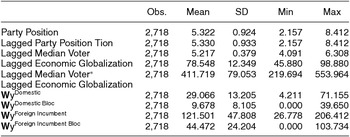
Finally, the effects of economic globalization on parties’ policy position may vary conditional on the median voter position (Ward, Ezrow, and Dorussen Reference Ward, Ezrow and Dorussen2011). We thus also include a multiplicative interaction term between Lagged Median Voter and Lagged Economic Globalization. Table 1 reports the descriptive statistics of the variables in our data.
Descriptive Statistics

Notes. The scale for Party Position has been recalibrated from the left-right estimates reported by the CMP to fit on the 1–10 median voter scale; all explanatory variables are based on one-year lags, but the spatial lags capture (foreign) parties’ policy positions of the year before the last election. The minimum values of 0 for WyDomestic Bloc and WyForeign Incumbent Bloc are explained by the fact that the lags refer to joint ideological bloc membership, and not all parties in our data have such bloc members either at the domestic level or abroad.
EMPIRICAL RESULTS
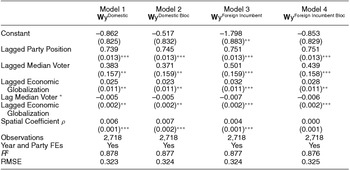
We begin with a replication of the findings in Adams and Somer-Topcu (Reference Adams and Somer-Topcu2009; see also Williams Reference Williams2015). Table 2 summarizes two models (Models 1 and 2) with one of the domestic spatial lags introduced separately in each model, while incorporating the explanatory variables (including fixed effects, which we omit from the presentation). Models 3 and 4 then focus on our hypotheses as we examine the impact of the foreign incumbent spatial lags. Because we do not row-standardize the underlying connectivity matrices, the coefficients of the spatial lags cannot be interpreted directly. In order to estimate the short-term impact, Plümper and Neumayer (Reference Plümper and Neumayer2010, 430f) suggest multiplying the coefficient of the spatial lag by the average number of neighbors, which then allows for a direct interpretation in the form of a marginal effect (Ward and Gleditsch Reference Ward and Gleditsch2008, 39). Here, all domestic/foreign parties or all domestic/foreign parties of the same ideological bloc are “neighbors” in this sense. The average number of neighbors is 5.37 for WyDomestic, 1.81 for WyDomestic Bloc, 22.30 for WyForeign Incumbent, and 8.32 for WyForeign Incumbent Bloc. Finally, due to the temporally lagged dependent variable, our coefficient estimates of the spatial lags (and all other explanatory variables) only reflect the short-term effect, i.e., the impact in a current year.Footnote 23 In order to estimate the asymptotic, long-term impact of a spatial lag, we consider the coefficient of the temporally lagged dependent variable by (Plümper, Troeger, and Manow Reference Plümper, Troeger and Manow2005, 336),
 $$\begin{equation}
\sum\limits_{t = 1}^T {\left( {\rho \sum\limits_j {{w_{ij}}{y_{je - 1}}} } \right)} \beta _0^{T - t}
\end{equation}$$
The Diffusion of Party Policy Positions—Single Spatial Lag Models (S-OLS)

Notes. Table entries are coefficients; standard errors in parentheses; year- and party-fixed effects included in all models, but omitted from presentation; the scale for party position (dependent variable) is recalibrated from the left-right estimates reported by the CMP to fit on the 1–10 median voter scale; all explanatory variables are one-year lags, but the spatial lags capture parties’ policy positions of the year before the last election.
* p < 0.10; ** p < 0.05; *** p < 0.01.
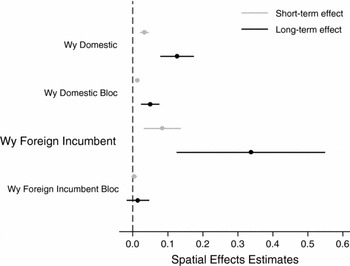
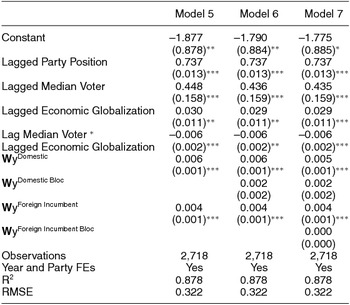
“where β0 is the coefficient of the lagged dependent variable, T is the number of periods with t denoting a single period” (Plümper and Neumayer Reference Plümper and Neumayer2010, 425), and i and j pertain to units (parties in a dyad). Accordingly, we estimate asymptotic long-term effects (in addition to short-term effects) for the spatial lag variables of Table 2 and summarize them in Figure 1. To demonstrate that our results are robust, we also present a series of m-STAR models based on S-OLS, which allow for a simultaneous inclusion of all spatial lags. The results are summarized in Table 3.
Short-Term and Asymptotic Long-Term Spatial Effects of Spatial-Lag Variables

The Diffusion of Party Policy Positions—Multiple Spatial Lag Models

Notes. Table entries are coefficients; standard errors in parentheses; year- and party-fixed effects included in all models, but omitted from presentation; the scale for party position (dependent variable) is recalibrated from the left-right estimates reported by the CMP to fit on the 1–10 median voter scale; all explanatory variables are one-year lags, but the spatial lags capture parties’ policy positions of the year before the last election.
* p<0.10; ** p<0.05; *** p<0.01.
The spatial lags in Models 1 and 2, WyDomestic and WyDomestic Bloc, are both positive and statistically significant. We are therefore able to replicate the findings in earlier studies (Adams and Somer-Topcu Reference Adams and Somer-Topcu2009; Williams Reference Williams2015): parties appear to respond to the left-right policy positions of their competitors at the domestic level and do so as well, perhaps even more strongly at least according to the coefficient estimate in Model 2, with regard to ideological bloc members.
The m-STAR models that simultaneously include both domestic-level spatial lags (Table 3) show that the effect of WyDomestic mirrors the estimated influence for this variable in Table 2; however, WyDomestic Bloc becomes statistically insignificant. Given the more conservative estimation strategy in Table 3, it thus seems that parties are more likely to respond to any party at the domestic level, not especially (or exclusively) to those in their ideological bloc.
Coming to our first hypothesis, in Table 2, the coefficient of WyForeign Incumbent is positively signed and statistically significant at conventional levels (Model 3). In Table 3, incorporating multiple spatial lags, the coefficient is always significant and similar in magnitude to Model 3, Table 2. The short-term effect for WyForeign Incumbent is 0.08. As previously described, it is calculated from its (rounded) coefficient of 0.004 multiplied by 22.30, which is the average number of neighbors for this spatial lag. The asymptotic long-term effect is 0.34, which is calculated using equation (2) described above. These estimates, 0.08 and 0.34, are statistically significant. In our data, the average party left-right policy position is 5.322. If all foreign incumbent parties adopt an average left-right position of 6.322 in the year before the last election, the effect on a focal party would be a rightward shift of 0.08 in the short-term and 0.34 in the long-term. Alternatively, when raising WyForeign Incumbent from one standard deviation below its mean to one standard deviation above its mean, Party Position increases by 0.36 in the short run (90 percent confidence interval in [0.167; 0.558]). Furthermore, according to Figure 1, WyForeign Incumbent has the largest coefficient estimates among all spatial lags, including the domestic ones, both in the short and long run, which indicates its substantive importance.Footnote 24 On first glance, it may seem surprising that the foreign-incumbent effect is larger than that of domestic parties. However, recall that we calculate the effects based on a given shift of all recent foreign incumbents—the relevant neighbors here. Generally, parties have many such foreign neighbors, and so the combined influence of foreign incumbents outweighs the influence of the generally smaller number of rival parties at the domestic level.
In relation to foreign incumbents, we find support for both direct and indirect paths of influence. While the foreign-incumbent spatial lag highlights that these parties affect domestic parties directly, a joint analysis of the domestic and foreign-parties spatial lags emphasizes that they also influence parties’ positions indirectly through their impact on other parties in the domestic system. Specifically, according to causal-path analysis (e.g., Lleras Reference Lleras and Kempf-Leopard2005), the effect of the indirect path is simply the product of the ρvalues in Table 3 Model 7. After taking into account the number of neighbors for WyDomestic and WyForeign Incumbent (Plümper and Neumayer Reference Plümper and Neumayer2010, 430f), i.e., those spatial lags that display consistently significant results in Table 3, the short-term indirect effect is approximately 0.003 = [(0.006*5.37)*(0.004*22.30)]. In total, the parameter estimates strongly support the Foreign Incumbent Hypothesis (directly and indirectly) that political parties’ policies are influenced by the policies of those parties that were recently governing coalition members in foreign countries.
In contrast to the empirical support for our first hypothesis, we do not find significant evidence for our second hypothesis. WyForeign Incumbent Bloc is neither significant in Model 4 nor in Model 7. Calculating short and long-term effects of this spatial lag in the same manner as above, we find that they are substantively small as well as being insignificant, as shown in Figure 1. The estimates on WyForeign Incumbent Bloc are consistent with studies by Bennett (Reference Bennett1991), Dobbin, Simmons, and Garrett (Reference Dobbin, Simmons and Garrett2007), Gilardi (Reference Gilardi, Carlsnaes, Risse and Simmons2012), or Lee and Strang (Reference Lee and Strang2006) who contend that it is primarily success of policies that matters for learning and emulation diffusion processes, while other influences (such as ideological similarity) are of lesser importance. In sum, joint ideological bloc membership could matter, but more likely at the domestic level than internationally.
The results concerning the control variables corroborate the findings reported in Ward, Ezrow, and Dorussen (Reference Ward, Ezrow and Dorussen2011) or Adams and Somer-Topcu (Reference Adams and Somer-Topcu2009), among others. There is evidence for a significant interaction effect between economic globalization and the median voter, so the rightward effect of globalization diminishes as the median voter is further to the right. We report the marginal effects of Lagged Economic Globalization conditional on Lagged Median Voter in the Supplementary Materials 3.
CONCLUSION
Our study extends earlier research on party competition and policy diffusion. The arguments and empirical analyses support the Foreign Incumbent Hypothesis that political parties respond to the left-right positions of political parties that recently were governing coalition members in foreign countries. Our theoretical arguments and empirical support for the Foreign Incumbent Hypothesis are relevant to parties’ election strategies (e.g., Alvarez, Nagler, and Bowler Reference Alvarez, Nagler and Bowler2000), because they imply that parties are motivated to learn from and emulate the policies of successful political parties in other countries.
There are several interesting questions to explore in future research. Based on this research and the analyses in the Supplementary Materials 2 and 3, many future studies will identify conditions under which party-policy diffusion effects are stronger or weaker. First, domestic factors may condition the influence of party-policy diffusion. It has been argued that coordinated market economies may dampen effects of economic globalization (Hall and Soskice Reference Hall and Soskice2001). If this applies and domestic politics are more insulated in these systems, then we might expect parties competing in these systems to be less influenced by parties in other political systems. It is also important to examine party policy diffusion by more specific issue areas such as immigration, the environment, or European integration. Although preliminary analyses in Supplementary Materials 3 suggest that emulating the policies of governing parties in other countries is an effective electoral strategy (see also Williams and Whitten Reference Williams and Whitten2015), this finding requires further exploration. Do parties tend to gain or lose incumbency when they emulate the policies of governing parties in foreign countries? Finally, although our sample includes some nonmainstream parties, the diffusion of party policies between niche parties exclusively is one interesting area to extend the framework of how parties’ policies diffuse that has been established in the study (e.g., is there party policy diffusion between far right parties in Europe?). We also suggest that qualitative studies of cross-national linkages between parties’ organizations and electoral campaigns will be crucial to triangulate the mechanism that we propose.
If the finding that parties respond to foreign incumbent parties is considered alongside the finding that the average party position in a political system influences government policy outputs (Kang and Powell Reference Kang and Powell2010; see also Budge et al. Reference Budge, Keman, McDonald and Pennings2012; McDonald and Budge Reference McDonald and Budge2005), this study becomes particularly relevant to the extensive literature on the diffusion of public policy outputs (e.g., Elkins and Simmons Reference Elkins and Simmons2005; Gilardi Reference Gilardi2010; Reference Gilardi, Carlsnaes, Risse and Simmons2012; Simmons, Dobbin, and Garrett Reference Simmons, Dobbin and Garrett2003). In particular, the two findings described above suggest that policy diffusion occurs, at least in part, through political parties responding to the policies of governing parties in other countries with a view to competing effectively at domestic level. Moreover, we found support for both direct and indirect paths of influence: foreign incumbents’ positions affect parties directly and they also affect them indirectly through their impact on other parties in the system. We conclude that governing parties abroad influence political parties at home.
SUPPLEMENTARY MATERIAL
To view supplementary material for this article, please visit http://dx.doi.org/10.1017/S0003055416000162.




Comments
No Comments have been published for this article.