




No CrossRef data available.
Vox Populi, Vox Dei, Vox Sagittae
Published online by Cambridge University Press: 25 April 2006
Extract
On April 19, 2005, after just four rounds of voting, the College ofCardinals announced that 78-year-old Cardinal Joseph Ratzinger hadbeen selected as the new pope. This announcement startled many. Tobe sure, as prefect of the Congregation for the Doctrine of theFaith for nearly a quarter of a century Ratzinger had helped selectthe vast majority of the cardinals who gathered to choose asuccessor to John Paul II, so his selection as pope could be seen asfulfillment of a simple quid pro quo. Even so, ithad been widely speculated that Ratzinger's conservative beliefswould spark passionate opposition among the electors and that hisage and reputed poor health would also work against him (Novak 2005).
Information
- Type
- FEATURES
- Information
- Copyright
- © 2006 The American Political Science Association
On April 19, 2005, after just four rounds of voting, the College of Cardinals announced that 78-year-old Cardinal Joseph Ratzinger had been selected as the new pope. This announcement startled many. To be sure, as prefect of the Congregation for the Doctrine of the Faith for nearly a quarter of a century Ratzinger had helped select the vast majority of the cardinals who gathered to choose a successor to John Paul II, so his selection as pope could be seen as fulfillment of a simple quid pro quo. Even so, it had been widely speculated that Ratzinger's conservative beliefs would spark passionate opposition among the electors and that his age and reputed poor health would also work against him (Novak 2005).
We will never know what really transpired in the Basilica Chapel. To ensure confidentiality, the chapel was scanned for electronic bugs, a system was activated to jam listening devices, and each cardinal swore, on pain of excommunication, to “observe absolute and perpetual secrecy … on all matters … related to the election of the Supreme Pontiff” (John Paul II 1996). For any participant to reveal what transpired during the conclave would have been a cardinal sin. Nevertheless, we can use what is known about the cardinals and the conclave to assess some plausible accounts, one of which, as we shall see, stands out above the others.
Officially, Ratzinger's selection was attributed to the will of God, a force not amenable to any empirical test that is in our power to conduct. The more immediate source of this outcome, however, was a factor about which political scientists can justifiably claim considerable expertise: the rules under which the election was held. Indeed, Pope John Paul II was certainly aware that these rules would shape the outcome of the election: otherwise there would have been no need for him to modify them.
On February 22, 1996, nearly a decade before Ratzinger's elevation to the papacy, John Paul II released the Apostolic Constitution, “Universi Dominici Gregis,” on the Vacancy of the Apostolic See and the Election of the Roman Pontiff. Since 1179, the rules governing papal succession have required a two-thirds majority of the cardinals, but John Paul II's new rules provided that after 30 rounds of voting a simple majority would suffice.3
John Paul II also expressly reaffirmed previous papal edicts “that the maximum number of cardinal electors must not exceed 120” and that cardinals who had celebrated their 80th birthday before the day when the Apostolic See became vacant would not be eligible to participate.
The strategic implication was clear: once a majority of cardinals emerged in support of a candidate, opposing candidacies would be doomed, for those in the majority could simply continue to vote for their favorite, secure in the knowledge that before long they would prevail (Tobin 2003). Nor, unlike the cardinals who had flocked to earlier conclaves, would they have to endure discomfort, deprivation, and indignity while they were waiting for developments to culminate in the puff of white smoke that betokens the election of a new pontiff (Allen 2002, 104). To ease the burden on the electors, John Paul II had a hotel-like facility built on the Vatican grounds, so during the 2005 conclave the cardinals were comfortably, even luxuriously, accommodated. Among other comforts, they feasted on chicken cordon bleu, wine, and ice cream—a far cry from Pope Gregory X's decree in 1274 that if the cardinals failed to select the Holy Father within eight days, their rations would be reduced to bread, water, and wine.
Notwithstanding the cardinals' vow of secrecy, press accounts indicated that in the first round of voting about 50 ballots were cast for Ratzinger (Rotella, Boudreaux, and Baum 2005), with several of the 115 participating cardinals apparently abstaining (Drudge Report 2005). In the second round, Ratzinger eked out a thin majority with 60 votes but fell short of the required supermajority. By the third round, Ratzinger's position had, according to the Vatican correspondent for La Repubblica, “become so strong that it was up to the other electors … to give their votes to the most prestigious … candidate” (Rotella, Boudreaux, and Baum 2005). In the fourth round, many of the holdouts capitulated and Ratzinger secured 95 votes, well above the 77 that were needed prior to the 30th round. In effect, John Paul II's rule change had transformed the selection process into a quest for a simple majority and had thereby drastically diminished the probability of a deadlocked conclave. The question, then, is why John Paul II changed the rules in a way that may have proven instrumental in Ratzinger's selection.
A Strange Decision
John Paul II was by no means the first pope to use his authority to revise the voting rules,4
In recent times, Saint Pius, Pius XI, Pius XII, John XXIII, and Paul VI all issued revised voting regulations.
Canon 332 § 1 C.I.C.; Canon 44 § 1 C.C.E.O. [footnote 9 of the preamble to the Universi Domini Gregis]; note that election is supplemented by “episcopal consecration.”
To be sure, modern times have not witnessed a recurrence of those 12th-century schisms. Even so, it is well understood that dissensus among the electors could jeopardize the claim of the new pontiff to be the visible representation of the “unseen Pastor”6
Universi Domini Gregis, preamble.
Why, then, did John Paul II alter the supermajority requirement? To answer this question, we assume that the pope was perfectly rational in his decision to change the rule and we reconstruct explanations for his selection accordingly. Of course, our methodological approach requires us to accept something that even the Vatican would be unlikely to grant on this matter: papal infallibility.7
We also assume that we have correctly identified the only conceivable motives that the pope could have had for changing the voting rules. Thus, like many contemporary political scientists, we also assert authorial infallibility.
Protecting His Legacy?
One such idea, which is the core of the initial explanation, is that of self-interest. Applying a self-interest criterion, John Paul II would have promulgated majority rule out of a desire to protect his own legacy, i.e., to preserve his influence over the Church after his death. Although he had been naming new cardinals since 1979, many cardinals appointed by John XXIII or Paul VI were still active and would retain their voting rights until they turned 80.
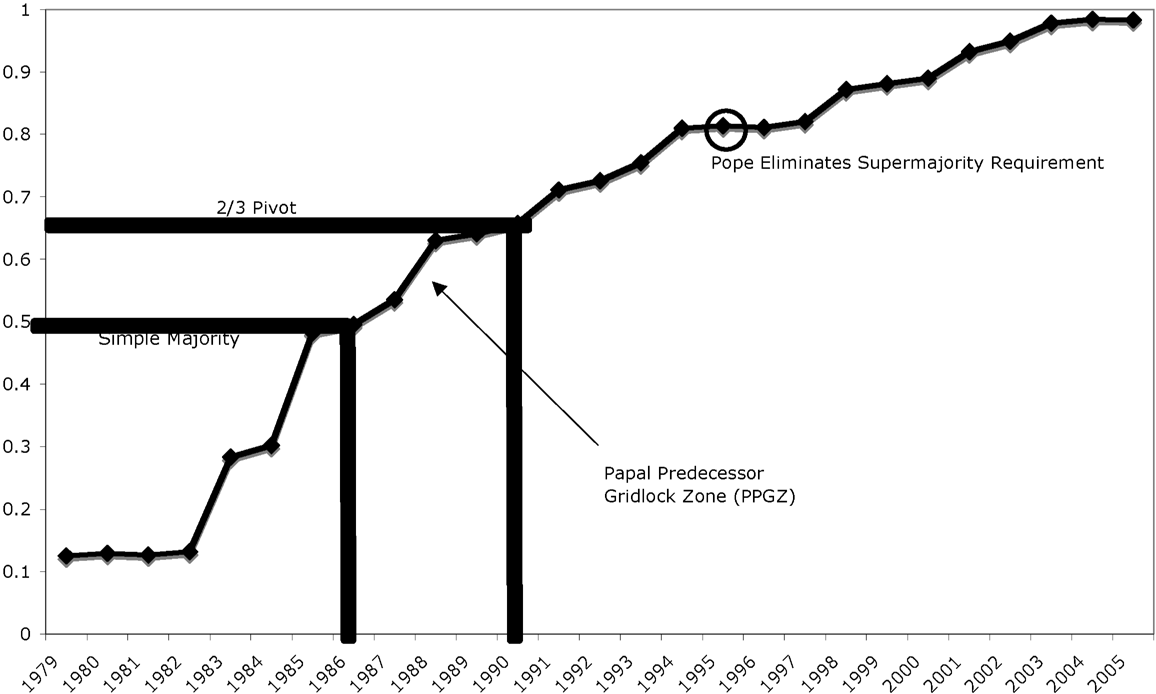
Under the rules that were in force when he assumed the papacy, John Paul II would have had to appoint two-thirds of the voting cardinals to guarantee that “his” cardinals could prevail if it came to a showdown over his successor. Given that there was a 120-cardinal cap on electors and that cardinals retained their voting rights until they either turned 80 or passed away, John Paul II must have recognized that it would take time until his appointees could control the outcome. If he were motivated by anxiety over whether his tenure would last that long (as well he might have been, having survived an assassination attempt in 1981), he should have changed the rule during the period after he had appointed a bare majority, but before he had appointed two-thirds, of cardinals. That period—the interval during which a candidate championed by John Paul II's appointees could have been blocked by a coalition of cardinals appointed by his predecessors—constitutes the Papal Predecessor Gridlock Zone (PPGZ). Alternatively, it is possible that the pope might have been able to anticipate the gridlock and thus enact his procedural reforms a few years ahead of time.
Figure 1 plots the yearly proportion of voting cardinals appointed by John Paul II.8
The figure draws upon data obtained from www.fiu.edu/∼mirandas/consistories-xx.htm. On a yearly basis, we determined which cardinals were eligible to vote. We deemed cardinals ineligible during the year in which they either died or turned 80. John Paul II announced his first consistory on June 30, 1979, when he named 15 cardinals. He elevated one other prelate to cardinal status at that time, but reserved his name in pectore (“in the heart”). This status is employed if the pope believes that the act of naming jeopardizes the prelate's ability to serve his mission. In 1991, the pope announced that Bishop Ignatius Kung Pin-Mei of China was this cardinal. For present purposes, we treat this person as a cardinal from the year of his selection, not of his naming. Another cardinal was chosen in pectore on October 21, 2003, but his name was never published.

Proportion of Cardinals Appointed by John Paul II
Protecting the Curia?
An alternative idea, which is the core of the second explanation, is that of group interest. Applying this criterion, John Paul II would have been motivated to change the supermajority rule in order to protect the existing Vatican power elite from the tumult that would likely ensue if the papal scepter were to pass into the hands of an out-group member.
If John Paul II were trying to maintain control of the Vatican in the hands of those with whom he had been most closely allied in the often fissiparous politics of the Church, the surest way to do so would have been to stack the deck so that his successor would be his close advisor and long-time member of the Vatican curia, Cardinal Ratzinger. Ratzinger himself seemed to bear out this interpretation when, two days after being named Supreme Pontiff, he reappointed the previous heads of the various Vatican departments (Williams 2005). It could not have escaped John Paul II's notice that Ratzinger would have to overcome considerable opposition to win the cardinals' blessing. Was it John Paul's apprehension that Ratzinger's opponents would muster the support of a third of the cardinals, thus blocking a Ratzinger papacy, that provoked the rule change?
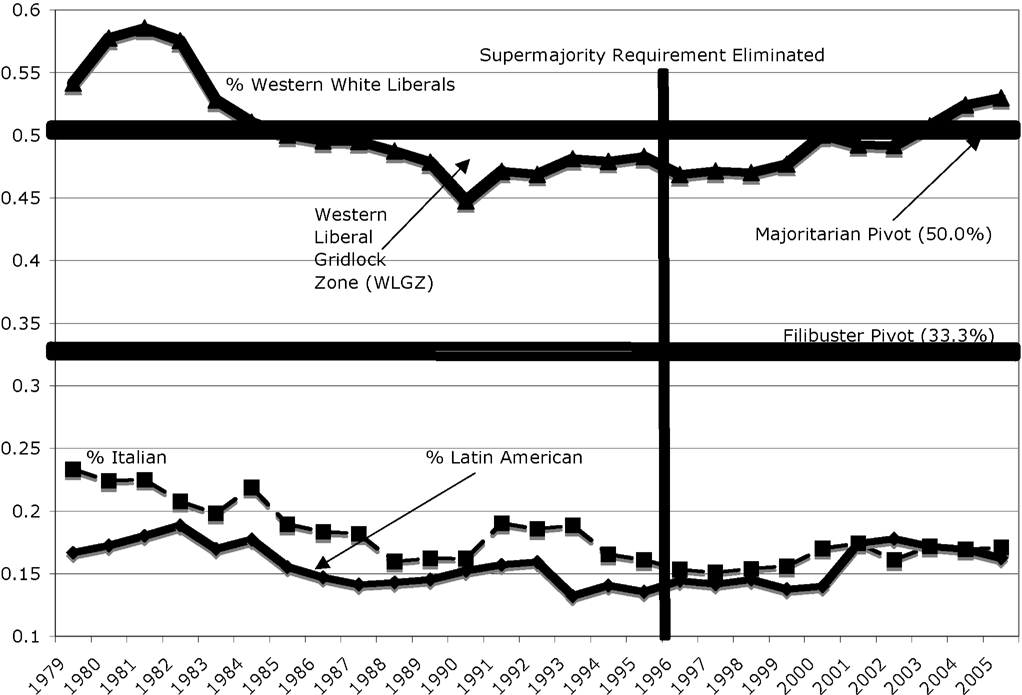
Opposition to Ratzinger seemed likely to come from Western liberals, repulsed by Ratzinger's role as an enforcer of Catholic orthodoxy. To gauge whether John Paul's rule change could plausibly be seen as an attempt to outflank these cardinals, we calculated the annual proportion of electors from Western Europe, the United States, Canada, Australia, and New Zealand.9
Of course, some Church conservatives (including both John Paul II and Ratzinger) hailed from this region. Thus, our operationalization overstates the voting power of the Western liberal bloc. We treated Cardinal Lubomyr Husar as Ukrainian rather than American because he renounced his U.S. citizenship after returning to Ukraine.

Capacity to Filibuster Ratzinger (proportion of cardinals by year)
Western liberals were not the only potential source of opposition to Ratzinger. For four and a half centuries prior to John Paul II, Italians had monopolized the papacy. Still smarting from the papacy of a Pole and anxious to regain the fisherman's ring when John Paul II's successor was named,10
During the conclave of 1377–1378, the crowd outside the conclave, exercised by fear that a non-Italian would be selected as the Bishop of Rome, “entered the Vatican itself, raiding pantries and threatening the cardinals that if they did not deliver a Roman they would be killed” (Catholic Online 2005). Eventually, the cardinals did elect an Italian, albeit not a cardinal, as Pope Urban VI. This pacified the crowd, but some cardinals argued that because they had acted under duress the election was illegitimate. They settled on another individual as the anti-pope. Although Urban VI was the last non-cardinal to be elected to the papacy, that possibility remains to this day.
When John Paul II was elected pope, Italian cardinals made up 24% of the college. At the time of his death, only 17% were Italians.
For accounts of Italians' difficulty in forming coalitions, see Sartori 1976; Mershon 2002.
Finally, there was also considerable speculation that in light of the hegemony of the Church in Latin America, a strong push would come from south of the U.S.-Mexican border. Thus, we singled out those cardinals who were from the Americas and resided south of the U.S.-Mexican border or in Puerto Rico. As can be seen in Figure 2, Latin American cardinals were never numerous enough to derail a Ratzinger candidacy.
All the evidence, then, points to the conclusion that John Paul II's decision to change the rules did not stem from a desire on his part simultaneously to ensure a Ratzinger papacy and protect the Vatican from the incursion of outsiders.
Fear of Encyclical Majorities
The third explanation, like the first two, treats the rule change as the application of a sound political science principle, but offers a different account of how John Paul II came to apply this principle, given his lack of training in our discipline.
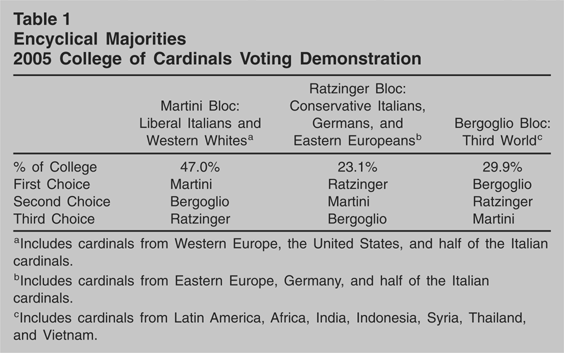
In introductory political science courses, students learn that aggregating voters' preference orderings across several alternatives can produce surprising results. A classic case in point is “Condorcet's paradox,” in which the aggregation of preference orderings that are individually transitive produces an intransitive result, which is commonly referred to as a “cyclical majority.” To illustrate, consider the three main coalitions that seem to have existed at the start of the 2005 papal conclave (Elie 2006), which formed around the candidacies of Cardinals Ratzinger, Carlo Maria Martini of Italy, and Jorge Mario Bergoglio of Argentina, respectively. We have no way of discerning cardinal preferences across the members of the three blocs, but in Table 1 we simulate the likely underlying preference orderings based upon the country of origin. This analysis indicates that if the cardinals, thus aligned, were rational and voted according to their true preferences, no candidate could have secured a majority of the votes, let alone a two-thirds majority. The result would have been a cyclical majority, which, given the context, we rechristen an encyclical majority. Under the old rules, the conclave would have deadlocked.
Encyclical Majorities 2005 College of Cardinals Voting Demonstration

Could John Paul II's rules change have stemmed from his understanding of encyclical majorities? The pope had good reason to fear the effects of cycles: following the death of Clement IV in 1268, neither the Italian nor the French faction of cardinals could attain the two-thirds majority necessary to elect a candidate, and deadlock persisted for nearly three years. Finally, the residents of the town of Viterbo removed the roof from the structure housing the cardinals and cut their provisions to bread and water. We can safely assume that this experience led Gregory X, who was elected three days later, to issue the aforementioned decree cutting rations after eight days. We might also expect that such a prolonged conclave would have cost the papacy dearly, both in material terms (including replacing the roof), and with respect to the legitimacy of the outcome, given the divisive nature of the deliberations and the absence of consensus about the rightful successor.
John Paul II, who was widely regarded as media-savvy, surely would have wished to avoid the spectacle of a prolonged conclave, which inevitably would have been accompanied by press speculation about division among the cardinals. As we have suggested, the legitimacy of the chosen successor may in part depend on the belief that his selection was relatively uncontested, or at least that the outcome did not result from a struggle for power.13
We suspect that the pope was probably more concerned with the fact that cycling would prolong the process than preclude the selection of a successor. Because many of the cardinals would not be viable candidates to be pope, the set of alternatives would be limited. Furthermore, the cardinal electors would inevitably realize that if the process broke down, the Church's hierarchy (and thus the value of their positions) would be de-legitimized. Even without the rule change, preferences may induce a determinative outcome. Cycles may be as rare in the Basilica Chapel as they are in the U.S. House.
The pope was by all accounts highly intelligent and well-educated—he had a doctorate in theology—but it is unlikely that he investigated Condorcet's paradox in any depth. Even so, we think there is strong reason to embrace the encyclical majorities explanation—reason embodied in the adage that “It's not what you know, but who you know.” John Paul II may not have studied political science seriously, but he did know someone who knew quite a lot of it, and he may have been able to draw on this person's guidance in applying the concept of encyclical majorities.
On January 1, 1994, two years before revising the voting rules, John Paul II established the Pontifical Academy of Social Sciences with the “aim of promoting the study and progress of the social, economic, political and juridical sciences, and of thus offering the Church those elements which she can use” (Vatican 2005b). According to John Paul II's decree, the Academy was to be composed of 20–40 members nominated by the Supreme Pontiff. One of the original pontifical academicians was the Nobel Prize-winning economist Kenneth J. Arrow. Arrow is best known for having proved the impossibility, given certain assumptions, of establishing a voting rule under which one alternative emerges as the most preferred—the so-called Arrow paradox, which amounts to a generalization of Condorcet's paradox (Arrow 1963). In order to ensure an outcome (i.e., to avoid (en)cyclical majorities), Arrow showed one must relax a basic condition on which voting is based. That, tellingly, is precisely what John Paul II did when he paired his relaxation of the supermajority requirement with a provision allowing the choice to be confined to the top two candidates from the previous round; the latter provision violated the prior requirement of unrestricted domain (a.k.a. “citizens' sovereignty”). Just two years later—just two years, that is, after naming to the Pontifical Academy the very social scientist who has thought most seriously about how to overcome cyclical majorities, and in the same year as the Academy held its first workshop on “democracy”—John Paul II changed the voting rules.14
Even if John Paul II had studied cycling at some point, the timing of the rule change nevertheless suggests that something had occurred to remind him of its potential risks.
Conclusion
The importance of institutions in structuring human life and decision-making cannot be overstated. Few institutions are more important than the guidelines employed in selecting the spiritual leader for over a billion people. Although the importance of such institutions is widely acknowledged, there is no consensus on their source. Usually, institutions associated with one's spiritual life are attributed to a supernatural force. It was revelations to Moses, Muhammad, and Joseph Smith that are the basis for three of the world's most important institutions (the Ten Commandments; the Koran; and the Book of Mormon).
While many attribute institutions to divinity, political scientists frequently attribute institutions to the rational calculations of pivotal figures. It is in this spirit that we have explored the elimination of the supermajority requirement for selecting the pope. Although we have no doubt that John Paul II had a preferred successor and we suspect that this successor is the current holder of the papal ring, we also do not doubt that John Paul II recognized that the legitimacy of the papacy depends in part on a relatively swift and harmonious selection process: that is, it is important that the cardinals appear to have easily identified the correct man, and not to have elected a compromise candidate after prolonged bargaining.
The timing of the pope's decision to empower a simple majority of the conclave suggests that his primary motive was neither to ensure a Ratzinger papacy nor to empower the cardinals he had selected. Instead, his decision stemmed from his discovery that social choice processes are frequently inconclusive. Is the appointment of the Pontifical Academy, and of one of its members in particular, a smoking gun? Perhaps not—but it is surely a flaming arrow.
Biographies
Forrest Maltzman is a professor of political science at George Washington University. He is the author of Competing Principals: Committees, Parties and the Organization of Congress (Michigan, 1997), and the co-author of Crafting Law on the U.S. Supreme Court (Cambridge, 2000).
Melissa Schwartzberg is an assistant professor of political science at George Washington University. She is the author of Democracy and Legal Change (Cambridge, forthcoming) and of “Athenian Democracy and Legal Change” (APSR, 2004).
Lee Sigelman is a Columbian College distinguished professor of political science at George Washington University and the editor of the American Political Science Review. He has written extensively on race, religion and politics, including Race and Politics (Cambridge, 2001) and Black Americans' Views of Racial Inequality (Cambridge, 1991).
Footnotes
The voice of the people is the voice of God is the voice ofArrow.
References
Allen, John L.
2002. Conclave: The Politics,
Personalities, and Process of the Next Papal Election.
New York: Random House.Google Scholar
Arrow, Kenneth J.
1963. Social Choice and Individual
Values, 2nd edition. New Haven,
CT: Yale University Press.Google Scholar
Catholic OnLine. 2005. “Unusual Conclaves.”
www.catholic.org.nz/pope/conclaves.htm,
accessed 5/12/2005.Google Scholar
Colomer, Josep M., and
Iain
McLean. 1998. “Electing Popes: Approval Balloting and
Qualified-Majority Rule.” Journal of
Interdisciplinary History
29: 1–22.Google Scholar
Drudge Report. 2005. “Ratzinger Won Final Balloting with 95 of 115
Votes.” www.drudgereportarchives.com/data/2005/04/24/20050424_132800_flash1.htm,
accessed 4/24/2005.Google Scholar
Fisher, Ian. 2005. “Pope Benedict XVI: The Decision; German
Cardinal is Chosen as Pope.” New York Times, April
20.Google Scholar
John Paul
II. 1996.
Apostolic Constitution, “Universi Dominici
Gregis,” on the Vacancy of the Apostolic See and the Election of
the Roman Pontiff. www.vatican.va/holy_father/john_paul_ii/apost_constitutions/documents/hf_jp-ii_apc_22021996_universi-dominici-gregis_en.html,
accessed 2/1/2006.Google Scholar
Klotz, Robert. 2004. “The Nuclear Option for
Stopping Filibusters.” PS: Political Science and
Politics
37: 843–846.Google Scholar
Mershon, Carol. 2002. The Costs of Coalitions.
Stanford, CA: Stanford University
Press.Google Scholar
Rotella, Sebastian,
Richard
Boudreaux, and Geraldine
Baum. 2005.
“Pope Benedict XVI: Groundswell Swept Ratzinger into
Office.” Los Angeles Times, April
21.Google Scholar
Sartori, Giovanni. 1976. Parties and Party Systems.
New York: Cambridge University
Press.Google Scholar
Tobin, Greg. 2003. Selecting the Pope: Uncovering the Mysteries
of Papal Elections. New York: Sterling
Publishing Company.Google Scholar
Vatican. 2005b.
“Motu Proprio, History and Aim of the Pontifical Academy of
Social Sciences.” www.vatican.va/roman_curia/pontifical_academies/acdscien/own/documents/rc_pa_acdscien_doc_09111999_history_social_en.html,
accessed 5/6/2005.Google Scholar
Williams, Daniel. 2005. “Benedict Reappoints Top Vatican
Officials.” Washington Post, April
22.Google Scholar
Proportion of Cardinals Appointed by John Paul II
Capacity to Filibuster Ratzinger (proportion of cardinals by year)
Encyclical Majorities 2005 College of Cardinals Voting Demonstration
 You have Access