Introduction
During the second Sino-Japanese War (1937 to 1945), many settlers from Japan were living in Northeastern China. That was because the Japanese government had promoted the settlement of Japanese people in the region, known as Manchuria, where Japan had created a puppet state, as a bulwark to defend against the Soviet Union and to strengthen Japan's control of the region. Moreover, sending farmers to Manchuria also served as a convenient solution to the ailing state of the rural economy in Japan.Footnote 1 The settlement of Japanese farmers in Manchuria began on a trial basis in 1932 and a 20-year project to settle one million Japanese farming households in the region was authorized as a national policy in 1936. As a result, by the end of the war in August 1945, around 270,000 Japanese people were settled in Manchuria, many near the Soviet-Manchuria border and other strategically important locations, such as areas along railways.Footnote 2 In the aftermath of Japan's defeat in 1945, many Japanese children living with their families in China became orphans, either because their parents had died or because they had been separated from their parents. Most of those orphans were children of farmers settled in Manchuria under the Japanese government's settlement project.Footnote 3 Around 3,000 Japanese orphans, aged twelve or younger, were adopted by Chinese families. As they were raised as children of Chinese families, the orphans missed the opportunity to return to Japan under the collective repatriation program that continued until 1958.Footnote 4 The orphans, although surviving under the care of Chinese families, were declared dead by the Japanese government and were removed from the Japanese family register system. As a result, they had to remain in China for more than three decades, and came to be known in Japan as “chugoku zanryu koji” (orphans left behind in China; hereinafter referred to as the “orphans”).
The normalization of diplomatic ties between Japan and China in 1972 was supposed to become a turning point that would pave the way for the orphans' return to Japan. However, the Japanese government did not take action toward repatriating them until 1981, as it maintained the position that the orphans' return was nothing more than a private matter for themselves and their families.Footnote 5 As the government continued to sit on its hands, some family members, including parents and siblings of the orphans, took the initiative in promoting repatriation. As a result of those people's efforts, a very small number of orphans had already returned to Japan by 1981, when the Japanese government started a repatriation program.
The government's repatriation program brought a total of 2,557 orphans back to Japan, but this was a long process that lasted for more than three decades, as shown in Figure 1. One factor that prolonged the process was a frequent revision of the repatriation policy. In the 16 years to 1997, the policy was revised nine times, with the repatriation criteria changed each time. At the start of the repatriation program in 1981, only orphans whose identity was confirmed and to whose repatriation their Japanese parents or other close relatives agreed were allowed to return to Japan. Only 243 orphans had returned to Japan by 1985, when the government responded to intense criticism of its restrictive repatriation policy by establishing a receiver system to enable orphans whose identity remained unclear to be repatriated. After the establishment of the receiver system, the number of returnees increased steeply, particularly between 1986 and 1991. A total of 1,537 orphans were repatriated to Japan between 1985 and 1993.Footnote 6
Number of Japanese war orphans repatriated from China by year.
Source: Zhang (Reference Zhang2017).

However, orphans whose identity was confirmed but to whose repatriation their Japanese parents did not agree still fell short of fulfilling the repatriation criteria. In 1989, the Japanese government established the special receiver system, under which persons other than the parents of orphans may serve as receivers, but this system hardly worked. In December 1993, the special receiver system was improved, and in April 1994, a new law was promulgated to help the orphans repatriated from China achieve independent lives. As a result, nearly half a century after the end of the war, the way was paved for repatriating all recognized orphans back from China. The enactment of a new law temporarily halted the downtrend, keeping the annual number of returnees flat for 5 years (1994–1998). In any case, it appears that most of the orphans who wanted to return were repatriated by the year 2000. The total number of orphans who returned to Japan since 1994 is 777.
As the orphans had already started their own families in China before the launch of the repatriation program, their repatriation entailed the immigration of their spouses and children.Footnote 7 In the case of the immigration of orphans' children, the Japanese government adopted a more strict policy than in the case of the return of orphans. At the same time, the policy was not fixed, but frequently changed. In principle, only spouses and unmarried children aged nineteen or younger were at first allowed to accompany orphans returning to Japan. If children who had already reached twenty at the time of their parents' repatriation were to immigrate to Japan, the families had to cover the expenses on their own. Moreover, the children would be allowed to come to Japan only after the repatriated parents settled down and achieved an independent life. In June 1994, the policy was revised to allow each returning orphan aged sixty-five or older to bring the family of one married child (as someone to look after the aged orphan) at government expense. The age threshold was lowered to sixty in April 1995 and to fifty-five in April 1997.
This article discusses the immigration and settlement process of orphans' children (“zanryu koji nisei” which means the “second generation”; hereinafter referred to as “nisei”). The analysis assumes that the settlement process varies depending on the life stage (age) at which nisei experienced immigration and that immigration has a significant long-term impact on their settlement.
Previous studies and theoretical framework
Review of previous studies
While the repatriation of orphans from China and their subsequent lives has attracted the attention of the mass media and researchers, Japanese society overlooked the presence of their children. With respect to nisei, “although there are bits of information, the full picture has hardly been clarified.”Footnote 8 The “bits of information” are related mainly to three issues: immigration motives, working life after immigration, and ethnic identity. As for immigration motives, it is clear that the material wealth of Japan provided a motive for nisei, offering the prospect that “wealth was within reach if I wanted it.”Footnote 9 In addition to these economic motives, there are also non-economic motives such as: “because my parents returned to Japan”; “for the purpose of improving skills”; and “I have strong feelings about Japan.”Footnote 10 In short, this study painted a picture of many nisei proactively seeking to immigrate to Japan. However, there were also passive motives, as pointed out by Shimono (Reference Shimono and Keiji1998): “Their parents happened to be Japanese and decided to return to Japan, so they had to come to Japan. That is what nisei feel.”Footnote 11 Asano and Tong (Reference Asano and Yan2020) pointed out that the immigration of nisei was largely determined by the repatriation policy of the Japanese government.Footnote 12
Regarding the working life of nisei after immigration, Komai (Reference Komai and Hiroshi1998) analyzed the employment situation from angles such as the means of finding a job, employment arrangement, and job-hopping. The study found that the popular means of finding a job included mediation by acquaintances and mediation by public employment offices. In the case of mediation by acquaintances, the employment arrangement tended to be non-regular employment. The majority of nisei surveyed had switched jobs at least twice until survey time. As indicated by other previous studies as well, many nisei (particularly those who came over to Japan at their own expense in the 1990s or later) failed to have their skills acknowledged and were relegated to the margins of the labor marketFootnote 13 unless they obtained qualifications in Japan by building on the vocational skills that they had cultivated in China while exploring how to adapt their lives to Japanese society.Footnote 14 Because of their age of immigration and the duration of time spent in Japan, nisei are a diverse group of people. Even so, “this great variety of people tend to be lumped together under the ‘nisei’ label.”Footnote 15 Therefore, Kong (Reference Kong2014) divided nisei into those who immigrated at government expense and those who did so at their own expense and analyzed each group's career path and working conditions. With respect to the career path, there was not a significant difference between the two groups in terms of the experience of switching jobs. As for the job type, those who immigrated at government expense tended to be engaging in clerical work as a regular employee or to be in a junior management position on a factory floor. On the other hand, those who immigrated at their own expense tended to be employed as a non-regular worker doing unskilled work. When it comes to working conditions, those who immigrated at their own expense were more likely to seriously suffer from problems such as low wages, overburdening, dirty or dangerous work, and discrimination. Asano and Tong (Reference Asano and Yan2021) concur that the labor and life conditions of nisei varied greatly depending on the immigration age.
With respect to ethnic identity, “many nisei have a positive attitude of seeking to become like a pure Japanese or a pure Chinese while avoiding full assimilation with either.”Footnote 16 Meanwhile, some nisei feel themselves to be a grey-area between Japanese and Chinese.Footnote 17 On the other hand, Zhang (Reference Zhang2011) found that some nisei have created a rich, multi-layered identity with no regard for nationality.
Correcting limitations in previous studies' viewpoints and methodology
Previous studies have three major limitations. First, they rarely consider the simultaneous progress of different courses of events at multiple levels – the individual, family, policy, and society. Second, few studies have collected or used primary-source documents. Third, they focused largely on the life experiences of the orphans and their children and failed to pay sufficient attention to the involvement of acquaintances, including “independence instructors,”Footnote 18 in their lives. Unfortunately, the blind spots created by these limitations become more pronounced in the case of immigrants who are in a special situation like the one that was faced by nisei in particular. It is essential to correct the abovementioned deficiencies.
Regarding the multi-level progress of time, the immigration and settlement of nisei involved pre-immigration processes, including preparing for immigration, and post-immigration processes, including learning, working and starting a family. On the other hand, immigration was not something that could be chosen by nisei themselves alone, but it involved their families' collective behavior. In other words, there were different courses of events for the first and second generations. However, those courses of events do not proceed independently of each other, but there were always intergenerational interactions. One concrete example is a change in family strategy. Moreover, changes in the government's repatriation policy and social changes in Japan and China since the late 1970s represent a course of events in the social context. The courses of events at the levels of the individual, family and society proceed simultaneously while mutually interacting.
The study of the settlement process of immigrants can be divided broadly into three categories – retrospective study, cross-sectional study, and prospective study. Especially, the principal characteristic of the prospective study is the use of follow-up surveys to continuously keep track of the settlement situation of immigrants. However, follow-up surveys on nisei that cover the decades until now were not conducted, as the immigration of nisei has become a research theme only in recent years. Therefore, it is essential to refer to primary-source documents (which can be used as follow-up survey data) that objectively describe the life experiences of nisei. In addition to their own accounts of their lives and primary-source documents, observations by supporters deeply involved in their settlement process are also important.
Theoretical framework: life course
The “life course” theoretical framework taken in this study works to overcome the three limitations discussed above. A life course is comprised of four factors – “location in time and place,” “linked lives,” “human agency,” and “timing of lives.”Footnote 19 “Location in time and place” refers to history, social structure and culture, while “linked lives” represents the results of individuals' interactions with social systems and groups.Footnote 20 Our lives are closely connected and are affected by the lives of other important people (particularly family members). Individuals' “human agency” itself undergoes developmental changes in accordance with the social environment. The timings of life events for individuals are outcomes of the interactions between their lives and these factors at three levels – at the macro-level (location in time and place), at the mezzo level (linked lives) and at the micro-level (human agency).Footnote 21
The immigration and settlement of nisei can be examined at these three levels. At the macro level, from the 1980s onward, the Japanese government revised its policy toward the repatriation and immigration of the orphans and their children, and over the same period, significant social changes occurred in Japan and China. The immigration of nisei occurred as a result of the interactions between their lives and those external factors. At the mezzo and micro levels, immigrant families faced different immigration and settlement challenges according to the timing of immigration, and the way of dealing with those challenges varied from family to family. Moreover, the strength of the human agency, or ability to adapt to changes in the social environment, of nisei is also presumed to vary across individuals. How did differences in the immigration timing affect the settlement process? Since their immigration, what challenges did nisei and their families face and what family strategies did they adopt? How were individuals' life transitions affected by immigration? These questions will be considered under the life course framework.
Survey and categorization of nisei
Overview of the surveys
This article is based on five datasets.
The first dataset includes interviews with 51 orphans over the 2 years from April 2015. I asked for the cooperation of four orphan support organizations in the Kanto region. They provided contact with all of the 77 orphans who were affiliated with them. Of these, 51 responded for the interview.
The second dataset includes surveys returned by 89 nisei. In March 2016, I sent a questionnaire to all of the Japan-resident 199 children (nisei) of the 77 orphans previously discussed. The questionnaire form was sent to nisei via the support organizations and was returned by mail after being filled in by nisei themselves. 89 were returned.
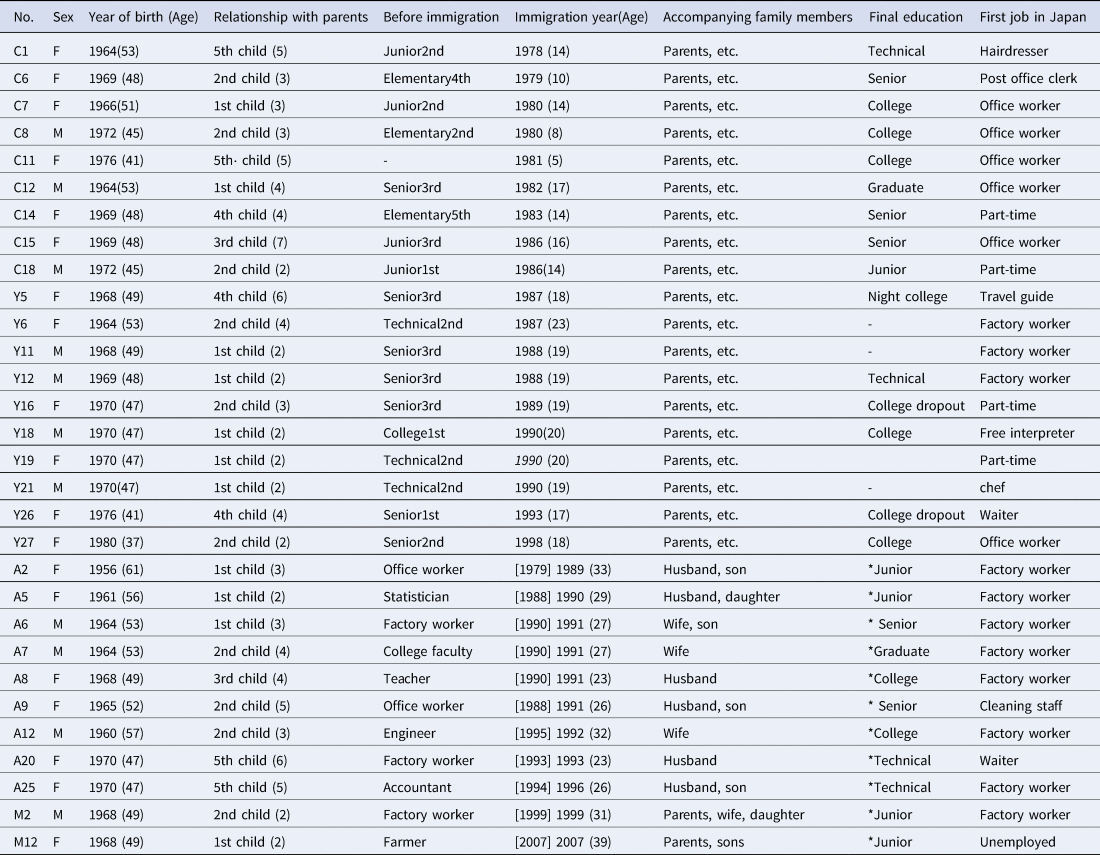
Of these 89 nisei who responded to the questionaire, 30 responded to invitations for interview. This interview data with 30 nisei is the third dataset. In the interviews, I checked on the life backgrounds of family members, one of the major items of the abovementioned questionnaire, and asked the interviewees to recount their lives after immigration. This interview is the primary data for discussion in this article. Table 1 shows the profiles of the 30 nisei interviewed.
The profiles of the 30 nisei interviewed (December 2017)

“Relationships with parents”: 2nd child (3) the number of nisei who immigrated to Japan in one orphan family is 3.
“Before immigration”: Junior2nd (Junior high school 2nd year), Senior3rd (Senior high school 3rd year).
“Immigration year (Age)”: [1979] 1989 (33) Repatriation year of orphan is 1979, while the immigration year of nisei is 1989.
“Final education”: Technical (Technical school in Japan), *Senior (Senior high school in China).
The fourth dataset is drawn from in-depth interviews with two persons who have been deeply involved in promoting the settlement of nisei. One of them is a former junior-high-school teacher (Supporter A) who had the experience of teaching more than 100 nisei. The other is a former “independence instructor” (Supporter B) who has supported orphans and their children for thirty years.
The fifth dataset is the information drawn from primary-source documents. Specifically, these documents include the Newsletter of the Kanagawa Association of Welfare Assistance for Returnees from China (referred to as the “Newsletter”) Vols. 1 to 109 (from 1982 to 2017),Footnote 22 81 issues of the Reports on Work Activities of Job Consultants (referred to as the “Reports”) (from 2001 to 2009),Footnote 23 and a teacher's diary (1984). These primary-source documents, which served as survey data, are useful for objectively describing the background circumstances of nisei.
Categorization of nisei
Nisei has been categorized, according to the age of immigration, into the following four groups for the purpose of analysis: the “child immigrant” group, the “adolescent immigrant” group, the “young adult immigrant” group, and the “elder adult immigrant” group. Of the 89 nisei surveyed, 73 (82.02%) were born between 1962 and 1972. Nisei is heavily concentrated in this narrow age range because most orphans were born between the late 1930s and the early 1940s and started a family in the 1960s. As a result, nisei may be considered to form a single cohort. On the other hand, the timing of immigration varies significantly across nisei due to frequent changes in the repatriation policy. Figure 2 shows the timing of the immigration of nisei. While more than 10,000 nisei are presumed to live in Japan, the government has not identified their exact number. As a result, the number of nisei in each group is unclear.
The immigration timing of nisei.

Group 1, child immigrant group
As shown in Figure 2, China's Great Cultural Revolution came to an end in 1976. The Revolution movement, which lasted more than 10 years, sapped China's strength as a state, significantly widening its economic gap with Japan, the latter of which achieved high growth during that period. It was against this historical background that the Japanese government started the repatriation program for the orphans in 1981. This group is mostly comprised of nisei who immigrated to Japan at government expense by the mid-1980s at the age of sixteen or younger.
Group 2, adolescent immigrant group
In the second half of the 1980s, the social environment changed drastically in Japan and China. Figure 2 shows that the shift to the reform and open-up policy proceeded in China, creating a wave of young Chinese people going abroad. Over the same period, Japan was in the midst of an economic bubble. In 1985, the receiver system was established. This enabled many orphans to be repatriated to Japan. This group is comprised of nisei who immigrated to Japan at government expense in the latter half of the 1980s at the age of between seventeen and nineteen. At the time of immigration, they were high school or university students, or had just started a working career.
Group 3, young adult immigrant group
In the late 1980s and later, many nisei aged twenty or older were unable to accompany their parents returning to Japan under the repatriation policy. Most people in this group immigrated in the 1990s at their own expense to be reunited with their parents. When they immigrated in their 20s, they abandoned their working careers in China.
Group 4, elder adult immigrant group
After the scope of support for nisei was expanded in 1997, orphans aged fifty-five or older were allowed to return to Japan together with the family of one married child at government expense. This group was comprised of nisei who experienced immigration in their 30 s or 40 s in the late 1990s, including both those who immigrated with their returning parents at government expense and those who came over later at their own expense to be reunited with the repatriated parents.
Immigration and settlement of nisei from a life course perspective
Child immigrant group
Figure 3 shows the immigration/repatriation timeline of the child immigrant group (hereinafter referred to as “children”) and their parents. The upper line represents the parents and the lower line represents the “children.”
The immigration/repatriation timing of the “children” and their parents.

The Great Cultural Revolution in China came to an end in 1976, and the Japan–China Peace and Friendship Treaty was concluded in 1978. These two historical events made it possible for the orphans to look for their parents at the individual level. In the late 1970s, the “children” were at school age. It was at that point in their life that the Japanese government launched the repatriation program for the orphans in 1981. The “children” encountered the launch of the repatriation program and experienced immigration when they were sixteen years old or younger, a sensitive age range.
At some time, the “children” were confronted with the fact that their parents were of Japanese descent, and they had no option but to accompany their returning parents. As the “children” were at school age, immigration was not an act of their own choice. In the case of C6, the parents' repatriation was authorized in 1978, and she came with her parents to Japan the following year (at age ten), wrongly assuming that this was “a temporary visit” and expecting to return to China soon. C18, with his “excellent” academic achievement, was enrolled in a prestigious junior high school in China at age thirteen. However, the following year (at age fourteen), he unwittingly boarded a ship bound for Japan when his father took him for a “pleasure boat ride.”
With regard to the challenges and family strategy for immigration, “children” did not show an eagerness for immigration, and some even opposed their parents' decision to return to Japan. However, orphans decided to come with their families to Japan in the belief that they would be able to live a happy life. The main factor behind that decision was the significant advantages that Japan had over China in many fields, not least economically. While orphans made proactive efforts to adapt to the social environments in Japan and China, including the social structure and repatriation policy, the human agency of the “children” concerning the choice of immigration was weak. In other words, when deciding to return to Japan, orphans put their families' interest before their children's preferences, and the behavior of the “children” was fully integrated into the family strategy.
“Joining school marked the start not of a new life but of a series of shocks,” C15 recalled. This comment indicates that for the “children,” life in Japan was not happy as had been expected by their families before immigration. Over the 10-year period of the Great Cultural Revolution, education was in a state of total paralysis in China. The “children,” who immigrated to Japan immediately after the Great Cultural Revolution, naturally had low academic achievement, and as a result, in Japan, they “were in principle assigned to a school grade level one to two notches junior to the one corresponding to their age (Supporter A).” In the period until 1985, around 90% of the “children” across Japan were made to join schools that did not have a Japanese-language class for non-native speakers despite their lack of Japanese language proficiency.Footnote 24 Japanese society before the mid-1980s was not an inclusive one, and at schools placing emphasis on uniformity in particular, the “children” were required to use Japanese names in the classroom. According to a teacher's diary at Junior High School “N” at that time, twelve of the seventeen nisei attending the school in 1984 retained Chinese nationality but only two of them used their Chinese names in the classroom. All of the “children” interviewed replied that they had the experience of being told by teachers to use Japanese names. Another serious problem faced by the “children” was discrimination. In Japan, a wave of school violence peaked in the first half of the 1980s, particularly at junior high schools. The number of motorcycle gang members, including high-school children, also hit record highs at that time, fueling concerns over youth delinquency.Footnote 25 In particular, the “children,” who were struggling with a lack of language proficiency and had few friends, became easy targets of classroom bullying. Supporter A, who was a teacher at that time, described the situation of the “children” in the 1980s as follows:
I suppose that the children were in a mentally difficult situation. For example, there was a child who skipped ordinary classes and waited for time to pass while writing Chinese poems and words reminiscent of their hometown across the wall of a toilet stall. Another child who was unable to blend in among Japanese classmates ran away from school and hopped on a bus without any destination in mind, and continued to go to and fro on the same route with a commuter pass. … I came to think that supporting their families' lives is essential for maintaining a stable education environment for the children. (Supporter A)
After returning to Japan, the orphans faced difficulty finding a job due to their age and language problems. C11 described her family's life as “extremely poor” and recalled that “there was not enough food to eat.” According to C18, dozens of “children” at his school had no money to buy school gym uniforms, so they were given used uniforms by seniors or borrowed uniforms confiscated from delinquent students. The needy family life of the “children” increased their sense of isolation, adding to their other problems such as low academic achievement, a lack of language proficiency, pressure for assimilation and discrimination.
Just a few years after immigration, the “children” faced the challenge of passing senior high school exams under the same conditions as Japanese students. For example, at Kasai Junior High School, which was the only junior high school in Tokyo that had a Japanese class for non-native speakers, fifteen “children” wished to advance to senior high school in 1984, but only four of them managed to advance to full-time senior high school.Footnote 26 In contrast, more than 95% of the general population of junior high school graduates moved on to senior high school at that time.Footnote 27 C13 (who replied through a questionnaire survey, but who was not interviewed) who immigrated to Japan in 1983 (at age sixteen) failed to advance to senior high school and started working at an auto parts factory. According to Supporter A, most of the “children” who did not advance to senior high school found a factory job.
“Children” who were relatively young at the time of immigration, including C6, C7 and C8, tended to overcome the language and academic achievement problems at an early stage after joining Japanese school and succeeded in advancing to senior high school. “Children” who graduated from senior high school during the bubble economy era or who graduated from university in the 1990s had little difficulty finding a job. For example, C15 easily found a trade-related job before graduating from senior high school in 1990 (at age twenty-one).
As for the challenges for settlement and solutions, as Japan's preparedness to accept immigrants was inadequate in the 1980s, it continued to be difficult even for repatriated orphans of Japanese nationality to find a job until the second half of the 1980s. Moreover, the repatriated orphans continued to face serious risk of poverty until the mid-1990s. Although many “children” were integrated into the ordinary school education system soon after immigration, no special assistance was provided. In addition, the “children” encountered school violence and were exposed to excessive pressure for assimilation, but consulting with parents or teachers, which is an essential option for coping with such a situation, was hardly available for them. They continued to endure the situation until they graduated from senior high school or started a working career. In order to overcome critical problems such as their parents' difficulty in finding a job and their families' poverty, the “children” set priorities for their activities. Those who were relatively old, 16 years old or so, at the time of immigration, started working early in order to meet their parents' expectations. Among those who advanced to senior high school, more children started working after graduation than advanced to university. The human agency of the “children” developed in accordance with the social and family circumstances.
In the 1990s, the “children” started families. When thinking about marriage, many “children” themselves did not care about the nationality of their partner. However, taking into consideration their relationships with their parents, they tended to choose a Chinese partner. To find a partner, the “children” received help from their relatives and parents' acquaintances or used their own network of connections. C1 and four other “children” surveyed are examples. On the other hand, some “children” had a steady relationship with a Japanese, in contrast with immigrants of other ages (see below). However, marriage with a Japanese was opposed by the families on both sides in most cases. Since the 2000s, the “children” have steadily built their working careers and led stable lives.
Regarding the impact of immigration on life transitions, the “children” experienced immigration at a relatively young age, and they received education in Japan and steadily built working careers through various practical experiences. Compared with other groups, the “children” were able to build the foundation for their livelihood at the time of marriage.
Adolescent immigrant group
Figure 4 shows the immigration/repatriation timing of the adolescent immigrant group (hereinafter referred to as the “adolescents”) and their parents. The upper line represents the parents and the lower line represents the “adolescents.”
The immigration/repatriation timing of the “adolescents” and their parents.

The “adolescents” immigrated to Japan in the second half of the 1980s. They were under the age of twenty, and before starting to map out a life plan of their own. In the case of Y12, the parents' repatriation was authorized in 1987 (at age eighteen), just before graduating from senior high school. In the following year (at age nineteen), he had to immigrate with his parents to Japan before a career path decision was made. Recalling those days, Y12's mother (an orphan) said: “My son was just about to become twenty years old, which meant we had little time left if the whole family was to go over to Japan together. Therefore, we quickly decided to return to Japan.” For Y5, Y11, Y16, and Y21 as well, the parents' repatriation was authorized when they were at senior high school. As they were unable to concentrate on learning, they did not take university exams. Y18 had advanced to university in China in 1990 (at age nineteen), then he immigrated to Japan with his parents and younger sister later in the same year. Y18 recounted the circumstances of his immigration as follows:
Having entered university, I wanted to wait until my graduation. However, the greatest problem was that I would have lost the chance to come over at government expense after reaching the age of twenty. Although I regret having had to abandon learning, I was not forcibly brought to Japan but came over of my own will. … We initiated application procedures in 1988 and sent several letters to the Japanese government, but we did not receive a clear reply. (Y18)
As for the timing of immigration, in the latter half of the 1980s, Japan was in the midst of an economic bubble, and that presented attractive prospects for Chinese people to earn foreign currency. Around the same time, there was a wave of young Chinese people going to Japan to study. At that time, the parents of the “adolescents” were in their late 40 s, while the “adolescents” themselves were just about to reach twenty. Most “adolescents” were in senior high school or university. When it comes to the challenges and family strategy for immigration, the “adolescents” were abruptly confronted with a decision as to whether to immigrate to Japan when they encountered historic events that occurred in rapid succession (repatriation policy changes, Japan's bubble economy, and a wave of young Chinese people going abroad) in the second half of the 1980s. Their choice was significantly impacted by the age limit imposed on the immigration of nisei in particular. Before considering why they should immigrate, the families developed the strategy of enabling the “adolescents” to immigrate to Japan before reaching the age limit of twenty so that the separation of the parents and children could be avoided. Many “adolescents” had already quit senior high school or university when their parents applied for repatriation. However, as Japan's preparedness to accept the orphans' families was inadequate, there was a waiting time of more than 1 year before permission for return was granted. Although the orphans sent letters calling for early permission, there was no effective way of speeding up the process. After all, because of interactions between the various factors, a blank “gap” occurred in the life course of the “adolescents,” causing their career to be suspended until immigration.
For the “adolescents,” who were senior-high-school or university students in China, it was extremely difficult to join senior high school mid-year after immigrating to Japan.Footnote 28 That was because “there was not a support program, so there was not any school willing to accept them.” “In most such cases, independence instructors chose to help them find a job (Supporter B).” Orphans who returned to Japan around 1990 were not necessarily accompanied by all their children. They had to leave children aged twenty or older, including the elder siblings of Y5, Y16 and Y26, behind in China. If the repatriated orphans were to later invite those left-behind children to join them in Japan, they had to first achieve independence in the country. However, as shown in Figure 4, the repatriated orphans were receiving public livelihood assistance (social security), and it was impossible to start living without the assistance within 1 year of returning to Japan.Footnote 29 In their needy family life, the “adolescents” had to achieve independence earlier than their parents. Some “adolescents” (Y11 and seven others) got engaged to a partner in China just before or after immigration and they chose to start working, rather than advancing to technical college or university, in order to prepare for married life in Japan. The following Newsletter article describes the situation of the “adolescents” around 1990. This indicates that the “adolescents” started their life in Japan in a pressed-for-time situation.
After completing the settlement procedures, nisei tend to choose the path of earning day to day although they have ample time to learn. Amid the labor shortage in Japan, the prospect of earning high wages by doing nighttime jobs or other work is alluring for the young. Nisei are eager to earn money and invite their betrotheds from China early. That is true of both men and women.Footnote 30
Most “adolescents” got married to Chinese partners or fellow “adolescents.” That was because the adolescents' circles of association were small. In 1990 and later, the Newsletters carried many articles about nisei going to China in order to look for a bride or a bridegroom.Footnote 31 Y11 married a Chinese woman in China in 1991 (at age twenty-three) and brought his wife to Japan. “Naturally, my wife did not understand Japanese at all, so I got her a job at the factory where I was working part-time,” he said. Y16 came to Japan in 1989 (at age nineteen) after graduating from senior high school in China and enrolled in a technical college the following year. As she was “unable to speak Japanese well and had few friends,” she entered into a steady relationship with an elder man who finished a training course at the same returnee settlement promotion centerFootnote 32 where she took a course, married him in 1991 (at age twenty-one), and suspended her academic career.
According to Supporter B, “adolescents” did not have anybody to turn to for advice. As they leaved their family of origin early (see below), it was also difficult for them to receive emotional support from their parents. It was under such circumstances that the “adolescents” were trying to get married and start a family. The cases surveyed and data available from articles in the Newsletters show that the average age of first marriage among the “adolescents” was twenty-two years old among both men and women, lower than the nationwide average in Japan and China at that time. Many “adolescents” started a family before finding a regular job, as in the case of Y11 and Y16.
For the “adolescents,” high-class jobs were out of reach. The range of occupations available was limited for most of them, so the norm was to start a working career with a physical job. Because the “adolescents” had no experience working before immigration, unlike the “young adults” (whose situation will be described later), they did not have prefixed ideas about jobs. As a result, they got used to hard physical labor on the factory floor in a short period of time. In addition, as the option of returning to China was not on their minds in the first place, the “adolescents” were always aware of having to work harder than other people to build the foundation for their livelihood in Japan. However, they did not speak Japanese fluently, nor did they have excellent academic achievements or special skills. As a result, it took more than 15 years before they achieved upward social mobility. Y12, who was working at a measurement equipment factory as a non-regular worker, was employed as a regular worker there in 1991 (at age twenty-two). He worked at the factory for a total of 17 years, doing parts processing work, but he switched jobs in 2006 (at age thirty-seven) mainly for a better wage. His mother (an orphan) described the lives of his son and other “adolescents” in the dozen or so years after their immigration as follows.
Like my son, many nisei came with their parents to Japan just before or after finishing senior high school. They were about to reach the age of twenty and their language proficiency was not good, so they did not advance to university in Japan. … Their employers expected them to be a useful cog in the machine, so to speak, but in reality, as they did not have excellent academic achievements or language proficiency, they were useless cogs. They continued to work at the bottom of the career ladder for an unusually long period of time. (Y12's mother)
The challenges for the settlement of the “adolescents” and solutions can be examined from three angles – the period, the family situation, and the life stages of individuals. As for the period, Japan was in the midst of an economic bubble in the second half of the 1980s through the early 1990s. When it comes to the family situation, the orphans continued to struggle to pull themselves out from under the protection of public livelihood assistance. Moreover, the betrotheds and adult siblings of many “adolescents” remained left behind in China, so inviting those people for a reunion in Japan was a major challenge for the orphans' families. Regarding the life stages of individuals, the “adolescents” were just about to reach or had reached the age of twenty after immigration. Because of the confluence of these factors, the “adolescents” became more interested in working careers at an early stage of the transition to adulthood. Soon after immigration, the “adolescents” separated from their parents and got married before finding a regular job. Afterwards, they always sought to build the foundation for their livelihood and placed priority on achieving a better quality of life. In the second half of the 2000s and later, the “adolescents”, who were in their 40 s at the time, gradually attained stability in their life, putting an end to their previous situation of being pressed for time due to the need to deal with various challenges.
As described above, the life transitions of the “adolescents” were significantly affected by the experience of immigrating before reaching adulthood. The “adolescents” were confronted with a transition to adulthood after immigration and had a strong interest in work. They succeeded in smoothly entering the labor market at an early stage. However, as they did not receive appropriate education in Japan, they did not have special skills. As a result, they were unable to accumulate personal resources that are supposed to be developed during the transition to adulthood. This resulted in the “adolescents” continuing to be unable to achieve upward social mobility for more than 15 years. In other words, the fact that their transition to adulthood was brought forward because of the experience of immigration continued to have negative effects on the subsequent settlement process.
Young adult immigrant group
Figure 5 shows the immigration/repatriation timing of the young adult immigrant group (hereinafter referred to as the “young adults”) and their parents. The upper line represents the repatriated parents and the lower line represents the “young adults.”
The immigration/repatriation timing of the “young adults” and their parents.

Many nisei came of adult age around 1990 and later. They were unable to accompany their returning parents due to the age limit and had to come over to Japan later at their own expense. They are the “young adults.” Most of these delayed immigrations took place in the first half of the 1990s.Footnote 33
As for life before immigration, “young adults” who were aged twenty or older and unmarried, particularly women (A5, A8, A9, A20, and A25), hurried to get married before their parents' return to Japan in order to put their parents at ease. The orphans interviewed said that after their repatriation, they wanted to invite their children to join them in Japan as soon as possible. Families of orphans who were repatriated around 1990 and later were separated when the parents moved to Japan. It is important to note that nisei were allowed to immigrate to Japan only if their parents were repatriated. Only then could the parent send invitations to the “young adults” for early immigration. “Young adults” often expected to receive livelihood support from their parents for a while after immigration and also considered the possibility of returning to China if it was difficult to adapt to life in Japan. It was with these ideas on their minds that the “young adults” abandoned their working careers in China and immigrated to Japan with their own families.
Compared with “children” and “adolescents,” the immigration timing of the “young adults” is more closely related to the repatriation policy. Between 1985 and 1994, the policy changed frequently. Each time the policy changed, orphans who met the new requirements returned to Japan. Most of nisei came of adult age and achieved stability in their working careers around 1990. Regarding the challenges and family strategy for immigration, one typical family strategy adopted by orphans was to have unmarried children aged twenty or older get married before their return to Japan. That is because the orphans were expecting that if married, their children would be better able to overcome challenges associated with settlement after coming over to Japan later. The “young adults” came over within 3 years from the parents' repatriation. The orphans realized reunion with their families in a relatively short period of time, thanks to strong family bonds. However, the immigration of the “young adults” was essentially incidental to their parents' repatriation, which means that the “young adults” themselves had no clear objective for immigration.
The “young adults” and their spouses, unlike orphans and the “adolescents,” who came over to Japan at government expense, did not have opportunities to learn Japanese or sufficient time to prepare for participation in Japanese society. Moreover, their immigration coincided with a long period of economic stagnation in Japan. This, coupled with their lack of language proficiency, made it all the more difficult for the “young adults” to find a job. As shown in Table 1, the “young adults,” who immigrated with their spouses and children to Japan, had to support their dependents. Under these circumstances, Supporter B helped to find jobs for many “young adults” and their spouses at companies whose business prospects were uncertain. She explained the situation as follows:
It was necessary to find a job, even at a company that appeared to be on the brink of failure. At the beginning of their work, I could not tell them to stick with the companies. I told them to study harder and acquire sufficient skills to get a better job. Japanese would have in no way worked for those sorts of companies. Therefore, I felt bad about that. But it could not be helped. The most important thing was to help feed them. (Supporter B)
However, “as the scope of independence instructors' work was limited to looking after the families of orphans for up to three years, the government did not tell us to give instructions to the nisei who came over at their own expense,” Supporter B said. Many “young adults” took their first step toward independence in their life in Japan without receiving support from independence instructors. For example, A6 found a container handling job through mediation by a Chinese student several days after arriving in Japan in 1991 (at age twenty-seven). Recalling that time, He said: “Although it was nothing but physical labor, I was trying to earn money by any means to support my family.” “While the government made not giving any assistance a condition for allowing the immigration of the left-behind children, it was impossible for the parents to look after them,” Supporter B said. In that situation, the “young adults” and their spouses worked for whichever company was willing to accept them regardless of the working conditions.
For “young adults” and their spouses who were working in that situation, the first several years of the settlement process involved job-switching. The main reasons for changing jobs were the failure of small businesses due to the recession and low wages. After the economic bubble burst in the early 1990s, the Japanese economy entered a recession and the unemployment rate continued to rise over a prolonged period of economic stagnation, hitting a postwar high in 2002.Footnote 34 “Employers of nisei who came to Japan at their own expense were all small businesses and could easily fail,” Supporter B said. Indeed, the prolonged economic stagnation had a significant impact on the “young adults” and their spouses, whose employment situation was unstable in the first place, strengthening the trend of frequent job-switching among this group. A12, who immigrated to Japan in 1992 (at age thirty-two), found a job making diecast products, but he lost that job due to the failure of the factory in 1994 (at age thirty-four) and found a new job at a cement plant. However, he became jobless again in 2002 (at age forty-two) due to the closure of the plant and found a new job at another cement plant more than a year later.
Job switching due to low wages can be explained by the employers' inadequate treatment of the immigrants and the self-perception of the “young adults.” For one thing, companies employing the “young adults” were small businesses, and some of them operated discriminatory treatment toward foreign nationals in terms of wages, paying less to them than to Japanese employees, according to Supporter B. For another, “many of them readily changed jobs, going from one company to another in pursuit of higher wages, even as little as 100 yen higher wages.”Footnote 35 As indicated by this case, it was nothing unusual for the “young adults” to be quick to move to companies paying relatively high wages. Meanwhile, some of them created problems when changing jobs by neglecting to give their employers prior notice.
While being strongly aware of their responsibility for supporting their families, men (who may be either “young adults” or their spouses) found it difficult to climb from the bottom of the wage ladder as a result of frequent job-switching. Men doing hard physical work were often subjected to verbal taunting by Japanese colleagues and they could only let off steam against their families. The husbands of female “young adults” not only bore the burden of responsibility for supporting their families but also felt lonely because of the absence of their parents and siblings in Japan. “Many women were complaining about their Chinese husbands, as they continued to face language problems and low wages,” according to Supporter B. In this situation, the “young adults” and their spouses, particularly the Chinese husbands, became more and more isolated in the workplace and in society at large.
The “young adults” and their spouses devoted efforts to building the foundation for their livelihood while being busy raising their children and doing other day-to-day family chores. As a result, their families' economic situation improved over several years from immigration.Footnote 36 Nonetheless, they remained isolated, and many of them were drawn into vices and crimes, including gambling, domestic violence, infidelity, sexual indecency and theft as they tried to relieve the stress and grudges that built up over many years.Footnote 37 The husband of A9 started to frequently visit “pachinko” parlors with other Chinese husbands (all of whom were the spouses of “young adults”) in his ninth year in Japan and then became addicted to higher-stakes gambling. After her husband squandered her savings, plunging their family into debt, A9 got divorced in 2002 (at age thirty-seven). She recounted her family's situation leading up to the divorce as follows:
My husband was doing a respectable job in China. However, after coming to Japan, he became a mere factory worker, so he felt resentful. Being the kind of person who conceals his weaknesses, he relieved his stress by lifting up his spirits through gambling. … As he wasted his salary on gambling, we naturally got into quarrels. I sometimes called the police as he acted violently towards me. He took away my health insurance certificate and passport and borrowed a total of 1.7 million yen from banks in several installments. (A9)
In other cases, infidelity was initiated by wives. The marital relationship of the “young adults” and their spouses was strained by attempts to relieve stress, and as a result, they began to feel it as a burden to maintain their marital lives. Supporter B was involved in job mediation for fifty-two “young adults,” of whom twelve got divorced around the year 2000. The divorce rate among the “young adults” is presumed to be much higher than the divorce rate of 2.10 per 1,000 persons among the Japanese.Footnote 38
Regarding the challenges for settlement, the “young adults” and their spouses continued to face a serious problem – a scarcity of jobs – and frequently lost and changed jobs. The challenges they faced until the early 2000s may be examined at three levels. At the macro-level, the economic bubble burst in the early 1990s (the first Heisei recession), followed by the second Heisei recession in the second half of the 1990s and by the third Heisei recession in the early 2000s. The labor market shrinkage caused by this succession of recessions significantly impeded the employment of the “young adults.” Moreover, the “young adults” were ineligible for public support, as they came over to Japan at their own expense. At the mezzo level, as the orphans had not yet established a foundation for the livelihood, they were unable to provide so much as basic support to the “young adults.” Outside the family, the “young adults” were unable to take advantage of resources in Japan. One factor behind that situation is that the orphans' return to Japan occurred intermittently. Repatriated orphans scattered across Japan had few opportunities to cooperate with each other. The “young adults” are people who came over to Japan as part of the repatriated orphans' families after some interval from the parents' repatriation, so their own network of connections in Japan was even more tenuous than their parents' network. Their immigration and settlement were not facilitated by the kind of networking function through which immigrants or expatriates of the same ethnic group would usually leverage to support each other – with earlier immigrants helping newcomers settle down, for example. At the level of the individual, the “young adults” were unable to take advantage of the personal resources that they had accumulated prior to immigration, including their working careers and special skills developed while in China. Because of the confluence of the factors that existed at those three levels, the “young adults” failed to fully exercise their human agency. Even so, they met their families' needs to maintain a livelihood and worked with their spouses in overcoming crisis situations, including joblessness. As such, it took a very long period of time until the “young adults” attained stability in their lives in the late 2000s and later.
When it comes to the impact of immigration on life transitions, many “young adults” were hit by a series of shocks amid the prolonged economic stagnation. Their behavior came to put their own needs before the needs of their families. As a result, the relationship between individuals and their families was distorted, leading to a gradual loss of the autonomy of the family as a collective unit. The experiences of immigrating without a clear objective and being confronted with prolonged economic stagnation triggered a family collapse for many “young adults.”
Elder adult immigrant group
Since the second half of the 1990s, around 580 orphans have been repatriated. Their children have not necessarily immigrated to Japan. According to interviews with the orphans, many nisei did not consider the option of immigrating to Japan at the price of abandoning their stable life in China. Most of the elder adult immigrants (hereinafter referred to as the “elder adults”) surveyed came from rural or lower-class urban families in China. As explained in “Introduction,” since the second half of the 1990s, the government has allowed each returning orphan to bring the family of one married child at government expense. Figures 6 and 7 show the immigration/repatriation timing of the “elder adults” who came over at government expense and their parents, and of the “elder adults” who came over at their own expense and their parents, respectively.
The immigration/repatriation timing of the “elder adults” who came over at government expense and their parents.

The immigration/repatriation timing of the “elder adults” who came over at their own expense and their parents.

According to the results of questionnaire surveys conducted with nisei, most of the “elder adults,” who immigrated to Japan in the second half of the 1990s and later, came in order to “get out of poverty” or “for the sake of children.” This was because regional inequality problems in China deepened further in terms of economy and education around the same time. Against this background, nisei, particularly those with low living standards, desired immigration to Japan in pursuit of a better quality of life.
At the time of their repatriation, deciding which child's family to be brought over has been a major challenge for the orphans' families. Rather than choosing the eldest child, some orphans came to Japan together with the largest family among their children's families, while others chose the neediest one. For example, M2's mother (an orphan) returned to Japan together with the largest family among their children' families. Recalling the situation at that time, she remarked as follows:
When we decided to return to Japan, there was my husband's mother to be looked after. Therefore, we decided to leave the family of our eldest son behind to look after her on behalf of my husband. As the youngest of our three sons was still single, we decided to bring to Japan with us the family of our second son, whose family was the largest. We wanted to bring to Japan as many family members as possible at government expense. (M2's mother)
In Japan, the economic stagnation deepened further in the late 1990s through the early 2000s. Moreover, because of their age and lack of language proficiency, the “elder adults” faced significant difficulty finding a job. Of the eighty-one Reports, more than half included observations indicating that difficulty, such as “there were no jobs available for foreigners,” “he failed to move onto the interview process due to language problems,” and “he was rejected during the interview process after the level of his Japanese language skills was tested.”Footnote 39 As the “elder adults” brought with them their spouses and school-age children, they needed to have a greater family supporting capability than the “young adults.” Some “elder adults” had to receive public livelihood assistance as they were unable to find a job.
Of the one hundred and one “elder adults” whose cases were cited in the Reports and their spouses, most started their working career in Japan as a non-regular worker. When employing those people, their employers imposed various restrictive conditions. For example, one employer only offered employment of a very short term, 2 months, while another offered to provide a job after a training period only if there was a job available. Some employers offered long-term employment, but only for part-time jobs.Footnote 40
During the period of short-term employment or training, many problems occurred between the “elder adults” and their employers. Amid the economic stagnation, some employers were not respectable companies, according to Supporter B. For example, one company reneged on the promises that it had made during recruitment interviews, while another miscalculated salary. Meanwhile, some “elder adults” had no motivation to work or had an irresponsible attitude toward work.Footnote 41 The Reports included many observations providing insights into their difficult employment situation, such as “he became jobless after being dismissed by a company for which he had worked for five years,” “she quit a company for which she worked for three years because she wanted to work where a regular job was available, but she was unable to find a new job” and “he was dismissed by a company for which he had worked for six years.”Footnote 42
For the orphans who returned to Japan in the second half of the 1990s and later, it was impossible to find a job.Footnote 43 Therefore, the “elder adults” who accompanied those orphans' return invited the siblings left behind in China to Japan on behalf of the parents after achieving independence themselves. For several years after immigration, bringing over the left-behind siblings and other family members continued to be a major challenge for the “elder adults.” However, amid Japan's prolonged economic stagnation, it was difficult for them to achieve economic independence, a situation that made it difficult to bring over the left-behind siblings at an early time. Regardless of whether they immigrated to Japan at their own expense or at government expense, the “elder adults” frequently lost and changed jobs. More than 10 years after immigration, most of them still continue to live at the bottom of Japan's social ladder. Depending on the situation of life surveyed as of December 2017, the “elder adults” can be divided into two groups. One group is comprised of those who remain unable to climb from the bottom of the social ladder despite working hard. M2 and his wife, both of whom are working at a chemical plant, have a university student daughter. M2 said: “I want to continue working steadily unless I am dismissed.” The other group is comprised of people receiving public livelihood assistance. More than half of the “elder adults” were forced into receiving public livelihood assistance,Footnote 44 but many of those people, including M12, have remained content with the status quo instead of striving to pull themselves out from under the protection of public livelihood assistance. Speaking of cases she witnessed, Supporter B remarked as follows:
People receiving public livelihood assistance are totally lacking motivation, so they do not work. That is true of those who are in their 40 s or 50 s. To help find a job, I take those people to recruitment interviews. However, as they lack motivation, they only say things that reduce their employment chances. (Supporter B)
Though not discussed at length here, the children of the “elder adults” (the third-generation) were brought to Japan in the 2000s when they were about to graduate junior high-school. They started working careers as non-regular workers soon after immigration. Their working careers, in the early stage, are similar to those of the “children” group. The delayed immigration of the “elder adults” affects both their own settlement and for the settlement of their children.
Conclusion
This article discussed the immigration and settlement process of the children of Japanese war orphans left behind in China to Japan using a life course framework, and discussed the dynamics from both the policy changes in the macro dimension and the orpans' family strategy in the micro dimension. This addresses a gap that has emerged due to limitations of previous nisei studies.
First of all, this article regards the intersection of historical time consisting of the repatriation policy changes and the socioeconomic developments between Japan and China, and immigration age as well as life stage of nisei as an timing, and categorizes the nisei into four groups – “children,” “adolescents,” “young adults,” and “elder adults.” This cohort setting avoids the rough categorization of nisei in previous studies, and makes it possible to analyze the immigration and settlement process of nisei on the basis of controlling the two variables of historical time and immigrant age.
Second, this article discussed nisei' immigration, transfer, advancement, employment, marriage, job-switching, and other life events, as well as the transition between life stages, and clarified their long-term immigration and settlement dynamics. Different from previous studies focusing on a life stage or a static life status (mostly employment), this article analyzed nisei' life process from the viewpoint of the simultaneous progress of different courses of events at multiple levels – the individual, family, policy, and society, which is original. The differences in the settlement process of the four groups cannot be explained only by the immigration age or the social conditions after nisei' immigration. This article analyzed these differences from interaction between the socioeconomic condition (period) and the life stage (age) of each group at the time of immigration, and successfully identified the cohort effect. Therefore, each group encountered unique challenges in the settlement process, depending on the timing of immigration. Moreover, these challenges went on for a long time in each group.
In addition, this article is valuable in that nisei are distinctive subjects that have experienced the effects of rapid and frequent policy changes over a short period of time (in the 16 years to 1997, the policy was revised nine times). Originally, immigration comes into being under the interaction of multiple factors such as the will of immigrants themselves, the push factor from the country of sending immigrants, the pull factor of the receiving country, and the participation of enterprises and intermediaries across the two countries.Footnote 45 The immigration of the Nikkei Brazilians, who arrived in Japan around the same time as most nisei are a typical case. The Nikkei Brazilians immigrated to Japan as “immigrant workers” through the mediation of brokers and travel agencies recruiting human resources in Brazil, taking into consideration the socioeconomic conditions of Brazil and Japan. However, nisei' immigration is significantly influenced by the repatriation policy other than the factors involved in general immigration mentioned above. After all, nisei accompanied their returning parents or were invited by their repatriated parents to Japan. For them, immigration has been something that was out of their control, as it largely depended on the continually changing repatriation policy. In other words, the purpose of their immigration is not clear.
On the whole, this article is an unprecedented study so far detailing the immigration and settlement process of the children of Japanese war orphans left behind in China in a life course framework, as well as a Japanese sociohistorical research work that sheds light on the fact that the war's scar in the form of the struggle of the Japanese war orphans has lingered until now across generations. Therefore, this article also contributes to the fields of international migration studies and Japanese studies.
Acknowledgments
This paper has been authorized as a result of ethics examination by author's affiliation. The author has asked all people who became subjects of my study to read the paper over and has obtained their consent to its publication. All pieces of personal information contained in this paper have been anonymized.
Conflict of interest
The author declares none.