Introduction
Insects rely primarily on their chemosensory systems to perceive and distinguish complex signals in the external environment, governing critical life-history behaviours such as host selection, predator avoidance, and reproductive activities like mate recognition and oviposition site selection (Andersson and Newcomb, Reference Andersson and Newcomb2017; Corcoran et al., Reference Corcoran, Sonntag, Andersson, Johanson and Löfstedt2018). Olfactory detection is mediated by several major families of chemoreceptors: odourant receptors (ORs), ionotropic receptors, and gustatory receptors. These receptors are expressed in the dendritic membranes of sensory neurons, where they initiate stimulus-evoked action potentials (Suh et al., Reference Suh, Bohbot and Zwiebel2014). Typically, environmental odourants enter sensilla through pore tubules and are transported by odourant-binding proteins (OBPs) to ORs on neuronal membranes, thereby triggering signal transduction (Stengl and Funk, Reference Stengl and Funk2013).
A typical functional OR complex consists of a highly variable odour-specific OR and a conserved olfactory receptor co-receptor (Orco), which together form a heteromeric ligand-gated ion channel (Sato et al., Reference Sato, Pellegrino, Nakagawa, Nakagawa, Vosshall and Touhara2008; Mukunda et al., Reference Mukunda, Lavista-Llanos, Hansson and Wicher2014). Orco is essential for stabilising ORs in dendritic membranes and forming the functional ion channel pore (Wicher et al., Reference Wicher, Schäfer, Bauernfeind, Stensmyr, Heller, Heinemann and Hansson2008). Studies across multiple insect orders have demonstrated that disrupting Orco expression leads to severe olfactory deficits, impairing behaviours critical for survival and reproduction, including host localisation, social interaction, and – crucially – pheromone-mediated mate recognition (Koutroumpa et al., Reference Koutroumpa, Monsempes, François, de Cian, Royer, Concordet and Jacquin-Joly2016; Li et al., Reference Li, Zhang, Chen, Yang, Jiang, Wang and Kang2016; Liu et al., Reference Liu, Liu, Zeng, Wang, Hao and Huang2017; Yan et al., Reference Yan, Opachaloemphan, Mancini, Yang, Gallitto, Mlejnek, Leibholz, Haight, Ghaninia, Huo, Perry, Slone, Zhou, Traficante, Penick, Dolezal, Gokhale, Stevens, Fetter-Pruneda, Bonasio, Zwiebel, Berger, Liebig, Reinberg and Desplan2017; He et al., Reference He, Ma, Wang, Wang, Dewer, Abd El-Ghany, Chen, Yang, Zhang and He2021). Consequently, Orco knockout is frequently employed to validate gene-editing systems due to the clear phenotype of anosmia, and thus such mutants serve as powerful models to dissect the molecular dependence of reproductive fitness on chemosensory signalling.
The variegated ladybird, Hippodamia variegata, originated in the Palaearctic region and is recognised as a key predator of multiple aphid species. In China, H. variegata is a dominant natural enemy in cotton fields, playing a critical role in suppressing populations of Aphis gossypii (Hemiptera: Aphididae) (Feng et al., Reference Feng, Lan, Xiong, Wang and Ji2000). The efficacy of such biological control agents depends not only on their predatory behaviour but also on their ability to locate mates and reproduce effectively in the field. To date, functional genomic studies in H. variegata have relied predominantly on RNA interference (RNAi). However, the variable efficiency of RNAi limits the reliability of functional validation of genes governing these critical physiological traits (Golizadeh and Jafari-Behi, Reference Golizadeh and Jafari-Behi2012; Palli, Reference Palli2023; Tang et al., Reference Tang, Xie, Liu, Khashaveh, Liu, Yi, Zhao, He, Sun and Zhang2023).
The CRISPR/Cas9 system has emerged as a versatile tool for insect genome editing (Hsu et al., Reference Hsu, Lander and Zhang2014; Sander and Joung, Reference Sander and Joung2014) and has been successfully employed to characterise Orco function across diverse insects, including dipterans, lepidopterans, and coleopterans. For instance, Lin et al. (Reference Lin, Xiao, Wu, Chen, Xu, Wang and Zang2025) applied CRISPR/Cas9 to generate knockout alleles of the HaEbony gene in the ladybird beetle Harmonia axyridis, revealing its pleiotropic effects on pigmentation and development. However, functional studies of chemosensation in predatory beetles remain limited, largely due to the lack of robust genetic tools in this group. Establishing a stable Orco knockout in H. variegata is therefore essential for understanding the molecular basis of olfaction in this beneficial predator and for evaluating its potential as a biocontrol agent.
By dissecting the genetic basis of critical traits – such as reproductive fitness and predatory efficiency – this tool facilitates the development of strategies to optimise the mass production and field performance of biological control agents. While the role of Orco in chemosensation is well-documented, emerging evidence suggests it may also function in non-sensory tissues, potentially influencing reproductive physiology and gametogenesis (He et al., Reference He, He, Hou, Liu, Wei, Guo, Li, Knaden, Hansson, Dong and Zhang2025). However, the extent to which Orco disruption impacts the comprehensive reproductive fitness, spanning mating success to egg viability, remains unexplored in predatory beetles. Furthermore, understanding these pleiotropic effects is crucial for risk assessment, as H. variegata is a dominant biological control agent in cotton ecosystems (Kontodimas and Stathas, Reference Kontodimas and Stathas2005; Skouras et al., Reference Skouras, Margaritopoulos, Zarpas and Tsitsipis2015; Fan et al., Reference Fan, Mo, Li, Huang, Guo, Gong and Wang2022).
In the current study, we established a CRISPR/Cas9 genome editing platform in H. variegata to generate stable Orco knockout mutants. We systematically evaluated the electrophysiological and behavioral responses of these mutant lines to ecologically relevant semiochemicals and, crucially, quantified the impact of gene disruption on mating success and egg viability. Our findings establish that HvarOrco-mediated signaling is not only required for environmental perception but is a fundamental determinant of reproductive fitness in H. variegata. Beyond elucidating the molecular basis of these traits, this study provides a robust functional genomics tool for future research in this ecologically important family of natural enemies.
Materials and Methods
Insect rearing
A laboratory colony of H. variegata, originally collected from cotton fields in Xinjiang, was established in the National Plant Protection Scientific Observation and Experiment Station, Langfang, China. Ladybirds were reared on the aphid Myzus persicae in climate chambers maintained at 25 ± 1°C, 65% ± 5% relative humidity, and a 16:8 (L:D) h photoperiod. The prey aphids, M. persicae, were reared on pea seedlings in a separate controlled environment room at 20 ± 1°C, 60% ± 5% RH, and a 16:8 (L:D) h photoperiod.
Selection of semiochemicals
Six key semiochemicals – including the aphid alarm pheromone (E-β-farnesene), the ladybird defence pheromone (2-isopropyl-3-methoxypyrazine), plant volatiles (cis-3-hexenol, cis-3-hexenyl acetate, trans-2-hexenal), and an herbivore-induced plant volatile (methyl salicylate) – were used in electrophysiological and behavioural assays. All the compounds were purchased at the highest available purity from Sigma-Aldrich.
Design and synthesis of sgRNA
The genomic (exon-intron) structure of HvarOrco was identified from the H. variegata genome assembly (NCBI accession number: GCA _ 046424425.1). Potential gRNA target sites within these exons were screened using the sgRNAcas9 software (v.3.0.5) (Xie et al., Reference Xie, Shen, Zhang, Huang and Zhang2014) and evaluated for specificity (off-target activity). Two target sites, located in exons 2 and 4, were selected based on high on-target scores and minimal predicted off-target effects (sgRNA1: GCCTTACACACTCTTCGGCTTGG; sgRNA2: GCTGCCAAGGCTGTTGGTGAGGG). Each target sequence consisted of 20 nucleotides upstream of a canonical 5’-NGG-3’ protospacer adjacent motif (PAM). To facilitate efficient in vitro transcription, a guanine (G) nucleotide was incorporated at the 5’ end of the target site to satisfy the T7 promoter requirement. The gRNAs were synthesised using the GeneArt Precision gRNA Synthesis Kit (Thermo Fisher Scientific, Waltham, MA, USA), and the purified products were diluted to a final working concentration of 1200 ng/μL.
Egg collection and embryo microinjection
Freshly laid eggs (within 60 min of oviposition) were obtained from mated females. The eggs were arranged on a glass slide using double-sided adhesive tape, and the slide was then placed in a Petri dish containing agarose gel to maintain humidity. The ribonucleoprotein (RNP) complex was assembled by incubating Cas9 protein (Lucigen, Madison, WI, USA) (1200 ng/μL) with sgRNA (1200 ng/μL) at room temperature for 30 min. The RNP mixture was microinjected into the eggs using a Nanoject III microinjection system (Drummond Scientific Company, Broomall, PA, USA). Following injection, the eggs were incubated at 25 ± 1°C and 65% ± 5% RH until hatching. To prevent neonate larvae from adhering to the tape, a thin layer of flour was applied over the adhesive surface 48 h post-injection.
Mutant generation and identification
Genomic DNA was extracted from surviving G0 adults using the E.Z.N.A.® Insect DNA Kit (Omega Bio-Tek, Norcross, GA, USA) according to the manufacturer’s instructions. To detect mutations, a pair of specific primers located in exons 1 and 4 were designed to amplify a 914 bp fragment flanking the target site. PCR amplification was performed in a 50 µL reaction mixture containing 25 μL of 2 × Gold Star Master Mix (Dye), 2 μL of each primer (10 μM), 2 μL of genomic DNA, and 19 μL of ddH2O. The resulting amplicons were initially screened via Sanger sequencing; mutagenesis was identified by the presence of overlapping peaks in the sequencing chromatograms near the target site (Sun et al., Reference Sun, Huang, Liu, Ge, Wang, Yang, Gao and Wu2021). To characterise specific insertion/deletion (indel) mutations, PCR products from putative mutants were cloned into the pClone007 Simple vector (Tsingke Biotechnology Co., Ltd., Beijing, China) and sequenced. G0 adults confirmed to carry mutations were backcrossed with wild-type (WT) H. variegata. The resulting G1 progeny were screened for the presence of the desired mutations, and G1 heterozygotes carrying the same mutation were intercrossed to obtain G2 homozygous Orco mutants.
Electrophysiological recordings
Antennal responses of WT and HvarOrco −/− mutant adults to selected semiochemicals were characterised using electroantennogram (EAG) recordings (Xie et al., Reference Xie, Liu, Yi, Liu, Tang, Sun, Shi, Khashaveh and Zhang2022). The panel of six tested compounds included E-β-farnesene, methyl salicylate, cis-3-hexenyl acetate, cis-3-hexenol, trans-2-hexenal, and 2-isopropyl-3-methoxypyrazine (Tang et al., Reference Tang, Xie, Liu, Khashaveh, Liu, Yi, Zhao, He, Sun and Zhang2023). All compounds were dissolved in mineral oil at a final concentration of 100 mg/mL, with pure mineral oil serving as the negative control. Antennae from 2- to 5-day-old adults were excised at the base and mounted between two electrodes on an EAG platform connected to a CS-55 stimulus air controller and an IDAC-2 recording module (Syntech, Kirchzarten, Germany).
A 10 μL aliquot of each test solution was applied to a filter paper strip (1 cm × 3 cm), which was then inserted into a 1.5 mL micropipette serving as the odour cartridge. The mounted antenna was continuously perfused with a humidified, clean air stream flowing at 150 mL/min. Odour stimulation was delivered via a pulse at a flow rate of 20 mL/min. Signals were acquired and analysed using EAG Pro V.2 software (Syntech, Kirchzarten, Germany). Each chemical was tested on at least ten separate antennal samples. To correct for baseline drift and mechanical artefacts, the solvent control (mineral oil) was applied immediately before and after each compound stimulation, and the EAG response was normalised as: EAG relative response = Response compound – (Response control-before + Response control-after)/2, where response compound is the EAG amplitude elicited by the test odourant, and response control-before and response control-after are the responses to the solvent control recorded before and after each compound stimulation, respectively.
Behavioural bioassays
Behavioural responses of adult beetles to candidate volatile compounds were assessed using a Y-tube olfactometer (main stem: 20 cm; arms: 16 cm, 60° angle). The olfactometer was placed in a metal box equipped with uniform white lighting and a video monitoring system. The six semiochemicals used in EAG assays were tested at two concentrations (100 and 10 mg/mL), dissolved in mineral oil. A 10 μL aliquot of the test solution or pure mineral oil (control) was applied to a filter paper strip and placed in a 100 mL glass flask. Charcoal-filtered air was pumped through the odour and control flasks into the respective arms of the olfactometer at a flow rate of 300 mL/min.
For each trial, a single adult (WT or HvarOrco −/− mutant) was introduced at the base of the main stem and observed for 5 min. A choice was recorded if the insect entered an arm and remained there for at least 10 consecutive seconds. Individuals that failed to make a choice within 5 min were recorded as ‘no choice’ and excluded from subsequent analysis. For each compound and concentration, 50 males and 50 females were tested individually, with each insect used only once. To eliminate positional bias, the odour and control arms were swapped after every four insects tested. Furthermore, the olfactometer was replaced with a clean one after testing every ten individuals to prevent odour contamination.
Mating and reproductive fitness assays
To evaluate the impact of Orco knockout on reproductive performance, mating and oviposition assays were conducted using four cross combinations of WT and mutant adults. Two-day-old virgin adults were paired in the following groups (n = 30 pairs per group): Group: WT♀ × WT ♂; Group : WT ♀ × HvarOrco−/−♂; Group : HvarOrco −/− ♀ × WT♂; Group Ⅳ: HvarOrco−/− ♀ × HvarOrco −/−♂. For the mating assay, single pairs were placed in 9-cm-diameter Petri dishes and observed. A mating event was recorded as successful if copulation was initiated within 10 min and lasted for >30 min (Fig. S1). Subsequently, 30 successfully mated females from each group were individually transferred to new Petri dishes provided with oviposition paper and an abundant supply of aphids. Fecundity (number of eggs laid) was recorded daily for 30 consecutive days. To assess hatchability, newly laid eggs were collected, transferred individually to 24-well plates, and monitored for hatching over a 5-day incubation period.
Statistical analysis
All statistical analyses were performed using RStudio (V4.2.3; R Core Team 2023, Vienna, Austria). Data are presented as mean ± standard error. Prior to analysis, data were checked for normality and homogeneity of variance; transformations were applied where necessary to meet test assumptions. Differences in EAG responses between WT and mutant groups were assessed using independent-samples t-test (P < 0.05). Reproductive parameters (mating rate, fecundity, and egg hatching rate) were compared among the four experimental groups using one-way analysis of variance followed by a least significant difference post-hoc test (P < 0.05). For behavioural assays, choice preferences were analysed using a Chi-square (χ 2) test to determine significant deviations from a hypothetical 50:50 null distribution.
Results
CRISPR/Cas9 mutagenesis successfully generates HvarOrco null alleles
To disrupt the function of HvarOrco, a total of 4,713 freshly laid eggs (<1 h post-oviposition) were microinjected with Cas9/sgRNA complexes. The post-injection hatching rate was approximately 5% (236 survivors). This survival rate is consistent with CRISPR/Cas9 microinjection outcomes reported in other coleopteran species, such as Tribolium castaneum (Gilles et al., Reference Gilles, Schinko and Averof2015). Genomic DNA from G0 adults and their progeny revealed no editing at the sgRNA2 target site; however, effective mutagenesis was observed at the sgRNA1 target site. We identified five distinct deletion genotypes (1-bp, 2-bp, 4-bp, 5-bp, and 11-bp) located proximal to PAM. All identified deletions resulted in frameshift mutations, predicted to cause a functional knockout of the HvarOrco gene. Due to a 4-bp deletion in the gDNA, which causes a frameshift mutation and premature termination of the HvarOrco amino acid sequence, a mutant line carrying this stable and heritable 4-bp deletion was selected to establish a homozygous HvarOrco−/− strain for all subsequent electrophysiological and behavioural assays (fig. 1; Fig. S2).
Generation of HvarOrco knockout mutants via CRISPR/Cas9 genome editing. (A) Schematic illustration of the HvarOrco gene structure and the specific sgRNA target site. (B) Representative Sanger sequencing chromatograms of wild-type and mutant individuals from the G0 and G2 generations. The Cas9 cleavage site is indicated by a red triangle. (C) Sequence alignment of the distinct mutant alleles identified in G0 and G2 progeny. The wild-type target sequence is highlighted in blue, and the protospacer adjacent motif (PAM) is highlighted in red. Deletions are represented by dashes, with the specific deletion size (in base pairs) indicated on the right.

Figure 1 Long description
Three parts illustrating CRISPR/Cas9 genome editing. In the first part, labelled A, a schematic of the gene structure is shown with two target sites, sgRNA1 and sgRNA2, indicated by arrows. The gene structure includes exons and introns, with coding sequences marked in yellow. The wild-type sequence is displayed at the top, highlighting the sgRNA target sites. In the second part, labelled B, representative Sanger sequencing chromatograms are presented for wild-type (WT), G0 and G2 generations. The chromatograms show nucleotide sequences with peaks representing different bases. The cut site is marked in the WT chromatogram. In the third part, labeled C, sequence alignment of distinct mutant alleles is shown for WT, G0 and G2 progeny. The wild-type sequence is highlighted in blue and the protospacer adjacent motif (PAM) is highlighted in red. Deletions are represented by dashes, with specific deletion sizes indicated on the right, such as minus 1 nucleotide, minus 2 nucleotides, minus 4 nucleotides, minus 5 nucleotides and minus 11 nucleotides.
HvarOrco knockout impairs olfactory sensitivity and behavioural preferences
EAG recordings demonstrated that olfactory sensitivity was severely compromised in HvarOrco−/− mutants. In females, mean response amplitudes to the six tested volatiles were reduced by 87.0%–98.6% compared to WT controls (P < 0.01; fig. 2A). Similarly, male mutants exhibited an 88.9%–99.2% reduction in EAG responses across all tested compounds (P < 0.01; fig. 2B). Consistent with the electrophysiological data, Y-tube olfactometer assays revealed a profound loss of chemotaxis in the mutants. WT adults exhibited robust attraction to cis-3-hexenyl acetate, trans-2-hexenal, and 2-isopropyl-3-methoxypyrazine at both tested concentrations (P < 0.05; fig. 3A, C). As a control for behavioural competence, individuals that failed to make a choice within the observation period were recorded, and their proportions are summarised in Tables S1–S3. Notably, we observed sexual dimorphism in olfactory preferences: while WT females were attracted to all six compounds, WT males showed no significant preference for E-β-farnesene (100 mg/mL), methyl salicylate, or cis-3-hexenol (10 mg/mL). In stark contrast, HvarOrco−/− mutants of both sexes displayed no significant behavioural preference for any odourant tested (fig. 3B, D), confirming that HvarOrco is indispensable for the detection of and orientation towards these host-associated cues.
Electrophysiological responses of wild-type and HvarOrco−/− mutant adults to six odourant compounds. Electroantennogram (EAG) responses of (A) female and (B) male adults. Data are presented as mean ± SEM (standard error of the mean). Different lowercase letters above the bars indicate statistically significant differences between genotypes for each respective compound (independent-samples t-test, P < 0.05, n = 10–15).

Figure 2 Long description
Female. The y axis label is EAG responses (mV). The y axis range is 0.0 to 1.0. The x axis categories are E-β-farnesene, Methyl salicylate, cis-3-hexenyl acetate, cis-3-hexenol, trans-2-hexenal, 2-isopropyl-3-methoxypyrazine. A legend lists WT and HvarOrco minus slash minus. Each odourant has two adjacent bars, one for WT and one for HvarOrco minus slash minus, with error bars. WT bars are higher than HvarOrco minus slash minus bars for all six odourants. WT bar heights span roughly from about 0.3 to about 0.9 on the y axis. HvarOrco minus slash minus bar heights are near 0.0 to about 0.1 on the y axis. Asterisks appear above the WT bars, including double asterisks and triple asterisks. Male. The y axis label is EAG responses (mV). The y axis range is 0.0 to 1.0. The x axis categories are E-β-farnesene, Methyl salicylate, cis-3-hexenyl acetate, cis-3-hexenol, trans-2-hexenal, 2-isopropyl-3-methoxypyrazine. A legend lists WT and HvarOrco minus slash minus. Each odourant has two adjacent bars, one for WT and one for HvarOrco minus slash minus, with error bars. WT bars are higher than HvarOrco minus slash minus bars for all six odourants. WT bar heights span roughly from about 0.3 to about 0.9 on the y axis. HvarOrco minus slash minus bar heights are near 0.0 to about 0.1 on the y axis. Asterisks appear above the WT bars, including double asterisks and triple asterisks.
Behavioural preference of wild-type and HvarOrco−/− mutant H. variegata adults in Y-tube olfactometer assays. Behavioural responses to six semiochemicals at concentrations of 100 mg/mL (A, B) and 10 mg/mL (C, D). Panels (A) and (C) display the responses of wild-type (WT) adults, while panels (B) and (D) display the responses of mutant adults. The numbers adjacent to the bars indicate the numbers of individuals choosing odourant or control arm. Asterisks indicate significant deviations from a 50:50 distribution (Chi-square test; ns: no significant difference, P > 0.05; * P < 0.05; ** P < 0.01, n = 50).

Figure 3 Long description
Grouped horizontal bar graph titled, WT 100 mg slash mL, comparing Control and Volatile choices for six odorants, split by Female and Male. The horizontal axis label reads, Choices left parenthesis percent right parenthesis, with tick labels from minus 60 to 80. For each odourant, two bars are shown, one for Control and one for Volatile and each bar contains two segments corresponding to Female and Male as indicated by the legend. Numbers are printed inside each segment. E beta farnesene: Control Female 10 and Male 27; Volatile Female 17 and Male 23; significance label ns. Methyl salicylate: Control Female 16 and Male 28; Volatile Female 20 and Male 20; significance label ns. cis dash 3 dash hexenyl acetate: Control Female 8 and Male 22; Volatile Female 26 and Male 26; significance label asterisk. cis dash 3 dash hexenol: Control Female 8 and Male 22; Volatile Female 18 and Male 28; significance label asterisk. trans dash 2 dash hexenal: Control Female 8 and Male 20; Volatile Female 20 and Male 22; significance label asterisk asterisk. 2 dash isopropyl dash 3 dash methoxy pyrazine: Control Female 12 and Male 20; Volatile Female 23 and Male 23; significance label asterisk asterisk. In this graph, the largest printed Control to Volatile increases occur for cis dash 3 dash hexenyl acetate in Female, 8 to 26 and for trans dash 2 dash hexenal in Female, 8 to 20. Grouped horizontal bar graph titled, HvarOrco superscript minus slash minus 100 mg slash mL, comparing Control and Volatile choices for the same six odorants, split by Female and Male. The horizontal axis label reads, Choices left parenthesis percent right parenthesis, with tick labels from minus 60 to 60. Each odorant has Control and Volatile bars with Female and Male segments and printed numbers. E beta farnesene: Control Female 16 and Male 16; Volatile Female 15 and Male 18; significance label ns. Methyl salicylate: Control Female 17 and Male 15; Volatile Female 17 and Male 18; significance label ns. cis dash 3 dash hexenyl acetate: Control Female 14 and Male 14; Volatile Female 16 and Male 22; significance label ns. cis dash 3 dash hexenol: Control Female 16 and Male 16; Volatile Female 16 and Male 20; significance label ns. trans dash 2 dash hexenal: Control Female 20 and Male 20; Volatile Female 20 and Male 20; significance label ns. 2 dash isopropyl dash 3 dash methoxy pyrazine: Control Female 15 and Male 20; Volatile Female 19 and Male 16; significance label ns. Across these rows, the significance labels are ns and several Control and Volatile values match closely, including trans dash 2 dash hexenal with 20 and 20 for both Control and Volatile in both Female and Male. Grouped horizontal bar graph titled, WT 10 mg slash mL, comparing Control and Volatile choices for the same six odorants, split by Female and Male. The horizontal axis label reads, Choices left parenthesis percent right parenthesis, with tick labels from minus 60 to 80. E beta farnesene: Control Female 15 and Male 20; Volatile Female 20 and Male 20; significance label asterisk asterisk. Methyl salicylate: Control Female 10 and Male 20; Volatile Female 30 and Male 20; significance label asterisk. cis dash 3 dash hexenyl acetate: Control Female 17 and Male 22; Volatile Female 27 and Male 20; significance label asterisk. cis dash 3 dash hexenol: Control Female 18 and Male 20; Volatile Female 20 and Male 22; significance label ns. trans dash 2 dash hexenal: Control Female 11 and Male 21; Volatile Female 31 and Male 18; significance label asterisk asterisk. 2 dash isopropyl dash 3 dash methoxy pyrazine: Control Female 12 and Male 21; Volatile Female 31 and Male 18; significance label asterisk asterisk. The largest printed Control to Volatile increases in this graph occur in Female for Methyl salicylate, 10 to 30, trans dash 2 dash hexenal, 11 to 31 and 2 dash isopropyl dash 3 dash methoxy pyrazine, 12 to 31. Grouped horizontal bar graph titled, HvarOrco superscript minus slash minus 10 mg slash mL, comparing Control and Volatile choices for the same six odorants, split by Female and Male. The horizontal axis label reads, Choices left parenthesis percent right parenthesis, with tick labels from minus 60 to 60. E beta farnesene: Control Female 16 and Male 14; Volatile Female 20 and Male 20; significance label ns. Methyl salicylate: Control Female 20 and Male 14; Volatile Female 16 and Male 22; significance label ns. cis dash 3 dash hexenyl acetate: Control Female 17 and Male 15; Volatile Female 15 and Male 23; significance label ns. cis dash 3 dash hexenol: Control Female 17 and Male 21; Volatile Female 13 and Male 19; significance label ns. trans dash 2 dash hexenal: Control Female 18 and Male 17; Volatile Female 17 and Male 18; significance label ns. 2 dash isopropyl dash 3 dash methoxy pyrazine: Control Female 15 and Male 17; Volatile Female 17 and Male 18; significance label ns. In this graph, the significance labels are ns across all odorants and several Control and Volatile values differ by small amounts, such as trans dash 2 dash hexenal Female 18 to 17 and Male 17 to 18.
HvarOrco knockout reduces mating and reproductive output
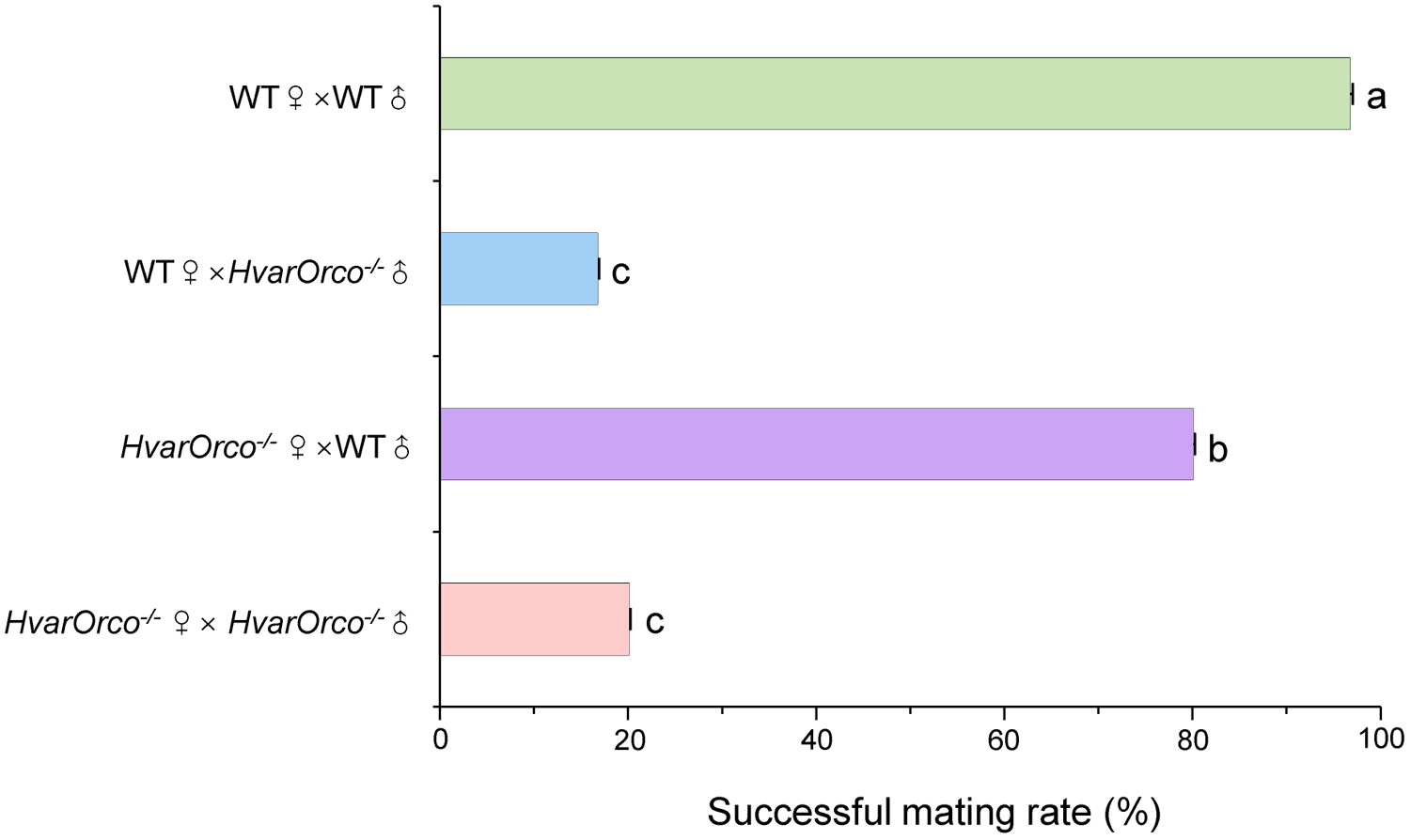
Mating assays indicated that Orco deficiency specifically impairs male behaviour. The mating rate for WT pairs (WT♀ × WT♂) was 96.7% ± 3%. Similarly, pairs consisting of mutant females and WT males (HvarOrco−/−♀ × WT♂) maintained a high mating rate of 80.0% ± 6%. However, when mutant males were paired with either WT or mutant females, mating rates decreased significantly to 16.7% ± 3% and 20% ± 6%, respectively (P < 0.001, fig. 4). Subsequently, we assessed the reproductive fitness of 30 successfully mated females from each group.
Mating rate of H. variegata across different genotype pairings. The bar graph illustrates the percentage of successful mating events observed in four cross combinations involving wild-type (WT) and HvarOrco−/− mutant adults. Data are presented as mean ± SEM. Different lowercase letters above the bars indicate statistically significant differences between different groups (one-way ANOVA followed by LSD, P < 0.05, n = 30).

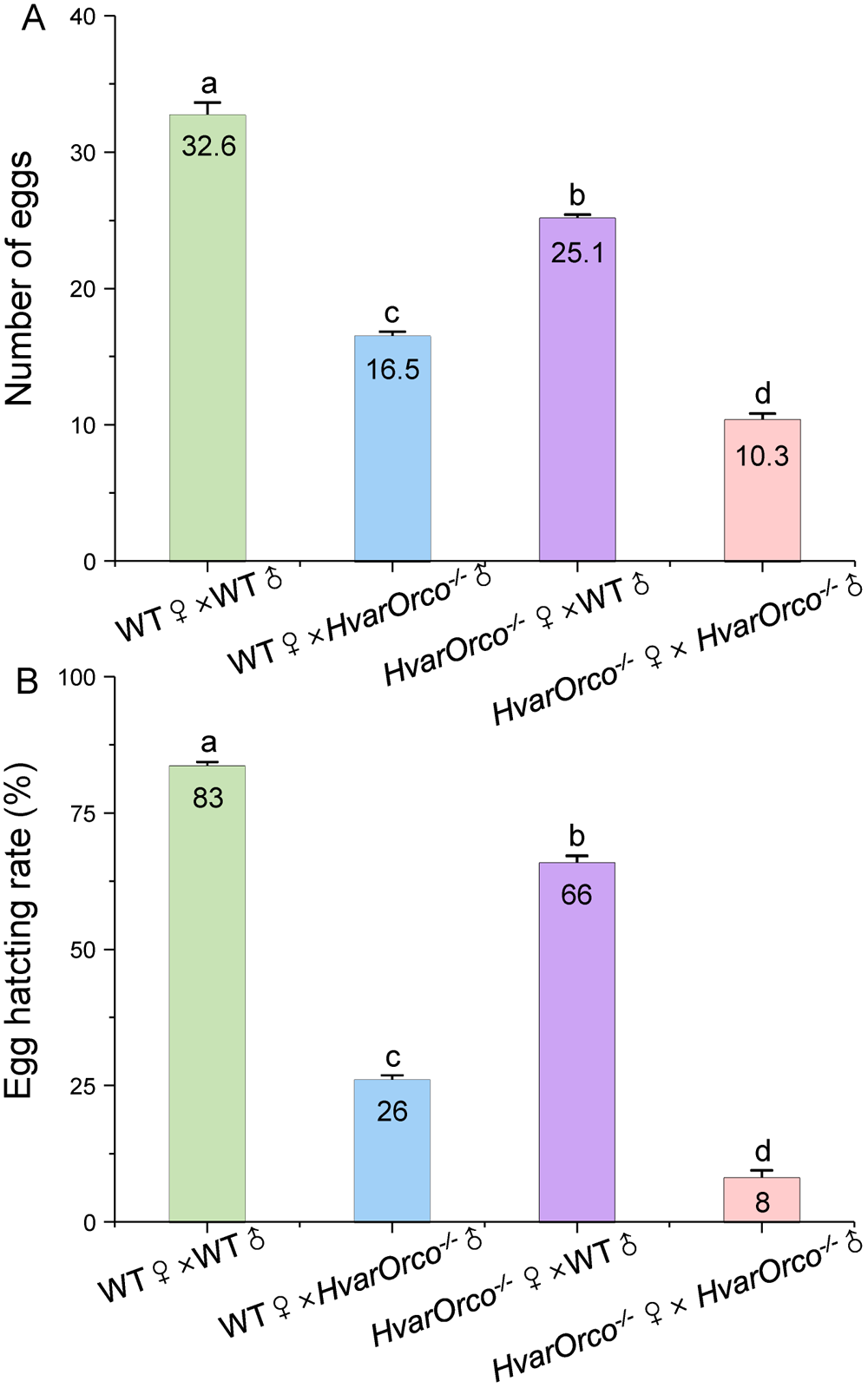
Over a 30-day observation period, the average fecundity was 32.6 ± 0.96 eggs for WT pairs, compared to 16.5 ± 0.36, 25.1 ± 0.31, and 10.3 ± 0.51 eggs for the other three groups, respectively (P < 0.001, fig. 5A). Egg hatching rates showed a similar decline: 83% ± 1% for WT pairs, dropping to 26% ± 1%, 66% ± 1%, and 8% ± 2% for the other groups (P < 0.001, fig. 5B). Overall, the disruption of HvarOrco resulted in approximately 68% reduction in fecundity and a 90% reduction in egg hatchability in the homozygous mutant pairs.
Reproductive fitness parameters of wild-type and HvarOrco−/− mutant pairs. (A) Average fecundity (total number of eggs laid per female) over a 30-day observation period post-mating. (B) Egg hatching rates (%). Data are presented as mean ± SEM. Different lowercase letters above the bars represent statistically significant differences between different groups (one-way ANOVA followed by LSD, P < 0.05, n = 30).

Figure 5 Long description
The bar graph A has y axis label, Number of eggs, with tick labels 0, 10, 20, 30, 40. The x axis shows four category labels: W T female sign times W T male sign; W T female sign times HvarOrco minus minus male sign; HvarOrco plus minus female sign times W T male sign; HvarOrco plus minus female sign times HvarOrco minus minus male sign. Four vertical bars are labeled 32.6, 16.5, 25.1 and 10.3. Lowercase letters above the bars are a, c, b and d, in the same left to right order. The bar graph B has y axis label, Egg hatching rate left parenthesis percent right parenthesis, with tick labels 0, 25, 50, 75, 100. The x axis shows four category labels: W T female sign times W T male sign; W T female sign times HvarOrco minus minus male sign; HvarOrco plus minus female sign times W T male sign; HvarOrco plus minus female sign times HvarOrco minus minus male sign. Four vertical bars are labeled 83, 26, 66 and 8. Lowercase letters above the bars are a, c, b and d, in the same left to right order.
Discussion
The successful establishment of a heritable HvarOrco knockout line represents a pivotal advancement in the functional genomics of predatory ladybeetles, a family where genetic manipulation has historically been challenging. While RNAi has been effectively employed to transiently silence chemosensory genes in coleopteran species such as Callosobruchus chinensis (Zheng et al., Reference Zheng, Bai, Zhao, Wu, Huang, Zhang, Yao and Zhang2025) and Colaphellus bowringi, the transient nature of gene knockdown often precludes the assessment of complex, long-term phenotypic traits like lifetime reproductive fitness. By utilising the CRISPR/Cas9 system, we generated a stable 4-bp deletion in HvarOrco, creating a frameshift mutation that functionally ablates the highly conserved transmembrane domain structure essential for ion channel gating.
This permanent disruption mirrors the ‘null’ phenotypes achieved in model dipterans (Gratz et al., Reference Gratz, Ukken, Rubinstein, Thiede, Donohue, Cummings and O’Connor-Giles2014; Xu et al., Reference Xu, Jiang, Tang, Yan, Schetelig and Wang2022), lepidopteran pests (Koutroumpa et al., Reference Koutroumpa, Monsempes, François, de Cian, Royer, Concordet and Jacquin-Joly2016; Li et al., Reference Li, Zhang, Chen, Yang, Jiang, Wang and Kang2016; Fan et al., Reference Fan, Mo, Li, Huang, Guo, Gong and Wang2022), and other coleopterans (Gilles et al., Reference Gilles, Schinko and Averof2015), supporting the evolutionary conservation of core olfactory machinery across these diverse orders. Furthermore, the high editing efficiency at the sgRNA1 site, despite the lack of editing at the second target, underscores the necessity of multi-target screening in non-model insects to ensure efficient mutagenesis (Sun et al., Reference Sun, Huang, Liu, Ge, Wang, Yang, Gao and Wu2021; Wang et al., Reference Wang, He, Qiao, Yu, Chen and He2022). This study provides the first robust evidence of Orco function in H. variegata and validates a precise genome-editing platform (Li et al., Reference Li, Fan, Zhang, Liu, Zhang, Zhao, Fang, Chen, Dong, Chen, Ding, Zhao, Feng, Zhu, Feng, Jiang, Zhu, Xiang, Feng, Li, Wang, Zhang, Kronforst and Wang2015) that can now be leveraged to deorphanise the remaining expanded repertoire of ORs in this crucial biocontrol agent.
Physiologically, the abolition of EAG responses in HvarOrco−/− mutants is consistent with the conserved role of Orco as an essential functional partner for ORs in this species. Previous transcriptomic and functional studies identified HvarOR25 and HvarOBP5 as key molecular components responsible for detecting the aphid alarm pheromone E-β-farnesene and green leaf volatiles such as cis-3-hexenyl acetate (Xie et al., Reference Xie, Liu, Yi, Liu, Tang, Sun, Shi, Khashaveh and Zhang2022; Tang et al., Reference Tang, Xie, Liu, Khashaveh, Liu, Yi, Zhao, He, Sun and Zhang2023). Our EAG data demonstrate that antennal responses to all tested compounds were abolished in the HvarOrco−/− mutant, despite these specific receptors remaining genomically intact. This observation aligns with the conserved model wherein Orco is required not only for heteromeric ion channel formation but also for the trafficking of specific ORs to the dendritic membrane (Sato et al., Reference Sato, Pellegrino, Nakagawa, Nakagawa, Vosshall and Touhara2008; Stengl and Funk, Reference Stengl and Funk2013), although direct evidence for trafficking defects in this species awaits further immunohistochemical validation.
Ecologically, the behavioural consequences of this molecular defect are profound. The six compounds tested are critical kairomones and synomones that H. variegata uses to locate aphid-infested habitats (Fan et al., Reference Fan, Zhang, Francis, Cheng, Sun and Chen2015). The complete loss of attraction in the Y-tube assays parallels findings in the hawkmoth Manduca sexta, where Orco mutagenesis disrupted floral foraging (Fandino et al., Reference Fandino, Haverkamp, Bisch-Knaden, Zhang, Bucks, Nguyen, Schröder, Werckenthin, Rybak, Stengl, Knaden, Hansson and Große-Wilde2019), and in the ragweed leaf beetle Ophraella communa, where Orco deficiency eliminated host plant recognition (Ma et al., Reference Ma, Cui, Bai, Tian, Zhang, Chen, Gao, Tian, Chen, Guo, Wan and Zhou2020). However, it is important to acknowledge that our assays were performed with individual synthetic compounds, whereas under natural conditions, H. variegata would encounter complex mixtures of plant- and prey-derived volatiles. The behavioural responses to isolated compounds may not fully reflect the integration of multimodal olfactory inputs that occurs in the field. While the ecological impact of such olfactory deficits cannot be directly inferred from laboratory assays, it is reasonable to hypothesise that HvarOrco−/− individuals would face challenges in locating both food sources and oviposition sites (Cury et al., Reference Cury, Prud’homme and Gompel2019). Nevertheless, field-based studies are required to assess the actual survival and reproductive consequences under natural conditions.
Beyond foraging deficits, our mating assays revealed a striking sexual dimorphism. While HvarOrco−/− females retained the ability to copulate with WT males (80% success), mutant males exhibited a near-total failure to mate (∼16%–20% success) regardless of the female’s genotype. This asymmetrical failure suggests that olfactory inputs mediated by Orco are specifically required for male mating initiation. One interpretation is that Orco in males is involved in detecting female-emitted signals, such as sex pheromones or close-range cuticular hydrocarbons (CHCs), that trigger courtship behaviour, as demonstrated in other insect systems (Trible et al., Reference Trible, Olivos-Cisneros, McKenzie, Saragosti, Chang, Matthews, Oxley and Kronauer2017; Yan et al., Reference Yan, Opachaloemphan, Mancini, Yang, Gallitto, Mlejnek, Leibholz, Haight, Ghaninia, Huo, Perry, Slone, Zhou, Traficante, Penick, Dolezal, Gokhale, Stevens, Fetter-Pruneda, Bonasio, Zwiebel, Berger, Liebig, Reinberg and Desplan2017). However, direct chemical identification of the putative female-derived cues and behavioural assays with purified compounds are needed to confirm this hypothesis in H. variegata. The observed male mating deficit could also involve additional mechanisms beyond peripheral olfactory impairment. In ants, Orco mutagenesis resulted in a severe reduction in antennal lobe glomeruli (Trible et al., Reference Trible, Olivos-Cisneros, McKenzie, Saragosti, Chang, Matthews, Oxley and Kronauer2017), raising the possibility that central neuroanatomical defects may contribute to the behavioural phenotype in our mutant. Furthermore, recent work in noctuid moths has shown that male reproductive success is driven by the interplay between Orco and male-biased proteins such as PBP4, which facilitate the precise detection of female signals (He et al., Reference He, He, Hou, Liu, Wei, Guo, Li, Knaden, Hansson, Dong and Zhang2025). Whether similar molecular interactions exist in H. variegata remains an open question. While our data establish a clear requirement for Orco in male mating success, the relative contributions of peripheral anosmia versus potential central processing deficits, as well as the specific signals involved, require further investigation.
Perhaps the most striking finding of this study is the drastic reduction in egg viability among the few successful matings involving mutant pairs. While WT pairs maintained an 83% hatching rate, pairs involving HvarOrco−/− individuals exhibited hatching rates as low as 8%, representing a >90% loss in reproductive output. This post-copulatory failure, observed even when mating was successful, points to a potential role for Orco beyond its function in peripheral olfactory neurons. Several non-mutually exclusive hypotheses could explain this reduced egg viability. In the mosquito Anopheles gambiae, Orco has been detected in the flagella of spermatozoa, where it mediates odourant-dependent activation of sperm motility (Pitts et al., Reference Pitts, Liu, Zhou, Malpartida and Zwiebel2014). Orco knockout in the moth H. armigera resulted in male infertility (Fan et al., Reference Fan, Mo, Li, Huang, Guo, Gong and Wang2022), and in Spodoptera exigua, disruption led to malformed sperm bundles and reduced sperm competitiveness (He et al., Reference He, He, Hou, Liu, Wei, Guo, Li, Knaden, Hansson, Dong and Zhang2025). It is therefore plausible, though remains to be tested, that HvarOrco deficiency in H. variegata similarly affects sperm function, such as motility or fertilising capacity. Alternatively, the recent discovery of ectopic olfactory receptors in non-chemosensory tissues (Kang and Koo, Reference Kang and Koo2012) raises the possibility that Orco-mediated signalling could be involved in early embryonic development, though direct evidence for this in Coleoptera is currently lacking. Nevertheless, we acknowledge that our knockouts were verified by targeted sequencing of the edited alleles, but we did not perform whole-genome sequencing to comprehensively assess off-target mutations. Therefore, we cannot entirely rule out the possibility that undetected off-target effects contributed to these severe reproductive defects. Histological examination of HvarOrco−/− gonads, sperm viability assays, and embryonic developmental staging will be required to distinguish between these possibilities and to determine whether the reduced hatchability results from fertilisation failure, embryo lethality, or both.
In summary, our investigation demonstrates that disruption of HvarOrco leads to profound deficits in olfaction, host plant and habitat recognition, and reproductive success in H. variegata. The observed phenotypes can be grouped into two categories: first, well-supported effects, including the abolition of EAG responses to all tested volatiles, complete loss of behavioural attraction in Y-tube assays, and severely impaired mating success in males; and second, intriguing but as-yet-unresolved effects, most notably the substantial reduction in egg viability among successful crosses, the mechanistic basis of which remains unclear. These findings highlight the pleiotropic nature of Orco and suggest that olfactory signalling pathways may be more deeply integrated with reproductive physiology than previously recognised, although direct evidence for the involvement of Orco in germline or embryonic functions in this species is currently lacking. From an applied perspective, this study validates a robust CRISPR/Cas9-based functional genomics platform for H. variegata, paving the way for future deorphanisation of specific receptors involved in aphid predation (Palli, Reference Palli2023). Moreover, the severe fitness costs associated with Orco loss of function underscore the potential of Orco as a target for RNAi-based pest management (Li et al., Reference Li, Tian, Di, Qu, Fu, Yang and Luo2024), while also serving as a cautionary note for the development of indiscriminate ‘olfactory disruptors’ (Andersson and Newcomb, Reference Andersson and Newcomb2017). Any chemical or genetic strategy targeting Orco in pest beetles should be carefully evaluated for potential off-target effects on beneficial natural enemies such as H. variegata (Kontodimas and Stathas, Reference Kontodimas and Stathas2005; Skouras et al., Reference Skouras, Margaritopoulos, Zarpas and Tsitsipis2015) to preserve their crucial role in biological control.
Supplementary material
The supplementary material for this article can be found at https://doi.org/10.1017/S0007485326101345.
Author contributions
X.L.: Methodology, Validation, Visualisation, Writing – original draft, Writing – review and editing. J.X.: Methodology, Conceptualisation, Writing – review and editing. Haoyu Tang: Methodology, Visualisation. H.L.: Validation, Methodology. A.K.: Methodology, Writing – review and editing. H.P.: Writing – review and editing. T.L.: Supervision, Project administration, Conceptualisation. Y.Z.: Supervision, Project administration, Conceptualisation, Writing – review and editing, Resources, Funding acquisition.
Data availability statement
The datasets generated and analysed during the current study are available from the corresponding author on reasonable request.
Financial support
This work was supported by the National Natural Science Foundation of China (32372639), the National Key Research and Development Program of China (2024YFD1400300), and the China Agriculture Research System (CARS-02-26).
Competing interests
The authors declare that they have no known competing financial interests or personal relationships that could have appeared to influence the work reported in this paper.