Introduction
Cysticercosis is a parasitic disease caused by the larval stage of the cestode Taenia solium, which affects mainly pigs and humans. The infection with T. solium cysticerci in the human brain is known as neurocysticercosis and is the main cause of adult epilepsy in endemic countries (White et al., Reference White, Robinson and Kuhn1997). Neurocysticercosis constitutes a public health problem in many underdeveloped countries. This zoonotic disease has spread to industrialized countries in recent years (Sorvillo et al., Reference Sorvillo, DeGiorgio and Waterman2007).
Taenia crassiceps Wake Forest University (WFU) cysticerci and worms have been used extensively as experimental models to investigate aspects related to human and pig cysticercosis, because they share immunological and morphological properties with T. solium parasitosis (Willms et al., 2004; Willms & Zurabian, Reference Willms and Zurabian2010).
Neurocysticercosis treatment remains a difficult clinical problem. Both host and parasite factors can contribute to variations in the response to treatment. The presence of cysticerci in the human brain and the administration of cystocidal drugs induce local inflammation; thus, immunoregulatory agents such as glucocorticoids are employed and have proved to be effective in reducing inflammation in the brain (Stanbury & Graham, Reference Stanbury and Graham1998; Jung et al., Reference Jung, Cárdenas, Sciutto and Fleury2008). Although inflammation triggered by cysticerci contributes to parasite destruction, the process can be lengthy and can also escalate symptoms and leave severe neurologic deficits in patients (Jung et al., Reference Jung, Cárdenas, Sciutto and Fleury2008).
Using thin layer chromatography (TLC) we have shown that cysticerci of T. solium and both T. crassiceps WFU and ORF strains synthesize androstenedione, testosterone and oestrogens, or androstenediol, testosterone and oestrogens through the delta 4 and delta 5 (Δ5) steroidogenic pathways, respectively (Gómez et al., Reference Gómez, Valdez, Larralde and Romano2000; Jiménez et al., Reference Jiménez, Valdez and Romano2006; Valdéz et al., Reference Valdéz, Jiménez, Cartas, Gómez and Romano2006). The importance of androgens and oestrogens in taeniid development was demonstrated by the stimulatory effect of sex steroid hormones on parasite cell proliferation (Romano et al., Reference Romano, Valdez, Hinojosa, Gómez and Jiménez2008), the inhibitory effect of fadrozole on the parasite load in hosts (Morales-Montor et al., Reference Morales-Montor, Hallal-Caballeros, Romano and Damian2002) and the antiandrogen flutamide on cultured cysticerci (Romano et al., Reference Romano, Valdéz, Cartas, Gómez and Larralde2003). In addition, we have demonstrated, by histochemistry, the presence and activity of a key steroidogenic enzyme, 3β-hydroxysteroid dehydrogenase (3β-HSD), in cysticerci and worm proglottids (Fernández Presas et al., Reference Fernández Presas, Valdez, Willms and Romano2008).
Oestrogen synthesis is carried out by P450-aromatase, an enzyme that uses androgens such as androstenedione and testosterone as precursors (Simpson et al., Reference Simpson, Zhao, Agarwal, Dodson, Bulun, Hinshelwood, Graham-Lorence, Sun, Fisher, Qin and Mendelson1997). The activity of the P450-aromatase is regulated by factors such as interleukin (IL)-1, tumour necrosis factor (TNF), retinoic acid and glucocorticoids in stromal vascular cells from human adipose tissue (Schmidt & Löffler, Reference Schmidt and Löffler1994; Zhao et al., 1995).
Although synthetic glucocorticoids such as dexamethasone are extensively used in cysticerci-infected patients, there is no information on the biological effects of in vitro or host corticosteroids on cysticercus physiology. Glucocorticoids (GCs) are steroid hormones synthesized by the glomerular zone of the adrenal cortex. In vertebrates, the main GCs are cortisol and corticosterone, but some species, such as the chicken, rabbit, rat and mouse, only synthesize corticosterone. GCs exert their effect by binding to specific receptors that share all the characteristics of a large family of molecules that finally recognize a site called glucocorticoid receptor element in DNA. The binding of the receptor to this site initiates the transcription of several proteins; GC receptors are widely distributed in most vertebrate cells and are classified as GC receptors (Type II) and mineralocorticoid receptors (Type I), that have great affinity for GCs and mineralocorticoids, respectively; however, Type I receptors act like mineralocorticoid receptors in some tissues but also have a high affinity for GC in others; non-genomic actions of GCs have also been reported.
In the present study we have investigated the effect of in vitro exposure to corticosterone or dexamethasone on sex steroid synthesis by T. crassiceps WFU strain cysticerci obtained after different infection periods.
Materials and methods
Parasites
Cysticerci from the WFU strain of T. crassiceps were collected from the peritoneal cavity of female BALB/c mice 3–4 months (young parasites) or 7–8 months postinfection (old parasites), and rinsed five times in phosphate-buffered saline, pH 7.2 (PBS). Cysticerci were pre-incubated for 24 h at 37°C in an atmosphere of 5% CO2 and air, in Dulbecco's Modified Eagle's Medium (DMEM; GIBCO BRL, Grand Island, New York, USA), plus 0.1% bovine serum albumin (BSA; Sigma-Aldrich, St. Louis, Missouri, USA), 25 mm of N-[2-hydroxyethyl]piperazine-N'-[2-ethanesulphonic acid] (HEPES; Sigma) and 1% antibiotic–antimycotic (penicillin at 100 U/ml, plus streptomycin at 100 μg/ml and amphotericin 0.025 μg/ml; GIBCO).
Experimental design
Following the pre-incubation period, the parasites were washed with DMEM and transferred to new wells (250 μl cysticerci/well) containing fresh culture medium as described above, and treated daily with different concentrations of corticosterone or dexamethasone dissolved in ethanol for 5 days. Ethanol (final concentration was 0.6%) was added to control groups. Finally, fresh medium was added containing 0.1 μCi of [3H]dehydroepiandrosterone (1,2,6,7-3H-(N)-androst-5-ene-3β-ol-17-one ([3H]DHEA) at 96 Ci/mmol; Perkin Elmer, Boston, Massachussetts, USA) and the cysticerci further incubated for 6 or 24 h. The tracer was also added to culture medium alone and incubated as a blank. At the end of the experiments, culture media were recovered and ether extracted. The samples were reconstituted in 100 μl of absolute ethanol.
Thin layer chromatography
Androstenediol, androstenedione, testosterone, 17β-oestradiol and oestrone were used as internal standards. Thin layer chromatography (TLC) was carried out using silica gel 60 F254 pre-coated sheet plates (Merck, Darmstadt, Germany) as described previously for T. crassiceps cysticerci (Valdéz et al., Reference Valdéz, Jiménez, Cartas, Gómez and Romano2006). Aliquots of 20 μl of the ethanolic samples were supplemented with standard steroids and further fractionated in a TLC system. The plates were developed with a mixture of benzene–methanol (9:1 v/v; Merck). The standard steroids (Steraloids, Wilton, New Hampshire, USA) were detected in the plates by ultraviolet light and exposed to 10% H2SO4 followed by heating at 120°C. Regions corresponding to authentic standards were cut and placed in vials containing scintillation liquid and radioactivity was counted in a liquid scintillation spectrometer. The recovered radioactivity was estimated by comparing the difference between initial and final counts per minute.
Results were expressed as the percentage of substrate transformation for each metabolite, after 6 or 24 h incubation in the presence of the precursor. Since the recovery of the radioactivity of each precursor was higher than 85%, no corrections were made. Results were submitted to analysis of variance and Student's t-tests.
Results
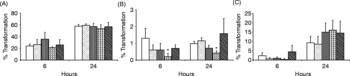
As shown in figs 1 and 2, both young and old parasites synthesized androgens and oestrogens from [3H]DHEA. The effect of different doses of corticosterone on sex steroid synthesis by young T. crassiceps WFU cysticerci is shown in fig. 1, where the incubation with [3H]DHEA yielded tritiated androstenediol, testosterone and 17β-E2 (control group). The addition of corticosterone to the culture media slightly decreased testosterone synthesis; the difference compared to the control group was significant at the dose of 250 nm at 6 and 24 h incubation. With the decrement in testosterone, 17β-E2 synthesis was increased with doses of 100–500 nm, but the increment was not statistically significant; the oestradiol synthesis was almost blocked at the 1000 nm dose (not shown).
Effect of corticosterone on [3H]DHEA transformation to metabolites by young Taenia crassiceps WFU cysticerci. Corticosterone at different concentrations or the solvent were added to the culture media and the cysticerci were cultured for 5 days. Results are expressed as the percentage of substrate transformation after 6 or 24 h incubation with the 3H-labelled hormone. Bars, from left to right at each time point: control, corticosterone 10 nm, corticosterone 100 nm, corticosterone 250 nm, corticosterone 500 nm. (A) Androstenediol; (B) testosterone; (C) oestradiol. Each value represents the average ± SD from four wells of a representative experiment repeated at least three times. *Indicates statistical differences compared to the control group (P < 0.05).
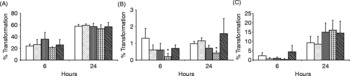
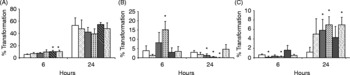
Effect of corticosterone on [3H]DHEA transformation to its metabolites by old Taenia crassiceps WFU cysticerci. Corticosterone at different concentrations or the solvent were added to the culture media and the cysticerci cultured for 5 days. Results are expressed as the percentage of substrate transformation after 6 or 24 h incubation with increasing concentrations of corticosterone. Bars, from left to right at each time point: control, corticosterone 10 nm, corticosterone 100 nm, corticosterone 250 nm, corticosterone 500 nm, corticosterone 1000 nm. (A) Androstenediol; (B) testosterone; (C) oestradiol. Each value represents the average ± SD from four wells of a representative experiment repeated at least three times. *Indicates statistical differences compared to the control group (P < 0.05).

Tritiated-DHEA transformation was significantly affected by corticosterone treatment of old parasites (fig. 2). [3H]Androstenediol synthesis progressively increased and reached statistical significance after 6 h incubation in 500 nm corticosterone; however, the effect was not evident after 24 h incubation with the hormone. The decrease in testosterone synthesis accompanied by an increment in 17β-E2 was more evident after 24 h incubation with corticosterone and became statistically significant at corticosterone concentrations over 100 nm.
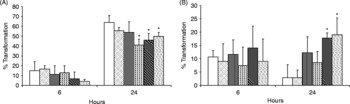
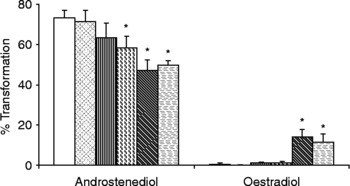
Figure 3 shows the effect of dexamethasone on tritiated androstenediol and 17β-E2 synthesis in old T. crassiceps WFU cysticerci. [3H]Androstenediol decreased while [3H]17β-E2 significantly increased after 24 h of culture in the presence of dexamethasone. Figure 4 illustrates the synthesis of tritiated androstenediol and 17β-E2 in young parasites cultured for 24 h in the presence of dexamethasone. In these conditions, a significant decrease in tritiated androstenediol and a statistically significant stimulation of [3H]17β-E2 were observed (fig. 4).
Effect of dexamethasone on [3H]DHEA transformation to its metabolites by old Taenia crassiceps WFU cysticerci. Dexamethasone at different concentrations or the solvent were added to the culture media and the cysticerci were cultured for 5 days. Results are expressed as the percentage of substrate transformation after 6 or 24 h of incubation with 3H-labelled hormone. Bars, from left to right at each time point: control, dexamethasone 10 nm, dexamethasone 100 nm, dexamethasone 250 nm, dexamethasone 500 nm, dexamethasone 1000 nm. (A) Androstenediol; (B) oestradiol. Each value represents the average ± SD of four wells of a representative experiment repeated at least three times. *Indicates statistical differences compared to the control group (P < 0.05).

Effect of dexamethasone on [3H]DHEA metabolism in young Taenia crassiceps WFU cysticerci. Dexamethasone at different concentrations or the solvent were added to the culture media and the cysticerci were cultured for 5 days. Results are expressed as the percentage of substrate transformation after 24 h of incubation with 3H-labelled hormone. Bars, from left to right for each hormone: control, dexamethasone 10 nm, dexamethasone 100 nm, dexamethasone 250 nm, dexamethasone 500 nm, dexamethasone 1000 nm. Each value represents the average ± SD of four wells of a representative experiment repeated at least three times. *Indicates statistical differences compared to control group (P < 0.05).

Discussion
Present data confirm our previous results that showed the ability of T. crassiceps WFU infrapopulations to transform [3H]DHEA to androgens, such as testosterone and androstenediol, and the oestrogen 17β-oestradiol (Jiménez et al., Reference Jiménez, Valdez and Romano2006; Valdéz et al., Reference Valdéz, Jiménez, Cartas, Gómez and Romano2006; Fernández Presas et al., Reference Fernández Presas, Valdez, Willms and Romano2008). Results shown here indicate that cysticerci that have proliferated for several months in the abdominal cavity of mice, maintain their steroidogenic capacity. The results also show that the steroid metabolism of [3H]DHEA in T. crassiceps WFU strain proceeds following the Δ5 steroidogenic pathway, which was demonstrated by the presence of androstenediol in the medium (figs 1–4). It is probable that the synthesis of testosterone follows a similar pathway, since androstenedione, which is also synthesized from [3H]DHEA by 3β-HSD, was not found in these experiments (Gómez et al., Reference Gómez, Valdez, Larralde and Romano2000; Jiménez et al., Reference Jiménez, Valdez and Romano2006; Valdéz et al., Reference Valdéz, Jiménez, Cartas, Gómez and Romano2006; Fernández Presas et al., Reference Fernández Presas, Valdez, Willms and Romano2008). Oestradiol released by both young and old cysticerci, probably derives from testosterone using this pathway.
Our results show that increasing concentrations of corticosterone significantly stimulated the synthesis of 17β-oestradiol in old cysticerci (fig. 2) and slightly increased it in young cysticerci. Data suggest that corticosterone may exert a stimulating effect on P450-aromatase-like activity, similar to that described in human skin fibroblasts (Simpson et al., Reference Simpson, Zhao, Agarwal, Dodson, Bulun, Hinshelwood, Graham-Lorence, Sun, Fisher, Qin and Mendelson1997) and stromal vascular cells in adipose tissue (Zhao et al., Reference Zhao, Nichols, Bulun, Mendelson and Simpson1995). It has been shown that, in spite of continuous budding, the parasites lose or change some of their biological responses, as has been described by Zurabian et al. (Reference Zurabian, Jiménez, Robert and Willms2008), who showed that old infrapopulations lose the ability to infect experimental hamsters. However, besides maintaining their steroidogenic capacity (figs 2 and 3), old cysticerci are still capable of responding to glucocorticoids, a response suggesting that the P450-aromatase-like activity is not affected by long infection periods (figs 3 and 4).
Stimulation of P450-aromatase activity by synthetic GCs such as dexamethasone has also been reported in human tissues (Simpson et al., Reference Simpson, Zhao, Agarwal, Dodson, Bulun, Hinshelwood, Graham-Lorence, Sun, Fisher, Qin and Mendelson1997). The increased synthesis of 17β-oestradiol that resulted from the addition of dexamethasone to the culture media of old and young T. crassiceps cysticerci, provides additional evidence of the capacity of the GCs to modulate the parasite sex steroid synthesis. The fact that dexamethasone is a more potent glucocorticoid than corticosterone may explain why young cysticerci responded better to the former steroid (figs 1, 4).
As shown in this study, androgen synthesis was affected by the culture of parasites with corticosterone or dexamethasone for 24 h. As androgens are substrates for oestradiol synthesis, the decrease tritiated androstenediol and testosterone in the media could be explained by a higher transformation to oestrogens. Negative and positive effects of glucocorticoids on mammal androgen synthesis have been described (for a review, see Hardy et al., Reference Hardy, Gao, Dong, Ge, Chai, Feng and Sottas2005) in conditions of chronic and acute stress (Brann & Mahesh, Reference Brann and Mahesh1991). Furthermore, corticosteroids have positive effects on processes such as promotion of oocyte maturation and maintenance of spermatogenesis, as well as on selected ovarian steroidogenic enzymes such as granulose P450-aromatase (Michael & Cooke, Reference Michael and Cooke1994).
In conclusion, the experiments presented here show for the first time that in vitro corticosterone and the synthetic GC dexamethasone modulate the synthesis of oestrogens in T. crassiceps WFU cysticerci. Since natural and synthetic GCs seem to favour the release of sex steroids that are important for parasite development, and because these steroids are extensively used in the treatment of human neurocysticercosis, our findings pose questions on the convenience of using glucocorticoids for long-term treatment of inflammation caused by neurocysticercosis.
Acknowledgements
The authors acknowledge the technical support of veterinary surgeon José A. Jiménez for maintaining the Taenia crassiceps WFU strain infections. This work was partially supported by Consejo Nacional de Ciencia y Tecnología (CONACyT) grants # 69347 (M.C.R.), SEP-CONACYT # 79686 and UNAM-PAPIIT # IN210407 (K.W.). L.H. is a postdoctoral CONACyT fellow.