Introduction
Vulnerability for a first episode of major depression during midlife is substantial for women. The National Comorbidity Study reported that among 35–54-year-old women with no prior major depression, 1.7–2.5% had a first onset of major depression within a 12-month period (Kessler et al. Reference Kessler, McGonagle, Zhao, Nelson, Hughes, Eshleman, Wittchen and Kendler1994). The Netherlands Mental Health Survey and Incidence Study observed an annual incidence rate of 2.5% among women aged 45–54 years (Bijl et al. Reference Bijl, De Graaf, Ravelli, Smit and Vollebergh2002). Cumulatively, these estimates add up to 12–17.5% of first onsets of major depression among midlife women over 7 years.
Few studies have examined predictors of first-onset depression and most have included only a few demographic variables, such as age, gender and education (Gallo et al. Reference Gallo, Royall and Anthony1993; Bruce & Hoff, Reference Bruce and Hoff1994), sampled broad age ranges or had a short follow-up (12 months) (De Graaf et al. Reference De Graaf, Bijl, Ravelli, Smit and Vollebergh2002). Factors shown to be associated with first-onset as well as recurrent depression in adults include: separated or divorced, less than a high-school education (Gallo et al. Reference Gallo, Royall and Anthony1993), poverty status, chronic physical conditions, history of substance abuse (Bruce & Hoff, Reference Bruce and Hoff1994), history of anxiety disorders (Breslau et al. Reference Breslau, Schultz and Peterson1995; Goodwin, Reference Goodwin2002; Wittchen et al. Reference Wittchen, Beesdo, Bittner and Goodwin2003), stressful event(s) (Post, Reference Post1992; Kendler et al. Reference Kendler, Thornton and Gardner2000; De Graaf et al. Reference De Graaf, Bijl, Ravelli, Smit and Vollebergh2002; Friis et al. Reference Friis, Wittchen, Pfister and Lieb2002), and an ongoing difficulty for at least 12 months (De Graaf et al. Reference De Graaf, Bijl, Ravelli, Smit and Vollebergh2002). Although the limited data suggest that risk factors for first episodes of depression are similar to those for recurrent episodes, it has been suggested that they may be different (Kessler, Reference Kessler1997, Reference Kessler2003; Daley et al. Reference Daley, Hammen and Rao2000).
Of particular relevance to midlife women is the role of menopausal factors in the occurrence of first episodes of major depression. Sex steroids, such as estrogens, can affect brain neurotransmitter systems that are associated with depression (McEwen & Alves, Reference McEwen and Alves1999) and estrogen may be effective in reducing perimenopausal depression (Schmidt et al. Reference Schmidt, Nieman, Danaceau, Tobin, Rocca, Murphy and Rubinow2000). Two longitudinal studies in a sample of women without past major depression at study entry reported that onset of depressive symptoms and depressive disorders (both major or other) were more likely to occur during perimenopause than premenopause (Cohen et al. Reference Cohen, Soares, Vitonis, Otto and Harlow2006; Freeman et al. Reference Freeman, Samuel, Lin and Nelson2006); one study found that women had higher mean levels of luteinizing hormones (LH) and a higher mean standard deviation of two measures of estradiol obtained during consecutive menstrual periods when they were depressed compared to when they were not (Freeman et al. Reference Freeman, Samuel, Lin and Nelson2006). Hot flashes were associated with depressive disorder in unadjusted but not adjusted analyses (Freeman et al. Reference Freeman, Samuel, Lin and Nelson2006). These studies, however, are not conclusive. In one study the determination of lifetime major depression was not made with a standard psychiatric interview (Freeman et al. Reference Freeman, Samuel, Lin and Nelson2006) and the relevant risk factors for depression (i.e. prior psychiatric morbidity, medical burden, and stressful life events) were not fully taken into account (Cohen et al. Reference Cohen, Soares, Vitonis, Otto and Harlow2006; Freeman et al. Reference Freeman, Samuel, Lin and Nelson2006). Furthermore, the young age of the samples (35–47 years) suggests that these findings may be limited to women with an early menopausal transition.
In the current study, we addressed the limitations above and extend the literature in two ways. First, we assessed lifetime and annual episodes of major depression in women by a standard psychiatric interview, the Structured Clinical Interview for DSM-IV Axis I Disorders (SCID). Second, in addition to menopausal-related factors, we examined two sets of risk factors because of their salience for midlife women: prior stress and health-related factors. Specifically, we hypothesized that the following factors would predict first-onset major depressive episodes during midlife: (1) menopausal factors: stage of the menopausal transition as determined by bleeding patterns, vasomotor symptoms (VMS; hot flashes and night sweats), estradiol (E2) or follicle stimulating hormone (FSH) levels; (2) health status, specifically physical conditions and symptoms, functioning, body mass index (BMI), and history of anxiety or substance use disorders; and (3) stressful life events.
Method
Subjects and procedures
This study was conducted among participants in the Study of Women's Health Across the Nation (SWAN) Menopausal Transition, Mental Health and Ethnicity Study (MHS) at the Pittsburgh site of the SWAN, a multi-site community-based cohort investigation of menopause and aging during the first 7 years of follow-up. The MHS was conducted only in Pittsburgh because of our specific interest in clinical depression and menopause. Based on the SCID, a semi-structured standard psychiatric interview on lifetime and current psychiatric disorders, 287 (64.8%) women did not have a history of or current major depression at study entry. Fifteen women were excluded because they were taking psychotropic medication at baseline and six were excluded because they dropped out of the study after the baseline assessment (n=4) or had a hysterectomy between baseline and their first annual visit (n=2), leaving a total sample size of 266. Three women were using Zanax, nine were using an antidepressant (sertraline, imipramine, desipramine, fluoxetine, nortriptyline, or paroxetine), two were using zolpidem, and one was using antipsychotic medications (fluphenazine and olanzapine).
The sampling procedures and design of the SWAN have been described previously (Sowers et al. Reference Sowers, Crawford, Sternfeld, Morganstein, Gold, Greendale, Evans, Neer, Matthews, Sherman, Lo, Weiss, Kelsey, Lobo, Kelsey and Marcus2000). In brief, each site recruited White women and a sample of a predetermined minority group. African American and White women in Pittsburgh were recruited using established sampling techniques, random digit dialing (RDD), and a voter's registration list. Eligibility criteria for the SWAN included being aged 42–52, having an intact uterus, having had at least one menstrual period and no use of reproductive hormones in the previous 3 months, and self-identifying with one of the site's designated race/ethnic groups. All women were either premenopausal or early menopausal. About 50% of eligible women (i.e. 463) entered the SWAN study in Pittsburgh, with 443 (95.6%) also participating in the MHS. SWAN study participants and those who were eligible but did not participate did not vary by ethnicity, marital status, parity, quality of life, social support or perceived stress. There were no significant differences between the MHS participants and non-participants with respect to sociodemographic factors and Center for Epidemiologic Studies Depression Scale (CES-D) scores ⩾16.
At the beginning of the study all participants signed an informed consent in accordance with the University of Pittsburgh Institutional Review Board. The women provided extensive health, psychosocial, lifestyle and biologic data at baseline and at annual follow-up visits as part of the larger SWAN study. Height and weight were measured using a common protocol. Women were scheduled for venipuncture for assays of reproductive hormones prior to 1000 h on days 2–5 of a spontaneous menstrual cycle occurring within 60 days of recruitment at the baseline visit, and annually thereafter. If a timed sample could not be obtained after two attempts, a random fasting sample was taken within a 90-day window of the anniversary of the baseline visit. Blood was refrigerated 1–2 h after phlebotomy and then, following centrifugation, the serum was aliquotted, frozen at −80°C, and batched for shipment to the central laboratory. In Pittsburgh, the SCID (Spitzer et al. Reference Spitzer, William, Gibbon and First1992) was administered at baseline and annually. Annual assessments were similar to the baseline.
Measures
Major depression assessment
Diagnoses of lifetime and current psychiatric disorders were determined by a standard psychiatric interview (SCID) conducted by trained interviewers (Spitzer et al. Reference Spitzer, William, Gibbon and First1992). The SCID has been used with many different ethnic groups and extensive field testing has demonstrated its suitability for research purposes; adequate reliability has been demonstrated in numerous studies (Williams et al. Reference Williams, Gibbon, First, Spitzer, Davies, Borus, Howes, Kane, Pope and Rounsaville1992). All interviewers had extensive clinical experience and at least a master's degree in a relevant field (e.g. social work, psychology). Interviewers were supervised by J.T.B.
Extensive training and qualitative procedures were used to ensure and monitor consistency of SCID administration, symptom elicitation, and diagnostic decision making across the interviewers. These included central training conducted by Biometrics Research Department, New York State Psychiatric Institute, follow-up practice with community volunteers, and ongoing supervision by the principal investigator J.T.B. All interviews with study participants were audiotaped and tapes were used for supervision, to estimate inter-rater reliability, and to monitor rater drift. Inter-rater reliability was very good to excellent for lifetime major depressive disorder (κ=0.81) and for major depression in the past year (κ=0.76–0.89) (Cohen, Reference Cohen1960).
Independent variables
Menopausal indicators
Menopausal status was based on menstrual bleeding patterns in the previous 12 months. Participants were categorized into one of the following five categories: premenopausal (no change in menstrual bleeding regularity), early perimenopausal (menses in the preceding 3 months with an increase in bleeding irregularity in the past year), late perimenopausal (menses in the previous 12 months, but not the past 3 months), postmenopausal (at least 12 months of amenorrhea), and hormone therapy (HT) user (currently or at last visit using HT or reported hormone use when pre- or perimenopausal). The latter group of women was considered separately because hormone use alters bleeding patterns and obfuscates the natural last menses. Women who had a hysterectomy were censored from the analyses at the first visit after surgery. The definitions, with the exception of ‘hormone therapy’, are similar to those recommended by the World Health Organization (WHO, 1996) and have been used in other studies. All women were premenopausal or early perimenopausal at baseline.
VMS data were obtained with a self-report checklist of symptoms commonly included in studies of the menopause (Neugarten & Kraines, Reference Neugarten and Kraines1965; McKinlay et al. Reference McKinlay and McKinlay1989; Matthews et al. Reference Matthews, Wing, Kuller, Meilahn and Plantinga1994). At each visit women were asked how frequently they had experienced hot flashes and night sweats in the previous 2 weeks (not at all, 1–5 days, 6–8 days, 9–13 days, and every day). We defined the presence of frequent VMS as either hot flashes or night sweats that occurred at least 6 days in the previous 2 weeks.
Reproductive hormones
FSH assays were conducted in singlicate and E2 assays in duplicate using an ACS-180 automated analyzer (Bayer Diagnostics Corporation, Norwood, MA, USA). E2 concentrations were measured with a modified, offline ACS-180 (E2-6) immunoassay. Inter- and intra-assay coefficients of variation (CVs) averaged 10.6% and 6.4% respectively over the assay range and the lower limit of detection was 1 pg/ml. Serum FSH concentrations were measured with a two-site chemiluminescent immunoassay. Inter- and intra-assay CVs were 12.0% and 6.0% respectively, and the lower limit of detection was 1.1 IU/l.
Life stress
At each visit women indicated whether any of 18 negative life events had occurred in the past year and, if so, to rate these according to how stressful they were: not at all, somewhat, or very stressful. Although we were interested in evaluating what events might have particular salience for midlife, there were not sufficient numbers of each to consider them separately. Therefore, women were categorized as having experienced at least one ‘very stressful’ event versus none since their last study visit. We also grouped very stressful events into the following five domains: serious problems or care of others, problems in relationships, major event happened to others, work-related problems, and financial problems.
Health-related factors
Substance abuse and dependence, and anxiety disorders were assessed with the SCID. Physical symptom data were obtained at every visit with the checklist described above, which included six symptoms: stiffness/soreness in joints, neck or shoulder; back aches or pains; dizzy spells; headaches; breast pain/tenderness; vaginal dryness. We defined the presence of physical symptoms as at least one that occurred for at least 6 days in the previous 2 weeks.
Medication use was ascertained at each annual visit. The number of medications used for a current chronic condition, such as diabetes or hypertension, was used as a proxy for health status at each visit and coded 0, 1, 2 or 3 or more because there were insufficient numbers of women using medications for a specific condition to analyze them separately. Interviewers verified use by examination of medication containers in the office or by having the participant read the label of the container over the telephone.
Three subscales of the 36-item Short-Form Health Survey (SF-36) were used to assess health-related quality of life (HRQL) during the previous 4 weeks: bodily pain, role limitations (functioning) as a result of physical health, and social functioning. The SF-36 is a widely used HRQL measure and the subscales have been shown to have good reliability and construct validity (Brazier et al. Reference Brazier, Harper, Jones, O'Cathain, Thomas, Usherwood and Westlake1992; McHorney et al. Reference McHorney, Ware, Lu and Sherbourne1994). These were scored using the original coding algorithm in which raw scores are transformed to a 0–100 range (Ware & Sherbourne, Reference Ware and Sherbourne1992) and then dichotomized into good (>75% of the distribution) and poor functioning (⩽25%) following the recommendations of Rose et al. (Reference Rose, Koshman, Spreng and Sheldon1999). Both role limitations and social functioning subscales were measured at baseline and used as long-term predictors. Bodily pain was measured annually except for visit 5 and treated as a time-varying variable.
Covariates included demographic and behavioral factors measured at baseline: ethnicity (African American or White), marital status, financial strain, and level of educational attainment. Psychotropic medication and hormone use in the past year were also considered for inclusion to account for potential confounding with depression.
Statistical analysis
Cox proportional hazard models were used to calculate hazard ratios of incident depression and their 95% confidence intervals (CIs) in both univariate and multivariate models. Women without a prior history of major depression at study entry and at risk for a first onset of major depression during the first 7 years of the study comprised the analytic sample. A woman was considered a case at the visit at which it was determined that she met criteria for a first onset of major depression currently or in the past year. Once a woman became a case or had a surgical menopause, she was censored from subsequent visits. Women without an onset of depression during the 7 years were non-cases until the end of the study and those lost to follow-up during the study were censored at their last known visit. Risk sets were constructed for each of the seven visits in the study for all women who had at least one follow-up visit. A risk set consisted of all women who met criteria for a first onset of depression at that particular visit (cases) and all other women who did not have an onset of major depression but were still at risk for one for that visit and all subsequent visits (non-cases). With the exception of menopausal status and psychotropic medication use, time-dependent explanatory variables (measured annually) were computed as of the last visit prior to the visit of major depression onset and were included in the risk set for the visit of depression onset. Menopausal status and psychotropic medication use concurrent with the visit at which the depression diagnosis was made were also included in the risk set. Over the 7 years of follow-up, 80% of the women in the sample had complete visit data.
Separate univariate models were fit for all the baseline and time-varying variables considered. Any variable statistically significant at the p⩽0.15 level (assessed by likelihood ratio statistics) was considered as a candidate in the multivariate model. The relationship between variability in the day of blood draw for E2 and FSH assays and onset of depression was not significant and was not included in subsequent analyses. Current or past year hormone use in postmenopausal women was also non-significant in univariate analyses and was omitted from further analyses. The multivariate model was fit using backwards stepwise regression with an inclusion criteria of p⩽0.10 for all the candidate baseline and time-varying variables and controlled for age at visit prior to onset. The statistical analyses were performed using stata version 9.0 (Stata Corporation, College Station, TX, USA). Statistical significance was set at p values of <0.05 for the multivariate model.
Results
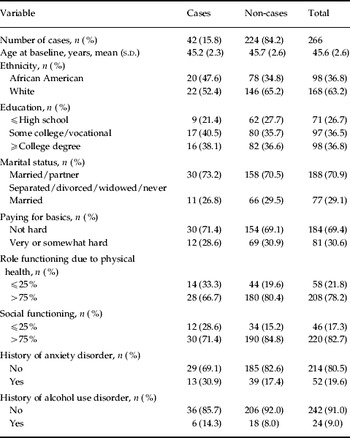
Of the 266 women without past or current major depression at baseline, 42 (15.8%) met criteria for a first-onset major depressive episode. Table 1 shows the baseline characteristics of women who did and did not become depressed over the first 7 years of the study. Of the 266 women, 22 had a hysterectomy over the 7 years, 228 were ever perimenopausal and 104 were ever postmenopausal.
Baseline characteristics of cases and non-cases (never a case) across 7 years

One case is missing for marital status and one non-case is missing for paying for basics.
Predictors of depression onset
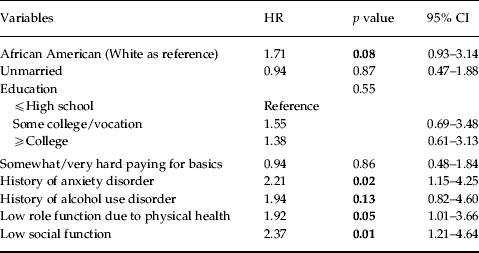
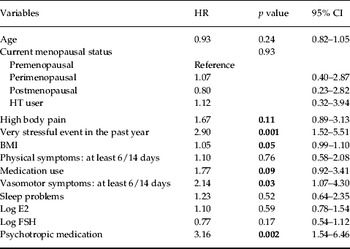
Table 2 shows the hazard ratio (HR) for becoming a case across the 7 years of follow-up for each of the baseline characteristics. Women who reported low role functioning due to physical health, low social functioning or had a history of an anxiety disorder were significantly more likely to experience their first major depressive episode. African American women were 71% more likely to have an onset of depression (p=0.08) although this did not reach the conventional level of statistical significance. Table 3 shows the univariate time-varying predictors of depression onset: very upsetting event in the past year, BMI, frequent VMS, and psychotropic medication use were significantly associated with major depression onset. An additional analysis to examine whether more proximal (prior visit) anxiety diagnoses might explain the association between baseline lifetime anxiety disorder and first-onset major depression was not significant.
Univariate analyses of the relationships between baseline sociodemographic, psychiatric history and functioning variables and first-onset depression (censoring women at the visit they become surgically menopausal) across 7 years
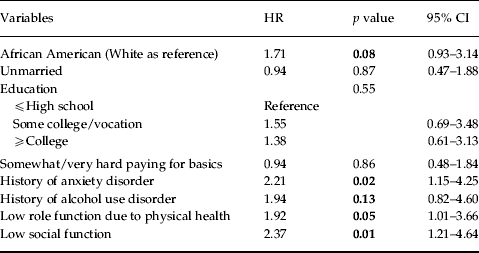
HR, hazard ratio; CI, confidence interval.
p values <0.15 are in boldface.
Univariate analyses of relationships between time-varying menopausal, health-related and stress variables and first-onset depression (censoring women at the visit they become surgically menopausal) across 7 years

HR, hazard ratio; CI, confidence interval; HT, hormone therapy; BMI, body mass index; E2, estradiol; FSH, follicle stimulating hormone.
p values <0.15 are in boldface.
Univariate χ2 analyses of each very upsetting event domain showed that four of the five were more prevalent among the women with a first episode compared to those without one. These included serious problems with or care of others, problems in relationships, major event happened to others, and financial-related problems. Work-related problems did not vary significantly between cases and non-cases.
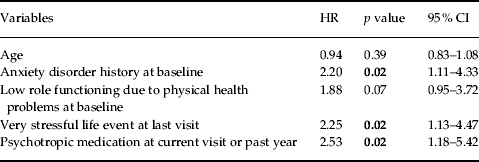
Table 4 shows results of the multivariate analyses. A history of an anxiety disorder (HR 2.20) at baseline and at least one very stressful event (HR 2.25) at the last visit prior to meeting criteria for a depressive episode currently or in the year since prior visit were independent significant predictors of depression onset. Low role functioning due to physical health (p=0.07) was marginally significant. Low social functioning and frequent vasomotor symptoms did not retain significance in the final model.
Results of final multivariate model predicting first depression onset
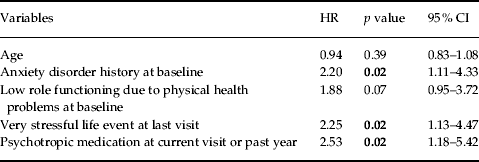
HR, hazard ratio; CI, confidence interval.
Significant p values are in boldface.
Discussion
In this community study of menopause, 15.8% of participants with no history of major depressive disorder at study entry met criteria for an onset of major depression over the course of 7 years. The results partially supported our hypotheses. In multivariate analyses, a history of an anxiety disorder and a very stressful event in the past year remained as significant independent predictors, with low role functioning due to physical health marginally significant. VMS, although significant in univariate analyses, did not remain significant.
The role of the menopausal transition and associated phenomena in the occurrence of depressive disorders has been discussed and debated for some time (Freeman et al. Reference Freeman, Sammel, Liu, Gracia, Nelson and Hollander2004; Soares et al. Reference Soares, Joffe and Steiner2004; Schmidt, Reference Schmidt2005). The current study is the first longitudinal community study to assess the association of first-onset major depressive disorder with factors such as VMS, hormone concentrations, stress, role functioning, and menopausal status together. We observed no association of menopausal status based on bleeding patterns or reproductive hormone levels with first-onset depression. Consistent with this, a small clinical study found no difference in basal plasma hormone levels of FSH and E2 between perimenopausal women with and without a first onset of depression (Schmidt et al. Reference Schmidt, Murphy, Haq, Danaceau and St Clair2002). Freeman et al. (Reference Freeman, Samuel, Lin and Nelson2006) reported that, in unadjusted analyses, transition from premenopause to perimenopause was associated with increased odds of a new depressive disorder, whereas in adjusted analyses only increased variability of E2 was significant. However, a history of depression at baseline was not determined by a standard interview with known reliability, such as the SCID, but by a medical history interview, and the outcome was a combination of current major and ‘other’ depression assessed by the Primary Health Questionnaire-9. Thus, the analytic sample may have included women who had a history of depression. Furthermore, the outcome was not exclusively DSM-IV major depression and did not account for depressive episodes occurring between assessments, but not current.
The measurement of serum steroid and gonadotropic hormone concentrations and their interpretation are complicated by the erratic pattern of hormones during the menopausal transition (Santoro, Reference Santoro2005). Unlike the Penn Ovarian Aging Study, which used averages of hormone levels obtained in the early follicular phase of two consecutive menstrual cycles, we had only annual specimens available. The annual measures may have limited our ability to adequately measure patterns of E2 and FSH even when obtained at standard times during the follicular phase and adjusted for blood draws outside of this window.
Frequent VMS over a 2-week period at the last annual visit significantly increased the hazard of a subsequent incident depression more than twofold in the unadjusted analyses. Given the higher rates of VMS in perimenopausal women than in premenopausal women (Gold et al. Reference Gold, Colvin, Avis, Bromberger, Greendale, Powell, Sternfeld and Matthews2006), our findings suggest that women who have a more symptomatic transition are at increased risk for a depressive episode. Because VMS are subjective, they may be linked to vulnerability factors such as somatic sensitivity/symptom amplification (Gold et al. Reference Gold, Colvin, Avis, Bromberger, Greendale, Powell, Sternfeld and Matthews2006) that affect both depression and awareness of symptoms (Barsky et al. Reference Barsky, Goodson, Lane and Cleary1988). The attenuation of the effect of VMS in the multivariate analyses may be due to the greater influence of psychiatric co-morbidity and/or life stress on the development of first-onset depression during midlife. It is also possible that a measure of VMS frequency over a longer period of time may have been more strongly related to major depression onset in the multivariate analysis, particularly because VMS may vary across a period of time. We consider that this is less likely, however, as the statistical methods we used made use of all the data available at every time point so that the results reflect an estimate of VMS effects averaged over the seven visits and not just at one time point.
Although medical conditions, physical symptoms and impaired role function are associated with depression (Armenian et al. Reference Armenian, Pratt, Gallo and Eaton1998; Ormel et al. Reference Ormel, Kempen, Deeg, Brilman, van Sonderen and Relyveld1998; Hammen & Brennan, Reference Hammen and Brennan2002; Rugulies, Reference Rugulies2002; Musselman et al. Reference Musselman, Betan, Larsen and Phillips2003), physical symptoms or medical conditions per se were not significant predictors of first episodes in our sample of midlife women. However, perception of the effect of physical health on role functioning nearly doubled the risk of first onset. Using the Epidemiologic Catchment Area (ECA) 1-year follow-up data of men and women aged 18 years and older, Bruce & Hoff (Reference Bruce and Hoff1994) also found that the number of medical conditions at baseline did not predict first onset of major depression. Their study had significant limitations as there were only eight incident cases in the 46- to 65-year-old group of men and women. Our data suggest that how a middle-aged woman perceives the influence of her physical health on her functioning may be a more important risk factor for first onset than the physical problem itself.
Depression is often co-morbid with anxiety disorders (Angst et al. Reference Angst, Vollrath, Merikangas, Ernst, Maser and Cloninger1990). Which comes first is unclear. In several studies, anxiety disorders preceded the first onset of a depressive disorder (Breslau et al. Reference Breslau, Schultz and Peterson1995; Goodwin, Reference Goodwin2002; Hettema et al. Reference Hettema, Prescott and Kendler2003; Wittchen et al. Reference Wittchen, Beesdo, Bittner and Goodwin2003). However, these have followed participants for only 1 year (Goodwin, Reference Goodwin2002), included young adults only (Breslau et al. Reference Breslau, Schultz and Peterson1995), or followed the relatives of affectively ill probands (Gallo et al. Reference Gallo, Royall and Anthony1993).
Stressful events are well-established risk factors for depression in women with current or prior histories of depression (Kessler, Reference Kessler2003) despite the differing views as to whether they are more important for first onsets of depressive disorders than for subsequent ones (Post, Reference Post1992; Kendler et al. Reference Kendler, Thornton and Gardner2000; Monroe & Harkness, Reference Monroe and Harkness2005). Assessing life events preceding the onset of depression allowed us to address the problem of the temporal ordering of events and depression onset that is inherent in retrospective and cross-sectional designs as life events can be both a predictor and a consequence of depression (Hammen, Reference Hammen1991; Harkness et al. Reference Harkness, Monroe, Simons and Thase1999).
Several limitations of this study should be noted. The prevalence of first episodes of major depression during the 7 years was consistent with other studies. Nevertheless, the number was small, limiting our ability to test interactions to evaluate possible subsets of women, for example those with physical symptoms or stressful events or who might be particularly vulnerable to the effects of the menopausal transition. In addition, the data on stressful events were obtained from self-administered checklists, which have been criticized as being less reliable than in-depth interviews (Monroe & Harkness, Reference Monroe and Harkness2005). Our univariate data showing that stressors involving relationship problems and events occurring to others were significant predictors of first-episode major depression are consistent with the literature (Nazroo et al. Reference Nazroo, Edwards and Brown1997), suggesting that our measure is reasonable.
An additional consideration is the high prevalence of lifetime major depressive disorder at baseline (35%) and cumulatively over the 7 years of the study. This is higher than rates found in epidemiological studies such as the National Comorbidity Survey (NCS) and its replication (NCS-R; Kessler et al. Reference Kessler, McGonagle, Zhao, Nelson, Hughes, Eshleman, Wittchen and Kendler1994, Reference Kessler, Berglund, Demler, Jin, Koretz, Merikangas, Rush, Walters and Wang2003). By contrast, rates of major depressive in the Virginia Twin Study (Kendler & Prescott, Reference Kendler and Prescott1999, Reference Kendler and Prescott2006) were considerably higher than the NCS; 30–35% for women based on same-sex pairs of twins. Kendler & Prescott (Reference Kendler and Prescott2006) suggest that they used methods that may have detected episodes missed in other studies, including extensive training procedures and clinically trained interviewers. These methods are the same that we used in the current study. In the present case, it is also possible that women who participate in a longitudinal study of menopause may be more likely to have had previous emotional problems or be willing to discuss these. Although we used state-of-the-art methods (SCID) and carefully assessed lifetime symptoms and disorder in each woman, it is possible that misclassification occurred.
Despite the limitations noted, the study has many strengths and is unique in prospectively evaluating the influence of a variety of factors, including menopausal-related factors, to the onset of a first major depressive episode in midlife women. We also followed women longer and collected data at more frequent intervals than did previous studies.
The findings in the current study are important and contribute to our limited knowledge about the onset of depression in women during midlife. Women without a prior history of major depressive disorder are, nonetheless, vulnerable to clinical episode(s) of depression during midlife, suggesting that they may benefit from close monitoring of mood and functioning and assessment of their situational and environmental circumstances. Such monitoring could lead to earlier interventions designed to interrupt the progression from dysphoric mood to minor or major depression. These could include interventions indicated at other times in the life cycle, such as antidepressants and psychotherapy. However, the treatment approach might also consider the problems unique to this period in a woman's life, such as vasomotor and genitourinary symptoms and sleep difficulties (Stewart & Khalid, Reference Stewart, Khalid, Romans and Seeman2006). For example, early intervention in women with dysregulated mood might include brief counseling on coping with changes in mood and symptoms associated with the menopausal transition. Behavioral interventions, such as regular exercise or relaxation, have shown some efficacy in reducing depression (Ernst et al. Reference Ernst, Rand and Stevinson1998; Blumenthal et al. Reference Blumenthal, Babyak, Moore, Craighead, Herman and Khatri1999) as well as symptoms associated with menopause that may exacerbate or be co-morbid with depression (Stewart & Khalid, Reference Stewart, Khalid, Romans and Seeman2006).
In conclusion, the risk factors for a first onset of major depression during midlife have not been well studied. Those studies that have examined first onset of this disorder have tended to focus on the menopausal transition as the primary risk factor. Although menopause is characterized by many psychological, social and biological alterations, our results suggest that it may not be central to the development of a first major depressive episode during midlife. Rather, factors documented previously as risk factors for a major depressive episode, whether first or recurrent, were found to be more important than indicators of the menopausal transition in our sample of middle-aged women.
Acknowledgments
The Study of Women's Health Across the Nation (SWAN) has grant support from the National Institutes of Health, DHHS, through the National Institute on Aging, the National Institute of Nursing Research and the NIH Office of Research on Women's Health (Grants NR004061; AG012505, AG012535, AG012531, AG012539, AG012546, AG012553, AG012554, AG012495). Funding from The National Institute of Mental Health is also gratefully acknowledged.
Declaration of Interest
None.