In the preface to his graphic narrative memoir, March, John Lewis recounts his role in a 1965 confrontation between members of the civil rights movement and the police. When stopped by the police on the Edmund Pettus Bridge, the marchers ask, “May we have a word with the major?” before they are told, “There is no word to be had” and are violently disbanded (7). The scene captures not only the use of excessive force against popular protest movements but also the graphic narrative's rise as a cultural mediator of rights claims. It is precisely when prose fails, or there are no words to be had, that the intermedial text bears witness to its failure and presents alternative avenues for confronting state force. This article situates the graphic narrative form within the current politics of protest movements. It argues that the graphic narrative captures the forms of civil disobedience that shape late-twentieth-century and twenty-first-century protest. Protest movements today increasingly operate within, or in accordance with, the systems they seek to challenge. The graphic narrative, similarly, combines complicity and critique in its narrative style and structure. The form's history in both commercial art and in countercultural movements gives it a simultaneously dominant and emergent position in popular culture.
As the graphic narrative—comprising both comics and the graphic novel—has gained popularity around the world, it has been adapted to different geographic contexts and political ends. From the Arab uprisings in 2011 to the women's rights marches in Delhi in 2012 and the Umbrella movement in Hong Kong in 2014, the intermedial form has been used to document dissent and posit alternative forms of political participation and citizenship. Specifically, it has offered a platform for popular movements to challenge state policy and state force. I focus on two examples—Vishwajyoti Ghosh's graphic narrative about the years of emergency rule in India in the 1970s (known as “the emergency”), Delhi Calm, and Amir Soltani and Khalil's work on Iran's Green movement, Zahra's Paradise—to show how the global graphic narrative articulates forms of contemporary protest in different regional and political contexts. Ghosh's and Soltani and Khalil's graphic fictions record real mass-movement calls for greater electoral accountability and represent the state's heavy-handed response. While both graphic narratives depict civil unrest during moments of democratic crisis, they do so in ways that not only draw on a global comics culture but also speak to local visual traditions—whether South Asian bazaar art or Islamic murals. Delhi Calm's collages and caricatures offer an alternative archive to the state record in India, providing a history for contemporary protest movements against the Hindutva policies of the government led by the Bharatiya Janata Party, and Soltani and Khalil's coded intertexts and paratexts model ways of circumventing censorship and Islamic state control in Iran.
Although creators like Lewis, Ghosh, and Soltani and Khalil use different methods to record and revive specific civil struggles, their graphic narratives rely on certain formal features that define the global graphic narrative as an emerging protest form. March provides a useful example for summarizing three of these features. First, graphic narratives adopt earlier, more didactic forms. March draws on Martin Luther King and the Montgomery Story (1957)—one of the first graphic narratives that communicated protest strategies to a popular audience (Hassler and Resnik). The Montgomery Story translated Gandhi's tactics of civil disobedience to the United States public and has since been used to disseminate those tactics in the Arab world; for example, it was circulated in Egypt's Tahrir Square during the Arab uprisings in 2011.
Second, graphic narratives not only display methods and means of protest, they recycle them between different epochs or linguistic and political contexts. In Lewis's case, the graphic narrative updates historic demands for civil rights, feeds them back into popular culture, and gives them renewed resonance among contemporary audiences—acting as a pertinent reminder of the continued fight for African American rights in the present day. In other cases, texts translate protest methods between regions. The Bengali Gond artist Manu Chitrakar's collaboration with Arthur Flowers, a civil rights scholar, adapts the vision of Martin Luther King, Jr., to an Indian idiom. I See the Promised Land presents Rosa Parks in a sari and the Alabama police officers in colonial uniform, suggesting ways in which the civil rights movement speaks to Indian sociopolitics (Flowers et al.).
Despite the widespread circulation of such narratives, they are far from being universally accessible. Glossy pages or color images can drive prices up through high production costs, preventing texts from reaching a popular audience. Ghosh's and Chitrakar and Flowers's readerships are largely anglophone and international. Graphic narratives also face the threat of censorship—by religious regimes like Iran's Islamic Republic or the agitational politics of an increasingly vocal public that determines what can be published. In India, for example, representations of historical figures or religious themes can cause a public outcry and even violence (Dhavan 8). In Iran, and large parts of the Arab world, creators evade censorship through web comics on online platforms. Internationally based hacktivist organizations help by rerouting servers, connecting bloggers or website curators to digital audiences at home and abroad. As forms of protest, however, graphic narratives do not necessarily have a popular reach; rather, they have an ability to capture means and methods of civil disobedience in their forms.
Third, then, graphic narratives like March mirror the systems of political representation they address, whether civil disobedience or other forms of political action. The graphic narrative's visual grammar allows creators to bear witness to injuries and injustices and to frame “moral shocks”—reference points of common feeling that trigger mobilization or political action (Jasper and Poulsen 498). The structure of the graphic narrative echoes state infrastructure: its grids and gutters function like architectural building blocks, and its frames and panels can operate like the social and legal frameworks that determine political participation within the state. As such, the graphic narrative can also experiment with different means through which characters and their stories can become legible within the state.
Popular Protest Forms
The graphic narrative builds on a longer history of politically engaged comics. The three world comics traditions that precede the global graphic narrative—the American, Franco-Belgian, and Japanese—have all maintained a close, critical relation to state politics. Newspaper strips satirized contemporary political figures and events, while action or adventure comics reflected larger geopolitical moments—albeit often from an ideologically dominant standpoint. Crumbling European empires, foreign military interventions, and the Cold War nuclear arms race all found expression in mainstream comics. The more self-reflexive and self-contained alternative comics that arose, broadly, in the 1980s pushed the form into new, more critical genres like autobiography, journalism, and history, under the moniker of the “graphic novel.” With this change in form and focus, comics grew as a global literature and as a critical, political medium.
Charles Hatfield's pivotal study on the “alternative comics” of the 1980s argued that these shifts in style and structure invited a “new formalism,” or a reexamination of “the formal tensions inherent in comics” (x). The graphic narrative—the combined visual and verbal narratives that spring from comics and graphic novels—has sparked numerous studies to that effect. Michael A. Chaney's edited collection Graphic Subjects demonstrates how, stylistically, their hybrid form has produced “new structures for the self to inhabit” (Chaney 6), and other works have shown how the hybrid form makes minority or marginal subject positions more visible through superhuman characters, like X-Men or mutants (Fawaz), or through experimental, visual memoirs or “autographics” (Whitlock). Hillary L. Chute's and Wendy Kozol's studies show how the graphic narrative's status as popular media, with a heavy reliance on images, has been advantageous for reportage, testimony, and documenting atrocity or trauma. As a result, graphic narratives have been adopted as a human rights tool to educate populations and give accounts of violations (S. Smith; Salmi). Their particular form makes them “kairotic”: an appropriate measure for a particularly opportune moment (Brister and Walzer 138). As Rose Brister and Belinda Walzer argue, the graphic narrative must therefore be situated in its “discursive and material contexts” to be fully understood as a cultural phenomenon (145).
These social and cultural contexts have changed since Hatfield's time. The current moment is colored by the rise of social media and large social movements—often in combination. Popular movements are turning to intermedial forms to testify to and amplify their struggles. Facebook Live as a tool for testimony in Black Lives Matter and Twitter as a tool for recruitment and rallying cries in the Arab uprisings of 2011 are just two of the many examples of intermedial forms that play a role in the culture of contemporary participatory politics. While popular movements have long combined popular activism with popular forms—Augusto Boal's theater of the oppressed, for example, or the anticolonial nationalist novel—the recent intermedial trends in protest culture have been paralleled by the growth in graphic narratives in the Arab world, Africa, and South Asia. These two developments have combined in the global graphic narrative.
To explain how these developments have dovetailed, I follow Hatfield's call for a “new formalism,” with the understanding that reading for literary form does not have to be an exercise in either ignoring the political, through New Critical explication, or in suspicion, in line with some strains of New Historicist critique (Wolfson 3). In her influential book Forms, Caroline Levine asks “what it would mean to read literary forms not as epiphenomenal responses to social realities but as forms encountering other forms” (33). Such a reading hinges on an understanding that political and aesthetic arrangements can share forms. Unlike Levine, I do not see this exercise as one of tracing aesthetic patterns at the expense of “deep” ideological content (42). The two are interlinked. Form, as Ellen Rooney points out, is an enabling condition of postcolonialism, feminism, cultural materialism, and other kinds of latent politics—partly because, at times, it shares their properties (18). Reading for form can see form as “the force that permits the text to emerge as ideology's or theory's interlocutor, rather than as its example” (34).
Similar conclusions have been reached in studies of intermediality and genre. While social action theorists have seen genre, the combination of form and substance, as a social construct, offering a “socially recognizable” way for writers to make their intentions known (Miller 158), Amy J. Devitt argues that form, which has been sidelined by these discussions, not only shapes the social action of genres but “comprise[s] the action genre takes”: “similarities of action should reveal similarities of form” and vice versa (30, 43–44). Intergenre works, therefore, are mixtures of forms as actions. Intermedial works, however, draw our attention to form as materiality—meaning that their references to other media depend on a perceptible difference between media (Rajewsky 60, 63). In both cases, borrowing extends beyond the material or aesthetic, and texts adapt and deploy the systems and shapes of sociopolitical organizations. If we approach the global graphic narrative as a popular intermedial form that speaks to the forms taken by popular movements, a parallel can be drawn between their qualities—what Levine terms “affordances” (24).
Contemporary protest is linked to how our understanding of the state has changed. Early definitions of the state drew on the German sociologist Max Weber's famous formulation, a “monopoly of the legitimate use of physical force” in a demarcated area (78). More recent studies have considered the Italian Marxist Antonio Gramsci's sociocultural understanding of hegemony as enforced by dominant groups in civil society. John L. Brooke and Julia C. Strauss argue that these two models of the state—the autonomous and the embedded—can be combined to offer an understanding of statehood as both a physical space with a bureaucratic administration and a set of actions or interactions between members (346). Both “hard and soft, knowable and elusive, object and action” (346), the modern state has been shaped by the gradual disenchantment or secularization of civil society through economic change (as outlined by Jürgen Habermas in his theory of the public sphere) and catalyzed by national or anticolonial revolutions. States in the postcolonial present build on the “cultural forms” and patterns of old regimes—whether colonial or monarchical (357). For example, in India the British policy of “divide and rule” entrenched sectarian and caste differences after independence, while in the Islamic Republic of Iran, revolution has led to an attempt at what Brooke and Strauss call “re-enchantment,” or the return of religious forms of authority (357).
If modern states are mixtures of old and new cultural forms, or systems of power, protest movements work with the structures they have inherited to advocate for change. They partake in processes of administration while shifting opinion in the public sphere. Contemporary protest movements are forms of collective action and, as such, are connected to civil society, understood as comprising nongovernmental organizations (NGOs), associations, unions, and other institutions that underpin democracy. In this capacity they have played a part in changing how citizenship is construed and exercised. The Occupy movement in New York City, for example, was labeled a “civil revival” by one participant—a phrase that Eva Cherniavsky suggests foregrounds the need to relearn forms of citizenship that have been forgotten and “the aspiration to remake the category through new practices of active inhabitation” (177). The move to simultaneously revive and remake characterizes civil action. Citizenship increasingly entails compromises with the state and alternative forms of political participation. Citizen subjects around the world do not just vote or pay taxes; especially in contexts where democratic institutions are weak, they also exercise “strategic clientelism”—using paternalistic relationships with NGOs, donors, tribal leaders, and so on—as forms of political agency (Robins et al. 1076). Citizen subjects balance institutionalized participation with dissenting methods, working within and outside invited political spaces (1081). These methods of participation are, in turn, reflected in the strategies of protest movements like Occupy, which, Cherniavsky argues, “duplicates, as much as it refuses, the tactics of elite power (and powerbrokers)” (183).
The tension between replicating and refusing is inherent to civil disobedience, whose actors Habermas calls “ambivalent dissidents” (qtd. in W. Smith 1). Tactics like noncooperation—sit-ins, boycotts, and other nonviolent means to challenge state policy or actions—are acts “contrary to law” undertaken in order “to communicate opposition to law and policies” rather than to promote radical change (W. Smith 3). Protest movements work both outside and inside the system because they have a respect for, and indeed an investment in, the policies and systems they seek to challenge. This two-pronged strategy, and related ambivalence toward the system, define protest as a less radical form of dissent than resistance or revolutions. Colonial regimes inspired a wholehearted rejection of a state run by a foreign power, while postcolonial regimes—whether democratic or authoritarian—do not. Postcolonial subjects are largely members of the state (though class, caste, and race still create unequal hierarchies) and are therefore conscious stakeholders even when they dissent. Etymologically, the word protest—from the Middle French for “declare (something) formally,” with its roots in the Latin protestari, to “bear witness” publicly—means to petition for change through official channels (“Protest, Vb.”).
The graphic narrative form shares some of these affordances. It testifies visually and declares dissent formally, using recognizable systems of representation. Comics’ dual roots in what Benita Mehta and Pia Mukherji call “the incorporated visual economy of a conservative mass culture” (2) and in subcultures of critique equip the graphic narrative to represent dominant social and cultural systems and to undermine them through satire or critique. Comics are both the commercialized products of conglomerates like Marvel and DC and the format of self-published, alternative narratives such as zines and underground comix. They are within and outside dominant culture. While newspapers in America used early comic strips to address a growing immigrant population in mainstream media (Sabin 20), satire and caricature were at the heart of comics’ origins in Britain and Japan. The word cartoon stems from an illustration criticizing the British parliament's expenditure on architectural designs—“cartones”—in the satirical magazine Punch (Hess and Kaplan 16).
Historically, there has been an ambivalence to the form. What Scott Bukatman terms a “dialectic of regulation and resistance to regulation” has been present in graphic narratives’ subject matter since their early days in cartoons and comics “funnies”—the vaudevillian satires of urban life that made up the first American newspaper strips (4). Cartoons in particular, Bukatman shows, started out reflecting and protesting the factory systems that they sprung out of, often portraying toys and machines that abandon their assembly lines to take on lives of their own. Dancing tin soldiers or galloping toy horses were indicative of the growing aspirations of the cogs (or indeed people) in the newly industrialized labor system to move beyond the “automatism of their programmed actions” (4). The dialectic that Bukatman highlights in early story lines can be seen in the formal properties of comics.
Comics rely on two types of lines. The structural line—the panels and grids through which narrative is constructed on the page—and the plastic line that represents characters’ embodiment, including speed and emotion, as characters elongate or disintegrate into dots and dashes to suggest sweat, surprise, or anger (LaMarre 277–78, 280–83). These techniques have inspired different drawing styles. In the Franco-Belgian tradition, the clear lines of Hergé's drawings and those of his followers, which privilege bold static outlines over shading and hatching, are contrasted with the so-called comic dynamic illustrations of the Marcinelle school, which focus on capturing energy in each sketch. The push and pull between structural and plastic lines exists in comics regardless of style. It creates a tension between the less flexible narrative systems that contain and control life on the page and the malleable and versatile subjects of comics narratives, which can pose a challenge to the fixity of those systems.
The “disobedient machines” that Bukatman argues resisted their creators in the cartoons of early-twentieth-century America have shaped a disobedient form that balances an interplay between order and misrule, stasis and dynamism (4). This dialectic is inherent both to the form and to protest movements. Protest movements build broad bases of support, often with state actors or civil society, and graphic narratives appeal to wider audiences to make rights claims, while shying away from more radical, ideologically specific demands. Both operate through the systems and cultural modes that they seek to challenge. Graphic narratives protest by means of the double entendre in the dictionary definition of the word protest: to declare formally. They declare dissent officially, through recognized means, and through form, literary form.
However, protest movements do not have universal aims or a universal form. Graphic protest narratives therefore share different qualities with the movements they depict. I turn to two regional examples—from India and Iran—to demonstrate how these narrative practices are manifested in different instances of the global graphic narrative. India is the world's largest democracy, with a secular constitution, which also enabled the curbing of civil rights during the years of emergency rule, while Iran was an empire and a monarchy until the Islamic Revolution in 1979, which instated a theocracy. Attempts by Prime Minister Mohammed Mossadeqh to democratize Iran in the early 1950s were thwarted by a coup backed by the Central Intelligence Agency and MI6 to strengthen the shah's rule. In both Delhi Calm and Zahra's Paradise, traditions of civil disobedience and anticolonial resistance, institutional participation and dissent, are balanced formally through the juxtaposition of image and text, grids and gutters (or paratexts). These graphic narratives mimic the affordances (the forms or systems) of the state, whether a democracy teetering on the brink of constitutional authoritarianism or a totalitarian theocracy, and use form to push against their limitations. The first example demonstrates how the graphic narrative acts as an archive of past popular protest that informs present-day movements, the second how it offers a platform for contemporary movements to perform civic action.
Civil Archives
Delhi Calm recounts the period in Indian history when Indira Gandhi used emergency rule from 1975 to 1977 to contain Jayprakash Narayan's popular opposition movement. The socialist movement had taken hold in India's poorest state, Bihar, and gripped the nation in its call for social justice. Gandhi responded by withdrawing citizens’ constitutional rights to speech and assembly and by using the government's ability to suspend law. This period of autocratic rule, which was instigated largely to secure Gandhi's power (and to avoid an electoral defeat), was marked by social campaigns such as the forced sterilizations and evictions of lower-caste citizens. Ghosh, who chose to represent this controversial period after conducting research for a student film, uses the graphic narrative form to testify to the silence around state violence. He produces an archive of collective action that serves as a precursor to civil movements in the present day. Protesters in India continue to use civil disobedience to object to laws that are unjust or unequally implemented—as seen in Anna Hazare's hunger strike against corruption (2011), the large-scale marches demanding better access to justice for survivors of sexual violence after the Delhi gang rape (2012), and, most recently, the popular demonstrations against the Citizenship Amendment Act (2019–20), which, in easing the pathways to citizenship for Christian, Buddhist, and Hindu minority populations in nearby nations, singles out Muslims for exclusion. Delhi Calm's study of protest against India's judicial system places past and current action on a continuum, giving current protest movements an archive, if not their own history.
The graphic narrative's archival form is well documented. It has been theorized as an “assemblage”—a term used by Gilles Deleuze and Félix Guattari to describe how component parts form parts of multiple wholes at the same time—shaped by interactions or “capacities” rather than “properties” (Dittmer 387). Most often, it contains boxes in grids, each grid forming part of the larger sequence of the narrative and each narrative, potentially, forming part of a series. As assemblages, graphic narratives gather other documents in their frames: not just images and text but copies of photographs and letters, portraits and objects. They collect the “forgotten artifacts and ephemera” of popular culture (Gardner 787) and form “archives of feelings” conveying the affective weight of the past (Cvetkovich 120). Graphic narratives not only demonstrate an archival drive to collect, order, and “fill in the gaps,” as Jared Gardner writes, but bridge the relation between the present media age and the media of the past (800; see 803).
Delhi Calm is an account of three friends and their different journeys to collective action that parodies the different types of documentation in the state archive. It presents popular artifacts and ephemera that capture the lived experience of the state's opposition. The graphic narrative operates like a collage, where layers of text and images complicate interpretations of events and question the monopoly that certain forms hold on historical truth. The plot unfolds between segments of so-called official history, told through the grayscale biographies of political figures like Gandhi in prose extracts from fictional newspapers and textbooks, and through the forgotten history of street-level politics, presented in comics sequences or in pamphlets, propaganda posters, and protest poems—sometimes all on the same sepia-toned page. What emerges is a popular account of India's postcolonial civil disobedience that gathers together alternative historical material to trouble the “paper truths” (Tarlo 9) of both the emergency and the present day—that is, it questions official accounts of events that suggest state actions were legally justified.
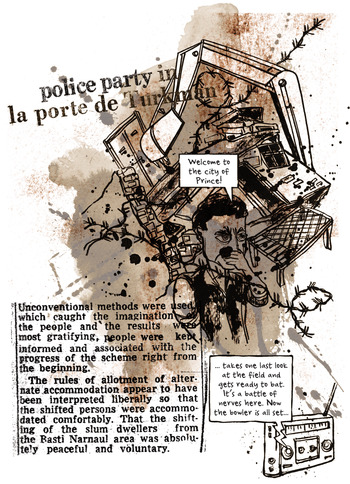
The interplay of image and text allows Ghosh to visualize the structural violence that state narratives are complicit in. Ghosh uses these juxtapositions to demonstrate how even democratic states deploy what Jean Comaroff and John Comaroff term “lawfare”—the use of legal instruments, namely “the violence inherent in the law, to commit acts of political coercion, even erasure” (“Law” 30). In one section, Ghosh depicts a particularly contentious part of Gandhi's urban development program—the slum clearance campaigns (and subsequent deaths) that have been left out of state history books. As bulldozers remove unwanted citizens, or “socially undesirables” (191)—dismantling their dwellings and burying their bodies—a transistor radio in the corner of the page broadcasts the commentary to the “final day, final hour” of India's cricket match against the West Indies (194). The illustrations of violated citizens contradict the accounts given by the newspaper clippings that claim the eviction was “peaceful and voluntary” (195; see fig. 1), while the layered collages and the accompanying ironic sports commentary challenge the state's record of its past and the idea of the state that hinges on that record: the conceptualization of the state as a democracy that has developed through different teleological stages of progress.
Indira Gandhi's slum clearance campaign in Ghosh's Delhi Calm. Reproduced in arrangement with HarperCollins Publishers India Private Limited from the book Delhi Calm, by Vishwajyoti Ghosh, and first published by them. All rights reserved. Unauthorized copying is strictly prohibited.

That narrative finds its expression on the page in text. Cricket, a British import to India, formed part of the imperial civilizing mission, and its inclusion in the scene through the radio commentary points to the ways in which the postcolonial state's rule book is a remnant of the so-called great game played by imperial powers. The state legitimizes its misuse of power by writing its violence into law and justifies its actions through a historical narrative of social disorder and crisis. Delhi Calm's juxtaposition of texts and images suggests that the postcolonial state's erasure of marginal lives in the name of progress is attributable to the state's commitment to a narrative of statehood that has placed European post-Enlightenment modernity at its pinnacle.
In response, Ghosh uses visual culture to represent alternative ways of articulating demands and identities. Luis Gomez Romero and Ian Dahlman argue that comics present us with an alternative “common law—comi'law.” They note that while stories depicting vigilante heroes or avengers contribute to popular debates of what is right or legitimate on the level of plot, comics’ visual media formally challenge the primacy of language in the expression of common values in communities and their legal systems (12). Comics can present alternative forms of civil society that the state fails to recognize. In India, the graphic narrative has its roots in both a commercial calendar art, which uses popular iconography to bring deities and rulers to the masses through the bazaar (Jain 96–97), and a contemporary comics tradition that started out as a correction to a colonial education. India's most long-standing comics series, Amar Chitra Katha, or “illuminated picture stories,” is still used by schools to teach local history and mythology. Today, graphic narrative publishing houses, like Navayana or Tara Books, are diversifying cultural and political representation by using Dalit artists to tell Dalit stories (e.g., using Gond art for a biography of the Dalit statesman B. R. Ambedkar, or Patua Scroll art to convey the effects of natural disasters on indigenous communities).
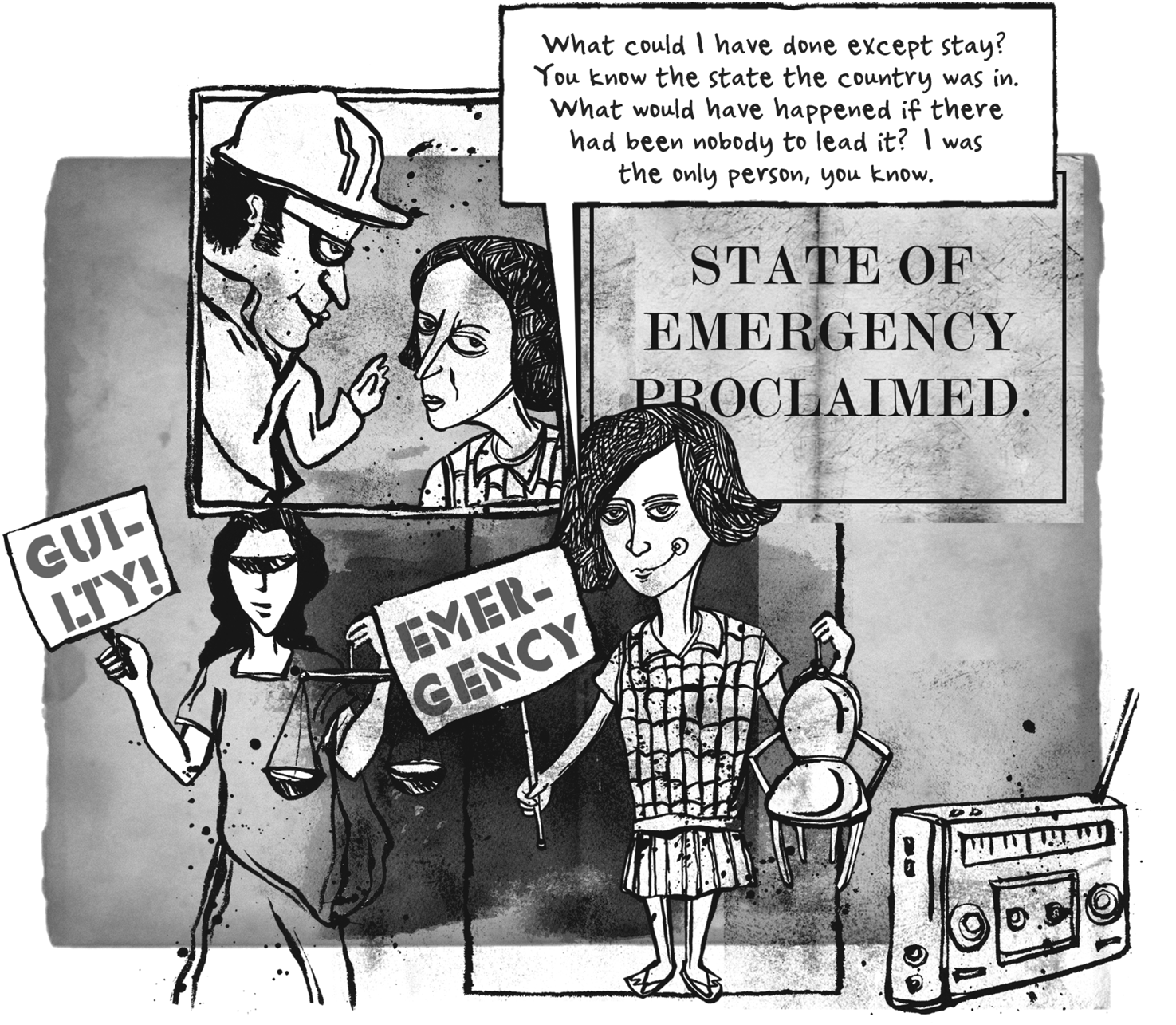
Ghosh's graphic narrative shows how visual media can be used to expose the ways in which power imbalances are concealed by state language and, subsequently, to highlight the limitations of language as a tool for dissent. While the emergency figures as a crackdown on civil rights, pictured in traffic signs like “Do Not Enter” and “Do Not Speak,” Delhi Calm borrows from different traditions of visual satire to represent a comi'law, or common law, through a carnivalesque folk culture. Indira Gandhi is represented as Mother Moon, whose political waxing and waning is echoed by the moon's trajectory across the night sky, while her supporters are identified by masks of the commedia dell'arte that fix their faces into ominously acquiescent grins. This satire exposes a show of democracy, a “New India Performance” where dissent is pushed to “a chorus in the wings” by a system that reduces participatory politics to a mere masquerade (Ghosh 11, 230). Ghosh's caricatures use exaggeration, inversion, and trivialization to remove what Gautam Bhatia calls “the aura” surrounding the primary participants and producers of history (xvi), ultimately subverting the state's monopoly over how it is represented. In one instance, Gandhi is depicted standing next to blindfolded justice, who weighs her scales to find the prime minister guilty. Gandhi, in turn, balances the emergency against her seat—the radio is silenced next to her (fig. 2). Gandhi tries to claim that her actions are legal, but Ghosh's image suggests she cannot ignore justice or hold popular opinion at bay indefinitely.
Caricature of Indira Gandhi in Ghosh's Delhi Calm, p. 117. Reproduced in arrangement with HarperCollins Publishers India Private Limited from the book Delhi Calm, by Vishwajyoti Ghosh, and first published by them. All rights reserved. Unauthorized copying is strictly prohibited.

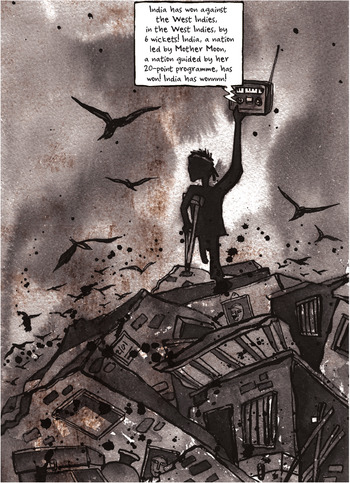
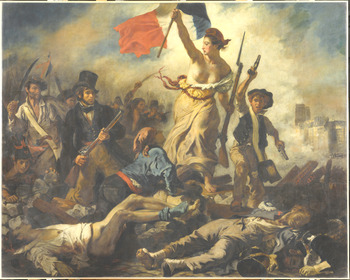
These satirical images capture the tension between the ludic and the rigid in the comics narrative system (the plastic and structural lines that Thomas LaMarre discusses, or the regulation and resistance to regulation that Bukatman theorizes). While these figures are not plastic (they lack the dynamism of shape-shifting characters), they break the narrative down into political, or editorial, cartoons that undercut the story lines they accompany. The slum-clearance sequence ends with a defiant silhouette of a one-legged man emerging from the wake of the bulldozers like a beacon against the dark sky, wielding a radio (fig. 3). It is a satirical take on Eugène Delacroix's classic painting Le 28 juillet: La Liberté guidant le peuple (1830; July 28: Liberty Leading the People), which similarly depicts a figure surmounting the rubble of the barricades (fig. 4). Whereas Delacroix portrays Marianne (the symbol of the French republic) brandishing a tricolor, leading the people forward after the July Revolution, Ghosh recasts Liberty as a heavily curtailed, mutilated form of democracy that denies its members constitutional rights. The homage is not so much to Delacroix as to his contemporary, Honoré Daumier, the French lithographer who used mimicry and mockery to disassemble state symbols and to keep the state responsible to higher ideals. The amputee is a reminder of the postcolonial state's own symbolism—or claim to represent freedom, equality, and fraternity—and its failure to fulfill these promises. The radio held up triumphantly—both a mouthpiece for the state and a rallying cry for resistance—is a symbol for the way popular culture works in and beyond the state.
Defiant figure emerging from the rubble in Ghosh's Delhi Calm, p. 198. Reproduced in arrangement with HarperCollins Publishers India Private Limited from the book Delhi Calm, by Vishwajyoti Ghosh, and first published by them. All rights reserved. Unauthorized copying is strictly prohibited.

Delacroix, Le 28 juillet: La Liberté guidant le peuple. 1830. Louvre Museum, Paris. Photo © RMN-Grand Palais (Musée du Louvre) / Michel Urtado.

Delhi Calm shows how the graphic narrative, as an alternative archive, continues the project of critiquing Indian national history begun by the subaltern studies school of historians. Scholars in subaltern studies have described how colonialism exported a Hegelian idea of world history in which the state, as Gyanendra Pandey argues, “creates the subject matter and the prose” (2). This form of history has overlooked not only alternative interpretations of modernity but also alternative modes of representing a collective political past. The spirit of development that G. F. W. Hegel saw resting on an idea of “a prose of the world” (150) is rooted in an experience of the prosaic that is captured by both the prose narratives of history and the prose form of the novel—an observation that Georg Lukács also makes in The Theory of the Novel (58–60, 88–90). As a result, the poetic, oral, and visual accounts that existed in other parts of the world were deemed evidence of other cultures’ backwardness and silenced as a means of political expression (Guha 5–8, 13). Graphic narratives like Ghosh's use the mixed form to revive the nonprose “narratologies” that Ranajit Guha suggests have been pushed to the limits of world history (5; see 5–6). They both collect alternative materials of history in a popular archive and act as a narratology of the past.
This type of history offers different ways of conceiving citizenship and political participation. If prose on the page in Delhi Calm stands for a particular form of statehood that is invested in a post-Enlightenment narrative of development, the nonprose records—captured by protest songs, poems, and, of course, the comics narrative itself—model alternative forms of collectivity and political action. Popular assembly (or clandestine meetings), for example, are represented through multiple panels that show not different moments in time but the same moment broken into fragments. The effect of these aspect-to-aspect transitions (to use Scott McCloud's terminology [72]) is, as Ghosh notes, a narrative “stillness” that dwells in “details, not in movement” (qtd. in Holmberg). This stillness promotes forms of political representation and collectivity that do not fit in a linear narrative of development.
On these terms, the graphic narrative calls on the civil sphere to challenge the state's monopoly over who receives political representation. Delhi Calm ends with a sign looming over Delhi's rooftops that situates the emergency among contemporary incidents of violence against minority groups that the Indian government has either covered up or condoned. “Do not speak about” the sign begins, and it goes on to mention both the emergency and the violence against the Sikh community in 1984 (which the state failed to hinder), the violence against India's Muslims in Ayodhya in 1992, and the riots in Gujarat in 2002 that the Bharatiya Janata Party (India's current ruling party) willfully ignored (Ghosh 246). Delhi Calm thus invites a critical stance toward the current state, whose recent laws delimiting pathways to citizenship by religion have sparked a wave of protests in India's larger cities, led especially by university students. The state, as a representative of the people, determines how that people is constituted. As Gayatri Chakravorty Spivak notes, citing Marx, representation in the sense of depiction (Darstellung), or speaking about, slides into representation as proxy (vertreten), or speaking for (275–76). The state lays claim to speaking for a people, concealing the ways in which it plays a hand in how those people are defined discursively. Delhi Calm reclaims the depiction, presenting portraits of protesting citizens and political leaders in order to challenge the state as an adequate, or a legitimate, representative of the people.
Nevertheless, graphic narratives like Ghosh's that exist at the limits of this understanding of state history are not outside it. Delhi Calm parodies (and critiques) its archive by drawing on Indian visual culture and borrowing the idioms of European satire—mimicking the paper truths of state documents and their devotion to European, colonial forms of modernity. It is an account of civil protest and state violence that turns to both law and history to justify its claims, thereby reinforcing their authority and replicating some of the strategies of the archives that it seeks to undermine. A discourse of justice informs the emergency (as exception), current objections to state laws, and the graphic narrative as exceptional history. Delhi Calm is framed, as much historic civil rights discourse has been, through an appeal to a law—moral or religious—that transcends the state: Mother Moon has perverted the course of justice, which popular narratives, like popular action, might set right. As writing on civil disobedience has long postulated, disobedience is a civic duty when the legal system is unjust (Bloom and Hobby). The breaking of laws in protest becomes a way of upholding superior, unwritten laws (or justice). Ghosh's graphic narrative offers not a rallying cry for action but a dissection of the difference between current law and justice. It uses the dialectic on the comics page to highlight the discrepancy between the state's claim to represent its people and the violent reality of that representation.
Disobedient Citizens
The global graphic narrative can also act as a platform for contemporary protest. Soltani and Khalil's web comic turned book, Zahra's Paradise, demonstrates how the graphic narrative's structural lines (and characters) can model forms of disobedience in an autocratic theocratic state. If in comics history the disobedient machines that break free of their production line have been mirrored in the elastic lines of comics characters that contrast with the rigid lines of comics narrative structure, Zahra's Paradise reflects this history, using form to play, metatextually, with the possibility of resistance within the structures of the state. Form becomes a vehicle to reflect on how oppression works through the Islamic Republic's infrastructure and a springboard to lobby the state for human rights. Zahra's Paradise portrays the fate of Iran's student-led Green movement—the so-called “lost generation” who disappeared after protesting the 2009 elections (14)—by following the story of a fictional mother, Zahra, in her search for her missing son, Mehdi. As we accompany Zahra through side alleys and seedy bureaucratic offices, witnessing underground beatings and prison torture, Soltani and Khalil use the graphic narrative's scenes and sequences, and its grids and gutters, to expose how a violent political system curtails speech and assembly.
Zahra's Paradise plays on the similarities between its own form and state infrastructure to get its message across. The role of visual propaganda in the Islamic Republic, where large looming portraits of the ayatollahs interpellate particular forms of disciplined citizenship, means that buildings resemble panels and the urban landscape turns into a graphic narrative of power. Conversely, in the text, the comic grids are emblematic of the state's systems and infrastructure. At the city morgue, Zahra's search is visually interlaced with snapshots from the book of the dead she must rifle through. Panels depicting Zahra and her son Hassan's conversations, set against the white background of the page, alternate with portraits of corpses against the black background of the morgue, creating the effect of a chessboard. The visual chess analogy shows citizens as pawns in the state's violent games and demonstrates the dark logic behind theocracy.
As a metaphor, it functions like Walter Benjamin's analogy of an eighteenth-century chess contraption in “Theses on the Philosophy of History.” The contraption comprises a table with a chessboard and a puppet player that is secretly operated by a person under the table. Benjamin argues that historical materialism operates like this rigged chess game. Like the hidden player that helps the puppet magically win, theology is the tool that enables historical materialism to redeem the present through the promise of radical change in the future. Through their chessboard, Soltani and Khalil suggest that Iran's judicial system likewise borrows from theology to defer justice to the afterlife.
The paneling in Zahra's Paradise signifies a rigged game, where citizens and popular movements have no representation other than in the morgue. Since in the Islamic Republic's legal system ultimate justice is divine, the only way to claim one's rights, or indeed to occupy a square, Soltani and Khalil's chessboard suggests, is through martyrdom. Mehdi, the missing son, is never fully represented in the text. Instead, his face is repeatedly evoked in other screens and panels—in his brother's blog, a missing person's poster, the still caught in a camera phone. Even as his tortured body is finally located and returned at the end of the graphic narrative, it is in a closed casket. As a protester, he cannot find representation in the existing structures of the narrative.
At the same time that Soltani and Khalil use the grids to stand in for the hard line(s) of the autocratic state's ideology, they use the graphic narrative's frames and gutters (the white spaces between panels in comics) to resist this system of political representation. For example, while the title of Soltani and Khalil's graphic narrative warns us that Zahra's search for justice is predestined to lead to Zahra's Paradise—the colloquial name for Tehran's cemetery, where the government buried protesters in secret—the structure of the graphic narrative resists this inevitability by playing with the concept of narrative closure. In comics terminology, closure is the process by which the reader has to fill in what the frames can only partially show, making leaps of imagination to complete scenes and actions (McCloud 65). By not representing Mehdi in their grids, Soltani and Khalil withhold emotional and visual closure, encouraging readers to seek resolution outside the existing frames—specifically in the gutter.
In the margins, or the gutters, of the text, Soltani and Khalil include alternative captions or text boxes, with poetry from an older Persian tradition that predates the British colonial intervention and the Islamic Republic, and provide glossaries that explain the graphic narrative's many intertexts and references. Verses by Omar Khayyam, Hafez, Saadi, and Rumi snake along the edges of the panels and present an idea of justice (and paradise) that can be reached without death or martyrdom. One couplet by Khayyam, “a jug of wine and thou . . . is paradise now,” is quoted by the underground printer and copy shop owner to Hassan, Mehdi's brother (143). The couplet, which suggests that paradise, freedom, and equality can be achieved in this world, is delivered in an open speech bubble in a panel without frames. Like Mehdi, who cannot be represented in the panels, the Khayyam quote cannot be contained in the frames of the comics grid. The narrative structure implies that Khayyam's utopian ideals of a more democratic and just society can be achieved only through a radical rupture with the system: through a break in the narrative panels or through reading their subtexts. In addition to these reflections on the nature of paradise, Soltani and Khalil's footnotes explain that Mehdi is named after the twelfth and hidden imam in Shia tradition—a messianic harbinger of justice yet-to-come. The subtexts, or paratextual meanings, make us dwell on the possibility of Mehdi's return as a revolutionary messiah, the twelfth imam, that might, as Benjamin writes in his theses on history, “blast open the continuum of history” and offer radical change (254).
If the narrative sequence in the panels (and grids) leads to the protesters’ inevitable deaths, the gutters encourage the reader to think that the utopian idea of change is possible. They hint at resurrection, or a rising—as a resolution for Zahra's son and for the Iranian state. By slowing down our reading—and thus the movement to Mehdi's inevitable fate (the arrival in Zahra's Paradise, the cemetery)—the paratextual notes and glossaries keep the possibility of change open, in the plot of the text and in the structure of the narrative. Soltani and Khalil's creative use of structural lines points to the ways in which exceptions to the rule, indeed changes in rulers, are possible if we look to the gutter—both the white spaces of the comics page and the liminal spaces of Tehran's backstreets and information highways. In fact, Zahra's Paradise started its life as a web comic, and a group of hackers who break into Iran's prison database eventually recovers Mehdi's body. The graphic narrative thus celebrates the “blogistan” where Iran's civic sphere, if not its tragically killed protesters, is being revived through an urban and digital counterculture (Elahi 960).
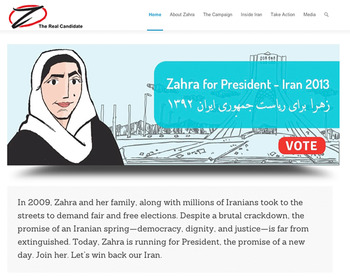
These alternative spaces, and the subcultures they foster, offer sites of emancipatory potential both within and outside the text. The digital platform where the graphic narrative was initially published allowed the creators to evade Iran's heavily censored publishing system and offered a different route into Iran's political debates. Following the success of their book, Soltani and Khalil used Zahra's character to launch an online human rights campaign in the presidential election of 2013. The website Vote4Zahra encouraged visitors, whether foreign or Iranian, to vote for a human rights agenda of free speech, assembly, and political accountability and to pledge their support to Zahra, “the real candidate” in the elections (fig. 5). In breaking the boundaries of the graphic narrative's fictional reality, the website invited readers to suspend their disbelief and to think beyond the limits of the text and the autocratic political system.
The home page of the website Vote4Zahra from XYZ Press, which designed the campaign materials (www.xyzpressinc.com/logo-design-web-design/).

The creators of Zahra's Paradise performed metatextually the forms of dissent they portrayed in the book. While the protesters in the narrative languish in Tehran's prisons, the web campaign released Zahra's character “from the tyranny of the page,” to adopt a phrase from Jason Dittmer and Alan Latham (429), and staged a breakout from the state grids. Zahra's figure became the fictional spearhead of a real protest campaign and in the process replaced the deindividualized and dehumanized citizen that emerges in the graphic novel's portrayal of Mehdi—a “signature of a people without a name, without a face, without a history, without a future” (Soltani and Khalil 221)—with an empowering symbol of defiance. The web campaign recast the state-endorsed figure of the mother of the martyr (prevalent in Iran's murals and critiqued in Soltani and Khalil's story) as Antigone, Sophocles's tragic Greek hero who lays claim to human, if not civil, rights.
Soltani and Khalil's graphic narrative—and its digital paratexts—thus demonstrated ways for citizens to make their voices heard outside the grids of power. Specifically, Zahra's Paradise encouraged a public of fans—alternative, more creative fanatics—to perform and project rights claims in a system where participatory politics have been heavily curtailed. The website rallied readers and visitors around Zahra as an icon for justice in order to model how to perform the character of a rights-bearing subject in the public sphere. By putting the “fun,” as Soltani quips in a BBC interview, “back in fundamentalism,” Vote4Zahra invited readers to perform small acts of civil disobedience online and on the street (qtd. in “Iran Exile”). It continued a comics tradition of showing disobedient machines defying their creators, this time in the digital realm. Visitors were encouraged to print Zahra's poster and upload photographs of themselves shielding their faces with hers in public, making bodies appear where they could not otherwise assemble. Zahra's digital figure resonated with other activist campaigns that are referred to in the text: the online dedications to Ziba (another Zahra) Kazemi, the Iranian-Canadian photojournalist beaten to death by the regime, and the campaign that arose around Majid Tavakoli, the arrested student protest leader who was photographed in a hijab by the revolutionary guard in an attempt to discredit him. Iranian men around the world responded by posting pictures of themselves in hijabs beneath the slogan “Be a Man.”
Zahra's Paradise is part of a longer lineage of graphic narratives that have modeled dissent for their readers. For example, the protagonist in Alan Moore's 1982 dystopian graphic novel, V for Vendetta—an insurgent in a fascist state who wears a Guy Fawkes mask—has become the adopted symbol of the hacktivist group Anonymous, whose followers use the mask in public demonstrations around the world. It is partly this history in comics fan culture that renders the graphic narrative such a successful medium for sparking different forms of opposition to authority. Fans engage in acts of reading that also appropriate narratives (through fan writing or role play—notably cosplay) and thereby pose a challenge to particular ideas of authorship. When the state is the subject of the text, such challenges can become democratic challenges to authoritarian ideas of political representation. Textual engagement, beyond the act of reading, models forms of civil disobedience.
Graphic narratives like Zahra's Paradise use new media technologies and interactive reading practices to shift readers from what James Holston and Arjun Appadurai term disengaged “spectators who vote”—whether the system is fair or not—to actors who can perform rights claims and be counted, grieved, and ultimately recognized in a more democratic state (7). When citizens cannot participate in routine practices of citizenship—voting, paying taxes, enlisting in the military—that are pre-scripted and state-controlled, they can disturb or rupture such actions by making “a scene,” a difference: performing alternative forms of political participation (Isin 379; see 378–83). Standing behind Zahra's sign on the streets of Tehran or Los Angeles, London or Mashhad, was to make a claim to be counted, but it also became a means of holding the state accountable by subscribing to the campaign's human rights agenda. Soltani and Khalil's blog, book, and website brought into being not just a public but a counterpublic, what Michael Warner terms an assembly that differs from the restrictive form of subjecthood put forward by the state through a “critical relation to power” (57). By pledging their support for Zahra, contributing to the site's questionnaire, or disseminating their posters, readers became members of a textual community that imagined and practiced alternative forms of political representation.
However, while modeling disobedience, Zahra's Paradise does not propose to overthrow the state. Mehdi's potential remains revolutionary, but the call for justice, through Zahra's character, is co-opted for a human rights agenda rather than a movement for radical political change. The narrative ends with a textual monument for the 16,901 Iranians who have gone missing since 1979, named OMID. The monument comprises the names of each missing Iranian. OMID's thirteen-page list expresses grief without resurrection, death without paradise, and offers another representation of the Iranian public outside the frames of the text and the administrative grids of the city. The monument has a digital parallel in the Abdorrahman Boroumand Center's searchable online gallery for the memorial. OMID acts as a competing cemetery to Zahra's Paradise and reframes Iranian lives as “grievable” lives, what Judith Butler argues in Frames of War is the measure of human worth.
At the same time that Zahra's Paradise challenges the economy of death (and martyrdom) that the Islamic Republic's violent theology promotes (OMID offers an idea of the state that Soltani and Khalil call “a democratic polity . . . where citizens posthumously enjoy their human rights” [257]), the graphic narrative frames its claims to democratic representation through the same discourse that the state uses to claim its legitimacy—that is, the afterlife. Zahra's Paradise uses similar “statements”—in other words, articulations of authority or power—to contemporary states, which discourse of governance, Comaroff and Comaroff argue, turns increasingly to a language of universal rights to produce the “impression of consonance amidst contrast” in heterogeneous communities (“Reflections” 457).
Zahra's Paradise's pragmatic approach to social justice serves as an example of how the graphic narrative captures the changing relation between street culture, citizen protest, and formal politics. It reflects the tactics of popular protest movements and their strategic, at times ambivalent, approach to the state. Maneuvering around the state, but within its frameworks, in order to make the rights claims or petitions for change that Zahra's Paradise promotes, is a feature of the current negotiation between popular movements and state structures or forms. Social theorists have shown that popular protest movements are adapting their strategies to the governmentalization of the street (Trejo; Almeida): as political parties in both democracies and autocracies recruit social movements to win elections, activism has become part of the machinery of governance. More violent or radical means of resistance are abandoned as the possibility of political participation (predominantly through elections, however unfree or unfair) engenders coalitions between activists—NGOs, students, labor unions, or minority groups—and political parties that would otherwise differ in their particular aims and means. While anticolonial movements were positioned against a state system imposed on them, postcolonial movements are working to change a state for which they are responsible. The shift in foreign intervention or colonial dynamics has resulted in a different kind of resistance. The symbiosis of the ballot box and the street in the postcolonial present has not only deradicalized protest (Trejo) but also demanded new nonviolent forms of expression: forms like the graphic narrative that stand up to the state, but through its own frameworks, or means of petition.
The global graphic narrative draws on a history of protest methods to represent dissent in the age of social media and social movements. Reading the graphic narrative, through Levine, as a global protest form that encounters and addresses political forms (of governance or citizenship, for example) demonstrates how participatory politics are being renegotiated in the postcolonial present. The graphic narrative form captures the ambivalent strategies of contemporary protest through the “double movement of containment and resistance” that Stuart Hall identified in popular culture (509). Popular culture cannot be defined by its mass appeal or particular status in a hierarchy of taste, Hall argues. It is neither a mouthpiece for tradition nor emblematic of resistance to the norms of dominant culture; it is rather a balance of dominant, oppositional, and emergent forces that offers the ground on which cultural “transformations are worked” (509). Contemporary political systems, whether democratic or authoritarian, demand political participation from their populations in order to enact change. In the graphic narrative these transformations occur through a juxtaposition of “regulation and resistance to regulation” or a politics of formal petition (Bukatman 4).
Studies of different forms of protest literature show us, as Zoe Trodd notes, alluding to Audre Lorde, how artists and writers have long appropriated the master's tools to dismantle the master's house (xxv). However, graphic narratives, like the social movements around them, do not dismantle the master's house; they mimic the architecture and the iconography of state infrastructures to make room for marginalized groups and voices within them. Graphic narratives like March, Delhi Calm, and Zahra's Paradise do not dissolve the state's archive or overthrow its legal systems, and they neither disavow the state nor radically break with its past. Instead their narrative systems expand existing forms of political representation. The graphic narrative uses its visual vocabulary to expose injustice (or bear witness), especially when that injustice is structural, while making a claim or demand that enters into dialogue with the state. It speaks its language as a mode of contemporary resistance—instead of rejecting its “codes and canons,” as Barbara Harlow argued about earlier forms of resistance literature (xvi). As a popular protest form, the graphic narrative speaks from the so-called gutters, on the page and the city streets, where the battles over political participation are fought and won.