Implications
Soybean meal (SBM) has been considered to be the most important plant-based protein source in livestock nutrition. However, the presence of anti-nutritional compounds such as trypsin inhibitor, lectins, non-starch polysaccharide in soybeans adversely affects their nutrient digestibility and absorption. In this study, feeding the diet supplemented with β-mannanase improved apparent ileal digestibility (AID) of dry matter, sum of essential amino acids, arginine, histidine, lysine, valine and glycine and the standardized ileal digestibility of lysine. Regarding SBM types, both SBMs had similar AID values for most of the nutrients except threonine and proline, which had higher AID values in SBM 48% CP. Results from this study indicate that the low digestibility of SBM might have favoured the positive effect of β-mannanase supplementation.
Introduction
Soybean comprises nearly two-thirds of protein sources used in animal feeds worldwide due to its popularity as a feed ingredient. Soybean meal undeniably plays an important role in swine nutrition. Therefore, efforts should be made to maximize its use so that it could benefit the swine industry’s sustainability as a whole (van Kempen et al., Reference van Kempen, van Heugten, Moeser, Muley and Sewalt2006). Soybean contains a high concentration of carbohydrates mainly consisting of non-starch polysaccharides (NSP) and oligosaccharides. NSP is divided into insoluble NSP (mainly cellulose) and soluble NSP (mainly pectic polymers that are partially soluble in water). Monogastric animals do not have enzymes to hydrolyze these carbohydrates. Thus, their digestion is through bacterial fermentation. β-mannan (also known as β-galactomannan) is a soluble NSP containing repeated units of mannose complexed with galactose or glucose linked to the β-mannan backbone(Ouhida et al., Reference Ouhida, Pérez and Gasa2002; Hsiao et al., Reference Jackson2006; Prajapati et al., Reference Prajapati, Jani, Moradiya, Randeriaa, Nagar, Naikwadi and Variya2013). The NSP can resist action by pig’s endogenous enzymes. However, it might be digested through bacterial action at the distal gastrointestinal tract (Choct et al., Reference Erickson2010). Although various NSPs have differing physicochemical characteristics, it is generally agreed that the anti-nutritional effects of soluble NSP are attributed to their potential in increasing digesta viscosity that could modify gut transit time, their potential in altering morphological and physiological function of the gut and their ability of influencing microbial population (Kerr and Shurson, Reference Kerr and Shurson2013).
The use of exogenous enzymes and feed processing methods such as heat treatment, dehulling and manipulating feed particle size are some of the techniques in animal nutrition to optimize the digestibility of nutrients available in soybeans (Kim et al., Reference Kim, Hancock and Hines2000). Enzymes are used to get rid of anti-nutritional factors such as trypsin inhibitors (TI) and lectins, digest NSP, or supplement the activity of endogenous enzymes to increase nutrient digestibility (Lee and Yu, Reference Lee and Yu2013). β-mannanase, a hydrolytic enzyme, has been reported to be effective in breaking down β-mannan fraction and reversing the negative impact caused by β-mannan when fed to livestock (Hsiao et al., Reference Jackson2006; Jackson, Reference Cervantes-Pahm and Stein2010). In addition, SBM 44% CP and SBM 48% CP are excellent sources of protein for pigs because soy proteins have excellent balance of indispensable amino acids. However, the digestibility of amino acids in SBM 48% CP is greater than that in SBM 44% CP (Baker and Stein, Reference Baker and Stein2009). SBM 48% CP contains high protein and low fiber leading to effective growth performance and production. Dehulling of SBM has additional advantage of allowing more space to formulate higher nutrient density and higher energy feeds at a lower cost. Thus, the use of de-hulled SBM is reported to be economical (Erickson, Reference Holst1995). To determine whether NSP hydrolyzing enzyme could promote ileal digestibility of nutrients in growing pigs when supplemented in a diet containing SBM, β-mannanase was supplemented to the diet of growing pigs containing two SBM sources (SBM 44% CP or SBM 48% CP). It was also expected that SBM with lower hulls would have better digestibility and there would be inter-relationship between enzyme and SBM source in promoting ileal digestibility of nutrients and amino acids.
Material and methods
The experiment protocol was reviewed and approved by the Animal Care Committee of Dankook University.
Experimental diets
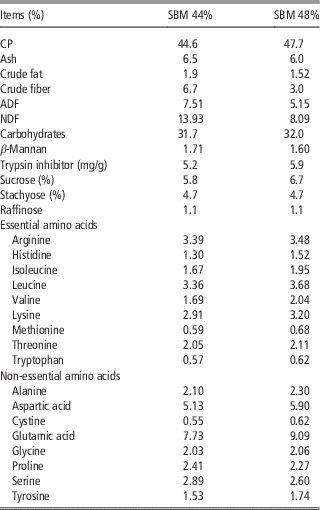
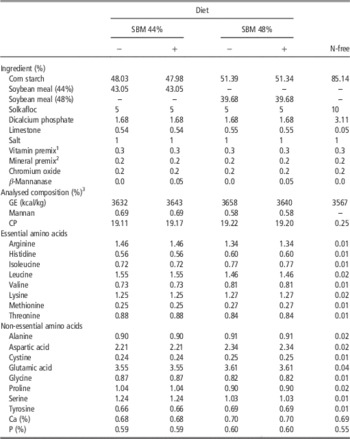
Test ingredient SBMs originated from India was obtained from commercial sources and identified by the supplier as either non-dehulled (SBM 44% CP) or dehulled (SBM 48% CP). The nutrient compositions and biochemical characteristics of test ingredients are summarized in Table 1. The experimental diet consisted mainly of corn starch and SBM 44% CP or SBM 48% CP supplemented with or without 400 U β-mannanase/kg. Enzyme was added to the diet at the expense of corn. The analysed gross energy (GE) for SBM 44% CP was 3632 kcal/kg and SBM 48% CP was 3658 kcal/kg. The CP content in all the diets was analysed to be ~19% and β-mannan content was 0.69% and 0.58% in SBM 44% CP and SBM 48% CP, respectively. The amino acids content in SBM 44% CP was lower than SBM 48% CP. The nitrogen-free diet was used to determine basal endogenous losses of amino acids. Commercial β-mannanase (CTC Bio Inc., Seoul, Republic of Korea) was produced by using Bacillus subtilis (WL-1) grown on Luria broth at guaranteed activity of 800 U/g. Experimental diets (Table 2) were provided in mash form and formulated to comply with the National Research Council (NRC, 2012) recommendations for nutrient requirements of swine.
Analyzed nutrient composition of soybean meals

SBM 44%=soybean meal with 44% CP; SBM 48%=soybean meal with 48% CP.
Ingredient composition of experimental diets as-fed basis

SBM 44%=soybean meal with 44% CP in diet minus (−) or plus (+) 0.05% β- mannanase enzyme; SBM 48%=soybean meal containing 48% CP in diet minus (−) or plus (+) 0.05% β- mannanase enzyme; GE=gross energy.
1 Provided per kg of complete diet: 11 025 IU vitamin A; 1103 IU vitamin D3; 44 IU vitamin E; 4.4 mg vitamin K; 8.3 mg riboflavin; 50 mg niacin; 4 mg thiamine; 29 mg d-pantothenic; 166 mg choline; 33 μg vitamin B12.
2 Provided per kg of complete diet: 12 mg Cu (as CuSO4·5H2O); 85 mg Zn (as ZnSO4); 8 mg Mn (as MnO2); 0.28 mg I (as KI); 0.15 mg Se (as Na2SeO3·5H2O).
3 Values for β-mannan, CP and amino acids have been analysed independently for the experimental diets.
Experimental design and animals
A total of 20 barrows ((Landrace×Yorkshire)×Duroc) with average BW of 25.08±3.42 kg were fasted for 16 h. After induction of anesthesia intramuscularly using a combination of tiletamine hypochloride and zolazepam hypochloride (0.2 ml/kg Zoletil 50; Virbac Labarotory, Carros, France), T-cannulas were surgically attached 15 cm proximal to the ileocecal junction. Animals were then placed individually in stainless steel metabolism enclosure (1.5×0.5 m) in a temperature controlled room (22°C) with each pen equipped with a nipple drinker and a feeder. Pigs were allowed 14 days recovery post-surgery before the start of the experiment. Pigs were selected based on their initial BW and randomly allocated to one of the four dietary treatments plus a N-free diet group using a completely randomized design (four replicates per treatment).
Experimental procedures
Daily feed allowance per pig (0.906 kg/day) was calculated according to the formula of 0.05×BW0.9 as proposed by Armstrong and Mitchell (1955). Pigs were provided two equal meals at 12 h intervals (0800 and 2000 h). Water was provided ad libitum. The experimental period consisted of 7 days of diet adaptation followed by 2 days (i.e. day 8 and day 9) of ileal digesta collection through cannulas. They were collected every 30 min for 12 h starting ~15 min after feeding the morning meal. Collected digesta were immediately frozen at −20°C until further analysis.
Chemical analysis
Before chemical analysis, feed samples and ileal digesta were thawed and dried at 60°C for 72 h. They were subsequently ground and passed through 1 mm screen. Digestibility was determined by using chromic oxide (Cr2O3) as an indigestible marker. All feed samples and ileal digesta were analyzed for DM (method 930.15) and N (method 990.03) according to AOAC International (2007) procedures. Chromium was analyzed using UV absorption spectrophotometry (UV-1201; Shimadzu, Kyoto, Japan) according to the methods of Williams et al. (Reference Williams, David and Iismaa1962). Nitrogen was measured using a Kjeltec 2300 Analyzer (Foss Tecator AB, Hoeganaes, Sweden). Energy was determined using a Parr 6100 oxygen bomb calorimeter (Parr instrument Co., Moline, IL, USA).
To determine mannan content, test ingredients and experimental feed samples were hydrolyzed with 72% (w/w) H2SO4 for 1 h. Samples were then diluted with distilled water to final 1N H2SO4 and incubated at 121°C for 45 min. Mannan contents in the hydrolysates were determined using an evaporative light scattering detector and a Shodex sugar column SP0810 (8.0×300 mm; Showa Denko K.K., Tokyo, Japan). Soybean meal sources, diets and ileal digesta were also subjected to CP (method 990.03; AOAC International, 2007) and AA (Hitachi Amino Acid Analyzer, model No. L8800; Hitachi High Technologies America Inc., Pleasanton, CA, USA) analysis using ninhydrin for post-column derivatization and norleucine as internal standard. Before analysis, samples were hydrolyzed with 6N HCl at 110°C for 24 h (method 982.30 E(a); AOAC International, 2007). Methionine and cystine were determined as Met sulfone and cysteic acid after cold performic acid oxidation overnight before hydrolysis (method 982.30 E (b); AOAC International, 2007). Tryptophan was determined after NaOH hydrolysis at 110°C for 22 h (method 982.30 E(c); AOAC International, 2007). Additional analyses on test ingredients included analysis for ether extract (method 2003.06; AOAC International, 2007), ash (method 942.05; AOAC International, 2007), ADF (method 973.18; AOAC International, 2007), NDF (Holst, Reference Hsiao, Anderson and Dale1973), sucrose, stachyose, raffinose (method 982.14; AOAC International, 2007) and TI activity (method Ba 12-75; American Oil Chemist Society, Reference Armstrong and Mitchell2006).
Calculations and statistical analysis
Values for apparent ileal digestibility (AID) and standardized ileal digestibility (SID) of nutrients and amino acids were calculated using the following equations adapted from Stein et al. (Reference Stein, Seve, Fuller, Moughan and de Lange2007).
 $${\rm AID}\,\left(\!{\rm \,\%\,}\!\right)\,{\rm {\equals}}\,\left[ {{\rm 1\!-\!(AA}_{{{\rm digesta}}} {\rm {\div}\,AA}_{{{\rm diet}}} {\rm ){\times}(Cr}_{{{\rm diet}}} {\rm {\,\div}\,Cr}_{{{\rm digesta}}} {\rm )}} \right]\!{\rm {\times}100 }$$
 $${\rm IAAend\,{\equals}\,(AA}_{{{\rm digesta}}} {\rm ){\times}(Cr}_{{{\rm diet}}} \,{\rm {\div}\,Cr}_{{{\rm digesta}}} {\rm )}$$
 $${\rm SID}\,\left( {\rm \,\%\,} \right)\,{\rm {\equals}\,AID{\plus}(IAA}_{{{\rm end}}} \,{\rm {\div}\,AA}_{{{\rm diet}}} {\rm ){\times}100}$$
where AAdiet and AAdigesta are AA concentrations of the diet and ileal digesta, respectively (g/kg of DM), Crdiet and Crdigesta are chromium concentrations of the diet and ileal digesta, respectively (g/kg of DM); and IAAend is the basal endogenous loss of an AA (g/kg of dry matter intake).
Data were analyzed as a completely randomized design with 2×2 factorial arrangement using GLM procedures (SAS Institute, 1996). Main effect included SBM types (SBM 44% CP v. SBM 48% CP) with or without β-mannanase administration as well as the interaction between β-mannanase and types of SBM. Variability in data was expressed as standard error of means. Statistical significance was considered when P-value was <0.05.
Results
Results of nutrient compositions of the SBM 44% CP and SBM 48% CP are summarized in Table 1. β-mannan contents in the SBM 44% CP and SBM 48% CP were 1.7% and 1.6%, respectively. ADF and NDF content in SBM 44% CP (7.5% and 13.9%, respectively) were higher than that in SBM 48% CP (5.2% and 8.1%, respectively). Anti-nutritional factor TI was 5.2 mg/g in SBM 44% CP and 5.9 mg/g in SBM 48% CP. Sucrose content was 5.8% in the SBM 44% CP and 6.7% in the SBM 48% CP. Analysed ingredient compositions of experimental diets are listed in Table 2.
AID of nutrients
AID values for DM, energy and N are summarized in Table 3. Supplementation of β-mannanase improved AID of DM but did not improve (P>0.05) AID of N and energy. The type of SBM had no significant effect on AID of DM, N or energy either.
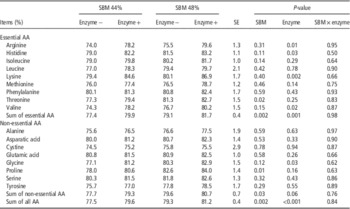
Effect of supplementation of β-mannanase on apparent ileal digestibility of nutrients in soybean meals

SBM 44%=soybean meal with 44% CP in diet minus (−) or plus (+) 0.05% β-mannanase enzyme; SBM 48%= soybean meal containing 48% CP in diet minus (−) or plus (+) 0.05% β-mannanase enzyme.
AID of amino acids
AID of both essential and non-essential amino acids are shown in Table 4. β-mannanase supplementation significantly (P<0.05) improved the AID of the sum of essential amino acids, arginine, histidine, lysine, glycine and valine. The AID of threonine and proline in SBM 48% CP was significantly (P<0.05) higher than that in SBM 44% CP.
Effect of supplementation of β-mannanase on apparent ileal digestibility of amino acids in soybean meals fed to growing pigs

SBM 44%=soybean meal with 44% CP in diet minus (−) or plus (+) 0.05% β-mannanase enzyme; SBM 48%=soybean meal containing 48% CP in diet minus (−) or plus (+) 0.05% β-mannanase enzyme; AA=amino acids.
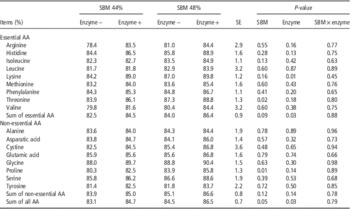
SID
SID of amino acids is shown in Table 5. β-mannanase supplementation significantly (P<0.05) improved the AID of lysine. The SID of threonine and proline in SBM 48% CP was significantly (P<0.05) improved than that in SBM 44% CP. The sum of amino acids in SBM 48% CP had the tendency (P=0.05) of improvement than that in SBM 44% CP.
Effect of supplementation of β-mannanase on standardized ileal digestibility of amino acids in soybean meals fed to growing pigs

SBM 44%=soybean meal with 44% CP in diet minus (−) or plus (+) 0.05% β-mannanase enzyme; SBM 48%=soybean meal containing 48% CP in diet minus (−) or plus (+) 0.05% β-mannanase enzyme; AA=amino acids.
Discussion
In agreement with published values (NRC, 2012), the CP concentration of SBM 48% CP in this study was greater than that of SBM 44% CP whereas the crude fiber content in SBM 44% CP was higher than that in SBM 48% CP. The concentration of ADF and NDF in SBM 44% CP was higher than that in SBM 48% CP. However, the values of ADF and NDF in SBM 44% CP were higher than published values (NRC, 2012). The TI content in de-hulled SBM was about 6 TI units, indicating that both SBM sources were not properly processed. The average concentration of TI in raw soybean is 35 TI units. In properly processed soybean, it is reduced to below 5 units which is an acceptable limit.
The AID of DM, N and energy of SBM 48% CP was not different from those of SBM 44% CP in the present study. Likewise, AID and SID of most indispensable and dispensable amino acids were not improved significantly in SBM 48% CP compared with those of SBM 44% CP except for the AID of threonine and proline, which was significantly higher in SBM 48% CP (87.3% and 83.9%, respectively) than that in non-SBM 44% CP (83.9% and 80.3%, respectively). The reason for no improvement of AID and SID of most nutrients in de-hulled SBM (SBM 48% CP) could be due to low quality of SBM. De-hulled SBM with high TI content might have inhibited trypsin activities in the small intestine of pigs, consequently leading to low digestibility of nutrients. The possible cause of higher digestibility of threonine and proline in SBM 48% CP may be due to lower fiber contents compared with SBM 44% CP. Moreover, the AID and SID values of indispensable and dispensable amino acids in both SBM sources were below the range of values reported by Cervantes–Pahm and Stein (Reference Cho and Kim2010) and NRC (2012) except that the AID value of threonine (81.3%) in SBM 48% CP was within the values reported by NRC (2012). The differences in AID and SID values in each amino acid in the present study may be attributed to variety and source of soybean, especially for de-hulled SBM. This might be due to the extent of dehulling and other processing technology employed as well as the quality of SBM (Kang et al., Reference Kang, Li, Xing, Mckinnon and Sun2003; Baker et al., Reference Baker, Kim and Stein2010).
To enhance digestibility, diets were supplemented with β-mannanase. We expected that this enzyme might hydrolyze the NSPs present in SBMs or supplement activity of endogenous enzymes to increase nutrient digestibility. In the current experiment, AID for DM consistently had a higher value in treatment groups consuming enzyme-supplemented diets. This is partially consistent with that of Mok et al. (Reference Mok, Lee and Kim2013). They have reported improvements in AID values for DM, CP and GE when β-mannanase was supplemented to diets containing palm kernel expeller. Meanwhile, the inclusion of both β-mannanase and xylanase in low nutrient density diets fed to swine feeds have been reported to improve total tract digestibility of N and energy (Cho and Kim, Reference Choct, Dersjant-Li, McLeish and Peisker2013). The efficacy of β-mannanase on AID of N and energy in the current study might have been influenced by the low quality of SBM because both SBM sources had TI at the level higher than accepted level.
Mok et al. (Reference Mok, Lee and Kim2013) have noted that β-mannanase supplementation in a diet based on corn, soybean meal and palm kernel expellers could increase the AID of leucine and phenylalanine when given to growing pigs. The increase in AID of these amino acids was explained by the availability of higher mannan content in palm kernel expeller, which is a substrate for β-mannanase. Results of the current study showed higher AID of arginine, histidine, lysine, valine and glycine in enzyme supplemented SBM than that in non-supplemented SBM. Considering SID values, only lysine, the first limiting amino acid in swine, had a higher SID value as a result of β-mannanase supplementation. Furthermore, supplementation of a single enzyme might have hydrolyzed a portion of NSP, which might have resulted in insignificant improvement of the digestibility of nutrients.
In the present experiment, supplemental β-mannanase did not have interactive effects with SBM on all the parameters measured. The probable reason why we failed to observe interaction between β-mannanase and soybean meals may be due to relatively small amount of mannan in the diets, which is the major substrate ingredient for β-mannanase. A study by Kiarie et al. (Reference Kiarie, Owusu-Asiedu, Simmins and Nyachoti2010) reported that the supplemental enzymes such as xylanase and β-mannanase interacted with phytase due to the abundance of substrate in wheat and barley-based diets. Further research with corn-SBM-based diet or other ingredients containing mannan in large quantity may elucidate a possible interaction between β-mannanase and diets.
Conclusion
In conclusion, the present study indicated that the ileal digestibility of most amino acids in SBM 48% CP was not significantly different from that in SBM 44% CP. Moreover, the AID and SID values of amino acids for both SBM sources were lower than reported values. Supplementation of β-mannanase showed higher AID of arginine, histidine, lysine, valine and glycine. However, it did not have significant effect on SID of these amino acids except for lysine. An improvement in the SID of lysine would be advantageous since it is the first limiting amino acid in swine.
Acknowledgements
This study was supported by the Research Fund of the Dankook University in 2015.