Introduction
Wheat (Triticum aestivum L.) occupies a major place in the cereal economy of the world. Globally, wheat is the largest cultivated crop, with an estimated 220.19 million hectares (mha). India occupies second place with 102.18 million ton production in 2018–19 from the acreage of 29.55 mha (ICAR-IIWBR, 2019). Being a staple crop, its production needs to be sustained for food and nutritional security. While most of the yield increases to date have resulted from manipulation of a few major traits such as height, photoperiodism and vernalization, meeting future demand for increased yields will require exploitation of novel genetic resources (Skovmand et al., Reference Skovmand, Reynolds and DeLacy2001).
The warmer parts of the wheat-growing areas globally are affected by several diseases, and among these, spot blotch (SB) or foliar blight caused by Bipolaris sorokiniana (Sacc.) Shoemaker is one of the most concerning. It is prevalent in wheat-growing regions of Bangladesh, Nepal, south-east Asia, Latin America, eastern India, south-east China, south-east Australia, sub-Saharan Africa, northern Kazakhstan and the Great Plains of the USA and Canada, causing significant losses in the yield of up to 70% under suitable climatic conditions with susceptible cultivars, and deteriorating the grain quality (Duveiller et al., Reference Duveiller, Kandel, Sharma and Shrestha2005; Sharma et al., Reference Sharma, Duveiller and Jacquemin2007; Acharya et al., Reference Acharya, Dutta and Pradhan2011; Duveiller and Sharma, Reference Duveiller, Sharma and Sharma2012; Zhu et al., Reference Zhu, Bonnett, Ellis, Singh, Heslot, Dreisigacker, Gao and Mujeeb-Kazi2014; Singh et al., Reference Singh, Zhang, He, Singh, Chand, Mishra, Malaker, Reza, Rahman, Islam, Chowdhury, Bhattacharya, Kalappanavar, Crossa and Joshi2015; Ayana et al., Reference Ayana, Ali, Sidhu, Hernandez, Turnipseed and Sehgal2018). In the wake of global climate change, SB is also becoming a serious concern in new areas with irrigated and low rainfall wheat production systems including certain parts of the breadbasket of South Asia, particularly the Indo-Gangetic and Trans-Gangetic plains (Gupta et al., Reference Gupta, Chand, Vasistha, Pandey, Kumar, Mishra and Joshi2018).
An important result from studies involving DNA polymorphism, electrophoretic karyotypes and comparative genomics based on whole-genome sequencing in B. sorokiniana is that different isolates differ in genome size and karyotypes. This suggests that differentiation in SB fungal isolates has occurred due to a variety of structural changes in chromosomes and the genomes, including deletions/duplications and translocations (Gupta et al., Reference Gupta, Vasistha, Aggarwal and Joshi2017), which speaks of enhanced possible threats due to this fungus in changing climatic conditions. A range of management strategies have been proposed and applied to prevent SB including timely sowing, adequate fertilization, chemical control, crop rotation and tillage, but host resistance has always been regarded as an indispensable component in the disease management system (Sharma and Duveiller, Reference Sharma and Duveiller2003). Resistance to SB is of quantitative nature and is subjected to genotype-by-environment interaction (Sharma and Duveiller, Reference Sharma and Duveiller2003; Joshi et al., Reference Joshi, Ortiz-Ferrara, Crossa, Singh, Alvarado, Bhatta, Duveiller, Sharma, Pandit, Siddique, Das, Sharma and Chand2007; Gupta et al., Reference Gupta, Chand, Vasistha, Pandey, Kumar, Mishra and Joshi2018).
Kumar et al. (Reference Kumar, Joshi, Kumar, Chand and Roder2010) using two mapping populations, Chirya 3×Sonalika and Ning 8201×Sonalika (highly resistant (HR) and highly susceptible (HS) to SB, respectively), confirmed that the closely linked markers, Xgwm148 to the QTL on chromosome 2B and Xgwm111 to the QTL on chromosome 7D, are potentially diagnostic markers for SB resistance. In view of this, the present investigation was undertaken to screen elite breeding lines of the International Centre for Maize and Wheat Improvement (CIMMYT) against SB severity in the field under epiphytotic conditions followed by confirmation of resistance using specific gene-linked SSR marker, Xgwm148.
Materials and methods
Experimental site and crop management
The field experiments were conducted during the winter crop growing season (Rabi) 2014–15 and 2015–16 at Norman E. Borlaug Crop Research Centre of G.B. Pant University of Agriculture and Technology (GBPUAT), Pantnagar, U.S. Nagar, India. Pantnagar is in the Tarai region of the Indo-Gangetic plains and falls in the humid subtropical zone and is located between 29°N latitude and 79.3°E longitude with an altitude of 243.84 m above mean sea level. Agronomic practices recommended for normal fertility (120 kg N: 60 kg P2O5: 40 kg K2O) were followed. The full dose of P2O5 and K2O was applied at the time of sowing. Nitrogen was given as split application; 1/3 at sowing, 1/3 at first irrigation (21 d after sowing) and 1/3 at the time of second irrigation (40 d after sowing). Other standard crop management practices were used to raise a healthy crop.
Resistance evaluation for SB in the field conditions
A total of 2200 germplasm samples of wheat were introduced from CIMMYT in the preceding years 2012 and 2013. These lines were evaluated for SB and a smaller set of 200 germplasm accessions (elite breeding lines) were selected to be further investigated as part of this study. Each germplasm accession was sown in two rows (20 cm apart) of 1 m length in Augmented Block Design. Two resistant checks, Chirya 3 and Francolin, and two susceptible checks, Sonalika and CIANO T79, were also sown after each 25th entry. Artificial epiphytotic conditions were created in the field following the method of Chaurasia et al. (Reference Chaurasia, Joshi, Dhari and Chand1999). Plants were inoculated with the inoculum suspension of a mixture of isolates of B. sorokiniana, which were obtained from the ICAR-Indian Institute of Wheat and Barley Research (IIWBR), Karnal, India. The inoculum was multiplied on sorghum seeds at laboratory conditions in Wheat Pathology Lab of GBPAUT, Pantnagar. All the germplasm samples were inoculated by spraying the inoculums at three different stages, i.e. at tillering, flag leaf emergence and anthesis stage with sporidial suspension of 104 spores/ml in the evening hours followed by irrigation to maintain high relative humidity that facilitated adequate disease establishment.
Disease assessment
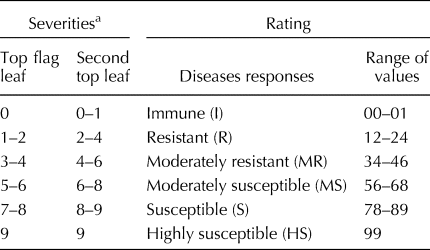
The disease severity was recorded using a double-digit scale (00–99) developed as a modified method of Saari and Prescott's severity scale to assess foliar blight diseases in wheat by visually scoring the per cent diseased area on the flag (F) and penultimate flag leaf (F − 1) as shown in Table 1 (Saari and Prescott, Reference Saari and Prescott1975). The first digit (D1) indicates a disease-covered area on the flag leaf and the second digit (D2) indicates the severity measured on the penultimate leaf. Thus, per cent disease severity displayed in each row of germplasm accessions was recorded at three different growth stages (GS) viz. GS 63 (beginning of anthesis to half anthesis complete), GS 69 (anthesis complete) and GS 77 (late milking). The area under disease progress curve (AUDPC) based on disease severity (GS63, GS69 and GS77) over time has been suggested to be a pragmatic approach for disease assessment (Jeger, Reference Jeger2004) and was estimated using the following formula (Roelfs et al., Reference Roelfs, Singh and Saari1992):
 $${\rm AUDPC} = \sum\limits_{i = 1}^n {\left[{\left\{{Yi + \displaystyle{{Y\lpar {i + 1} \rpar } \over 2}} \right\}x\lpar {t\lpar {i + 1} \rpar -ti} \rpar } \right]} \comma \;$$
where Yi = disease level at time ti; t(i + 1) − ti = time (days) between two disease scores; n = number of dates on which SB was recorded. The lines that showed AUDPC (<500) were considered resistant and the lines that showed AUDPC (>2000) were considered susceptible (Tyagi et al., Reference Tyagi, Nandan, Kumar, Prasad, Chand and Joshi2008).
A double-digit scale for appraising spot blotch severity

First and second values represent per cent blighted area on the top (flag) and second top leaves.
a Values 1, 2, 3, 4, 5, 6, 7, 8 and 9 correspond to 10, 20, 30, 40, 50, 60, 70, 80 and 90% blighted area, respectively (Saari and Prescott, Reference Saari and Prescott1975).
PCR analysis and electrophoresis
The molecular marker analysis was carried out at Wheat Grain Quality and Molecular Breeding Laboratory, Department of Genetics and Plant Breeding GBPUAT, Pantnagar. Genomic DNA isolation was done by using the CTAB method modified from Doyle and Doyle (Reference Doyle and Doyle1990). Polymerase chain reaction (PCR) was performed using a microsatellite marker Xgwm148 tightly linked to SB QTL located on chromosome 2B (Kumar et al., Reference Kumar, Joshi, Kumar, Chand and Roder2010). The marker Xgwm148 gives a product of 163 bp. For conducting PCR, 20 μl amplification reaction contained buffer (10X) with 10 mMTris-HCl (pH 9.0), 15 mM MgCl2, 50 mMKCl and 0.01% gelatin; 2.5 mM of each dNTP (deoxyribonucleotide); 40 ng of each primer; 50 ng genomic DNA; and 1 U Taq DNA polymerase (Genei Merck, Bangalore, India) were used. Amplifications were performed in a Paqlab™ Gradient Thermal cycler (Sigma-SVI Biosolutions Pvt. Ltd., New Delhi, India) programmed at 94°C for 4 min, followed by 40 cycles at 94°C for 1 min, at annealing temperature for 1 min and 72°C for 1 min, the final extension step was kept at 72°C for 10 min. Total PCR product was analysed on 3.5% metaphor agarose gels stained with ethidium bromide and visualized on the Alphaimager™ gel documentation system. Analysis of the presence and absence of the desired allele was done manually for the respective gels. A total of 189 accessions out of 200 were subjected to molecular characterization.
Results
In the current study, as an integral part of phenotypic characterization, a field screening study of 200 diverse germplasm samples was conducted in two consecutive years, 2014–15 and 2015–16, by the inoculation of a mixture of aggressive isolates of SB in India. As a result, a broad range of disease severity and resistance patterns was observed in germplasm possessing broad pathological behaviour (Fig. 1, Tables 2–4 and online Supplementary Table S1). For ensuring the utility of phenotypically resistant germplasm accessions, we employed a microsatellite marker tightly linked with potential SB-resistant QTL and pleiotropic APR gene Lr34. The findings of field experiments and molecular characterization are as follows:
The frequency distribution of 200 germplasm accessions showing the pathological rating in the field-based study against the spot blotch reaction in 2014–15 and 2015–16.

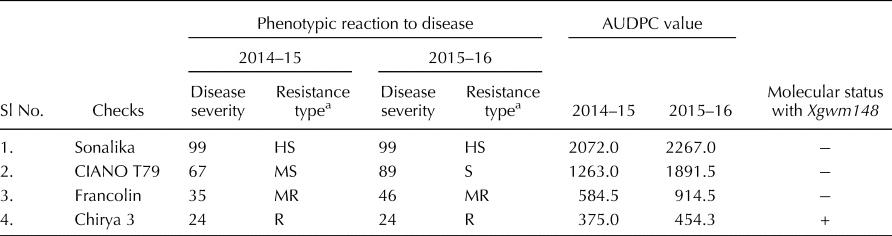
Reaction to spot blotch severity in check genotypes, AUDPC values during 2014–15 and 2015–16 and molecular status with Xgwm148

a The host reaction type was availed as MR: moderately resistant; R: resistant; HS: highly susceptible; MS, moderately susceptible; S, susceptible.
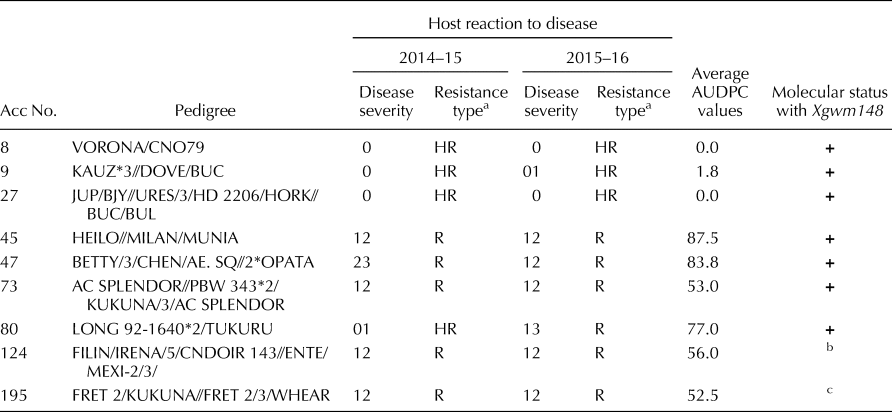
Germplasm accessions showing host reaction, AUDPC value <100 over 2014–15 and 2015–16 and molecular status with Xgwm148

a The host reaction type was availed as HR: highly resistant; R: resistant.
b No amplification was observed.
c This accession could not be subjected to marker analysis.
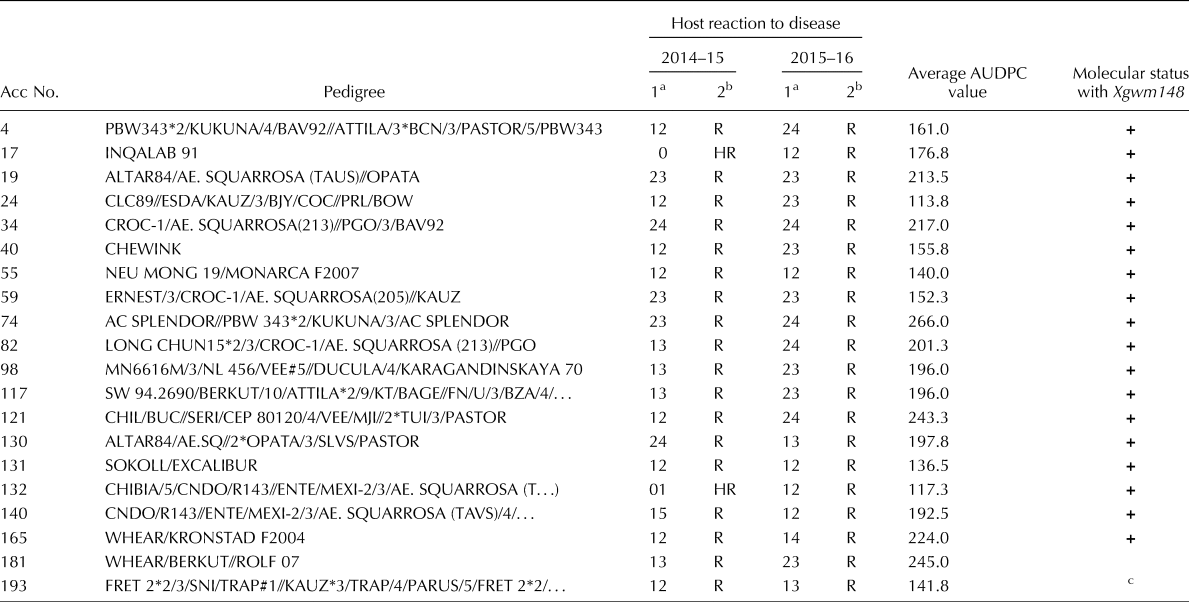
Germplasm accessions showing host reaction, AUDPC value between 100 and 300 over 2014–15 and 2015–16 and molecular status with Xgwm148

The host reaction to disease described as 1a: disease severity; 2b: resistance type; HR: highly resistant; R: resistant.
cThis accession could not be subjected to marker analysis.
Field evaluation of wheat germplasm accessions under epiphytotic conditions
The observations on disease severity on the check entries recorded by using a double-digit scale (00–99) revealed that in the field experiments conducted during 2014–15 and 2015–16 Rabi seasons, the check Sonalika as expected was observed to be HS in both the years with AUDPC values of 2072.0 and 2267.0. The check, CIANO T79 was observed to be moderately susceptible (MS) with AUDPC values of 1263.0 and 1891.50 in 2014–15 and 2015–16, respectively. The check, Francolin gave moderately resistant (MR) reaction with AUDPC values of 584.5 and 914.5 in the 2 years. Both CIANO T79 and Francolin were observed with comparatively higher AUDPC values in 2015–16 than that of 2014–15. The check, Chirya 3 gave resistant host reaction in both the years with AUDPC values of 375.0 and 454.3 (Table 2). Generally, the disease pressure in the first year was lower than that in the second year, as reflected by disease scores of the checks.
In the field experiment conducted during 2014–15, out of 200 germplasm accessions, six were observed HR, 78 resistant (R), 46 MR, 42 MS, 10 S and 18 HS (Fig. 1). The germplasm accessions showing HR reaction were the Accession (Acc) No. 8-VORONA/CNO79, Acc No. 9-KAUZ*3//DOVE/BUC, Acc No. 27-JUP/BJY//URES/3/HD 2206/HORK//BUC/BUL and Acc No. 80-LONG 92-1640*2/TUKURU with average AUDPC values below 100 (Table 3), and Acc No. 17-INQALAB 91 and Acc No. 132-CHIBIA/5/CNDO/R143//ENTE/MEXI-2/3/AE. SQUARROSA (T…) with average AUDPC values below between 100 and 300 (Table 4). Similarly, in the second year (2015–16) of experimentation, out of 200 germplasm accessions, only three were found possessing HR reaction, 81 R, 43 MR, 45 MS, 8 S and 20 with HS reaction (Fig. 1). It is to be mentioned that three accessions, namely, Acc Nos. 8, 9 and 27 were found to be HR during both the experimental years. However, the other three accessions, namely, Acc Nos. 17, 80 and 132 showed HR reaction in 2014–15 but R in the year 2015–16. The majority of accessions, including the check entries, were observed with higher AUDPC values in 2015–16 compared to 2014–15. Online Supplementary Table S1 possesses the information about resistance host reaction and average AUDPC values between 300 and 500 over the years 2014–15 and 2015–16, along with their molecular status with Xgwm148.
Molecular screening for the confirmation of SB resistance
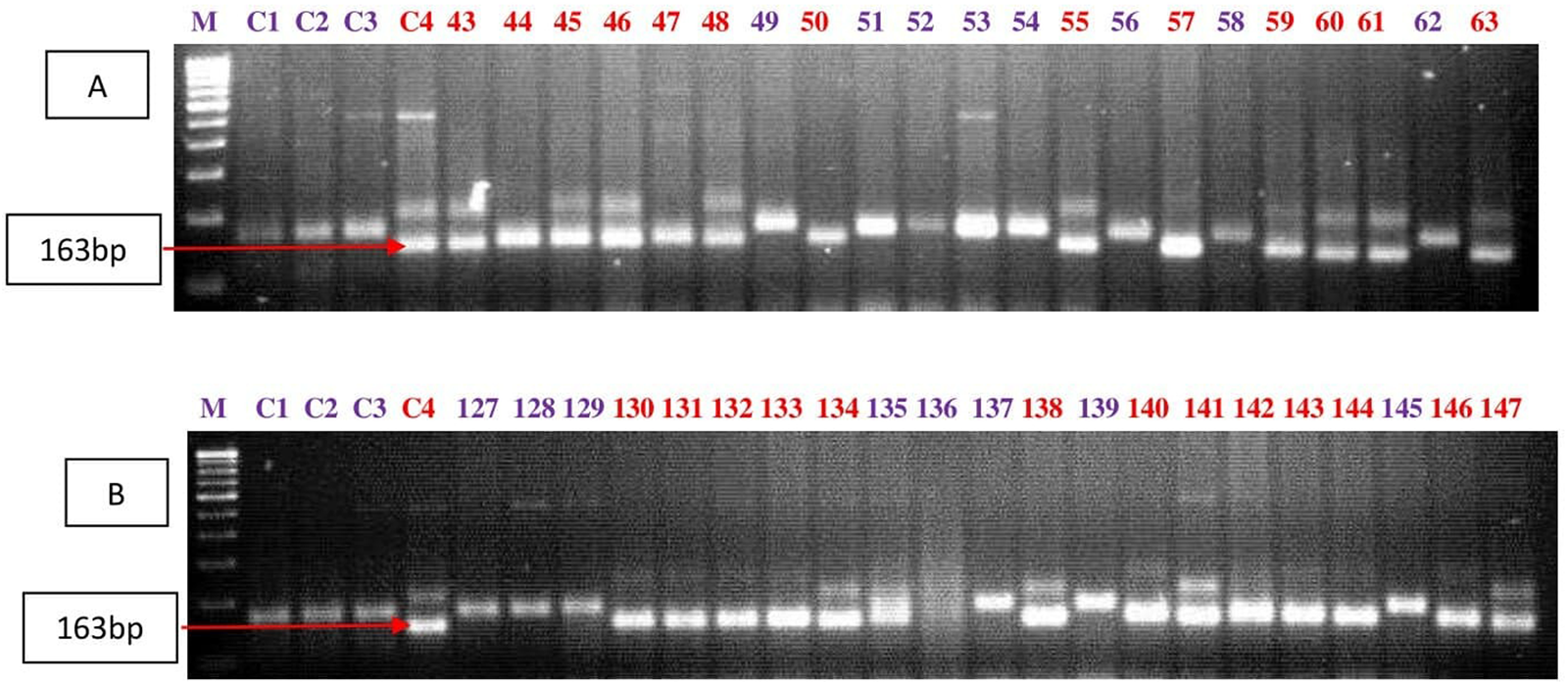
Molecular screening of 189 out of 200 wheat germplasm accessions for SB resistance was carried out using the specific SSR marker, Xgwm148 linked to the QTL on chromosome 2B for resistance along with the checks, Sonalika (C1), CIANO T79 (C2), Francolin (C3) and Chirya 3 (C4). The marker Xgwm148 was amplified in C4 with a specific band size of 163 bp. The marker Xgwm148 was amplified in 82 out of the 189 germplasm accessions except in Acc No. 124, which also possesses resistant host reaction and average AUDPC value below 100 (Table 3). Two representative gels showing the amplification of Xgwm148 in the resistant check, Chirya 3 and phenotypically resistant lines are depicted in Fig. 2.
Representative agarose gel electrograms of screening for spot blotch resistance in a set of 200 germplasm accessions. (A) M-100bp ladder, C1: Sonalika, C2: Ciano T 79, C3: Franclolin, C4: Chirya 3, Lane 43–63: molecular screening of germplasm accessions using SSR marker Xgwm148 (163bp); red colour marked lanes showing the accessions with the presence of desirable allele of 163 bp. (B) M-100bp ladder; C1: Sonalika, C2: Ciano T 79, C3: Francolin, C4: Chirya 3, Lane 127–147; red colour marker lanes showing the accessions with the presence of desirable allele of 163 bp.

Discussion
Several biotic and abiotic stresses constrain wheat production. Among biotic stresses, rust and SB are of immense importance in Indo-Gangetic Plains of India, which accounts for major acreage under wheat. Due to widespread prevalence and severe intensities, SB is of increasing concern in India and the eastern part of South Asia. In this study, an effort has been made to identify resistant elite breeding lines for SB, developed by CIMMYT using multiple parentages.
Out of four checks, only Chirya 3 was observed possessing true resistance having resistance host reaction as reflected by low AUDPC scores. Chirya 3 and Sonalika, the resistant and susceptible genotype, respectively, have been widely used for the detection of QTLs against SB (B. sorokiniana), as evident by the findings of Kumar et al. (Reference Kumar, Joshi, Kumar, Chand and Roder2010) and Singh et al. (Reference Singh, He, Sansaloni, Juliana, Dreisigacker, Duveiller, Kumar, Joshi and Singh2018). The marker Xgwm148 was not amplified in both the susceptible checks, Sonalika and CIANO T79, and simultaneously in Francolin (MR). Francolin was observed with MR host reaction and AUDPC values of 584.5 and 914.5 in 2014–15 and 2015–16, respectively; this has revealed the robustness of the Xgwm148. Categorically, this marker was not amplified in any of the accessions possessing MR, MS, S and HS reaction. The resistance and susceptibility reactions shown by Chirya 3 and Sonalika, respectively, in the years 2014–15 and 2015–16 revealed that weather conditions at Pantnagar were quite favourable for the development of disease. Chowdhury et al. (Reference Chowdhury, Singh, Tyagi, Ojha, Dhar and Bhattacharya2013) reported that the genotype with the highest grain yield and grain weight (Altar-84/Ae. squarrosa (224)//Yaco) also had low disease severity. This showed progress in combining SB resistance and high grain yield, which was not possible earlier. This supported our findings as Acc No. 19 (Altar84/Ae. squarrosa (Taus)//Opata) and Acc No. 130 (Altar84/Ae. squarrosa//2*Opata/3/SLVS/Pastor) in the background of Altar84/Ae. squarrosa were found with resistant host reaction and average AUDPC value of 213.5 and 197.8, respectively (Table 3). Similarly, Acc No. 34 (CROC-1/AE. SQUARROSA(213)//PGO/3/BAV92), Acc No. 82 (LONG CHUN15*2/3/CROC-1/AE. SQUARROSA (213)//PGO) and Acc No.132 (CHIBIA/5/CNDO/R143//ENTE/MEXI-2/3/AE. SQUARROSA (T…)) possessing Ae. squarrosa, as one of the parents, were found with resistant host reaction and average AUDPC values between 100 and 300 (Table 4), and Acc Nos. 48, 60, 70, 81, 83, 84, 85, 90, 108, 133, 167 and 168 were found with resistant host reaction and average AUDPC values between 300 and 500 (online Supplementary Table S1).
Sources of SB resistance have been identified over the years and governed by one or more genes, and their origins can be differentiated into three categories: Latin America, China and wild relatives of wheat or alien species (van Ginkel and Rajaram, Reference van Ginkel, Rajaram and Duveiller1998) and Ae. squarrosa crosses had shown impressive resistance to SB in Mexico. SB disease in wheat may also be tackled through a multipronged strategy that led to the development of new modern sources of resistance as donors. As a result, many high yielding lines with SB resistance were identified and shared with different centres across India (Singh et al., Reference Singh, Tyagi and Shoran2007). Breeding for SB resistance is one of the major targets of wheat improvement at CIMMYT. Large-scale germplasm screening for SB resistance was performed at CIMMYT in the 1980s and 1990s and the resultant resistant lines were used extensively in CIMMYT's wheat breeding programmes. In order to facilitate the utilization of SB-resistant materials by breeders and researchers worldwide, a special nursery called CSISA-SB was developed in 2009, which included elite CIMMYT breeding lines with promising SB resistance, as well as good agronomy and high yield potential (Singh et al., Reference Singh, Zhang, He, Singh, Chand, Mishra, Malaker, Reza, Rahman, Islam, Chowdhury, Bhattacharya, Kalappanavar, Crossa and Joshi2015). This nursery later named Helminthosporium leaf blight screening nursery (HLBSN) has been sent to multiple South Asian and South American countries where SB is of major importance and to other countries where the disease existed (Singh et al., Reference Singh, He, Sansaloni, Juliana, Dreisigacker, Duveiller, Kumar, Joshi and Singh2018).
The findings of both the experiments revealed that sufficient genetic variability was present in the evaluated germplasm accessions since these accessions were grouped into HR, R, MR, MS and HS based on the disease severity recorded under epiphytotic conditions. Further, 82 phenotypically resistant accessions were also confirmed as genotypically resistant with a robust molecular marker. Therefore, these 82 germplasm accessions, which were phenotypically resistant in the field under epiphytotic conditions and also confirmed with the marker Xgwm148, could be considered resistant genetic stocks and these are suitable for utilization in hybridization scheme for the development of SB-resistant wheat varieties. The germplasm accessions with HR reaction in both the years, namely, Acc No. 8-VORONA/CNO79, Acc No. 9-KAUZ*3//DOVE/BUC and Acc No. 27-JUP/BJY//URES/3/HD2206/HORK//BUC/BUL could be used in developing mapping populations and for the QTLs detection for speedy development of SB-resistant varieties following the maker-assisted breeding.
Improvement of any crop lies in exploring and exploiting the rich gene pools available in its cultivated forms, land races, wild relatives and related genera. The conservation of a resource only becomes important if the resource has or acquires recognized value (Kumar et al., Reference Kumar, Phogat, Vikas, Sharma, Saharan, Singh, Kumari, Singh, Jacob, Singh, Sivasamy, Jayaprakash, Madhumeeta, Jaiswal, Deepshikha, Honrao, Kalappanavar, Mishra, Singh, Vaish and Solanki2019). Elite breeding lines developed at CIMMYT using multi-parents are very useful assets. The genetic base for SB resistance among cultivars could be broadened and diversified through the use of resistant accessions identified in the current study.
Supplementary material
The supplementary material for this article can be found at https://doi.org/10.1017/S1479262120000490
Acknowledgements
The authors pose sincere thanks to CIMMYT, Mexico for financial support from Seeds of Discovery project funded by Sustainable Modernization of Traditional Agriculture (MasAgro) project supported by the Government of Mexico and Director, Experiment Station, GBPUAT, Pantnagar, India for providing necessary facilities for carrying out the investigation.