Ethnicity, especially in the context of the ancient world, remains a notion that provokes discussion. Attempts to define it that consider sociological, psychological, or biological constructs focus largely on the role of the individual and their sense of belonging within a particular community.Footnote 1 In his already classic studies on ethnic identification in ancient Greece, Hall regards ethnic identification as a casual occurrence that was often an answer to current needs and formed part of the dialectic between local social groups.Footnote 2 Based on the investigation of five Mediterranean ports, Demetriou concluded that cultural phenomena such as law, religion, and political institutions had a bigger influence in cosmopolitan societies on ‘ethnicity negotiations’ than mythic genealogy or territorial community.Footnote 3 Material culture is the main medium that documents ethnicity and ethnicity negotiations.Footnote 4 Regarded as a sociocultural marker of ethnicity, acculturation is demonstrated in many ways, including the use of onomastics. Based on direct anthroponymic evidence provided by epigraphic monuments, this article will be an attempt to define the ethnic and cultural diversity of a particular urban centre on the Mediterranean coast, namely Roman Carthage.
The creators of provincial Roman literature who were of African descent, such as Saint Augustine or Apuleius, often identified both themselves and their readers as African in their works.Footnote 5 Although this notion only usually appears as a rhetorical device, it can be concluded that – no matter how difficult it is to define – African identity functioned in social awareness. Among those who identified as African was the provincial population who had adapted to the Roman lifestyle and at the same time remained under the influence of local culture-forming factors of Punic or Libyan origin. Open access to the Mediterranean Sea, Eastern influences, and migratory movements from the south of the continent also led to the accumulation of population movements.Footnote 6 Recently there has been heated scientific debate about the social identification of the individual and about African identity.Footnote 7
It is axiomatic that port cities had the greatest religious, social, and ethnic diversity.Footnote 8 As commercial spaces, cities created favourable conditions for the mixing of populations of different origins.Footnote 9 Thus, Carthage, which was the capital of the Roman province Africa Proconsularis – the fifth largest port of the Roman world and the centre of political and cultural life – seems to be an interesting research object in ethnic diversity. Another factor that distinguishes Carthage is its history. As a result of the destruction of this Phoenician city, there appeared an unprecedented settlement void in which the Romans were able to found their city. The objective of the research presented in this article is to indicate some distinctive anthroponymic features of this African urban centre that reflected, to a certain degree, its inhabitants’ ethnic diversity.
Since ancient times, people have been aware of the fact that cultural and linguistic traditions can be indicators of ethnicity.Footnote 10 This was usually demonstrated in the notions of ‘fellow’ and ‘foreign’, which were based on linguistic differences explicitly shown in the notion of the barbarian. There are not many opportunities to identify linguistic differences when conducting research into a community belonging to Roman culture where Latin was the dominant language. However, in this respect, onomastics can provide some help, although it is acknowledged that anthroponymy tends to be much more susceptible to acculturation than, for example, toponymy.Footnote 11 The onomastic customs that are present in a particular culture often leave traces, even when local names are adjusted to new communication conditions. The majority of studies on ethnicity emphasise the communication of an individual and their identity through self-description, which is particularly clearly seen in Roman epigraphic habits.Footnote 12 Despite the fact that there are many limitations regarding the usage of epigraphic material, this remains the only source that provides direct insight into the lives of the majority of social classes in this ancient society. As far as the survival of epigraphic material is concerned, Northern Africa is a particularly privileged area. There have been several works on the distinctive features of African onomastics.Footnote 13 Many cities have been the subject of detailed analyses, such as Thugga, Bulla Regia, Lepcis Magna, Lambaesis, and Volubilis.Footnote 14
The use of onomastics in discussions about ethnic composition and the cultural diversity of a particular society involves certain risks. First, ethnicity (where a person originates from) cannot be clearly defined by a single factor such as a name. The use of epigraphy has an inherently fragmentary nature. Moreover, privileged social groups tend to be overrepresented in inscriptions due to economic factors, as only certain social groups could afford to make inscriptions. Finally, the cognomina which are the subject of this research can hardly be considered explicit evidence that determines a person's origins. But if we analyse the Roman naming system, we may find that it is the cognomen that constitutes the most individualized element of a name, unlike the praenomen, whose meaning in the context of individual onomastics is considered to be ‘fossilized’ to the extent of becoming gradually obsolete in epigraphic testimonies from the 2nd century.Footnote 15 In the case of Carthage, the analysis of nomina gentilicia may also fail to achieve results in determining the ethnic composition of the city as every person mentioned in the studied inscriptions is distinguished by a typical Roman nomina.Footnote 16 Pflaum emphasises that despite the above-mentioned difficulties, attempts to conduct such research are worthwhile because, despite their obvious limitations, they offer clues about the social and cultural structure of the city.Footnote 17
This analysis covers nearly 2,000 inscriptions that are written in Latin, Greek and Neo-Punic and which originate from areas of Roman Carthage that are related to pagan cultural circles.Footnote 18 Most were published in volume VIII of Corpus Inscriptionum Latinarum,Footnote 19 L’ Année épigraphique, or in other periodicals and corpora that cover a smaller geographical range.Footnote 20 Based on the collected material, it is possible to distinguish 1,186 personal names that appeared in inscriptions which were preserved well enough to enable investigation. In most cases, votive and sepulchral inscriptionsFootnote 21 with a date range generally between the 2nd and 3rd century enforce quite a static vision of the onomastics of the city. In the case of sepulchral inscriptions, the names of both the deceased and the issuers of the inscriptions were taken into consideration. Due to a specific onomastic custom within Christian culture, Christian sepulchral inscriptions were excluded from the investigation.Footnote 22 This will be explored by expanding on and supplementing the research of Lassère, who included in his work research regarding slaves buried in both the officials’ cemeteries and the Jewish cemetery.Footnote 23
The state of Carthage's epigraphy leaves a lot to be desired. As the city was one of ‘The Great Four’ of the empire, more than 3,000 inscriptions have been found there:Footnote 24 however, many of these were only partially preserved. Therefore, Carthage is considered one of the most underrepresented African cities in terms of epigraphy and is often omitted from investigations that are based on inscriptions.Footnote 25 Above all, the Carthaginian epigraphic habit is defined by discoveries in two cemeteries for the Familia Caesaris. Tombs originating from the so-called ‘official's cemetery’ provide nearly 900 sepulchral inscriptions for members of the imperial house.Footnote 26 This makes Carthage a unique centre comparable only to Rome in terms of the preservation of sources of information about the Familia Caesaris. It should be borne in mind that analysis of the anthroponymy of Carthage will cover only a specific group of people who were mainly slaves and imperial freedmen. The results cannot be considered to be a cross-section of the entire onomastics of the city because of the particular historical sources at our disposal. Nonetheless, it is worth attempting to conduct this investigation in order to reveal certain characteristics of the local anthroponymy. It should again be stated that the objective of this paper is not to carry out a detailed analysis of Roman Carthage's social structure (as this requires extensive investigation) but to focus on ethnicity and how this is reflected in onomastic custom.
It is very rare to find direct evidence of the origins of Carthage's inhabitants. Only the six inscriptions listed below provide clear information on the origins of the people mentioned.

Based on the inscriptions above, the majority of distinguishable people in the inscriptions appear to be newcomers from Italy. Two of the inscriptions involve representatives of the lower social classes: slaves and freedmen for whom migration to Africa was probably an involuntary choice which involved unpleasant experiences that can be reflected in Carthage's inscriptions.Footnote 27 In such cases, it is possible that the purpose of marking a person's origins on their tomb was to stress the owner's distinctness, which was impossible using only their cognomen because African onomastics was highly Romanized. Apparently, the above-mentioned individual ethnika are considered the only certain method of determining ethnic origins. Bang's research of Italy during the period of the Roman Empire was based on 360 ethnika,Footnote 28 but this sample is too limited.Footnote 29 Moreover, there is no justification for the use of this limited sample in research on either Italic citiesFootnote 30 or provincial centres where ethnika do not in fact appear (apart from in single cases). Contrary to different parts of Africa where there is an abundance of inscriptions explicitly confirming the presence of newcomers from different parts of the empire, such as Germania, Spain (continental) or Noricum, Carthage does not provide such unambiguous written evidence.Footnote 31
Throughout the course of history, Libyans, who were the indigenous inhabitants of North Africa, had to undergo the process of acculturation twice: first under the Phoenician-Punic influence, and later adjusting their cultural practices to Roman standards.Footnote 32 It has been confirmed that in today's Maghreb about 500 cognomina of Libyan descent have been found,Footnote 33 which would appear to be a small proportion in comparison with the 100,000 cognomina present in this area.Footnote 34 The inscriptions, which remain scattered, are usually found in smaller towns. Rare cases of concentration concern mainly urban centres, which may be the result of the general accumulation of material in such places. As far as the preservation of material is concerned, Africa Proconsularis definitely offers the greatest quantity of cognomina. Carthage is the place of origin of 10% of the inscriptions found in this province.Footnote 35 Fifteen cognomina of Libyan provenance are contained in Carthage's epigraphic material.Footnote 36 The majority of these are the names of people who cannot be put into any of the categories of Roman citizens: one slave, five einnamig, and four that belong to the incerti category.Footnote 37 Among the citizens, the majority of inscriptions (4) concern women who did not have a filiation, which can obviously be dictated by the specifics of onomastic custom.Footnote 38 However, this does not make it possible to rule out the possibility that they could belong to either the freedmen class or that of peregrini. Moreover, it is curious that in the closest neighbourhood of the African metropolis, on Cape Bon, Libyan onomastics remain absent.Footnote 39 Although such information is too limited to confirm any kind of hypothesis, it would seem to suggest that a Libyan substrate was present in Carthage, which attracted migration movements from the interior. This is clearly evident from the local, Latinized anthroponymy in the form of the cognomina of people belonging to the lower social classes. It remains impossible to determine whether Libyan names were inherited because none of the remaining inscriptions provide information on genealogy.
Libyan influences are strongly evidenced in the deep interior inhabited by indigenous people, whereas the cultural presence of the Punic substrate is clearly seen in seaside towns where Phoenicio-Punic traditions were both profound and ancient.Footnote 40 In his Apologia, the already mentioned Apuleius reproaches one of his stepsons because he only spoke the Punic language, despite the fact that he had received a thorough education and learned Latin.Footnote 41 Although this comes from a specific source, it suggests that in the 2nd century the Punic tradition remained alive in many circles of African society. According to Ferjaoui, the use of Neo-Punic in Roman times was more a matter of daily needs and cultural preservation than the cultivation of old traditions.Footnote 42 The majority of Neo-Punic inscriptions which date back to between the 1st century BC and 2nd century AD were found within the terrain of today's Libya, Tunis, and eastern Algeria.Footnote 43 Thirteen votive inscriptions dedicated to Baal and Tanit originated from Carthage. In the case of 11 of these, it is possible to trace the onomastics of their donors. In this material, the domination of theophoric names that contain the name of a deity, for example ‘BD'ŠTR’ (‘between the hands of Astarte’) or ‘BDMLQRT’ (‘the servant of Melqart’), is clearly visible. Four names refer to Astarte,Footnote 44 two to Eshmun,Footnote 45 three to Baal,Footnote 46 and three to Melqart;Footnote 47 the remaining names are hypocoristic names. Moreover, two are defined as Libyan names.Footnote 48 This anthroponymy of Carthaginian inscriptions is not repeated in any other centre. However, this is probably the result of the limited amount of preserved material. Analysis concerns both the names of donors and names evidenced in ancestral writings. According to Phoenician onomastic practice, which is the foundation of Punic culture, the phenomenon of double filiation, where they gave not only the father's but also the grandfather's name, was popular. Cases that reproduce this custom appear in the onomastics of Latin Africa, especially among peregrini. Footnote 49 One of the Carthaginian inscriptions also has all the hallmarks of this practice, although this cannot be determined definitively due to the poor preservation of the material.Footnote 50 Thus, it can be seen that the anthroponymy of Neo-Punic texts remains in the Semitic cultural circle, although there are known African examples of Latin names that are written in the Punic script. However, none of these concern Carthage.Footnote 51 This shows the permanence of tradition, especially within a religious context, which suggests the character of both the inscription and the carved names.
Emphasis is normally placed on the highly Latin character of the onomastics of North African cities.Footnote 52 However, local identities, in particular Punic, can be hidden under Latin cognomina. Since Mommsen, researchers have indicated that some Latin names gained particular popularity in Africa because of their connections to Punic culture.Footnote 53 These names were translations of Punic names into Latin and were usually of a theophoric character,Footnote 54 or they were nouns expressing the ideas of success, auspiciousness, and luck.Footnote 55
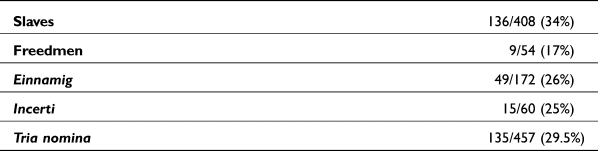
In the majority of social groups,Footnote 58 as represented in Carthage's epigraphic material, the percentage of African cognomina fluctuates at around 30% (Table 1). However, it is difficult to determine whether this is a high number because of the shortage of estimations for other cities in North Africa. Syme emphasizes that the analysed names were particularly popular among the lower social classes.Footnote 59 At first glance, analysis carried out for Carthage seems to confirm this idea. However, it should be borne in mind that names like Fortunatus or Felix have quite a high prevalence in the anthroponymy of Carthage (40%). Besides, they are considered to be African cognomina. They also belong to the category of names that are typical of slave groups and indicate social status.Footnote 60 The fact that a slave had a name does not necessarily suggest an attachment to Punic tradition: it might be merely an adjustment to the onomastic custom typical of a particular social group.
The presence of AfricanFootnote 56 cognomina according to social groupsFootnote 57

As far as the Punic permanence of the cultural substrate is concerned, the temporal distribution of material is worthy of consideration (Table 2). Although the wide date range of these inscriptions results in the presented picture remaining quite vague, it is evident that the percentage of the occurrence of inscriptions that present African cognomina is much higher in the reign of the Flavian dynasty. This is, of course, due to the distribution of source material because a greater number of inscriptions occur between the 2nd and 3rd centuries than at any other time. The fact that the difference is less than 15% suggests that these names enjoyed greater popularity in the earlier period, when the position of Roman culture was not so well established on African soil.
Temporal distribution of inscriptions

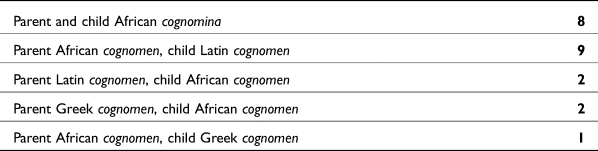
Only 22 inscriptions allow researchers to draw conclusions about the inheritance of African cognomina (Table 3). In fact, fewer children were given names that were attributable to Punic heritage than to African origins. It was much rarer to find a child who had an African name than a parent who had a Latin name. Fourteen of the above cases concern slaves. In the case of people of slave origin, the issue of the name given by a parent is not always unambiguous. Thus, it cannot be claimed that, in the cases above, people with African names wanted their children to be given such names for the sake of local tradition.
The inheritance of African cognomina

Another phenomenon that can be seen in the anthroponymy of Roman Carthage is the occurrence of names of Greek origin. There have been many scientific discussions on the significance of Greek cognomina over the last century, beginning with the research of Frank, who, on the basis of Bang's calculations, presented a thesis on the relationship between Greek names and the Greek-Oriental origins of their owners, especially in the nomenclature of lower social groups.Footnote 61 Gordon rejected this thesis on the basis of available information concerning the Greek cognomina of slaves and freedmen in the eastern provinces.Footnote 62 As a result of discussions on this topic, researchers have been divided into two camps: some are staunch supporters of Frank's theory,Footnote 63 whereas some reject it outright.Footnote 64 Furthermore, Kajanto and later Solin, while revising and supplementing Bang's statistics, agreed with the observation that the majority of slaves from the East had Greek names.Footnote 65 Investigation into Greek cognomina is particularly important in the context of Carthage, where there is an overrepresentation of members of slave groups in the epigraphic habit. Above all, this overrepresentation is conditioned by the presence of the official's cemetery, the necropolis of Familia Caesaris, from which comes the majority of Carthaginian inscriptions.
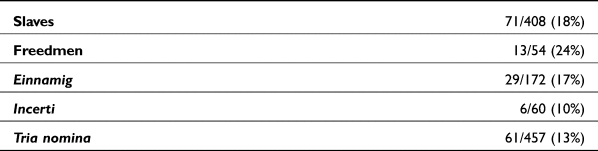
The percentage of Greek cognomina is definitely lower in comparison to the number of cognomina of African origin. There is a clear difference between slaves, freedmen, einnamig, and the rest of the community, which allows them to be considered more as an indicator of social status than of ethnic origin (Table 4). However, these indicators do not contradict each other. A small percentage appears in the incerti group, where the influences of indigenous inhabitants can clearly be seen. Lassère, when presenting results for Lambesis, Theveste, Cirta and Caesarea, points to the relatively small proportion of Greek name holders present in African slave structures.Footnote 66 Nonetheless, this percentage is higher in the domains of imperial Carthage, which suggests that slaves were imported from the East.
The distribution of Greek cognomina according to each social group

The anthroponymy of a slave group called the vernae may shed some light on the relationship between Greek cognomina and their origins. It is supposed that Greek slaves in Roman society were considered better educated and qualified, therefore owning a slave of Greek origins could have been seen as a reflection of the owner's material and social status. At the same time, the philhellenic tendencies of the upper classes could have influenced the naming of slaves born in their homes. In order to confirm this assumption, Solin provides data concerning the Roman Familia Caesaris, where 75 vernae had a Greek cognomen and only 64 had a Latin cognomen.Footnote 67 Łoś emphasises that it should be taken into consideration that in great manor houses where the number of slaves was considerable, the owner did not name newborns, therefore it was the parents’ decision.Footnote 68 In 17 cases noted in Carthage, only six slaves born in their master's home were given Greek names, whereas the rest of the names were Latin; among those names, six were considered to be of African origin. This shows that in provincial circumstances, the significance of Greek onomastics was less clear, and consequently it could have an actual connection to ethnic origins. Lassère addressed the issue of the inheritance of Greek anthroponymy using data regarding the functional slaves from the official's cemetery.Footnote 69 In the case of parents who had a Greek cognomen, their children inherited both Greek and Latin names equally.
The presence of representatives of Greek and oriental cultural circles is clearly seen in inscriptions connected to religion. Some of the votive inscriptions that were dedicated to Serapis, in which it is possible to decipher the name of the donors, were written using the Greek alphabet.Footnote 70 In the remaining four cases, three donors had Greek cognomina.Footnote 71 The cult of Serapis in Carthage was probably popularised by traders of Alexandrian origins who maintained commercial contacts with the African metropolis, where they founded the deity's temple.Footnote 72 Furthermore, in the case of different oriental cults like the cult of Hepius of EpidaurusFootnote 73 and the cult of Isis,Footnote 74 which were individually confirmed in Carthage, the names of the donors were non-Latin.
The cult of Saturn, which was often identified with Punic Baal,Footnote 75 enjoyed great popularity in African society. In more than 60% of cases, votive inscriptions related to this cult were founded by people who had African names.Footnote 76 It should be emphasised that although all of these people can be considered citizens, it cannot be ruled out that some of them were freedmen. In the only bilingual Latin-Punic votive inscription offered to Baal that comes from the terrains of Carthage, the Latin name Crescens also appears.Footnote 77 This name belongs to a group of translations from Punic and means auspiciousness or favourable development. The presence of this name in bilingual inscriptions, which is direct confirmation of the appearance of a Punic cultural substrate in an urban space, seems to confirm the relationship between Latin cognomina (also called African cognomina) and the tradition of Phoenician colonisers. In contrast with the domination of African cognomina among the followers of Saturn, in the case of deities of the Roman pantheon that did not gain popularity in Africa, Latin names that do not have Punic connotations dominate in 77% of cases.
The Jewish community is an important group in the context of the ethnic composition of the African metropolis. It is known that there were a considerable number of representatives of the Jewish community, which is not surprising in a city that was both a provincial capital and a port with developed commercial contacts. It has also been speculated that Jews already inhabited Carthage by the Punic period, although this has not been confirmed in historical sources.Footnote 78 Researchers have extracted the majority of their information on Carthaginian Jews from the suburban Gammarth necropolis, from which the majority of accessible epigraphic documentation emanates.Footnote 79 Lassère paid a great deal of attention to Jews in his research on African people.Footnote 80 As far as the linguistic layer is concerned, Latin definitely predominates (with 47 inscriptions),Footnote 81 while there also are four Hebrew inscriptions, 12 Greek, and one bilingual Hebrew-Greek inscription. Moreover, Greek names were Romanised in inscriptions. The domination of Latin definitely sets the Jewish community apart from the Roman community, where Greek was the dominant language.Footnote 82
It is worth taking note of the presence of anthroponymy created in relation to geographical names.Footnote 83 These names could also be found in Carthage, although they are barely represented.

As is evident from the above, these cognomina were popular among the representatives of the lower social classes. The majority of names generally appear individually, although we can distinguish three groups that are more representative. One group that definitely dominates is nomenclature concerning local African areas; the remaining two concern Rome and Asia. Although the occurrence of such cognomina suggests a certain relationship with local migratory movements from the deep interior, Italy, or the Eastern part of the Mediterranean, it can in no way determine the actual origins of Carthage's inhabitants.
It is difficult to determine if the results presented above show Roman Carthage's ethnic diversity. However, comparison with onomastic studies conducted on other towns in Africa could prove to be helpful. Nonetheless, this task is extremely difficult especially if we take into consideration specificity and diversity of the analyzed epigraphic material. In Calama's case, there were only four slaves and one freedman among 306 people taken into consideration during the onomastic research.Footnote 84 The group of Roman citizens is ‘overrepresented’ in Volubilis’ epigraphy.Footnote 85 Slaves and freedmen appear very rarely in Thugga's inscriptions, where free-born Roman citizens and peregrini form a majority.Footnote 86 A similar situation can be noticed in onomastic studies dedicated to CapsaFootnote 87 and Castellum Celtianum.Footnote 88 Therefore, Carthage can be considered an exceptional case because in spite of its obvious rank of African metropolis attracting the most privileged social group (so-called ‘African oligarchy’),Footnote 89 its members appear quite seldom in epigraphic testimonies. Hellström has suggested in her recent studies that in Carthage's case we can assume the creation of a ‘superstratum’ formed by the most affluent families whose presence was not revealed in inscriptions.Footnote 90 Hellström carried out her study mostly on building inscriptions. However, when it comes to other types of inscriptions, such an interpretation does not seem to be unjustified. Another difficulty arises when we compare the investigation results because the vast majority of analyses focuses mostly on presenting the social structure of a city on the basis of onomastics, which is not the main objective of this paper. Due to the fact that the participation of non-Latin names is easy to compare, it is an anthroponymic aspect worthy of special consideration. In the above-mentioned cases, the participation of non-Latin names is marginal. However, due to its similar specificity Caesarea in Mauretania can be a good example in comparisons. The city, whose population fluctuated around 100,000, was the third biggest African port boasting a wide range of commercial contacts. Pawlak estimated that 25,9% of the free population in Caesarea had non-Latin cognomina.Footnote 91 On the other hand, in Carthage only 12,9% in the same social group had non-Latin cognomina. Therefore, this number is considerably smaller and closer to a general estimation for the African population. According to Picard, the participation of non-Latin cognomina in the African population amounted to 8%.Footnote 92 At first glance it may seem that such small participation of non-Latin names in Carthage in comparison with other African port centres disproves that Carthage was a multicultural city. We should bear in mind an already mentioned fact that a non-Latin cognomen was to a greater degree an indicator of social status rather than an indicator of origin. The analysis of names born by vernae in Carthage shows that the trend of giving Greek cognomina was not so popular and in fact it is most probably related to ethnic origins. Thereby the difference between Carthage and Caesarea does not necessarily imply that Caesarea was more multicultural town. It can merely suggest differences in onomastic customs or a higher participation of people of slave origins in the cities’ structure.
Because of its limitations, onomastics research cannot provide an unambiguous answer that would define the ethnic composition of the town. The basic question to be addressed when talking about ethnicity or cultural differences is who?Footnote 93 The presented results may bring us closer to answering this question. Besides the unquestioned, dominating role of the nomenclature that was typical of the Roman cultural circle, local onomastics also revealed the relationships that existed between local traditions, which were mainly of Punic origins, as well as the influences of eastern migrations. Local identities were often hidden under Romanised names, which also shows the evolution of African linguistic traditions. For the sake of communication, African inhabitants also translated their identity, which meant they became Roman Africans. As Bénabou stresses, the presence of a Punic cultural substrate which is also evident in the domain of onomastics does not confirm resistance to Romanisation but merely emphasises faithfulness to a certain order.Footnote 94 In comparison to ethnos, anthroponymy allows researchers to take a closer look at the identity and social belonging of an individual. Onomastics defines belonging to a social group, and usage of the proper nomenclature distinguishes its representatives. At the same time, onomastics limits any possibility of determining the origins of an individual. During the Roman period, Carthage can certainly be considered a cultural conglomerate, although at first glance local anthroponymy only shows this marker to a limited degree. Despite this fact, it is possible to find traces of the presence of local Libyan inhabitants and evidence of an attachment to Punic traditions under the guise of Roman onomastic custom in Carthaginian inscriptions. Greek and oriental influences are most visible in religious practices. The slave group, which is the most widely represented group in the urban epigraphic habit, causes problems for anthroponymy. However, this group also provides the most information on both cognomina graeca and African names. Although the presented results are based extensively on statistics, there are reasons to deem Carthage a multicultural centre where dominant Roman practices coexisted with the local Punic substrate and were under the influence of migratory movements from both the interior and eastern parts of the Mediterranean.