Introduction
Soil-transmitted helminth (STH) infections are communicable parasitic infections of major public health importance with a considerable impact on the economic development of the affected communities (WHO, 2005). Conditions related to STH infections include impaired nutritional status, iron-deficiency anaemia, vitamin A deficiency, eosinophilic pneumonia and decreased physical and cognitive performance (Bain & Flower, Reference Bain and Flower1996; Montresor et al., Reference Montresor, Awasthi and Crompton2003; Albonico et al., Reference Albonico, Allen, Chitsulo, Engels, Gabrielli and Savioli2008). To avert the negative consequences of STH infections on child health and development, children aged 12–59 months in Zambia are given anthelminthic drugs twice yearly – in June and December – during the child health week (CHW). In addition to receiving anthelminthic drugs, the children receive vitamin A supplementation and are weighed for growth monitoring. Vaccination of infants is also done during the CHW. The Ministry of Health strategy aims to have all children fully immunized against tuberculosis, polio, dipththeria, whooping cough, tetanus, hepatitis B, meningitis, pneumonia and measles by their first birthday. This means, ideally, that after the first birthday the child only goes to the health centre when ill and during the CHW to receive anthelminthic drugs, vitamin A supplementation and for growth monitoring.
Effective control of STH infections requires regular treatment of the children (WHO, 2005). However, the treatment coverage pattern observed varies widely across districts and health centres in Zambia. Some districts consistently have treatment coverage as low as 7% (National Food and Nutrition Commission report, unpublished data). This means that such districts have a majority of children not receiving treatment under the health facility-based (HF) approach.
Several socio-demographic factors have been associated with utilization of health services. Factors like previous immunization, concerns about side effects, gender of child, birth weight, ethnic group, maternal age and birth order of child have been shown to affect uptake of immunization (Lochhead, Reference Lochhead1991; Li & Taylor, Reference Li and Taylor1993; Meirion & Thomas, Reference Meirion and Thomas1998; Jordan et al., Reference Jordan, Roderick, Martin and Barnett2004; Negussie & Chepngeno, Reference Negussie and Chepngeno2005). Other factors that affect uptake of immunization among children include availability of, and proximity to, health facility, caretaker's education, ownership of assets like a radio, economic condition of the household and region of residence (Bhuiya et al., Reference Bhuiya, Bhuiya and Chowdhury1995; Pullen et al., Reference Pulle, Fiandt and Walker2001). However, because of the non-specific nature of symptoms and subtle morbidity of STH infections compared with other infectious diseases with more acute morbidity and specific symptoms, the factors affecting participation in anthelminthic control programmes might be different from those affecting participation in immunization programmes.
A study was implemented where the current HF approach of delivering anthelminthic drugs to children aged 12–59 months was compared with an approach where community-directed treatment (ComDT) was added to the HF approach (i.e. HF+ComDT). In this paper, the socio-demographic factors associated with treatment coverage in the HF and HF+ComDT areas in December 2007 are reported.
Methods
Study area and population
The study area and population are described in detail elsewhere (Halwindi et al., Reference Halwindi, Magnussen, Meyrowitsch, Handema, Siziya and Olsen2010), but briefly, this study was conducted in households in the catchment areas of Chivuna and Magoye rural health centres (RHCs) in Mazabuka district, Zambia. The majority of the population were subsistence farmers depending on subsistence agriculture for food and as a source of income. Formal education levels were low, rarely going beyond 7th grade. The catchment population for under-five children was 2404 for Chivuna RHC and 2431 for Magoye RHC. These children and their caretakers were eligible for inclusion in the study. The CHW programme had been in existence in both Chivuna and Magoye since 2001. Mebendazole was the anthelminthic drug used during CHWs. In the last two CHWs prior to project implementation, treatment coverage in both areas was low. In June 2005, treatment coverage was 36.8% (885/2404) and 33.4% (813/2431) in Chivuna and Magoye, respectively. In December 2005, treatment coverage was 23.6% (567/2404) and 25.3% (615/2431) in the two areas, respectively (Ministry of Health statistics, unpublished data).
Description of the two drug delivery approaches
During each CHW, children in the HF area were treated by health workers at the health centre and at outreach posts. However, in the HF+ComDT area treatment was offered on two different occasions during each CHW. First, children were treated at the health centre and at outreach posts during the CHW (the HF component). Second, children who were missed by the HF approach on this first occasion were treated by community drug distributors (CDDs) within the villages the following week (the ComDT component). The CDDs were ordinary community members chosen by the communities to carry out drug distribution after receiving training. Children who were not treated by the HF approach were identified from the treatment registers where the names of children treated under the HF approach were marked as treated and names of children not treated were marked as untreated. Each child received a single dose of 500 mg mebendazole and 200,000 IU of vitamin A (0.3 μg retinol) twice a year under either treatment approach. There were no other programmes giving mebendazole or other anthelminthic drugs to children aged 12–59 months in the study areas. However, the school health programme gave anthelminthic treatment against schistosomiasis and STHs to enrolled school children.
Drugs distributed by CDDs were supplied by the district health office, together with drugs used under the HF approach, and were collected from the district pharmacy by the RHC. Two methods of drug delivery to children were used by the CDDs: the door-to-door method and the ‘central place’ method. In the door-to-door method the CDDs moved from one household to another to deliver drugs to the children. In the ‘central place’ method treatment was done at a specific location in the community chosen by community members.
Study design and sampling
The ComDT intervention was implemented and monitored between June 2006 and December 2007. Four treatment rounds (CHW1, CHW2, CHW3 and CHW4) were monitored during this period. The effects of the two approaches on STH infections and treatment coverage are reported elsewhere (Halwindi et al., Reference Halwindi, Magnussen, Meyrowitsch, Handema, Siziya and Olsen2010, Reference Halwindi, Magnussen, Siziya, Handema, Meyrowitsch and Olsen2011). The present study consisted of a community-based cross-sectional survey conducted in December 2007, during the CHW4 treatment round. After determining the treatment coverage for June and December 2005 for all the RHCs in Mazabuka district, Chivuna and Magoye RHCs were selected based on comparable low treatment coverage, equal sized population of under-five children and comparable staff situation. Chivuna RHC was then randomly selected as the intervention area where the ComDT approach was implemented simultaneously with the regular work of the RHC, thereby becoming the HF+ComDT area. This made Magoye RHC the comparison area where the HF approach continued alone as usual.
Villages in each catchment area were grouped into local geographical areas (LGAs) based on the existing neighbourhood health committee (NHC) zones. Five LGAs were created in each catchment area. A census was conducted in each LGA to record all children aged 12–59 months living in the area. The stratified sampling method, using LGA as stratum, was used to select the sample of caretakers to be interviewed. In each LGA 100 eligible children were randomly selected by systematic sampling, where children were chosen at regular intervals from the sampling frame. The sampling frame was the list of all eligible children who were registered during census. A total of 500 children were sampled from each study area. The caretakers of the selected children were interviewed.
Data collection
Ten trained field assistants conducted the interviews in December 2007. Data on socio-demographic factors were collected and included: (i) child variables – age and sex; (ii) caretaker variables – age, marital status and educational level of caretaker; (iii) household factors – number of under-five children in the home, how long the family had lived in the area, straight-line distance from the household to the health centre or the outreach health post used by the family during the CHW. A wealth index for economic status of a household was computed based on five indicators: the type of floor and roof on the main house, ownership of a bicycle and a radio, and whether the household had sold any crop from the last harvest before the survey. The wealth index was computed using the method of equal weighting of all the selected economic indicators (Howe et al., Reference Howe, Hargreaves and Huttly2008). The data for straight-line distance were collected by mapping the co-ordinates for the two selected RHCs, the outreach health posts and all households with eligible children using a Magellan Sportrak global positioning system (GPS) receiver 12137 (Magellan Navigation Inc., USA).
Data analysis
EpiData 3.1 software (EpiData Association, Odense M, Denmark) and Microsoft Office Excel version 2003 (Microsoft Corp., Redmond, WA, USA) were used for data entry. STATA 9.2 software (StataCorp, College Station, TX, USA) was used for statistical analysis. The data analysis was done in three steps. Bivariate analysis was first performed to investigate crude associations between treatment status and each independent variable, ignoring all other variables. Unadjusted odds ratio (OR) and their 95% confidence intervals (CIs) for the ORs were calculated. To control for possible confounding and identify interaction effects, multivariate logistic models were developed for each of the treatment arms. The final multivariate model was developed for both treatment arms together. Effect modification of living in the HF+ComDT area or HF area was tested by including treatment arm as a factor in the final multivariate model, together with interaction terms. The multivariate models were obtained by performing logistic regression using a backward variable selection method and specifying robust standard errors to account for clustering. The village was included as a cluster since the health-seeking behaviour of individual members of a village is not entirely independent of the health-seeking behaviour of other members of the same village. The bias due to sampling and also the different levels of non-response from each LGA was corrected by weighting the analysis using sampling weights by LGA (Bennett et al., Reference Bennett, Woods, Liyanage and Smith1991). For variable selection (i.e. significance of change when a variable was removed) p<0.05 was used for inclusion and p>0.10 for exclusion. To contrast two models (one with the variable of interest and one without the variable) each model was stored and ‘likelihood-ratio test after estimation’ was performed. When the difference between the two models was statistically significant the variable was kept in the final model. Adjusted odds ratios (AOR) and their 95% CIs are reported for the multivariate logistic regression. Missing values were excluded from the statistical analysis by using the STATA command ‘.list id’. For example, missing values for the variable ‘education’ were excluded using the command ‘.list id educ>13 & <.’, where 13 was the code for tertiary education and ‘.’ was the code for missing values.
Ethical considerations
The research proposal was reviewed and approved by the University of Zambia Research Ethics Committee (Ref.: 003-01-06) and recommended by the Danish National Committee on Biomedical Research Ethics (Ref.: 2006-7041-83) before the research was carried out. In addition, the Ministry of Health in Zambia gave permission for the study to be conducted. Informed consent was sought from the caretakers for their participation in the interviews after an explanation of the objectives of the survey. Participants were told that they were free to withdraw from the study at any time. They were also informed that confidentiality and anonymity would be preserved.
Results
Factors associated with the study area
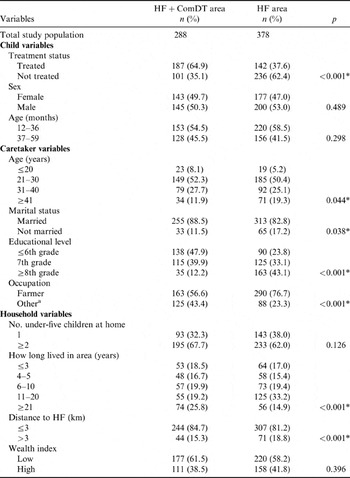
Table 1 shows the characteristics of the 288 and 378 children sampled in the HF+ComDT and HF areas, respectively, whose caretakers were interviewed. The total population in Table 1 does not add up to 500 in each area because of missing values that resulted from non-collection of data for some of the variables. Data on variables ‘marital status’, ‘occupation’, ‘education level’ and ‘wealth index’ were collected using a different questionnaire and towards the end of December, while data for the other variables were collected at the beginning of December. The two questionnaires were later merged during data analysis. The large number of children with missing values was partly because the end of December (when the second survey was done) is the peak planting season for the staple crop (maize) in Zambia and most caretakers are busy in their fields and therefore were not available for interviews. This resulted in differences in the number of caretakers interviewed during the two surveys. There was a statistically significant difference between the two study areas in relation to proportion of children treated, caretaker's age, marital status, occupation and educational level, how long the family had lived in the area and distance to health facility. However, age and sex of child, number of under-five at home and the wealth index did not differ significantly between the two study areas.
Characteristics of the children and caretakers interviewed by treatment area, rural Zambia, December 2007

HF: health facility; ComDT: community-directed treatment.
a Other occupations include charcoal burners, farm workers, formal employment, traders and fishing.
* Statistically significant result.
Factors associated with treatment status
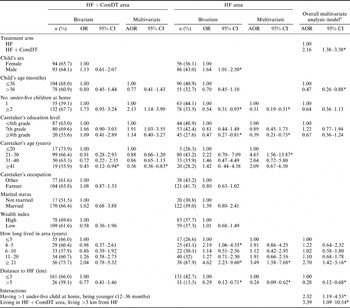
The results of the bivariate and multivariate analyses are shown in Table 2. In the HF+ComDT area results from both the bivariate and multivariate analyses indicated that age of caretaker was the only variable that was significantly associated with the probability of treatment. Children with caretakers aged >40 years were significantly less likely to be treated than those with caretakers aged ≤20 years. In the HF area bivariate analysis showed that the following variables were statistically associated with the treatment status of a child: sex of child, number of under-five children in the household, educational level of caretaker, how long the family had lived in the area and distance between home and health facility. A multivariate analysis for the HF area showed that a child was more likely to be treated if: the caretaker had an educational level of ≤6th grade than one with ≥8th grade; if the child's family had lived in the area for 6–10 years or ≥21 years compared with those who had lived in the area for ≤3 years; and if the family lived 3 km or less from the health facility compared with those lived >3 km.
Bivariate and multivariate analysis of association between probability of treatment of children and socio-demographic factors

HF: health facility; ComDT: community-directed treatment; OR: crude odds ratio; AOR: adjusted odds ratio; CI: confidence interval.
a The final model summary: number of observations=652; Wald χ2 (12)=51.73; Prob. <0.001; Pseudo R 2=0.112; Log likelihood=−401.192. Standard errors adjusted for 76 clusters in villages.
* Statistically significant result.
Five variables emerged as strong explanatory variables from the final multivariate regression analysis. A child living in the HF+ComDT area was more likely to be treated than one in the HF area (AOR=2.2; 95% CI: 1.4–3.4) and a child aged >36 months was less likely to be treated than a child aged ≤36 months (AOR=0.5; 95% CI: 0.3–0.9). Furthermore, a child whose family had lived in the area for ≥21 years was more likely to be treated than one whose family had lived there for ≤3 years (AOR=2.7; 95% CI: 1.4–5.2), and a child who lived >3 km from the health centre was less likely to be treated compared with a child who lived ≤3 km from the health centre (AOR=0.3; 95% CI: 0.1–0.7). Effect modification of factors on the likelihood of children being treatment was observed. Long distance to health facility turned out to reduce the likelihood of being treated in children living in the HF area compared with those in the HF+ComDT area. The chance of being treated for a child living >3 km from the health centre in the HF+ComDT area was about 3 times higher as compared with a child living ≤3 km from the health centre in the HF area (AOR=3.4;95% CI: 1.1–10.5). In addition, having more than one under-five child at home reduced the likelihood of older children being treated. In a home with more than one under-five child, the younger child (12–36 months) was twice as likely to be treated than the older child (37–59 months), with AOR of 2.32 and 95% CI of 1.2–4.5. The wealth index was not significantly associated with likelihood of being treated in either the bivariate or the multivariate analyses.
Discussion
The results of this study highlight the importance of socio-demographic factors on utilization of health care services in two different settings (HF approach or HF+ComDT approach). Five factors significantly affected the proportion of children treated: treatment approach, distance to health facility, duration of residence in the area, number of under-five children at home and age group of child. The strong association between treatment status and living in the HF+ComDT area suggests the positive effect of the ComDT intervention on raising treatment coverage, as has been found in other studies (Amazigo et al., Reference Amazigo, Obono, Dadzie, Remmie, Ndyomungyenyi, Roungou, Noma and Seketeli2002; Seketeli et al., Reference Seketeli, Adeoye, Eyamba, Nnoruka, Drameh and Amazigo2002; TDR, 2008; Halwindi et al., Reference Halwindi, Magnussen, Meyrowitsch, Handema, Siziya and Olsen2010). The multivariate logistic regression with inclusion of the interaction terms further suggests the impact that the intervention had on mitigating the negative effects of these socio-demographic factors on treatment status of children in the HF+ComDT area. Distance was found to be a strong predictor of treatment status in the HF area, but not in the HF+ComDT area. A child living ≤3 km from the health centre in the HF area was still less likely to be treated compared with a child living more than 3 km from the health centre in the HF+ComDT area. Some of the underlying reasons in the HF area could be the difficulty for the caretakers of reaching the health centre if it was far away, as it is well known that families living closer to health facilities are more likely to utilize the health centres than families living further away (Baume et al., Reference Baume, Helitzer and Kachur2000; Kiwanuka et al., Reference Kiwanuka, Ekirapa, Peterson, Okui, Rahman, Peters and Pariyo2008; Phukhan et al., Reference Phukhan, Barman and Mahanta2008).
The lower likelihood of being treated in the HF area for a child coming from a home with more than one under-five child may result from the difficulty in carrying all children to the health facility when there is more than one under-five child at home. It could also be due to priority being given to small children who still need vaccines. Caretakers may also be more motivated to seek treatment for younger children due to perceptions of the younger children being less robust and more likely to become ill due to worm infections. The results on effect of children's age on treatment status suggest that older children (>36 months) were less likely to be treated compared with younger children. Furthermore, the effect modification of children's age on the association between number of under-five children at home and the likelihood of children being treated amplifies the important role that the age of children plays in accessing health care. If this is considered in relation to long distance to health facility, the age of children might affect the likelihood of being treated in that it might be difficult to carry the older under-five children, who are heavier but who cannot manage to walk the long distances to the RHCs. This is further compounded by scarcity of public transport and lack of bicycles in rural areas. If this assumption is correct, approaches that can alleviate the problems of distance should include strengthening of the existing outreach programmes and implementation of interventions like ComDT that ensure services are delivered closer to the households (Victoria et al., Reference Victoria, Wagstaff, Schellenberg, Gwatkin, Claeson and Habicht2003). The outreach programmes can be strengthened by increasing the number of outreach posts where necessary and feasible. Higher immunization coverage and utilization levels of general maternal and child health services have been seen when there is an outreach health post in the community and when community members have regular monthly visits by outreach health workers (Archarya & Cleland; Reference Archarya and Cleland2000 Sasaki et al., Reference Sasaki, Igarashi, Fujino, Comber, Brunsdon, Muleya and Suzuki2011).
The length of time that a family has lived in an area may influence the likelihood of a child being treated or the utilization of other health services through various mechanisms. One such mechanism is social networking, which is associated with higher utilization of health care services. This is through the provision of information to caretakers about the importance of health interventions, thereby reducing the uncertainty and misconceptions that community members might have about formal health systems (Varenne et al., Reference Varenne, Petersen, Fournet, Msellita, Gary, Ouattara, Harang and Salem2006; Gage, Reference Gage2007). For instance a study on utilization of maternal health care found that living in close proximity to other women who had utilized modern forms of prenatal care significantly increased the odds of utilizing the services (Gage, Reference Gage2007).
The caretaker's age was a strong predictor of a child being treated in the HF+ComDT area as older caretakers (>40 years) were significantly less likely to have their children treated compared with the younger caretakers. The odds ratios show a steady decline in likelihood of a child being treated with increasing age of the caretaker. It is likely that older women were more confident in child rearing and were more inclined to use alternative sources of health care (Taffa & Chepngheno, Reference Taffa and Chepngeno2005). Older caretakers may also not see worm infections and thus de-worming as an issue in life. They may have experienced that children – in the absence of treatment – ‘grow out’ of the wormy stages in life, and they therefore may not see it as an important issue with a high priority. Child's sex was another factor significantly associated with treatment status in the HF area. The higher proportion of boys treated compared with girls is more likely the result of the greater value accorded to male children in traditional societies. Studies conducted in different developing countries have also found that boys were more likely to be taken for preventive and curative health care than girls (Levin et al., Reference Levin, Rahman, Quayyum, Routh and Barkat-e-Khuda2001). In areas where sex inequalities in receiving treatment are still significant, interventions and health education messages should focus on narrowing the sex differentials in accessibility, in the long term.
The caretaker's education level was identified as an important factor affecting children's treatment status in the HF area but not in the overall multivariate regression model, though it had a significant effect on the overall model. Education is believed to affect the health of families in two ways. It is believed to increase the demand for services with a resulting increase in child survival (Agha, Reference Agha2000; Ensor & Cooper, Reference Ensor and Cooper2004) and to affect the ability to assimilate health messages, thus affecting health-seeking behaviour. The close association between higher parental education and higher utilization of child health care has been documented by various studies in developing countries (Singh & Yadav, Reference Singh and Yadav2000; Luman et al., Reference Luman, McCauley, Shefer and Chu2003; Chhabra et al., Reference Chhabra, Nair, Gupta, Sandhir and Kannan2007; Ndugwa & Zulu, Reference Ndugwa and Zulu2008). On the contrary, the present study found that a caretaker with no education or with an education of ≤6th grade was twice as likely to take her child for treatment compared to a caretaker with ≥7th grade education. One possible reason is that parents with higher educational attainment are more likely to be involved in income-generating activities, either formal work or business ventures, and therefore might be less likely to have time to take children for treatment during the CHW (Arora & Jaswal, Reference Arora and Jaswal1995; Levin et al., Reference Levin, Rahman, Quayyum, Routh and Barkat-e-Khuda2001; Iram & Sabihuddin, Reference Iram and Sabihuddin2004). Furthermore, the better-educated caretakers may earn more money and may buy the anthelminthic drugs and treat their children from home. However, the non-significant association between caretaker's level of education and treatment status in the overall model of the present study is likely to have resulted from the significant difference (p<0.001) in the distribution of education levels of caretakers in the two study areas (Table 1). The proportion of children treated increased with increasing educational attainment of caretaker in the HF area, but decreased with increasing educational attainment in the HF+ComDT area.
The economic status of the household, though found to be significantly associated with treatment status in other studies (Lochhead, Reference Lochhead1991; Bhuiya et al., Reference Bhuiya, Bhuiya and Chowdhury1995; Meirion & Thomas, Reference Meirion and Thomas1998; Jordan et al., Reference Jordan, Roderick, Martin and Barnett2004) did not significantly affect the treatment status of children in the present study. This may be because the present study was conducted in a rural area, where the difference between households in income or ownership of assets is insignificant (Iram & Sabihuddin, Reference Iram and Sabihuddin2004). This suggests that factors other than economic status are important in determining treatment-seeking behaviour in such rural communities. The lack of association between treatment status and economic status in this study could also have resulted from the selection of economic indicators used in the wealth index. It is possible that other economic variables not included in the wealth index could have been significantly associated with treatment status. In addition, the method used to measure economic status could have affected the relationship with treatment status. The ‘equal weighting’ method of estimating the economic status does not identify that economic indicators have both direct and indirect effects on the outcomes. For instance, the ownership of a bicycle may both indicate greater wealth but also reduce travel time to the health centre and therefore lower the relative opportunity cost of taking a child to the CHW.
The current study had the limitation that missing values for some of the variables may have introduced a level of non-response bias, thereby reducing the power of the study. The large number of children with missing values was partly because the month of December (when the survey was done) is the peak planting season in Zambia when most caretakers were busy in their fields, and thus were not available for interviews. This means the children with missing details might have been different from those with complete details in certain respects. In spite of the limitation, the current study has identified various socio-demographic factors that are important determinants of treatment against STH infections in under-five children. Identification of these factors can help identify groups ‘at risk’ and assist in planning health intervention programming. Furthermore, interventions like the ComDT approach that bring treatment close to the households need to be implemented and strengthened in such rural areas so that all children can have equal access to treatment. Many studies have looked at factors that predict higher utilization of programmes, and have identified attendance of health education sessions as one of them (Katabarwa & Mutubazi, Reference Katabarwa and Mutabazi2000; Burnham & Mebrahtu, Reference Burnham and Mebrahtu2004). In addition, knowledge of people's vulnerability to the disease, methods of prevention and the cause and transmission of the disease have been shown to be significantly associated with higher treatment coverage of community-directed interventions (Nuwaha et al., Reference Nuwaha, Okware and Ndyomungyenyi2005; Mbonye et al., Reference Mbonye, Bygbjerg and Magnussen2006). Community-directed interventions therefore need to be complemented by health messages that focus on specific factors that are important determinants of treatment status. The health messages should be formulated and delivered such that they reach, and are meaningful to, all community members.
Acknowledgments
The authors thank the Mazabuka district health office for allowing the study to be conducted in the area, and Chivuna RHC, Magoye RHC and the parents and children in the catchment areas for participating in the study. The input of the field assistants is also acknowledged. The authors have no conflict of interest concerning the work reported in this paper.