Introduction
The sterile insect technique (SIT) has been successfully applied in Mexico since the 1950s to eradicate or contain several insect species of economic importance (Klassen and Curtis, Reference Klassen, Curtis, Dyck, Hendrichs and Robinson2005). More recently, a large-scale SIT-based eradication campaign against several fruit fly species of the genus Anastrepha has been launched (Gutierrez-Samperio et al., Reference Gutierrez-Samperio, Reyes, Villaseñor, Aluja and Liedo1993). The campaign has successfully eradicated the Mexican fruit fly Anastrepha ludens (Loew) and the West Indian fruit fly Anastrepha obliqua (Macquart) in north-western Mexico (Reyes et al., Reference Reyes, Santiago, Hernández and Tan2000) and achieved some degree of population suppression in north-eastern Mexico and the state of Sinaloa on the Pacific coast (Gutiérrez-Ruelas and Santiago, Reference Gutiérrez-Ruelas, Santiago, Montoy, Diaz-Fleischer and Flores2008). Despite this success, complete eradication in north-eastern Mexico has been difficult to achieve.
For the SIT to be successful, sterile male behaviour is of paramount importance (Hendrichs et al., Reference Hendrichs, Robinson, Cayol and Enkerlin2002). To induce sterility into feral populations, sterilized males have to survive, feed, mature, call, court, mate and induce long refractory periods in wild females. Among others, elevated irradiation doses have been found to affect sterile male mating success in the melon fly Bactrocera cucurbitae (Coquillet) (Hamada, Reference Hamada1980), the Caribbean fruit fly Anastrepha suspensa (Loew) (Webb et al., Reference Webb, Sivinski and Smittle1987), the Mediterranean fruit fly Ceratitis capitata (Wiedemann) (Lux et al., Reference Lux, Vilardi, Liedo, Gaggl, Calcagno, Munyiri, Vera and Manso2002), A. obliqua (Toledo et al., Reference Toledo, Rull, Oropeza, Hernandez and Liedo2004), A. ludens (Rull et al., Reference Rull, Brunel and Mendez2004), the South American fruit fly Anastrepha fraterculus (Wiedemann) (Allinghi et al., Reference Allinghi, Calcagno, Petit-Marty, Gómez Cendra, Segura, Vera, Cladera, Gramajo, Willink and Vilardi2007) and the Queensland fruit fly Bactrocera tryoni (Froggatt) (Collins et al., Reference Collins, Weldon, Banos and Taylor2008).
To achieve 99.9% sterility of the released males, elevated radiation doses are required, but they often have deleterious side effects on biological functions and male sexual performance (Robinson, Reference Robinson2002). Reduction of the radiation dose has been found to result in an increase in the sexual performance of sterile males of several fruit fly species subjected to the SIT (Lux et al., Reference Lux, Vilardi, Liedo, Gaggl, Calcagno, Munyiri, Vera and Manso2002; Toledo et al., Reference Toledo, Rull, Oropeza, Hernandez and Liedo2004; Rull et al., Reference Rull, Diaz-Fleischer and Arredondo2007). However, programme managers in low-prevalence and fruit fly-free areas prefer fully sterilized insects to minimize the risk of spreading quarantine pests (Robinson, Reference Robinson2002).
Rull et al. (Reference Rull, Diaz-Fleischer and Arredondo2007) demonstrated that in small laboratory cages A. ludens males irradiated at a low dose (40 Gy) induced sterility into wild females similar to those irradiated at the standard high dose (80 Gy). Under a more natural setting, other functions of sterile males such as dispersal and courtship are more likely to manifest differences with respect to wild male behaviour. In small cages, females are forced to copulate with males that do not necessarily need to disperse or court (Rull et al., Reference Rull, Brunel and Mendez2004). When comparing males irradiated at high and low doses, it has been found that reduction of the negative side effects of radiation in a natural setting could result in improved sterile male performance. Rull et al. (Reference Rull, Diaz-Fleischer and Arredondo2007) suggested that in areas of high pest prevalence, where the SIT is applied in conjunction with other control methods to suppress pest populations, the release of males irradiated at low doses would yield better results than that of males irradiated at high doses. This trade-off applies as long as the reduced radiation doses are sufficient to achieve 100% sterility of the released females. The reasoning behind this argument is that the release of small percentages of partially fertile males (due to irradiation at low doses) will be compensated by improvements in dispersal ability and mating performance. This argument is supported by theoretical models (Klassen and Creech, Reference Klassen and Creech1973), but has not been experimentally tested.
To identify the negative effects of high radiation doses, in this study, the following were compared: adult emergence, flying adults, survival, mating propensity and duration of copulation among A. ludens males irradiated at various doses. Also, to determine whether releasing bisexual strains irradiated at low doses results in greater sterility induction into cohorts of wild Mexican fruit flies, a comparison of male mating performance and sterility induction was made between males irradiated at a high standard dose (80 Gy) and males irradiated at the minimal dose (40 Gy) that still caused 100% female sterility.
Materials and methods
Laboratory experiments
Effects of radiation dose
Mexican fruit fly pupae were obtained from the Moscafrut mass-rearing facility at Metapa de Dominguez, Chiapas, where they had been reared following standard procedures. Before (48 h) adult emergence, five lots of 50 ml pupae were placed in 1-litre plastic containers and irradiated in a Gammacell 220 (MDS, Nordion, ON, Canada). One lot was left unirradiated as a control, and four lots were irradiated at doses of 20, 40, 60 and 80 Gy, respectively. Irradiated and control pupae were placed in wooden cages (60 × 60 × 60 cm) in a laboratory for adult emergence to occur.
Adult emergence and flying adults
To compare adult emergence and flying adults among flies irradiated at different doses, 100 pupae were placed in a plastic cylinder (9 cm diameter × 10 cm high) lined with talcum powder to prevent non-flying adults from crawling out of the containers. Pupae were left in cylinders within cages (50 × 50 × 50 cm) for 5 days, after which non-enclosed pupae and non-flying adults remaining in the cylinders were counted. Five 100-pupa lots from five different mass-rearing production batches were tested for each radiation dose (n= 25).
Survival
To compare survival among flies irradiated at different doses, 30 males and 30 females irradiated at each dose were placed in wooden cages (30 × 30 × 30 cm) with free access to water and food. Cages were checked at 5, 10, 15, 20 and 25 days after fly release and the dead flies counted. Five 30-adult lots from five mass-rearing production batches were tested for each radiation dose (n= 25).
Field cage tests
Mating propensity and duration of copulation
To compare mating propensity and duration of copulation among males irradiated at various doses and wild females, 10 sexually mature 13-day-old irradiated males were placed in field cages (3 m diameter × 2 m high) (BioQuip Products, Gardena, CA, USA) along with 30 non-irradiated 19-day-old wild females (laboratory flies mature earlier than wild flies) and observed from 16.00 to 21.00 h (A. ludens mates at dusk). Wild flies originated from naturally infested mango Mangifera indica L. collected in the vicinity of Tapachula, Chiapas, and laboratory males originated in the Moscafrut mass-rearing facility and were irradiated at various doses (0, 20, 40, 60 and 80 Gy) with a Gammacell 220 (cobalt-60 irradiator). All copulations and their duration were recorded for each cage. Five lots from five different mass-rearing production batches were tested for each radiation dose (n= 25). Among the laboratory male treatment groups, male size was controlled by sorting pupae and then using males in the same pupal-size category across the experiment. The proportion of laboratory males mating with wild females was recorded.
Mating competitiveness and sterility induction
To compare sterility induction, naturally infested white sapote (Casimiroa edulis Llave & Lex [Rutaceae]) was collected in the vicinity of Xalapa, Veracruz, Mexico. The infested fruit was taken to the laboratory and pupae were recovered following the methods of Aluja et al. (Reference Aluja, Piñero, Lopez, Ruiz, Zuñiga, Piedra, Diaz-Fleisher and Sivinski2000). The recovered pupae were placed in 200 ml containers with moist vermiculite and then into Plexiglas cages (30 × 30 × 30 cm) for adult emergence to occur. At emergence, adults were sexed and placed in cages with free access to water and food. Laboratory pupae were recovered from the Moscafrut mass-rearing facility and separated into two lots. One lot was irradiated at 40 Gy (dose causing 100% female sterility (Rull et al., Reference Rull, Diaz-Fleischer and Arredondo2007)) and the other lot was irradiated at the standard dose of 80 Gy. Irradiated pupae were shipped to Xalapa overnight, placed in emergence cages and treated as wild pupae. At sexual maturity (15 days for wild flies and 10 days for laboratory flies), 20 males and 20 females of each radiation treatment group (80 Gy, 40 Gy and wild) were marked on the back of the thorax with a distinctive dot of acrylic paint according to treatment. Three large field cages (4 × 4 × 4 m) were set up under a canopy of large cloud forest trees in the ‘Santuario del Bosque de Niebla’ surrounding the Instituto de Ecología A.C. in Xalapa. The inner perimeter of each field cage was lined with potted citrus, mango, guava and sapote trees (2–3 m tall) placed on top of wooden boxes and bricks to reach the cage ceiling. A central tree island was created in each cage by clumping several potted trees together. The branches of the potted trees were arranged so as to touch the branches of the neighbouring trees and thereby facilitate fly movement across the entire cage. Large leaves were placed over the cage ceiling to attenuate natural light and prevent flies from concentrating in illuminated areas. Later, 20 wild females and 20 wild males were released into each of the three cages and in addition 20 couples of laboratory flies irradiated at 40 and 80 Gy were released into two of the cages, respectively, and no additional flies were released into the third cage.
Males were released at about 14.00 h and allowed to establish lekking territories; observations were recorded after females were released at 16.00 h. An observer looked for mating couples on foliage and on the cage walls and ceiling. On finding a mating couple, male and female identities (wild or irradiated) were determined based on marks, and a small numbered flag was carefully placed close to the mating couple; the time of initiation of copulation was recorded. Observers constantly patrolled the cages to record new copulations and the time of termination of copulation by flagged couples. Flies were observed from 16.00 to 19.00 h. The flies were left in the cages for 24 h after the observation day to permit additional copulations to occur. The following day at about 10.00 h all flies in the cages were captured and taken to the laboratory. Five wild females from each treatment field cage (40 Gy, 80 Gy and wild) were placed individually in a small Plexiglas cage (15 × 15 × 15 cm) with a 2.5 cm agar sphere for 24 h to recover eggs. The next day the eggs were dissected from the spheres and lined up on a dark piece of cloth placed over moist cotton in Petri dishes. The Petri dishes were placed in a dark room at 33 °C for 6 days for eclosion to occur. After the 6-day period, the percentage of eclosion was calculated.
The experiment was replicated six times. Treatment position was rotated each time in the field cages so that each cage was subjected to each treatment (40 Gy, 80 Gy and wild) twice to control for any position effect.
Statistical analysis
The percentage of adult emergence, percentage of flying adults and proportion of males mating in laboratory cages were compared among the radiation treatment groups (non-irradiated and 20, 40, 60 and 80 Gy) by means of a one-way analysis of variance (ANOVA) on arcsin(sqrt of (x))-transformed proportions followed by least significant difference (LSD) mean comparison. The number of surviving adults at 25 days was compared among the treatment groups by means of a one-way ANOVA followed by LSD mean comparison. The duration of copulation was compared among the treatment groups by constructing a linear model, followed by a one-way ANOVA and a LSD mean comparison.
The total number of copulations in field cages per replicate among mating couple combinations (laboratory male × laboratory female, laboratory male × wild female, wild male × laboratory female, and wild male × wild female) was compared by means of a Kruskal–Wallis ANOVA. The duration of copulation among the different mating couples was compared by constructing a linear model, followed by a factorial ANOVA with radiation dose and mating combination as factors. The percentage of egg hatch in wild females was compared among the radiation treatment groups (40 Gy, 80 Gy and wild) by means of a Kruskal–Wallis ANOVA.
Results
Laboratory experiments
Adult emergence, flying adults and survival
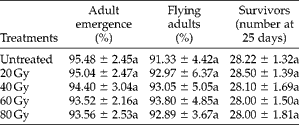
As shown in Table 1, one-way ANOVA on transformed proportions revealed no significant differences in the percentage of adult emergence (F 4,120= 2, 12; P= 0.0824) or flying adults (F 4,120= 1, 147; P= 0.3374) among flies irradiated at various doses and no significant differences in survival at 25 days among the treatment groups (F 4,120= 0.73; P= 0.572).
Mean (±SD) percentage of adult emergence from pupae, percentage of flying adults and number of adults (out of 30) surviving at 25 days for untreated and irradiated laboratory flies
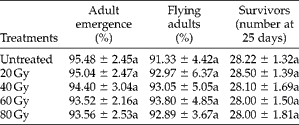
Means within a column followed by the same letter are not significantly different.
Field cage tests
Mating propensity and duration of copulation
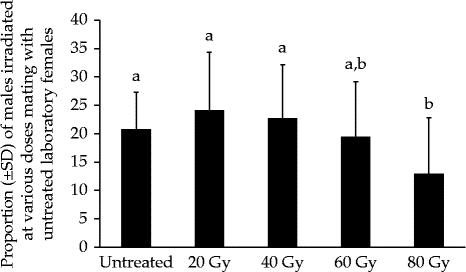
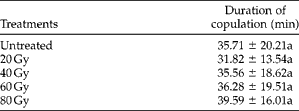
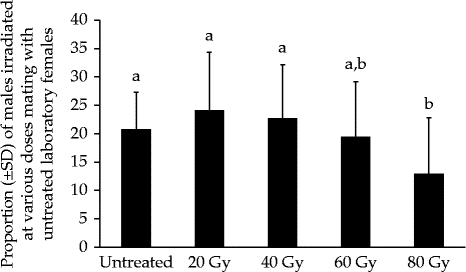
There were significant differences in the proportion of treated males mating with laboratory females among males irradiated at various doses (F 4,120= 6, 41; P= 0.00103), with smaller proportions of males irradiated at 80 Gy mating with untreated laboratory females (Fig. 1). Although there were no significant differences in the duration of copulation among males irradiated at various doses (F 4,205= 0.86; P= 0.4885), males irradiated at 80 Gy tended to mate for longer periods of time (Table 2).
Proportion of males treated at various radiation doses (0, 20, 40, 60 or 80 Gy) mating with untreated wild females in 3 m-diameter × 2 m-high field cages. Bars with the same letters are not statistically different after a one-way ANOVA on arcsin(sqrt (x))-transformed proportions.
Mean (±SD) duration of copulation between males irradiated at various doses and untreated laboratory females
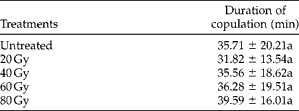
Means followed by the same letter are not significantly different.
Mating competitiveness and sterility induction
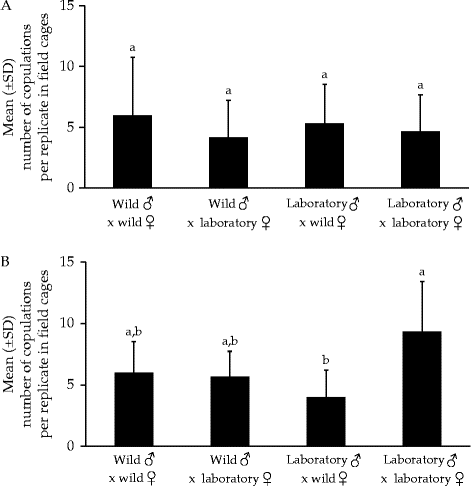
The statistical analysis revealed no significant differences in the number of wild × wild, laboratory × wild, wild × laboratory, and laboratory × laboratory matings in field cages where flies irradiated at 40 Gy were released (F 3,20= 0.34; P= 0.7969) (Fig. 2A). By contrast, there were significant differences in mating frequencies according to mating combination in field cages where flies irradiated at 80 Gy were released (F 3,20= 3.08; P= 0.05). Laboratory males mated more often with laboratory females than with wild females (Fig. 2B).
Mean number of copulations per mating couple type per replicate in field cages where (A) flies irradiated at 40 Gy and (B) flies irradiated at 80 Gy were released with a cohort of wild flies. Bars at the same dose with the same letters are not statistically different after a one-way ANOVA on log(x+1)-transformed frequencies.

Duration of copulation
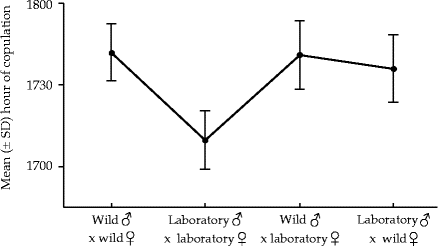
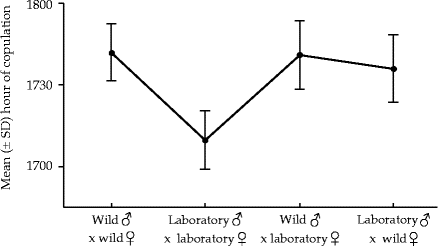
The analysis revealed significant differences in the duration of copulation among the different mating combinations (F 3,253= 7, 45; P= 0.00 008), while radiation treatment had no significant effect (F 1,253= 1.52; P= 0.220). Laboratory flies tended to mate earlier in the day among themselves than with wild flies (Fig. 3).
Mean hour of the day of initiation of copulation in field cages according to mating-type combination.
Sterility induction
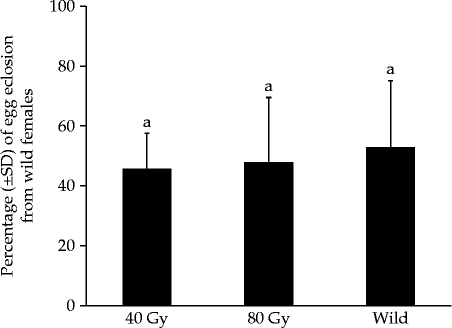
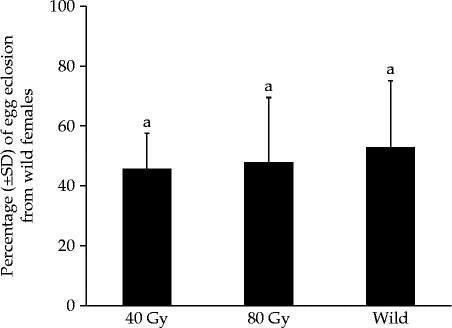
The percentage of egg eclosion was numerically higher in cages with wild flies, followed by those with flies irradiated at 80 Gy and those with flies irradiated at 40 Gy (Fig. 4). However, no significant differences were observed in the eclosion of eggs laid by wild females from cages where flies irradiated at 80 and 40 Gy and non-irradiated flies were released (H 2,33= 1.01; P= 0.60).
Mean percentage of egg eclosion from wild females recovered 48 h after release from field cages where a cohort of wild flies was released along with no other flies, flies irradiated at 40 Gy or flies irradiated at 80 Gy. Bars with the same letters are not statistically different after a one-way ANOVA on arcsin(sqrt (x))-transformed proportions.
Discussion
Some parameters such as adult emergence, flying adults and survival of A. ludens were not affected by the radiation dose. Such results are consistent with those reported by Rull et al. (Reference Rull, Brunel and Mendez2004, Reference Rull, Diaz-Fleischer and Arredondo2007) and Toledo et al. (Reference Toledo, Rull, Oropeza, Hernandez and Liedo2004). Collins et al. (Reference Collins, Weldon, Banos and Taylor2008) also did not find an effect of radiation dose on emergence and flying adults of treated Queensland fruit flies; however, they found a negative effect on survival under stress in flies irradiated at high doses. In any case, such parameters are not very informative for detecting deleterious effects of radiation on flies for release in SIT programmes.
By contrast, we found a significant effect of radiation dose on male mating performance. As only mass-reared males were used for mating propensity experiments, the observed decrease in male mating propensity with increasing radiation dose is independent of mass-rearing history and only reflects radiation effects on behaviour. The highest male mating propensity in laboratory cages was observed for males irradiated at 20 Gy. Nevertheless, at such a low dose, a small proportion of females may be fertile (Rull et al., Reference Rull, Diaz-Fleischer and Arredondo2007). Residual fertility of females can be extremely damaging for eradication purposes in terms of the released females' contribution to the next generation (Robinson, Reference Robinson2002). Male residual fertility, however, may only reduce the rate of population suppression. Rull et al. (Reference Rull, Diaz-Fleischer and Arredondo2007) argued that low percentages of fertility in released males could be compensated in the field by a boost in male mating performance. Rull et al. (Reference Rull, Diaz-Fleischer and Arredondo2007) also argued that such a trade-off could be reflected by greater sterility induction into wild populations by males irradiated at low doses as long as the dose applied caused 100% sterility in the released females of bisexual strains. In the case of A. ludens, a dose of 40 Gy produces 100% female sterility and more than 95% male sterility.
When comparing the mating performance of wild and laboratory irradiated males, we did not find differences in performance between flies irradiated at 40 Gy and wild untreated flies. By contrast, when releasing flies irradiated at the high standard 80 Gy dose, there were significantly more irradiated male × irradiated female matings than irradiated male × wild female matings. Irrespective of the radiation dose, however, mass-reared flies tended to mate significantly earlier in the day than wild flies. This behavioural difference is probably the result of artificial selection during mass-rearing, where light intensity is kept constant during the day (Meza-Hernández and Díaz-Fleischer, Reference Meza-Hernández and Díaz-Fleischer2006). As a consequence of this modification, in the early afternoon, we observed many failed copulation attempts between laboratory males and unreceptive wild females. As soon as males were able to secure a female, they attempted intromission, but females vigorously tried to prevent this by shaking their bodies and buzzing their wings. Males irradiated at low doses appeared to be better able to overcome unreceptive female resistance than males irradiated at high doses and could struggle with females for up to 30 min before copulation.
The improved mating performance of males irradiated at low doses resulted in lower percentages of egg hatch in wild females 48 h after release in cages. Obviously, low doses did not lower induced sterility. However, the difference was not significant, and thus this study did not prove conclusively that a low dose versus a high dose was beneficial for inducing higher sterility in wild flies. Nevertheless, in such large field cages, a period of 48 h was perhaps not enough time for all females to mate. Also, possibly the release of a higher sterile:fertile male ratio (e.g. 3:1) would make the difference more evident.
The results support the idea that reducing the radiation dose in areas of high pest prevalence, where the SIT in combination with other measures is intended for population suppression, will yield better results than releasing flies irradiated at doses causing 100% male sterility. Future studies should include field cage comparisons for other species under the SIT that may be more sensitive to radiation than A. ludens and also manipulate fly densities, sterile:fertile ratios and the duration of exposure of wild cohorts to irradiated flies.
Acknowledgements
The authors are grateful to Emilio Hernandez, Claudia Gallardo, Eduardo Tadeo, Brizia Gonzalez-Luna and Romeo Saldaña for technical assistance. They acknowledge the Campaña Nacional contra Moscas de la Fruta (DGSV-SAGARPA) and the International Atomic Energy Agency (FAO/IAEA) for funding the study.