1 Introduction
Medical malpractice has been at the heart of the hot debate over tort reform in the United States in the past decades. The literature about malpractice litigation in the United States is extensive and controversial (Baker, Reference Baker2005; Hyman and Silver, Reference Hyman and Silver2006).Footnote 1 There is a sense of excessive litigation over medical malpractice.Footnote 2 An important aspect is the repercussion of malpractice litigation on the legal system. The most immediate aspect is the number of suits filed against hospitals and doctors. In addition to their number, the duration of malpractice litigation has been an object of specific concern.Footnote 3
As a consequence of the importance of medical malpractice and tort reform in the United States, a broad stream of empirical literature has been developed (Mello et al., Reference Mello, Studdert and Brennan2003; Sage, Reference Sage2003; Danzon et al., Reference Danzon, Epstein and Johnson2004; Baker, Reference Baker2005). Inevitably, this literature relies on the specifics of the American healthcare delivery and legal system, those being in particular a fundamentally private enterprise-based healthcare system and a jury-based legal system (Danzon and Lillard, Reference Danzon and Lillard1983; Faber and White, Reference Faber and White1991).
It is very difficult to draw appropriate inferences on the efficiency of the American malpractice claim system when we look at other jurisdictions (Towse and Danzon, Reference Towse and Danzon1999; Danzon, Reference Danzon2000). For the case of the United Kingdom, the role of the NHS makes the analysis significantly different from the American literature. However, the empirical literature seems to confirm that expected litigation costs do shape medical behavior.Footnote 4
Our paper provides an empirical assessment of medical malpractice in a civil law jurisdiction dominated by government-provided healthcare (Burau et al., Reference Burau, Wilsford and France2009). The Italian legal system is not unique in the way it addresses medical malpractice cases, but rather reflects the civil law world.
There are very few studies about medical malpractice in civil law jurisdictions. One practical reason is the inexistence of data. In terms of litigation, in Italy the available data (e.g. that from the National Institute of Statistics, Istat) are basic aggregates such as divorces, bankruptcy procedures or labor legislation claims. Further independent statistical elaborations are apparently held back by the fact that much of the Italian judges’ output is still handwritten, and court records until recently were not kept electronically (Ministero della Giustizia, 2000, 2001). Not surprisingly, Italian studies, broadly speaking, on important legal topics generally lack any kind of empirical approach (Comandè and Turchetti, Reference Comandè and Turchetti2004). On the other hand, in a legal system less dominated by lawyers and with healthcare provided overwhelmingly by the government, there has not been a proliferation of medical malpractice lawsuits as in the United States. Civil law jurisdictions in general and Italy in particular, have not seen the rise of the hot debates over medical malpractice and tort reform that has been present in the United States.
Owing to practical limitations concerning data, we deal with the decisions of the Court of Cassation (Corte di Cassazione),Footnote 5 the court of last instance for both civil and criminal matters. The computerization of judicial decisions started earlier at this highest court than for the local courts. Therefore, at this stage, there are data available concerning decisions by the Court for a much longer period.
Looking at malpractice litigated at the highest court presents several advantages and disadvantages. On the minus side, it must be stressed that we are confronted with problems of sampling from the real population of malpractice cases.Footnote 6 In the case of the Court, this remark is particularly compelling. It is not a court of last appeal, but rather a court of legitimacy, that is, providing for a uniform interpretation of the law in the tradition of civil law jurisdictions. By focusing on the Court, we lose some additional information; for instance, at present there is no way to assess the compensation awards associated with most of these cases. There are occasional references, but typically there is no indication of damages.
In our view, the advantages partially overcome the disadvantages. The decisions of the Court reflect both criminal and civil malpractice claims, consistently with two special features of the Italian litigation system. The first trait is the possibility to seek compensation within the criminal trial (costituzione di parte civile). Unlike the Anglo-American system, criminal judges may also award damages (i.e. in tort law cases), though the main indictment retains a criminal nature. For example, in many of the criminal cases in our sample, the criminal allegations against a physician were not substantiated, but the civil settlement was in favor of the patient or her relatives.Footnote 7 A second trait is due, as far as our investigation is concerned, to the legal definition of causation. The approach to causation shaped in criminal law is applied to civil liability, quite differently from what happens in the Anglo-American legal system. Given that criminal action does not rely upon discretion of either the victim or the public prosecutor,Footnote 8 the inclusion of criminal liability is expected to decrease the specific biases of litigation (due to the nature of the case or to the behaviors of the different involved parties).
From a policy perspective, the Court's preeminent role makes this empirical analysis more valuable. The decisions of the Court can be considered de facto precedents, as is to be inferred from both the laws that regulate the judiciary and the powers assigned to the Attorney General of the Court of Appeal.Footnote 9 Looking at the production of important precedents concerning malpractice, it is possible to sketch the effects of current law regulating civil liability for the medical profession in Italy.
A particularly important aspect that affects the production of important precedents concerning malpractice in Italy is delays. If the outcome of either civil or criminal litigation takes too long, the deterrence effect is likely to be diminished. The main argument is that much of the delays in determining liability are discounted away by prospective tortfeasors. First, there is no insurance mechanism that shields the plaintiffs from the perverse effect of delays. Second, the perception of Italian commentators is that delays could not potentially add to the costs defendants subjectively bear. In fact, it is unlikely that defendants are hurt by delays since they could always opt for a settlement and they clearly do not (unlike in the United States or the United Kingdom, settlements are not prevalent in Italian litigation). Appeals are widely used by doctors to delay payment of damages. Third, in general deterrence terms, delays could potentially incentivize doctors by virtue of legal uncertainty. However, that is neither the view of the government (otherwise, the pressure for reform would be absent) nor of the general public (for whom delays are perceived as shielding doctors from effective liability).
Excessive delays are the symptom of a less effective legal system that naturally does not produce the appropriate incentives to deter negligent behavior and injuries. Not surprisingly, several reforms in both the Italian civil and criminal justice systems have tried to address excessive delays. If successful, they should make the production of important precedents concerning malpractice more efficient, and therefore enhance deterrence.
Our empirical analysis suggests that these reforms have largely failed in the field of medical malpractice. The impact of these reforms on reducing delays on the production of precedents is largely statistically insignificant. The inevitable consequence is that there has been no substantive improvement in the production of precedents in the period we consider, 1970–2009. One possibility could be that the reforms were so successful that they attracted more lawsuits. This in turn clogged the court system so that duration did not change. There is no evidence supporting such an explanation. In fact, our analysis does not show any significant reduction of delays in some period of time that attracted more lawsuits than in later periods. Another possibility is that other changes happening at the same time have eliminated the substantive improvement in the production of precedents. We cannot exclude completely such a possibility, but there is no obvious candidate. Yet another explanation is that these reforms failed because they were never implemented or effective. Given the political history of these recent Italian legal reforms, this seems quite unrealistic. Finally, it simply might be too early to determine whether the changes have had any impact on duration given the long average length for both civil and criminal cases. Although that is a possibility, many of these reforms have been in place for more than 15 years.
Our analysis does not suggest that there was no reduction in delays, but rather proposes the inexistence of a correlation between such reduction and legal reform in the context of medical malpractice. The apparent reduction in delays in this period seems to be explained more by the medical characteristics of the cases that get to the Court and less by the important reforms intended to reduce delays. This observation seems to confirm that Italy, and civil law jurisdictions more generally, have yet to address the medical malpractice debate.
The following section provides a basic overview of the role of the Court of Cassation within the Italian judiciary and the main features of medical malpractice law. Section 3 deals with the data set. Section 4 presents the econometric model, the different estimations (Weibull and Cox methods, the latter with time varying covariates), the results and the implications. Section 5 concludes.
2 Background (and some legal principles)
2.1. Background review of the Italian legal system and the role of the Court of Cassation
The administration of justice (both civil and criminal) in Italy includes: the Justice of Peace; a collegial court (Tribunale), that can act in some circumstances through a single judge (giudice monocratico); special collegial courts (e.g. the Juvenile Court); the Court of Appeal; and the Court of Cassation, as a court of legitimacy that should provide for a consistent and uniform interpretation of the law. While initiating a civil action is entirely dependent on the initiative of individual parties, the Italian Constitution (Article 112) states a principle of ‘mandatory criminal action’. Unlike the Anglo-American jurisdictions where a principle of opportunity prevails, Italy applies the principle of legality, which prescribes a criminal indictment if the prosecutor has reason to suppose a crime has been committed.Footnote 10
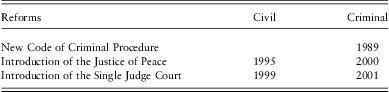
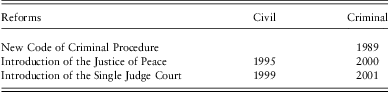
Excessive delays in both the civil and the criminal justice systems have been a curse of the Italian legal system. Since the end of the 1980s, a series of legal reforms aimed at solving or reducing the significant backlog affecting the delivery of legal (both civil and criminal) decisions in Italy. These excessive delays have raised constitutional issues since they practically deny the constitutional right to justice. The Italian Constitution (Article 111)Footnote 11 dictates individuals be discharged ‘within a reasonable period of time’. This obvious violation of constitutional rights has prompted several claims against Italy filed before the European Court of Human Rights (Varano, Reference Varano1997: 657). The responses have included several important reforms and the appointment of more judges, including a new penal procedure code in 1989 (Boari, Reference Boari1997; Grande, Reference Grande2000), the development of the Justice of Peace in 1995 (Varano, Reference Varano1997),Footnote 12 and the establishment of the single judge court in the first instanceFootnote 13 in 1999. We summarize the main reforms in Table 1.
Main reforms in Italian civil and criminal procedure
In Italy, the Court of Cassation is the court of last appeal (only on points of law, not on factual evidence) for both the civil and the criminal jurisdiction. Unlike the US or the UK Supreme Courts, the Court has different sections to address matters in criminal and civil litigation. The Court has no control over the dockets since the justices have no discretion as to whether or not to review a petition. When two or more sections of the Court disagree on a legal interpretation, the case is submitted to the United Section (Sezioni Unite),Footnote 14 only recently instituted for the several criminal sections.
Appeal to the Court may be lodged if and only if founded on one of the categories indicated in Article 360 of the Code of Civil Procedure or in Articles 606 and 609 of the Code of Criminal Procedure; otherwise the appeal is declared inadmissible. If the petition is declared admissible, the Court has the power to overturn (wholly or in part) a decision of a lower instance court either with remand (the case is generally remitted to the original jurisdiction) or without remand (after the 1995 reforms) (Proto Pisani, Reference Proto Pisani2002; Siracusano et al., Reference Siracusano, Galati, Tranchina and Zappala2004; Mandrioli, Reference Mandrioli2004).Footnote 15
It is incorrect to consider the Court of Cassation as a court of last appeal; it is not a court of third instance in the Anglo-American sense. It should rather ensure ‘the correct observance and the uniform interpretation of the law’ (Article 65 Royal Decree 1/30/1941 number 12) in full respect for the jurisdiction of the other courts. However, the formal role must be understood in the context of the Italian legal system with a high rate of appeals lodged every year. Some legal scholars observe that such a burden does not allow the Court to exert its original function.Footnote 16 Others have accused the Court of not providing the appropriate certainty of law because of ‘bureaucratic’ delays, in particular when considering the (often substantial) time elapsing from the moment the decision is deposited to the publication of the decision or of its massima (precept).Footnote 17 These delays undermine the production of clear and transparent precedents since the different sections of the Court can reach different conclusions (partially because they ignore each other's progress in reaching a decision). Such inefficient production of precedent distorts incentives for those lawyers authorized to litigate before the Court. They tend to file appeals on points that have been declared rejected in the past or on which there is a clear doctrine, simply relying on internal inconsistencies or dissent across sections (Pellegrini, Reference Pellegrini2005). Still, the Court does indeed shape legal doctrines, and the lower courts end up following the same interpretation of the law.Footnote 18
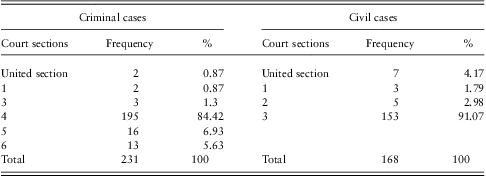
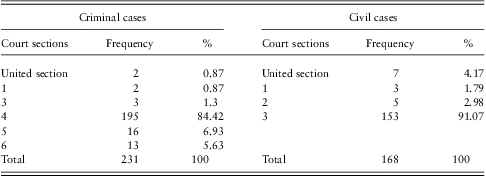
In conclusion, the Court of Cassation de facto produces precedents in a complex environment and is overloaded by too many cases. Such consideration certainly holds for medical malpractice cases, which are reviewed mainly (and have constantly been reviewed over the past decades) by the Third Civil Section and the Fourth Criminal Section, allowing for specialization and consistency, with the United Section intervening only on a mere handful of occasions. The Third Civil Section decided 91.1% of the civil cases included in our sample, and 84.4% of the criminal claims were settled by the Fourth Criminal Section (see Table 2).
Court of cassation on malpractice – record by sections
2.2. Principles of malpractice law in Italy
Italy possesses no specific statute law to regulate the physician–patient relationship, although attempts have been made. Therefore, the physician–patient relationship is regulated mostly by judge-made law just like in the United States or in the United Kingdom, in particular through the doctrines developed by the Court.Footnote 19 Legal scholars have already singled out medical malpractice as a civil liability ‘sub-system’ within Italian private law (De Matteis, Reference De Matteis1995; Izzo, Reference Izzo2005). The duties of a medical staff member, public or private hospital employee or independent practitioner toward the patient are interpreted as contractual obligations as far as liability is concerned. Tort law liability rules (responsabilità aquiliana) are not applicable here; it is principles of contract law that formally regulate the position of doctors before patients (Articles 1218, 1176 and 2236 of the Civil Code). The Court has recently reaffirmed this contractual nature by openly remarking on the divergence with common law jurisdictions (Third Civil Section 589/99).Footnote 20 The path followed by the Court has been characterized as “the making of a contractual relationship by planned stages” (contrattualizzazione a tappe forzate) (Giardina, Reference Giardina1993; Breda, Reference Breda2004). It started at the beginning of the 1990s and reached its end in the 2004 decisions of the Third Civil Section (decisions numbers 4400, 9741, 10297 and 11488). The overreaching consequences, in liability terms, have impacted mostly: (1) the burden of proof, which is on the defendant (physician or hospital; Article 1218 of Civil Code);Footnote 21 (2) applicable provisions on professional diligence requirements (Article 1176 of Civil Code);Footnote 22 (3) on the liability of an employee (Article 2236 of Civil Code);Footnote 23 and (4) the statute of limitations, currently 10 years, rather than the standard five years for compensation claims not originating from a contract.
Thus, medical malpractice in Italy is quite different from the United States both in terms of substantive law and in terms of procedure. However, even though Italy is a civil law jurisdiction, medical malpractice law is essentially judge-made law. It has been shaped and developed by the highest court in Italy, the Court of Cassation. The effectiveness of medical malpractice law relies on the capacity of the Court to enforce their own doctrines in due time. Excessive delays undermine the appropriate deterrence effect medical malpractice law should have. Inevitably, legal reforms have been enacted to address this serious problem, in criminal justice (mainly the 1989 reforms of the Code of Criminal Procedure) and in civil justice (mainly the 1995 introduction of the Justice of Peace and the 1999 introduction of the single judge court).
3 The empirical investigation: the data
3.1. The data set
The database is composed of 399 Court of Cassation decisions, gathered in two separate stages (see Table 2). A first bulk of data were created with reference to Fiori et al. (Reference Fiori, Bottone and D'Alessandro2000), which reports decisions on malpractice from 1960 to the beginning of 1999. This publication also included, as it is often the case, claims against physicians who practiced without authorization because they either did not hold an MD degree or had not passed the professional exam. Although a person without proper authorization and, in the extreme, proper qualifications, is likely to put a patient's health or even life in jeopardy, we did not include this group of cases for the purpose of our investigation. In fact, these cases could be simply regarded as fraud allegations or illegal practice of the medical profession. Following the same rationale, we have omitted those cases where the charge was solely a violation of the code of ethical conduct. However, given that we are addressing the phenomenon of medical malpractice concerning avoidable mistakes taking place in a strictly institutionalized patient–physician/hospital relationship, cases of nonfeasance, failure to carry out one's duties and forgery of a public deed Footnote 24 have been counted, since these issues involve conduct directed to cover a committed mistake, or worse, the refusal to grant prompt assistance to a patient.
The initial data set was verified and enlarged by examining the main Italian legal database (JurisData, De Agostini Professionale, Repertorio del Foro Italiano). The Court itself manages its own electronic archive, the CED (Centro Elettronico di Documentazione), so we went through those detailed records as well.Footnote 25 At this second stage, we had to cope with another source of sample selection problems: not all Cassation decisions are published and available. Publication implies the complete disclosure of the decision, while often individuals have access only to the precepts, and sometimes even precepts lack. Decisions collected in Fiori et al. (Reference Fiori, Bottone and D'Alessandro2000) include both published and unpublished pronouncements, and extensive research was carried out for the period 1999 through 2009.Footnote 26 The final result is our current dataset.
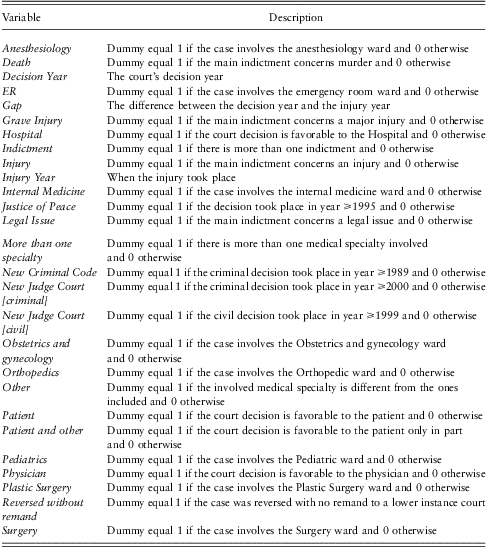
Each decision by the Court counts for an individual case. The characteristics of the case taken into account by our original database are: (1) the nature of the lawsuit (whether criminal or civil) (Civil); (2) the specific court section (Court Division); (3) the decision number (Decision Number); (4) the decision year (Decision Year); (5) the injury year (Injury Year); (6) the medical specialization(s) involved (Specialization); (7) the main indictment(s) (Indictment); (8) the outcome of the appeal (Outcome); (9) whether or not there was reversal without remand (Reversal without remand); (10) whether the Cassation appeal is to be considered the last stage of the judgment (appeal declared inadmissible; admissible but rejected; admissible and decision reversed without remand) or not (appeal declared admissible, and the case sent back to the appropriate lower court) (Final Appeal).Footnote 27
The variable Outcome deserves a more detailed comment. An outcome favorable to the patient may correspond to the case in which the public prosecutor has filed the appeal and won, but also to the case in which the doctor or the hospital have filed the appeal and this has been rejected (or declared inadmissible). On the other hand, an appeal can have an outcome favorable to the doctor or the hospital when the patient or the public prosecutor has filed the appeal and it has been rejected. This does not mean that the original appealed decision was completely favorable either to the physician or to the hospital, although this might often be the case. Given the possibility to file counter-appeal against the appeal filed by the patient, for instance, there are decisions in which the Court accepts in part the arguments of both parties. Therefore, Outcome cannot be used per se as a good proxy for winning the appeal.
The initial database underwent several modifications. A new continuous variable (Gap) corresponds to the difference between the injury year and the decision year. Malpractice cases might require longer time because claim verification takes longer. The choice in favor of the injury year (rather than the year in which the first claim was filed) is to allow for pre-trial negotiations and settlement attempts.
We then generated group indicator variables working on the outcome and the indictment variables. Where indictment is concerned, we created four groups as a proxy for the kind of injury the Court has to address (i.e. the subject of the malpractice case before the court of lower instance). This may not coincide with the real injury (the original contention of malpractice). For example, it might be that a case of failure to carry out one's duties had been associated with grave injury or death, however, the legal indictment at stake was the former rather than the latter. The resulting classification is: Legal Issue, for the indictment of nonfeasance, failure to carry out one's duties and forgery of a public deed. Such cases usually define a behavior that has increased the probability of an ultimately poor health state, but which cannot be assumed a direct cause; Injury (minor and major) groups the original category damages included in the indictment list; Grave Injury is an indicator for personal culpable injury and assistance in committing a crime; Death stands for manslaughter and murder in the second degree.Footnote 28
A second group of indicators decomposes Outcome; we grouped the variables according to the party to which the final outcome was favorable. The hospital dummy groups the successful outcome for both private and public hospitals and for the local health administrations in charge of the hospitals (Hospital).Footnote 29 The indicators for the patient (fully or in part) and the physician (fully or in part) are defined in the same way (Patient and Physician, respectively). By ‘in part’, we mean that the patient presented several reasons (motivi) in the appeal and only a part of these (or even only one) was eventually granted. A last category (Patient and other) represents a non-unilateral result, as a consequence of the possibility to file a counter-appeal against the main appeal.
Finally, we generated an indicator group for medical specialties. We took into account only medical specialties involved in more than 10 decisions, coming up with eight of the most relevant specializations. The dummy Other represents those not included in the selected eight (the 24 remaining specializations). The selected eight are: Anesthesiology, Obstetrics and gynecology, Pediatrics, Emergency room (ER), Surgery, Orthopedics, Plastic surgery and Internal medicine.
In order to take into account the legal reforms to reduce excessive delays (and therefore make the production of precedent more effective), we created three additional dummies: New Penal Code, New Judge Court and Justice of Peace. New Penal Code refers only to the criminal cases and decision years following 1989, when the new code was enforced. New Judge Court, compounding the effect of the 2000 and 2001 reforms for criminal cases, refers to decisions after 2000, and for civil cases subsequent to 1999. Justice of Peace refers only to civil cases tried after 1995.
Table 3 summarizes the variables coded for the empirical exercise.
Variables

3.2. Descriptive statistics
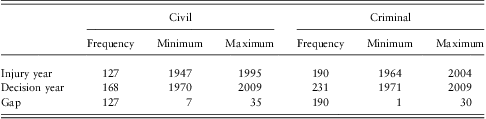
In aggregate terms, the decisions included correspond to malpractice events taking place between 1947 and 2004 (see Table 4). In our data set, 63% of the appeals had an outcome favorable to the patient, 29% to the physicians, while the rest of the cases were equally favorable to the physician or hospital (or insurance company) and the patient.Footnote 30 The medical specialization dummies emphasize that although 20% of the cases involved surgery, the majority of claims regarded obstetric and gynecologist specializations (25%), a percentage greater even than all other indicted specializations grouped together (22%). From the indictment grouping, we have that 45% of the events concern the death of the patient, a circumstance indirectly confirmed by the fact that 42% of the appeals were about civil claims, implying therefore a majority of criminal cases. Five percent of cases involved more than one specialty, and 4% involved more than one indictment, figures worth noting since they are a measure of more complex cases appealed. Finally, for 70% of the cases the appeal was declared inadmissible, admissible but rejected, or admissible and decision reversed without remand. Starting from the 1990s, we can also observe an increase in the number of litigated malpractice cases before the Court (see Figure 1).
Timing of data set (dependent variable)
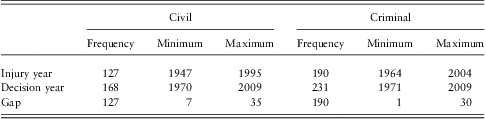
Note: Gap is defined as the time elapsing between the injury year and the decision year.
Aggregate trend.
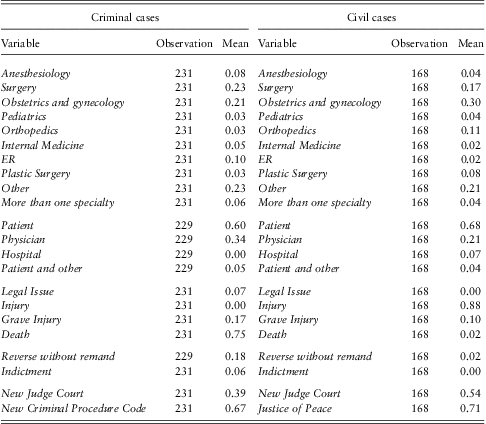
The regressors partially differ between the criminal (231) and the civil (168) cases (see Table 5). In fact, there are no criminal cases with an outcome favorable to the hospital (criminal liability is generally personal), while there are no civil cases involving internal medicine or, quite obviously, more than one indictment.
Sample means of the sub-samples (independent variables)
Note: ER = emergency room.
Criminal cases include claims for injuries occurring between 1964 and 2004, while the events considered in the civil cases dated between 1947 and 1995. In the criminal subsample, almost 60% were outcomes favorable to the patient, against 34% for the doctor. The difference is even more pronounced in the civil subsample, where the ratio is 68% vs 21%, and 7% of appeals were in favor of hospitals. Since the Court acquired the power to reverse a decision without remand, it has exerted that right in very few civil cases (2%), while more often in criminal claims (18%). The indictment variable also deserves comment. Since the main indictment for civil claims is related to damages, indictment alone is not very informative for this class of cases and we dropped it.
The dummies for reforms are quite good indicators of an increase in the frequency of appeals for malpractice before the Court: 71% of the civil cases were judged after 1995, while 67% of the criminal cases date after 1989 (see Figure 2). The increase in the civil claims frequency is associated with a decrease in their duration. The aggregate scatter shows, taking as baseline the injury year, a tendency to an overall decrease in Gap, which seems due to a decrease in the civil cases gap rather than in the criminal cases (see Figure 3).
Criminal and civil trends.
Gap scatter over injury year: civil and criminal cases. Note: Each dot represents a case.
This result is particularly striking for at least two reasons. On the one hand, in light of the 1989 introduction of the new Italian Code of Criminal Procedure, the scatters seem to suggest that the reform did not produce any effect at least as far as our sample is concerned (in contradiction with our regression analysis).Footnote 31 On the other hand, the decrease experienced in the civil sample seems to clash with an asserted general distrust toward civil justice in Italy due to its overall inefficient administration (Marchesi, Reference Marchesi2003). It is hard to believe that the reforms introduced in 1995 and 1999 could be appropriately regarded as the only cause of a phenomenon which involves claims originated by events dated at the latest in 1995.
4 An econometric model and its estimation
4.1. The specification of the modelFootnote 32
In duration models, we define T as the duration of the event we are interested in (e.g. a legal claim), and we can denote the cumulative distribution function of T as
 $$F(t)\: = \:P(T\:{\leqslant}\:t)$$
S(t) is the survival function, which gives us the probability that the process under study survives at least time t, formally
 $$S(t)\: \equiv \:{\rm{1 - }}F{\rm{(}}t{\rm{)}}\:{\rm{ = }}\:P{\rm{(}}T\, \gt \, t{\rm{)}}$$
and f(t) is the density function of T, representing the probability of failing it at time t:
 $$f(t)\: = \:\frac{{{\rm{d}}F}}{{{\rm{d}}t}}(t)$$
As Jones (Reference Jones2007: 70) points out, f(t) is used for (right-hand) uncensored observations (fully litigated cases) because we can observe their actual duration, while S(t) is used for (right-hand) censored observations (remitted cases), for which we know they survive beyond a given t. The hazard rate h(t) is
 $$h(t)\: = \:\frac{{f(t)}}{{S(t)}}$$
A parametric approach, as for instance the Weibull model, assumes a known baseline hazard. The baseline hazard represents the hazard for an observation with all covariates set at 0. As far as we are concerned, the definition of such a function will depend on the subset. The Weibull model defines the hazard rate for failure at time t as
 $$h(t)\: = \:\lambda p{{t}^{p{\rm{ - 1}}}} $$
and so
 $$f\left( t \right)\: = \:{{\lambda }_i}p{{t}^{p{\rm{ - 1}}}} \exp \left( {{\rm{ - }}{{\lambda }_i}{{t}^p} } \right)$$
 $$S\left( t \right)\: = \:\exp \left( {{\rm{ - }}{{\lambda }_i}{{t}^p} } \right)$$
where  $$)(--><$>{{\lambda }_i}\: = \:\exp \left( {{{X}_i}\beta } \right)<$><!--$$, λ and p are the parameters to be estimated and Xi represents the vector of regressors. In particular, p is the duration dependence parameter or shape parameter. In the Weibull specification, the probability of resolution varies with the duration of the dispute according to whether p is more or less than 1 (Hughes and Savoca, Reference Hughes and Savoca1997: 267–268). The Weibull model relies on a nonconstant hazard: if p > 1 (<1), the probability of resolution rises (decreases) with the time span the claim is open, and this shows the existence of a positive (negative) duration dependence. In survival analysis, the estimated coefficients represent how the regressors affect the hazard rate, h(t); that is, the probability that a case will be fully litigated in the interval (t, t + dt), given that it has not been closed before t. The impact of the regressors on the probability of resolution can be derived substituting for λ and setting the hazard rate equal to exp(β 0 + β 1Z 1 + ⋯ + βkZk)pt p − 1. The impact of a dummy, say New Judge Court, can be measured as the ratio of the hazard of a claim for which New Judge Court = 1 to the hazard of a claim for which New Judge Court = 0, that is, exp(β 1). We would expect the reforms coefficients showing an increase in the hazard ratio (i.e. a decrease in the survival time). In the same way, we are expecting that claims associated with a higher level of complexity would show higher survival duration. For instance, when a case involves an obstetrician it can potentially affect two people: a woman and a baby (or fetus). Therefore, it is expected to be more complicated and to last longer than a case involving a dermatologist.
However, a parametric approach suffers from a significant shortcoming related to the need of a fully specified baseline hazard function. To take into account this problem, we also provide results using a semi-parametric model, the Cox model, which is based on a lack of priors on the shape of the baseline hazard function. Additionally, the utilization of a Cox model is particularly useful to enhance flexibility in order to address the cases coming across the different reforms with the use of time-varying covariates. A time-varying covariates approach, as described in Narandranathan and Stewart (Reference Narandranathan and Stewart1993) and Jenkins (Reference Jenkins1995), allows us to take into account the fact that there might be some across-the-reform cases (i.e. Injury Year<Reform Year and Decision Year>Reform Year). For these cases, it would be inappropriate to consider the reforms only in terms of a categorical variable taking the value one if the decision of the Court is dated after the reform and zero otherwise. In fact, we would consider the effect of the reform equivalently for those cases entirely debated after the reform enforcement and for those cases for which such enforcement is supposed to be ex ante less relevant. In order to address this issue, we are basically duplicating the across-the-reform observations. The basic intuition is the following: move from the fact that we are dealing with two reforms, Reform 1 and Reform 2, that, to be consistent with our framework, are assumed to be enforced at time t 1 and t 2, respectively with t 2>t 1. This means that potentially we can have up to six types of cases:
1. Cases decided before Reform 1;
2. Cases filed before Reform 1 and decided after it;
3. Cases filed after Reform 1 and decided before Reform 2;
4. Cases filed before Reform 2 and decided after it;
5. Cases filed before Reform 1 and decided after Reform 2;
6. Cases filed and decided after Reform 2
Types one and six do not represent a concern, whereas problems stem from types two through five. We provide an example of these problems in Figure 4. Define t oi the time of the opening and t di the time of the decision of case i, with t di>t 1 and t oi<t 1. Since we are measuring the reform using a dummy variable, if we are not taking into account the across-the-reform nature of i, the reform dummy will take the value of one on the entire period between t oi and t di as shown in the lower part of Figure 4.Footnote 33 However, once we consider such ‘across’ nature of i, we will end up having two observations for i. The first identifies the duration from t oi and t 1 and for it the reform dummy will take the value of zero. The second corresponds to the duration of the case between t 1 and t di and only on that spell the reform dummy will be equal to one.Footnote 34 One shortcoming associated with the use of this model to our data stems from the fact that the appropriate definition of toi would be the time of filing, whereas, given the lack of such information, we can only approximate toi with the date of the injury, being aware of the limitation that this approximation might produce in the analysis.
Time variant vs time invariant treatment.
All in all, we estimate the following equation:
 $${ Duratio{{n}_i}\: = \:\alpha Case^{\prime}\: + \:\beta Outcome^{\prime}\: + \:\gamma Indictment^{\prime}\: + \:\delta Reverse\: \cr & \quad+ \: {{\theta }_{\rm{1}}}Refor{{m}_{\rm{1}}}\: + \:{{\theta }_{\rm{2}}}Refor{{m}_{\rm{2}}}\: + \:{{{\epsilon}}_i} \cr}$$
where i = 1, 2, …, N stands for the cases, and the duration of each case. The equation reports the spell between the injury year and the Court of Cassation decision year (Duration) as explained by a function of a vector of case characteristics such as the medical specialty involved (Case), who won the appeal to the Court (Outcome), the kind of indictment discussed in the case (Indictment), and whether or not the Court decided the case without reversing it to a lower court (Revers). One of the variables of each vector is dropped since we are working with dummy variables, to avoid co-linearity problems. The dropped variable is the reference within the group for the interpretation of the coefficients. θ 1 and θ 2 are the coefficients of the reforms, which took place, respectively, in the civil system (Single Judge Court and Justice of Peace) and in the criminal system (New Code of Criminal Procedure and Single Judge Court). Hence, we estimate the equation separately on the two subsamples and using both a parametric with time unvarying reforms’ variables and a semi-parametric time varying reforms’ controls approach.
4.2. Survival descriptive statistics
For the purpose of survival analysis, let us start by recognizing that our data set suffers both from truncation and censoring. A case has to last long enough to be fully litigated before the Court in order to appear in the set; this is left-hand truncation. Obviously, left-hand truncation of the sample (delayed entry) generates estimation bias. Therefore, we need to modify duration for the probability that a case ‘survives’ up to the time of our observation period (Jones, Reference Jones2007). Other possible sources of bias are left-hand and right-hand censoring of the data. Our data set of cases closed between 1 January 1970 and 31 December 2009 includes cases: (1) opened before 1970 and closed after 1970; (2) opened and closed within the temporal span 1970–2009; and (3) opened within the span and closed after 2009. The first category is associated with a length bias sampling problem, and the third to a finite sampling horizon bias. For instance, in our survey, the probability of making it through to the Court can vary by medical specialization; it might be less probable that the Court examines dermatology cases rather than obstetrician cases. Hughes and Savoca (Reference Hughes and Savoca1999) propose techniques to correct for biases using all observations, and we incorporate them into our analysis.Footnote 35 As a matter of fact, we know the exact duration for a majority of observations and only a minority of results was left-hand censored. In order to remedy the left-hand truncation bias, we need to adjust the origin parameter of the analysis, the point in time from which the case started to be exposed to the risk of being fully litigated. This ‘time origin’ is the ‘age’ of the case taking into account the moment the claim was filed. The first filing procedure started the period of exposure for that claim. Since the dependent variable is the duration of a malpractice case up to the last decision at the Court, the failure variable is Appeal.
The descriptive analysis is developed in two stages. First, we focus on the original data set, which contains only one record per observation: each individual malpractice event is counted only once. Then we duplicate (or triplicate for cases going through both reforms) the observations related to the across-the-reforms cases so that we can recode the reforms variable accordingly to the real length of their impact on the case.
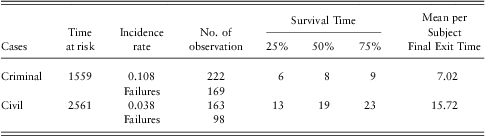
The statistics associated with the first stage show that for 25% of criminal cases the final gap was only six years, 50% last up (fall in) to eight years and 75% were tried within nine years. The civil cases present a different scenario, with 25% of the cases closed within 13 years, 50% 19 years and 25% last more than 23 years (see Table 6). The percentages express cases fully litigated, without having to go through another stage of the judicial system. That criminal cases display a shorter duration should not suggest per se that criminal justice administration is more efficient than its civil counterpart. We need to remember that we derived Gap with the purpose of taking into account pre-trial negotiations and settlement attempts, which basically take place in the civil system and not in the criminal. The pace of the two systems is also influenced by different procedural rules; there is, for instance, a different statute of limitations. The average time of exit is seven years for criminal cases and slightly <16 years for civil. The Court had addressed 169 criminal cases and 98 civil cases with no remand (i.e. failures) by 2009.
Descriptive survival statistics
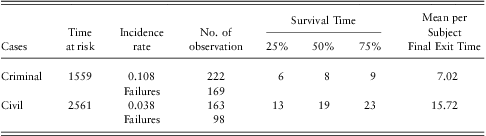
Results of log-rank tests (Cleves et al., Reference Cleves, Gould, Gutierrez and Marchenko2008) mostly confirm that there is no significant difference in the probability of lasting more than a certain amount of time given to the reforms enforcement.Footnote 36 We then consider the baseline hazard functions for both civil and criminal cases. The baseline hazard represents the hazard for an observation with all regressors equal to zero. In our case, the practical definition of such a function will depend on the subset. The Weibull baseline hazard functions show consistency with the assumption that the more the cases are ‘exposed’ to the courts the higher the probability to be decided.
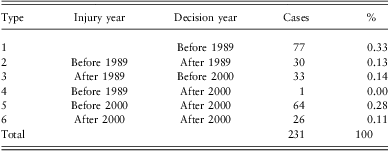
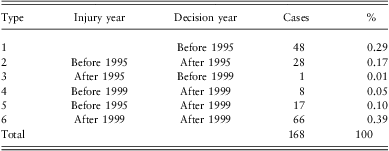
Moving to the descriptive evidence of the second stage, the incidence of each type of across-the-reforms cases addressed in Section 4.1 in each subsample is reported in Tables 7 and 8. Overall, 57% of the criminal cases and 69% of the civil cases took place in clear-cut defined time spell as far as the reforms are concerned. As expected, the portion of cases affected by both the reforms is higher in the civil system than in the criminal system.
Criminal cases across the reforms
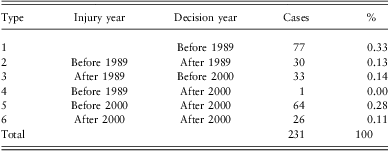
Note: Type refers to the possible combinations of across-the-reforms cases described in Section 4.1.
Civil cases across the reforms
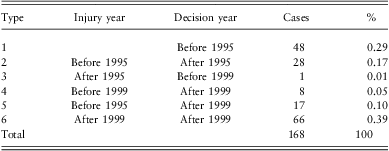
Note: Type refers to the possible combinations of across-the-reforms cases described in Section 4.1.
4.3. Results
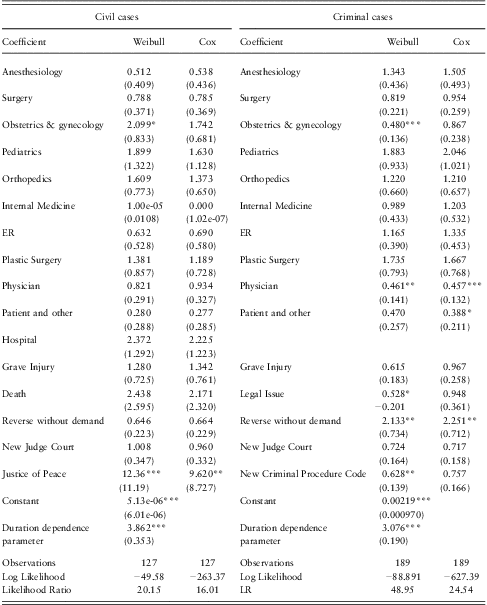
The results of the estimation of equation (1) according to the two models, Weibull and Cox, on the two subsets, criminal and civil, and according to a time unvarying and varying definition of the reforms are reported in Tables 9 and 10, respectively. In both tables, the coefficients express hazard ratios and, as such, when higher than one they account for an upward shift of the hazard ratio (which means for our cases a higher probability to be closed sooner) while if lower than one there is a decrease (downward shift of) in the hazard ratio (therefore, a higher probability that it will take longer to be fully litigated). In each table, the reference category (reference cell coding as in Hosmer and Lemeshow, Reference Hosmer and Lemeshow1999) is, for the criminal sample, a case involving Other medical specialty, which sorted out to be decided in favor of the Patient, where the main legal indictment was manslaughter (i.e. Death). In the civil sample, the coefficients need to be interpreted in reference to a case involving a medical specialty grouped in Other, which had a final outcome for the Patient, and dealing with a request of compensation for personal injuries (i.e. Injury).Footnote 37
Econometric results
Note: The dependent variable is the time span between the injury year and the decision year. The coefficients are hazard ratios: when higher than one they indicate higher hazards and therefore a lower probability to survive (a decrease in the expected duration), when lower than one a higher probability to survive. The reference category for the medical specialties is Other, for the outcome variable is Patient, for the indictment is Death for the criminal sample and Injury for the civil sample.
ER = emergency room.
Standard errors in parentheses.
Significance at the 10% level is represented by *, at the 5% level by ** and at the 1% level by ***.
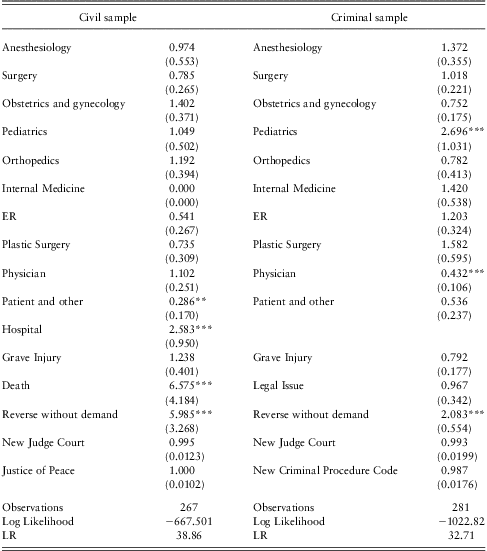
Econometric results using a Cox model with time varying covariates
Note: The dependent variable is the time span between the injury year and the decision year. The coefficients are hazard ratios: when higher than one they indicate higher hazards and therefore a lower probability to survive (a decrease in the expected duration), when lower than one a higher probability to survive. The reference category for the medical specialties is Other, for the outcome variable is Patient, for the indictment is Death for the criminal sample and Injury for the civil sample.
ER = emergency room.
Standard errors in parentheses.
Significance at the 10% level is represented by *, at the 5% level by ** and at the 1% level by ***.
Table 9 shows that for both samples, the Weibull duration-dependence parameter, p, is higher than one, so that the hazard of failure increases with time, consistent with what we have stated in section 4.1. The 95% confidence interval for both values of p gives no reason to reject the hypothesis that p > 1. The value of the constant term depends mainly on the number of non-censored cases.
According to these results, the introduction of the single judge in both the criminal and the civil systems has not had any significant effect on the duration of the cases under consideration, quite consistent with the findings of other studies (although the sign of the coefficient is negative in both regressions). However, the reforms concerning both the Justice of Peace and the New Criminal Procedure Code are assessed to have had a significant impact; the first is detected in both models (Weibull and Cox), the second only in the Weibull model. However, while the introduction of the justice of peace is associated with a reduction in the duration time, the new code of criminal procedure seems to have had the opposite effect.
The possibility to reverse without remand was originally introduced with the purpose of increasing the speed of claims’ resolution, and this effect is detected in the criminal sample but not in the civil sample. Medical specialization, outcome and indictment coefficients are quite disappointing in a way especially for the civil sample, for which the special traits of a malpractice case do not appear to influence its duration. Only the coefficient of the Obstetrics and Gynecology is significant, but only in the Weibull model and at the 10% significance level. Aware of this caveat, and also relevant in the context of criminal cases, it is worthwhile to pinpoint the different effect associated with this coefficient in the civil and the criminal sample. While in civil cases it seems to decrease the time needed to arrive at a decision with respect to the residual category, when criminal liability is involved, this characteristic tends to increase the amount of time needed for a conclusion. Among the criminal cases, the only coefficient statistically different from zero in both the used specifications is the one detecting a decision favorable to a physician; compared with decisions closed in favor of the patient, those closed in favor of the physician take more time.
The Cox estimation of equation (1) based on the time-varying definition of the reforms’ impact wipes out any significance associated with the reforms of the code in the criminal system and with the introduction of the Justice of Peace in the civil system. The expected effects are now making more sense; none of them is statistically different from zero. Overall, some of the characteristics of the case gain significance. In the civil sample, a case dealing with the death of the patient is decided much faster than one dealing with only a personal injury. When the outcome is in favor of the hospital, the case is closed sooner, while outcomes not as clear-cut are associated with longer resolution times (i.e. Patient and other). In the criminal sample, the effect of an outcome favorable to a physician compared with the one favorable to a patient is confirmed, while the relevant medical specialty is pediatrics, which, when involved, decreases the resolution time. The effect of reversal without remand is consistent with results showed in Table 9, and significant from both samples.
4.4. Implications
The first results indicate that the criminal procedure reform of 1989 and the introduction of the justice of peace in the civil system had some sort of impact. However, these results do not withstand a more careful evaluation of the impact of the reform run through a time-varying covariates Cox model, through which the real dimension of the potential impact on the analyzed cases is sharply assessed. As for what concerns the civil case sample, we should expect that reforms take more time to be effective given that seven years is the average duration for the Court of Cassation to close a case. Accordingly, the lack of statistical significance could be connected to the absence of a definite tendency toward a shortening in the length of civil claims filed before the reforms.Footnote 38
Given the econometric results, the reduction in delays shown in Figure 3 could possibly be interpreted as a sign of an evolving social attitude rather than the outcome of legal policy. While in the past only the most complicated cases would be the subject of a lodge to the Court, now Italians tend to feel increasing distrust toward medical practitioners, appealing much more commonly than in the past (increased frequency). The fact that civil cases depend on the decisions of the parties might have amplified the (decreasing) bias affecting that particular subsample.
5 Concluding remarks
Although the decisions of the Court of Cassation cannot be regarded as a straightforward indicator of the medical malpractice litigation in Italy, they nevertheless prove informative given the ‘production’ of precedents. First and foremost, through them we secure a sketch of the aggregate features of the legal provisions for malpractice cases in Italy since medical malpractice law is fundamentally judge-made law. From an economic analysis viewpoint, the Court has shaped the system of incentives, which eventually determines deterrence of negligent behavior. The effectiveness of medical malpractice law is undermined by excessive delays that seem to contaminate the Italian legal system. Several legal reforms have been passed since the late 1980s to reduce delays. If successful, we should expect the incentives provided by Italian medical malpractice law to be more effective.
Our empirical research does not seem to show that legal reforms have been generally successful. The findings seem to point out that variations on duration seem to be more related to specificities of the case and features of the Italian judiciary (in particular, reversal without remand). The legal reforms have no statistically significant impact on duration. The observed reduction of duration in the period 1970–2009 does not seem to be significantly explained by legal reforms, but rather the characteristics of the cases that are appealed to the Court of Cassation.
We recognize that our empirical findings are a partial understanding of medical malpractice in Italy. Any full analysis must take into consideration the actions of the lower courts. For example, it is unclear in the period of analysis if the medical malpractice law shaped by the decisions of the Court has impacted both frequency and reduction/increase of malpractice compensations awarded by lower courts. For instance, the 1999 reform could still have an impact on the enforcement of medical malpractice law in terms of the single judge lower courts, but may not be a turning point in terms of the practices of the highest court.
These excessive delays and the lack of success of the legal reforms since the late 1980s might also explain why the full medical malpractice debate in Italy cannot be compared with the hot controversies in the United States at this stage. It obviously lacks the relevance it has in the context of US healthcare delivery. At the same time, given the way the Italian legal system addresses medical malpractice, we can speculate that deterrence of negligent behavior could be a serious problem in Italy.
We cannot easily generalize the results of the Italian legal reforms and their limited impact on the duration of medical malpractice cases to other civil law countries. However, it is known that the problem of delays is common to many jurisdictions in Europe. At the same time, the legal reforms pursued in Italy are not unique. In fact, some of the reforms introduced in Italy in criminal and civil procedure have influenced legal policies in other European countries. Therefore, we can say the case of Italy provides an indication of similar problems and solutions in other European jurisdictions. Our results point out that we have reason to be skeptical of recent legal trends in Europe in terms of their ability to enhance medical malpractice laws.
Acknowledgments
The authors are grateful to two anonymous referees and Alessandro Petretto, Peter Simmons, Vincenzo Varano, and those working at Binariodieci (Office of the Italian National Institute of Statistics), and the participants of the second annual meeting of the Italian Association of Law and Economics for kind suggestions. They gratefully acknowledge as well the outstanding assistance of the University of Florence librarians in our research on legal databases, and feel especially indebted to Sonia Sciclone (Bank of Italy, Legal Department) and Palma Rossi (Court of Cassation Criminal Archive) for precious help in the effort to supplement the data. Roya H. Samarghandi has provided superb research assistance. The usual disclaimers apply.