Phonological awareness (PA) and naming speed (NS) have consistently been found to be closely associated with children’s reading development (Landerl et al., Reference Landerl, Freudenthaler, Heene, De Jong, Desrochers, Manolitsis, Parrila and Georgiou2019). Studies on clinical samples have given evidence that these two skills are the most common deficiencies in children with dyslexia in transparent and opaque orthographies (see Landerl et al., Reference Landerl, Castles and Parrila2021, for a review). PA refers to the ability to identify and manipulate phonological segments in spoken words. PA is likely to be the strongest predictor of individual differences in reading accuracy (Ziegler et al., Reference Ziegler, Bertrand, Tóth, Csépe, Reis, Faísca, Saine, Lyytinen, Vaessen and Blomert2010) and the most accurate cognitive measure to discriminate between children with dyslexia and typically developing (TD) children regardless of the language’s spelling consistency (Moura et al., Reference Moura, Pereira, Alfaiate, Fernandes, Fernandes, Nogueira and Simões2017). NS, which represents the ability to name serial displays of letters, digits, objects, or colors as quickly as possible (Landerl et al., Reference Landerl, Freudenthaler, Heene, De Jong, Desrochers, Manolitsis, Parrila and Georgiou2019), tends to be the strongest predictor of children’s reading fluency (Norton & Wolf, Reference Norton and Wolf2012). During typical development, children shift from total reliance on decoding strategy to reading by sight. This requires more orthographic knowledge about the spelling system as a function of reading experience. Accordingly, NS and orthographic knowledge seem to play an essential role during further reading development after initial stages. This is also evident from PA essentially reaching ceiling early in transparent orthographies (e.g., de Jong & van der Leij, Reference de Jong and van der Leij1999, Reference de Jong and van der Leij2002).
Whereas the independent roles of PA and NS have been extensively studied in Arabic, a Semitic transparent orthography, only few studies have examined the role of orthographic processing (OP) in reading as an independent factor beyond PA and NS (e.g., Tibi & Kirby, Reference Tibi and Kirby2019). Likewise, examining the respective contribution of these three factors and their association in the explanation of dyslexia in children has not attracted much attention so far. The current study was designed to examine whether the combination of PA, NS, and OP could explain a significant amount of variance in word-level reading skill in a representative sample of Arabic-reading children, and whether OP is an additional/independent predictor besides PA and NS. As the triple-deficit hypothesis (TDH; Badian, Reference Badian1997) was developed as an extension of the double-deficit hypothesis (DDH), we first briefly address this theoretical point of view before we go into the fundamentals of the TDH and the related literature.
The DDH of dyslexia
The DDH (Bowers & Wolf, Reference Bowers and Wolf1993; Wolf & Bowers, Reference Wolf and Bowers1999) was developed as an extension of the dominant phonological account (Ziegler et al., Reference Ziegler, Perry, Zorzi, Verhoeven, Perfetti and Pugh2019). The DDH acknowledges the phonological impairment as a core deficit in dyslexia but proposes that there is a second independent core deficit in processes indexed by NS. NS, typically measured by rapid automatized naming tasks, is a strong risk factor for reading fluency difficulties (Kirby et al., Reference Kirby, Georgiou, Martinussen and Parrila2010; Norton & Wolf, Reference Norton and Wolf2012). However, controversies still exist regarding whether NS should be considered a subskill related to phonological processing or an independent process (Kirby et al., Reference Kirby, Georgiou, Martinussen and Parrila2010, see also Protopapas et al., Reference Protopapas, Katopodi, Altani and Georgiou2018; van den Boer et al., Reference van den Boer, Georgiou and de Jong2016, for an overview). The DDH postulates that NS is an independent core deficit in developmental dyslexia that may underlie reading difficulties in addition to or in the absence of a phonological deficit. That is, PA and NS deficits are separable sources of reading difficulties, whereas their combined presence leads to even more severe reading impairment (Wolf & Bowers, Reference Wolf and Bowers1999; Wolf et al., Reference Wolf, Bowers and Biddle2000). Children with a double deficit have been found most impaired in word identification, word decoding, and reading comprehension (Wolf et al., Reference Wolf, Bowers and Biddle2000), and also in reading fluency in different languages (Steacy et al., Reference Steacy, Kirby, Parrila and Compton2014; Torppa et al., Reference Torppa, Parrila, Niemi, Lerkkanen, Poikkeus and Nurmi2013), compared to children with a single deficit.
Similar patterns of findings were also reported in Arabic-based studies. For example, Gharaibeh et al. (Reference Gharaibeh, Sartawi, Dodeen and Alzyoudi2019) investigated the effects of PA and NS on reading ability, including word and pseudoword identification and comprehension, in Arabic-speaking third-grade students. Students with a NS deficit scored lower than the no-deficit group, as did both the PA deficit and dyslexia groups, suggesting that phonological and NS skills make distinct contributions to reading ability. Layes et al. (Reference Layes, Lalonde and Rebaï2017) investigated the predictors and correlates of dyslexia in Arabic-speaking school children. They reported that students with dyslexia were inferior to typical readers in terms of both PA and NS measures, indicating some support for the DDH. Tibi and Kirby (Reference Tibi and Kirby2018) also tested the DDH model in Arabic-speaking children from Grade 3. The results indicated that PA and NS were significant and unique predictors of every reading outcome (i.e., word and pseudoword accuracy, word- and text-reading fluency, and reading comprehension), after controlling the effects of age, cognitive ability, and vocabulary, with PA being the more powerful factor. Moreover, Asadi and Shany (Reference Asadi and Shany2018) examined the DDH in Arabic by investigating the reading and cognitive profiles of readers with selective deficits in NS, PA, or both, in third and fourth graders. Among children with reading difficulties, the authors found that 12% of them were classified as having a PA deficit, 18% as having a NS deficit, and 24% as having a double deficit. Children with a double deficit performed worse than those with a NS deficit but similar to those with a PA deficit on word-reading accuracy, reading comprehension, working memory, morphological knowledge, vocabulary, and syntax knowledge. However, the group with a double deficit performed slower than the two other groups on word-reading fluency. Yet, given that only 54% of the children in this study could be classified based on these deficits, it is likely that the remaining percentage might be identified through a third additional deficit that has not been considered so far. In this respect, the authors suggest that OP may be another separate core deficit in Arabic.
A similar logic would also apply for other languages than Arabic. Indeed, research in other languages indicates that the relationship between PA and NS on the one hand and reading on the other hand appears to be complex and may be dependent on orthographic complexity (e.g., Caravolas et al., Reference Caravolas, Lervåg, Defior, Seidlová-Málková and Hulme2013; Moll et al., Reference Moll, Kunze, Neuhoff, Bruder and Schulte-Körne2014). For example, Landerl et al. (Reference Landerl, Freudenthaler, Heene, De Jong, Desrochers, Manolitsis, Parrila and Georgiou2019) concluded that whereas NS was found to tap into a language-universal cognitive mechanism that is involved in reading independently from the orthographic complexity, the relationship between PA and reading depends on many factors including orthographic complexity. Beyond the strong contribution of PA and NS to the variance in scores in reading outcomes, OP has already been shown to contribute significantly to reading accuracy and fluency (Stanovich, Reference Stanovich, Gough, Ehri and Treiman1992). Thus, OP is proposed as another key variable in the prediction of reading (Ehri, Reference Ehri, Cain, Compton and Parrila2017) and has been adopted as a third component of the TDH besides PA and NS.
The role of OP in reading
OP refers to the knowledge of letter strings (letter patterns) and word-specific orthographic representations (Apel, Reference Apel2011). Orthographic knowledge involves memory for specific visual/spelling patterns that identify individual words, or word parts in print (Barker et al., Reference Barker, Torgesen and Wagner1992; Stanovich, Reference Stanovich, Gough, Ehri and Treiman1992). Orthographic knowledge thus plays an important role in developing reading and spelling skills and facilitates the ability to effortlessly recognize printed words (Chetail, Reference Chetail2015), as well as patterns across words (e.g., Dich & Cohn, Reference Dich and Cohn2013). OP skill is thought to be acquired through reading experience as children develop extensive spelling-to-sound knowledge during reading. The self-teaching hypothesis developed by Share (Reference Share1995, Reference Share2004) relies on this idea. The self-teaching model proposed that each successful identification of a word is providing an opportunity to acquire the word-specific orthographic information. The phonological recoding at work for each new word identification allows the readers to build and specify its orthographic knowledge, which is the foundation of skilled visual word recognition and fluent reading.
Although many tasks used to assess phonological processing necessarily depend on orthographic knowledge (e.g., pseudoword reading; Bowers & Wolf, Reference Bowers and Wolf1993), both phonological and orthographic skills were found to make independent contributions to word recognition (Olson et al., Reference Olson, Forsberg, Wise, Rack and Lyon1994). Ehri (Reference Ehri1997) maintains that, for sight word reading, letter-sound knowledge is needed to form a complete network of visual–phonological connections in lexical memory. Therefore, when the orthographic representation for single letters is unstable, the process of automatic orthographic and phonological connections will be impeded (Badian, Reference Badian1997).
The role of OP in Arabic
From the MAWRID model (Saiegh-Haddad, Reference Saiegh-Haddad2018), it is argued that the development of word reading in Arabic is shaped by vowelization (i.e., through including diacritics representing short vowels). This results in the development of an initial phonological recoding mechanism that is based on converting all of the graphemes within the word (letters and diacritics) into the sounds they represent. This grapheme-based phonological recoding mechanism is optimized and subsequently substituted by a letter-based morpho-orthographic recoding mechanism that bypasses diacritics by the second grade (Saiegh-Haddad, Reference Saiegh-Haddad2018). This morpho-orthographic mechanism is an emergent processing mechanism that develops in response to the transparent representation of the morphological structure of the word in its letter representation in Arabic (Saiegh-Haddad & Henkin-Roitfarb, Reference Saiegh-Haddad, Henkin-Roitfarb, Saiegh-Haddad and Joshi2014). Throughout reading acquisition, children discover that the morphological structure of the word provides phonological information that is redundant with that marked by the phonemic diacritics and can therefore use them to expedite their word identification process. As a result, they supplement their initially emerging linear, grapheme-based phonological recoding process with a morpho-orthographic recoding mechanism that is based on the letters of the word, which map the morphological structure (consonants and long vowels), and less on the diacritics. Therefore, an interactive process between a bottom-up grapheme-based phonological process (letter and diacritic) and a top-down letter-based morpho-orthographic process emerges very early on in Arabic reading (Saiegh-Haddad, Reference Saiegh-Haddad2018).
There are several features of the Arabic language and writing system that are especially relevant to the role of phonological and morpho-orthographic skills and explain why OP may be challenging in Arabic. A first feature concerns the graphic characteristics of the Arabic letters which covers the formation of the letters themselves. Many look similar and are only distinguished by dots above, under, or in the letter (e.g., خ ,ح ,ج). Most letters also have four different forms that depend on their position in the word. Thus, the connected graphemes change their shape depending on their position in the word (initial, medial, or final). Arabic letters can be either connected (i.e., ligatured) letters or non-connected in the word. However, ligaturing between some successive letters is mandatory (Khateb et al., Reference Khateb, Khateb-Abdelgani, Taha and Ibrahim2014). Therefore, a word containing such letters must be written in a connected (cursive) way, considered as a rule, which determines the incorrectness of spelling. Several studies concluded that these characters constitute a specific challenge to Arabic readers, particularly in terms of the reader’s ability to distinguish individual letters (e.g., Eviatar et al., Reference Eviatar, Ibrahim and Ganayim2004; Ibrahim et al., Reference Ibrahim, Eviatar and Aharon-Peretz2002).
A second feature is the use of vowelized (with diacritics) and unvowelized (without diacritics) scripts. Short vowels are usually omitted, except for didactic purposes in children’s books. As stated above, readers need to use lexical morpho-orthographic knowledge as well as syntactic and semantic information to retrieve the correct pronunciation when the diacritics are absent (Saiegh-Haddad & Henkin-Roitfarb, Reference Saiegh-Haddad, Henkin-Roitfarb, Saiegh-Haddad and Joshi2014). There are inconsistencies about the role of vowelization in reading in Arabic. Vowelization has been argued to have a positive effect on reading in Arabic, indicating that diacritics facilitate reading accuracy and comprehension in both poor and skilled readers (e.g., Abu-Rabia, Reference Abu-Rabia2001). More recent research, however, provides a different view showing that diacritic vowelization may result only in more accurate reading in the early grades and in reading disabled children (Schiff & Saiegh-Haddad, Reference Schiff and Saiegh-Haddad2017). Moreover, diacritical vowelization has been found to reduce reading fluency across all grades from childhood to adolescence (Saiegh-Haddad & Schiff, Reference Saiegh-Haddad and Schiff2016). This inconsistency may be related to the fact that early research on the role of diacritical vowelization did not clearly distinguish between phonemic and morpho-syntactic diacritics, and this might explain some of the mixed patterns of results observed (Schiff & Saiegh-Haddad, Reference Schiff and Saiegh-Haddad2018). With unvowelized pseudowords combining pseudo-roots with real patterns, even the youngest participants (second graders) produce about 75% correct pattern completions, suggesting that they applied their knowledge of possible patterns.
A third feature concerns neighborhood density (Marian & Blumenfeld, Reference Marian and Blumenfeld2006) which is relevant to visual recognition of Arabic unvowelized homographs. Neighborhood density, which refers to the number of words similar to others, can manifest itself in terms of orthography, morphology, or phonology. In Semitic languages, visual word recognition is considered to be mainly influenced by phonological as well as orthographic neighborhood density (Marian & Blumenfeld, Reference Marian and Blumenfeld2006) which may be relevant to word reading of unvowelized Arabic letter strings creating homographs. Another phonological aspect that has been argued to impact visual word processing in Arabic is related to phonological distance between standard and spoken languages as a linguistic manifestation of diglossia in Arabic (Saiegh-Haddad, Reference Saiegh-Haddad2018; Saiegh-Haddad & Henkin-Roitfarb, Reference Saiegh-Haddad, Henkin-Roitfarb, Saiegh-Haddad and Joshi2014). The impact of the phonological distance between standard and spoken Arabic on PA in native Arabic-speaking children has been tested by systematically comparing awareness of linguistic units (phonemes, syllables, words) that keep an identical form in the spoken dialect and in standard Arabic with “diglossic units/variables”, namely those that are different in the two varieties and have a unique form in standard Arabic. These studies showed that the construction and acquisition of phonological representations are affected by structural linguistic factors (e.g., neighborhood density). Tibi et al. (Reference Tibi, Edwards, Kim, Schatschneider and Boudelaa2022) also investigated diglossia as possible factors that contribute to Arabic letter knowledge in addition to other factors such as letter frequency and visual similarity in a sample of native Arabic-speaking monolingual kindergartners (N = 142). The results showed that diglossia contributed significantly when entered separately in a model.
Studies have revealed that Arabic children with reading disabilities generally show severe OP difficulties due to the high morpho-orthographic processing demand imposed by the writing system to be learned. In their study, Maroun et al. (Reference Maroun, Ibrahim and Eviatar2019) assessed the influence of visual processing on Arabic word-reading accuracy and fluency for unvowelized and vowelized versions of the Arabic script in typical readers and children with dyslexia. Three groups were considered: typically reading sixth graders, sixth graders with dyslexia, and typically reading fourth graders who were matched on reading levels with the dyslexia group. The results showed that although phonological processing was the best predictor of accuracy in reading both words and nonwords, OP abilities also contribute significantly. In addition, OP abilities were the best predictor of the speed of reading words and nonwords for all groups. The authors concluded that vowelized script slowed down recognition and lowered accuracy for all groups. Consistent with the importance of OP in Arabic, measures that require this type of processing were found to be predictive of word reading in Arabic (Abu Ahmad et al., Reference Abu Ahmad, Ibrahim, Share, Saiegh-Haddad and Joshi2014).
TDH in dyslexia
To extend the double-deficit theory, Badian (Reference Badian1997) involved OP deficits to create the triple-deficit theory (TDH). Children with deficits in PA and NS may also present deficits in orthographic skills and, consequently, greater difficulties in reading acquisition. Badian (Reference Badian1997) explored the TDH by analyzing the relationships among NS, PA, OP skills, and different reading performance profiles in English children aged 6–10 years. Badian (Reference Badian1997) concluded that children with poor decoding skills have double or triple deficits in PA, the visuospatial orientation of graphemes, and NS. In a subsequent study on a sample of English typical readers (ages 8–10), Badian (Reference Badian2005) also reported that along with PA and NS, basic visual-orthographic skills are relevant. Progress in reading is hampered by poor orthographic memory, as expressed through difficulties in recognizing the orientation of graphemes and numbers.
Badian (Reference Badian1997) also attempted to determine whether the number of deficits in phonetic, orthographic, and NS skills impacted the level of reading disability in children with dyslexia. In both the NS and orthographic tasks, younger children and children with dyslexia displayed similar scores; this may indicate a developmental delay in these skills for children with dyslexia. All children with dyslexia had at least one deficit; 14 (50%) of these children had a triple deficit, 10 (35.8%) had double deficits, and the remaining four (14.2%) had single deficits in the areas of orthographic (2) and phonological (2) skills. These findings align with the idea that the reading difficulties are more severe when risk factors are stacked, creating an overload of deficits in reading-related skills (Badian, Reference Badian1997). For example, Cho and Ji (Reference Cho and Ji2011) identified that PA, NS, and visuo-perceptual deficits caused most reading problems in Korean. Similar findings were reported for Arabic by Asadi and Shany (Reference Asadi and Shany2018), who also identified spelling processing as a deficit. In line with this, our research has sought to confirm the triple deficit, including OP as the third deficit, in Arabic, for which findings may be influenced by the specific spelling system.
Arabic studies directly examining the TDH are lacking. Saiegh-Haddad (Reference Saiegh-Haddad2005) conducted a study on 42 first-grade students to test the relevance of cognitive (NS and short-term working memory), phonological (phoneme discrimination and phoneme isolation), and orthographic (letter recoding speed) skills for reading fluency in vowelized Arabic. The results revealed that NS had a direct effect on reading fluency, and that the strongest predictor of reading fluency in vowelized Arabic was letter recoding speed. In addition, letter recoding speed emerged as the strongest predictor of reading fluency suggesting that this measure captures two processes: alphabetic knowledge and rapid coordination of orthographic and phonological information (Saiegh-Haddad, Reference Saiegh-Haddad2005). However, one major limitation of this study was the absence of testing for the independence of the statistical contributions of both PA and NS deficits to reading fluency. Also, reading accuracy as dependent variable was not taken into account in this study. Therefore, it was not possible to determine whether the contributions of NS and PA as measured in this study were truly independent (Gharaibeh et al., Reference Gharaibeh, Sartawi, Dodeen and Alzyoudi2019).
Tibi and Kirby (Reference Tibi and Kirby2019) investigated the cognitive and linguistic processes that underlie reading in Arabic-speaking children from Grade 3, who were administered measures of vocabulary, PA, NS, OP, morphological awareness, nonverbal ability, and five reading outcomes including word- and text-level skills (i.e., word and pseudoword accuracy, word- and text-reading fluency and comprehension). Results showed that each of the constructs explained unique variance when added to the model. In the final models, PA was the strongest predictor of all the reading outcomes. NS had strong significant effects particularly for fluency measures (word-reading fluency and text-reading fluency). OP was associated with increased performance on each of the reading measures, but it also maintained a unique contribution in all of the outcomes, except for comprehension. Although this study was not intended to directly test the TDH in Arabic, it does provide support for the TDH in an Arabic context. However, some gaps should be highlighted. For example, the number and percentage of children in each reading group with PA, NS, and OP deficits were not identified and, as a consequence, the number of participants with single, double, or triple deficits was unknown. More specifically, the number of deficits in relation to word reading standard scores was not calculated and therefore the reading impairment level could not be evaluated as function of the number of deficits as assumed by TDH.
The present study
Based on the reviewed studies, it is clear that OP has a prominent role in reading development and possibly dyslexia. However, previous research about its role in the TDH has been conducted exclusively in Indo-European orthographies. Yet, the extent to which readers use and integrate phonological and orthographic processes to access the lexicon varies depending on the characteristics of the spoken and written language (Frost, Reference Frost, Snowling and Hulme2005). The level of orthographic consistency as a key factor determining the interaction between the different factors involved in reading development (Ziegler et al., Reference Ziegler, Bertrand, Tóth, Csépe, Reis, Faísca, Saine, Lyytinen, Vaessen and Blomert2010) may influence the likelihood of prevalence of the TDH in reading impairment. As Arabic orthography has specific orthographic features that affect the OP during word recognition, and considering the lack of studies directly testing the TDH hypothesis in Arabic language, the current study was designed to fill this gap. Extending research on the TDH to Arabic increases our understanding of the extent to which this theory could be applicable across languages with different characteristics.
The research questions and hypotheses guiding our study were formulated as follows: First, to what extent are double- and triple-deficit groups present in our sample? We hypothesized that both groups of children (with double and triple deficits) can be identified in our sample of Arabic third graders. Second, how does the triple-deficit group perform in terms of reading outcomes compared to the PA–NS double-deficit group? The triple-deficit group was expected to be most severely impaired, more so than double-deficit groups. Third, to what extent is OP an additional independent predictor of word-reading accuracy and fluency that also contributes unique variance to these reading outcomes in Arabic? We expected that OP is an additional independent predictor of and uniquely contributes to both reading outcomes (accuracy and fluency), after controlling for PA and NS. Fourth, what is the predictive value of the three combined deficits (PA, NS, and OP) for dyslexia group membership compared to the classic PA–NS double deficit? We expected more accurate classification based on the three-deficit approach.
Method
Participants
In total, 258 Arabic-speaking students from Grade 3 took part in this study. The participants, recruited through schools in south east Algeria, were native Arabic speakers exposed to standard Arabic in regular classes, and all received an identical literacy instruction program based on the same textbook. Quick screening was performed using word- and pseudoword-reading tests to select participants who meet principal diagnostic criteria for dyslexia. An additional criterion for the group with dyslexia was adequate nonverbal cognitive ability on a shortened version of Raven Progressive Matrices compared to controls. Participants were classified into a group of TD readers (n = 204; M age = 110.51 months; SD age = 7.92) and a dyslexia group (n = 54; M age = 108.37 months; SD age = 8.45) based on their scores on a word- and pseudoword-reading test (Layes et al., Reference Layes, Lalonde and Rebaï2017, Reference Layes, Lalonde and Rebai2019, Reference Layes, Lalonde and Rebai2020) falling below −1.3 SD of the mean of the total sample. There were no significant differences between the two groups in nonverbal intelligence quotient (IQ) (t = 0.20, p > .05) and age (t = −0.524, p > .05). All participants were exempt from any oral language disability, history of hearing or visual impairment, and any developmental disorder such as hyperactivity, or repeated a grade in school based on the health school history report. Children and their parents were informed of the purpose of the study, and they gave their permission to participate.
Measures
Nonverbal reasoning
The Raven Standard Progressive Matrices are a test of nonverbal reasoning ability and general intelligence that minimizes cultural bias. We used the shortened form (Bouma et al., Reference Bouma, Mulder and Lindeboom1996), comprising 36 items (sets A, B, and C), which reduces the time of test administration. The children filled the missing patch in matrices by selecting one out of six to eight alternatives. The reliability and validity of the test are well established (Raven, Reference Raven2006).
Word- and pseudoword-reading accuracy
Participants were asked to read aloud 80 fully vowelized words and 20 pseudowords printed on A4 sheets. The 80 words are equally divided into two lists of 40 words each, one for frequent words and the other for infrequent words. The word frequency was taken from the lexical database of Modern Standard Arabic known as “Aralex” (Boudelaa & Marslen-Wilson, Reference Boudelaa and Marslen-Wilson2010) with a count of at least 30 (per million) for the frequent words and below 10 (per million) for the infrequent words. The words were administered in order of increasing length from one syllable to five syllables. The pseudowords also varied in the number of letters and syllables, covering a variety of Arabic phonemes and various orthographic combinations, some of which contained real-word patterns. The score was the total number of words or pseudowords read accurately. The reliability was satisfactory (Cronbach’s alpha = .88).
Word-reading fluency
Participants were shown a list of 90 words and asked to read out aloud quickly and accurately as many words as possible within 60 s. The items were arranged in 15 rows of six words each. All items were vowelized and represented different parts of speech with nouns comprising the largest percentage followed by verbs, adjectives, and particles. The words ranged from one to three syllables in syllabic structure with high frequency (greater than 100 per one million). The score for this test was the number of words read correctly in 60 s. The test–retest reliability of this test was sufficient (r = .72).
Phonological awareness
Three PA tasks, syllable deletion, phoneme substitution, and syllable manipulation, were used (see below; Layes et al., Reference Layes, Lalonde and Rebaï2017, Reference Layes, Lalonde and Rebai2019). The items selected for this test included well-known words for the children. The items were verbally presented to the participants and the expected correct answers are meaningful words. These were administered individually in standard Arabic, whereas instructions were given in vernacular spoken language to ensure children’s understanding of task demands. The reliability of the three PA tasks was satisfactory (Cronbach’s alphas > .85).
Syllable deletion
This task included 10 words in which the initial, medial, or final syllable had to be deleted. The words were presented verbally one by one. Participants were instructed to isolate the syllable from the target word and then pronounce the remaining part after removing the specified syllable (e.g., /bahar/ [sea] becomes /har/ [hot]). For each position, three to four items were provided according to the number of their constituting syllables ranging from one to three syllables.
Syllable manipulation
Ten pairs of words were selected for this task. Each pair was verbally presented, and the child was asked to isolate the first syllable from each word and then pronounce them as a new combination (e.g., [šaʻr] (hair) - [ṭawīl] (long) results in [šat]).
Phoneme substitution
This task included 10 words in which the initial, medial, or final sound was to be substituted with another sound given by the assessor. As in the previous test, for each position, three to four items were selected according to the number of their constituting syllables ranging from one to three syllables. For example, when the first phoneme in /raml/ (sand) was substituted with the sound /n/, it becomes /naml/ (ant).
Naming speed
Two NS tasks were administered, objects and digits (Layes et al., Reference Layes, Lalonde and Rebaï2017). These measures were administered individually and children were required to rapidly name the recurring objects (house, shoe, dog, tree, and rose) or digits (2, 3, 4, 5, 7, 8) arranged in semi-random order. Objects are displayed in six rows recurring six times, whereas digits are disposed in five rows recurring eight to nine times. The time taken to name all items on a page was recorded in seconds. The task was preceded by a short practice session to make sure the child named the presented pictures correctly. As the reliability coefficient for the NS composite was not satisfactory (Cronbach’s alpha = .58), we calculated test–retest reliability based on a sample of children with the same chronological age of our participants. This reliability was satisfactory (r = .74).
Orthographic processing
OP was assessed using two tasks. The scores on the two tasks were combined into a total OP score for data analysis purpose.
Word choice task
An adapted 20-item paper-based orthographic word choice test (Tibi & Kirby, Reference Tibi and Kirby2019) was administered individually, in which participants must recognize the correct spelling of vowelized words in pairs. Each pair of words consisted of a real correct and a misspelled word. The child was asked to underline the correctly spelled item without reading it aloud. The incorrectly spelled item differed from the correct spelling by one character, which differed in each case, and sounded similar to the correct word (e.g.,/الشمس - أشمس/ [sun]). The score was the total number of correct answers. The reliability was adequate (Cronbach’s alpha = .75).
Parsing task
This test was a modified version of the test used by Maroun et al. (Reference Maroun, Ibrahim and Eviatar2019). The participants were presented with a list of 10 sentences with no spaces between the words. The sentences varied in length (the number of words). The task was to segment the strings of letters into constituent words by marking vertical lines between the words. The number of correctly placed lines served as the outcome measure. The implementation speed was not measured. The reliability was adequate (Cronbach’s alpha = .75).
Procedure
Before testing commenced, parents, teachers, and school administrators were informed about test procedures, such as timing and general examination principles, including the importance of creating optimal conditions (e.g., adequate lighting and arrangement of the testing room) and avoiding interruptions and distractions. Except for the “parsing test” used to assess OP, which was administered in small groups (approximately 15 min), all tests in the battery were administered individually during two sessions. The first session took about 40 min and covered the Raven and word- and pseudoword-reading tests. The second session took about 45 min and covered the PA, NS, and OP tests in the order described above. Testing took place in a quiet room in the children’s schools and was done by two trained and supervised postgraduate students. Prior to administration, participants were assured that they would not be evaluated on the test for a school examination purpose to minimize pressure and anxiety generated by the test situation. All written tests were presented fully vowelized and instructions were given in vernacular Arabic to ensure full comprehensibility. All tests were preceded by two practice items to ensure that children understood task demands, except for word-reading accuracy and fluency. Ample breaks were provided during testing. Research materials for word-reading accuracy and fluency, PA, NS, and OP are available at https://osf.io/w3dbp/.
Statistical analyses
First, a case-series analysis was performed to gain more insight in the prevalence of deficits in PA, NS, and OP, as well as combined deficits, in our sample. The cutoff for deficits was set at 1 SD below the mean of the TD group on any of the PA, NS, and OP tasks, indicating weak performance. Other studies have applied this criterion before (e.g., Nag & Snowling, Reference Nag and Snowling2012; Ramus et al., Reference Ramus, Rosen, Dakin, Day, Castellote, White and Frith2003; van Viersen et al., Reference van Viersen, de Bree, Kroesbergen, Slot and de Jong2015, Reference van Viersen, de Bree and de Jong2019). Proportions of individual deficits as well as combinations of deficits (i.e., single vs. double vs. triple) were compared between the TD and dyslexia groups using chi-square tests. Second, in order to examine the impact of the number of deficits on reading accuracy and fluency outcomes, a one-way MANCOVA was conducted to determine whether there are differences between groups of children with no deficit, one deficit, double deficits, and triple deficits, with age and IQ as covariates. These analyses were conducted on the full sample. Third, a hierarchical regression was performed to assess the added predictive value of OP for word-level reading skills over and above PA and NS. In addition, commonality analyses served to assess the shared and unique contributions of the potential predictors. Finally, a logistic regression analysis was performed to test whether (possible deficits in) PA, NS, and OP affect the likelihood that participants have dyslexia, after controlling for age and nonverbal IQ.
Results
Data screening
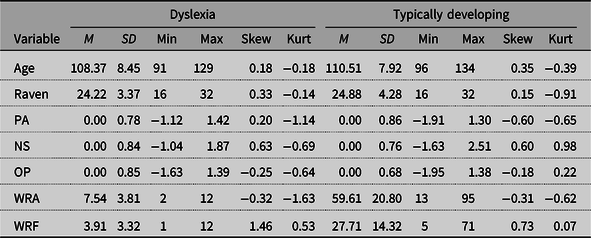
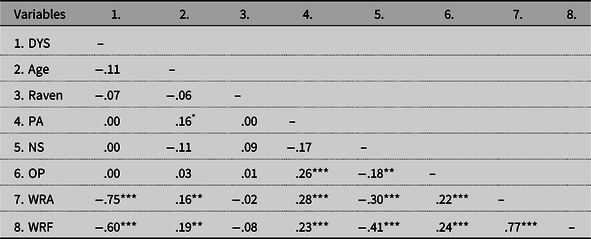
The data contained no missing values (data and code are available at https://osf.io/w3dbp/). An outlier analysis using z-scores (<−3.3 or >3.3) and scatter plots indicated that there were five outliers in the TD group (i.e., two on NS objects and three on NS digits). These outliers were winsorized (using percentile adjustment) so that scores could be maintained in the analyses. The distributions of the combined scores for the underlying skills and for the word-reading tasks were approximately normal in each group (see Table 1 for descriptive statistics). There was no multicollinearity between the variables (see Table 2). For the covariates, correlations show that nonverbal IQ (Raven) is not related to any of the underlying skills or outcomes. Age is only weakly related to PA and both word-reading tasks. Dyslexia status was moderately to strongly related to the two word-reading tasks, as would be expected based on the selection criteria for the dyslexia group. All underlying skills show weak correlations with each other, except for the relation between PA and NS. The three underlying skills (i.e., PA, NS, and OP) also show weak to moderate correlations with the word-reading tasks.
Descriptive statistics background measures

Note. PA = phonological awareness; NS = naming speed; OP = orthographic processing; WRA = word-reading accuracy; WRF = word-reading fluency.
Correlations between predictors and word reading outcomes

Note. DYS = dyslexia status; PA = phonological awareness; NS = naming speed; OP = orthographic processing; WRA = word-reading accuracy; WRF = word-reading fluency.
* p < .05.
** p < .01.
*** p < .001.
Case series
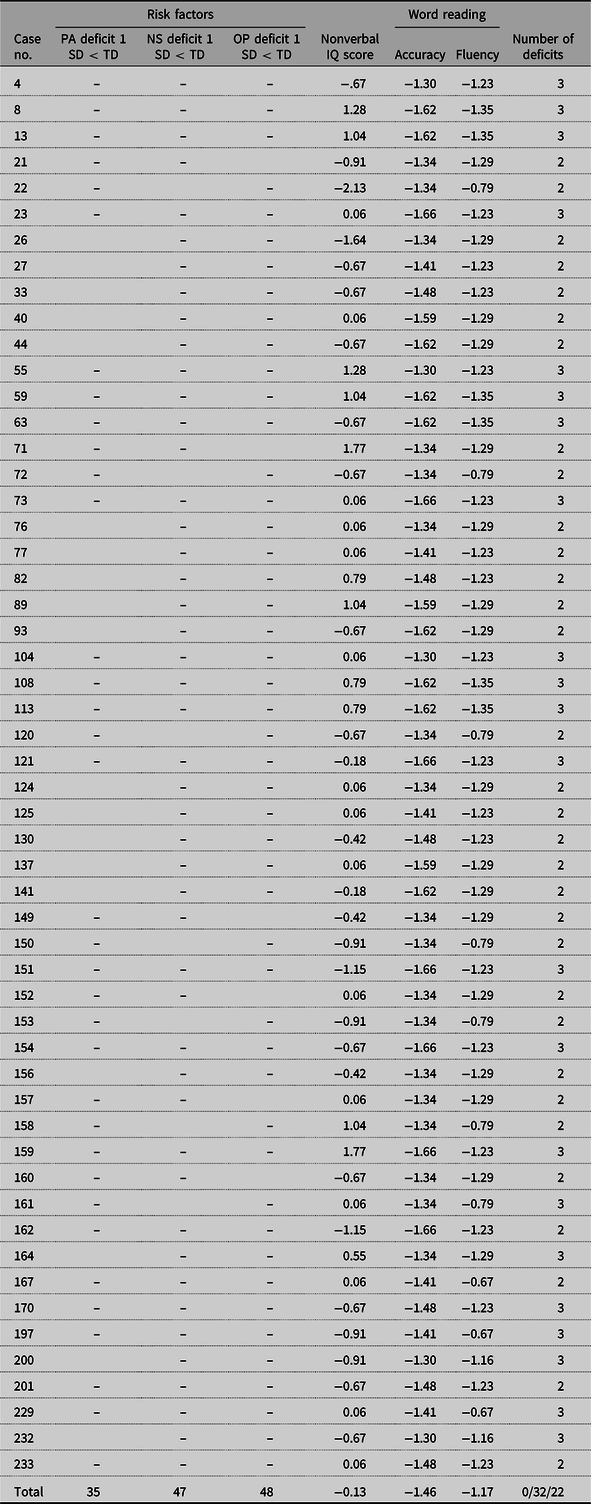
The case-series analysis provides a first insight in the prevalence of an OP deficit in our sample of children with dyslexia, in addition to other commonly found deficits in PA and NS (see Table 3). Overall, 64.1% of the children with dyslexia had a deficit in PA, 87.0% had a deficit in NS, and 88.9% had a deficit in OP. These percentages were all significantly higher than in the TD group (i.e., PA: 17.6%; NS: 15.2%; OP: 14.2%). The same holds for the numbers of combined deficits. None of the children in the dyslexia group had only one deficit, 59.3% of them had a double deficit (either PA–NS, PA–OP, or NS–OP), and 40.7% had deficits in all three areas. In contrast, among the children in the TD group showing deficits (60.3%), 62.7% of them had one deficit, 27.5% had a double deficit, and only 9.8% had a triple deficit.
Case-series showing risk factors among children with dyslexia using z-scores

Note. PA = phonological awareness; NS = naming speed; OP = orthographic processing.
Group comparisons
Regarding our prediction about the impact of the number of deficits on word-reading accuracy and fluency outcomes, a one-way MANCOVA was conducted to determine whether there are differences between groups of children with no deficit, one deficit, double deficits, and triple deficits, with age and nonverbal IQ as covariates. Although our hypothesis focused specifically on the difference between the triple-deficit group and the PA-NS double-deficit group, we could not separate specific double-deficit groups in the analyses due to the small numbers for some combinations of deficits (i.e., NS–OP was most prevalent). Instead, we opted to compare groups only based on the number of deficits. These analyses were conducted on the full sample.
There was a statistically significant difference in reading scores based on the number of deficits subgrouping (Wilk Λ = 0.29, F [12, 659] = 32.39, p < .001, partial η2 = .34). Pairwise comparisons revealed that the most striking differences between the three-deficit group and one- and two-deficit groups lie in frequent and infrequent word-reading accuracy performances, where the triple-deficit group had the lowest scores (all p-values < .001). However, for word- and pseudoword-reading fluency, the triple-deficit group performed comparably with the double-deficit group. Both groups performed lower than the one- and no-deficit groups on all reading measures (all p-values < .001, except for pseudowords).
Hierarchical regressions
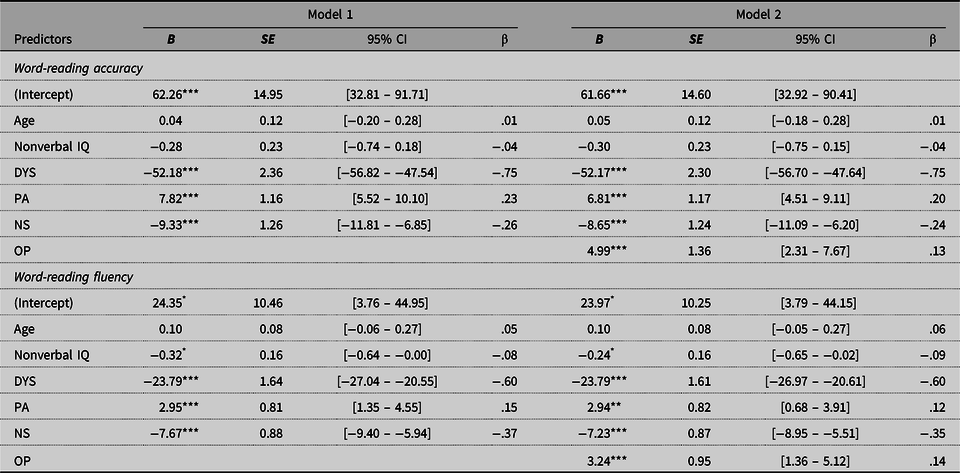
Separate analyses were conducted for word-reading accuracy and fluency, but the approach was the same for both outcomes. In the first step, we added age and nonverbal IQ as covariates, and dyslexia status as a dummy variable, together with PA and NS (Model 1, see Table 4). The latter two predictors are generally accepted as underlying skills of word-level reading and common deficits associated with dyslexia. In the second step, we added OP to assess whether this is an additional independent predictor of word-level reading skills after considering the other variables in the model (Model 2, see Table 4).
Hierarchical regression models for word-reading accuracy and fluency

Note. SE = standard error; CI = confidence interval; IQ = intelligence quotient; DYS = dyslexia status; PA = phonological awareness; NS = naming speed; OP = orthographic processing. For word-reading fluency: Model 1 R 2 = .57, F(5, 252) = 66.10, p < .001. Model 2 R 2 = .59, F(6, 251) = 59.29, p < .001, ΔR 2 = .02 (p change = < .001).
* p < .05.
** p < .01.
*** p < .001.
For word-reading accuracy, Model 1 was significant, F(5, 252) = 125.00, p < .001. Dyslexia status was a strong negative predictor, indicating that children with dyslexia obtain significantly lower scores on word-reading accuracy. In addition, PA and NS were both moderate predictors. Higher PA scores and lower NS scores (indicating faster naming) lead to higher scores on word-reading accuracy. Together, these variables explained 71.0% of the variance in word-reading accuracy. Adding OP also resulted in a significant Model 2, F(6, 251) = 111.60, p < .001. All effects from the previous model remained significant. In addition, OP was found to be a weak but significant predictor of word-reading accuracy after accounting for PA and NS (and the other variables in the model). This model also showed a significant increase in total explained variance to 73.0% (ΔR 2 = .01, p change = < .001).
For word-reading fluency, Model 1 was also significant, F(5, 252) = 66.10, p < .001. Here, there was a weak effect of nonverbal IQ. Dyslexia status was a moderate predictor of word-reading fluency, as was NS. In contrast to the larger effect on word-reading accuracy, PA was found to be a weak but significant predictor of word-reading fluency. Together, these variables explained 57.0% of the variance. Adding OP showed that it is also a weak but significant additional independent predictor of word-reading fluency over and above PA and NS (and the other variables in the model). All effects from the previous model remained significant and of similar size. There was also a significant increase in total explained variance to 59.0% (ΔR 2 = .02, p change = < .001).
Commonality analyses
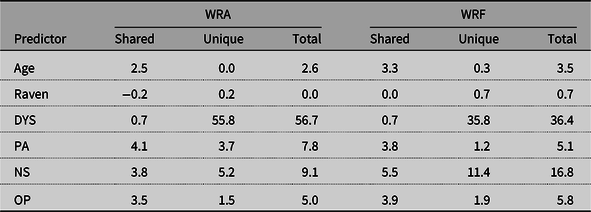
We also performed commonality analyses to assess the shared and unique contributions of the predictors in the regression models of word-reading accuracy and fluency (see Table 5). The results indicate that dyslexia status explains by far most unique variance in the two word-level reading skills. For word-reading accuracy, NS explains most unique variance, followed by PA and then OP. For word-reading fluency, NS again explains most unique variance, but much more than in word-reading accuracy. OP follows and PA explains least variance in word-reading fluency. Both covariates contribute very little (and mostly shared) variance to word-level reading skills.
Shared and unique variance (percent) per predictor for word-reading accuracy and fluency

Note. WRA = word-reading accuracy; WRF = word-reading fluency; DYS = dyslexia status; PA = phonological awareness; NS = naming speed; OP = orthographic processing.
Logistic regression
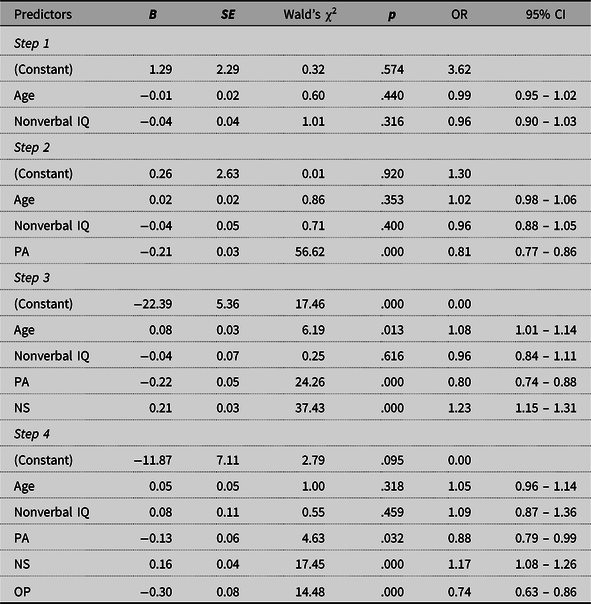
A logistic regression analysis was performed to test whether PA, NS, and OP affect the likelihood that participants have dyslexia, after controlling for age and nonverbal IQ (see Table 6). The factors were entered in the model in the following order: age and nonverbal IQ were entered first, followed by PA (second), NS (third), and OP (last), respectively. The logistic regression model was not statistically significant for the first set of variables, χ2(2) = 4.468, p > .05), where age and nonverbal IQ were entered. The logistic regression model was statistically significant when PA was entered, χ2(3) = 90.029, p < .001. The model explained 45.9% (Nagelkerke R 2 ) of the variance in dyslexia status and correctly classified 83.7% of cases. Adding NS to the logistic regression resulted in a statistically significant model, χ2(4) = 171.26, p < .001. This model explained 75.6% of the variance in dyslexia status and correctly classified 92.2 % of cases. Lastly, the logistic regression model was statistically significant when OP was entered, χ2(5) = 213.76, p < .001. The model explained 87.8 % of the variance in dyslexia status and correctly classified 96.1 % of cases.
Summary of binary logistic regression analysis predicting the likelihood of dyslexia status

Note. SE = standard error; OR = odds ratio; CI = confidence interval; IQ = intelligence quotient; PA = phonological awareness; NS = naming speed; OP = orthographic processing.
Discussion
The purpose of this study was to examine the pertinence of three key constructs of the TDH, namely PA, NS, and OP, in a sample of Arabic-speaking children with and without dyslexia from Grade 3. Our hypotheses regarding 1) the presence of double- and triple-deficit groups in our sample, 2) additive effects of deficits on word-level reading outcomes, 3) the independent contribution of OP as a predictor of word-level reading, and 4) use of the triple-deficit model for accurate classification of dyslexia were largely confirmed. The findings illustrate and support the benefit of considering OP as an additional and independent deficit that may underlie dyslexia in Arabic developing readers.
Regarding the identification of double- and triple-deficit subgroups in our sample of Arabic children, the findings showed that in fact all children with dyslexia had either double (nearly 60%) or triple (almost 40%) deficits. Importantly, the OP deficit (i.e., prevalence of 88.9%) co-occurs with PA or NS deficits as part of a double deficit, as well as with both PA and NS in a triple deficit. These figures suggest that a deficit in OP is more a rule than an exception in Arabic children with dyslexia, while it is a rather uncommon deficit in TD children. This also suggests that many of the poor decoders have not yet established automatic orthographic representations by Grade 3, which may partly be the result of their additional problems with phonological processing (van Gorp et al., Reference van Gorp, Segers and Verhoeven2017). However, the occurrence of deficits in the TD group (i.e., 27.5% double deficit; 9.8% triple deficit) shows that having one or multiple deficits in underlying skills does not automatically lead to impaired word-level reading skills. Yet, there is reason to suspect that also the effect of a deficit in OP works additively for children with dyslexia.
Indeed, the findings for our second hypothesis support the additive nature of combined deficits in PA, NS, and OP. Children with triple deficits showed lower performance on both word-reading accuracy and fluency compared to children with double, single, and no deficits. Furthermore, the group of children with double deficits also scored significantly lower than those with one or no deficit. These findings, indicating that the risk of developing more severe reading impairment increases with each additional underlying deficit, align with both double-deficit and triple-deficit hypotheses. Badian (Reference Badian1997) assumed that a serious reading impairment in children of at least average verbal intelligence results from an overload of deficits in skills related to reading. The OP deficit seems to play an essential role in that respect.
Concerning our third hypothesis, OP has indeed been confirmed as an additional independent predictor of word-level reading skills besides PA and NS, while controlling for age and nonverbal abilities. Although PA, NS, and OP are correlated skills, they each contribute uniquely to both word-reading accuracy and fluency. As expected, the contribution of PA to word-reading accuracy was larger than to fluency, whereas the contribution of NS was larger to word-reading fluency than to accuracy (Kirby et al., Reference Kirby, Georgiou, Martinussen and Parrila2010; Landerl et al., Reference Landerl, Freudenthaler, Heene, De Jong, Desrochers, Manolitsis, Parrila and Georgiou2019; Norton & Wolf, Reference Norton and Wolf2012; Torppa et al., Reference Torppa, Parrila, Niemi, Lerkkanen, Poikkeus and Nurmi2013). OP contributed about equally to both word-level reading outcomes. Interestingly, for word-reading fluency, this contribution of OP was even slightly larger than the contribution of PA. These results demonstrate the key roles of both PA and NS, as well as OP, in both accurate and fluent reading of vowelized Arabic. This might be specifically relevant in relation to the characteristics of the Arabic orthography and effects of OP may become even more pronounced over time. As stated before (Saiegh-Haddad & Schiff, Reference Saiegh-Haddad and Schiff2016), second graders can benefit from the presence of vowel diacritics, which facilitate phonological decoding of words. Yet, older children are required to develop the ability to exploit their lexico-orthographic and morpho-orthographic knowledge to complete the missing information in unvowelized stimuli. This would increase the importance of OP ability only further.
Regarding accurate classification of Arabic third graders with dyslexia, we were able to establish the benefit of including OP as a third deficit in addition to PA and NS. The findings suggested that, in our study, NS is the strongest risk factor for dyslexia, followed by PA and OP, which were about equally important. This is consistent with the claim that NS accounts for more variance in transparent orthographies than in opaque orthographies (Landerl & Wimmer, Reference Landerl and Wimmer2008; Moll et al., Reference Moll, Fussenegger, Willburger and Landerl2009; Ziegler et al., Reference Ziegler, Bertrand, Tóth, Csépe, Reis, Faísca, Saine, Lyytinen, Vaessen and Blomert2010). One possible explanation of the effect of NS on reading is its status as a prerequisite for OP (e.g., Bowers & Newby-Clark, Reference Bowers and Newby-Clark2002; Bowers et al., Reference Bowers, Sunseth and Golden1999). Though PA has still been a relevant predictor of our reading outcomes, it seems that its role decreases across the two first years of instruction, while the influence of NS increases. In several studies, the effect of PA was found to diminish over the kindergarten years up to Grade 3 (e.g., de Jong & van der Leij, Reference de Jong and van der Leij1999, Reference de Jong and van der Leij2002; Wagner et al., Reference Wagner, Torgesen, Rashotte, Hecht, Barker, Burgess, Donahue and Garon1997). A plausible explanation of the diminished effect for PA is related to changes in the nature of the children’s reading by the later grades, shifting from reliance on phonetic (vowelized script in Arabic) to more orthographic skills (unvowelized), rendering PA less relevant to reading success (Kirby et al., Reference Kirby, Parrila and Pfeiffer2003). Our findings are in line with the study conducted by Tibi and Kirby (Reference Tibi and Kirby2019) who found that NS played an important role, having significant effects on all outcomes of word reading in the overall group. Its effects were particularly strong for word-reading fluency and text-reading fluency, which concurs with prior evidence on the role of NS in fluency measures (Asadi et al., Reference Asadi, Khateb, Ibrahim and Taha2017; Georgiou et al., Reference Georgiou, Parrila and Papadopoulos2008; Tibi & Kirby, Reference Tibi and Kirby2018).
More importantly, our classification findings showed that the presence of triple deficits maximizes the risk of reading failure. In other words, the presence of deficits in more than one skill increases the probability of poor reading performance (McGrath et al., Reference McGrath, Pennington, Shanahan, Santerre-Lemmon, Barnard, Willcutt and Olson2011; Pennington, Reference Pennington2006; Steacy et al., Reference Steacy, Kirby, Parrila and Compton2014). The contribution of OP in the prediction of word-level reading outcomes and the dyslexia status, over and above the respective roles of PA and NS, provides clear evidence of the primacy of morpho-orthographic processing in reading acquisition in Arabic. In fact, Grade 3 represents the point when Arabic children are likely to encounter unvowelized text which may lead to more dependency on OP over phonological decoding. Hence, additional reading skills should be developed and slowly replace a phonological decoding strategy for efficient reading. When orthographic and morpho-orthographic processing mechanisms are required, children will progressively abandon the full reliance on phonological information conveyed by short vowels and thus shift to unvowelized orthography (Saiegh-Haddad & Schiff, Reference Saiegh-Haddad and Schiff2016; Schiff & Saiegh-Haddad, Reference Schiff and Saiegh-Haddad2017; Share & Bar-On, Reference Share and Bar-On2018).
Lexical and sublexical mechanisms underpinning OP
A reason why we are finding effects of OP in Arabic readers may be related to the nature of our OP measure. Measures of OP are generally based on orthographic choice tasks and thus only include the lexical element of OP. However, we also included a measure of sublexical OP, using a letter sequence parsing task. Sublexical orthographic knowledge refers to knowing orthographic regularities within an orthographic system including letter position, letter pattern, and positional and contextual rules in the use of letters (Apel, Reference Apel2011). The parsing test requires children to section a continuous line of unvowelized text into separate words. However, as this task was still built up from existing words, instead of pseudowords, the task may tap on both lexical and sublexical OP. Maroun et al. (Reference Maroun, Ibrahim and Eviatar2019) previously reported that children with dyslexia showed lower performance on the parsing test. More precisely, they found an age effect in typical readers, with older readers outperforming younger readers, and a reading-level effect, with typical readers outperforming readers with dyslexia. This suggests that the children with dyslexia have a specific difficulty with recognizing patterns of specific orthographic representations. In contrast, on a task similar to often-used word choice tests, the children with dyslexia showed similar performance to the typical readers in terms of accuracy. These findings demonstrate that letter sequence parsing may be a cleaner measure of OP (Maroun et al., Reference Maroun, Ibrahim and Eviatar2019). Hence, by combining sublexical and lexical elements within our OP measure, we introduce additional variance within the measure that is considered relevant in relation to models of word reading in Arabic.
In her model of Arabic word reading, Saiegh-Haddad (Reference Saiegh-Haddad2018) stated that the consistent and complete representation of the phonological structure of the word in vowelized Arabic reinforces the early emergence of a sublexical phonological foundation that initially relies on all of the graphemes within the word: the letters and the diacritics. In fact, regarding the nature of the Arabic orthography, the subtle differences between many letters (e.g., ت /t/, ث /θ/) and the changing forms of some of the letters according to their positions in the words, in addition to the diacritic marks, may mean that Arabic readers need to represent fine-grained letter features that could be ignored in other languages (Al Ghanem & Kearns, Reference Al Ghanem and Kearns2015). Basic visual-orthographic skills, such as recognizing the orientation of a letter, are relevant for reading due to the importance of orthographic memory in the orientation of graphemes (De la Calle et al., Reference De la Calle, Guzmán-Simón, García-Jiménez and Aguilar2021). At the sublexical level, readers may use orthographic skill when they are required to identify the individual letters. Because Arabic is cursive and involves different position-specific letter representations, readers with greater skill in identifying sublexical features may have better word-reading skills. The value of sublexical orthographic knowledge should persist even when children begin reading unvowelized Arabic, as the ability to identify words’ sublexical constituents is not less important later in development. In addition, readers may need a highly specified representation to distinguish a word from competing lexical entries (Perfetti & Hart, Reference Perfetti, Hart and Vehoeven2002). For example, the words ( /dʒasad/ [body]) and (
 /ħasad/ [envy]) differ only in the presence of the dot under the first (i.e., rightmost) letter, meaning that a reader must have a very precise orthographic representation of
 to identify it (Al Ghanem & Kearns, Reference Al Ghanem and Kearns2015). If the reader’s word-specific orthographic representation of
 does not include the dot distinguishing between ح and ج, the word cannot be identified with a lexical strategy. Thus, proficiency on measures tapping lexical orthographic skill would relate very strongly to word reading. Therefore, readers need to represent orthographic features from both lexical and sublexical orthographic levels (Deacon et al., Reference Deacon, Benere and Castles2012).
OP as an independent predictor of word reading in Arabic
A remaining question concerns the position of OP in theoretical models of word-reading accuracy and fluency, besides PA and NS. Our findings indicate that OP is independently involved in both word-level reading skills. We also found that OP explained much more shared variance than unique variance to word-level reading skills compared to PA and NS. Especially, its relation to PA is interesting. It has been stated that if the orthographic imagery for single letters is unstable, the formation of automatic orthographic–phonological connections will be impeded (Badian, Reference Badian1997). This orthographic instability could be associated with the inefficient formation of the letter representations at an abstract level which is critical for efficient processing of visual-word recognition and for learning to read (Boudelaa et al., Reference Boudelaa, Norris, Mahfoudhi and Kinoshita2019; Carreiras et al., Reference Carreiras, Perea and Mallouh2012). Ehri (Reference Ehri1997) suggested that in sight word reading letter-sound knowledge is needed to form a complete network of visual–phonological connections in lexical memory, and Berninger’s (Reference Berninger1990) model is similar. Others have also stressed the importance of orthographic–phonological connections in reading (Bowers & Wolf, Reference Bowers and Wolf1993). A primary deficit in phonological processing might thus also hinder the ability to create well-specified orthographic word representations during reading acquisition (Perfetti, Reference Perfetti2007; Share, Reference Share2008). These ideas are supported by behavioral studies showing that readers with dyslexia are more sensitive to reduced word familiarity, frequency, and imageability, especially for difficult-to-decode irregular words with inconsistent spelling-to-sound mapping (Bruck, Reference Bruck1992; Shaywitz & Shaywitz, Reference Shaywitz and Shaywitz2003; Strain & Herdman, Reference Strain and Herdman1999). Possible specifications of the type of letter representation that needs to be mapped onto an abstract letter level in Arabic could also be related to the phonemic distance between standard and spoken Arabic in understanding the phonological sensitivity of children in a diglossic context toward the language they learn to decode (Saiegh-Haddad, Reference Saiegh–Haddad2004). Given the specific characteristics of the Arabic language, and the special role of OP as an underlying skill, our findings may thus not translate to other languages.
Although Arabic is considered a transparent language, transparency may not be the (only) relevant aspect in relation to effects of OP on reading and emergence of reading impairments. In this context, it is worth noting that while the vowelized Arabic orthography is considered shallow when the orthographic form of the word and the phonological form it encodes are considered, it may not be psycho-linguistically shallow because the phonological form that the spelling of the word encodes could be different from the phonological form the reader encodes in his own lexicon as a result of diglossia (see Saiegh-Haddad, Reference Saiegh-Haddad2018; Saiegh-Haddad & Henkin-Roitfarb, Reference Saiegh-Haddad, Henkin-Roitfarb, Saiegh-Haddad and Joshi2014). It is argued that word-reading development and difficulties in Arabic are better understood when the discrepancy between the standard phonological forms of the word that is encoded in print versus the spoken form is taken into account. For instance, the grapheme-based representation of the shallow orthography of vowelized Arabic and its effect on the early emergence of grapheme-based phonological recoding implies that it is critical for beginning readers of Arabic to learn the mappings of graphemes (letters and phonemic diacritics) to phonemes in order to crack the code that links sound to print (Saiegh-Haddad, Reference Saiegh-Haddad2018).
Limitations
Although our study demonstrated the role of the OP deficit as a key aspect of dyslexia in Arabic population, this cognitive process was addressed mostly at the lexical level (words, but see the word string task that required some extent of sublexical processing). However, it would be more accurate if this process could be studied at the sublexical level (letters) while also taking into account two main linguistic characteristics of Arabic language in this regard: phonemic distance (e.g., Saiegh-Haddad, Reference Saiegh–Haddad2004) and the frequency of letters (Boudelaa et al., Reference Boudelaa, Perea and Carreiras2020). As stated by Boudelaa et al. (Reference Boudelaa, Perea and Carreiras2020), the frequency and similarity of Arabic letters and their allographs in the visual and motoric domains, as well as the similarities among the letter sounds, could be useful for researchers interested in the processes underpinning OP, visual word recognition, reading, and literacy acquisition.
Conclusions
Overall, the present study corroborates the main aspects portrayed within the TDH (Badian, Reference Badian1997, Reference Badian2005) for reading acquisition in Arabic children. This study provides a demarcation for the value of mapping risk factors based on the double- and triple-deficit models of reading impairment. Specifically, a triple-deficit model, including PA, NS, and OP as underlying risk factors, has proven useful for identifying risk of reading impairment in Arabic children. By highlighting the role of OP skills in reading acquisition, we are now better able to anticipate the difficulties involved in learning to read in an Arabic-speaking child population. Implications for assessment and care programs targeting at-risk readers should be further evaluated.
Replication package
Data and code are available at: https://osf.io/w3dbp/.
Financial support
The authors declare that they have no known competing financial interests or personal relationships that could have appeared to influence the work reported in this paper.
Conflicts of interest
The authors have no conflicts of interest to declare. No funds, grants, or other support were received.