INTRODUCTION
Commercial trade of its native plant and animal species is one way in which a country can gain economic benefits from its natural genetic resources. These benefits may include direct income to companies and individuals participating in trade, but also wider benefits such as increased income from taxes (Laird & Lisinge Reference Laird and Lisinge1998), greater in-country business spending (e.g. on rent or materials) and creation of jobs in supporting industries (Jepson et al. Reference Jepson, Ladle and Sujatnika2011). The sovereign right of a country to sustainably exploit its natural genetic resources, and benefit when these resources are used by others, is known as access and benefit sharing (ABS), and is one of the three core objectives of the Convention on Biological Diversity (CBD) (CBD 1992; Nagoya Protocol Reference Protocol2011). Exploitation of another country's natural resources usually involves collection of wild material to supply companies directly, or to enable artificial propagation or captive breeding ex situ (Laird & Lisinge Reference Laird and Lisinge1998; Trommetter Reference Trommetter2005). Where the use of these resources takes place formally, ABS principles require compensation, which may include up-front or ongoing payments, royalties from sales (Trommetter Reference Trommetter2005) or the transfer of knowledge, goods or technology to build capacity for trade within the country of origin (FAO 2009). However, shifts in trade networks, product types and methods of trade have taken place since the CBD came into force over two decades ago, some of which are likely to add further complexity to ABS implementation. A good example is the rapid increase in online wildlife trade, a development that has provided opportunities for small businesses to access international markets, but that has proved difficult to monitor and regulate (Lavorgna Reference Lavorgna2014).
Identifying and addressing ABS inequities is important not only because benefit sharing is an ethical issue (Schroeder Reference Schroeder2007), but also because in some cases it has the potential for tangible conservation benefits, such as by providing an incentive for the protection of exploited species and habitats (e.g. butterflies; Gordon & Ayiemba Reference Gordon and Ayiemba2003). However, despite its recognized importance, to date there have been few studies of how ABS has worked in real markets. These studies include ABS examples in the agricultural (Richerzhagen & Holm-Mueller Reference Richerzhagen and Holm-Mueller2005), cosmetic (Lybbert et al. Reference Lybbert, Barrett and Narjisse2002), pharmaceutical and phytomedical (Laird & Lisinge Reference Laird and Lisinge1998), and food supplement sectors (Vermeylen Reference Vermeylen2007). However, efforts to assess the extent and form of ABS in other markets that rely on the development of new products from wild genetic resources are limited. One such market is the international horticultural trade, which has a relatively limited awareness of ABS (Ten Kate & Laird Reference Ten Kate and Laird2000; Secretariat of the Convention on Biological Diversity 2008), despite clear emphasis on the importance of benefit sharing by the Global Strategy for Plant Conservation (CBD 2002; CBD 2012). The horticultural trade is extremely lucrative, with an estimated global export value of US$9.1 billion in live plants in 2013 (ITC 2014). Although most traded plants are mass-produced hybrids, wild species are important in the development of new products, a trend that is predicted to increase as breeding technology improves (Volk & Richards Reference Volk and Richards2011). The only high-profile horticultural ABS case was in 1999 between the South African National Biodiversity Institute (SANBI) and the American company Ball to jointly develop new products from South Africa's wild flora (Henne & Fakir Reference Henne and Fakir1999).
Here, we focus on ABS in the Southeast Asian orchid market by studying online sales of orchid species. Orchids are one of the top horticultural plants in trade in terms of sales volume, net profits and price consistency over time (FloraHolland 2013; USDA 2014) and comprise 70% of all species listed by the Convention on the International Trade in Endangered Species of Wild Fauna and Flora (CITES) (CITES 2013). However, even though all orchid species are listed by CITES, their trade receives little attention (Phelps & Webb Reference Phelps and Webb2015). In addition, they are relatively easy to transport across international borders, as they are difficult to identify (McGough et al. Reference McGough, Roberts, Brodie and Kowalczyk2006) and likely to be a low priority for busy customs officers. Orchids are also widely traded online, including some trade that does not comply with national and international trade regulations (Krigas et al. Reference Krigas, Menteli and Vokou2014; Hinsley et al. Reference Hinsley, Nuno, Ridout, John and Roberts2016b). Here, we test the use of an online survey to assess ABS for traded products, with the aim of identifying which countries are not trading in their native and endemic species, and which countries are trading in the species of others. We hypothesize that the countries with the least capacity for trade (in terms of paucity of botanical and horticultural expertise and limited access to propagation technology) will be the ones most likely to be losing out.
METHODS
The internet is increasingly being used to sell plants, animals and other products derived from wildlife (Lavorgna Reference Lavorgna2014), including horticultural plants (e.g. Krigas et al. Reference Krigas, Menteli and Vokou2014). Trading online allows traders and buyers of illegal products to evade detection (Hinsley et al. Reference Hinsley, Nuno, Ridout, John and Roberts2016b), but online trade also provides a good opportunity for the study of large-scale trade patterns. We focus our analysis on Southeast Asia, a hub of legal and illegal wildlife trade (Nijman Reference Nijman2010), and a centre of diversity for the tropical epiphytic orchid species that are popular in trade, including two species (Dendrobium cruentum and Renanthera imschootiana) and one genus (Paphiopedilum) listed in CITES Appendix I (CITES 2013). Studies of orchid trade via street markets in the region have already taken place (e.g. Phelps et al. Reference Phelps, Carrasco and Webb2014), but little attention has been paid to the study of internet trade, which is becoming increasingly important for horticultural plants (Shirey & Lamberti Reference Shirey and Lamberti2011; Sajeva et al. Reference Sajeva, Augugliaro, Smith and Oddo2013). We focus on the ten Association of Southeast Asian Nations (ASEAN) countries: Brunei Darussalam (hereafter Brunei), Cambodia, Indonesia, Lao Peoples’ Democratic Republic (hereafter Laos), Malaysia, Myanmar, the Philippines, Singapore, Thailand and Viet Nam (ASEAN 2013).
Between April and June 2012, we searched the www.orchidmall.com and www.orchidwire.com vendor directories and carried out Google searches for each country name plus ‘orchid nursery’, ‘orchid for sale’ and ‘orchid species’ (after Shirey & Lamberti Reference Shirey and Lamberti2011). We then consulted in-country orchid experts to identify any missed nurseries. Due to our focus on ABS, we restricted analysis to trade via official nursery websites, as these are likely to represent formal, although not necessarily legal, trade.
Each website was visited and all orchid species for sale were recorded, including any recognized species listed as parent plants of hybrids. We recorded all species, whether wild or artificially propagated, but omitted complex hybrid plants, many of which are mass produced for non-specialist buyers (Hinsley et al. Reference Hinsley, Verissimo and Roberts2015), and often too far removed from wild genetic resources for these links to be made. In addition, species are usually aimed at the smaller specialist market, which presents a greater opportunity for small-scale producers. To look at variations in taxonomic accuracy and listing language in each country, we coded each listed name as: (1) an accepted species name; (2) a recognized synonym; and (3) an unknown/trade name. Presence/absence and type of descriptors were also recorded, such as whether the listing included a physical description (e.g. flower colour/size), geographical (country/region) or other information (e.g. ‘new species’).
We used the World Checklist of Selected Plant Families (WCSP 2013) to check the taxonomy and species’ distributions and to compile national lists of native and endemic species. The coding system in this database for distributions matched political boundaries for most countries, with some exceptions. The code for New Guinea did not distinguish between species in Papua New Guinea and Indonesian New Guinea, so all species with this code were omitted unless further detail showed that they were present or endemic in Indonesia. In addition, the Borneo code did not separate Indonesian Borneo, Malaysian Borneo or Brunei. As these countries were all part of the study, this code was included and, where available, additional information in each species listing was used to assign species as present or endemic to one of these countries. For those that could not be assigned, we used a sensitivity analysis to investigate the effect of including these species in either Malaysia or Indonesia. Singapore was listed under the Malaysia code, so Singaporean species were identified using Chong et al. (Reference Chong, Tan and Corlett2009). Finally, East Timor endemics (Silveira et al. Reference Silveira, Schuiteman, Vermeulen, Sousa, Silva, Paiva and De Vogel2008) were removed from the Indonesian total.
We produced descriptive statistics for the region and individual countries, and used a Pearson's χ 2 goodness of fit test to compare each country to the regional figure for the proportion of own native and endemic species that it sold. We then used simple weighted network analysis (Opsahl Reference Opsahl, Agneessens and Skvoretz2010) to calculate eight network measures for each country: the out-degree, in-degree, out-strength and in-strength for both native and endemic species. For each country, the degree is defined as a count of the number of other countries that: (a) sell that country's native/endemic species (out-degree); and (b) have native/endemic species sold by that country (in-degree). Similarly, the strength is defined as a count of the number of species: (a) native/endemic to that country that are sold by other countries (out-strength); and (b) sold in that country that are native/endemic to another country (in-strength).
Finally, we carried out an analysis of all recently discovered endemic species found for sale outside the country of origin to investigate whether exports have taken place via formal channels, and how rapidly these species are commercialized for international trade by their country of origin. We calculated the time from date of description (WCSP 2013) to first commercial export reported to CITES from the country of origin (UNEP-WCMC 2017). Our search was for all exports (importer or exporter reported) of any product that could lead to the production of live plants for trade (live plants, cultures, seeds, roots and stems). We analysed only species described since CITES began in 1975, with a separate analysis of species described since 1996, as better data checks were introduced in late 1995 (UNEP-WCMC 2013). Although Laos only became a party to CITES in 2004, non-Parties are required to have equivalent documents for the export of listed species (Resolution Conf. 9.5 (Rev. CoP16)).
RESULTS
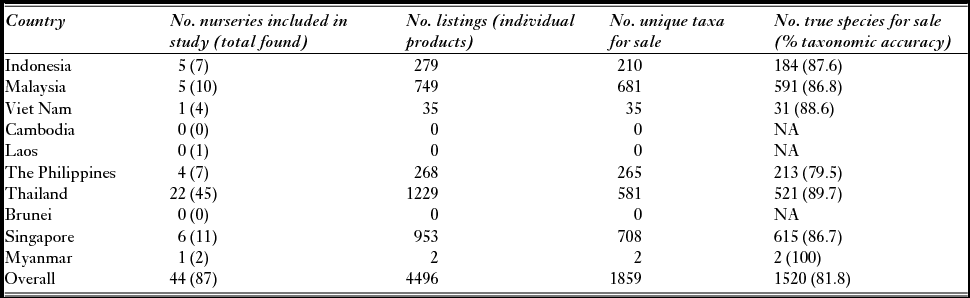
We found 87 websites, 49% (n = 43) of which were excluded from the analysis because: they only sold complex hybrids or cut flowers (n = 24), they were for a related business (e.g. selling pots or fertilizer; n = 7), they were not working for the whole study period (n = 6) or they listed no products for sale online (n = 6) (Table 1).
Summary of the nurseries, listings and taxa found during the online orchid trade survey in Southeast Asia.

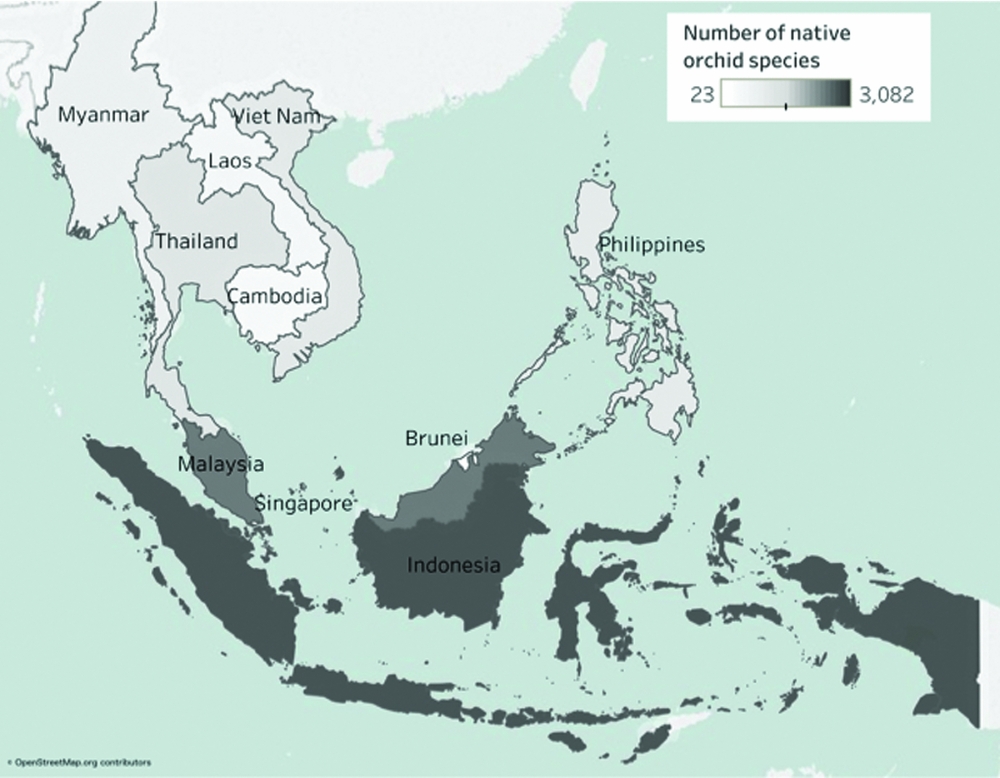
There were 5387 species reported to be native to at least one country in the region, ranging from 23 in Brunei to 3082 in Indonesia (including all Borneo species) (Fig. 1). Of this regional total, 20.8% (n = 1120) were found for sale. When Borneo was included in Indonesia, 9.9% of species endemic to at least one country in the region were in trade; when Borneo was included in Malaysia, this figure was 9.6%. The observed proportions of native species sold by country of origin differed significantly from the expected value (Borneo = Indonesia: χ 2 = 979.0, 6 d.f., p < 0.001; Borneo = Malaysia: χ 2 = 868.1, 6 d.f., p < 0.001). Similarly, sales by each country of their own endemic species differed significantly from what was expected, both when the figure used was 9.9% (Borneo = Indonesia: χ 2 = 274.5, 6 d.f., p < 0.001; Borneo = Malaysia: χ 2 = 275.8, 6 d.f., p < 0.001) and 9.6% (Borneo = Indonesia: χ 2 = 195.0, 6 d.f., p < 0.001; Borneo = Malaysia: χ 2 = 195.9, 6 d.f., p < 0.001).
Total number of native orchid species in each country in Southeast Asia (all species listed under the Borneo code with no further information are included in both the Indonesian and Malaysian totals) (data from World Checklist of Selected Plant Families; WCSP 2013).

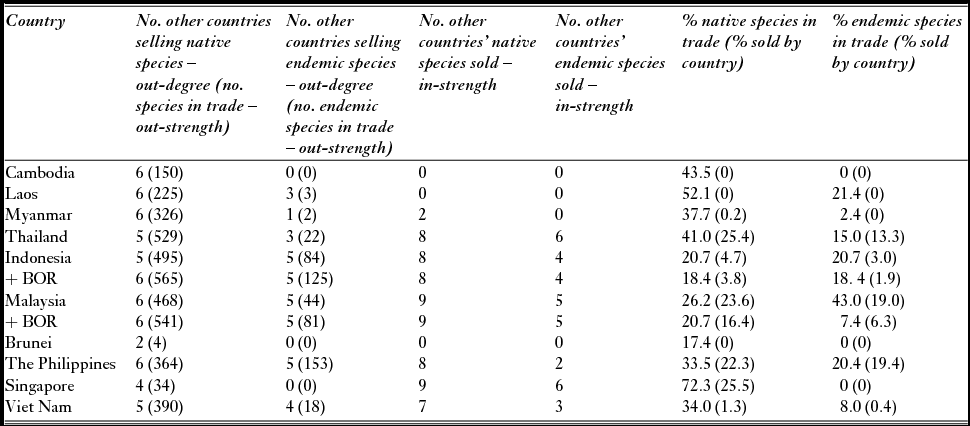
Native species from Cambodia, Laos, Myanmar, Indonesia (including Borneo), the Philippines and Malaysia were on sale in every country where trade was occurring (n = 6). Endemic species from Indonesia, Malaysia and the Philippines were on sale in the most countries (five out of six trading countries). Nurseries in Singapore and Malaysia sold native species from every country in the region, whilst Thailand and Singapore sold endemic species from the most other countries (six out of nine) (Table 2).
Summary of directed network analysis of Southeast Asian online orchid trade. The BOR botanical country code includes Malaysian and Indonesian Borneo and Brunei. Extra rows for Malaysia and Indonesia show the effect of incorporating BOR species with no further location information in the analysis for this country. This was not done for Brunei due to its small size. BOR = Borneo.

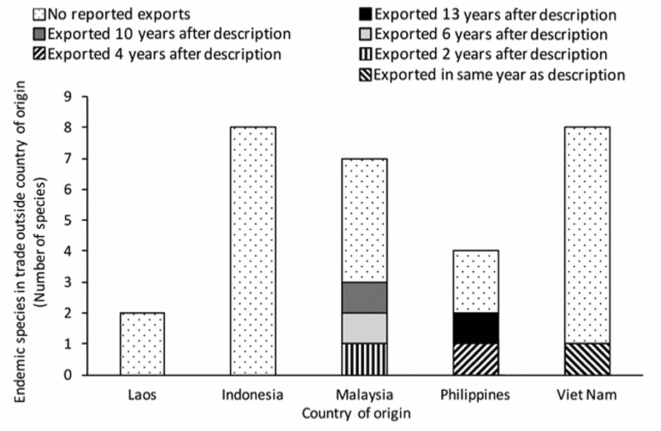
We found 137 endemic orchid species for sale in at least one non-range state, of which 21 were described between 1975 and 1995, and 29 were described between 1996 and 2012. Of the 50 endemic species described since 1975, 32 (64%) had no CITES record of export from their country of origin. For those described after 1996, 21 (72%) had no reported exports form their country of origin (Fig. 2), including four CITES Appendix I Paphiopedilum species. Most of these 21 species were from Indonesia and Viet Nam. In addition, two species (Bulbophyllum coweniorum and Holcoglossum calcicola) were from Laos, which had no facilities to produce artificially propagated orchids at this time.
Number of endemic species described from 1996 to 2012 for sale from non-range states, showing a breakdown of the number of years from discovery to first reported CITES export from country of origin (data from CITES Trade Database; UNEP-WCMC 2017).

DISCUSSION
Our study of the online horticultural orchid trade in Southeast Asia suggests that the international movement and commercialization of species is widespread, with more than one in five of the region's species found for sale from online platforms. However, much of this trade appears to have taken place without formal ABS implementation, and some without CITES permits. This supports earlier concerns of limited awareness of ABS in the horticultural sector (Ten Kate & Laird Reference Ten Kate and Laird2000; Secretariat of the Convention on Biological Diversity 2008) and findings of CITES non-compliance in the orchid trade, especially by professional growers (Hinsley et al. Reference Hinsley, Nuno, Ridout, John and Roberts2016b).
Despite the growth of online trade in wildlife products (Lavorgna Reference Lavorgna2014), there has been little work to understand how this trade is linked to broader trade patterns. We show that large numbers of species are being sold online and that these numbers are comparable to recorded data on offline trade. For example, Phelps and Webb (Reference Phelps and Webb2015) found 13% of Thailand's orchid flora for sale during surveys over 1 year in four large flower markets, compared to our finding of 25.2% of the country's orchid species sold by Thai nurseries online and 41% sold by nurseries in the whole region. Further, broad patterns observed in online trade can closely match offline data, suggesting that these markets can be a good proxy for understanding broad trade trends in related products. For example, the countries in our study with the most (Thailand, Malaysia and Singapore) and least trade (Myanmar, Cambodia, Lao and Brunei) match customs data for the countries with the highest- and lowest-value exports of both general horticultural products and cut orchid flowers (ITC 2014). Despite their utility, we acknowledge that online surveys will not capture the local trends and patterns of trade that can be observed in offline shops and markets (e.g. Phelps et al. Reference Phelps, Carrasco and Webb2014). In addition, surveys of online formal online trade may omit important informal platforms where orchid trade takes place, such as social media websites (Hinsley et al. Reference Hinsley, Lee, Harrison and Roberts2016a). However, online sales are playing an increasingly prominent part in horticultural and other wildlife trades (Lavorgna, Reference Lavorgna2014), and surveying them provides an easily accessible method for the study of these markets (Shirey & Lamberti Reference Shirey and Lamberti2011; Sajeva et al. Reference Sajeva, Augugliaro, Smith and Oddo2013; Krigas et al. Reference Krigas, Menteli and Vokou2014). Further work to assess the linkages between online and offline markets for horticultural and other wildlife products is needed to better understand these interactions.
Our findings suggest that two decades on from the introduction of the CBD, the countries of Southeast Asia are not benefitting equally from trade in their native species. We acknowledge that our focus on formal trade does not recognize the benefits that may be transferred from illegal orchid trade, which may be essential supplementary income for some households (Hinsley Reference Hinsley2011). However, the collection of orchids for trade can quickly become a significant conservation issue without careful management, leading to rapid decline or extinction (Averyanov et al. Reference Averyanov, Cribb, Phan Ke and Nguyen2003). These informal agreements may bring short-term benefits to some people, but the potential benefits from the commercialization of valuable species will exist over a much longer period, meaning that overall the country is losing out (Laird & Lisinge Reference Laird and Lisinge1998). We therefore identify several countries that would benefit from action to address ABS inequities in formal trade, primarily Laos, Cambodia and Myanmar. These findings are likely to be linked to economic development, as Cambodia and Laos have the lowest gross national incomes per capita in the region (no data available for Myanmar) (World Bank Reference Bank2014). Identifying the form that ABS activities could take is not straightforward. The Nagoya Protocol recommends that equitable sharing of benefits should be achieved by “appropriate transfer of relevant technologies . . . and by appropriate funding” (Nagoya Protocol Reference Protocol2011, p. 4). Other examples for ABS have shown that this often takes the form of direct payments for the bioprospecting of new products (e.g. Richerzhagen & Holm-Mueller Reference Richerzhagen and Holm-Mueller2005). However, applying the principles of ABS to the orchid trade will require a different approach. For example, direct payments for initial access to, or ongoing use of, a country's genetic resources is an approach taken in the pharmaceutical industry (Trommetter Reference Trommetter2005), but has had limited application in the horticultural trade. The landmark agreement between the horticultural company Ball and South Africa's National Biodiversity Institute (SANBI) eventually resulted in direct benefits being shared, but demonstrated that careful management was essential (Secretariat of the Convention on Biological Diversity 2008). The company in this case was large and had the resources to make a long-term commitment to fund SANBI. Whilst this may be a useful model for the mass-market horticultural industry, it is unlikely to work for the orchid species market, which is supplied by small businesses selling a large range of species in small numbers. Additionally, direct payments would only be successful for newly commercialized species, as sharing benefits is particularly difficult if captive breeding or propagation has already been taking place for some time in different countries (Roe et al. Reference Roe, Milledge, Mulliken, Mremi, Mosha and Grieg-Gran2002; Richerzhagen & Holm-Mueller Reference Richerzhagen and Holm-Mueller2005).
If direct payments are unsuitable, another approach suggested in other ABS cases is capacity building to allow countries to develop their own trade (FAO 2009). In theory, this approach may address some of the potential causes of the gaps found in our study. For example, we found that the countries with little or no trade in their own taxa contributed a large proportion of their species to the trade of other countries, including over half of Laos’ native species and three of its 12 endemic species. This suggests that the gaps in trade are not due to a lack of market for these species, but to a lack of interest or capacity for trade. The former is unlikely, as several countries in the region have declared an interest in developing orchid trade (Viet Nam News 2010; Hajramurni Reference Hajramurni2011; Malanes Reference Malanes2014; Phyu Reference Phyu2014). Producing plants for the international market requires laboratories and greenhouses, a well-developed infrastructure and expertise in breeding, growing and marketing plants for export. In our study, reliable internet access and the expertise to develop websites and online commerce also likely played a role. This capacity is well developed in those countries with existing horticultural industries (ITC 2014), but limited in those such as Laos, where most plants in trade are wild sourced (E. Vernon, personal communication 2014) and only one company was in the early stages of producing orchids legally for trade in 2009 (Lamxay Reference Lamxay2009). Similarly, in 2014, Cambodia had only one well-established nursery, which grew hybrids to supply local cut-flower markets (C. Jancloes, personal communication 2014).
Although, in theory, building capacity for countries to trade in their own orchids may be a good solution to tackling ABS inequities, this may have negative conservation outcomes. Whilst there are examples of the development of legal trade successfully reducing wild collection (Entwistle et al. Reference Entwistle, Atay, Byfield and Oldfield2002), there are others showing that demand for wild-sourced products remains stable (Drury Reference Drury2009; Dutton et al. Reference Dutton, Hepburn and Macdonald2011), including for the Southeast Asian orchid Rhynchostylis gigantea (Phelps et al. Reference Phelps, Carrasco and Webb2014). Further, cultivation can also increase wild collection (Williams et al. Reference Williams, Jones, Annewandter and Gibbons2014), and legitimizing trade may facilitate laundering of wild products (Lyons & Natusch Reference Lyons and Natusch2011), a problem already occurring in the orchid trade as a method to bypass CITES rules (Hinsley et al. Reference Hinsley, Nuno, Ridout, John and Roberts2016b). In addition to these conservation concerns, the CBD recognizes ABS at a state level, giving no guarantee that direct payments or capacity-building efforts would reach places where they would benefit development or conservation (Richerzhagen Reference Richerzhagen2011). People in rural communities may rely on the income from collecting wild animals or plants for trade (Broad et al. Reference Broad, Mulliken, Roe and Oldfield2001), and the development of formal trade may shift profits from these people to a few wealthy business owners (Lybbert et al. Reference Lybbert, Barrett and Narjisse2002; Roe et al. Reference Roe, Milledge, Mulliken, Mremi, Mosha and Grieg-Gran2002). Where a community approach is taken, as was the case of the appetite suppressant Hoodia, it is essential that participants in capacity-building projects are not given unrealistic expectations that trade will be an easy, risk-free source of income (Vermeylen Reference Vermeylen2007).
Considering these limitations of traditional ABS approaches for the horticultural market, we suggest a different approach to capacity building, one that focuses on strengthening the ability of countries to better control the commercialization of their species. The primary way of doing this is though CITES, which maintained a neutral position on ABS in the past (Roe et al. Reference Roe, Milledge, Mulliken, Mremi, Mosha and Grieg-Gran2002), but has developed closer links with the CBD in recent years, including joint meetings in 2016 (Secretariat of CITES and the CBD 2016). We show that most of the recently described endemic species in trade outside their country of origin have crossed international borders without reported CITES exports, including four CITES Appendix I species. All international movement of orchid species must have CITES paperwork, with some exemptions for trade in seeds and seedlings in sterile flasks (CITES 2013). It is possible that some species with no reported CITES exports may have been legally exported as these exempt products, although trade in orchid seeds is rare, and the production of seedlings in sterile flasks requires expertise and equipment for propagation. In some cases, this seems unlikely; Bulbophyllum coweniorum, a Laotian endemic species with no reported CITES exports, has been popular in trade since at least 2007 (Cockel Reference Cockel2013), but was not being propagated in Laos at this time (Lamxay Reference Lamxay2009). In addition, some endemic species may have been exported with CITES permits that were not reported to CITES by Parties, or low botanical capacity could mean that some endemics are, in fact, naturally present in the neighbouring countries where they are being sold. However, this is unlikely to be the case for all the species we identified, and several are likely to have left their country of origin without the correct CITES permits. This is supported by recorded examples of this occurring, most recently in the case of Paphiopedilum rungsuriyanum, a Laotian endemic that was first described from a plant that had been wild-collected and transported to a Thai nursery (Gruss et al. Reference Gruss, Rungruang, Yongyouth and Dionisio2014). Our findings therefore support those of recent studies showing that the current CITES rules for orchids are not always followed (Phelps & Webb Reference Phelps and Webb2015; Hinsley et al. Reference Hinsley, Nuno, Ridout, John and Roberts2016b).
To address these problems, we suggest capacity building in two key areas. Firstly, to enhance in-country expertise and knowledge of native species by building botanical capacity, which for Cambodia, Laos and Myanmar are amongst the lowest in the region (Seidenfaden Reference Seidenfaden1992; Schuiteman & de Vogel Reference Schuiteman and De Vogel2000). Species often enter trade very quickly after discovery, due to consumer preferences for novelty in these specialist markets (Courchamp et al. Reference Courchamp, Angulo, Rivalan, Hall, Signoret, Bull and Meinard2006; Hinsley et al. Reference Hinsley, Verissimo and Roberts2015). This is especially true in the horticultural trade, where market saturation for commonly traded species has increased the importance of the rapid development of products from new wild species or varieties (Volk & Richards Reference Volk and Richards2011). Therefore, improving botanical capacity may increase the chances that species are discovered before they have already entered trade and become threatened by over-collection, both of which are common occurrences (Vermeulen & Lamb Reference Vermeulen and Lamb2011; Vermeulen et al. Reference Vermeulen, Phelps and Thavipoke2014). This may allow conservation measures to be put in place before over-collection occurs, where there is the will and capacity to do so. Secondly, building the capacity of these countries to monitor and control the wild collection and export of their species is also important. This includes strengthening protection of wild plants from over-exploitation and improving the ability of customs officers to detect and identify plants leaving the country. Encouraging CITES Parties to report exports of their orchid species would allow emerging trade trends to be better monitored, such as via the CITES Review of Significant Trade process. This could be facilitated by efforts to raise the profile of orchid trade in CITES discussions, and could increase awareness amongst countries regarding the value of their native orchid species.
ACKNOWLEDGEMENTS
T. Lee for advice on network analysis. E.J. Milner-Gulland and Z. Davies for their comments on a draft of this manuscript. AH gratefully acknowledges the support of the Oxford Martin Programme on the Illegal Wildlife Trade.
FINANCIAL SUPPORT
AH was funded by the Natural Environmental Research Council. Grant number: NE/J500458/1.
CONFLICT OF INTEREST
None.
ETHICAL STANDARDS
None.