

This monograph presents the results of fieldwork under-taken in 2011 and 2012 at the im-portant Late Bronze Age settlement of Pyla-Kokkinokremos, located on a high, rocky plateau over-looking the Bay of Larnaca in southern Cyprus. The site is of particular significance for the light it potentially throws on the final years of the Late Bronze Age, c. 1200 BC—a period characterised by population movements, disruption to maritime trade networks and the collapse of major political systems throughout the East Mediterranean. The aims of the 2011–2012 excavations were twofold: firstly, to determine the layout of building complexes over the whole plateau, focusing on the area immediately to the south of excavations undertaken during the early 1980s (area II, Karageorghis & Demas Reference Karageorghis and Demas1984); secondly, to confirm that the casemate wall encircled the site and functioned as a fortification system. A further important question addressed here (Chapter 6) is the role of Pyla within the island's settlement hierarchy: should it, as suggested by several archaeologists (Keswani Reference Keswani1996: 234; Steel Reference Steel2004: 188; Knapp Reference Knapp2008: 238–39), be interpreted as a nodal point within a network of sites associated with the maritime trade of Cypriot copper, or was it a refugee site, possibly for Aegean migrants (Karageorghis & Demas Reference Karageorghis and Demas1984).
The volume clearly presents the excavation results, following the format of earlier excavations directed by Karageorghis at this and other contemporary sites. This consistency of presentation allows the reader to navigate easily through the text. In keeping with the stated aims of the project, the main focus is the architectural remains of the settlement at Pyla. Four separate building complexes were identified, each built contemporaneously and with only a single phase of occupation. The architecture, stratigraphy, construction and finds are clearly reported in Chapter 1, the detailed presentation allowing the reader to extract meaningful information for the interpretation of the use of space and the range of activities within individual buildings. Chapter 2 addresses specific architectural problems, including the nature of the casemate wall, the site's water supply and the extent of habitation. Individual architectural features are discussed in Chapter 3 and the casemate wall is contextualised within the architectural traditions of the Aegean and East Mediterranean. The picture presented in these three chapters is of a well-planned settlement. Links with Aegean architecture are highlighted; for example, the hearth in complex F (p. 116) and the casemate walls, which are compared to those of Kastrokephala (Crete) and Malthi (the Peloponnese). The latter is of particular significance for constructing narratives of the final stages of the Late Bronze Age, both because of the political relationship between Cyprus and the Hittites, as indicated in contemporary textual accounts, and because of the possible Aegean migrations to the island and the southern Levant c. 1200 BC. Given the absence of any detailed consideration in the chapter of Hittite casemates, it is hard for the reader to draw their own conclusions as to the significance of Pyla's casemates. Although the text highlights possible external cultural links in relation to this architecture, the discussion only hints at the ‘aegeanisation’ of Cyprus.
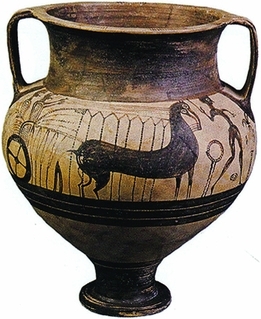
One of the challenges faced by excavators in Cyprus and the Near East is the publication of large quantities of finds in a meaningful manner. An inventory of objects is presented in Chapter 4 and there is more detailed discussion of the finds in the subsequent chapter. In addition, there are in-depth specialist contributions on specific aspects of the material culture in eight of the nine appendices; these include petrographic analysis of the Canaanite jars, chemical analyses of copper alloy artefacts and an in-depth discussion of potmarks. The inventory is perhaps not the most instructive way of presenting these data: some sort of summary reporting in the form of tables and graphs would certainly have enhanced navigation around this material. Nevertheless, it should be emphasised that all the information needed to reconstruct the material world of Late Bronze Age Pyla is at hand in this chapter. The discussion in Chapter 5 is more helpful, contextualising the main classes of artefacts within wider discussions of similar material from other Late Bronze Age Cypriot sites. For the most part, the finds are typical of Cypriot household materials—much, however, is also made of the presence of Mycenaean pottery, including a near-complete amphoroid krater and several Minoan amphoroid kraters, which are interpreted as evidence for an Aegean element alongside indigenous Cypriot inhabitants of the site.
The summary and historical conclusions presented in the final chapter serve to place Pyla-Kokkinokremos both within its immediate landscape and likewise within the historical narrative of the end of the Late Bronze Age on Cyprus. The excavators highlight that this is a single-phase occupation and propose that it represents some form of refuge settlement for inhabitants from the previously densely populated plain around the Bay of Larnaca. The apparent lack of metallurgical activity at the site, despite the presence of several hoards, supports the excavators’ opinion that it was not involved in the movement of copper within the island. Although much of the material culture is clearly local, the apparent Aegean aspects identified in the architecture, as well as the Minoan and Mycenaean pottery, are viewed as evidence for the presence of some Aegean migrants amongst the settlers. No doubt the debate surrounding the Aegean migrations will continue, with different archaeologists choosing to read this material according to alternative agendas.
The publication is well illustrated. The results of the excavations of the building complexes are presented in four plans at the back of the publication: plans 1 and 2 illustrate the physical relationship between the buildings uncovered in the old and new excavations; plans 3 and 4 focus at a larger scale on the new excavations. These are supplemented in the text by numerous plans and photographs from the excavations. It would have been helpful if the architectural features had been tied into the topography of the site presented in the contour plan (fig. 2.1)—this would have allowed for a more meaningful orientation of the architecture and understanding of its placement within its landscape. The finds, primarily ceramic but also a couple of bronze attachments, are illustrated as line drawings and photographs in plates at the back of the publication. These are mostly well reproduced but some are too small and some photographs are too dark to see the detail clearly. The colour plates illustrating the Mycenaean and Minoan amphoroid kraters, as well as the geological map of the immediate area of the site, are of excellent quality.
Karageorghis and Kanta are to be congratulated on their prompt publication, the detailed coverage of the archaeological remains and the in-depth analysis of the site's historical significance. This monograph is well produced and is a significant contribution to Cypriot archaeological literature. It provides detailed information about Late Bronze Age architecture and material culture for scholars of later Cypriot prehistory, and moreover will be of broad interest to scholars researching the collapse of the Late Bronze Age economic and state systems around the East Mediterranean.


