1. Introduction
Possession is nine points of the law, the root of title, the origin of property (Krier, Reference Krier2009).Footnote 1 In many circumstances, what begins as a relationship between an individual and an asset – this is possession as commonly understood among legal scholars – is then recognized and institutionalized by a community and therefore becomes a relationship between individuals with respect to an asset. This is what is commonly defined as property (Hodgson, Reference Hodgson2015). One way to understand the connection between possession and property is through the lenses of the Hawk–Dove (H–D) game, introduced by theoretical biologists (Maynard Smith and Parker, Reference Maynard Smith and Parker1976) to explain the emergence of property-like behavior in animals. The game models animal conflicts for the appropriation of a scarce resource and stylizes two possible strategies to be followed: (i) with the Hawk (H) strategy, the subject is always prepared to fight to retain or gain a contested asset and (ii) with the Dove (D) strategy, the subject defers and retreats if its opponent escalates the fighting. The theoretical literature on the game highlights that the most efficient (fittest) strategy is in fact the so-called bourgeois strategy, which is ‘defend aggressively when one possesses and defer to the opponent when one is an intruder’ (Maynard Smith, Reference Maynard Smith1982; Maynard Smith and Parker, Reference Maynard Smith and Parker1976). The most successful contenders adopting the bourgeois strategy respect others' belongings and expect others to respect theirs. This evolutionary account of the emergence of property can be extended to humans as well (Sugden, Reference Sugden1989, Reference Sugden2004) and closely resembles the David Hume's account of the emergence of the property convention. It should be noted that the evolutionary account of what is property is just one among many authoritative ones.Footnote 2
Notwithstanding this enduring debate, our paper concentrates on testing the evolutionary explanation of the institution of property, where possession plays a crucial role, as it spurs contenders to coordinate on the bourgeois convention where all players play the bourgeois strategy. Here lays a first catch: from the theoretical point of view possession is not strictly necessary for the evolutionary explanation of the emergence of the property convention to stand. In fact, any other uncorrelated asymmetry (UA) between subjects could be exploited in the H–D game to achieve efficient coordination.
This leads us to formulate the first research questions: is there anything specific in possession that induces coordination or is coordination really attainable by any type of UA? Is possession at least comparatively superior to other UA? The answers to these questions may have important implications for our understanding of property because if any UA is good enough to produce efficient conventions then any philosophical argument supporting property as an efficient coordinating institution is weakened.
Furthermore there is also a second catch: even if possession is indeed the chosen UA, theory predicts that subjects might equally likely coordinate on the antibourgeois strategy, in which the possessor plays D and the intruder plays H (Eshel, Reference Eshel2005; Sherratt and Mesterton-Gibbons, Reference Sherratt and Mesterton-Gibbons2015). Of course even if both conventions are equally likely to be selected in theory, only one is consistent with our understanding of property; Maynard Smith and Parker (Reference Maynard Smith and Parker1976) distinguished the ‘commonsense’ bourgeois convention from the ‘paradoxical’’ antibourgeois one. And this brings up further questions: how can a theory of property be based on a model which predicts results that are at odds with the very same understanding of property?
In this paper, we attempt to address these questions by presenting the results of a laboratory experiment where the standard H–D game is played and where the nature of the UA is manipulated. The goal of the paper is not to address theoretically the catches mentioned above (others have tried to do so and we review this literature below) but rather to check whether they are empirically relevant. In other words, we ask our self: (i) do subjects playing an H–D game really behave the same regardless of whether the UA is based on possession or on color? And (ii) when provided with the UA in the form of possession, is coordination on the antibourgeois convention equally likely to happen as coordination on the bourgeois? Moreover our experimental design allows us to qualify the role of possession even further as one treatment manipulation concerns whether initial possession is acquired with merit or luck. Therefore we can ask; (iii) is merit important in establishing the property convention?
We address these research questions by means of a laboratory experiment because the lab makes it possible to recreate the conditions of an H–D game to study whether property emerges as a Humean bottom-up convention and at the same time to neutralize the confounds of institutions that impose top-down the respect of property such as criminal law and social norms in everyday environments. Indeed the role of possession in the H–D game has been previously tested with many animal species, for which it is easy to rule out the influence of top-down legal institutions, but to our knowledge never with adult human subjects.
In our experiment we mimic three well-known mechanisms of property acquisition that are also universally enforced in property law. Among all the possible ways property can be acquired (such as purchase, will, descent, and confusion), we have focused for now on reproducing three paradigmatic ones: Gift, Treasure Trove, and Labor. There is an important distinction between these possessory treatments: in Gift the tokens are given to the possessor arbitrarily while, in Treasure Trove and Labor, subjects have to engage in a competitive task (the first one resembling a treasure hunt and the second resembling an effort-intensive job) the outcome of which determines who is the possessor meritoriously. As a control, we have further two treatments where, instead of assigning the possession, we assign a color label and we do it either arbitrarily or meritoriously.
To our knowledge, we are the first to test whether the bourgeois strategy emerges in a lab setting once the possessor-intruder asymmetry is introduced; other UA have been used in previous H–D experiments but never possession. By having both possessory and non-possessory treatments, we are able to prove that possession is indeed a superior coordinating asymmetry. Furthermore, we also highlight that meritoriousness plays an important part in fostering coordination over the bourgeois convention. We further show that possession, both when established arbitrarily or with merit, always leads to bourgeois coordination and never to antibourgeois coordination.
The remainder of the paper proceeds as follows. At the beginning of Section 2, we give a textbook introduction to the H–D game, the bourgeois strategy, and some extensions of the game. Those scholars familiar with the game can skip this section entirely. In Section 3, we present the experiment and the procedures, in Section 4 we present the predictions and in Section 5 we present the results. We draw the conclusions in the last section.
2. Possession, property, and the H–D game
Possession and property are two different legal concepts, although this distinction is often ignored by economists and biologists who write on property (see Chang, Reference Chang2015; Hare et al., Reference Hare, Reeve and Blossey2016; Hodgson, Reference Hodgson2015, for noticeable exceptions). Possession describes a relationship between an individual and an asset. In many jurisdictions (but not all), possession deserves legal protection on its own (Chang, Reference Chang2015; Cole, Reference Cole2015; Rose, Reference Rose1985). Property, however, describes a legal relationship between individuals with regard to an asset (Merrill, Reference Merrill2015; Merrill and Smith, Reference Merrill and Smith2001). While possession sometimes conflicts with property in most of the cases the former is a precursor of the latter (Rose, Reference Rose2015).
Legal scholars and economists have only recently picked up the analysis of the relationship between possession and property, and several scholars (Eswaran and Neary, Reference Eswaran and Neary2014; Gintis, Reference Gintis2007; Lewinsohn-Zamir, Reference Lewinsohn-Zamir and Yun-chien2015; Rose, Reference Rose2014; Waldron, Reference Waldron, Penner and Smith2013) have put forward the hypothesis that property law values and protects possession for its key role in igniting the establishment of the property convention.
This mechanism has been modeled by the evolutionary biologist John Maynard Smith, who developed the H–D game with animal behavior in mind. Population dynamics and biological fitness are two key concepts to understand evolution and equilibrium in such a game. However, as shown by Sugden (Reference Sugden1989, Reference Sugden2004), if we substitute ‘utility’ for ‘fitness’ and ‘learning’ for ‘natural selection’, this approach can explain the property convention among humans as well. In the H–D game,Footnote 3 both subjects face a symmetric situation in which they can choose between two strategies: (i) to play the hawk, which implies fighting aggressively for an asset of value v at cost c or (ii) to play the dove, which means displaying aggression and, if faced with major escalation, retreating from the fight. If not faced with escalation, the dove shares the asset. In the variation of the game we implement, sharing the asset implies the costs a for the dove, reflecting the idea that non-exclusive control of the asset may imply transaction costs and diminished incentives for investment (see Rose, Reference Rose2014). Figure 1 summarizes the payoff matrix of an H–D.
The H–D game.

If c > v > a, the H–D gameFootnote 4 has three Nash equilibria (NE). Assuming multiple repetitions with anonymous, randomly matched subjects, the H–D game has two NE in pure strategies (H–D and D–H) and a NE in mixed strategy, where subjects play H with probability p. The presence of a modest cost for asset sharing a in this variation of the game only affects the probability p with which the NE in mixed strategy is played. Furthermore, only the two NE in pure strategies are efficient (payoffs are maximal in H–D and D–H), as the mixed strategy equilibrium only achieves the efficient outcome with probability 2p(1 − p). Evolutionary game theory provides tools for equilibrium selection among these three NE. In the H–D game with identical subjects, the evolutionary approach predicts that the unique evolutionary stable equilibrium is the mixed strategy NE one. In other words, evolution is predicted to select the inefficient equilibrium. This is true unless a UA between subjects is introduced. This UA implies that the two subjects engaging in an H–D contest are identical except for a payoff-irrelevant characteristic that tells them apart and that can be observed by both. Subjects can be arbitrarily assigned different labels, such as ‘red’ versus ‘blue’, or the labels can be determined by some characteristic of the subjects themselves, as long as the characteristic that determines the label is uncorrelated with subjects' fighting ability and thus with their payoffs. The UA is important because subjects can use it to select one of the two efficient NE in pure strategies over the inefficient one in mixed strategies; Sugden (Reference Sugden1989) calls this equilibrium refinement a convention. The equivalent concept in evolutionary game theory is called an evolutionary stable strategy. In the H–D game subjects can coordinate on one of the two pure and efficient NE; if, for instance, subjects are randomly assigned either a blue label or a red label before each fight, they could coordinate so that whoever happens to be blue plays H and the other plays D (or vice versa). Such coordination minimizes the aggregate harm produced by the society.Footnote 5 Notice, however, that there is no criterion to consistently select one equilibrium among the two evolutionary stable NE.Footnote 6
Both the original studies of Maynard Smith and Price (Reference Maynard Smith and Price1973) and Sugden (Reference Sugden1989) explicitly refer to possession (of land or things) as a salient UA. Being first to possess the asset to be contested introduces a payoff-irrelevant piece of information that can be used to develop two alternative conventions: the bourgeois convention, where the possessor plays H and the intruder plays D, or the antibourgeois convention, where the possessor plays D and the intruder plays H.Footnote 7 Even if both conventions are equally likely to be selected in theory, only one is consistent with our understanding of property; Maynard Smith and Parker (Reference Maynard Smith and Parker1976) distinguished the ‘commonsense’ bourgeois convention from the ‘paradoxical’ antibourgeois one. It is no surprise that the empirical evidence from animal studies points at the absolute predominance of the commonsense bourgeois strategy. We know that many animal species display hawkish behavior when they possess a territory; among these are baboons (Kummer et al., Reference Kummer, Gotz and Angst1974), damselflies (Waage, Reference Waage1988), desert ants (Wenseleers et al., Reference Wenseleers, Billen and Hefetz2002), Ozark zigzag salamanders (Mathis et al., Reference Mathis, Schmidt and Medley2000), some colonial spiders (Hodge and Uetz, Reference Hodge and Uetz1995), and many species of birds (Beletsky and Orians, Reference Beletsky and Orians1987; Krebs, Reference Krebs1982). Kokko et al. (Reference Kokko, López-Sepulcre and Morrell2006) survey 100 papers on animal behavior in resource contests and find that 84 species adopted the bourgeois convention while only one adopted the antibourgeois convention. Rigorous empirical evidence concerning the emergence of the bourgeois convention among human populations is more scant, but this is rather obvious given the fact that in human societies, the existence of laws and norms governing the protection of private property prevents researchers from observing the emergence of bourgeois conventions in purely lawless environments (Kandori, Reference Kandori1992; Posner, Reference Posner2000; Zasu, Reference Zasu2007). However, humans also display a great deal of territoriality. Pape (Reference Pape2003) reports empirical evidence that suicide attacks are most likely carried out by people who are trying to displace occupying invaders, and Johnson and Toft (Reference Johnson and Toft2014a, Reference Johnson and Toft2014b) show how territory is central to some of today's most vexing conflicts and wars. More intriguingly, there is also ample evidence of both humans and animals displaying dovish behavior when they are the intruders. Potential intruders retreat in front of simple signals, such as occupancy, scent marking, or song, that the asset or territory is ‘owned’ (Davies, Reference Davies1978; Parker, Reference Parker1974). In lab experiments on the dictator game with takings, there is ample evidence that dictators playing the role of potential intruders respect property to some extent, even if the potential reaction of the possessor is ruled out by design (Faillo et al., Reference Faillo, Rizzolli and Tontrup2019).
Similarly, experimental psychologists report evidence that young children – who are arguably not aware of the institutional environment they live in – already develop bourgeois conventions, as they are both willing to fight hard to maintain control of an asset they possess and at the same time recognize and respect others' possession of an asset (Fasig, Reference Fasig2000; Goulding and Friedman, Reference Goulding and Friedman2018; Rochat et al., Reference Rochat, Robbins, Passos-Ferreira, Oliva, Dias and Guo2014; Rossano et al., Reference Rossano, Rakoczy and Tomasello2011). Against the difficulty of disentangling the bottom-up emergence of a bourgeois convention from the top-down deterrence effect of property law enforcement, the controlled environment of a laboratory makes it possible to recreate an ad-hoc pre-institutionalized setting that allows researchers to isolate the effects of these factors.
The puzzling preponderance of the bourgeois convention
As stated, the simple H–D model cannot explain why subjects preponderantly choose the bourgeois strategy over the antibourgeois strategy. Kokko et al. (Reference Kokko, López-Sepulcre and Morrell2006) and Sherratt and Mesterton-Gibbons (Reference Sherratt and Mesterton-Gibbons2015) survey several extensions of the H–D game that could possibly explain the preponderance of the bourgeois strategy. One set of extensions is based on the idea that the asymmetry between possessor and intruder is, after all, correlated with the payoffs in the game; in other words, being the possessor gives some advantage in fighting. Another set of extensions maintains that the asymmetry between possessor and intruder is uncorrelated, but certain mechanisms ensure that the commonsense strategy prevails. The best known of these explanations is infinite regress (Mesterton-Gibbons, Reference Mesterton-Gibbons1992), hinting at the idea that in an antibourgeois convention no subject could hold an asset for long enough to benefit from it.Footnote 8 Kokko et al. (Reference Kokko, López-Sepulcre and Morrell2006) provide an extension with eco-evolutionary feedback where both the value of the asset and the cost of fighting are endogenized. Finally, value asymmetry is a possible mechanism; once one becomes possessor of the asset, its value increases vis-à-vis the value the intruder places on it, and this increases the basin of attraction of the bourgeois convention while decreasing convergence on the antibourgeois one (Sherratt and Mesterton-Gibbons, Reference Sherratt and Mesterton-Gibbons2015). Why does the possessor value the asset more than the intruder? There are some very plausible rational explanations for this, such as settlement cost (establishing relationships with neighbors, discovering the best feeding places, and so on). In fact, the current holder has to pay the same settlement costs again if he is displaced by the intruder but does not if he manages to keep the current possession, whereas the intruder will have to pay the settlement cost either way (Kokko, Reference Kokko2013).
Asymmetries in valuation that arise endogenously to the simple fact of being possessors have long been observed; this behavioral phenomenon has been called the ‘endowment effect’ and has been widely studied in law and economics (Zeiler, Reference Zeiler, Teitelbaum and Zeiler2018). The endowment effect is the result of subjects' loss aversion and status quo bias (Kahneman et al., Reference Kahneman, Knetsch and Thaler1991) and in recent years this literature has been generalized within the theory of reference dependent preferences (O'Donoghue and Sprenger, Reference O'Donoghue, Sprenger, Douglas Bernheim, DellaVigna and Laibson2018). Indeed acquiring possession may create a reference point and endogenously increase the valuation of the asset for the possessor as a result of his loss aversion.
Gintis (Reference Gintis2007) has been the first to bridge the literature on the H–D game with the literature on the endowment effect by showing that the endowment effect generates a disutility in giving up the asset for the actual possessor that exceeds the utility gain experienced by the intruder. Therefore, because individuals' effort in the contest is endogenously determined by the private evaluation of the asset, the model predicts that in equilibrium the actual possessor devotes a greater effort in protecting his property than the effort exerted by an intruder trying to expropriate it, and this makes the bourgeois convention more likely to prevail. Along similar lines, Eswaran and Neary (Reference Eswaran and Neary2014) model how an innate sense of property rights may have emerged in humans and other animal species as a result of evolutionary forces. The authors move from Locke's (1988 [1689]) theory of property, according to which labor expended on an asset results in an innate psychological claim over the asset itself. This claim leads the producer to develop a stronger preference for such asset compared to an intruder who seeks to appropriate it. In a potential conflict over the attribution of this asset, these asymmetric valuations are reflected in the possessor–producer being willing to expend more effort defending his claim relative to the intruder.
Against this background, our experiment is a pure H–D set-up with asymmetry in the form of either color or possession, which are totally uncorrelated with the payoff structure of the game. None of the theoretical extensions that might explain the prevalence of the bourgeois convention reviewed above could possibly apply to our set-up. In other words, our experiment is an ideal test-bed to see whether the predominance of the bourgeois strategy can really be observed in a plain vanilla H–D game and whether possession, through the endowment effect and/or the innate sense of property, is the natural culprit that explains the commonsense emergence of the bourgeois convention.
We conclude this section with a short review of the experimental economic literature relevant to our paper. Surprisingly, the H–D game has been little explored in economic labs and never, to our knowledge, explicitly using possession as the UA. Older papers used the H–D game to examine the impact of cheap talk (Cooper et al., Reference Cooper, DeJong, Forsythe and Ross1989) and of forward induction (Berninghaus et al., Reference Berninghaus, Ehrhart and Ott2012; Cooper et al., Reference Cooper, DeJong, Forsythe and Ross1993) in such games. McAdams and Nadler studied the focal point theory of law with two H–D experiments. In the first one (2005) they have a third-party player providing a non-enforceable indication of one of the two pure NE. Interestingly, in the last of their treatments, the third party is chosen through a merit-based procedure. In the second paper (2008) their subjects play either a one-shot H–D game or a Prisoner-Dilemma game, both framed as a property or a contractual conflict. In each of the two variants one of the two NE could be suggested as the lawful solution. Neugebauer et al. (Reference Neugebauer, Poulsen and Schram2008) have shown that most subjects in H–D games do not display any social preference, and Duffy and Feltovich (Reference Duffy and Feltovich2010) use the H–D game to explore the existence of correlated equilibria. Finally, Oprea et al. (Reference Oprea, Henwood and Friedman2011) alternate one and two populations matching protocols with the UA being the distinction between ‘row’ and ‘column’ subjects. Their main innovation is the use of a continuous time design that allows for asynchronous decisions with instantaneous feedback and the possibility of altering their decisions an unlimited number of times, thus approximating the ‘long run’ time horizon. In comparison, previous experiments used a limited number of synchronous repetitions; for instance, Van Huyck et al. (Reference Van Huyck, Battalio, Mathur, Van Huyck and Ortmann1995) use 70 repetitions.
It should be noted that the question of what is property has been tackled by several experimental scholars without using the H–D. Several papers (Fabbri and Dari-Mattiacci, Reference Fabbri and Dari-Mattiacci2020; Faillo et al., Reference Faillo, Rizzolli and Tontrup2019; Jakiela, Reference Jakiela2015; Korenok et al., Reference Korenok, Millner and Razzolini2014, Reference Korenok, Millner and Razzolini2017) use the dictator game with takings to study the existence of taking-aversion. Other papers (Crockett et al., Reference Crockett, Smith and Wilson2009; Duffy and Kim, Reference Duffy and Kim2005; Durham et al., Reference Durham, Hirshleifer and Smith1998; Jaworski and Wilson, Reference Jaworski and Wilson2013; Tk et al., Reference Tk, Balafoutas, Batsaikhan, Ortiz, Putterman and Sutter2016; Wilson et al., Reference Wilson, Jaworski, Schurter and Smyth2012) develop games where specialization, exchange, and theft are feasible to study the emergence of bottom-up coordination and the role of top-down enforcement.
3. The experiment
The experiment is articulated in three phases: in the first phase the initial endowment is assigned or gained; in the second phase there are 30 rounds and in each round both our treatment manipulation and the H–D game take place and in the last phase individual characteristics and demographics are elicited.
The payoffs are described as experimental currency units (ECU) to be converted to cash at the end of the experiment at the rate of 50 ECU = €1. In the instructions, we never use the words ‘property’ or ‘possession’ and we never refer to subjects' roles as ‘owner/possessor’ or ‘intruder’. In the first part of each round where ‘possession’ in fact comes into play we use different wording depending on the treatment.Footnote 9
Phases of the experiment
First phase
At the beginning of the experiment, subjects receive an initial endowment of roughly 300 ECU depending on the procedure specific to each treatment, as described in the next subsection. The purpose of the first phase is to allow the subjects to start the game with a positive amount of tokens and large enough so that they cannot go bankrupt during the second phase as the H–D game indeed envisages also negative payoffs. However, a combination of a small show-up fee and the tokens acquired during the first phase gained minimizes the possibility of finishing the experiment with losses.
Indeed, we could have provided all initial tokens simply with a larger show-up fee. We chose to do otherwise because the show-up fee is windfall money. It would have thus been appropriate and coherent in the arbitrary treatments where also the tokens in the subsequent second phase are distributed randomly but it would have been dissonant in those treatments where tokens in the second phase are gained meritoriously.
Second phase
At the beginning of the second phase, each subject is assigned to a group of six. In each round, subjects are randomly re-matched with one of the other group members (stranger matching) so that for each group, three pairs are formed in each round. Participants are informed that interaction takes place with the same other five group members until the experiment terminates.
Each of the 30 rounds is divided into two parts. In the first part of the round, a UA is introduced among subjects according to a procedure that varies with the treatment, as described in the next subsection. In the second part of the round, subjects play an H–D game with parameters v = 50, c = 100, and a = 10 so that we obtain the payoff matrixFootnote 10 as in the right quadrant of Figure 1. Notice that the 50 tokens to be contended are added at each round and they are not detracted from the initial endowment; indeed the initial endowment is eroded only when both players play H and negative payoffs are produced.
In each round, participants can either maintain, lose, or increase their endowment of tokens.Footnote 11
Third phase
In the third phase, individual and socio-demographics characteristics are elicited.Footnote 12 In order to avoid introducing a second UA, all the subjects see themselves as ‘row subjects’. In each round, they can choose between strategy H (labeled ‘A’, in order to maintain a neutral language) and strategy D (labeled ‘B’). At the end of each round, participants receive the following feedback information:
• Their opponent's choice (and thus payoff for the round);
• Their 6-player group aggregate behavior in the last round and average behavior in all previous rounds (e.g. in last round, 30% of the subjects chose strategy H; on average so far, 23% of the subjects chose strategy H);
• The total and average individual payoff up to that round;
• The average payoff of all subjects in the same group up to that round, divided by player's type.
Treatments
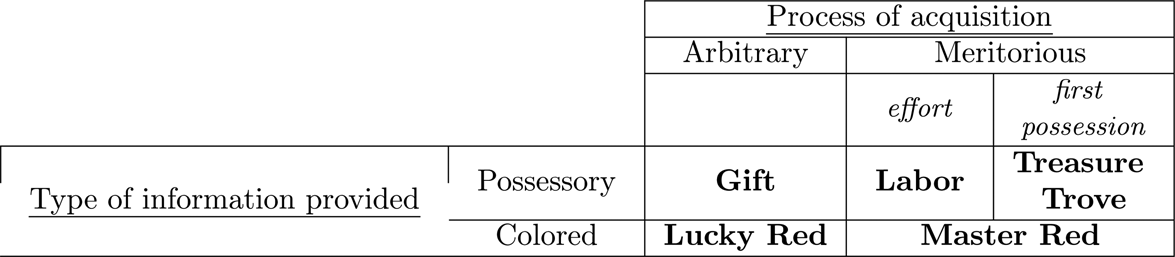
The treatment variation happens both in the first phase, when the initial amount is acquired, and within each period of the second phase when the additional tokens are further distributed before the H–D game is played. We have a total of five treatments organized along two main dimensions. The first dimension concerns the type of information provided (the UA is either possessory or colored), and the other dimension concerns the process of acquisition (the UA is either arbitrary or meritorious) (Figure 2).
Experimental treatments.

Gift treatment
In the first phase each participant is endowed with 300 tokens as windfall money. In the second phase, in each of the 30 rounds, the computer randomly assigns 50 tokens to one of the two subjects, who thus becomes the possessor. The other subject (the intruder) does not receive any token.
Labor treatment
In both, the first and second phase participants have to perform an individual effort task following Gill and Prowse (Reference Gill and Prowse2012). The task consists of moving the cursors of 0–100 scale sliders to the right position.Footnote 13
In the first phase, each subject works on the slider task to gain the initial endowment. This initial task is divided in two parts. In the first part, each subject gains 250 tokens if he or she correctly positions at least 40 cursors within nine minutes.Footnote 14
In the second part of the first phase, lasting 1 minute, each correctly positioned slider is worth 8 tokens. So effort here is rewarded linearly. This second part was devised to have a measure of individual productivity in the effort task in order to control for possible differences in individual ability. We include this control in the regressions. At the end of the 10-minute initial period, subjects gained possession of an average of 329 tokens.
In the second phase subjects play the effort task in each of the 30 rounds. At every round each participant has one minute to move the cursors of as many 0–100 scale sliders as possible to the position indicated by the computer. For each matched pair of subjects, the one that correctly positions the highest number of cursors gains possession of 50 tokens.
In this case thus, effort is rewarded via a tournament, as only the best performer gets the 50 tokens. This rewarding mechanism was devised so that, at each round, exactly 50 tokens could be rewarded to only one of the two subjects, thus keeping the treatments comparable in terms of payoffs. On the other hand, because this activity does not require any particular ability or knowledge to complete, it is likely that participants perceive the endowment gained through individual performance to be correlated with individual effort even if it is competitively assigned. By using a meritorious mechanism of acquisition based on effort, and accepting some design trade-offs that added some elements of competition to the mixture, this treatment mimics labor as an almost universal mechanism for legitimizing property (Henry, Reference Henry1999; Locke, Reference Locke1980).
Treasure trove treatment
The first phase before the beginning of the 30 rounds is divided in two parts. In the first part each subject sees 130 squares as in the lower portion of Figure 1 available in the online appendix. There is one code for each subject to be found. Subjects have 3 minutes to find and register the code. If they succeed they gain 250 tokens. The time-frame was large enough for having most of the subjects finding the code.Footnote 15 In the second part, lasting 1 minute, of this initial phase, subjects see 130 squares again behind which there are 10 treasures of 10 tokens value each. Subjects have thus the incentive to register as many codes as possible and this allows us to have a measure of individual ability in this specific task.Footnote 16 Together, the two parts of phase 1 granted an average of 310 tokens.Footnote 17 In the second phase, at the beginning of each of the 30 rounds, subjects participate in a treasure trove contest. Each pair sees the same 25 squares on the computer screen, as in the upper screenshot of Figure 1 in the online appendix, and can uncover their content by pressing on each of them. Hidden behind one of the squares is a 50-token treasure in the form of a code composed of numbers and letters. Whoever registers its trove in the dedicated filling area at the bottom of the screen takes possession of the 50-token treasure that will then be contended in the second part of each round with the H–D game.
This mechanism of acquisition implies a mix of luck (uncover the ‘right’ square) and individual ability (being faster than competitors in registering the codes). The way assets are acquired in this contest closely resembles a classic first-possession mechanism that has long been considered a legitimate approach to the establishment of property rights (Grotius, Reference Grotius2012; Pufendorf et al., Reference Pufendorf, von Pufendorf and von Pufendorf1991) that is recognized in virtually any legal system (Ellickson, Reference Ellickson1989; Lueck, Reference Lueck1995).
Lucky red treatment
In this treatment each subject is randomly labeled either Red or Blue at the beginning of each round so that a UA is introduced along the lines of Hargreaves-Heap and Varoufakis (Reference Hargreaves-Heap and Varoufakis2002). However, this color label is not related to the initial possession of the 50 tokens; in fact nobody possesses the tokens before the contest. Furthermore, in the first phase before beginning the 30 rounds, each participant is endowed with 300 tokens as windfall money.
Master red treatment
This treatment is very similar to the Treasure Trove one. In the first phase each subject can find treasures to build her initial endowment exactly in the same way as in the Treasure Trove treatment.
In the second phase, in each of the 30 rounds, subjects participate to the same treasure hunt as in the Treasure trove treatment. The only difference is that whoever registers the trove first is assigned color Red (Blue)Footnote 18 instead of initial possession. Notice that the assignment of this color label is not related to the initial possession of the 50 tokens; in fact, nobody possesses the tokens before the contest.
Procedures
We conducted 27 laboratory sessions with 12 or 18 subjects each, for a total of 474 participants (45% female).Footnote 19 Each subject participated one session only. The experiment was conducted using computer interfaces at the CESARE lab of LUISS Guido Carli University. To program the experiment, we used the software Z-tree (Fischbacher, Reference Fischbacher2007). The vast majority of participants were graduate and undergraduate students at the University and were recruited using the online system ORSEE (Greiner, Reference Greiner2015).
At the beginning of each session, instructions were read aloud by the experimenterFootnote 20 to ensure common knowledge. Before the experiment started, all the participants had to correctly answer some control questions. Throughout the reading of the instructions and the control questions stage, participants had the opportunity to ask the experimenter questions in private. After the experiment ended, each subject was asked to fill in a questionnaire reporting socio-demographic characteristics and measuring individual risk preferences, logical abilities, and the level of impulsivity. Communication among participants was not allowed during the experiment.
Each session lasted approximately 70 minutes. During the sessions, subjects' endowment and payoff were expressed in tokens. Final payment was made in Euros at the exchange rate of 50 tokens for €1. Participants earned €14 on average, including a €2 show-up fee. To guarantee anonymity, cash payments were distributed individually and privately at the end of each session.
4. Predictions and potential experimental outcomes
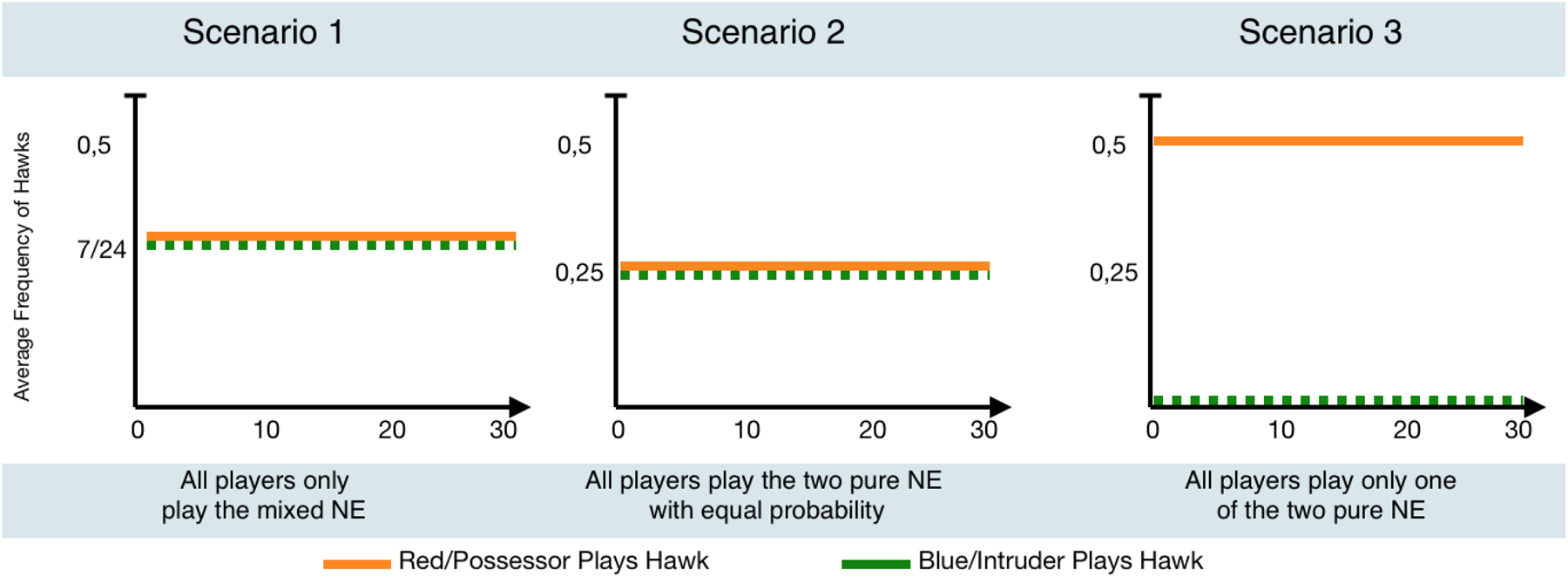
Before proceeding with the Results section, it is useful to organize our thoughts on the several different patterns that might be observed in the data. Against the theoretical background of the H–D game, and given our experimental design, we can expect to observe different behaviors that can be illustrated graphically with some stylized scenarios that depend on whether subjects will coordinate and, in case they do, whether they will make use of the UA or not. These scenarios are stylized insofar as they envisage all subjects behaving the same way.
Scenario 1. No convention. If no subject exploits the UA, no convention is established and all subjects in each group play the mixed strategy equilibrium ${\rm \lpar play\ }\,{\rm H\ }\,{\rm with}\,p = 7/12\rpar$ . If a subject happens to be red/possessor with p = 1/2 then the probability that the red/possessor plays H and the blue/intruder plays H is the same and is equal to 7/24. This strategy is inefficient (see Section 2). In a graph depicting the average frequencies of hawkish behavior of, respectively, possessors and intruders over the 30 rounds, under scenario 1 we should observe two lines overlapping around the value of 7/24, as in the first quadrant of Figure 3.
Scenarios about the expected frequency of Hawkish behavior by subjects, organized in accordance with the UA (either Red/Blue or Possessor/Intruder). The orange continuous line depicts the frequency with which subjects play Hawk when they are either Red in the color treatments or Possessors in the possessory treatments. The green dashed line instead depicts the frequency with which subjects play Hawk when they are either Blue or Intruders.

Scenario 2. Two conventions. If all subjects fully exploit the UA, they perfectly coordinate on one of the two pure NE. Because each convention is equally likely to emerge (p = 1/2) in each group, looking at the average behavior across groups one should observe that the red/possessor plays H and the blue/intruder plays H with roughly the same frequency of 1/4, as depicted in the middle quadrant of Figure 3 (remember that subject happens to be red/possessor with 1/2). This scenario yields an efficient result because coordination in each group happens in all the rounds. However, there is no dominant convention, and each group coordinate on one convention at random.
Scenario 3. One convention. If all subjects fully exploit the UA and they all coordinate across groups on just one of the two conventions (red/possessor plays H(D) while blue/intruder plays D(H)), then we should observe in all rounds the red/possessor subjects playing H(D) and the blue/intruder subjects playing D(H) as in the last quadrant of Figure 3. This scenario also yields an efficient result.
Notice that in all treatments a UA is provided, and therefore we should expect one of the two conventions to emerge. Furthermore, given the standard H–D game we implement, there is no theoretical reason to anticipate that only one convention should be selected, and therefore we should expect to observe scenario 2.
Scenario 1 should emerge only if subjects fail to take advantage of the UA, while scenario 3 should emerge only if the UA triggers individuals to collectively select one equilibrium over the other.
5. Results
Individual behavior and (anti-)bourgeois coordination
We begin the analysis by focusing on subjects' individual behavior. We introduce the dummy variable defend that takes the value 1 when a subject is a possessor and chooses the H strategy. Similarly, we create the dummy steal that takes value 1 when the subject is an intruder and chooses the H strategy. Before proceeding, we need to identify who is the possessor and who is the intruder. This is immediate in the possessory treatments (the possessor is the subject in the pair that possesses the 50 tokens at the end of the first part of each round and the intruder is the other subject).Footnote 21 Identifying the possessor is also simple in the Master Red treatment; even if there is no possession, the Treasure Trove introduces a sort of ‘meritorious incumbency’ that translates into the assignment of the red colorFootnote 22 to the winner. Assigning the possessor label in the Lucky Red treatment is less straightforward because there is no possession or any meritorious incumbency. We proceed as follows. First, we identify for each group of six subjects interacting throughout a session the convention that is established more often in the initial 10 rounds.Footnote 23 To do so, we count the number of times that (i) red plays H while blue plays D and (ii) blue plays H while red plays D. If (i) is larger than (ii), then we claim that the convention ‘red plays H while blue plays D’ is the established convention and we label red as possessor. Conversely, if (ii) is larger than (i), we label blue as possessor.Footnote 24
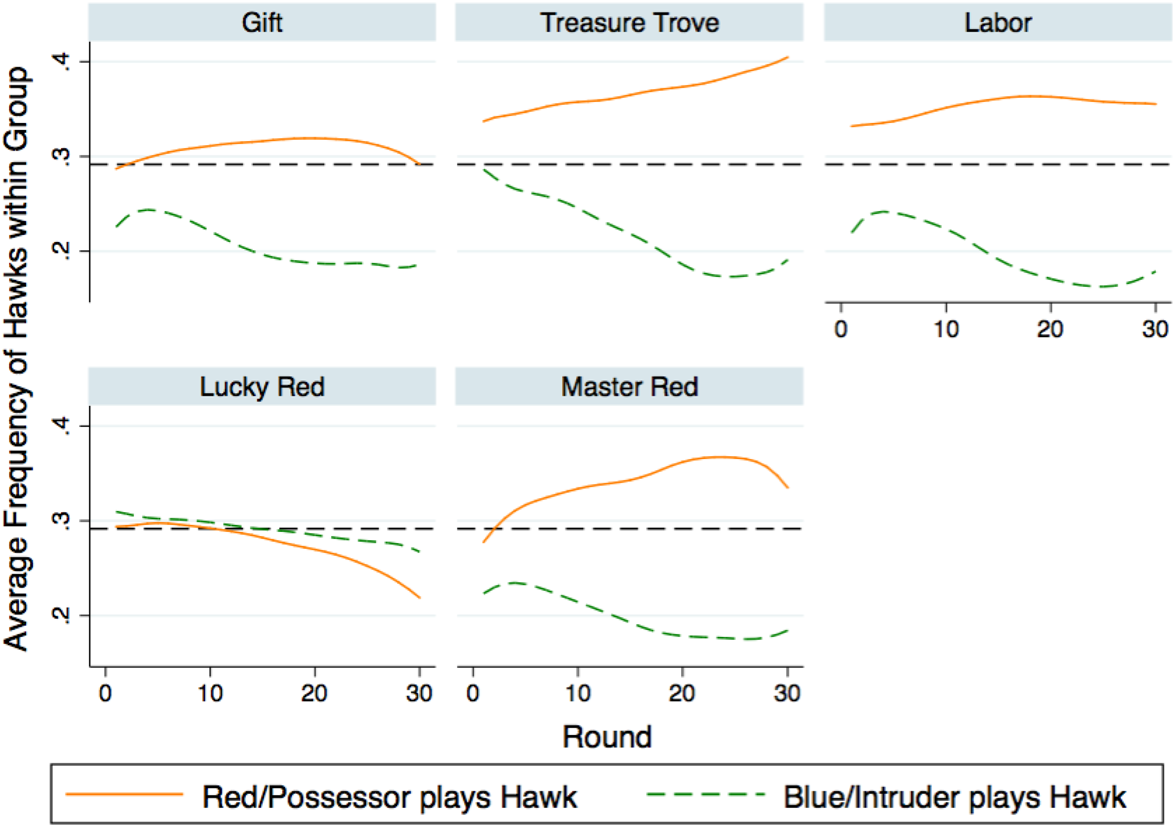
Figure 4 shows the fraction of subjects playing the H strategy when they are either possessors (orange continuous line) or intruders (green dashed line) through the 30 periods for each treatment. In all the possessory treatments (Labor, Treasure Trove, and to a lesser extent Gift) and in the Master Red treatment, the introduction of the UA induces possessors to play H at higher frequencies than intruders.
Evolution of hawkish behavior dependent on the UA in each treatment.

This figure is to be compared to the different scenarios provided in Section 4 and in particular with Figure 3. In four out of five treatments (Gift, Treasure Trove, Labor, and Master Red) the evidence is consistent with scenario 3 where only one convention is established. The only treatment in which a convention does not seem to emerge is the Lucky Red one, where the two lines are close and cross both the 1/4 and the 7/24 line. This graphical finding is compatible with both scenario 1 (where no convention is established but coordination over the mixed NE is realized) and scenario 2 (where both conventions are established, with each one played with roughly equal frequency). An examination of Figure 2 in the online appendix shows that in none but one of the Lucky Red groups a clear pattern of coordination on one convention emerges. Therefore, the graphical evidence of Figure 4 suggests that the Lucky Red treatment induces behavior in accordance with scenario 1.
We verify these graphical impressions using a regression analysis. The individual data are in the form of panels of individual behavior clustered within groups. A clear hierarchy can be detected in the data structure, and different sources of heterogeneity might arise at different levels of the hierarchy. Therefore, we allow for multilevel random effects, capturing the correlation between repeated individual measurements and the group-specific effect. Hierarchical/multilevel random effects are often used in the analysis of binary hierarchical data (Goldstein, Reference Goldstein2011), as they provide a flexible strategy to account for complex correlation structures in the analysis of longitudinal data; see, for example, Skrondal and Rabe-Hesketh (Reference Skrondal and Rabe-Hesketh2004); Steele (Reference Steele2008); Muthén and Asparouhov (Reference Muthén and Asparouhov2009). Here, a hierarchical mixed-effects logistic regression is employed, containing both fixed effects and random effects. The random effects are useful for modeling intra-panel correlation, as observations share common panel-level random effects.
In the following, we specify a three-level model by introducing random effects for six-player groups interacting for 30 rounds and individuals nested within groups; the time-specific observations comprise the first level, the individuals comprise the second level, and the groups comprise the third level. Formally, let y tig be the behavior at time t for the i-th individual clustered within the g-th group, the three-level mixed-effects logistic model is defined as:

Here, $x_{tig}^{\prime}$ is a vector containing all covariates, u ig is a random intercept varying over individuals (level 2), and v g is a random intercept varying over groups (level 3). The random intercepts u ig and v g are assumed to be independent of each other and independent across groups, and u ig is assumed to be independent across individuals as well. Both random intercepts are assumed to be independent of the covariates x tig. The responses y tig are independently Bernoulli distributed given the random effects and covariates. Model (1) can be alternatively written as a latent-response model, widely used in the econometric literature:

where ε tig has a standard logistic distribution with variance π 2/3. The ε tig are assumed to be mutually independent and to be independent of u ig, v g, and x tig. The observed binary responses are then presumed to be generated by the threshold model:

To ensure model identifiability, the random effects u ig and v g are assumed to have zero-mean. Furthermore, a Gaussian distribution is often taken for granted for the random terms. Here, to specify the distributions of the random terms, we take a non-parametric approach (Aitkin, Reference Aitkin1999) and assume that the random-effects are drawn from discrete distributions with a finite number of mass points, associated with some mass points probabilities. This involves an additional step in the model selection, because the support of these distributions is not known in advance; it must be selected by evaluating the goodness of fit that different supports obtain. However, there are several advantages that compensate for this complication. First, the random effects model reduces to a finite mixture model with a computationally tractable likelihood function. Second, the possibly inappropriate and unverifiable parametric assumptions about the distribution of the random effects are avoided. Third, the outcomes are clustered in a finite number of latent classes that can have an economic meaning. Parameters estimates are obtained in a maximum likelihood framework by using the expectation–maximization algorithm (Dempster et al., Reference Dempster, Laird and Rubin1977).
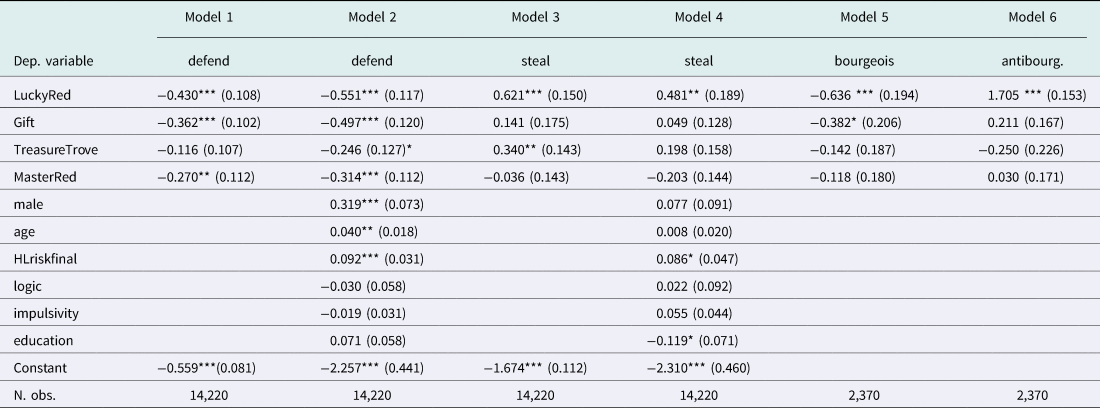
Table 1 reports the results. In models 1 and 2, the dependent variable is defend, but model 2 differs in that it also controls for individual risk preferences, logical abilities, and socio-demographic characteristics. The coefficients of the treatment dummies show that players in the Labor and Treasure Trove treatments play H when they are possessors significantly more frequently than in the other treatments (in Labor, weakly significantly more than in Treasure Trove, once we control for individual characteristics). Notice that both meritorious possession treatments – but especially the labor one – are the ones generating the highest rates of defend behavior. Indeed, arbitrary possession (in the Gift treatment) or the meritorious assignment of the color (in the Master Red treatment) do not induce as much hawkish behavior as in the meritorious possession treatments.
Claim 1. Participants who possess the resources in both meritorious possession treatments are significantly more likely to choose the Hawk strategy. The effect is marginally stronger in the Labor treatment than in the Treasure Trove treatment.
Individual behavior and coordination

Notes: Models 1–4 study individual behavior. Dependent variable: in models 1 and 2 the dummy defend = 1 when a subject plays H if possessor; in models 3 and 4 steal = 1 when a subject plays H if intruder. Models 5 and 6 study coordination. Dependent variable: in model 5 the dependent variable is bourgeois while in model 6 antibourgeois. All are multilevel models for longitudinal data. Link function: models 1–4 – logit, models 5 and 6 – ordinal logit. Compared to models 1 and 3, models 2, 4, 5, and 6 control for participants' gender, education, risk preferences, logical ability, and impulsivity. Symbols ***, **, and * indicate significance at the 1%, 5%, and 10% levels, respectively.
Overall, gaining possession of an asset through effort induces the highest rates of hawkish behavior. This result seems to support the John Locke theory of property (Henry, Reference Henry1999) that justifies and legitimizes property in terms of labor. In addition, the other mode of acquisition via first possession mimicked in the Treasure Trove treatment produces high rates of hawkish behavior; this mode of acquisition constitutes the base of other important theories of property proposed by Grotius ([1625] Reference Grotius2012) and Pufendorf et al. ([1708] Reference Pufendorf, von Pufendorf and von Pufendorf1991).
In models 3 and 4, the dependent variable is steal (model 4 additionally controls for individual risk preferences, logical abilities, and socio-demographic characteristics). The coefficients of the treatment dummies reveal that, with the exception of the Lucky Red where intruders choose H at a significantly higher rate, intruders in the remaining treatments have the same low likelihood to choose the hawk strategy.
Therefore, an asymmetry across treatments emerges in subjects' likelihood to play H or D depending on whether they are possessors or intruders. Being a possessor induces a clear hierarchy of hawkish behavior among treatments (Labor > Treasure Trove > Master Red > Gift > Lucky Red). On the other hand, being an intruder induces a similar dovish behavior in all the treatments but the Lucky Red one, for which the likelihood to play D is significantly smaller.
Claim 2. In the Lucky Red treatment, intruders are significantly more likely to choose the Hawk strategy compared to all other treatments. Intruders choose the Hawk strategy with the same frequency in the remaining treatments.
We now move from the study of individual behavior (whether the possessor plays strategy H or D) to focusing on pairs' coordination on a pure strategy NE (whether the possessor plays H and at the same time the intruder plays D, or the other way around). We create two categorical response variables, bourgeois and antibourgeois, that take values {1,4} indicating for each six-player group in each round how many pairs of subjects implement a bourgeois (i.e. possessor plays H, intruder plays D) or an antibourgeois (intruder plays H, possessor plays D) convention, respectively.Footnote 25
In the following regression analysis we focus on data aggregated at the group level and consider a hierarchical/multilevel model for longitudinal data. In detail, we assume the existence of a latent variable in round t for the g-th group:

where ν gt is the linear predictor decomposed in two parts, the first one explained by observed covariates x tg and the second one being a group-specific random variable η g. ε tg is an error term, and the four observed response categories {1,4} are generated, conditionally on η g, by applying thresholds κ s to y*, as follows:

Assuming a logistic cumulative density function F(⋅) for ε tg, the model considered has the following general form:

To have a well-defined probability, we would like to remark that the restriction $\Pr \lpar {y_{tg} \lt a_s{\rm \mid }x_{tg}\comma \;\eta_g} \rpar \lt \Pr \lpar {y_{tg} \lt a_{s + 1}{\rm \mid }x_{tg}\comma \;\eta_g} \rpar$ has to be fulfilled. As a further remark, in this model the effective thresholds vary across groups. The parameters estimation is performed in a maximum likelihood, leaving unspecified the distribution of the random term η g, as in Aitkin (Reference Aitkin1996, Reference Aitkin1999). Several empirical models are specified; that is, different sets of x tg are considered.
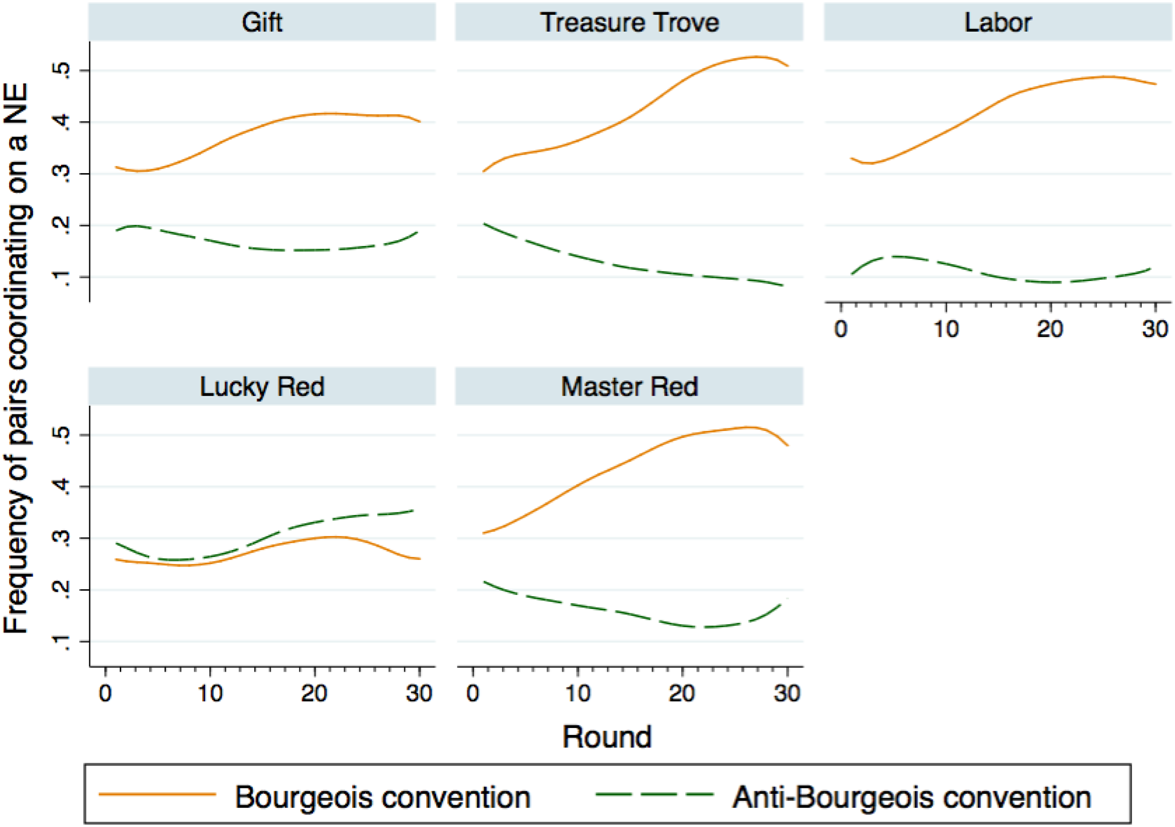
In model 5 of Table 1 we investigate bourgeois behavior. Here a clear treatment effect emerges, with Labor being the treatment where the bourgeois convention emerges more frequently, along with the Master Red and the Treasure Trove treatments. The Lucky Red and Gift treatments are the ones less likely to induce bourgeois coordination (albeit only marginally less so for Gift). Significant differences are also estimated between the Lucky Red and the Master Red, between the Lucky Red and the Treasure Trove, and between the Gift and the Master Red treatments. This suggests that bourgeois behavior is implemented to a larger extent in the treatments characterized by a meritorious process of acquisition of the UA (Labor and Treasure Trove). Moreover, the meritorious acquisition is effective in inducing bourgeois coordination, even in the absence of an ex-ante explicit assignment of possession (Master Red) (Figure 5).
Level of bourgeois and antibourgeois coordination.

Antibourgeois behavior has a significantly higher likelihood of being observed in the Lucky Red treatment (see model 6 in Table 1) compared to all other treatments. Furthermore, a significant difference is estimated between the Gift and the Treasure Trove treatments, with the former increasing the probability of behaving in an antibourgeois manner. Finally, no significant differences are estimated between Labor and the other treatments.
Claim 3. In the meritorious treatments (Labor, Treasure Trove, and Master Red), subjects predominantly coordinate on the bourgeois convention. In the Gift treatment, subjects achieve marginally significantly lower levels of coordination on the bourgeois convention. In the Lucky Red treatment, coordination on the bourgeois convention is significantly lower and coordination on the antibourgeois convention is significantly higher compared to the other treatments.
6. Discussion and conclusions
The present study is situated within the Humean tradition that sees property as a convention emerging from the deliberate and rational coordination of individuals over the appropriation, production, and use of assets (Waldron, Reference Waldron, Penner and Smith2013). This longstanding tradition has been reinvigorated in the last 40 years by the contribution of natural sciences both at the theoretical level with biologists' work on evolutionary game theory and at the empirical level with the study of the respect many species have for territoriality and property.
Quite surprisingly, this prolific literature on the H–D game and its implications for understanding the nature of property institutions has received little attention from economists, with the few notable exceptions of Sugden (Reference Sugden1989, Reference Sugden2004), Gintis (Reference Gintis2007), Eswaran and Neary (Reference Eswaran and Neary2014) and, among the law and economics scholars, Rose (Reference Rose2014) and Lewinsohn-Zamir (Reference Lewinsohn-Zamir and Yun-chien2015).
Even more strikingly, the H–D game has received very limited attention by experimental economists and, to our knowledge, it has never been studied in the lab by introducing possession as the UA. Indeed the only experiments using the H–D game in relation to law and economics are McAdams and Nadler (Reference McAdams and Nadler2005, Reference McAdams and Nadler2008) who however study the role of the law (an exogenous suggestion about expected behavior in the experiment) as a coordinating device.
There might be an intuitive and at the same time important reason why previous implementations of the H–D game avoided using possession as UA (see Berninghaus et al., Reference Berninghaus, Ehrhart and Ott2012; Neugebauer et al., Reference Neugebauer, Poulsen and Schram2008; Oprea et al., Reference Oprea, Henwood and Friedman2011). The reason is that possession may be culturally loaded, while other asymmetries, such as colors or ‘row’ versus ‘column’ roles previously used, are almost certainly not. However, as the focus of the paper is exactly on the role of possession in establishing the property convention, we used possession along the color label as our UA. While our experimental subjects, mainly university students, could have been nurtured to some extent to coordinate on the property convention, the results of some recent experiments done with young children (Goulding and Friedman, Reference Goulding and Friedman2018; Rochat et al., Reference Rochat, Robbins, Passos-Ferreira, Oliva, Dias and Guo2014; Rossano et al., Reference Rossano, Rakoczy and Tomasello2011) seem to suggest that the disposition to respect and enforce property rights is innate and thus it is also driven by nature. Our current treatment variation is not meant to answer the question of whether the property convention is driven by ‘nature or nurture’, and further research is needed to shed light on the neurobiological origins of property as a social convention.
The use of experiments in law and economics is still relatively limited and questions of external and ecological validity (Roe and Just, Reference Roe and Just2009) routinely surface when such research is presented. While we acknowledge that our experiment, and lab experiments in general, are only stylized analogies of the real situations that are studied, we also must highlight how most of legal theory contents itself with speculation and therefore any empirical evidence, including a carefully manipulated, albeit quite abstract one derived from an experiment, must be seen as a good step ahead. The empirical evidence provided by experiments is particularly useful when it is hard to find convincing counterfactuals and this is exactly the case in point: indeed possession is legally recognized in almost all legal orders of the world and thus, while observing real people's respect for others' possession, it is impossible to disentangle the effects of legal enforcement from the ones deriving from the establishment of the Humean convention. In the lab however it is possible to randomly assign possession to some subjects and shade their counterparts from the legal implications of appropriating the asset.
We want to conclude by stressing what our paper is about and what it is not. This paper is not meant to cover all reasons that might favor the legal recognition of possession but rather it focuses on its specific role as a coordinating device that minimizes the social costs of fighting over the appropriation of scarce resources. In our framework possession works as a behavioral refinement, helping anonymous interacting partners to find an equilibrium which minimizes conflicts. This result is predicted theoretically (with the caveats seen before) by the H–D game; it has been shown to be consistent with the behavior of many animal species and now it is also show to be explicative of human behavior.
Furthermore, we like to think that our experimental exercise is evocative with respect to some aspects of the long lasting debate on what is property that begun with the 17th–19th centuries philosophical giants and is still currently taking place among political and legal philosophers and economists. In Leviathan, Hobbes ([1651] Reference Hobbes2016) depicted the state of nature, where no institution exists, as a state of war where every man takes what he can get and for so long as he can keep it. The H–D game captures the potentially catastrophic outcomes of endemic fighting over the appropriation of resources. Hobbes offered a top-down solution to this nasty, brutish, and short equilibrium with the establishment of a property rights' regime by the Leviathan. Without the need for a Leviathan, David Hume in his Treatise of Human Nature provided a bottom-up theory of the emergence of the property convention out of the voluntary coordination of individuals: I observe, that it will be for my interest to leave another in the possession of his goods, provided he will act in the same manner with regard to me (Hume ([1738] Reference Hume2007: 315). As Sugden (Reference Sugden1989) points out, the bourgeois strategy in the H–D game is indeed the contemporary game theoretic modeling of the modern era Humean property convention, and our experiment shows that possession is indeed sufficient to ignite coordination around the property convention. Compared to Hobbes, Locke ([1689] Reference Locke1980) had a more positive idea of the state of nature and envisaged the existence of natural law, which obliges every one not to harm another in his life, health, liberty, or possessions; and it is by virtue of natural law that the labor of his body, and the work of his hands legitimizes the existence of individual property rights. Indeed, our Labor treatment, where possession is gained in exchange for effort, triggers the highest willingness of the possessor to defend her endowment. This supports the idea that while individuals recognize other means of acquiring possession of a resource as legitimating its ownership, they perceive labor as the most natural condition to legitimize the property convention.
Acknowledgements
We thank Ian Ayres, Maria Bigoni, Alessandra Casella, Gary Charness, Marco Casari, Shahar Dillbary, Robert Ellickson, Marco Faillo, Tim Friehe, Sven Hoppner, Russell Korobkin, Cesar Martinelli, Johanna Mollerstrom, Murat Mungan, Gideon Parchomovsky, Francesco Parisi, Kirill Pogorelskiy, Hans-Bernd Schäfer, Paul Seabright, Simone Sepe, Avraham Tabbach, Mirco Tonin, Avishalom Tor, Kathryn Zeiler, and two anonymous referees for their valuable comments. We thank seminar participants at George Mason University, at the Institute for Advanced Study in Toulouse, at the Free University of Bolzano, at LUMSA University, at the University of Bonn, and at LUISS University and conference participants of the American Law and Economic Association, the European Law and Economic Association, the Conference on Empirical Legal Studies in Europe, and participants in the SONIC experimental workshops in Bologna and in the seminar series of the research group Behavioral Approach to Contracts and Torts at Erasmus University Rotterdam for their comments on the early design. This project was funded by the Einaudi Institute for Economics and Finance Research Grant. Marco Fabbri is grateful to the Behavioral Approach to Contracts and Torts research group at Erasmus University Rotterdam for the financial support received during the completion of the work. The usual disclaimers apply. Additional material is available at: https://osf.io/wjmnp/?view_only=7b7328c265af4944aeb337131d7f1288.