Introduction
The change in incidence and prevalence of common mental disorders (CMDs) with age is a central issue in psychiatric epidemiology and health care provision. Some studies have reported an improvement in mental health in old age (Clark, Reference Clark2007; Blanchflower & Oswald, Reference Blanchflower and Oswald2008; McManus et al. Reference McManus, Meltzer, Brugha, Bebbington and Jenkins2009), but this is not a universal finding (Jorm, Reference Jorm2000). Moreover, many of these studies have not included individuals older than 70 years of age (Jorm et al. Reference Jorm, Windsor, Dear, Anstey, Christensen and Rodgers2005; Clark, Reference Clark2007; Green & Benzeval, Reference Green and Benzeval2011) so it is unclear whether the positive mental health development continues beyond early old age. There is a suggestion that the incidence of depression increases (Palsson et al. Reference Palsson, Ostling and Skoog2001; Vink et al. Reference Vink, Aartsen, Comijs, Heymans, Penninx, Stek, Deeg and Beekman2009) and levels of personal life satisfaction decline after age 70 (Mroczek & Spiro, Reference Mroczek and Spiro2005; Baird et al. Reference Baird, Lucas and Donnellan2010). It is also possible that mental health trajectories plateau in older age (Jokela et al. Reference Jokela, Ferrie, Gimeno, Chandola, Shipley, Head, Vahtera, Westerlund, Marmot and Kivimäki2010a, Reference Jokela, Singh-Manoux, Ferrie, Gimeno, Akbaraly, Shipley, Head, Elovainio, Marmot and Kivimäkib). Regarding health care provision, there have been increasing concerns for adequate treatment in elderly people raised by the Healthcare Commission (2009) and the Royal College of Psychiatrists (2009), among others.
The effects of age can be modified, or confounded, by secular trends (time period effects) and birth cohort effects but their role in ageing trajectories remains poorly understood. Some (Hagnell et al. Reference Hagnell, Lanke, Rorsman and Öjesjö1982; Klerman & Weissman, Reference Klerman and Weissman1989; Lewis & Wilkinson, Reference Lewis and Wilkinson1993) but not all (Lehtinen et al. Reference Lehtinen, Lindholm, Veijola, Väisänen and Puukka1991; Murphy et al. Reference Murphy, Laird, Monson, Sobol and Leighton2000) of the earlier studies on the topic showed increasing rates of depression over the years, but evidence for a continuing secular trend in CMDs is weak. Rates of diagnosed depression have declined in the UK between 1993 and 2005 (Moore et al. Reference Moore, Yuen, Dunn, Mullee, Maskell and Kendrick2009) whereas the Psychiatric Morbidity Survey (Singleton et al. Reference Singleton, Bumpstead, O'Brien, Lee and Meltzer2001; Brugha et al. Reference Brugha, Bebbington, Singleton, Melzer, Jenkins, Lewis, Farrell, Bhugra, Lee and Meltzer2004) suggested an increasing prevalence of ‘mixed anxiety and depressive disorder’ between 1993 and 2000 but no change in most other mental disorders. Population-based studies in the UK have produced mixed findings concerning cohort effects in CMDs (Paykel, Reference Paykel2000; Sacker & Wiggins, Reference Sacker and Wiggins2002; Green & Benzeval, Reference Green and Benzeval2011; Spiers et al. Reference Spiers, Bebbington, McManus, Brugha, Jenkins and Meltzer2011).
With respect to treatment, older people seem to be less likely to receive ‘talking therapies’ (Olfson et al. Reference Olfson, Marcus, Druss and Pincus2002; Cooper et al. Reference Cooper, Bebbington, McManus, Meltzer, Stewart, Farrell, King, Jenkins and Livingston2010), suggesting an ageing effect, but time period and cohort effects in these associations have not been studied systematically. Based on current evidence, there has been little change in the utilization of psychotherapy in the UK between 1993 and 2000 (Brugha et al. Reference Brugha, Bebbington, Singleton, Melzer, Jenkins, Lewis, Farrell, Bhugra, Lee and Meltzer2004; Jokela et al. Reference Jokela, Batty, Vahtera, Elovainio and Kivimäki2012) or in the USA between 1987 and 1997 (Olfson et al. Reference Olfson, Marcus, Druss and Pincus2002) but a dramatic increase in the prescription of antidepressants (Brugha et al. Reference Brugha, Bebbington, Singleton, Melzer, Jenkins, Lewis, Farrell, Bhugra, Lee and Meltzer2004; Moore et al. Reference Moore, Yuen, Dunn, Mullee, Maskell and Kendrick2009).
A longitudinal, cohort-sequential study design offers one of the strongest approaches to examine whether and how cohort effects and secular trends modify the effects of ageing (Farrington, Reference Farrington1991; Miyazaki & Raudenbush, Reference Miyazaki and Raudenbush2000). By following individuals from different birth cohorts over partly overlapping age periods, it is possible to assess whether successive cohorts or time periods follow a common developmental age trajectory or whether age trajectories change according to period or cohort effects. Using 18-year longitudinal data from the British Household Panel Survey (BHPS) of individuals between ages 15 and 100 years, we examined age trajectories of CMDs (assessed with the General Health Questionnaire, GHQ) and the utilization of psychotherapy treatment to better understand the life-course dynamics influencing mental health problems and their treatment. We hypothesized that CMDs and utilization of psychotherapy treatment become less prevalent with age, and that CMDs may have become more prevalent in more recent years or in younger birth cohorts. We did not have specific hypotheses concerning time period or cohort effects in psychotherapy treatment.
Method
Participants
The participants were from the BHPS (ESRC Research Centre on Micro-Social Change, 2009; Taylor et al. Reference Taylor, Brice, Buck and Prentice-Lane2010), a longitudinal survey of a nationally representative sample of more than 5000 British households with annual follow-ups. The original sample included 10 264 individuals aged 16–97 years at baseline in 1991 (mean = 44.4 years, s.d. = 18.3). New participants have been included in the sample over the years if they were born to an original sample member, if they moved into a household in the original sample, or if a member of the original sample moved into a new household with one or more new people. In addition, the sample was enriched with additional recruitment of participants from Scotland and Wales at wave 9 onwards, from Northern Ireland at wave 11, and from the UK European Community Household Panel study between waves 7 and 11, extending the sample to cover the whole of the UK. The most recent (18th) follow-up of the BHPS was carried out in 2008–2009, after which the cohort has become part of the larger Understanding Society study (www.understandingsociety.org.uk/).
For the present analysis, we included all person-observations of participants for which information on a measure of CMD and psychotherapy use was available (n = 30 224 unique individuals, of whom 17 249 were from the original sample, 3574 from the Wales sample, 3452 from the Scotland sample, 3905 from the Northern Ireland sample, and 2044 from the UK European Community Household Panel sample; 46% men, 93% white). An average participant contributed 7.3 person-observations to the dataset, with an average 11.0-year follow-up period (s.d. = 5.6). Supplementary Table S1 shows the number of participants by age, period and cohort.
Measures
At each study wave, CMDs were identified using the 12-item GHQ (Goldberg, Reference Goldberg1972; Pevalin, Reference Pevalin2000), which asks the participant to reports symptoms of depression, anxiety and stress-related concerns over the past few weeks. The items were scored using the GHQ scoring method (0 = ‘not at all’ or ‘no more than usual’, 1 = ‘rather more than usual’ or ‘much more than usual’), resulting in a total score ranging between 0 and 12. GHQ caseness was defined as a GHQ score >2. At each study wave, the participants were also requested to report whether or not they had used different health and welfare services since the September preceding the interview year (‘Here is a list of some health and welfare services. Have you yourself made use of any of these services since September 1st last year?’). One of the items was ‘Psychotherapist (including psychiatrist or analyst)’ and this response (no/yes) was used as the dependent variable for psychotherapy treatment in the present study. Given that the time interval was framed with reference to last September, it has some variability across study members (mean interval length = 13.2 months, s.d. = 1.5). We therefore included time interval as a covariate in all models.
Statistical analysis
In the longitudinal study design with annual surveys, each participant could contribute between 1 and 18 person-observations to the dataset. Measures of GHQ and use of psychotherapy were treated as time-dependent variables, that is the same participant could have different values for each person-observation. Sex, birth year, ethnicity and subsample were treated as time-independent variables.
We first assessed the ageing trajectories using population-averaged multilevel logistic regression, which takes into account the non-independence of the repeated person-observations within the same individual. In addition, we examined whether birth cohort or period effects were associated with overall mean level differences in GHQ or psychotherapy treatment after taking into account ageing. To prevent forcing the age trajectories and period/cohort effects into any predefined functional form, we used age, period and cohort as categorical variables. Within the 10-year age categories, older cohorts (and earlier time periods) contributed data from older ages than younger cohorts (and more recent time periods). To take this into account, we created a variable indicating the deviation of the person's age from the median age of the age group, and included this variable in all the models including cohort or period effects.
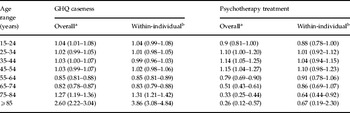
We then allowed the period and cohort indicators used in the first analysis to interact with age, so that the age trajectories of GHQ and psychotherapy treatment could follow different trajectories by birth cohort and time period (Farrington, Reference Farrington1991; Miyazaki & Raudenbush, Reference Miyazaki and Raudenbush2000). The model-predicted trajectories of GHQ caseness and psychotherapy treatment from these models were plotted by cohort and time period against age to illustrate the differing trajectories. Finally, we examined whether the overall ageing patterns observed in the first analysis were replicated in a within-individual analysis that removes mean-level differences between different individuals and considers only age-related variation within the same individual, also known as fixed-effect estimates (Curran & Bauer, Reference Curran and Bauer2011). For this purpose we examined the rate of within-individual change in different age groups by allowing the within-individual change to vary by age group.
Additional supplementary analyses were carried out to examine cohort and period effects within specific age groups. We also fitted age trajectories for all the 12 items of the GHQ scale separately to examine whether the results were sensitive to individual questions related to mood versus more physical symptoms. The models were fitted using the random-effect model packages of Stata v. 12.1 (Stata Corporation, USA).
Results
Main analysis
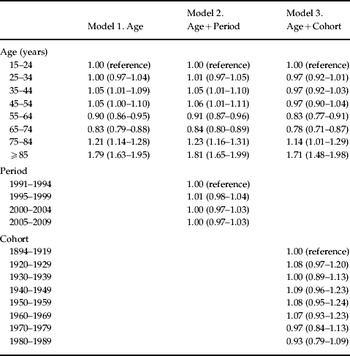
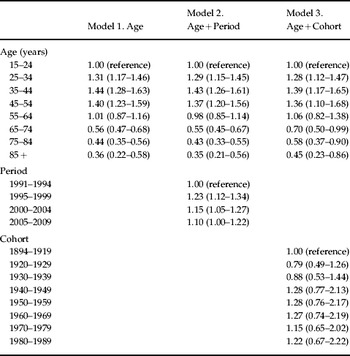
The risk of GHQ caseness remained almost constant up to age 55, after which it decreased moderately up to age 75, followed by a steep incline after age 75 (Table 1). There was no evidence of period or cohort effects in mean levels of GHQ caseness (Table 1). Utilization of psychotherapy treatment increased up to age 35–44, after which it decreased up to age 85 and beyond (Table 2). Psychotherapy utilization was at its highest in 1995–1999, although the absolute differences between time periods were modest (1.7, 2.2, 2.1 and 1.9%, respectively), with no significant cohort differences.
Associations of age with GHQ caseness, adjusted for cohort and period effects

GHQ, General Health Questionnaire.
Values are odds ratios (95% confidence intervals).
n = 30 220 participants, 220 184 person-observations over 18-year follow-up time.
Associations of age with psychotherapy use, adjusted for cohort and period effects

Values are odds ratios (95% confidence intervals).
n = 30 220 participants, 220 184 person-observations over 18-year follow-up time.
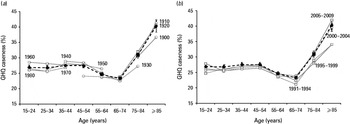
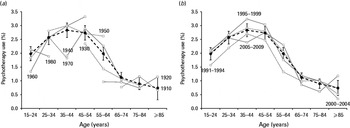
Next, we assessed whether different birth cohorts or time periods followed different age trajectories in GHQ caseness. There were no systematic interaction effects between age and period or cohort effects, indicating that all the time periods and birth cohorts followed essentially the same age trajectory (Fig. 1), except that the increase in GHQ after age 75 was steeper in 2000–2009 than in 1991–1999 (time by age interaction, p = 0.01), with GHQ caseness increasing by odds ratio (OR) 1.57 [95% confidence interval (CI) 1.49–1.65] in 2000–2009 and by OR 1.43 (95% CI 1.35–1.53) in 1991–1999 per 10 years of age in participants aged ⩾65 years. There were no systematic age–period or age–cohort interaction effects in psychotherapy treatment utilization (Fig. 2).
Risk of common mental disorders [General Health Questionnaire (GHQ) caseness (%)] according to (a) age and birth cohort and (b) age and time period. Broken black line represents age trajectory (and its 95% confidence interval) without cohort or time period interactions, grey lines represent different birth cohorts or time periods.

Utilization of psychotherapy treatment (%) during the past year according to (a) age and birth cohort and (b) age and time period. Broken black line represents age trajectory (and its 95% confidence interval) without cohort or time period interactions, grey lines represent different birth cohorts or time periods.

We then examined whether the ageing patterns observed in the first analysis were replicated when considering only longitudinal variation within the same individuals, that is when excluding mean-level differences between different individuals (Table 3). The ORs in Table 3 describe change in the outcome per 5 years separately within the eight age groups. Within-individual longitudinal analysis of GHQ caseness supported the ageing effects observed in the main analysis. For psychotherapy treatment, the within-individual change was less marked than suggested by the overall analysis combining within-individual and between-individual comparisons. This was largely due to birth cohort differences identified in Table 2; after adjusting for birth cohort the difference between the overall and within-individual estimates attenuated considerably (data not shown).
Rate of change in psychological distress (GHQ caseness) and psychotherapy treatment by age in different age categories

GHQ, General Health Questionnaire.
Values are odds ratios (and 95% confidence intervals) associated with a 5-year increase in age within the different age groups.
a Overall associations are the estimates from random-intercept models that combine the comparisons of different individuals at different ages (between-individual effects) and the same individuals at different ages (within-individual effects).
b Within-individual coefficients are the fixed-effect estimates based on only the longitudinal variance in the outcome within the same individuals.
Supplementary analysis
An item-level analysis of GHQ age trajectories suggested that almost all the individual items followed the same ageing pattern as total GHQ caseness risk (see Supplementary Fig. S1). In addition to the main analyses of period and cohort effects presented in Figs 1 and 2, we carried out a more detailed exploratory analysis examining whether there were period and cohort effects specific to some age groups. These analyses suggested some associations not observed in the overall analysis of cohort and period effects (Supplementary Figs S2–S5). First, GHQ caseness decreased linearly between 1991–1994 and 2005–2009 in participants aged 25–54 by OR 0.97 (95% CI 0.95–0.98) per 5 years of time (Supplementary Fig. S2), suggesting a modest period effect in these age groups, whereas the period effect was in the opposite direction in individuals aged ⩾65. Second, the utilization of psychotherapy treatment increased with time (OR 1.17, 95% CI 1.07–1.29, per 5 years; Supplementary Fig. S4) in individuals 55–64 years of age. In the same age group, younger birth cohorts had higher rates of GHQ caseness (OR 0.95, 95% CI 0.90–1.00 per one increase in birth cohort; Supplementary Fig. S3) and higher use of psychotherapy (OR 0.72, 95% CI 0.62–0.84; Supplementary Fig. S5). Third, in the youngest age group (15–24 years), GHQ caseness was lower and psychotherapy utilization higher in more recent birth cohorts (OR 1.07, 95% CI 1.01–1.13 and OR 0.84, 95% CI 0.70–1.00 respectively per one increase in birth cohort; Supplementary Figs S3 and S5). However, given that several comparisons in Supplementary Figs S2–S5 were tested without a priori hypotheses, these statistically significant age-specific trends need to be interpreted cautiously and replicated in independent samples before drawing firm conclusions.
Discussion
The present data suggest that the improving mental health trajectory observed in early old age may be disrupted by a steep increase in CMDs after age 75. This adverse trend associated with old age has become more marked over the past two decades. Otherwise, there were no substantial differences between time periods or birth cohorts in the overall age trajectory of CMDs. The utilization of psychotherapy treatment followed an inverse J-shaped curve with age, with individuals ⩾65 being the least likely to have psychotherapy, implying that the elderly most likely to suffer from mental health problems are the least likely to receive psychotherapy treatment. Utilization of psychotherapy increased slightly in the 1990s but then decreased in the 2000s, while there were no overall cohort differences.
Our findings suggest that the mental health improvements after midlife reported in many previous studies (Jorm, Reference Jorm2000; Clark, Reference Clark2007; Blanchflower & Oswald, Reference Blanchflower and Oswald2008) may not carry over to old age. Other studies have similarly shown that life satisfaction declines (Mroczek & Spiro, Reference Mroczek and Spiro2005; Baird et al. Reference Baird, Lucas and Donnellan2010) and depression incidence increases (Palsson et al. Reference Palsson, Ostling and Skoog2001; Vink et al. Reference Vink, Aartsen, Comijs, Heymans, Penninx, Stek, Deeg and Beekman2009) after age 70, supporting the present results. However, in the third British Psychiatric Morbidity Survey (McManus et al. Reference McManus, Meltzer, Brugha, Bebbington and Jenkins2009), participants aged >75 years were the least likely of all age groups to have any CMDs. It is unclear why two population-based studies from the same area and time period can produce such contradictory results on ageing and CMDs. Differences in study design (cross-sectional versus longitudinal) and participation rates might contribute to this discrepancy. In longitudinal data, survival bias induced by differences in longevity or selective attrition might explain some of the positive associations of age with better mental health, but it seems unlikely that such bias would explain the adverse associations of ageing observed in the present study. Different measures might also explain some of the discrepancy but probably not the diametrically opposite results.
The declining mental health in old age was accompanied by decreasing rate of psychotherapy utilization after age 55, indicating that the discrepancy between development of CMDs and their treatment grows with age. The observed age trajectory of psychotherapy utilization is in agreement with the Psychiatric Morbidity Study (Cooper et al. Reference Cooper, Bebbington, McManus, Meltzer, Stewart, Farrell, King, Jenkins and Livingston2010), in which those aged ⩾75 were least likely to receive talking therapies. It should be emphasized that our study did not assess the proportion of individuals in need of, but not receiving, treatment as we did not have data on psychiatric diagnosis. There were also no data on antidepressant use or other treatment measures, so the present data give only a limited picture of ageing and psychiatric treatment (Cooper et al. Reference Cooper, Bebbington, McManus, Meltzer, Stewart, Farrell, King, Jenkins and Livingston2010). Nevertheless, the increasing GHQ caseness in old age does imply increasing mental distress exposing individuals to the risk of psychiatric disorders and, thereby, need for treatment. The use of psychotherapy in older individuals did not vary by time period or birth cohort.
Age–period and age–cohort interactions demonstrated that an overall test for period and cohort effects may not be enough to identify age-specific patterns. Whereas people aged ⩾75 had worse mental health in the 2000s than in the 1990s, there was an opposite, albeit less marked, period effect in those aged 25–54. Studies in American college students have demonstrated higher rates of psychopathology (Twenge et al. Reference Twenge, Gentile, Dewall, Ma, Lacefield and Schurtz2010) and anxiety (Twenge, Reference Twenge2000) in younger generations of this population. The present results showed age-specific cohort effects in individuals aged 15–24, but these effects suggested better mental health and increasing use of psychotherapy in younger birth cohorts (born in the 1980s) compared to older cohorts (born in the 1960s). Except for the differences of old age and CMDs in the 1990s versus 2000s, the observed period and cohort effects were modest in magnitude. Furthermore, the age-specific cohort and period effects need to be interpreted with caution before they are replicated in independent samples.
Early studies from the 1970s to 1990s showed increasing rates of depression in the USA (Klerman & Weissman, Reference Klerman and Weissman1989), Sweden (Hagnell et al. Reference Hagnell, Lanke, Rorsman and Öjesjö1982) and the UK (Lewis & Wilkinson, Reference Lewis and Wilkinson1993) but not in Finland (Lehtinen et al. Reference Lehtinen, Lindholm, Veijola, Väisänen and Puukka1991) or Canada (Murphy et al. Reference Murphy, Laird, Monson, Sobol and Leighton2000). These cohort effects do not seem to have continued after the 1990s. The incidence of diagnosed depression has declined in the UK between 1993 and 2005 (Moore et al. Reference Moore, Yuen, Dunn, Mullee, Maskell and Kendrick2009), although there was a 14% increase in the prevalence of ‘mixed anxiety and depressive disorder’ between 1993 and 2000 according to the Psychiatric Morbidity Survey (Singleton et al. Reference Singleton, Bumpstead, O'Brien, Lee and Meltzer2001; Brugha et al. Reference Brugha, Bebbington, Singleton, Melzer, Jenkins, Lewis, Farrell, Bhugra, Lee and Meltzer2004). The prevalence of other CMDs remained essentially the same. No change in CMDs between 2000 and 2007 was observed in the most recent Psychiatric Morbidity Survey (McManus et al. Reference McManus, Meltzer, Brugha, Bebbington and Jenkins2009). Similarly, the prevalence of depression remained stable or decreased slightly in Australia between 1998 and 2004 (Hawthorne et al. Reference Hawthorne, Goldney and Taylor2008). These more recent findings have challenged the common belief in a growing epidemic of depressive and anxiety disorders (Paykel, Reference Paykel2000).
Previous studies on cohort effects in CMDs have produced surprisingly mixed results. In the British National Psychiatric Morbidity Survey, there were no consistent cohort effects, although men born in the 1940s had higher rates of CMDs than those born in the 1950s (Spiers et al. Reference Spiers, Bebbington, McManus, Brugha, Jenkins and Meltzer2011). Comparison of the 1958 and 1970 British birth cohorts demonstrated higher psychological distress in the earlier-born cohort (Sacker & Wiggins, Reference Sacker and Wiggins2002). In the Scottish Twenty-07 study (Green & Benzeval, Reference Green and Benzeval2011), symptoms of anxiety in those born in the 1950s were less common than in those born in the 1930s but more common than in those born in the 1970s, implying a non-linear cohort effect in anxiety, while there was no evidence for cohort or period effects in depression.
The present findings should be interpreted within the limitations of the instruments used to assess CMDs and psychotherapy treatment. First, the GHQ is a screening instrument for CMDs and does not provide a clinical measure for assessing specific mental disorders (Goldberg, Reference Goldberg1972; Pevalin, Reference Pevalin2000). It is therefore important to examine whether different measures of mental disorders follow different age trajectories. For example, compared to more specific measures of depression and anxiety, the GHQ might be more sensitive to somatic complaints that increase with age and thereby lead to false positives in identifying mental health problems among the elderly (Papassotiropoulos & Heun, Reference Papassotiropoulos and Heun1999; Bell et al. Reference Bell, Watson, Sharp, Lyons and Lewis2005). Second, we assessed mental health service utilization based only on psychotherapy treatment. Information on psychotherapy treatment was collected with a single self-reported question, with no information on the type, indication, frequency, length or effectiveness of treatment. The use of different types of therapies (e.g. cognitive-behavioural versus psychoanalytically oriented therapy) might follow different age trends, but our data were not capable of taking such differences into account. In addition, we cannot exclude the possibility that socially patterned reporting biases may have affected our findings; for example, it might be more acceptable for younger individuals or more recent birth cohorts to report having used psychotherapy treatment.
The present longitudinal data collected over an 18-year period from individuals born in different times allowed us to examine how ageing is related to CMDs and psychotherapy utilization, and whether these age trajectories have changed with time or over generations. To summarize, the main findings include: (1) a steep increase in CMDs after age 75, an increase that has become more marked over the past two decades (period effect); (2) a decreasing rate of psychotherapy utilization after age 55, demonstrating a discrepancy between effects of ageing on mental health and provisioning of treatment; (3) lower rates of CMDs and higher utilization of psychotherapy in younger compared to older birth cohorts in those aged 15–24; and (4) a slightly decreasing prevalence of CMDs with time in those aged 25–54. These results indicate that cohort and period effects may interact with ageing in complex and age-specific ways, which may help to explain the mixed findings of many previous studies. Future research needs to examine whether other psychological and social factors related to mental health exhibit similar patterns of age, period and cohort. This would strengthen the reliability of conclusions derived from measures of mental health, and would allow empirical identification of the societal changes accounting for the changes in mental health across times and generations.
Supplementary material
For supplementary material accompanying this paper visit http://dx.doi.org/10.1017/S0033291712003042.
Acknowledgements
G.D.B. is a Wellcome Trust Fellow. The Centre for Cognitive Ageing and Cognitive Epidemiology is supported by the Biotechnology and Biological Sciences Research Council, the Engineering and Physical Sciences Research Council, the Economic and Social Research Council (ESRC), the Medical Research Council (MRC) and the University of Edinburgh as part of the cross-council Lifelong Health and Wellbeing initiative. M.K. is an ESRC Professor and is supported by the Academy of Finland (grant numbers: 124322, 124271 and 132944), the BUPA Foundation, UK and the MRC. The data used in this article were made available through the ESRC Data Archive. The data were originally collected by the ESRC Research Centre on Micro-Social Change (MISOC) at the University of Essex (now incorporated within the Institute for Social and Economic Research). Neither the original collectors of the data nor the Archive bear any responsibility for the analyses or interpretations presented here.
Declaration of Interest
None.