Introduction
Clozapine is a second-generation antipsychotic used in the treatment of psychiatric disorders such as schizophrenia, schizoaffective disorder, and bipolar disorder, as well as for secondary indications such as psychosis occurring within Parkinson’s disease. In adult populations, its benefits include reductions in symptoms (Essali et al., Reference Essali, Al-Haj Hassan, Li and Rathbone2009; Li et al., Reference Li, Tang and de Leon2015; Siskind et al., Reference Siskind, McCartney, Goldschlager and Kisely2016), mortality (Cho et al., Reference Cho2018; Vermeulen et al., Reference Vermeulen, van Rooijen, van de Kerkhof, Sutterland, Correll and de Haan2019), hospitalization rates and duration of stay (Land et al., Reference Land, Siskind, McArdle, Kisely, Winckel and Hollingworth2017), and aggression (Frogley et al., Reference Frogley, Taylor, Dickens and Picchioni2012). Due to the potential for serious adverse effects, clozapine is generally reserved for use in treatment resistance (Galletly et al., Reference Galletly2016; National Institute for Health and Care Excellence [NICE], 2014).
The adverse effects of clozapine have been well described (De Berardis et al., Reference De Berardis2018; Fitzsimmons et al., Reference Fitzsimmons, Berk, Lambert, Bourin and Dodd2005). Older adults are more vulnerable to clozapine’s adverse effects due to greater medical comorbidity, polypharmacy, increased risk of drug interactions, and age-related physiological changes resulting in altered pharmacokinetics and pharmacodynamics (Bishara and Taylor, Reference Bishara and Taylor2014; Gareri et al., Reference Gareri, De Fazio, Russo, Marigliano, De Fazio and De Sarro2008; Mukku et al., Reference Mukku, Sivakumar and Varghese2018). Specific evidence regarding the outcomes of clozapine treatment in older adults is required to inform decisions about whether the increased risks are acceptable. However, older adults are often excluded from clinical trials or are not separately analyzed as a group, resulting in assumptions of effectiveness being extrapolated from younger adult populations (Cohen et al., Reference Cohen, Meesters and Zhao2015; Herrera et al., Reference Herrera, Snipes, King, Torres-Vigil, Goldberg and Weinberg2010).
To date, there are no systematic reviews addressing the question of treatment outcomes for older adults on clozapine with a particular focus on primary psychotic and bipolar disorders. The primary aim of this systematic review was to evaluate the evidence on the effectiveness of clozapine in reducing symptoms of primary psychotic and bipolar disorders in older adults. The secondary aim was to describe other reported outcomes of clozapine treatment relevant to patients and caregivers.
Methods
This systematic review was conducted according to PRISMA guidelines (Moher et al., Reference Moher, Liberati, Tetzlaff and Altman2009).
Search strategy
A systematic search of the literature was conducted in March 2020 using the electronic databases MEDLINE, Embase, PsycINFO, ProQuest, and PubMed. Search terms were “clozapine” and a combination of “treatment outcome”, “clinical outcome”, “drug efficacy”, “efficacy”, “effectiveness”, “effic*”, or “effect*”. Search limit functions were utilized to restrict results to English language publications and subjects aged 65 years and over. No limits were placed on the year of publication.
After removing duplicate results, titles were screened and selected for their potential eligibility. The remaining records were screened by abstract, and records identified as potentially meeting the inclusion criteria were selected and read in full text. Reference lists of included studies were also examined to identify further eligible studies.
Articles selected for inclusion were assessed independently by the second author to ensure they met inclusion criteria. Where there was uncertainty about eligibility, this was discussed and a consensus reached.
Inclusion and exclusion criteria
Original empirical articles were included if they (a) involved adults aged 65 or more or contained a subgroup analysis of older adults within a larger adult cohort; (b) examined subjects receiving clozapine as the main intervention for a primary psychotic or bipolar disorder; (c) reported an outcome of effectiveness using a validated objective measure of symptom change; and (d) were in English.
Articles were excluded if (a) subjects were aged under 65 or if insufficient data were provided to allow subgroup analysis of the older subjects within general adult cohorts; (b) subjects were receiving clozapine for other indications such as psychosis in Parkinson’s disease, major neurocognitive disorder, and psychotic disorder due to another medical condition; (c) clozapine was not the primary intervention evaluated; (d) primary outcomes were not directly related to treatment effectiveness (e.g. tolerability and adverse effects); and (e) no validated objective measure was used to report results.
Data extraction
Due to the heterogeneity of studies, a systematic review, rather than meta-analysis, was undertaken. Data extraction was performed independently by two authors. For each included study, the following data were extracted using a standardized form: (a) general study information (location, study design, sample size, setting); (b) subject characteristics (age, gender, psychiatric diagnosis, age at illness onset, physical and cognitive comorbidity); (c) clozapine dose (mean dose or maximum individual dose); (d) outcome measure/s; and (e) findings. For those studies with a broad age range of subjects, data were obtained only for the older subject/s (≥65 years of age).
Quality appraisal
The quality of included studies was assessed using the Alberta Heritage Foundation for Medical Research Standard Quality Assessment Criteria for quantitative research (hereafter referred to as “QualSyst”) (Kmet et al., Reference Kmet, Lee and Cook2004). This tool was chosen for its ability to compare studies of diverse design using an established critical appraisal framework.
QualSyst comprises 14 items, each scored from 0 to 2 (2 = Yes, 1 = Partial, 0 = No). Where an item is not relevant to a given study, it is deemed not applicable (N/A) and excluded from the total possible score. A summary score is calculated as the total sum [(number of Yes × 2) + (number of Partial)] divided by the total possible sum [28 − (number of N/A × 2)] and expressed as a percentage. The definitions of quality provided by Lee et al. (Reference Lee, Packer, Tang and Girdler2008) were followed: strong (score >80%), good (70–80%), adequate (50–70%), or limited (<50%).
Two authors independently assessed each included paper using the QualSyst tool. Any discrepancies in scoring were resolved by discussion.
Results
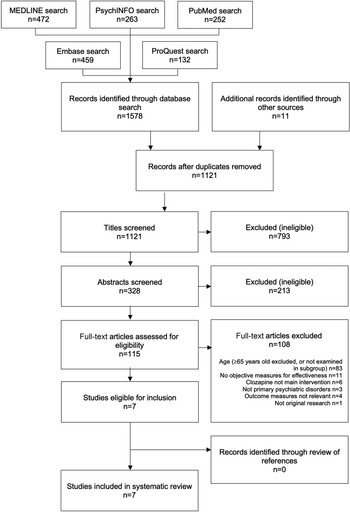
A total of 1121 citations were identified through electronic database searches, of which seven articles met the criteria for inclusion. The study selection process is illustrated in the PRISMA flow chart (Figure 1).
PRISMA flowchart summarizing study selection process.

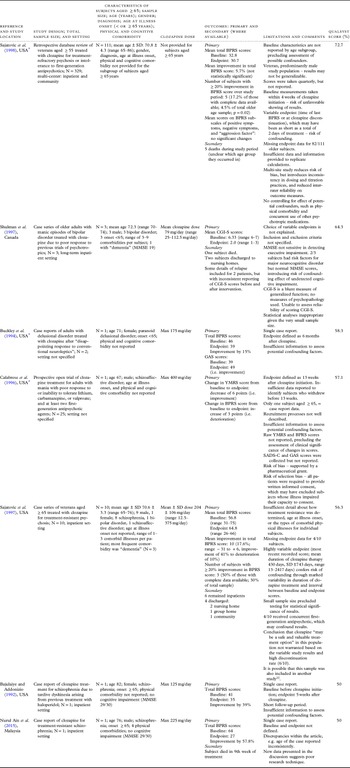
The study design, population, clozapine indication and doses, outcome measures, key findings and methodological limitations, and quality scores are described in Table 1. Of the seven identified studies, there was one prospective open trial (Calabrese et al., Reference Calabrese1996), one retrospective database review (Sajatovic et al., Reference Sajatovic, Ramirez, Garver, Thompson, Ripper and Lehmann1998), two case series (Sajatovic et al., Reference Sajatovic, Jaskiw, Konicki, Jurjus, Kwon and Ramirez1997; Shulman et al., Reference Shulman, Singh and Shulman1997), and three single case reports (Bajulaiye and Addonizio, Reference Bajulaiye and Addonizio1992; Buckley et al., Reference Buckley, Sajatovic and Meltzer1994; Nurul Ain et al., Reference Nurul Ain, Rosdinom and Raynuha2015).
Characteristics of included studies

“Aggression factor” – defined by authors as combination of BPRS items on hostility (item 10), uncooperativeness (item 14), and excitement (item 17).
BPRS = Brief Psychiatric Rating Scale; CGI-I = Clinical Global Impressions scale, “severity of illness” item (item 1); GAS = Global Assessment Scale; MMSE = Mini Mental State Examination; SADS-C = Schedule for Affective Disorders and Schizophrenia, Change Version; SD = standard distribution; YMRS = Young Mania Rating Scale.
* NB. Studies that included ≥65-year-olds as a subset of the study population.
In total, 128 subjects aged 65 years or older (range 65–86) participated in the studies. The study participants were people with schizophrenia (Bajulaiye and Addonizio, Reference Bajulaiye and Addonizio1992; Nurul Ain et al., Reference Nurul Ain, Rosdinom and Raynuha2015), schizoaffective disorder (Calabrese et al., Reference Calabrese1996), bipolar disorder (Shulman et al., Reference Shulman, Singh and Shulman1997), delusional disorder (Buckley et al., Reference Buckley, Sajatovic and Meltzer1994), and mixed diagnoses (Sajatovic et al., Reference Sajatovic, Ramirez, Garver, Thompson, Ripper and Lehmann1998, Reference Sajatovic, Jaskiw, Konicki, Jurjus, Kwon and Ramirez1997). The reported indication/s for clozapine use were treatment resistance (Nurul Ain et al., Reference Nurul Ain, Rosdinom and Raynuha2015; Sajatovic et al., Reference Sajatovic, Jaskiw, Konicki, Jurjus, Kwon and Ramirez1997; Shulman et al., Reference Shulman, Singh and Shulman1997), “intolerable” tardive dyskinesia (Bajulaiye and Addonizio, Reference Bajulaiye and Addonizio1992), and a mix of both treatment resistance and intolerable adverse effects (Buckley et al., Reference Buckley, Sajatovic and Meltzer1994; Calabrese et al., Reference Calabrese1996; Sajatovic et al., Reference Sajatovic, Ramirez, Garver, Thompson, Ripper and Lehmann1998). A variety of rating scales were used to assess change in psychopathology scores from baseline to endpoint, including the Brief Psychiatric Rating Scale (BPRS) (Bajulaiye and Addonizio, Reference Bajulaiye and Addonizio1992; Buckley et al., Reference Buckley, Sajatovic and Meltzer1994; Calabrese et al., Reference Calabrese1996; Nurul Ain et al., Reference Nurul Ain, Rosdinom and Raynuha2015; Sajatovic et al., Reference Sajatovic, Ramirez, Garver, Thompson, Ripper and Lehmann1998, Reference Sajatovic, Jaskiw, Konicki, Jurjus, Kwon and Ramirez1997), Young Mania Rating Scale (YMRS) (Calabrese et al., Reference Calabrese1996), Global Assessment Scale (GAS) (Buckley et al., Reference Buckley, Sajatovic and Meltzer1994), and Clinical Global Impressions Scale (Severity Subscale; CGI-S) (Shulman et al., Reference Shulman, Singh and Shulman1997). Secondary outcomes were reported in four studies, including discharge from hospital, death, and relapse (see Table 1).
Primary outcome
Overall, 6/7 studies (85.7%) reported some improvement on the primary outcome measure after treatment with clozapine (Table 1). In studies reporting improvement on the BPRS, scores decreased by 2.1–37 points (5.7–57.8% reduction from baseline) (Bajulaiye and Addonizio, Reference Bajulaiye and Addonizio1992; Buckley et al., Reference Buckley, Sajatovic and Meltzer1994; Nurul Ain et al., Reference Nurul Ain, Rosdinom and Raynuha2015; Sajatovic et al., Reference Sajatovic, Ramirez, Garver, Thompson, Ripper and Lehmann1998, Reference Sajatovic, Jaskiw, Konicki, Jurjus, Kwon and Ramirez1997). One study reported a three-point improvement in the YMRS score, but worsening of the BPRS score in the single subject (Calabrese et al., Reference Calabrese1996). In the studies utilizing a global outcome measure, the mean CGI-S decreased by 5 points (from “severely ill” to “borderline mentally ill”) (Shulman et al., Reference Shulman, Singh and Shulman1997) and the GAS score increased by 10 points (indicating improvement) (Buckley et al., Reference Buckley, Sajatovic and Meltzer1994).
Secondary outcomes
Two case series reported discharge destination after hospitalization. In the Sajatovic et al. (Reference Sajatovic, Jaskiw, Konicki, Jurjus, Kwon and Ramirez1997) study, the discharge destination was reported for 4/10 subjects: nursing home (n = 2), group home (n = 1), and community (n = 1). Of the three subjects reported by Shulman et al. (Reference Shulman, Singh and Shulman1997), two were discharged to nursing homes and one died.
Three studies reported deaths (total n = 7), ranging in timing after commencement of clozapine from 9 weeks (n = 1) (Nurul Ain et al., Reference Nurul Ain, Rosdinom and Raynuha2015) to 9 months (n = 1) (Shulman et al., Reference Shulman, Singh and Shulman1997), or unspecified (n = 5, ages of the deceased also unspecified) (Sajatovic et al., Reference Sajatovic, Ramirez, Garver, Thompson, Ripper and Lehmann1998).
A single study reported on relapse, which occurred in 2/3 subjects with bipolar disorder (Shulman et al., Reference Shulman, Singh and Shulman1997). One subject had a depressive relapse after 12 months, which improved with the addition of an antidepressant and no change to clozapine. The other subject had a psychotic relapse after 14 months, which improved with an increase in clozapine dose and the addition of valproate.
Quality assessment of included studies
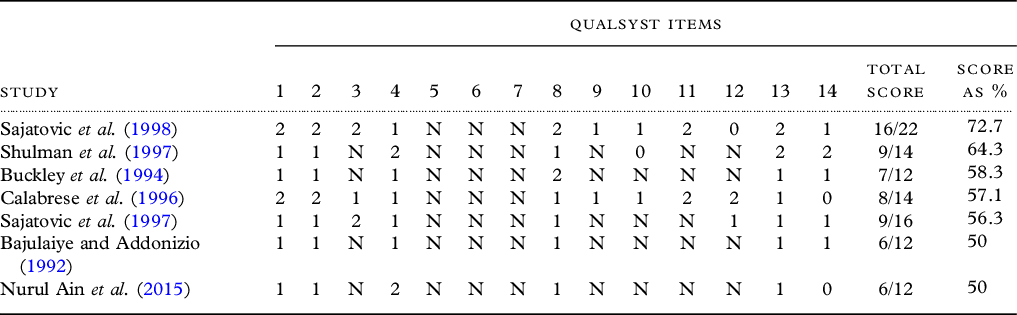
Table 2 presents a summary of the QualSyst scoring for each study. Most studies demonstrated adequate methodological quality, with only one study meeting criteria for good methodological quality.
Methodological quality of studies as defined by QualSyst

2 = yes, 1 = partial, 0 = no, N = not applicable.
Discussion
This is the first systematic review of clozapine’s effectiveness for primary psychotic and bipolar disorders in older adults. Seven studies were identified that reported the effects of clozapine treatment in this group using validated outcome measures. Notably, the methodology of reviewed studies was observational or case reports/series, corresponding to Level 4 evidence (OCEBM Levels of Evidence Working Group, 2011), and there were no studies comparing clozapine to a control/comparison treatment. Six studies reported some beneficial effect of treatment with clozapine; however, the studies were primarily of only adequate methodological quality, with the largest study (Sajatovic et al., Reference Sajatovic, Ramirez, Garver, Thompson, Ripper and Lehmann1998) (accounting for 111/128, 87%, of subjects in the review) demonstrating only modest improvement in symptom scores of questionable clinical significance.
The included study subjects were a clinically diverse group, with different psychiatric diagnoses, variable burden of medical and cognitive comorbidity, and a mix of illness onset in old age and earlier in life. However, findings may not be generalizable given the preponderance of men and veterans (94% of the largest reviewed study were men, and all were veterans (Sajatovic et al., Reference Sajatovic, Ramirez, Garver, Thompson, Ripper and Lehmann1998)), and the setting of most of the studies in high-income, westernized countries.
The majority of reviewed studies demonstrated improvement in symptom scores, but the clinical relevance of these improvements is uncertain. Based on their correlation of percentage change in BPRS scores with scores on the CGI-I (Improvement Scale), Leucht and colleagues (Reference Leucht, Kane, Kissling, Hamann, Etschel and Engel2005) suggested cut-off points of 25–30% and 55% to indicate “minimally improved” and “much improved” responses, respectively. The improvements in mean BPRS scores in the larger studies included in this review (by 17.6% in Sajatovic et al., Reference Sajatovic, Jaskiw, Konicki, Jurjus, Kwon and Ramirez1997, and 6.4% in Sajatovic et al., Reference Sajatovic, Ramirez, Garver, Thompson, Ripper and Lehmann1998) did not meet these thresholds for clinical significance. Nurul Ain et al. (Reference Nurul Ain, Rosdinom and Raynuha2015) were the only group to report a case with marked improvement on the basis of BPRS score changes (by 57.8%). By contrast, the case reported by Buckley et al. (Reference Buckley, Sajatovic and Meltzer1994) did not demonstrate clinically significant BPRS score improvement, although the GAS score indicated some functional improvement. Shulman et al. (Reference Shulman, Singh and Shulman1997) also reported global improvement in all three of their subjects. It is possible that reports of global improvement derive from factors other than the direct effects of clozapine, for example, the increased frequency of follow-up and close monitoring mandated for clozapine prescription (McCarney et al., Reference McCarney2007). This effect was not considered in any of the papers. The inclusion of a broader range of outcome measures, beyond measures of psychopathology, may have enhanced the ability of the included studies to demonstrate meaningful improvement across multiple domains, as has been suggested by Correll et al. (Reference Correll, Kishimoto, Nielsen and Kane2011). However, other outcomes were inconsistently and infrequently considered in the reviewed studies.
No randomized controlled trials meeting inclusion criteria were identified for review. However, two small randomized, double-blind, controlled trials targeting older adults were excluded as they did not meet the age inclusion criteria. One study compared clozapine to chlorpromazine in inpatients aged ≥55 years (those on clozapine had a mean age of 65 years) with treatment-resistant schizophrenia or schizoaffective disorder (n = 42) (Howanitz et al., Reference Howanitz1999). The other study used a crossover protocol to compare clozapine with haloperidol in inpatients aged ≥60 years (mean age 66.6) with treatment-resistant schizophrenia (n = 17) (Salganik et al., Reference Salganik, Modai, Bercovici, Kutzuk and Weizman1998). Both studies reported no significant difference in effectiveness based on symptom reduction between clozapine and the comparison drug in this relatively young older population and were limited by small sample sizes, short follow-up periods (minimum 5 weeks after dose titration, and 10 weeks, respectively), and risk of selection bias.
A secondary aim of this review was to describe other reported outcomes of clozapine treatment, in addition to changes on measures of symptoms. While some of the included studies did report additional outcomes (including discharge destination, relapse, and death), overall there was insufficient data to draw broader conclusions about the relationship of these outcomes to clozapine treatment in older people. Notably, none of the three studies that reported deaths (Nurul Ain et al., Reference Nurul Ain, Rosdinom and Raynuha2015; Sajatovic et al., Reference Sajatovic, Ramirez, Garver, Thompson, Ripper and Lehmann1998; Shulman et al., Reference Shulman, Singh and Shulman1997) considered whether the deaths may have been related to treatment with clozapine. Alongside assessment of symptomatic response, examination of other outcomes is important in evaluating whether a treatment is worthwhile. These may include mortality, functional ability, rates and duration of hospitalizations and readmissions, relapse, discharge destination, patient-reported quality of life and satisfaction, and caregiver burden (Correll et al., Reference Correll, Kishimoto, Nielsen and Kane2011; Meltzer, Reference Meltzer1992). However, there is little in the published literature examining such outcomes of clozapine treatment in older adults specifically. Pridan et al. (Reference Pridan, Swartz, Baruch, Tadger, Plopski and Barak2015) found a significant reduction in the rate of readmission to hospital in the 5 years after starting clozapine compared to the 5 years before (0.41 vs 3.8 admissions per 5 years, p < 0.001) in their retrospective chart review of 43 adults aged 60 years or more with treatment-resistant schizophrenia. By contrast, Law and Croucher (Reference Law and Croucher2019) found no significant difference in hospital admissions or number of days in hospital in their comparison of the 12 months before and 12 months after starting clozapine in a sample of older people aged 65 years or more with mixed indications for clozapine, including both primary psychotic and bipolar disorders and other disorders such as Parkinson’s psychosis, major neurocognitive disorders (including dementia with Lewy bodies), and psychotic disorder due to another medical condition.
Numerous studies were excluded from this review because they did not use an objective outcome measure, instead using reports of clinician or family impression. Many of these studies reported favorable outcomes of clozapine treatment (Barak et al., Reference Barak, Wittenberg, Naor, Kutzuk and Weizman1999; Frankenburg and Kalunian, Reference Frankenburg and Kalunian1994; Frye et al., Reference Frye, Altshuler and Bitran1996; Phaldessai et al., Reference Phaldessai, Butler, Radhakrishnan and Basheer2019; Salzman et al., Reference Salzman, Vaccaro, Lieff and Weiner1995; Snowdon and Halliday, Reference Snowdon and Halliday2011; Vasile and Steingard, Reference Vasile and Steingard1995), while several other studies reported lack of clinical improvement or inability to tolerate clozapine due to adverse effects (Ball, Reference Ball1992; Chengappa et al., Reference Chengappa, Baker, Kreinbrook and Adair1995; Herst and Powell, Reference Herst and Powell1997; Pitner et al., Reference Pitner, Mintzer, Pennypacker and Jackson1995).
All but one of the studies reviewed was published in the 1990s. As the use of second-generation antipsychotics (SGAs) was only emerging at that time, most subjects examined in this review were deemed to be treatment-resistant on the basis of failure to respond to previous trials of only first-generation antipsychotics (FGAs). Considering the evidence in broader adult populations that clozapine may have greater efficacy over FGAs as compared to SGAs (Asenjo Lobos et al., Reference Asenjo Lobos2010; Essali et al., Reference Essali, Al-Haj Hassan, Li and Rathbone2009; Leucht et al., Reference Leucht2013; Samara et al., Reference Samara2016), the results of this review may not be generalizable to the present day older adult population, who would usually have received trial/s of SGAs before a determination of treatment resistance was made. Inconsistent definitions of treatment resistance were used across the included studies, with only two reporting use of published criteria (Nurul Ain et al., Reference Nurul Ain, Rosdinom and Raynuha2015; Sajatovic et al., Reference Sajatovic, Jaskiw, Konicki, Jurjus, Kwon and Ramirez1997), although the usefulness of rigidly applying published treatment resistance criteria that depend on responses to set doses of medication to an older population is questionable given the different pharmacokinetics and pharmacodynamics in this group.
The included studies were found to have a range of methodological issues, which was reflected in their largely only adequate scores on quality assessment (50–64.3% for 6/7 studies). Recruitment processes were not described in three studies (Buckley et al., Reference Buckley, Sajatovic and Meltzer1994; Calabrese et al., Reference Calabrese1996; Shulman et al., Reference Shulman, Singh and Shulman1997), raising concerns about selection bias. Several studies lacked a standard endpoint for collection of outcome measures, with two using the last recorded measures in databases (Sajatovic et al., Reference Sajatovic, Ramirez, Garver, Thompson, Ripper and Lehmann1998, Reference Sajatovic, Jaskiw, Konicki, Jurjus, Kwon and Ramirez1997), one reporting different endpoints for different subjects without explanation (Shulman et al., Reference Shulman, Singh and Shulman1997), and one not clearly defining the endpoint (Nurul Ain et al., Reference Nurul Ain, Rosdinom and Raynuha2015). Of the three articles that performed statistical analysis of their data, two performed multiple statistical comparisons with small sample sizes (one without correction for this (Shulman et al., Reference Shulman, Singh and Shulman1997)), introducing the risk of obtaining significant results by chance (Calabrese et al., Reference Calabrese1996; Shulman et al., Reference Shulman, Singh and Shulman1997).
Few of the studies included sufficiently detailed information on the baseline characteristics of their subjects, making it impossible to consider the effect of potential confounding factors on outcomes. Notably, none of the included studies mentioned the smoking status of their subjects, a major oversight given the effect of cigarette smoking on clozapine plasma concentration (Rostami-Hodjegan et al., Reference Rostami-Hodjegan, Amin, Spencer, Lennard, Tucker and Flanagan2004). Only one study provided clear information on who had administered the rating scales (Sajatovic et al., Reference Sajatovic, Jaskiw, Konicki, Jurjus, Kwon and Ramirez1997), raising concerns about the reliability of the reported outcomes in the remaining six studies. Two studies were missing data (on baseline characteristics (Sajatovic et al., Reference Sajatovic, Ramirez, Garver, Thompson, Ripper and Lehmann1998), and on symptom scores (Sajatovic et al., Reference Sajatovic, Ramirez, Garver, Thompson, Ripper and Lehmann1998, Reference Sajatovic, Jaskiw, Konicki, Jurjus, Kwon and Ramirez1997)), and one study did not report results and analysis for all data collected (Calabrese et al., Reference Calabrese1996).
Implications for practice
For older people with primary psychotic and bipolar disorders, there is insufficient evidence to determine clozapine’s effectiveness in relation to existing pharmacological alternatives. This review highlights that there may be modest reductions in symptoms of some patients with clozapine treatment, but little is known about its effects on other important parameters for older people such as function, quality of life, ability to live independently in the community, and burden on caregivers. Older adults are known to be at greater risk of adverse effects of clozapine and are particularly more susceptible to agranulocytosis, postural hypotension, anticholinergic effects (including constipation, urinary retention, dry eyes, blurred vision, and tachycardia), sedation, cognitive dysfunction, and delirium (Bishara and Taylor, Reference Bishara and Taylor2014; Gareri et al., Reference Gareri, De Fazio, Russo, Marigliano, De Fazio and De Sarro2008; Mukku et al., Reference Mukku, Sivakumar and Varghese2018). Thus, an individualized and shared approach to decision-making is required, taking into consideration the impact of the psychiatric disorder on the individual’s function and quality of life, the other treatment options that have been or could be tried, and the risks of clozapine for the individual in the context of their medical comorbidities and concurrent treatments.
Strengths and limitations
The strengths of this systematic review include a systematic approach to identify, review, and report data according to PRISMA guidelines (Moher et al., Reference Moher, Liberati, Tetzlaff and Altman2009); the search of multiple electronic databases; and inclusion of all study designs to ensure no relevant studies were missed. The fact that no randomized controlled trials meeting inclusion criteria were identified in the comprehensive search strategy validated taking this broad approach. The requirement for included studies to use at least one validated, objective outcome measure to report results was intended to increase the reliability of results and reduce the risk of observer bias inherent in studies reliant on clinician impression alone. The use of objective measures also facilitated comparison of results across different studies.
This review did not include a search of the grey literature, i.e. studies not published in academic journals, including research reports, conference abstracts, theses, and dissertations, as such work has not been peer-reviewed and subject to the independent scrutiny and validation important for quality assurance (Adams et al., Reference Adams, Smart and Huff2017). Furthermore, given the design of published included studies was observational rather than interventional (resulting in Level 4 evidence, the second lowest tier (OCEBM Levels of Evidence Working Group, 2011)), broadening the search strategy may have been expected to include more studies with low levels of evidence of questionable significance. Nonetheless, publication bias is possible when excluding the grey literature, as studies with null or negative results are less likely to be published (Paez, Reference Paez2017). Given the premature ageing of people with major mental illness, including schizophrenia (Laursen, Reference Laursen2011), the exclusion of studies with subjects aged under 65 years of age in this review may be considered a limitation; however, we deliberately sought to examine the effectiveness of clozapine in older adults.
Finally, the overall adequate quality ratings of the studies included in this systematic review indicate significant methodological issues which increase the risk of bias. No minimum threshold was set for inclusion in the study based on quality assessment using the QualSyst tool, in order to ensure all relevant studies were included. Nonetheless, the ability to draw firm conclusions about clozapine’s effectiveness from this review is limited by the relatively small number of total included subjects (n = 128). This figure may be even smaller if there was an overlap in the samples of two separate studies (Sajatovic et al., Reference Sajatovic, Ramirez, Garver, Thompson, Ripper and Lehmann1998, Reference Sajatovic, Jaskiw, Konicki, Jurjus, Kwon and Ramirez1997), as was considered possible based on their common veteran population; however, this could not be verified after contacting the common lead author.
Future research should utilize rigorous methodology to examine clozapine prospectively in comparison to a control group, in order to further our understanding of clozapine’s effectiveness in older people and allow comparison to alternative treatment options. Of particular importance is the comparison of clozapine with a range of SGAs in head-to-head trials, given the dearth of studies examining this in older adults. Larger studies are also required, with sufficient power to detect potentially clinically and statistically significant effects.
Conclusions
Although the findings of the review suggest clozapine may have positive effects for primary psychotic and bipolar illnesses in some older adults, the group effects reported in essentially only observational studies were modest and there were no controlled interventional studies, which provide higher levels of evidence. Further research on this topic should utilize controlled, interventional study design with larger sample sizes to examine treatment effectiveness on symptomatology, and assess a broader range of treatment outcomes such as cognitive function, adverse effects, social function, independent living, quality of life, patient satisfaction, length of hospital stay, readmission rates, caregiver and family burden, treatment adherence, and cost-effectiveness (Meltzer, Reference Meltzer1992). Currently, clinical decision-making about whether or not to trial clozapine should involve an individualized analysis of potential benefits and risks in collaboration with patients and their families and caregivers.
Conflict of interest
None.
Description of authors’ roles
M. Renzenbrink was responsible for the study concept, literature searches, screening of studies, and initial draft of the manuscript. All authors contributed to the study design, data extraction, quality assessment, interpretation of study results, and writing and review of the manuscript. All authors have given final approval of the version to be published.
Acknowledgement
Assistance was provided by Stella Galanis in formulating the search strategy.