INTRODUCTION
The cotton (Gossypium hirsutum) varieties commonly cropped in West and Central Africa, are sown at the onset of the rainy season and grown at a stand density ranging from 40 000 to 60 000 plants ha−1. These varieties can thrive under extended but irregular rainfall conditions: they have a high flowering potential, long branches, long internodes and an indeterminate phenological cycle – the plants can quickly begin a new fruiting cycle after reaching cutout under suitable temperature and humidity conditions (Hau et al., Reference Hau, Lançon, Dessauw, Charrier, Michek, Serge and Dominique2001). Such varieties were considered well adapted to rainfed cropping and to the soil and climatic conditions that prevail in West and Central Africa.
Farmers sometimes plant their crops late due to financial problems, a lack of available manpower or irregular rainfall at the beginning of the crop season. The results of a survey carried out in Benin (unpublished data) confirmed the frequency of such delayed planting, which reduces the amount of effective rainfall and affects the crop yield. According to Lançon et al. (Reference Lançon, Klassou and Chanselme1989), the seedcotton yield potential declines by 20–30 kg ha−1 for each day of delay in planting after the onset of the rains. Agronomists have thus developed new cultivation practices adapted to late planting and aiming at accelerating the crop cycle, while reducing its vegetative vigour. They combine a higher planting density and the use of growth regulators to offset the absence of varieties specifically adapted to shorter crop cycles (Lançon et al., Reference Lançon, Wery, Rapidel, Angokaye, Gérardeau, Gaborel, Ballo and Fadegnon2007). It is now up to breeders to develop varieties adapted to these new cultivation techniques and which do not require the use of growth regulators.
This study was carried out to set the stage for a targeted cotton breeding initiative. The aim was to identify ideotypes within the genetic variability of G. hirsutum that are best adapted to these new cultivation practices and to propose breeding strategies based on heritability estimates and geared towards developing these high performance cotton ideotypes.
MATERIALS AND METHODS
A split-split plot experimental design with three replicates arranged in blocks was used with three factors: two planting dates in main plots, three stand densities in sub-plots, and 10 varieties in sub-sub-plots.
The first planting date, corresponding to rainfall onset, was in late June. The ‘delayed’ planting date was about 3–5 weeks after the first date, from mid to late July. The three stand densities were 42 000 plants ha−1 (0.8 × 0.3 m spacing), 125 000 plants ha−1 (0.4 × 0.2 m), and 167 000 plants ha−1 (0.4 × 0.15 m).
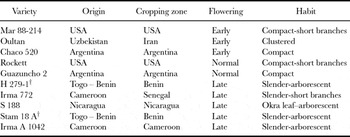
The 10 cropped varieties differed markedly in terms of morphology and growth cycle (Table 1). Mar 88–214 was the earliest variety and Irma A1042 was the latest. The Oultan variety has very different morphological features, i.e. clustered habit with very short internodes and fruiting branches, in comparison with varieties conventionally cropped in Africa, such as Stam 18 A and Irma A 1042, which have much more vigorous vegetative growth.
Morphotypes and flowering earliness of the 10 varieties.

The varieties are ranked from the presumed earliest variety (Mr 88-214) to the later one (Irma A 1042).
†H 279-1 and Stam 18 A are progenies of the same cross.
The study was carried out for two consecutive years at two different sites in Benin, Okpara (2°41′East, 9°18′North, 320 m asl), in the middle of a cotton-growing area, and at Cana (2°5′East, 7°6′North, 89 m asl) in southern Benin.
The basic plots (14.4 m2) were set up with three or six 6 m rows, depending on the planting density. Seedlings were thinned to one plant per station. Fertilizers were applied according to extension service recommendations: 200 kg ha−1 complete fertilizer (14-23-14 formula), and only in the case of early planted crops, 50 kg ha−1 urea applied at flowering. Ten pesticide treatments were applied to avoid shedding of fruiting organs due to insect infestation.
On the basis of the overall results, seven indicators were chosen according to their ability to differentiate significantly the 10 varieties in the experiments:
− Mean first flower opening date (FF), determined by counting the number of flowers daily after flowering onset. This corresponds to the date (expressed in days after emergence) when the sum of the daily counts is equal to the number of plants in the row.
− Effective flowering time (EFT), calculated as the difference between the date of the last effective flower (cf. Sekloka et al., Reference Sekloka, Lançon, Hau, Gozé, Lewicki and Thomas2007a) and the first flower opening date (FF). EFT (expressed in days) indicates the time during which the flowers that open are able to develop into bolls.
− Height at harvest (HH), measures the height of the main stem (in cm) from the cotyledonary node to the tip.
− Height to node ratio (HNR), is the ratio of the plant height (in cm) to the total number of nodes counted above the cotyledonary node on the main stem.
− Number of vegetative branches (NVB).
− Length of fruiting branch (LFB) is measured (in cm) on the third fruiting branches of the plant, as described by Hau and Goebel (Reference Hau and Goebel1986).
− Average boll retention at the first positions of the fruiting branches (RP1) is the ratio of the number of bolls harvested at the first positions of the fruiting branches to the number of fruiting branches.
Seedcotton yields were also calculated on the basis of boll harvests from the central rows of the elementary plots. The mean productivity of varieties was analysed.
Variance analyses were performed with the SAS® software package (SAS-Institute, 1988), and considering year and location as random environmental effects. Means were compared using the Tukey-Kramer test (Reference Tukey-Kramer1956). For the seven indicators, broad-sense heritability coefficients were estimated using the general linear model with random effects (Comstok and Robinson, Reference Comstock and Robinson1952). Heritability was estimated as the part of the genetic variance (between varieties) to the global variance. It was calculated in the two most contrasted cultivation conditions, i.e. normal planting date and stand density versus delayed planting date and high stand density. Confidence intervals associated with the heritability coefficients were calculated using the method described by Agresti and Coul (Reference Agresti and Coul1998). Heritabilities were calculated for individual plants and for sets of five nearby plants on the same plot. For each of these indicators, we also calculated correlations between measurements obtained under the two different cultivation conditions.
RESULTS
Mean genetic effects on yield
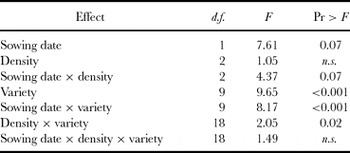
None of the controlled effects (sowing date and density) or their interaction were significant at the 0.05 level of probability (Table 2).
F tests of the ANOVA, in which years and locations are considered as random effects.

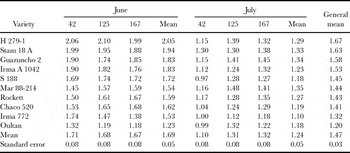
Although the effect was not significant, late sowing reduced the average seed cotton yield by 0.45 t ha−1 (26%). Also, in late sowing conditions, high density produced a yield increase of 0.20 t ha−1 (16%) above the low density (Table 3). Genetic effects were highly significant as well as their interaction with sowing date and density of planting (Table 2).
Seed cotton yields (t ha−1) of the 10 varieties at two planting dates (June and July) and three stand densities (42, 125 and 167 thousand plants ha−1).

The varieties are ranked from the top (H 279-1) to the bottom mean yield (Oultan).
For all situations, the two best varieties were African with large vegetative development (H 279-1 and Stam 18 A), followed by a variety with medium development (Guazuncho 2). The Oultan and Irma 772 varieties never performed well enough to compete with the other varieties (Table 3).
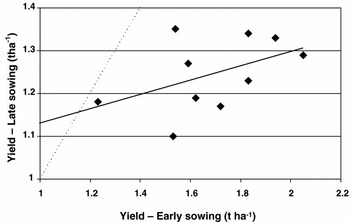
All varieties yielded better when planted in June (Table 3 and Figure 1). Figure 1 indicates a clear interaction between genotypes and sowing date. At the early date of sowing, the best two varieties were H 279-1 and Stam 18 A, the commercial varieties grown in Benin. Between-variety differences were lower when the crop was planted in July, and early varieties such as Mar 88-214, or even Rockett had better classifications. The difference between the first and last variety was only 0.25 t ha−1 (less than 20%) for the July-planted crops as compared to 0.80 t ha−1 (40%) for the June planting date.
Production of seed cotton (t ha−1) by variety at two sowing dates (June vs July). The plain and the dotted lines indicate respectively the data regression and the diagonal (X=Y).

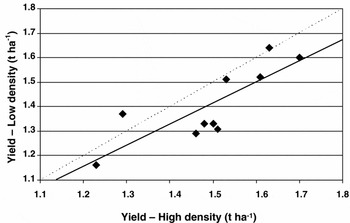
The differences between low density (42 000 plants ha−1) and the mean of both high densities (125 000 and 167 000 plants ha−1) were small, although eight out of 10 varieties benefited from an increase in stand density (Table 3 and Figure 2). Stand density variations slightly modified the variety classification, i.e. compact varieties such as Mar 88-214, Chaco 520 or Rockett, benefited especially from the higher density (+15%), and some later varieties like H 279-1 and Guazuncho 2 also benefited, but to a lesser extent (+6%). The tallest varieties like Stam 18 A, Irma A1042, Irma 772 or Oultan did not benefit at all. Although the analysis of variance did not indicate significant interactions between density, sowing date and variety, high density seems to be particularly more favourable for Mar 88-214 in late sowing conditions (Table 3). The increase could then reach 24% (+0.28 t ha−1), instead of 9% (+0.13 t ha−1) for early planting.
Production of seed cotton (t ha−1) by variety at two densities of planting (42 000 plants ha−1vs mean of 125 000 plants ha−1 and 167 000 plants ha−1). The plain and the dotted lines indicate respectively the data regression and the diagonal (X=Y).

Description of the two high yielding ideotypes
The above results highlighted two varieties that were especially high yielding under our experimental conditions:
− Variety H 279-1 was the highest yielding under early planting conditions and at all stand densities considered.
− Genotype Mar 88-214 gave high yields when sown in July.
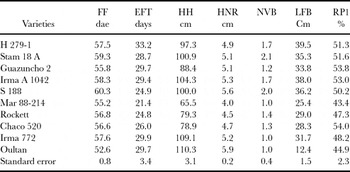
Table 4 more accurately describes these two varieties according to the seven most discriminant indicators (based on the variance analysis). These indicators concern cotton phenology (FF, EFT), morphology (HH, HNR, NVB, LFB) and boll retention (RP1). They provide insight into what differentiates these two varieties from the others:
Mean performance of the varieties for seven indicators.

The varieties are ranked from the top (H 279-1) to the bottom mean yield (Oultan).
FF = mean first flower opening date (in days after emergence). EFT = effective flowering time (in days). HH = plant height at harvest (in cm). HNR = height to node ratio (in cm). NVB = number of vegetative branches. LFB = length of the longest fruiting branch (in cm). RP1 = average boll retention at the first position of the fruiting branches (in %).
− H 279-1 has long-standing late flowering and strong vegetative development: it is one of the tallest varieties, with long fruiting branches and numerous vegetative branches. Boll retention at the first position on fruiting branches is high.
− Mar 88-214 is short-lived early flowering and has a compact habit: it is short, with short internodes and fruiting branches, with few vegetative branches. It has one of the lowest boll retention rates at the first position.
The strong performances of the two interesting varieties could not be reduced to a single indicator among those we studied. We therefore considered them to be good models of architecture and development that could be utilized by breeders to create genetic material to be planted early at low stand density or late at high stand density.
Heritability estimates
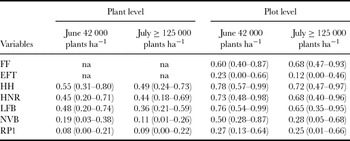
With the seven indicators that discriminated the cultivars, we could describe two varietal ideotypes and their physiological production development patterns. The overall heritability assessment of these indicators is shown in Table 5. According to the monitoring method, five indicators were analysed at individual plant level and the other two at plot level (several plants).
Heritability of the seven indicators. Estimates are followed by the limits (lower-upper) of their confidence interval (95%).

FF = mean first flower opening date. EFT = effective flowering time. HH = plant height at harvest. HNR = height to node ratio. NVB = number of vegetative branches. LFB = length of the longest fruiting branch. RP1 = average boll retention at the first position of the fruiting branches.
FF and EFT were observed or computed at the plot level only.
Of the five indicators analysed at plant level, plant height (HH), height to node ratio (HNR) and length of fruiting branch (LFB) were much more heritable (h2 > 0.4) than the number of vegetative branches (NVB) and the boll retention rate (RP1) (h2 < 0.20). In four cases out of five, the estimated heritability coefficients were higher for early planting as compared to late planting.
The heritability coefficients calculated at plot level were much higher (around +0.30 on average) than those calculated at plant level. At the early sowing date and the low stand density, six out of seven were significant (Table 5), with five coefficients above 0.50 (HH, HNR, LFB, NVB and FF), and two (RP1 and EFT) under 0.30. In the late sown trials, only four indicators were found to be heritable (HH, HNR, LFB and FF). The coefficients were higher when assessed at plot level. Only the FF indicator had higher heritability in the late sown trials than in the early ones.
Correlations between the late planted–high stand density and the early planted–normal stand density results
The combination of early planting and low stand density was found to be the best breeding environment for cotton – the indicator heritability was maximal under these conditions. We thus investigated the potential for predicting the behaviour of genotypes under late planting-high stand density conditions on the basis of the early planting–low stand density observations.
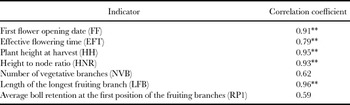
Table 6 shows the correlations calculated between the performances of the 10 varieties measured in the two extreme cropping conditions, i.e. early planting at normal stand density versus late planting at high stand density. A positive correlation was obtained for all the indicators and was significant (p < 0.05) for five of them: plant height (HH), height to node ratio (HNR), length of the longest fruiting branch (LFB), first flower opening date (FF) and effective flowering time (EFT). Breeding initiatives could thus be focused on these indicators to assess varieties under either of these cultivation conditions.
Correlations between variety performances measured in the two extreme situations: June planted and low stand density vs July planted and high stand density.

** Significant at the 1% level.
For the two other indicators, a positive but non-significant correlation was obtained for the number of vegetative branches (NVB) and the boll retention rate at the first position of the fruiting branches (RP1). These criteria should be monitored under conditions resembling the cropping environment targeted by the breeding programme.
DISCUSSION AND BREEDING STRATEGIES
In this study, we tested the hypothesis that early varieties with a compact habit could adapt to a shorter rainfall cycle (Constable, Reference Constable1998) and that their low spatial footprint would enable these plants to withstand higher stand densities, thus compensating for their lower individual yields. The results partially confirmed this hypothesis. When sown at the recommended and early date, short-cycle varieties such as Mar 88-214 had a lower production potential than varieties like H 279-1 with a longer cycle. This deficit was offset under late planting–high stand density conditions, but yields, except for Mar 88-214, still did not surpass those of later varieties with less determinate growth, thus confirming previous results obtained by Crawley et al. (Reference Crawley, Coskrey, Baugh and Lege2004), Galanopoulou-Sendouka et al. (Reference Galanopoulou-Sendouka, Sficas, Fotiadis, Gagianas and Gerakis1980) and Porter et al. (Reference Porter, Sullivan, Harvey and Brown1995). In late planting conditions, the effective flowering time is uniformly shorter for all ideotypes (Sekloka et al., Reference Sekloka, Hau, Gozé, Lewicki, Thomas and Lançon2007b) and early varieties do not fully benefit from their higher yielding capacity. In North Carolina, May and Bridges (Reference May and Bridges1995) also found no significant genotype by late or early cropping system interaction for yield, but their results were obtained with a narrow genetic pool of lines already adapted to intensive agriculture (irrigation, mechanical harvest).
In Africa, where cotton is generally cropped under rainfed conditions, the quantity and distribution pattern of rain available during the crop cycle are very irregular between years, sites and plots sown at different dates. This rainfall constraint could be partially overcome by planting varieties adapted to these conditions.
The Mar 88-214 ideotype, which is compact, early and has a short flowering time, should be preferred when there is a high risk of a short rainy period. In all the other situations when such a risk cannot be assessed, the African H 279-1 ideotype should be favoured for its high flexibility. Due to its long effective flowering period, it can easily adapt to variations in available environmental resources, and particularly to water stress that may occur during boll setting. A tall vegetative system represents a reserve and a high flowering potential and enables plants with this trait to survive better under variable climatic and environmental conditions (Rosenheim et al., Reference Rosenheim, Wilhoit, Goodell, Grafton-Cardwell and Leigh1997). H 279-1, which is already grown commercially, could benefit from a higher density of sowing than the one actually recommended to the farmers. These two interesting ideotypes can be characterized with the seven selection criteria linked with plant function, morphology and flowering. Most of these criteria, as also shown by Lançon et al. (Reference Lançon, Sekloka, Sinha and Djaboutou2000), have a sufficiently high heritability for them to be combined in specific breeding strategies, associating mass and pure-line selection under different cultivation conditions.
NVB and RP1 could be efficiently used under monitoring conditions that maximize genetic variability over environmental variability, i.e. plants in groups, under early planting and low stand density. The EFT indicator distinguished between different late varieties and different early varieties (Sekloka et al., Reference Sekloka, Hau, Gozé, Lewicki, Thomas and Lançon2007b). In H 279-1, a high EFT value indicated that the effective flowering cycle of late varieties could be extended despite late flowering onset. In Mar 88-214, the low EFT value indicated that the effective flowering of this early variety could be completed over a very short period. This would be of interest in order to analyse and characterize relatively homogeneous plant populations (F4 and subsequent lines), although inadequate for selecting individual plants.
H 279-1 ideotype selection
Selection of the H 279-1 ideotype should aim at maintaining moderate plant size and height to node ratio in order to keep it from developing into an excessively tall form like Irma A 1042 or Oultan. It should be grown with early planting at low plant density since this ideotype is targeted for such cropping conditions. The highest heritability for all traits of interest was noted under these conditions. HH, HNR and LFB were highly heritable indicators at the plant scale and could be used by breeders as early as the F1, F2 and then later generations. The other indicators (NVB, RP1, FF and EFT) had satisfactory heritability when monitored at the plot scale. These indicators should thus be the focus of selection (pure-line selection) as of the F3 generation.
Mar 88-214 ideotype selection
This ideotype, which is restricted to late planting conditions, could be bred in a mixed selection scheme in order to optimize the genetic potential. On the basis of previous results, a two-phased selection strategy could be used: a first phase carried out at a normal planting date with a normal stand density, and a second phase at a late planting date with a high stand density. The first phase would focus on the early generations, i.e. first F2 by selecting the best individuals for the most heritable indicators (HH, HNR and LFB), and then F3 by selecting individuals on the basis of the same indicators and lines according to less heritable indicators (FF and EFT). The second phase would focus on subsequent generations and indicators whose performances noted under the early planting conditions were not very representative of those noted under late planting conditions. A pure-line selection programme is thus implemented with late planting at high stand density as of the F4 generation. In addition to the above indicators, which should confirm the selection pressures involved during the first phase, the number of vegetative branches and boll retention rate at the first position of the fruiting branches must also be monitored.
CONCLUSION
Under these study conditions, we demonstrated that high cotton yields could be obtained by two different combinations of seven traits that characterize plant function, morphology and flowering. These combinations correspond to two varietal ideotypes that perform consistently and optimally enough to achieve the highest yields when the risk of rainfall shortage is high (Mar 88-214), low or unknown (H 279-1). H 279-1 is already cropped by African farmers, but no Mar 88-214 type variety has ever been released in Africa. Like most exotic germplasm, Mar-type varieties lack many essential traits, e.g. resistance to cotton bacterial blight (Xanthomonas malvacearum) and jassids (Empoasca minor), along with ginning out-turn and technological qualities (fibre length, tenacity, micronaire, maturity, fineness and colour) that meet market expectations. Breeders should now create new cotton varieties that integrate all of the technological and agronomic traits of modern varieties. The two interesting ideotypes that we identified in this study could be the focus of two parallel breeding programmes, each one corresponding to a breeding target, a region and specific cropping or market conditions.