Introduction
The Brazilian Cerrado and Atlantic Forest are considered global priority areas for conservation due to their high number of endemic species and widespread habitat loss (Myers et al., Reference Myers, Mittermeier, Mittermeier, Fonseca and Kent2000). The Cerrado (Brazilian savanna) is the most biologically diverse and threatened tropical savanna in the world, having been highly disturbed by agriculture and livestock activities (Silva and Bates, Reference Silva and Bates2002; Klink and Machado, Reference Klink and Machado2005). The Atlantic Forest is one of the most species-rich biomes worldwide, but is highly endangered due to deforestation (Myers et al., Reference Myers, Mittermeier, Mittermeier, Fonseca and Kent2000), with only about 12% of its original coverage remaining (SOS Mata Atlântica, INPE, 2014). Understanding the biology of species of these Brazilian hotspots, especially in relation to seed longevity, is very important for the prevention of species extinction and to facilitate the conservation of biodiversity.
Among the species of seed plants in these biomes, the genus Dimorphandra (Fabaceae, Caesalpinioideae) contains woody species, generally trees, typical of tropical regions, most of which have very limited distributions (Silva, Reference Silva1986). Dimorphandra wilsonii Rizzini and D. exaltata Schott are two endemic trees of Brazil. Dimorphandra wilsonii is a native species of Cerradão (Cerrado forest vegetation type), and is considered critically endangered with a narrow distribution (Fernandes and Rego, Reference Fernandes and Rego2014); it is listed on ‘The IUCN Red List of Threatened Species 2015’ (IUCN, 2015). Dimorphandra exaltata is distributed in the Atlantic Forest of the states of Minas Gerais (Fernandes and Rego, Reference Fernandes and Rego2014), São Paulo and Rio de Janeiro, although some authors have suggested that it occurs throughout Brazil (Silva, Reference Silva1986). Both D. wilsonii (Lopes and Matheus, Reference Lopes and Matheus2008) and D. exaltata (data not published) are known to produce water-impermeable seeds (i.e. physically dormant seeds), and there is no information reported about seed longevity, both in the field and under controlled conditions.
The physical dormancy (PY) is recurrent in the family Fabaceae, with seeds featuring specialized structures that detect environmental cues (water gaps) and are responsible for water uptake and subsequent germination at a suitable time for seedling establishment (Baskin et al., Reference Baskin, Baskin and Li2000; Baskin, Reference Baskin2003; Baskin and Baskin, Reference Baskin and Baskin2014). Moreover, the ability to respond to the environmental cues enables seasonal germination of these seeds (Van Assche et al., Reference Van Assche, Debucquoy and Rommens2003; Taylor, Reference Taylor2005; Jayasuriya et al., Reference Jayasuriya, Baskin and Baskin2008, Reference Jayasuriya, Baskin and Baskin2009a). The lens acts as a water gap in the seeds of most Fabaceae species that have PY; however, although these structures have evolved along with PY (Baskin and Baskin, Reference Baskin and Baskin2000), their function is not clearly understood in many species as they do not play a role during seed imbibition (Rolston, Reference Rolston1978; Lersten et al., Reference Lersten, Gunn and Brubaker1992; Morrison et al., Reference Morrison, McClay, Porter and Rish1998; Paula et al., Reference Paula, Delgado, Paulilo and Santos2012).
Several studies have reported that seed structures other than the lens may act as water gaps in species of Fabaceae or may act along with the lens (Morrison et al., Reference Morrison, McClay, Porter and Rish1998; Hu et al., Reference Hu, Wang, Wu and Baskin2009; Paula et al., Reference Paula, Delgado, Paulilo and Santos2012; Delgado et al., Reference Delgado, Paula, Santos and Paulilo2015). Furthermore, the site where water enters the seed can vary according to the dormancy-break treatment, confirming the presence of other regions of weakness in these seeds (Hu et al., Reference Hu, Wang, Wu and Baskin2009). Knowledge about the opening of water gaps is important for understanding the ecophysiology of physically dormant seeds. However, most studies have used artificial treatments to break seed dormancy and do not consider the breaking of dormancy in the natural environment of the species. Thus the objectives of this study were to: (1) determine in situ and ex situ longevity, and (2) verify the effects of burial and cold storage on the seed coat and relate it to dormancy break of seeds of D. exaltata and D. wilsonii.
Materials and methods
Seed collection
Fruits of D. exaltata and D. wilsonii were collected from natural populations in Minas Gerais State, Brazil, from October to December 2010. Seeds were manually extracted from the fruits and stored in sealed semi-permeable plastic bags under laboratory conditions. Assays were initiated immediately after seed collection.
In situ and ex situ longevity and germination of physically dormant seeds
Thirty samples of 50 seeds per species were kept in nylon bags to allow water to reach the seeds yet prevent seed loss to animals. The bags with seeds were buried at the end of rainy season (in autumn), at a soil depth of 5 cm (Van Mourik et al., Reference Van Mourik, Stomph and Murdoch2005) and with a minimum distance of 1 m between samples, in a area where both species naturally occur at the Floresta Nacional de Paraopeba (FLONA Paraopeba), in the municipality of Paraopeba, Minas Gerais, Brazil (19°16′15.1′′S, 44°24′02.4′′W). Four bags were exhumed at 3-month intervals for 12 months (initially planned for 24 months) to assess the seed water content, seed germination and morphological analyses. Fresh harvested seeds were used as a control. The percentage of seed loss was calculated by the number of recovered seeds relative to the initial 50 of each sample.
Twenty samples of 50 seeds each were placed in airtight aluminium containers and stored at 5 ± 2°C. Four samples were removed at 3–6 month intervals for 24 months and germination (intact and scarified seeds) and water content of seeds were assessed.
Germination tests involved four replicates of 25 seeds, which were disinfected by immersion in a 2% chlorine solution for 15 min followed by washing three times in sterile deionized water. After disinfection, intact and manually scarified seeds (with sandpaper) were kept in Gerbox-type plastic containers with paper moistened with a solution of 0.2% Nistatina fungicide (Medley, Brazil) at 30°C under a 12 h photoperiod (white light, 40 μmol m–2s–1). Germinated seeds were scored daily for 30 (scarified seeds) and 60 days (intact seeds). The criterion for determining germination was the protrusion of the primary root ≥ 2.0 mm. To determine seed water content (fresh weight), four replicates of 10 seeds each were subjected to the oven method at 105 ± 3°C for 24 h.
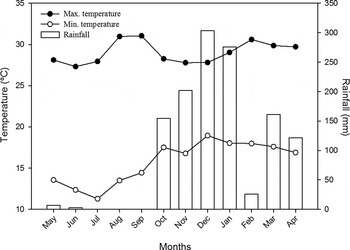
Air temperature and rainfall data in the region were obtained from the Brazilian Instituto Nacional de Meteorologia (INMET) and from the Agência Nacional de Águas (ANA), respectively (Fig. 1). The regional climate is characterized by two well-defined seasons: a dry season (from May to September), and a rainy season (from October to April).
Climate data of the study area during the experimental period.

Scanning electron microscopy analyses
Surface analyses were performed on intact seeds (four replicates of 10 seeds) of each species immediately after collection and after 12 months of burial in the soil and storage in the cold chamber. Samples were directly adhered to aluminum stubs and coated with gold (Robards, Reference Robards and Hall1978) using a MED010 Balzers Union apparatus. The samples were examined in a Quanta 200 scanning electron microscope (FEI Company, Eindhoven, Netherlands) and the images were captured digitally.
Statistical analysis
The experimental design was completely randomized for all assays. All data were subjected to tests for normality (Lilliefors) and homoscedasticity (Cochran), and to repeated measures ANOVA followed by a Tukey's test (P ≤ 0.05). The software SAEG 9.1 (SAEG, 2007) and SigmaPlot 11.0 (Systat Software Inc., San José, CA, USA) were used for graphics and statistical tests.
Results
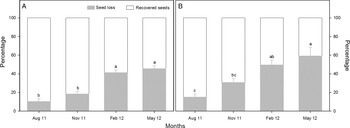
The percentage of seed loss increased significantly over time (Fig. 2), with the greatest losses occurring after the sixth month, which coincides with the beginning of the rainy season (spring) (Fig. 1). At the end of the burial experiment (12th month, i.e. late rainy season/beginning of dry season) 45 and 60% of D. exaltata and D. wilsonii seeds were not recovered, respectively.
Percentage of seed loss for Dimorphandra exaltata (A) and D. wilsonii (B) buried in soil for 12 months (mean ± SD). The same lower case letters indicate non-significant differences according to a Tukey's test (P ≤ 0.05).

Buried seeds of both species remained viable in the soil after 12 months, with germination (for scarified seeds) of approximately 90% for both species. Seed germination was greater than 92% for D. exaltata and 88% for D. wilsonii over all evaluation periods, without any significant differences throughout the experiment (P > 0.05). The high percentage of seed loss prevented the assessment of in situ longevity for longer than 12 months. Seeds stored at 5 ± 2°C (cold chamber) remained viable for two years, with germination of over 70% for both species.
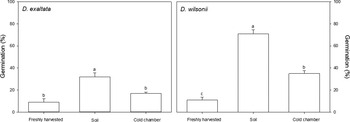
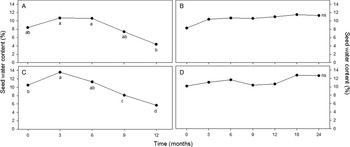
After 12 months, germination of buried intact seeds of D. exaltata and D. wilsonii increased from 9 and 11% (freshly collected seeds) to 32 and 71%, respectively. Cold temperature increased germination for only D. wilsonii seeds, which increased from 11% (control) to 35% after 12 months (P ≤ 0.05) (Fig. 3). The water content of buried seeds of both species decreased, with significant decreases after the ninth month. However, at 5 ± 2°C, seed water content did not change over the two years of the experiment (Fig. 4).
Germination of intact seeds of Dimorphandra exaltata and D. wilsonii at 30°C immediately after collection, and after 12 months buried in the soil and stored in a cold chamber. The same lower case letters indicate non-significant differences according to a Tukey's test (P ≤ 0.05) (mean ± SD).

Seed water content of Dimorphandra exaltata (A, B) and D. wilsonii (C, D) during burial in soil (A, C) and cold storage (5 ± 2°C) (B, D). The same lower case letters indicate non-significant differences according to a Tukey’s test (P ≤ 0.05) (mean ± SD). ns = non-significant differences.

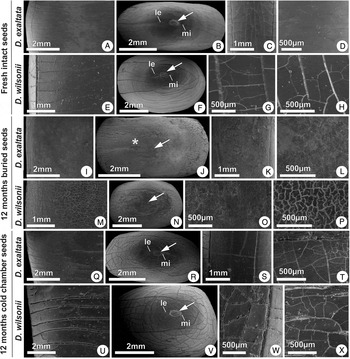
The micromorphological analyses of fresh harvested and intact seeds showed a widely ribbed testa surface, with fracture lines forming large areolae in both species (Fig. 5A–H). The contour of the areolae is angular in D. exaltata (Fig. 5C and D) but tends to be more curved in D. wilsonii (Fig. 5G and H). The fracture lines are shallow (Fig. 5C, D, G and H), rarely allowing the observation of the outer end of the palisade cells of the exotesta (Fig. 5H). Seeds of D. exaltata buried for 12 months exhibited changes to the seed coat; there was the occurrence of flaking on the testa, which camouflages most areolae and fracture lines (Fig. 5I–L), all which were deeper than seen in the fresh seeds. Dimorphandra wilsonii seeds buried in the soil for 12 months exhibited changes similar to those described above, although at a higher intensity, with flaking of entire areolae and with remarkable fracture lines (Fig. 5M–P). After 12 months in the cold chamber, D. exaltata seeds did not exhibit any noticeable structural changes (Fig. 5Q–T), with fracture lines and areolae remaining similar to those of freshly harvested seeds (Fig. 5S and T). For D. wilsonii, however, there was an evident increase in the depth of fracture lines and the areolae (Fig. 5U–X).
Micromorphology of seed surface of Dimorphandra exaltata (A–D, I–L, Q–T) and D. wilsonii (E–H, M–P, U–X). (A–H) Fresh and intact seeds in general view (A, E), hilar view (B, F), rapheal view (C, G) and detail of the lateral region (D, H). (I–P) Seeds buried for 12 months in general view (I, M), hilar view (J, N), rapheal view (K, O) and detail of the lateral region (L, P). (Q–X) Seeds after 12 months in cold chamber in general view (Q, U), hilar view (R, V), rapheal view (S, W) and detail of the lateral region (T, X). Arrow, hilum; le, lens; mi, micropyle. *Slight disruption that occurred in the lens region.

Evaluating the hilar region revealed a deep effect of keeping the seeds of the both species in the soil for 12 months (see Fig. 5J and N), as the hilar region was completely altered and flaked in both species. The characteristic structure of the seeds can only be recognized in fresh intact seeds (Fig. 5B and F) and in seeds after 12 months in the cold chamber (Fig. 5R and V). Furthermore, some disruption occurred in the region of the lens in D. exaltata seeds following 12 months of burial; if this was the formation of a water gap or not could not be determined because of the flaking in this region that makes it difficult (Fig. 5J).
Discussion
The favourable conditions for microbial action and predation in the tropics (Foster, Reference Foster1986; Skoglund, Reference Skoglund1992; Vázquez-Yanes and Orozco-Segovia, Reference Vázquez-Yanes and Orozco-Segovia1993) strongly affect the seeds in the field and may lead to seed death. In addition, the main cause of seed loss in burial experiments simulating soil seed banks is due to seed germination (Thompson, Reference Thompson and Fenner2000). In the present study, a high percentage of seed was not recovered at the end of the rainy season and 32 and 71% of intact seeds of D. exaltata and D. wilsonii, respectively, germinated in laboratory conditions. These results indicate that most of the seed loss detected in the present study was caused by germination, as seeds with PY are not light dependent (Baskin et al., Reference Baskin, Baskin and Li2000) and when the PY is broken seeds germinate quickly if water is available. Seed germination is considered the main factor of seed loss in soil seed banks (Fenner and Thompson, Reference Fenner and Thompson2005), and this event has been previously suggested in studies with buried physically dormant seeds of Fabaceae, such as Acacia longifolia (Marchante et al., Reference Marchante, Freitas and Hoffmann2010) and Leucaena leucocephala (Marques et al., Reference Marques, Costa, Atman and Garcia2014).
As soil seed banks have less influence on vegetation dynamics in tropical ecosystems (Skoglund, Reference Skoglund1992), other strategies must be responsible for maintenance of plants in these environments, and seedling establishment may be primarily controlled by the timing of dispersal and seed dormancy, as reported by Salazar et al. (Reference Salazar, Goldstein, Franco and Miralles-Wilhelm2011) for tree species from the Cerrado. This decrease in the role of seed banks reflects a reduction of seed persistence in the soil, with a smaller proportion of tropical species forming persistent seed banks, both in wet (Vázquez-Yanes and Orozco-Segovia, Reference Vázquez-Yanes and Orozco-Segovia1993) or dry (Salazar et al., Reference Salazar, Goldstein, Franco and Miralles-Wilhelm2011; Escobar and Cardoso, Reference Escobar and Cardoso2015) tropical forests. Moreover, Thompson (Reference Thompson and Fenner2000) reported that perennial plants should be expected to invest less in seed persistence, as perenniality allows multiple opportunities for reproduction. In the present study, even with the high percentage of seed loss preventing the assessment of persistence of Dimorphandra seeds for longer than 12 months, seed viability remained high over time. Thus we conclude that both Dimorphandra species studied here form short-term persistent seed banks (sensu Bakker et al., Reference Bakker, Poschlod, Strykstra, Bekker and Thompson1996).
Physically dormant seeds are able to detect changes in temperature and moisture, open their water gaps and then become water permeable (Martin et al., Reference Martin, Miller and Cushwa1975; Baskin, Reference Baskin2003; Van Klinken and Flack, Reference Van Klinken and Flack2005; Jayasuriya et al., Reference Jayasuriya, Baskin and Baskin2008, Reference Jayasuriya, Baskin, Genev,e and Baskin2009b). During our experiments, the dry season, which lasted about five months (between May and September), was practically a rainless period (see Fig. 1), and the significant increase in seed loss occurred at the beginning of the rainy season (i.e. November 2011; the sixth month of burial). Thus these physically dormant seeds responded to this seasonality by coming out of dormancy and germinating in the spring/summer. The significant increase in PY break after 12 months of burial indicates that seeds of both species are able to respond to climate seasonality. Dimorphandra wilsonii seeds increased germination more than sixfold after seed exhumation and threefold after cold temperature storage. A difference between these two conditions was that seeds lost significant amounts of water when buried in the soil, unlike when they were stored in a cold chamber. Additional studies should be undertaken to verify whether water loss is a step towards dormancy break in these seeds, as reported by Jayasuriya et al. (Reference Jayasuriya, Baskin, Genev,e and Baskin2009b) for Ipomoea hederaceae seeds. While dry cold storage did not break seed dormancy, it should be noted that it also had little effect on the viability of seeds of these two Dimorphandra species, even after two years. This highlights that cold conditions could be used for long-term storage and subsequent utilization of seeds, information that is particularly relevant for management of the critically endangered D. wilsonii.
The surface morphology of Dimorphandra seeds exhibited little or no change after storage for 12 months in the cold chamber, unlike what occurred after being buried in the soil for the same period, indicating differential response of seeds to these conditions, with D. wilsonii seeds exhibiting more evident changes. The pronounced change in the hilar region indicates it plays a role in water uptake in the seeds of both species. Furthermore, studies addressing subfamily Caesalpinioideae demonstrated the role of the lens, micropyle and the hilum in seed water uptake after exposure to artificial methods to break dormancy (Geneve, Reference Geneve2009; Paula et al., Reference Paula, Delgado, Paulilo and Santos2012; Souza et al., Reference Souza, Voltolini, Santos and Paulilo2012; Rodrigues-Junior et al., Reference Rodrigues-Junior, Faria, Vaz, Nakamura and José2014; Jaganathan et al., Reference Jaganathan, Wu, Han and Liu2017), which reinforces the role of the hilar region in controlling physical dormancy break in Dimorphandra seeds. Despite the increase in seed germination for D. wilsonii after 12 months of burial (70%), the opening in the water gap was not seen during scanning electron microscopy evaluation, suggesting that seeds were still dormant but sensitive to high temperatures for breaking dormancy (e.g. 30°C), as reported by Jayasuriya et al. (2008, 2009a,b) in studies with physically dormant seeds.
In conclusion, physically dormant seeds of both D. exaltata and D. wilsonii can maintain their viability for at least 1 and 2 years buried in soil and in the cold chamber, respectively. Furthermore, our results indicate that seeds respond to spring/summer temperatures by breaking dormancy and germinating during the rainy season, which allows seedling establishment before the beginning of the prolonged dry season. Nevertheless, a difference was noticed between the two study species: D. wilsonii seeds are more sensitive to environmental signals for breaking dormancy and could form a smaller soil seed bank than D. exaltata, and along with habitat loss, needs to be investigated further to provide insight as to why this species is critically endangered.
Acknowledgements
The authors are grateful to Fernando M. Fernandes (Fundação ZooBotânica de Belo Horizonte) for his help with seeds collection and FLONA Paraopeba for permission to install the field experiment.
Financial support
The authors are grateful to the Brazilian agencies, Coordenação de Aperfeiçoamento de Pessoal de Nível Superior (CAPES) for the study grant awarded to A.G.R-J. and M.T.M., and Conselho Nacional de Desenvolvimento Científico e Tecnológico (CNPq) for the research productivity grants awarded to D.M.T.O. (process 308117/2014-0) and Q.S.G. (process 308122/2013-5).
Conflicts of interest
None.