


Introduction
Stigma is experienced when ‘individuals possess (or are believed to possess) some attribute, or characteristic, that conveys a social identity that is devalued in a particular social context’ (Crocker et al., Reference Crocker, Major, Steele, Gilbert and Fiske1998). Negative public attitudes towards people who experience psychosis continue to prevail, despite widely publicized anti-stigma media campaigns such as Rethink Mental Illness's ‘Time to Change’ initiative in the UK (Henderson and Thornicroft, Reference Henderson and Thornicroft2013; Taylor Nelson Sofres British Market Research Bureau, 2014), which may be due to these campaigns addressing general mental health rather than psychosis specifically. Internalized stigma occurs when an individual becomes aware of negative stereotypes and applies them to oneself, often resulting in emotional distress (Corrigan and Watson, Reference Corrigan and Watson2002). The internalized stigma of psychosis is associated with negative personal impacts including increased hopelessness, depression, low self-esteem and self-efficacy, reduced social networks, and reduced engagement with mental health services (Corrigan et al., Reference Corrigan, Watson and Barr2006; Link et al., Reference Link, Struening, Neese-Todd, Asmussen and Phelan2001; Livingston and Boyd, Reference Livingston and Boyd2010).
Internalized stigma is a particularly prevalent issue among people with psychosis; 41.7% of a large European sample reported moderate to high levels of internalized stigma (Brohan et al., Reference Brohan, Elgie, Sartorius and Thornicroft2010a). As a consequence, the construct of internalized stigma and its theoretical underpinnings have been increasingly scrutinized. To date, it has not been conceptualized from a cognitive behavioural perspective despite internalized stigma having cognitive and behavioural consequences (Rüsch et al., Reference Rüsch, Lieb, Bohus and Corrigan2006). The majority of theoretical models have been developed using social cognitive theory, and relate to the broader concept of ‘severe mental illness’ (SMI), and have therefore lacked specificity. There is a model of social anxiety that incorporates stigma in psychosis (Birchwood et al., Reference Birchwood, Trower, Brunet, Gilbert, Iqbal and Jackson2007), but this was not specific to internalized stigma. We propose a theoretical framework that conceptualizes internalized stigma in psychosis from a cognitive behavioural perspective.
Social cognitive theory of stigma
Link and Phelan (Reference Link and Phelan2001) outlined one of the original social cognitive conceptualizations of stigma. Drawing upon evolutionary theories of social and natural selection, they explain that people distinguish and label human difference. Dominant cultural beliefs connect the labelled person to undesirable characteristics, and the person is then placed in a distinct category different to us, which allows for emotional distancing and results in status loss. Due to social, economic and political power, the stigmatized individual experiences disapproval, rejection, exclusion and discrimination in society. The person develops appraisals that others will reject and devalue them, which consequently causes emotional distress and impacts on their behaviours, causing them to withdraw and avoid social situations (Link et al., Reference Link, Yang, Phelan and Collins2004). Corrigan and Watson (Reference Corrigan and Watson2002) built upon this theory and distinguished between public and self-stigma. Public stigma consists of three components: stereotypes (negative beliefs about a group), prejudice (agreement with the belief and/or negative emotional reaction), and discrimination (negative behavioural response to prejudice). Self-stigma also consists of the same three components, but applied to one's self. They further detail that appraisals of stigma can lead to low self-esteem and self-efficacy if the perceived legitimacy of public stigma is high, or righteous anger if the perceived legitimacy is low and there is high group identification.
Further refinement by Brohan et al. (Reference Brohan, Slade, Clement and Thornicroft2010b) focused on personal stigma and identified three distinct categories that form the construct: experienced, perceived and internalized stigma (Brohan et al., Reference Brohan, Slade, Clement and Thornicroft2010b). Experienced stigma has been defined as ‘instances of discrimination . . . on the grounds of their perceived unacceptability or inferiority’ (Scrambler and Hopkins, Reference Scrambler and Hopkins1986). Perceived stigma is the extent to which the stigmatized person believes that others associate them with the negative stereotypes (Link, Reference Link1987). Internalized stigma, as defined by Corrigan and Watson (Reference Corrigan and Watson2002), is the self-application of the negative stereotypes and the consequential emotional distress.
One of the main drawbacks of these models of stigma is that they lack clinical applicability and there is insufficient emphasis on the complex relationships between the components of stigma. Moreover, they have been broad and not solely focused on those who experience psychosis. This broadness has restricted the models’ specificity to include the complex interaction between stigma and pre-existing experiences of psychosis (Drapalski et al., Reference Drapalski, Lucksted, Perrin, Aakre, Brown, DeForge and Boyd2013). This led to more clinically focused models being developed.
Major and O'Brien (Reference Major and O'Brien2005), further examined by Rüsch et al. (Reference Rüsch, Corrigan, Wassel, Michaels, Olschewski, Wilkniss and Batia2009), developed a stress-coping model of stigma which identified why some individuals internalize stigma as distressing and others do not. This internalization is dependent on sensitivity to rejection, perceived legitimacy of stereotypes, experiences of discrimination, identification with labelled group and stigma appraisals, which leads to stress (Rüsch et al., Reference Rüsch, Corrigan, Wassel, Michaels, Olschewski, Wilkniss and Batia2009). This can impact on the behavioural outcomes for the individual, for example leading to avoidance and withdrawal. Drapalski et al. (Reference Drapalski, Lucksted, Perrin, Aakre, Brown, DeForge and Boyd2013) and Schrank et al. (Reference Schrank, Amering, Hay, Weber and Sibitz2014) proposed and tested two further models of internalized stigma, which incorporated the impacts on psychiatric symptoms. Internalized stigma was core to development and maintenance of psychiatric symptoms in both models. These models are the first clinical models of internalized stigma to include the impacts on psychiatric symptoms of psychosis. However, both models have significant limitations, being simplistic and lacking specificity regarding the psychological processes involved in the development and maintenance of internalized stigma.
Only one model has examined the role of stigma in maintaining distress in people who experience psychosis using cognitive behavioural theory (Birchwood et al., Reference Birchwood, Trower, Brunet, Gilbert, Iqbal and Jackson2007); however, this was focused on understanding social anxiety in psychosis, utilizing stigma shaming beliefs as one component of the model. This model does not capture the complex emotional reactions to internalized stigma (such as depression, hopelessness, anger), or attempt to explain why only some people experience internalized stigma, and does not draw upon relevant stigma theory, e.g. Link and Phelan (Reference Link and Phelan2001) and Corrigan and Watson (Reference Corrigan and Watson2002). Birchwood et al. (Reference Birchwood, Trower, Brunet, Gilbert, Iqbal and Jackson2007) suggested that internalized cultural values of mental illness stigma lead the person to develop an other-to-self focus, i.e. worries that he/she will be judged or rejected by others. This leads to a self-focus, which results in the individual becoming hypervigilant towards how they look or perform in social situations (Clark, Reference Clark, Crozier and Alden2001). These collectively cause catastrophic shaming beliefs, which either result in anger, or anxiety responses. Despite limitations, the theory described by Birchwood et al. (Reference Birchwood, Trower, Brunet, Gilbert, Iqbal and Jackson2007) has informed the current proposed model; however, it primarily seeks to explain the development and maintenance of social anxiety in psychosis, rather than internalized stigma.
A cognitive model of internalized stigma in psychosis
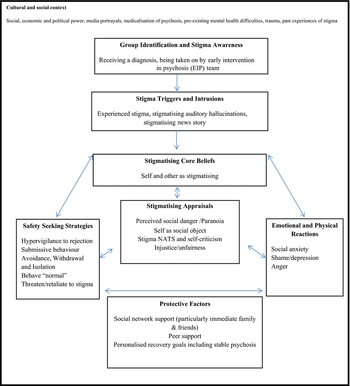
To date, the proposed theoretical models of stigma indicate a role for cognitive and behavioural components, which maintain internalized stigma in SMI (Corrigan and Watson, Reference Corrigan and Watson2002; Rüsch et al., Reference Rüsch, Corrigan, Wassel, Michaels, Olschewski, Wilkniss and Batia2009). Furthermore, these models have also suggested the role of evolutionary psychology ideas such as loss of social status and learned helplessness (Link and Phelan, Reference Link and Phelan2001). However, the psychological models described to date have not simultaneously drawn upon cognitive theory, which appears imperative to understanding internalized stigma, nor have they outlined why some people experience internalized stigma and others do not, or described a theoretical model that could inform therapeutic practice. This paper presents a model that will address these issues by integrating elements of the existing stigma models with social mentality theory (SMT; Gilbert, Reference Gilbert2000) and a cognitive model of psychosis (Morrison, Reference Morrison2001) to describe a cognitive model of internalized stigma specifically for people who experience psychosis. This model is shown in Fig. 1.
A cognitive model of internalized stigma in psychosis

Cultural and social context
The cultural context of the stigmatized person is extremely important to consider in the development and maintenance of internalized stigma. In their conceptualization of stigma, Link and Phelan (Reference Link and Phelan2001) comment upon social, economic and political power in causing and maintaining stigma, and Green (Reference Green2009) explains that stigma would not exist without it. Negative media portrayals and the medicalization of psychosis continue to maintain stigmatizing public attitudes towards people who experience psychosis (Read and Harre, Reference Read and Harre2001). Consequently, people with psychosis are associated with the most negative stereotypes such as dangerousness, unpredictability and an inability to recover (Crisp et al., Reference Crisp, Gelder, Goddard and Meltzer2005). Moreover, the medicalization of psychosis and the depiction of it as a biological mental illness has been found to perpetuate stigma by reinforcing an ‘us and them’ paradigm (Angermeyer et al., Reference Angermeyer, Holzinger, Carta and Schomerus2011). Read and Harre (Reference Read and Harre2001) found that biological and genetic explanations of mental health difficulties were directly related to negative stereotypes (being seen as dangerousness, anti-social and unpredictable) and also with a reluctance to develop relationships. Therefore, an individual with psychosis is likely to develop an awareness of the stigma of psychosis prior to experiencing it themselves.
It is important to emphasize the importance of pre-existing trauma and mental health difficulties in the cause and maintenance of internalized stigma. It is acknowledged that increased levels of trauma worsen the severity of psychotic symptoms (Shelvin et al., Reference Shelvin, Houston, Dorahy and Adamson2008). It is postulated that the more severe the experiences of trauma, the more likely it is that the person will experience internalized stigma and become distressed. This is due to the likely increase of sensitivity to threatening experiences such as stigma (Gilbert, Reference Gilbert2010). Collectively, this social context perpetuates stigma and can act as a causal and maintenance factor. It shapes the person's pre-existing conceptualizations of psychosis that influence how they interpret their own experiences.
Group identification and stigma awareness
Watson et al. (Reference Watson, Corrigan, Larson and Sells2007) describe that an integral part of internalizing stigma was to (a) identify with the stigmatized group, and (b) to believe that this group identification was legitimate, which is also integral to this model. Key factors such as having insight (Hasson-Ohayon et al., Reference Hasson-Ohayon, Ehrlich-Ben Or, Vahab, Amiaz, Weiser and Roe2012), pre-existing low self-esteem or shame (Corrigan et al., Reference Corrigan, Watson and Barr2006), and pre-existing social identity (Yanos et al., Reference Yanos, Roe and Lysaker2010) have all been found to contribute to group identification and the consequential development of internalized stigma.
It has been identified that experiencing a first episode of psychosis can result in a fear of stigma, therefore it is likely that group identification can begin at this point (Franz et al., Reference Franz, Carter, Leiner, Bargner, Thompson and Compton2010; Iqbal et al., Reference Iqbal, Birchwood, Chadwick and Trower2000). Furthermore, a recent service user-led study examining the impact of diagnosis found that receiving a diagnosis of psychosis or schizophrenia-spectrum disorder led to feelings of internalized stigma (Pitt et al., Reference Pitt, Kilbride, Welford, Nothard and Morrison2009). Participants described that once they had received a diagnosis they felt ‘labelled’, which was a cause of ‘social exclusion’ (p. 421). It is likely that an event such as receiving a psychiatric diagnosis that confirms the belongingness to the stigmatized group can trigger this process.
Stigma awareness (Watson et al., Reference Watson, Corrigan, Larson and Sells2007), which has also been described as perceived stigma (Brohan et al., Reference Brohan, Slade, Clement and Thornicroft2010b) and anticipated stigma (Gerlinger et al., Reference Gerlinger, Hauser, De Hert, Lacluyse, Wampers and Correll2013), occurs at this stage and is the belief that others view people with psychosis negatively and associate them with negative stereotypes. Stigma awareness has been found to be directly related to internalized stigma, causing experiences such as withdrawal and poor self-efficacy in those who experience psychosis (Kleim et al., Reference Kleim, Vauth, Adam, Stieglitz, Hayward and Corrigan2008). This relationship was also found in a large international study (n=1229) where internalized stigma was predicted by perceived discrimination (Brohan et al., Reference Brohan, Elgie, Sartorius and Thornicroft2010a).
Our model postulates that group identification and stigma awareness would cause people to evaluate their social roles, supported by SMT (Gilbert, Reference Gilbert2000). SMT based within evolutionary psychology theory outlines a model to understand humans’ abilities to detect threats within their social environment (Gilbert, Reference Gilbert2010). Social mentalities coordinate our cognition, affect and behaviours in order to undertake our social roles. If we experience significant threat, our social role is devalued and shame is experienced. This is supported by stigma-relevant research; for example, Rüsch et al. (Reference Rüsch, Todd, Bodenhausen, Olschewski and Corrigan2010) found that perceived legitimacy of stigma was directly associated with automatic shame-related associations in a group of people with mental health problems.
Stigma triggers
‘Stigma triggers’ are internal and external factors that can activate internalized stigma. The primary external trigger is experienced stigma. The most common experiences of stigma are verbal abuse, physical abuse, loss of contact or rejection, patronizing attitudes, disapproval and being judged (Dinos et al., Reference Dinos, Stevens, Serfaty, Weich and King2004). Within SMT, experienced stigma would be considered a social threat that would trigger the threat system (our emotional system which reacts to threatening situations; Gilbert, Reference Gilbert2010) in stigmatized people (Gumley and Schwannauer, Reference Gumley and Schwannauer2006).
Some research has illustrated that a stigmatized person can internalize stigma without experiencing stigma if they perceive stigma to be an ongoing threat (Quinn et al., Reference Quinn, Williams and Weisz2015). As a consequence, triggers of stigma have been noted to include witnessing a stigmatizing event or news story (Brohan et al., Reference Brohan, Slade, Clement and Thornicroft2010b). The present authors would also hypothesize that neutral triggers, as identified in the psychosis model (Morrison, Reference Morrison2001), may also trigger internalized stigma. Similarly, neutral internal bodily sensations may also be interpreted in a catastrophic manner and trigger internalized stigma, as outlined in other cognitive models of psychosis (Morrison, Reference Morrison2001) and panic (Clark, Reference Clark1986).
Qualitative interviews with service users have identified that auditory hallucinations and intrusive stigma-oriented thoughts or memories can act as triggers of internalized stigma (Wood et al., Reference Wood, Byrne, Enache and Morrison2016b). Participants explained that certain auditory hallucinations had stigmatizing content, telling them that they were ‘mad’ and ‘bad’. Furthermore, they reported experiencing intrusive thoughts, images or memories related to an incident of experienced stigma. Relatively little is known about the relationship between internal triggers and internalized stigma; the few studies available have examined stigma and psychosis more broadly. For example, Lysaker et al. (Reference Lysaker, Davis, Warman, Strasburger and Beattie2007a) examined a small sample (n=36) of people with schizophrenia and found that ongoing positive symptoms significantly predicted internalized stigma (although the specific psychotic symptoms were not identified).
Stigmatizing core beliefs
When the individual has (a) identified with the group and perceives stigma as legitimate and (b) experienced a stigma trigger, they will go on to activate stigma-based core beliefs. Core beliefs are defined as fundamental, inflexible, absolute and generalized beliefs that people hold about themselves, others and the world (Beck, Reference Beck1979). Extensive research has been conducted to understand the core beliefs of people who experience psychosis (Fowler et al., Reference Fowler, Freeman, Smith, Kuipers, Bebbington and Bashforth2006; Smith et al., Reference Smith, Fowler, Freeman, Bebbington, Bashforth and Garety2006). They broadly fall into two categories: beliefs of negative self-evaluation, particularly of being different (Gumley and Schwannauer, Reference Gumley and Schwannauer2006), and beliefs that others are hostile, rejecting and untrustworthy (Fowler et al., Reference Fowler, Freeman, Smith, Kuipers, Bebbington and Bashforth2006). Stigma-specific core beliefs have been documented as being associated with internalized stigma (Birchwood et al., Reference Birchwood, Trower, Brunet, Gilbert, Iqbal and Jackson2007; Hinshaw, Reference Hinshaw2007). Most commonly, an individual can internalize the stereotypes and believe that they are dangerous, mad and unpredictable (Ritsher et al., Reference Ritsher, Otilingam and Grajales2003), therefore core beliefs regarding the self are likely to incorporate this content. Furthermore, stigma-related core beliefs are also going to reflect existing core beliefs related to experiences of psychosis; for example, beliefs of being different and others being hostile/rejecting are common in psychosis (Fowler et al., Reference Fowler, Freeman, Smith, Kuipers, Bebbington and Bashforth2006). This is unsurprising given the high prevalence of experiences of adversity that are also commonly stigmatized, such as sexual abuse and institutional care (Varese et al., Reference Varese, Smeets, Drukker, Lieverse, Lataster and Viechtbauer2012).
Stigma appraisals
Stigma-related appraisals are core to internalized stigma and have been described as intrusive and automatic (Rüsch et al., Reference Rüsch, Todd, Bodenhausen, Olschewski and Corrigan2010). The stigmatized person is also likely to have a cognitive-attentional bias (Morrison, Reference Morrison2001), which consequentially leads them to have heightened self-focused attention, attentional bias and ruminative processes (Wells, Reference Wells1995; Wells and Matthews, Reference Wells and Matthews1994) regarding stigma. We hypothesize that there are three subtypes of appraisals which pertain to different emotional responses. The first subtype of appraisal would relate to social anxiety and paranoia, and refer to perceived social danger (Michail and Birchwood, Reference Michail and Birchwood2009, Reference Michail and Birchwood2013). If socially anxious, the person would process themselves as a social object (detailed monitoring of themselves in social situations) (Birchwood et al., Reference Birchwood, Trower, Brunet, Gilbert, Iqbal and Jackson2007; Clark, Reference Clark, Crozier and Alden2001). Secondly, stigma-specific negative automatic thoughts and self-criticism are widely documented to be associated with depression (Beck, Reference Beck1979; Gilbert and Procter, Reference Gilbert and Procter2006), and more recently have been demonstrated in people with psychosis (Shahar et al., Reference Shahar, Trower, Iqbal, Birchwood, Davidson and Chadwick2004; Waite et al., Reference Waite, Knight and Lee2015). Finally, cognitions pertaining to injustice and unfairness are also considered important; for example, Watson et al. (Reference Watson, Corrigan, Larson and Sells2007) report that when people perceive stigma to be unfair or unwarranted, or they feel disrespected, they will experience righteous anger and frustration.
Emotional and physiological consequences
The subtypes of stigma appraisals are hypothesized to lead to three key emotional responses in relation to stigma. Firstly, it is proposed that appraisals related to social danger and processing the self as a social object will lead to social anxiety. This has been identified in a number of studies with people who experience psychosis (Lysaker et al., Reference Lysaker, Yanos, Outcalt and Roe2010; Markowitz, Reference Markowitz1998). In the qualitative literature, (social) anxiety and fear have also been identified by service users as a response to stigma (Wood et al., Reference Wood, Burke, Byrne, Pyle, Chapman and Morrison2015). Birchwood et al. (Reference Birchwood, Trower, Brunet, Gilbert, Iqbal and Jackson2007) illustrated in a sample of people experiencing first episode psychosis that social anxiety was associated with greater shame, and that their diagnosis socially marginalized them, and resulted in loss of social status.
Secondly, shame and depression are recognized as emotional responses to stigma due to a loss of social rank (Gilbert, Reference Gilbert2010). This has also been widely documented in systematic reviews of internalized stigma (Livingston and Boyd, Reference Livingston and Boyd2010), service user literature (Wood et al., Reference Wood, Byrne, Enache and Morrison2016b), and quantitative explorations through path analysis (Lysaker et al., Reference Lysaker, Roe and Yanos2007b; Vass et al., Reference Vass, Morrison, Law, Dudley, Taylor, Bennett and Bentall2015; Yanos et al., Reference Yanos, Roe, Markus and Lysaker2008). Shame and depression have been illustrated to be directly predicted by different forms of stigma, but also mediate the relationship between stigma, recovery, positive symptoms of psychosis and recovery (Rüsch et al., Reference Rüsch, Corrigan, Wassel, Michaels, Olschewski, Wilkniss and Batia2009; Vass et al., Reference Vass, Morrison, Law, Dudley, Taylor, Bennett and Bentall2015).
Finally, anger has been identified as a response to stigma, although there has been less exploration of its relationships with stigma compared with the other emotional responses. Anger has been described as a positive response to stigma and considered righteous and empowering (Watson et al., Reference Watson, Corrigan, Larson and Sells2007). Anger occurs when an individual identifies with the stigmatized group but perceives the stigma to be unjust or unfair (Rüsch et al., Reference Rüsch, Angermeyer and Corrigan2005). This has also been described as important by service users who experience psychosis in qualitative interviews (Dinos et al., Reference Dinos, Stevens, Serfaty, Weich and King2004; Wood et al., Reference Wood, Burke, Byrne, Pyle, Chapman and Morrison2015).
Safety-seeking strategies
Safety-seeking behaviours are utilized to prevent a feared catastrophe and are widely documented in cognitive models (Clark and Wells, Reference Clark, Wells, Liebowitz, Hope and Schneier1995; Salkovskis et al., Reference Salkovskis, Clark, Hackmann, Wells and Gelder1999). Within psychosis, safety-seeking behaviours are also prevalent and broadly pertain to avoidance and resistance (Freeman et al., Reference Freeman, Garety, Kuipers, Fowler, Bebbington and Dunn2007). Safety-seeking behaviours within internalized stigma in psychosis would serve to protect the individual from feeling stigmatized by others. One of the most significant safety behaviours for internalized stigma is the avoidance of disclosure about experiences of psychosis to all areas of their social network (e.g. friends, family, employers) (Corrigan et al., Reference Corrigan, Kosyluk and Rusch2013). Service users have also described having to ‘act normally’ when they are around others by hiding their experiences of psychosis (Pyle and Morrison, Reference Pyle and Morrison2013). Social avoidance is also an identified coping strategy for stigma by keeping a distance from others and not having relationships in order to protect against rejection. Furthermore, stigmatized people are more likely to avoid mental health services due to concerns regarding stigma (Rüsch et al., Reference Rüsch, Angermeyer and Corrigan2005).
Another potential safety-seeking behaviour is heightened awareness and threat monitoring of stigma. It is widely documented that people who experience psychosis and trauma have a heightened threat system due to actual threat experiences (Freeman et al., Reference Freeman, Garety and Kuipers2001; Morrison, Reference Morrison2001; Morrison et al., Reference Morrison, Frame and Larkin2003). In particular, psychosis is underpinned by inter-relational trauma and is thought to be at the core of the development and maintenance of psychosis (Braehler et al., Reference Braehler, Gumley, Harper, Wallance, Norrie and Gilbert2013). In a similar vein, experienced and perceived stigma are additional social threats that could increase hypervigilance and attunement to social cues regarding stigma (Birchwood et al., Reference Birchwood, Trower, Brunet, Gilbert, Iqbal and Jackson2007). Additionally, another safety behaviour identified is submission within relationships. Submissive behaviour is a widely documented safety behaviour with cognitive models of depression (Gilbert and Allan, Reference Gilbert and Allan1998). From an evolutionary perspective, submissive behaviours are a result of low social rank, i.e. seeing oneself as not good enough in comparison to others, and show themselves in the context of others who are more powerful (Gilbert and Allan, Reference Gilbert and Allan1998). Within the context of internalized stigma, submission can be understood as protecting the individual from powerful and stigmatizing others.
Other types of safety-seeking responses include cognitive strategies which aim to manage the distressing cognitions and emotions as a response of internalized stigma. Such strategies are often described as metacognitive and include tactics such as anticipatory processing, post-event rumination, selective attention to unwanted thoughts and cognitive avoidance or suppression. Such strategies are widely noted in the psychosis literature as an attempt to manage the cognitive and emotional distress (Morrison, Reference Morrison2001).
Protective factors
A number of protective factors are suggested by the proposed theoretical model, and have been drawn from existing evidence. Firstly, social network support has been outlined. Supportive relationships and secure attachments are important to our well-being and can protect us from social threats such as stigma (Gumley et al., Reference Gumley, Braehler, Laithwaite, MacBeth and Gilbert2010). This is widely documented in the stigma literature (Chronister et al., Reference Chronister, Chou and Lao2013), particularly from qualitative explorations of service user perspectives (Pyle and Morrison, Reference Pyle and Morrison2013). Even when an individual has multiple experiences of stigma, the close social network of family and friends acts as a buffer (Wood et al., Reference Wood, Burke, Byrne, Pyle, Chapman and Morrison2015), which has been supported by a recent mediation analysis (Chronister et al., Reference Chronister, Chou and Lao2013).
The second most commonly cited protective factor against stigma is peer support, for similar reasons as those outlined above. In addition, peer support offers understanding, normalization and empathy (Russinova et al., Reference Russinova, Rogers, Gagne, Bloch, Drake and Mueser2014). Peer support has been shown to improve self-identity and self-esteem, make the individual feel more valued, and ultimately reduce internalized stigma (Repper, Reference Repper2013). Qualitative accounts have supported this finding; service users state they appreciate ‘being around people who are the same’, and that it brings ‘a silent understanding’ (Wood et al., Reference Wood, Byrne, Enache and Morrison2016b). Interventions for internalized stigma that have included peer support have also shown promising results (Corrigan et al., Reference Corrigan, Kosyluk and Rusch2013; Russinova et al., Reference Russinova, Rogers, Gagne, Bloch, Drake and Mueser2014).
Developing personal recovery goals has been identified as an important protective factor. The ‘recovery movement’ has long emphasized the importance of overcoming stigma as part of the recovery process (Allot et al., Reference Allot, Loganathan and Fulford2002; Pitt et al., Reference Pitt, Kilbride, Nothard, Welford and Morrison2007). In addition to overcoming stigma, qualitative research has identified that having idiosyncratic goals is important to achieve despite stigma, for example gaining employment, accessing education and developing relationships (Andreasen et al., Reference Andreasen, Oades and Caputi2003; Wood et al., Reference Wood, Byrne, Enache and Morrison2016b). In addition, having stable experiences of psychosis has been identified as an important protective factor against stigma as experiencing overt symptoms, such as responding to auditory hallucinations, can make you a vulnerable target for experienced stigma (Rüsch et al., Reference Rüsch, Angermeyer and Corrigan2005; Wood et al., Reference Wood, Byrne, Enache and Morrison2016b). Finally, and in relation to empowerment and righteous anger, service users have noted that that activism, such as open disclosure about personal experiences, or involvement in a service user movement such as the Hearing Voices Network (Corstens et al., Reference Corstens, Longden, McCarthy-Jones, Waddingham and Thomas2014) and Mad Pride (Dellar et al., Reference Dellar, Curtis and Leslie2003), can be helpful in tackling both internalized and public stigma.
Case example
In order to demonstrate the application of this formulation, a case example is presented with a brief treatment plan.
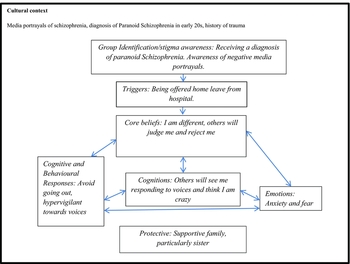
Mark was a 39-year-old White British, single man with a diagnosis of paranoid schizophrenia, who had a history of experiencing auditory hallucinations and paranoid beliefs since university in his early twenties. He had recently been admitted into a psychiatric in-patient ward following a relapse of his psychosis. He was in hospital for four months and nearer discharge was becoming more pre-occupied with readjusting to his life away from hospital. In particular he was concerned about experiencing stigma and discrimination in social situations. Mark enjoyed going to the local pub to watch football but was reluctant to do so as he was concerned that others would judge him and verbally abuse him when he was out. His experiences of internalized stigma have been included in a formulation outlined in Fig. 2. Mark identified with the stigmatized group and has done since he received a diagnosis of paranoid schizophrenia a few years after his first episode of psychosis. Since this time, he has been concerned about stigma due to the negative media portrayals of ‘schizophrenics’ being ‘crazy’ and ‘violent’. He has experienced verbal discrimination in the past as a result of responding to his voices in public, when passers-by called him ‘crazy’ and a ‘nutjob’. The recent trigger for his current internalized stigma cycle was being offered home leave from hospital. This triggered his core beliefs of being different and that others would be judgemental and rejecting.
A formulation of Mark's experiences of internalized stigma

With regard to the maintenance cycle of Mark's stigma beliefs, his appraisal was that when going out on leave others will call him ‘crazy’ when he is out in public. This caused him to experience anxiety and fear in relation to the social context and activated his safety-seeking behaviours of only going out when he really needed to, masking his voices, and being hypervigilant towards them. These safety behaviours in turn maintained his cycle of internalized stigma. Mark was keen to break the cycle of internalized stigma and we set up a series of behavioural strategies in order to challenge his belief that he would be called ‘crazy’ when out on leave. Mark's behavioural experiments related to going out with his sister to the local pub, as he was less likely to respond to voices when in the company of others and people were less likely to notice if he did, as they would assume he was speaking to his sister. Mark became less pre-occupied with what others thought of him and he was able to go out with his sister on a number of occasions which reduced his anxiety, and then later was able to go out on his own.
Clinical implications
The outlined cognitive model of internalized stigma in psychosis is the first of its kind and has some important clinical implications in supporting service users to overcome internalized stigma. Essentially, it is imperative that future clinical interventions for psychosis target the cognitive and behavioural responses that are affected by stigma. To date, the research examining the efficacy of interventions to reduce internalized stigma has been inconsistent, with most trials not finding a significant improvement in their primary outcome (Wood et al., Reference Wood, Byrne, Varese and Morrison2016c). In a systematic review of internalized stigma interventions, Wood et al. (Reference Wood, Byrne, Varese and Morrison2016c) concluded that the inconsistent findings were potentially due to the lack of formulation or conceptualizations of individual participants’ internalized stigma difficulties. This present paper outlines a framework to support the development of idiosyncratic formulations of internalized stigma in order to inform clinical interventions. Furthermore, an idiosyncratic formulation would also facilitate personal understanding and normalization, which have been identified as important factors within internalized stigma interventions by service users (Wood et al., Reference Wood, Burke, Byrne and Morrison2016a).
Specific recommendations for intervention include identification of the different levels of stigma cognitions (core beliefs and stigma appraisals) and identification of safety behaviours, which are both likely to be crucial in optimizing the efficacy of intervention. Techniques for modifying cognitions in relation to internalized stigma include psycho-education, normalization, behavioural experiments, reducing avoidance and generating alternative explanations of stigma beliefs that have been used in previous internalized stigma cognitive therapy trials (Morrison et al., Reference Morrison, Burke, Murphy, Pyle, Bowe and Varese2016; Uchino et al., Reference Uchino, Maeda and Uchimura2012). Psycho-education and normalization have been highlighted as particularly helpful in alleviating internalized stigma by service users who experience psychosis (Wood et al., Reference Wood, Burke, Byrne and Morrison2016a). In the same study, the therapeutic relationship was highlighted as particularly important and a process that modelled a non-stigmatizing relationship. As a consequence, it is proposed that a good therapeutic relationship is important in implementing therapy for internalized stigma based on the model proposed here.
Finally, this model demonstrates the importance of the cultural context in causing and maintaining stigma, and that internalized stigma would not exist without it (Corrigan and Watson, Reference Corrigan and Watson2002). Therefore a final implication is the continued need to develop interventions that tackle stigma at a societal level through service user activism and public education.
In conclusion, this paper has presented a theoretical model of understanding internalized stigma using cognitive theory and SMT. It is the first model developed which can be used in clinical practice to develop a formulation with a person with experience of internalized stigma related to psychosis. It provides a framework for developing an idiosyncratic formulation and structuring a cognitive therapy intervention. Further randomized controlled trials of cognitive therapy interventions for internalized stigma are required based on this theoretical model. Moreover, future studies should also test the mechanisms of action within the model, e.g. examining whether cognitive strategies such as psycho-education or normalization reduce internalized stigma through impact on stigma appraisals and core beliefs. However, we also require change in public attitudes at a societal level, since eliminating the negative stereotypes of psychosis would ensure that there are no stigmatizing attitudes to internalize.
Acknowledgements
Ethics statement. The authors have abided by the Ethical Principles of Psychologists and APA code of conduct. Ethical approval was not sought for this paper as it is a theoretical paper that did not gather data from human participants.
Conflicts of interest. The authors have no conflicts of interest with respect to this publication.



Comments
No Comments have been published for this article.