China's Administrative Litigation Law (ALL) was promulgated in 1989 to protect citizens and enterprises from abuses by administrative agencies and to assist administrative organs in achieving compliance with their directives.Footnote 1 These dual purposes are illustrated by the two categories of lawsuits under ALL. The first type, in which government agencies are defendants, consist of administrative litigation cases (ALCs) (xingzheng susong anzi 行政诉讼案子) filed by citizens and organizations to challenge administrative decisions. The second type, in which agencies are plaintiffs, consists of “non-litigation” administrative execution cases (NAECs) (feisu xingzheng zhixing anzi 非诉行政执行案子) used by agencies to seek court assistance in enforcement when regulated parties fail to comply with agency decisions.
The scholarly literature in both Chinese and English on ALL routinely discusses the purposes, processes and effects of citizens suing agencies via ALCs,Footnote 2 but what is virtually never discussed is the single ALL provision that allows agencies to obtain court assistance in enforcing their decisions via NAECs.Footnote 3 In the few studies of NAECs (all in Chinese), analysis has mostly been limited to theoretical discussions of court reviews and problems with the NAEC system.Footnote 4 To the best of our knowledge, the effects of NAECs on regulated parties or bureaucratic behaviour have not yet been examined in empirical studies of ALL. Our study contributes to an understanding of ALL based on an examination of NAECs in the environmental protection field.
Existing empirically based literature on China's environmental law enforcement has focused on administrative enforcement by environmental protection bureaus (EPBs), and how EPB enforcement is affected by political and socio-economic factors and civil society.Footnote 5 For example, there have been studies to understand the styles and effectiveness of EPB enforcement.Footnote 6 Some scholars have examined the impact of recent institutional reforms on EPBs.Footnote 7 The few studies that have discussed the role of courts have focused exclusively on ALCs (not NAECs). Some of these found that ALCs had forced EPBs to follow the letter of the law more closely,Footnote 8 while others concluded that courts have played a very limited role in overseeing administrative sanctions by EPBs.Footnote 9
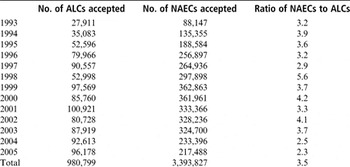
Although the literature has largely ignored NAECs, they have consistently dominated the court cases filed under ALL. From 1993 to 2005, the number of NAECs was, on average, 3.5 times the number of ALCs at the national level (see Table 1), with the ratio of the two types of cases ranging between 5.6 (1998) and 2.3 (2005). The dominance of NAECs raises the questions of why agencies use ALL much more extensively than citizens; and how NAECs affect the behaviour of agencies and regulated parties.
Administrative Litigation Cases (ALCs) and Non-litigation Administrative Execution Cases (NAECs) in China, 1993–2005

Sources:
Zhongguo falü nianjian (China Law Yearbook), 1993–2005.
Our research uses NAECs filed by EPBs in Hubei province between 1992 and 2005 to explore the legal processes and outcomes of those cases and their effects on administrative behaviour and regulated parties. Three sub-municipal units in Hubei, referred to as District A, County B and County C, served as study locations.Footnote 10 From April 2005 to July 2006, court records and official documents were collected from both courts and EPBs in the three study localities, and in-depth, personal interviews with judges, EPB officials and waste dischargers involved with NAECs were conducted.
This article introduces the legal procedures related to NAECs and elements of the pollution levy system, the policy instrument involved in the vast majority of NAECs examined in our research. It then analyses the incentives faced by courts and EPBs that led to a symbiosis between the two, and the effects of NAECs on the behaviour of EPBs and regulated parties.
Use of ALL by Administrative Organs
The legislative history of ALL demonstrates that the law's dual purposes resulted from a compromise between legal scholars and powerful interests within China's administrative bureaucracy.Footnote 11 During the drafting of ALL in the late 1980s, a drafting group consisting of prominent legal scholars was generally in favour of limiting ALL exclusively to protecting the rights of citizens by allowing them to sue agencies. But many administrative organs did not want their power circumscribed; rather they wanted to enhance it by being able to use the courts to enforce their administrative decisions. The final version of ALL reflected a compromise between these competing interests: 73 of the ALL's 74 articles provide the legal basis for ALCs filed by citizens; and one (article 66) concerns enhancing bureaucratic interests via NAECs. Based on the legislative history and ALL's final wording, it appears that protecting citizens' interests (via ALCs) was intended to be the primary objective, whereas assisting administrative organs in exercising their authority (via NAECs) was to be a supplementary function added to satisfy objections raised by agencies.
Article 66, which uses general terms, allows an agency to file an NAEC if two conditions hold: the regulated party fails to comply with the regulating agency decision within agency-specified time limits (a condition that assures the decision has become legally effective); and the regulated party fails to file an ALC challenging the agency's decision within 15 days.Footnote 12
Fundamental differences exist between ALCs and NAECs. ALCs involve trials with rigorous court reviews, and decisions by lower courts can be appealed. In contrast, NAECs involve distinct Chinese judicial practices unlike typical litigation in Western legal systems. NAECs involve no trials (hence “non-litigation”) and therefore have less stringent court review. Court review of NAECs is often limited to “documentary review” (shumian shencha 书面审查), that is, reviews of written documents submitted by agencies. Moreover, a regulated party subject to an NAEC cannot appeal a court's decision.Footnote 13
ALL includes no instructions for handling NAECs. The Supreme People's Court's legal interpretations of ALL issued in 1991 and 2000 provide some guidance,Footnote 14 but they do not specify criteria for determining the legality of a decision an agency asks a court to execute in an NAEC. Moreover, the Supreme People's Court's interpretations do not clarify which divisions within a court should handle NAECs. The absence of clear procedural requirements has left courts with flexibility in processing NAECs in ways that meet the courts' own needs.
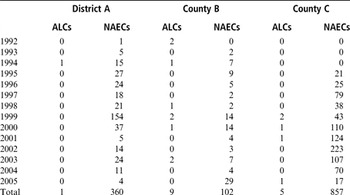
As shown in Table 1, the number of NAECs has been significantly larger than that of ALCs throughout China. Table 2 shows that the same holds for NAECs filed by EPBs in our three study locations: between 1992 and 2005, the number of EPB-initiated NAECs was much greater than that of ALCs involving EPBs. While each EPB filed more than 100 NAECs between 1992 and 2005, the number of ALCs involving the three EPBs combined was only 15. Almost all the NAECs concerned collection of pollution levies.
ALCs and NAECs Involving EPBs: Three Localities in Hubei, 1992–2005

Sources:
Local court case registration books, 1992–2005.
Pollution Levy System
China introduced the pollution levy system in 1978 with two goals: to provide an economic incentive for waste dischargers to cut pollution; and to generate revenues to support waste treatment projects.Footnote 15 Before 2003, the national programme had applied only to enterprises and public service units (qishiye danwei 企事业单位).Footnote 16 But some local governments moved beyond the national regulations. For example, in 1994, the Hubei Provincial People's Congress issued the “Environmental Protection Regulation of Hubei Province,” which expanded the subjects of pollution levies to include all units and individual industrial and commercial businesses (danwei he geti gongshanghu 单位和个体工商户).”Footnote 17 EPBs in Hubei were thus authorized to collect levies for “sanitary” wastewater discharges (wastewaters from toilets, sinks and so on) from administrative agencies and service-oriented businesses in the tertiary sector, including barbershops, hair salons, hotels, restaurants and nightclubs.
Levy assessment and collection starts with the pollution registration programme, which requires self-reporting by wastewater dischargers. Data from dischargers provide a basis for assessing a pollution levy. EPBs often conduct routine, pre-arranged on-site inspections to obtain information for assessing or verifying levies. Once the levy amount is decided, an EPB issues a formal collection notification signed by the EPB director. Environmental supervision stations, which are subsidiaries of EPBs, are in charge of assessing and collecting levies and related fines.
A discharger that refuses to register its waste releases or fails to pay some portion of the assessed levy might face an administrative penalty. The decision to proceed against a violator needs, at the county and district levels, approval from either the EPB director or the vice-director in charge of enforcement. The proposed penalty decision is typically discussed among relevant EPB leaders before being issued to the violator in a notification signed by the EPB director.Footnote 18
Procedures for collecting levies and issuing penalties allow EPB leaders to exercise considerable discretion.Footnote 19 Although inspectors have opportunities to negotiate levies or penalties with dischargers during on-site supervisions and can exert influence by making proposals, ultimately the size of a discharger's levy and/or penalty is determined by EPB leaders, such as heads of supervision stations, EPB vice-directors and directors.Footnote 20 For economically important local enterprises, amounts of levies (penalties are rarely considered) are negotiated between EPB directors and enterprise managers. Even for small polluters, final decisions on levy and penalty amounts must be approved by EPB directors. As one EPB inspector put it, “ordinary staff members have little say [in setting levy amounts].”Footnote 21
EPBs at district and county levels have also exercised discretion in reducing or waiving pollution levies, which is not permitted by applicable regulations. Article 2 of the 2003 “Notice on Reducing, Waiving and Delaying Payment of Pollution Levies” states that such applications should be sent for approval to relevant government agencies at or above the municipal level.Footnote 22
Because of reductions and exemptions, pollution levy amounts collected were far lower than they would be if national regulations had been followed. This is a well-known problem with the levy system.Footnote 23 Reductions and exemptions often result from informal negotiations between EPBs and dischargers. In addition, local government leaders often require EPBs to cut levies in order to protect key local enterprises. The influence of local intervention and informal negotiations has long been of concern to national environmental officials.Footnote 24
Another levy-system implementation problem concerns its failure to meet one of its original objectives: reducing pollution.Footnote 25 That goal has, in many instances, been displaced completely by a focus on generating revenues for EPBs. Many EPBs throughout China depend on pollution levies for survival and growth. According to one researcher, “EPBs today look at discharge fees [pollution levies] as their annual budgets.”Footnote 26
As of 2005, local leaders in two of our three study locations allocated budgets for EPBs based entirely on the amounts of levies and fines they collected.Footnote 27 The importance EPBs place on levies is indicated by the widespread local practice of linking site inspectors' wages and/or bonuses to pollution levies (guagou 挂钩).Footnote 28 Within a supervision station, a division (or an inspector) is assigned a quota each year that specifies the minimum amount of pollution levies and fines they need to collect. Wages and/or bonuses for inspectors are determined by whether quotas are filled and by how much they are exceeded.
Incentive-Based Symbiotic Relationships
The reasons NAECs have become the dominant use of ALL in the environmental protection field were described succinctly by a waste discharger and reinforced by an EPB vice-director we interviewed: “Courts and EPBs are a profit community (liyi gongtongti 利益共同体). Both benefit from the execution [of NAECs].”Footnote 29
EPBs' need for coercive power
As mentioned by many judges and EPB officials, polluters resist EPB levy collection and EPBs lack coercive powers that could force them to pay.Footnote 30 EPBs are weak regulatory agencies with far fewer coercive powers than courts. The most a county EPB can do on its own is to issue a penalty for noncompliance with levy payment requirements. If a violator ignores an EPB order, the EPB, unlike the courts, cannot force compliance using coercive measures, such as detaining a polluter or confiscating property.
Resistance to paying levies in Hubei became especially pronounced in 1995, when provincial regulations expanded the levy system to all polluting sources, including small and individual businesses in the service sector that had not previously been required to pay levies. Many such enterprises did not understand why they needed to pay, given that (in their opinion) they generated no pollution or if they did, it was in insignificant amounts.Footnote 31 On occasion, resistance even included threats on the lives of EPB personnel; for example, EPB inspectors in County B were once chased by an angry, knife-wielding restaurant owner.Footnote 32
Courts' need to increase ALL caseloads
In the 1990s, superior courts pressured local courts to augment ALL-related work by using ALL caseload targets in court personnel performance evaluations.Footnote 33 According to several judges we interviewed, the ALL workload was, at that time, measured by the combined number of ALCs and NAECs involving all agencies.Footnote 34 Soon after ALL went into effect in 1990, many courts faced major challenges in maintaining adequate caseloads, and had difficulties increasing the number of ALCs filed by citizens. The concept of “citizens suing officials” (mingao guan 民告官) was alien to ordinary Chinese, and few people dared to legally challenge a government agency or official.Footnote 35 Even when ALCs were filed they were problematic: courts could not easily make case acceptance and adjudication decisions without interference from local leaders, who often controlled court personnel, financial and welfare matters. Moreover, many local leaders and agency heads did not accept being judged by courts and often refused to accept their role as defendants.
For some local courts, lack of an adequate ALL caseload threatened the existence of their administrative divisions. During an interview, the administrative division chief of a municipal court in Hubei recalled an instance in 1991 in which a district court's administrative division was almost eliminated because its ALL caseload was too low.Footnote 36
As noted by a Hubei Provincial Court senior judge, courts responded by “taking the initiative to approach administrative agencies and work for them.”Footnote 37 This was accomplished efficiently in the early 1990s by creating “circuit courts” (xunhui fating 巡回法庭) throughout China to assist selected agencies such as EPBs and water bureaus.Footnote 38 Circuit court judges helped agencies by establishing standardized enforcement procedures and preparing documents to assist in implementation. By co-operating with agencies to increase the number of NAECs, courts increased their overall ALL workloads and thereby safeguarded the existence of their administrative divisions and improved their performance evaluations.Footnote 39 An EPB vice-director we interviewed recalled that in 1993 the National Environmental Protection Agency encouraged EPBs at all levels throughout the nation to establish circuit courts.Footnote 40 This is reflected in approximately 40 news articles written in China Environmental News between 1991 and 1995 on circuit courts established at provincial, municipal and county EPBs in 16 provinces.Footnote 41
Mutual monetary gains
Budgets for EPBs and courts have been linked to funds they can generate on their own, and both courts and EPBs collect revenues from NAECs. Monetary gains are particularly important to county EPBs and courts in less-developed regions, such as the ones we investigated. In those regions, local governments are unable to collect tax revenues in the amounts needed to cover the public goods and services they are obliged to provide. In such contexts, NAECs provide a notable revenue stream.
The rule of “Two lines of revenue and expenditure” (shouzhi liangtiao xian 收支两条线), introduced by the State Council in 1993 to disconnect fees collected by administrative organs from their budget allocations, appeared to have little influence in our study localities.Footnote 42 Many EPB officials and judges claimed that EPB budgetary funds are still allocated based on amounts of pollution levies and penalties collected.Footnote 43 By engaging courts in enforcement, EPBs could force an otherwise non-paying polluter to pay at least a portion of a levy and related penalty, which was better than getting nothing.
Similarly, many local courts had to rely on court fees collected from both litigation and execution cases as a part of their budgets.Footnote 44 As the president of County B Court said: “The government still allocates our budgetary funds based on fees we collect. In fact, funds from the local government only provide one-third of our budget; the rest comes from court fees.”Footnote 45 To motivate judges to collect more fees, many courts based the benefits and bonuses of divisions (or judges) on the number of cases they accepted, which is analogous to the incentives many EPBs established regarding pollution levy collection. A County B senior judge reported:
Allocation of caseload quotas to each adjudication division, such as administrative, civil, execution and economic, has been common in Hubei and elsewhere … Courts in Liaoning and Hunan provinces even allocated caseload quotas directly to individual judges. A judge in Liaoning I met claimed he earned 80,000 yuan in one year, four times as much as his salary.Footnote 46
Official court fee structures, applicable to all agencies, made it more profitable for courts to handle NAECs than ALCs. Before 2006, the case acceptance fee (shouli fei 受理费) for an ALC was a fixed amount in the range of 5–100 yuan.Footnote 47 The corresponding fee for an NAEC was based on the “execution amount” (zhixing jine 执行金额), that is, the amount of levies and fines collected by the agency. The fee for a case with an execution amount under 10,000 yuan was 50 yuan. For larger execution amounts, an additional 0.5 per cent of any portion between 10,000 and 500,000 yuan was added, and another 0.1 per cent was charged for anything exceeding 500,000 yuan. For example, an NAEC involving an execution amount of 25,000 yuan would bring the court a fee of 125 yuan, compared to only 50 yuan for an ALC. Many localities acknowledged the courts' financial motivation for handling NAECs at the 1999 National Court Conference on Administrative Adjudication Work.Footnote 48
In our study, courts' monetary gains from NAECs were particularly significant for EPB-initiated NAECs. Courts not only received and retained processing fees from waste dischargers subject to court action but also, with the EPBs' consent, sometimes kept the additional processing fees that EPBs paid in advance in the expectation that they would be repaid later.Footnote 49 EPBs in Counties B and C sometimes even let courts keep the levies they collected in order to give courts additional incentives for supporting future EPB levy collection.Footnote 50
Effects of Court Enforcement
Deterrent effects
Court enforcement of EPB decisions has generated significant deterrent effects on waste dischargers, particularly among small businesses in the tertiary sector. As a result of the courts' interventions, waste dischargers involved in NAECs that had previously refused to pay any pollution levies typically decided to pay some levies (though not the full amount) and did not resist EPB levy collection efforts in subsequent years. Moreover, waste dischargers that had not been subjects of NAECs and that ordinarily might have refused to pay any levies decided to negotiate reduced levies with EPBs.Footnote 51 “Deterrent effects,” as used in this sense of making partial payments, was well characterized by the former County C EPB director, who was instrumental in enlisting court assistance in collecting levies:
The court mainly played a deterrent role, but we could not depend on the court to collect [the entire amount of imposed] pollution levies for us. What I wanted [the court to do] was [to establish EPB's] authority. I wanted them [waste dischargers] to understand that the court could punish them if they did not comply with us [the EPB]. They would have to pay more, not less once being turned over to the court. They would therefore be better off working with us.Footnote 52
As some judges we interviewed noted, many Chinese still regard the court system with awe.Footnote 53 Therefore, in most cases, when judges confronted violators and announced a deadline for levy payment, and sometimes even delivered a court summons personally, polluters recognized that levies needed to be paid. The owner of a small restaurant expressed the general feeling of many waste dischargers involved in NAECs: “I paid both pollution levies and court fees. The court can temporarily shut down your business if you do not pay. You know you need to pay once judges come.”Footnote 54 Once court actions made clear that EPBs had authority to impose pollution levies, dischargers felt it made sense to negotiate rather than resist. By taking the initiative to negotiate a levy reduction with EPBs, dischargers could avoid being taken to court and paying court processing fees.
If court enforcement discouraged waste dischargers from resisting levy payments, then we would expect that multiple NAECs involving the same discharger would be unusual. That is what court records show. Statistics for 1992–2005 indicate that repeat offenders were involved in only 12 of 360 cases (3 per cent) in District A, five of 102 cases (5 per cent) in County B and 35 of 856 cases (4 per cent) in County C.Footnote 55
Deterrent effects are particularly strong when court actions involve coercive measures, such as detaining polluters for up to 15 days or confiscating their private property. These actions, which courts reserved for dischargers who refused to co-operate and acted badly towards judges, sent strong signals: courts would, if necessary, use coercive legal measures to assist in EPB levy collection.
EPB and court interviewees summarized the overall deterrent effect using a well-known Chinese idiom: “Kill one to scare a hundred” (shayi jingbai 杀一儆百).Footnote 56 For example, a small restaurant owner in County B refused to pay a pollution levy in 2005 and threw away the summons in front of the judges who delivered it. The judges immediately sent several court policemen to place the owner in handcuffs. He was then forced to write a self-criticism in front of more than 100 people who had been dining in either his restaurant or restaurants nearby. A local television station (invited by County B EPB) showed frequent rebroadcasts of the entire process. Footnote 57 Such actions made strong impressions on community members.
The effectiveness of court enforcement in enhancing the co-operation of waste dischargers to pay at least some fraction of imposed levies is a possible explanation for the drop in numbers of NAECs in recent years in District A and County C (see Table 2). A County C judge explained the decline:
The number of NAECs filed by EPB was initially low. It gradually increased and reached a peak [in 2002]. By that time, court enforcement had already had significant effects [on polluters]. Many people recognized EPB's authority and began co-operating with it. EPB did not need us anymore. The number of cases has fallen lately.Footnote 58
A District A judge felt that confiscating the property of many small, service-oriented businesses in 1999 had a deterrent effect on the entire tertiary sector, an effect that caused the number of EPB-related NAECs to drop from 154 in 1999 to 37 in 2000.Footnote 59 However, some EPB and court interviewees in District AFootnote 60 mentioned other factors contributing to the NAEC decrease, particularly the removal of pressure for high ALL caseloads. In 2003, the municipal court supervising District A court stopped evaluating lower court performance on the combined number of ALCs and NAECs involving all agencies.Footnote 61 Greater emphasis was placed on ALCs. Another possible explanation for decreases in NAECs is the increased stringency of court review; this is reflected in District A court's 2004 requirement for informal hearings involving regulated parties and agencies to identify (mostly) procedural errors that could not be determined by examining agency documents.Footnote 62 Some EPB personnel considered such informal hearings as “quasi-court investigations,”Footnote 63 and others complained that many cases were rejected for minor errors.Footnote 64
These alternative explanations apply only to District A, the location of the aforementioned internal court changes, which followed personnel changes at District A court in 2000.Footnote 65 Analogous internal changes were not made in County C court, where the number of NAECs also declined notably in 2003. Since our study investigated only three localities and declines took place in two of them, we cannot generalize by arguing that the deterrent effect of court enforcement is the most important factor explaining the decline. We pose this as a hypothesis worth testing using a larger sample size based on court data in other provinces.
Improved enforcement procedures
Many judges we interviewed claimed that the greatest impact of court review of EPB decisions was on EPB enforcement procedures and documents.Footnote 66 Procedural shortcomings were often revealed via NAECs, and EPBs followed up by making changes suggested by courts. A common error made by EPBs involved failure to obtain adequate proof that polluters had received required documents.Footnote 67 As an illustration of a change to obtain adequate proof, in 2002 County C EPB followed the court's suggestion and began notarizing delivery of penalty documents.Footnote 68
Another class of EPB errors involves mistakes in identifying proper legal subjects in NAECs.Footnote 69 In both District A and County C, courts told EPBs that if they were uncertain of a violator's legal name they should verify it by consulting the industrial and commercial bureau issuing business licences. Both EPBs adopted these procedures after courts declined to accept cases containing errors in legal names on their levy and penalty documents.Footnote 70 In many cases, EPBs could correct errors and resubmit the cases to courts.
As one County C judge observed: “EPB penalty decisions need to be executed by courts; courts examine their cases, and so they must listen to us [the court].”Footnote 71 As a result of extensive interactions with courts, EPB enforcement procedures and documents have been standardized in ways courts find acceptable.
Limits of Court Enforcement
Court assistance in EPB enforcement has failed to change one long-standing practice in the pollution levy system: the arbitrary exercise of discretion by EPBs and local leaders in collecting levies and penalties in amounts far below those stipulated in national regulations. Almost every judge and EPB official we interviewed claimed that, even with court engagement, the full sum of pollution levy initially imposed by the EPB was rarely collected. Court enforcement had significant deterrent effects in the sense that formerly resistant polluters paid some amount of levy, but they rarely paid all that was required by law.Footnote 72 Substantial levy reductions were common.Footnote 73
According to available court records on NAECs, among the 77 District A cases from 1995 to 2000, the full amount initially requested was collected in only eight cases (10.4 per cent).Footnote 74 For the remaining 69 cases, the average amount collected was 23.5 per cent, and less than 20 per cent was collected in approximately two-thirds of the cases. Differences between initial assessments and the final collections were even more striking in 2003 for County B. For all seven cases, levies and fines collected ranged between 5 and 20 per cent of amounts required by national regulations; the average was 10.5 per cent.
In some cases, levies and penalties were waived or lowered because local leaders intervened in court enforcement. This generally took place when NAECs involved enterprises that were either economically significant or established with investments from outside the county or district. EPBs occasionally took such enterprises to court because either prior negotiations had collapsed or EPBs failed to anticipate local leader interventions.Footnote 75 Outside investments are privileged because the amount of them a county or district government attracts is a key indicator in evaluating local leaders' performance, and promotions are based on these evaluations.Footnote 76 To attract external investments, county and district government leaders frequently offer investors preferential treatment that includes setting environmental fees at fixed amounts, usually much lower than those legally required. Neither courts nor EPBs can do much about local leader interventions because those leaders determine EPB and court budget and personnel matters.
Other reasons court enforcement failed to help EPBs collect full levy amounts concern the pervasive influence of guanxi (“connections”) and renqing (“human feelings”). Personal relationships between EPBs and polluters have long influenced levy collection, and court involvement opened up another avenue for polluters: employing renqing or guanxi with judges to influence amounts of levies and penalties paid. Most NAECs brought by EPBs were settled through informal court mediation.Footnote 77 Almost all judges and EPB officials we interviewed were born and raised in the localities we studied. During the course of schooling, marriage, work and social activities, these officials established and maintained their guanxi, and most possessed (or owed) substantial amounts of renqing. Because reciprocal obligation and indebtedness are at the heart of guanxi and renqing, it is difficult for a judge who has guanxi and/or renqing with a polluter either to decline a request for help or to fail to repay a debt of renqing.Footnote 78 As a County C EPB vice-director noted:
Judges are local people and have a lot of local guanxi and renqing, and thus they cannot fully enforce [high pollution levies and penalties] either. When judges could not process a case because of guanxi and renqing, they came to negotiate with us privately while, at the same time, trying to persuade the polluter to pay some of the levy.Footnote 79
Judges play important roles as intermediaries between waste dischargers and EPBs because they have a good sense of what some interviewees called the “bottom-line” (dixian 底线): the amount EPBs would find acceptable.Footnote 80 Amounts initially set by EPBs in NAECs are typically at levels required by national regulations, but this is merely a mechanism for complying formally with national regulations and leaving room for anticipated negotiations during court enforcement. In practice, judges know the bottom line either from direct conversations with EPB officials or based on levies and penalties EPBs collected in the past. In providing bottom-line information to polluters who have guanxi and renqing with them, judges, at no cost to themselves, do dischargers a favour by giving them an advantage in negotiating with EPBs.Footnote 81 Both EPB officials and judges are willing to offer polluters levy reductions or waivers because they believe levies set by national regulations are too high (especially for the small businesses involved in our study) and most polluters are unable to pay the full amount.Footnote 82
According to some senior judges we interviewed, court mediation in getting pollution levies and related penalties reduced or waived is common throughout Hubei, even though ALL does not permit it.Footnote 83 ALL's article 50 makes this clear: “A people's court shall not apply mediation in trying an administrative case.”
Court involvement in EPB levy collection has also failed to alter the long-standing focus of EPBs on revenue generation, as opposed to pollution reduction. Court statistics for our study locations demonstrate that court enforcement has done little to cut pollution: the majority of NAECs involved small tertiary-sector businesses that produce little pollution compared to economically important local enterprises. In this context, a tertiary business is classified as “small” if it is individually owned and registered under an individual's name.
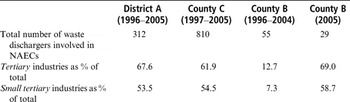
As demonstrated in Table 3, approximately two thirds of the EPB-initiated NAECs in District A and County C involved tertiary industries. The corresponding figure for County B was only slightly more than 10 per cent before 2005. However, County B EPB started large-scale levy collection from tertiary enterprises in 2005, and 69 per cent of EPB-related cases in 2005 were from them. Court statistics also reveal that (except for County B before 2005) more than half the NAECs were for small businesses in the tertiary sector.
Waste Dischargers Involved in EPB-Initiated NAECs: Three Localities in Hubei, 1996–2005

Sources:
Local court case registration books, 1996–2005.
Results in Table 3 raise a question: given that small service-oriented businesses provided a relatively small fraction of total local pollution, why were they the most common targets in NAECs? The explanation revolves around EPBs' inability to pursue larger, more significant polluters. EPB officials know that punishing a key local enterprise for failure to pay levies would often cause local leaders to intervene, and thus the money would not be collected anyway.Footnote 84 For the same reason, judges advised EPBs not to send NAECs involving economically significant enterprises.
Moreover, EPBs want to maintain co-operative relationships with major enterprises, which, because of their size, contribute substantially to the levies EPBs collect.Footnote 85 Several current and past EPB directors in Counties B and C noted that, as part of their relationship-building efforts, they had helped key local enterprises identify and secure funding for reliable and affordable waste management technologies when the enterprises were forced to cut pollution because of pressures brought by downstream or downwind counties and cities.Footnote 86 Most economically significant local enterprises failed to meet discharge standards and were willing to pay some levies because of solid EPB–enterprise relationships. Many EPB interviewees felt that punishing key enterprises would ruin these relationships, thereby making future levy collection difficult.Footnote 87
EPBs' heavy use of NAECs against small, service-oriented businesses has generated many complaints from these businesses. The director of County C government's legal office identified complaints about EPB levy collection as the most frequent type of public complaint.Footnote 88 This strategy has even elicited criticism from judges, one of whom indicated: “EPB did not go after the large ones [significant polluters]; EPB spent all their time on small fish and shrimp [small polluters].”Footnote 89 Many small, service-oriented business owners believed EPBs should prioritize major polluters that cause environmental damage and leave small polluters alone.Footnote 90 They felt that EPB enforcement work was only about collecting money to cover staff salaries and not about reducing pollution.Footnote 91 This perception, which has long been discussed in the literature on China's pollution levy system,Footnote 92 has damaged EPBs' reputations in the eyes of small, service-oriented businesses.
Many small dischargers have also complained that the better the interpersonal relationship (based on guanxi and renqing), the smaller the levy.Footnote 93 Moreover, some judges reported inappropriate behaviour by EPB personnel during levy collection, such as waiving a barbershop's levy after having a haircut and not paying for it, or eliminating a restaurant's levy after having a dinner without paying.Footnote 94 Although the judges were aware of arbitrary decisions made by EPBs in reducing or waiving levies and penalties, we saw no indication of any attempts by them to restrict this exercise of discretionary power.
Conclusions
The legislative history and provisions of ALL as well as the ALL-related literature indicate that the primary intent of that law is to empower ordinary citizens and place the enforcement activities of administrative organs under the supervision of citizens and courts. This is to be done by ALCs, which account for nearly all ALL's provisions. However, our study found that ALL mainly empowered EPBs, which are among the less powerful regulatory agencies (via NAECs), to collect some amount of pollution levies and related penalties. This unexpected outcome resulted primarily because of the incentive-based symbiosis between EPBs and courts that formed in the 1990s: EPBs used court assistance strategically to improve their ability to collect levies and penalties; courts used NAECs to fulfill their ALL-related caseload requirements; and both EPBs and courts gained additional revenues from NAECs.
EPBs' use of courts to enhance their regulatory power has important implications for other weak regulatory agencies in China – such as bureaus of quality and technical supervision, urban planning, and city appearance and environmental sanitation – in the context of ALL.Footnote 95 Although we have not studied other weak regulators, it would not be surprising if, like the EPBs in our study, they also relied heavily on NAECs to enhance their power.
Court involvement in EPB levy collection has generated notable deterrent effects inasmuch as formerly non-compliant polluters now pay some levies. Court involvement was dominated by informal negotiations, and courts frequently served as mediators, even though that role is not permitted by ALL. In addition, EPBs improved enforcement procedures to make them acceptable to courts.
Court engagement in EPB enforcement failed to change two long-standing practices in implementing the pollution levy system: the arbitrary exercise of discretion by EPBs and local leaders in collecting levies and penalties, and the dominance of revenue generation (as opposed to pollution reduction) as a levy system objective. This arbitrary exercise of agency authority is what ALL was intended to prevent. The real strength of ALL in curbing arbitrary administrative decisions lies in ALCs brought by citizens treated unjustly by administrative organs. In recent years, the court in District A has moved away from handling NAECs and emphasized work on ALCs filed by citizens.Footnote 96 This approach seems more in keeping with the original goal of ALL: empowering citizens and restraining administrative behaviour.