1 Introduction
Sociologists have long been interested in understanding how international organisations (IOs) create global norms of law, diffuse model laws to different nations and shape their national policies (Halliday and Carruthers, Reference Halliday and Carruthers2007; Carruthers and Halliday, Reference Carruthers and Halliday1998; Halliday and Osinsky, Reference Halliday and Osinsky2006; Chorev, Reference Chorev2005; Babb, Reference Babb2013; Meyer et al., Reference Meyer1997; Dobbin et al., Reference Dobbin, Simmons and Garrett2007; Bennett, Reference Bennett1991; Henisz et al., Reference Henisz, Zelner and Guillén2005; Twining, Reference Twining2005). Transnational legal indicators (TLIs) produced by the IOs play an important role in this process (Davis et al., Reference Davis, Kingsbury and Merry2012a; Davis, Reference Davis2014; Merry et al., Reference Merry, Davis and Kingsbury2015; Amariles, Reference Amariles2015; Reference Amariles2017; Amariles and Mclachlan, Reference Amariles and Mclachlan2018; Siems and Nelken, Reference Siems and Nelken2017; Frydman, Reference Frydman2017). The TLIs turn the complex and abstract features of legal rules and systems into quantitatively expressed scores, which allow the IOs to compare, rank and order legal systems according to their conduciveness to economic development. Such rankings inform the aid and credit allocation decisions of international investors, powerful nations like the US and the IOs themselves (Amariles and Mclachlan, Reference Amariles and Mclachlan2018; Nelson, Reference Nelson2014). This compels especially the developing economies to follow the legal-reform and ‘best-practice’ law recommendations of the IOs in order to improve their TLI scores and rankings (Bromley and Powell, Reference Bromley and Powell2012; Siems and Nelken, Reference Siems and Nelken2017).
However, the political functions of the TLIs are linked to their role as representations of reality. Policy-makers and the IOs are attracted to the TLIs also because of their scientific credibility as reliable sources of information (Merry et al., Reference Merry, Davis and Kingsbury2015). This role is reinforced by their use in testing scientific theories on the social and economic effects of laws (La Porta et al., Reference La Porta1996; Djankov et al., Reference Djankov2003; Reference Djankov2006 are the most known examples). But there are also social-science studies on the construction and use of the TLIs themselves, which paint a picture of ‘bad science’, finding significant ‘construct- and content-validity problems’ (Broome et al., Reference Broome, Homolar and Kranke2018). The TLIs often suffer from construction problems, because they rely on inaccurate survey strategies and unjustified data-aggregation methods (Amariles and Mclachlan, Reference Amariles and Mclachlan2018; Davis and Kruse, Reference Davis and Kruse2007). They also suffer from content problems, demonstrating a narrow scope, using ‘strictly functionalist and instrumental’ criteria (Khartchenko-Dorbec et al., Reference Khartchenko-Dorbec, Blanchet, Gaudusson and Marais BA2006) and ‘obsessing’ over legal efficiency (Perry-Kessaris, Reference Perry-Kessaris2011, p. 507). Such important credibility problems in the TLIs cast serious doubt on their political legitimacy and functionality as well.
How do the IOs respond to the credibility problems in the TLIs? In the case of the World Bank (WB)'s Doing Business (DB) legal indicators, such critique, especially coming from the internal reviews organised by the WB itself (IEG, 2008; IP, 2013), was important to create a data revision in 2014 (it was explained in the DB 2015 report). The DB indicators are one of the most comprehensive and well-studied TLIs with coverage of various legal fields including the corporate, property, banking, financial, insolvency, administrative, commercial and labour law (Davis and Kruse, Reference Davis and Kruse2007, p. 1096), but only a few studies on the DB indicators have investigated the 2014 revision. Previously, the DB indicators were criticised for focusing too narrowly on the economic costs of legal regulation for the economic actors involved and ignoring their potential benefits for everyone else in the society (Davis and Kruse, Reference Davis and Kruse2007; Niemann, Reference Niemann2013; Arruñada, Reference Arruñada2009). Responding to such criticisms, the WB created new ‘regulatory quality’ indicators during the 2014 revision. ‘Going Beyond Efficiency’ (WBDB, 2014), the WB announced, these quality indicators attempt to measure the laws’ inherent merits and worth rather than their immediate economic costs. However, the literature has not yet inquired what the WB means by the ‘quality’ and the ‘performance’ of law, and whether these new indicators indeed overcome the scientific-validity problems previously suggested.
This paper will argue that the new quality-of-law indicators did not overcome the biases and narrow scope of the DB project; instead, these new indicators suffer from similar content-validity problems by relying on the utilitarian ‘law-and-development’ approach. The ‘performance-of-law’ concept and measurement build on the ‘law-and-economics’ theory that legal regulation is only justified when its formal procedures are cost-efficient for their participants. The ‘quality-of-law’ concept and measurement instead build on the older ‘Benthamian’ utilitarian perspective that justifies legal regulation for its allocation of economic rights and contributions to the long-term goals of economic development. Therefore, these measurements are both conceived from a narrow utilitarian perspective, but they do use different instrumentalist criteria, so they suggest different legal-reform possibilities. I argue that the role of the DB performance-of-law indicators is to promote reforms in legal procedures that decrease the time and cost of legal enforcement, while the DB quality-of-law indicators encourage changes in the substantive legal rights and obligations given to different economic actors.
Aside from this content-validity problem, there is also a major scientific-validity problem with the connections that the WB established between its legal-quality and legal-performance indicators. After the revision, the DB reports started to claim that the quality and the performance of law are positively correlated – that is, the improvement (or deterioration) in one corresponds to (or, more ambitiously, leads to) the improvement (or deterioration) in the other – or to put more stylistically – ‘the quality and the performance go hand in hand’ (WBDB, 2016, pp. 1, 6–7, 12; 2017, pp. 8, iv). The existing studies on the scientific validity of the TLIs focus solely on the weaknesses in the construction and use of individual TLIs, not exploring the potential problems with their connections to one another. Nevertheless, as the example of the DB legal indicators shows, the TLIs are rarely conceived and produced in isolation from each other; rather, they are grouped and organised in connection to one another while making policy claims. These connections can play important roles in the IOs’ policy recommendations, and therefore should also be subjected to scientific scrutiny.
Therefore, this paper will also investigate the WB's claim that the quality and performance of law are positively correlated by running new empirical tests focusing on a single indicator set from the DB database: Resolving Insolvency. The DB reports specifically claim that ‘there is a positive correlation between the recovery rate for creditors and the strength of the legal framework for insolvency’ (WBDB, 2014, p. 10), which is offered as strong evidence for the connection between the performance and quality of law more broadly. The DB reports substantiate this claim using two levels of empirical analyses. First, they use simple graphics and regression tests to show a positive correlation between the quality and performance of bankruptcy laws using macro-level data comprising all countries in the DB dataset. Second, they use case-studies on bankruptcy-law reforms in different countries to exemplify the types of institutional process that can lead to a ‘virtuous cycle’ between legal-quality and performance improvements. I dispute the validity of both of these empirical tests.
First, looking at the macro-level data offered by the DB indicators, I demonstrate that the main bankruptcy legal reform that can in theory lead to improvements in both the performance and the quality of bankruptcy law – that is, the introduction of a reorganisation bankruptcy procedure – has not worked in the way it was expected in most countries. Furthermore, the WB's regressions on these variables did not take into account some important factors that can have an effect on the performance of law, such as the countries’ legal origin, quality of juridical proceedings, level of financialisation, etc. This paper will show that these omissions amount to a significant statistical misrepresentation of this relationship. Lastly and perhaps most importantly, when countries are divided into different income groups and the same regressions are performed, the quality and the performance of bankruptcy laws are either minimally or negatively correlated. This suggests that, while the DB project is trying to influence policy and law-making especially in developing economies, its claims may not be fit for especially these economies.
Second, through an in-depth investigation of Turkey's bankruptcy-law reforms in the early 2000s, I show that the disjunction between the quality and the performance of bankruptcy laws may occur for various domestic reasons. In this case, the WB-recommended reforms to the reorganisation of the bankruptcy-law system improved the quality of the rights and duties of the economic actors involved, but made the implementation of the law worse, making the procedures lengthier and costlier. In fact, the new law was implemented so inefficiently in practice that the negative effects of poor performance nullified the potential positive returns from the improvements in the law's quality: neither the creditors could recover sufficient debt, nor could the viable companies be rescued by the Turkish reorganisation bankruptcy procedure. My interviews with the experts in this country suggest that local factors such as the inefficiency of the Turkish courts and the debtors’ misuse may have led to this outcome. As a result, Turkey eventually reversed the WB-recommended bankruptcy-law reforms and the country went back to using an outdated reorganisation bankruptcy procedure, which can be deemed to be of a lesser quality, but has better performance. This case also serves as an important counterexample to the positive cases shown in the DB reports.
This study suggests a new way of looking at the scientific credibility of the TLIs, by focusing on not just the construct and measurement problems in individual TLIs, but also the IOs’ claims to connect them to one another. It reveals that important construct- and content-validity problems can also occur in the connections and distinctions between individual indicators inside the same indicator set. I show that the distinction between the legal-quality and performance indicators relies on different instrumentalist criteria but suffers from the same narrow utilitarian perspective. By showing the empirical inaccuracy of the WB's attempt to connect the quality and the performance of law, this paper also reveals the potentially misleading effects of this connection for policy-making. If the developing economies are taking the DB indicators as seriously as suggested by the previous studies, they would be misled to believe that the improvement in the quality of law through the adoption of the WB best practices would also improve their performance and vice versa. But, as this study suggests, the procedural reforms that make laws more efficient do not necessarily make these laws of a better quality, and the quality improvements in law by changes in the legal rights and obligations given to different economic actors do not make the laws more efficient either. Thus, even though this correlation claim lacks scientific validity, it may still play an important political role in encouraging the adoption of the WB's legal-reform recommendations as a whole.
1.1 The politics and science of the TLIs and the DB indicators
According to Merry and Conley's definitions, a social indicator is ‘a special use of statistics to develop quantifiable ways of assessing and comparing characteristics among groups, organizations and nations’ (Merry and Conley, Reference Merry and Conley2011, p. 84). They are tools of knowledge production, helpful in simplifying the complexity of social relations, ranking and ordering them according to some useful criteria and assessing their compliance with some set standards (Davis et al., Reference Davis, Kingsbury and Merry2012a). TLIs are those indicators that have ‘a global ambition’ to govern the legal systems of sovereign states (Siems and Nelken, Reference Siems and Nelken2017). They comprise ‘measures, standards and rankings of the quality of law and legal institutions across the entire world, particular regions, or selected jurisdictions’ (Amariles, Reference Amariles2017, p. 466).
The WB started collecting and issuing data on legal systems and developing benchmarks and rankings in 2003, and published its first DB report in 2004 (WBDB, 2004b). The collection of legal indicators and their analyses in the DB reports came to be known as the ‘Doing Business Project’. The WB explains its goal with this project as creating ‘a body of knowledge that will catalyze reforms and help improve the quality of the rules underpinning the activities of the private sector’ (WBDB, 2013, p. v). To academics, the DB indictors offer simple quantification and mathematical evaluation methods to use in comparative legal studies (Fauvarque-Cosson and Kerhuel, Reference Fauvarque-Cosson and Kerhuel2009). To legal practitioners, they offer legible and user-friendly data to make informed recommendations on the legal risks in different countries (Amariles and Mclachlan, Reference Amariles and Mclachlan2018). To law-makers especially in the developing economies, they provide a ‘more optimistic view’ on the positive effects of legal reform (Davis, Reference Davis2014). To the WB itself, they provide a measure to evaluate countries based on its own standards of ‘good investment climate’ and to evaluate its own efforts to improve this climate (Perry-Kessaris, Reference Perry-Kessaris2011).
The TLIs in general and the DB indicators in particular play an important role as ‘technologies of global governance’ (Davis et al., Reference Davis, Kingsbury and Merry2012a; Reference Davis2012b). Countries are compelled to improve their rankings and scores on the TLIs because they have direct economic consequences. The influential IOs, such as the US Aid, use them to allocate monetary and other resources among nations (IEG, 2008, p. 14). Credit-rating agencies, investors and multinational corporations also use them to assess legal risks and ‘shop’ for the most business-friendly national legal jurisdictions (Amariles and Mclachlan, Reference Amariles and Mclachlan2018). The International Monetary Fund (IMF) uses the TLIs to assess creditworthiness and to design economic crisis-management policies that involve legal reforms (Nelson, Reference Nelson2014). Aside from these direct effects, TLIs also exercise a more indirect and ‘soft power’ over nations (Goodwin, Reference Goodwin2017). They set the global norms for legal systems (Davis et al., Reference Davis, Kingsbury and Merry2012a; Reference Davis2012b) and assess compliance with the legal ‘best practices’ determined by IOs (Hafner-Burton, Reference Hafner-Burton2008). They maintain the ‘policy paradigms’ (Babb, Reference Babb2013) and ‘dominant policy scripts’ (Kentikelenis and Seabrooke, Reference Kentikelenis and Seabrooke2017) that are generally accepted around the world as legitimate ways to govern. While improving their TLI rankings is especially important for developing economies, this sometimes leads to ‘symbolic adoptions’ (Bromley and Powell, Reference Bromley and Powell2012, p. 491) or ‘gaming’ the TLIs (Siems and Nelken, Reference Siems and Nelken2017, p. 442), meaning lack of implementation of the new laws that were passed solely to get international prestige. But, even when the new laws are implemented infrequently, they still ‘cast a shadow’ over the behaviours of social actors (Carruthers and Halliday, Reference Carruthers and Halliday1998, p. 37).
However, the TLIs’ political power to shape national politics and international norms depends on their scientific credibility. They have to pass as real knowledge on the legal systems of countries, compiled based on scientific expertise and devoid of political and partisan considerations. For that reason, some of the original DB legal indicators relied on the existing measurements created by economists (Davis and Kruse, Reference Davis and Kruse2007, p. 1096). For example, the popular academic works by La Porta et al. (Reference La Porta1996) and Djankov et al. (Reference Djankov2006; Reference Djankov2003) on bankruptcy laws and contract laws had direct influence on how these areas of law were measured by the DB TLIs (Siems and Nelken, Reference Siems and Nelken2017). However, a growing number of scholars are questioning the scientific credibility of the TLIs and their ability to represent reality accurately. They have uncovered many important ‘construct- and content-validity problems’ that can only amount to a ‘bad science’ (Broome et al., Reference Broome, Homolar and Kranke2018).
Construct validity refers to ‘whether the evaluation techniques used to construct a global benchmark effectively measure what they purport to measure’ (Broome et al., Reference Broome, Homolar and Kranke2018, p. 6). Problems can occur in the operationalisation of concepts and the collection and aggregation of data for creating individual TLIs. For example, the TLIs rely on ‘observational’ rather than ‘factual’ information on legal systems (Amariles and Mclachlan, Reference Amariles and Mclachlan2018). The respondents may have different understandings of the survey questions and prompts, or may not be familiar with the situations they ask about (Davis and Kruse, Reference Davis and Kruse2007). And the variations inside the legal system may prevent them from giving definitive answers (Amariles, Reference Amariles2015). Also, there may be common informal practices (such as bribery) that are not asked in these questionnaires (Amariles, Reference Amariles2015, p. 1106). In the case of the DB TLIs, an Independent Evaluation Group (IEG) review (2008) found very low responding rates to surveys among countries (ranges between 1 and 3.5 for each indicator) (p. 14) and highlighted the obscure nature of the aggregation process in the TLIs estimation (p. 16).
In terms of the content validity of the TLIs, scholars underlined the existence of ideological biases and political dispositions that are ingrained into the construction and measurement of TLIs (Davis et al., Reference Davis, Kingsbury and Merry2012a; Merry and Conley, Reference Merry and Conley2011). Specifically, the TLIs represent the economists’ reductionist interpretation of law and do not take into account all law's social complexities (Khartchenko-Dorbec et al., Reference Khartchenko-Dorbec, Blanchet, Gaudusson and Marais BA2006). Being constructed from the economists’ point of view, indicators also ‘obsess over’ the efficiency of legal procedures (Perry-Kessaris, Reference Perry-Kessaris2017) and ignore the questions over the realisation of justice or due process (Amariles and Mclachlan, Reference Amariles and Mclachlan2018). Moreover, they are biased against countries with a French civil-law tradition over countries with a British common-law tradition for they usually have a more detailed, complicated and expansive corpus of law (Khartchenko-Dorbec et al., Reference Khartchenko-Dorbec, Blanchet, Gaudusson and Marais BA2006). This is also a symptom of their ‘universalistic’, ‘one-size-fits-all’ attitude towards law that ignores the particular characteristics of societies (Goodwin, Reference Goodwin2017).
This literature, however, questions the political power of the TLIs by scrutinising their scientific accuracy, mostly focuses on how the TLIs are individually conceived, created and used, and ignores the connections between the TLIs. But the TLIs rarely exist or are put into use on their own, and they work in conjunction with each other to offer a more comprehensive picture of reality. The connections between the TLIs can also distort and misrepresent the reality in certain ways. For example, individual TLIs are often connected through subject areas. For example, the DB project has subjects such as ‘starting a business’, ‘getting credit’ and ‘enforcing contract’ that refer to different areas of law and business conduct. This suggests a complementary relationship between the TLIs inside the same subject group, which does not have any scientific basis and is more likely to reflect the institutional priorities and biases of the IOs creating the TLIs. Second, as I will show in the case of the WBDB project, causal connections can be argued between the TLIs. In a causal connection, the TLIs not only complete each other in the same subject area, but also influence each other. The WB created this causal connection after an internal review process that suggested the broadening of the scope of the DB indicators.
The most forceful criticisms of the DB indicators came from the internal review processes organised by the WB itself. The IEG report in 2008, the Oversight Process for Ranking Indicators in 2010 and, lastly, the Independent Panel (IP) report in 2013 have uncovered some important biases and credibility problems in these indicators and suggested ways to improve their scientific legitimacy (Perry-Kessaris, Reference Perry-Kessaris2017). The IEG report emphasised that the DB project did not take into account ‘the relevance and quality of legal reform’ (IEG, 2008, pp. 45, 46). It recommended that the DB indicators also measure improvements other than those made to regulatory costs and burdens, ‘which is only one dimension of any overall reform of the investment climate’ (IEG, 2008, p. 46). More recently, the IP report in 2013 challenged the WB to think beyond the argument that ‘minimal regulation and very low taxes create the most attractive environment for business’ and to take into considerations the potential benefits of well-constructed law and regulations to advance societal goals (IP, 2013, p. 11). After this report, a new interest emerged in the WB to begin measuring the quality of law in the DB indicators. However, as I will show, the evaluation criteria for these new indicators were also found in the utilitarian ‘law-and-development’ approach.
2 The legal-quality and performance indicators and the utilitarian evaluation of law
Originally, the DB indicators almost only measured the performance of laws in terms of speed, ease and accuracy (Twining, Reference Twining2005). For example, they measured how fast and cheap businesses can be established, debt contracts can be enforced and administrative permits for certain economic activities (such as for exports) can be obtained in a jurisdiction (Twining, Reference Twining2005). As a result, the DB report recommendations were also largely limited to procedural reform to increase legal efficiency. For instance, the reports recommended using a fast-tracking system in the judiciary, summary procedures for the general courts and simplified procedures for the commercial courts, and making the attorney representation not mandatory for contract-law cases (WBDB, 2004a, p. xix).
During the year of the data revision, the DB report came out with a self-reflective title of ‘Going Beyond Efficiency’ (WBDB, 2014) and proclaimed that ‘starting this year a systematic effort is being made to include measures of quality in most of the indicator sets’ (WBDB, 2014, p. 25, emphasis added). The expressed reason for this new direction was ‘while efficiency continues to be ‘very important’, there is also a need to consider “regulatory quality”’ (WBDB, 2014, pp. 1–2, emphasis added), because ‘increasing efficiency may have little impact if the service provided is of poor quality’ (WBDB, 2014, p. 26). New quality measurements were added first to the ‘resolving insolvency’, ‘getting credit’ and ‘protecting minority investors’ subject areas that year (WBDB, 2014). The next year, four new quality measures were added to the ‘construction permits’, ‘getting electricity’, ‘registering property’ and ‘enforcing contracts’ subject areas (WBDB, 2016).
New legal-reform recommendations involving rights and obligations of economic actors were also added to the DB reports for the first time. For example, the reports recommended ‘allowing all creditors to vote in judicial reorganization proceedings’ as a bankruptcy-law best practice (WBDB, 2014, p. 9). Similarly, they recommend ‘allowing both incorporated and non-incorporated companies to create security interests’ for improving the secured-transactions laws (WBDB, 2014, pp. 70–71), and ‘strengthening the rights of minority shareholders’ for improving the corporate laws (WBDB, 2014, p. 35). These DB project recommendations are essentially the same as the WB legal good-practice guidelines published separately. For example, the quality recommendations on bankruptcy laws are based on the WB's ‘Principles for Effective Insolvency and Creditor/Debtor Regimes’ (World Bank, 2001).
What to make of these additions? How does the WB conceive the distinction between the ‘quality’ and ‘performance’ (efficiency) of law? I argue that the WB's attempt to measure the quality and performance of law separately follows the broader trends in the utilitarian ‘law-and-development’ approach to either evaluate laws based on their rights and duties and normative goals, or the efficiency and economic finalisation of its procedures. The ‘law-and-development’ approach to law is now mainstream, thanks to the ‘new institutional economics’ (Alchian, Reference Alchian1965; Williamson, Reference Williamson1971) that underlines the importance of institutions for economic development, and especially since the Nobel Prize-winner economist Douglas North's work (Reference North1990) measuring the importance of secure private-property and contractual rights for economic development. There are now many empirical studies that associate private-property rights and contract laws (e.g. Scully, Reference Scully1988; Knack and Keefer, Reference Knack and Keefer1995; Clague et al., Reference Clague1996) and bankruptcy laws (La Porta et al., Reference La Porta1996; Djankov et al., Reference Djankov2006) with sustained economic development. The WB DB indicators were built on this law-and-development perspective. As early as in 1994, the WB was arguing that sustainable development required ‘a predictable and transparent framework of rules and institutions for the conduct of private and public business’ (cited in Krever, Reference Krever2013, p. 134). However, there is not one single approach to evaluating the utility of legal rules and procedures for economic development, but there are two distinct schools in utilitarian thought from which the WB is borrowing the ‘quality’ and ‘performance’ concepts.
The idea to evaluate legal rules based on the extent to which their outcomes achieve societally valuable, normatively supported goals has a long history in legal thought. Utilitarian legal scholars such as Jeremy Bentham argued that the quality of laws should be measured according to the ‘principle of the greatest happiness of the greatest number’ (Bentham, Reference Bentham1879, p. 5). Today, evaluating the quality of law through the principle of increasing economic welfare involves looking at how the legal rights and duties structure the behaviour of economic actors, organise their relations, and incentivise and condition them to adopt economic behaviours that are most conducive to increasing economic welfare (often defined as an increase in aggregate economic production measured by GDP). Examples of such beneficial economic behaviours include taking entrepreneurial risks, consumer spending and people's participation in the labour market. In the case of bankruptcy laws, this can be giving rights to the creditors and allowing them to control the renegotiation of the debt with their debtors, which is shown to contribute to economic welfare under certain conditions (see e.g. Morrison, Reference Morrison2007; Peng et al., Reference Peng, Yamakawa and Lee2010).
The WB's conception of ‘regulatory quality’, or the quality-of-law indicators, is based on this utilitarian ‘law-and-development’ perspective. These indicators are measuring the extent to which the legal rights and duties in the laws give the right economic incentives to economic actors and can contribute to economic development. Partially relying on the existing research in law-and-development studies, the WB makes its own evaluations on which legal rights and duties are more conducive to business and suggests them as ‘best-practice’ laws. In order to quantify the information on the quality of law, the WB surveys collect information through survey questionnaires distributed to local professionals, such as lawyers, consultants and judges, that ask the respondents to provide information on the presence or absence of certain legal practices, procedures and rules that the WB selects as best practices (WBDB, 2018). As a result, when the DB quality-of-law indicators rank and order countries, they encourage them to adopt these best practices and make changes to the rights and obligations inside their laws.
In contrast, the idea to evaluate legal rules based on the extent to which they economise the costs and duration of the legal procedures is much newer. This idea is associated with the transaction-costs economics developed by Ronald Coase in the 1960s (see Coase, Reference Coase1960) and later the ‘law-and-economics’ approach influenced by this school (see the works by Richard Posner, Frank Easterbrook and Guido Calabresi). When evaluating laws from this efficiency perspective, the purpose is to determine whether the costs of putting the laws into practice are lower or higher than the potential economic gains from such enforcement – according to transaction-cost economics, laws that have higher enforcement costs should not be legislated in the first place. But, when the laws are already in place, the goal is then to reduce such transaction costs to make their implementation worthwhile. Thus, evaluating the performance of law with the purpose of increasing its efficiency requires measuring the average time and monetary costs–benefits created by legal procedures. Examples of such costs (benefits) include court and administrative fees (or the waiver of these fees). In the case of bankruptcy laws, the costs include court fees, government levies, fees of insolvency administrators, auctioneers, assessors, lawyers, etc. (WBDB, 2014).
This idea led to the WB's conception of performance-of-law indicators as measures of the efficiency of the procedures of law in terms of the costs incurred by the parties involved (including the enforcement authorities), direct economic gains for the parties involved (e.g. damage payments promised to winning parties) and time spent during the procedure (which could have been used for other economically beneficial activities). The WB collects these data through a separate set of questions it its surveys, asking the respondents to provide information on the average time, cost and outcome to complete a specific legal procedure (e.g. filing and closing bankruptcy, getting a business license, registering land property, etc.) in their jurisdiction, based on a hypothetical scenario provided in the questionnaire (specifying e.g. the size of the company, the worth of the estate, the number of disputants, etc.) (WBDB, 2018). Also, when the performance-of-law TLIs rank and order countries, they are effectively promoting procedural reforms in order to decrease the times and costs of the laws’ implementation.
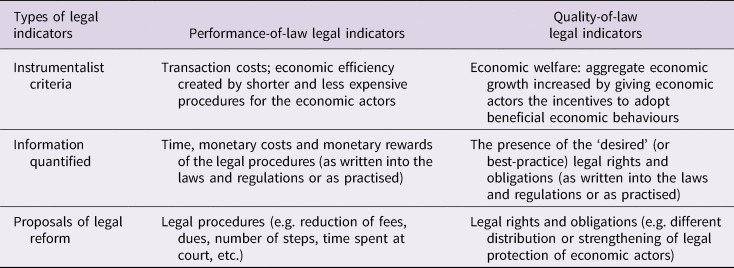
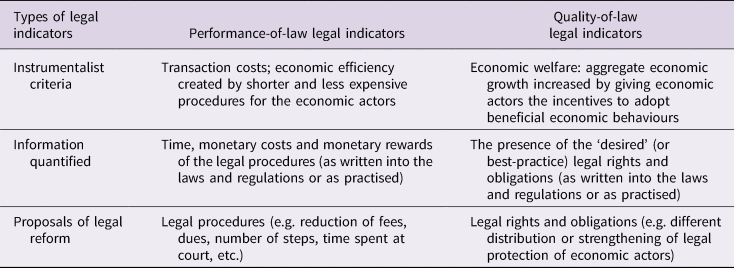
It is important to emphasise that the distinction between the quality and performance of law does not overlap with a better-known distinction between the law in books and the law in practice, referring broadly to the distinction between written laws and the laws in action (more extensively discussed in Berkowitz et al., Reference Berkowitz, Pistor and Richard2003; Pistor, Reference Pistor2002; Halliday and Osinsky, Reference Halliday and Osinsky2006; Shaffer, Reference Shaffer2009; Edelman and Stryker, Reference Edelman, Stryker, Smelser and Swedberg2005). Both the quality- and the performance-of-law indicators can quantify information derived from either the written laws or the law in action. For instance, the performance-of-law TLIs can be constructed using information on the procedural fees, dues and timelines as written into the laws and regulations or on the actual average of fees, dues and duration of legal procedures in practice. Similarly, the quality-of-law TLIs can be constructed using information on the legal rights and obligations written into the law or on how much these legal rights and obligations are actually protected by the courts. The main distinction between the performance- and quality-of-law indicators, instead, is whether they rely on an instrumentalist criterion that focuses on transaction costs or economic welfare, quantify information on the legal procedures or the presence or absence of legal best practices and they suggest reforms on legal formal procedures or legal formal rights and obligations. Table 1 summarises my argument and compares the performance and quality indicators in terms of these characteristics.
Characteristics of the performance-of-law and quality-of-law TLIs
Thus, although the 2014 revision introduced the quality-of-law measures as an improvement on the narrowly construed legal indicators in the DB project, these new indicators also suffer from the limitations of a utilitarian, ‘law-and-development’ perspective on law. This utilitarian perspective has come under serious scrutiny in recent years. Scholars have argued that it is an error to think of law ‘as a technology that can be transferred elsewhere’ (Haggard et al., Reference Haggard, MacIntyre and Tiede2008, p. 219); instead, law is deeply embedded in the particular political, economic and social settings. That is why the same legal rules may not have the same effect when transplanted in another context (Berkowitz et al., Reference Berkowitz, Pistor and Richard2003). After transplantation, the laws need to be modified and adapted to the local settings (Kanda and Milhaupt, Reference Kanda and Milhaupt2003; Pistor et al., Reference Pistor, Raiser and Gelfer2000). Critical legal studies and ‘law-in-context’ approaches emerged in opposition to this utilitarian perspective (Trubek and Galenter, Reference Trubek and Galanter1974; Perry-Kessaris, Reference Perry-Kessaris2011). These scholars suggest that it is futile to try to measure and compare the performance and quality of legal rules cross-nationally.
2.1 The DB project connecting the quality and performance of law
The continuing reliance on utilitarian thought aside, there were other major problems in the 2014 DB data revision as well. The 2014 data revision had offered an opportunity to develop the quality TLIs and performance TLIs separately. In fact, there are a number of statements in the DB reports that suggest the performance of law or the quality of law can lag behind each other, and thus can express different empirical facts. For example, with regard to the Resolving Insolvency Indicators, the DB report admits that ‘Many economies have an insolvency system with low efficiency and high quality. These are economies that have well-designed laws but face challenges in implementing them effectively’ and adds that ‘well-designed laws are necessary but not sufficient to achieve efficiency in an insolvency system’ (WBDB, 2014, p. 10).
However, such statements that create a suspicion that the quality and performance of law may not align are quickly dispelled by stronger and more explicit statements that they do. For example, the 2014 DB report also adds to the statements above: ‘On average, though, economies with better-designed laws tend to have higher recovery rates’ and ‘economies that offer a simple, fast and inexpensive process for transferring property are also likely to have a land administration system providing reliable land records’ (WBDB, 2014, p. 10). The 2016 report even goes one step further and contradicts the 2014 report's statement that there are countries with good-quality laws and poor efficiency. It states instead that there are very few economies that are currently in the group of economies ‘where the quality of regulation is high but the processes for implementing it remain complex’ (WBDB, 2016, p. 6). Rather, it insists that ‘those with low regulatory efficiency tend to also have low regulatory quality’ (WBDB, 2016, p. 6).
In fact, the statement that ‘quality and efficiency go hand in hand’ is one of the most recited statements in the DB reports after the 2014 revision (WBDB, 2016, pp. 1, 6–7, 12; 2017, pp. 8, iv). This narrative in the DB reports connects these distinct aspects of the law. It does this in two ways: first, by including certain measurements of performance of law inside the measurements of quality of law and, second, by explicitly and strongly arguing that the quality and the performance of the law are positively correlated – that is, the improvement (or deterioration) in one corresponds to (or, more ambitiously, leads to) the improvement (or deterioration) in the other.
The first way of connection can also be called a ‘measurement trick’. By taking into account some factors that make up a law's efficient performance while measuring their quality, the DB quality TLIs are already to some extent interlinked with the performance of law. This also reinforces the appearance of a correlation between the quality and performance TLIs. For example, the Strength Index – that is, the quality-of-bankruptcy-law measure in the DB dataset – includes the existence or absence of reorganisation bankruptcy procedures, which can increase a country's index score by up to 25 per cent. The Recovery Rate – that is, the performance-of-bankruptcy-law measure in the DB dataset – also rewards having the reorganisation bankruptcy law by up to 30 per cent. Thanks to this trick, the improvement in one indicator is automatically mirrored by the other, which creates an appearance of a positive correlation.
The second way of connecting the quality and performance of law is perhaps more serious, because it is seemingly supported by empirical evidence. Case-studies provide the primary evidence in the DB reports. For example, the 2016 DB report heavily relies on case-studies to show this positive correlation inside land-registry laws and insolvency regimes. The report details that the Danish land-registry system requires very few procedures and time to complete a registry, which encourages people to register their property transfers more accurately – this, according to the report, is evidence that ‘regulatory efficiency and quality go together and in fact reinforce each other in a virtuous cycle’ (WBDB, 2016, p. 6). In the ‘inefficient’ Greek registry system, by contrast, people are discouraged from keeping good registries, and this creates a ‘vicious-cycle’ problem instead. Similarly, the report contrasts the insolvency regimes of Finland and São Tomé and Príncipe, and argues that ‘where there is a good legal framework for insolvency, creditors recover a larger share of their credit at the end of the insolvency process’ (WBDB, 2016, p. 9).
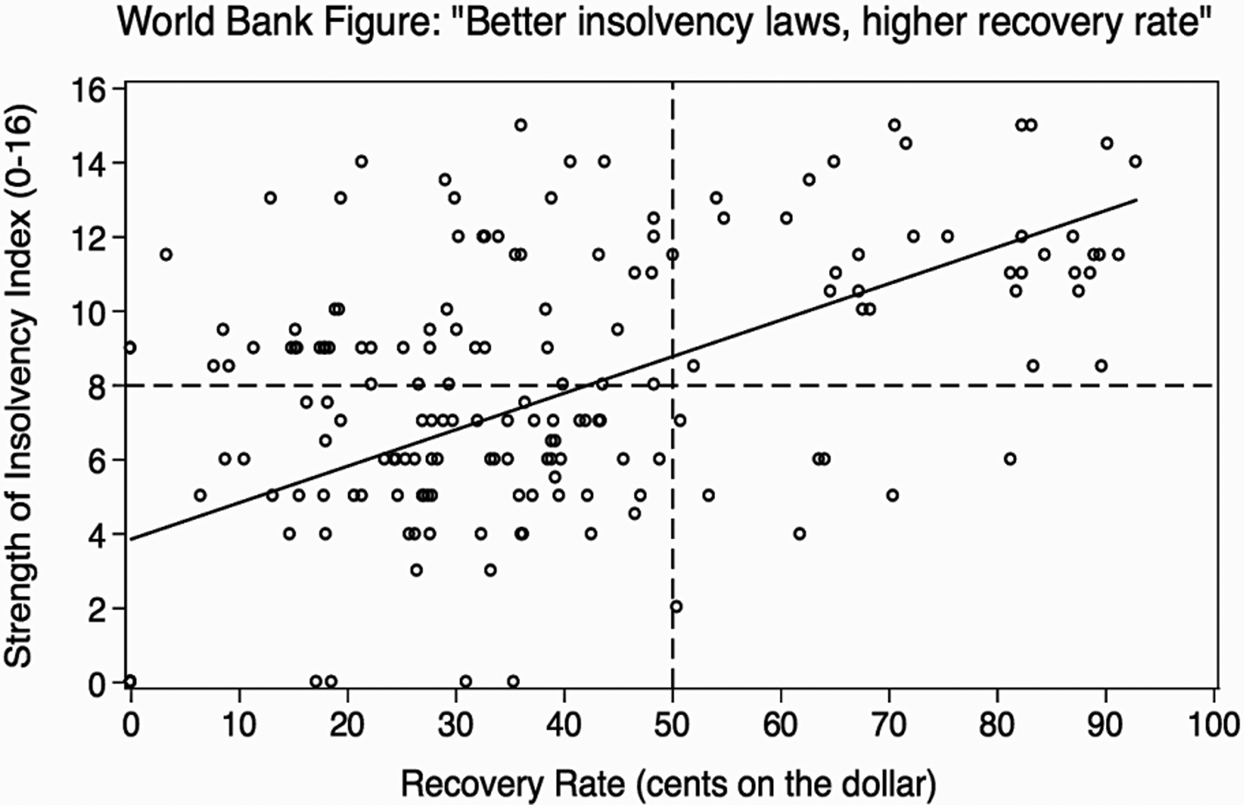
The DB reports also provide evidence based on macro-level data showing a positive correlation between the performance and the quality of law. These are often simple representations of data – what Niemann calls ‘associational charts’ (Niemann, Reference Niemann2013). Niemann argues that these charts present relationship between two variables to offer a possible explanation for an outcome of desire, but they do not have enough statistical power and reliability to show a correlation that can strongly suggest a causation (Niemann, Reference Niemann2013, p. 56). One of the clearest examples of such an associational chart can be found in the 2015 report, reproduced by the same data in Figure 1, which shows a positive regression line formed by Strength Index and Recovery Rate data in 2014 (the first year these data were collected by the WB).Footnote 1 This simple graph alone led the 2015 and 2016 reports to state that ‘there is a positive correlation between the recovery rate for creditors and the strength of the legal framework for insolvency’ (WBDB, 2014, p. 10; 2016, p. 9). Similar associational charts were also used to suggest that the quality of the land-registry systems positively correlates with the efficiency of land transfers and the quality of court infrastructures with the efficient enforcement of contracts (see other charts on WBDB, 2014, p. 11).
Reproduced with the DB 2014 data by the author (WBDB, 2014, p. 10).

The rest of this paper will show that, by using associational charts and case-studies, the DB project does not provide real evidence for the existence of a correlation, but rather creates an appearance of correlation between the performance and the quality of law. We cannot dispute each and every case-study or macro-level statistical analysis that the WB uses in these reports; instead, we will focus on the evidence that the WB could collect by measuring the quality and the performance of bankruptcy laws with its Strength Index and Recovery Rate indicators. The seeming connection between the Strength Index and Recovery Rate has been crucial to the WB's argument that the quality and performance go hand in hand.
This paper will also only focus on the DB data from 2014 when running new macro-level tests. This was the first year that the new DB quality-of-law indicators started measuring countries’ scores and these scores were reported in the DB 2015 report. This was a choice to make the presentation of the empirical tests simpler, but also taking multiple years of data did not make any difference to the results. Similar analyses can be run using the following recorded years, or by taking an average of all the recorded years, but the conclusions are the same, since the scores and rankings in these TLIs do not change much over the years. Also, since the 2014 revision, there has not been any important measurement revision in the DB data to warrant updating the results presented in this paper.
3 Testing the relationship between the quality and performance of law using the Resolving Insolvency Indicators
3.1 Resolving Insolvency Indicators
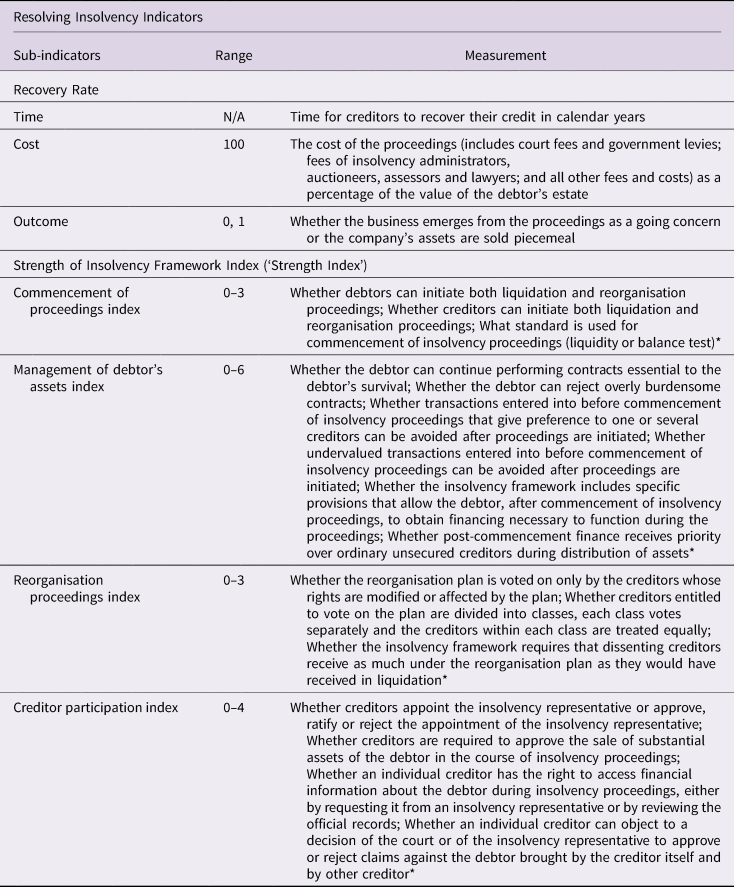
The DB's Resolving Insolvency Indicator set is composed of two main indicators: the Recovery Rate and the Strength Index. The Recovery Rate indicator ranges between 0 and 100, and estimates the percentage (or cents on the dollar) of the insolvent firm's assets that secured (financial) creditors can recover through a bankruptcy procedure. The components of the Recovery Rate are the average time, cost and (the likely) outcome of the insolvency procedure, combined with the interest-rate estimate to calculate the depletion of the assets over time.Footnote 2 Higher numbers on the Recovery Rate indicate the efficiency gains of the creditors in the process. The Strength Index indicator ranges between 0 and 16, and measures the compliance of the national bankruptcy laws with the WB-recommended best practices on four aspects: the commencement of the bankruptcy process, the management of the debtor's assets during the bankruptcy process, the creditors’ participation during the bankruptcy process and, lastly, the creditors’ rights and duties when there is a reorganisation procedure (WBDB, 2014, p. 96). Compliance in each of these best-practice areas is separately measured: scores in the Commencement of Proceedings Index range between 0 and 3, the management of debtor's assets index ranges between 0 and 6, the creditor participation index ranges between 0 and 4, and the reorganisation proceedings index ranges between 0 and 3. Countries’ Strength Index scores are estimated by a simple addition of these.Footnote 3 Higher numbers on the Strength Index indicate better access of the debtors to the bankruptcy procedure, better protection against the creditors when they can save their businesses and better rights to creditors in controlling and surveying the process (see Table A1 in the Appendix for more details on both indicators and how they are calculated).
The Recovery Rate and Strength Index are connected to each other by both rewarding the adoption of the reorganisation bankruptcy procedure. The base rate of the Recovery Rare is 30 points (or 30 per cent) and the Strength Index is 3 points (or 18.75 per cent) higher for countries with a reorganisation bankruptcy procedure.Footnote 4 This is because the Recovery Rate's estimation is based on the assumption that keeping or selling the insolvent companies as ‘going concerns’ (or in operation) is a more efficient outcome, which requires the existence of some sort of a reorganisation bankruptcy procedure (Djankov et al., Reference Djankov2006). This assumption is based on the economic research that shows more recovery for secured creditors in successful reorganisation cases. For example, Bris and others (Reference Bris, Welch and Zhu2006) found that, in the US, the mean Recovery Rate is 69 per cent for reorganisation proceedings, as opposed to 27 per cent for liquidation (also see Menezes, Reference Menezes2014; Armour et al., Reference Armour2015). Similarly, the Strength Index’ Reorganization Proceedings sub-index is calculated as 0 when a country does not have any reorganisation bankruptcy procedure. This reflects the DB's commitment to promoting the reorganisation bankruptcy procedure as a ‘best practice’ (see WBDB, 2014, p. 96; 2016, p. 99), based on the WB's own guide called ‘Principles for Effective Insolvency and Creditor/Debtor Regimes’ (World Bank, 2001). However, despite this common valuation of the reorganisation bankruptcy procedure, this procedure itself is not sufficient to create a direct and strong link between the performance and the quality of the bankruptcy law.
3.2 Testing the macro-level evidence from the WBDB data
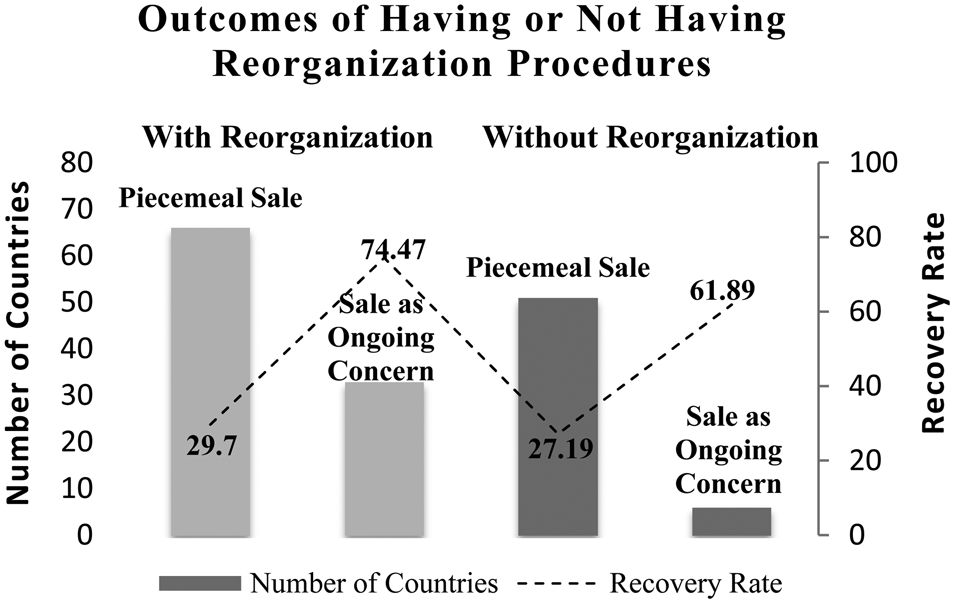
Figure 2 shows the number of countries with and without a reorganisation procedure in 2014, broken down into those with an efficient bankruptcy outcome (have the likely outcome of selling or saving the insolvent companies as going concerns) and without an efficient outcome (have the likely outcome of selling them piecemeal through foreclosure or liquidation) and reports their recovery rates.Footnote 5 It shows that a large majority (106 out of 167) had some sort of a bankruptcy reorganisation procedure but, in practice, also a large number of these countries (66 out of these 106) could not process their insolvency cases through a reorganisation procedure. This means that, in many countries, companies that should be reorganised by the available reorganisation laws were either falsely liquidated or foreclosed at the end of the bankruptcy process. These countries’ Recovery Rate was also very low (29.7 per cent) and was almost the same as in the countries with lower-quality laws that foreclose or liquidate insolvent companies without a formal alternative (27.18 per cent). In fact, only thirty-three out of 167 countries had the reorganisation bankruptcy best practice and could implement it efficiently at the same time, thus have a high Recovery Rate of 74.46 per cent. This shows that the reorganisation bankruptcy procedure alone cannot establish a strong positive correlation between the Strength Index and the Recovery Rate.
Insolvency regimes in terms of having reorganisation bankruptcy and getting the efficient outcome of bankruptcy in 2014 (source: WBDB data)

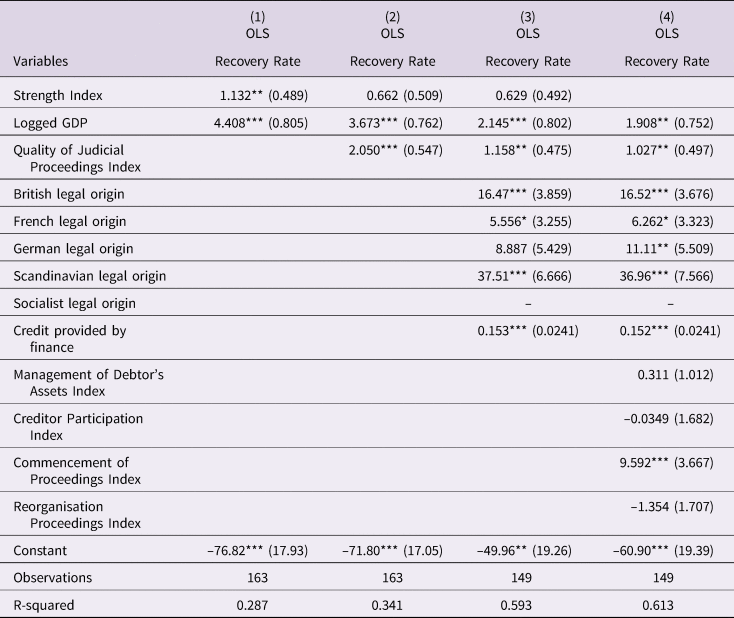
The simple associational charts in the DB reports like Figure 1 do not take into account other factors that can play a role in the performance of law. The statistical analysis presented in Table 2 tests whether including these factors in the analysis changes the appearance of a positive correlation between the Strength Index and Recovery Rate. One of the most important factors omitted by the WB is the quality of the courts system. Scholars have argued that inefficient courts can be significantly detrimental to the bankruptcy process; their slowness (Palumbo et al., Reference Palumbo2013), congestion (Espasa and Esteller-Moré, Reference Espasa and Esteller-Moré2015) and lack of resources and personnel (de Oliveira Gomes et al., Reference de Oliveira Gomes, de Aquino Guimaraes and Akutsu2016) can cause lower rates of recovery and rehabilitation. Considering these, the WB and the IMF also advise countries on reforming and modernising their courts after they reform their bankruptcy laws (e.g. see Rowat and Astigarraga, Reference Rowat and Astigarraga1999; Cirmizi et al., Reference Cirmizi, Klapper and Uttamchandani2012). This factor is accounted for in Table 2 by the Quality of Judicial Proceedings Index, which measures the quality of the court structure and proceedings, case management, court automation and alternative dispute resolution in a court system (WBDB, 2016, p. 31).
Table of regressions
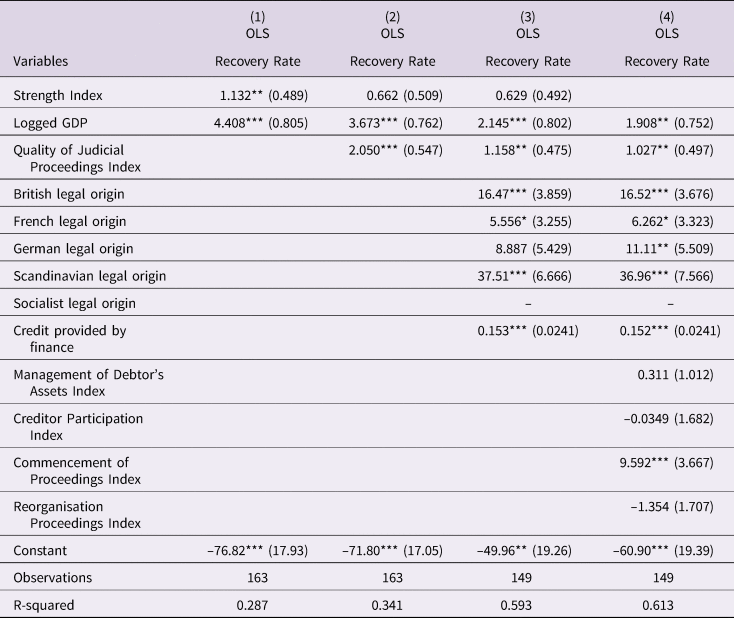
Robust standard errors in parentheses. ***p < 0.01; **p < 0.05; *p < 0.1.
Another important factor that the WB's analysis omits is the legal origin. Different legal traditions – English common law and French civil law – typically have different legal procedures, which are shown to have important effects on legal efficiency (see La Porta et al., Reference La Porta1996; Djankov et al., Reference Djankov2002). Civil-law countries are often thought to have less efficient legal procedures than the common-law countries. To account for this factor, this paper uses the most extensive legal-origins variable compiled and used in the last La Porta et al. work (La Porta et al., Reference La Porta, Lopez-de-Silanes and Shleifer2008).
Another factor that can play a role in the performance of bankruptcy laws is the level of financialisation. The amount of available credit for the companies going through a reorganisation bankruptcy procedure is vital to their survival, and thus the amount of credit that the creditors can recover with this procedure (see e.g. Menezes, Reference Menezes2014). This factor is controlled in Table 2 by the domestic credit provided by finance indicators published by the IMF and WB.
Column 1 in Table 2 shows the positive correlation reported by the WB in Figure 1. This analysis only controls for the size of the economy (using logged GNI variable). Column 2 adds to this analysis the quality-of-courts variable (i.e. Quality of Judicial Proceedings Index), which reduces the effect of the quality of bankruptcy law (Strength Index) over the performance of this law to a statistically insignificant amount. Column 3 further adds the legal origins and the financialisation controls. This model is the most complete model that can be achieved with these variables (as shown by a higher R-squared). It again shows that the effect of the quality of law is insignificant on the performance of law, which is largely determined instead by the size of the economy, the quality of courts, legal origin and amount of financialisation (interestingly, both the British origins and French origins have a positive effect, while the highest positive effect is recorded by the Scandinavian origin). In other words, both Column 2 and Column 3 suggest that the omission of such potentially important factors leads to a misrepresentation of the relationship between the quality and the performance of bankruptcy laws.
Furthermore, the WB's analysis leaves unclear whether the improvements in each sub-index of the Strength Index (measuring and representing different parts of the bankruptcy law subject to substantive quality improvements recommended by the WB) can lead to improvements in the Recovery Rate or only some of these sub-indices are important. Column 4 in Table 2 tests for the importance of these different quality measures separately (instead of their aggregated form, as in the DB reports). This analysis reveals that only one component of the Strength Index – the Commencement of Proceedings Index – might have a positive and significant effect on the performance of law. The WB bases this index on two bankruptcy-law-quality recommendations: both the creditors and debtors should be able to initiate both the liquidation and reorganisation bankruptcy procedures, and the standard test of bankruptcy should be the ‘liquidity test’ – that is, the debtor is generally unable to pay its debts as they mature, rather than the more restrictive ‘balance-sheet test’ (i.e. the liabilities of the debtor exceed its assets). Making these changes should increase the number of bankruptcies filed (both liquidation and reorganisation). Explaining why a numerical increase in filings could increase the performance (efficiency) of bankruptcy laws is a matter for another paper. Yet, this test shows that not all the quality improvements recommended by the WB (in fact, most of them) can have a positive effect on the performance of law.
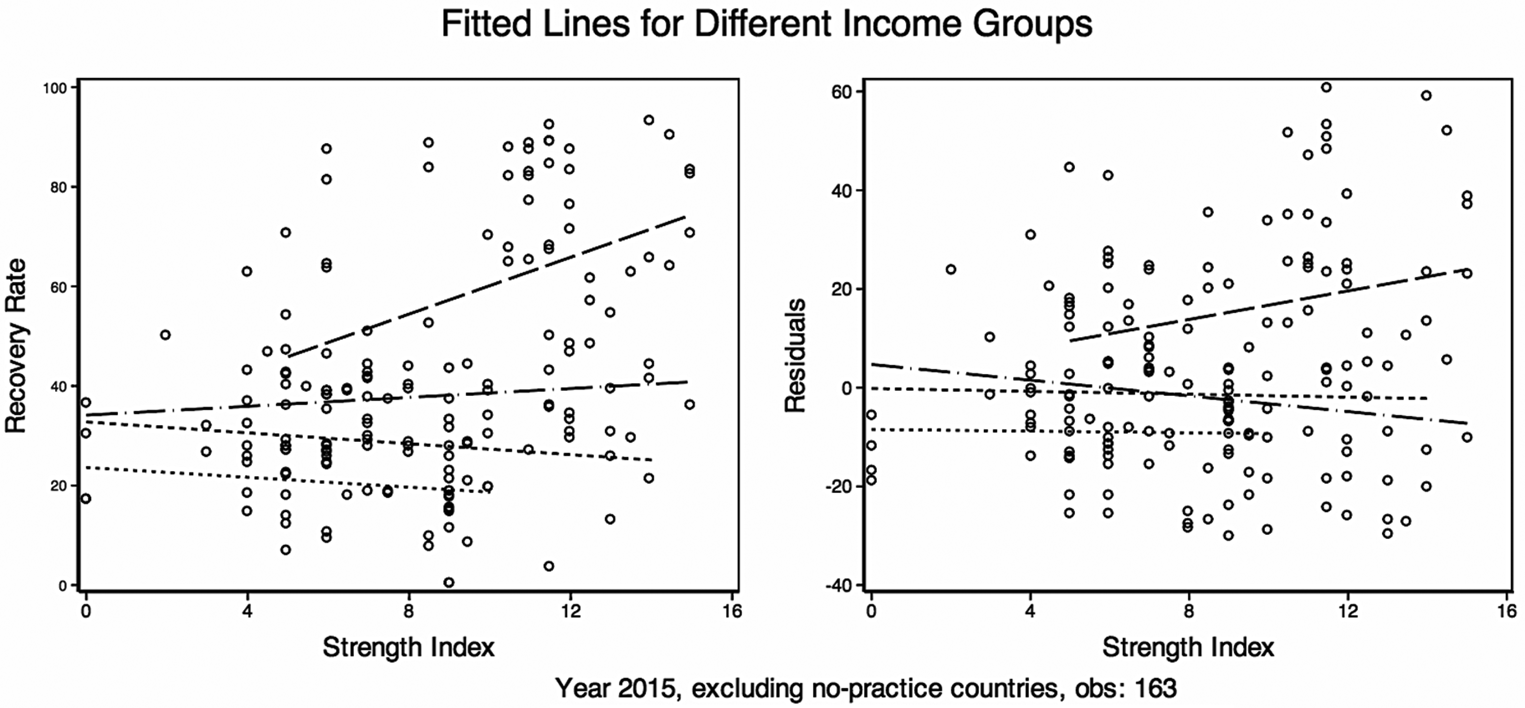
Lastly, it is important to check whether there are categorical effects over the Recovery Rate – that is, whether countries with different levels of economic development respond to the increase in the quality of the bankruptcy regime differently. Figure 3 shows four separate fitted lines showing the relationship between the Strength Index and the Recovery Rate for the four categories of level of income recognised by the WB (low, low–middle, high–middle and high income).Footnote 6 The left-hand side of the chart shows the regression lines without the quality of judiciary control and the right-hand side shows the regression lines with this control. Both sides of the chart indicate that an increase in the Strength Index corresponds to a statistically significantly higher Recovery Rate only for the high-income countries. In fact, for countries with less than a high income (although estimated insignificant in this regression), the correlation might even be negative. This suggests that the positive correlation drawn and presented in the WB DB's association chart for all countries in the dataset might be carrying over the positive correlation for the high-income countries. This means the strongly argued positive correlation between the quality of the law and the performance of the law may not exist, especially for the countries that the WB targets the most as the audience of its DB project.
Scatter plots of Strength Index and Recovery Rate with separate regression lines for different income groups

Of course, these simple tests on the correlation between the quality and the performance of law are not conclusive and cannot dismiss entirely that such a correlation exists. Reforms in the quality of law and the performance of law can affect each other through other mechanisms. However, these tests are sufficiently sophisticated to show that the statistical evidence provided by the DB project is far from conclusively showing a positive correlation between the quality and performance of law.
3.3 The case of Turkey's WB-led insolvency-law reform
Aside from associational charts, the WBDB reports use country case examples to substantiate their claim that the quality and the performance of law are mutually reinforcing or that they work towards a common goal. In a similar vein therefore, this paper uses a country that experienced a WB-led insolvency-law reform and investigates whether the expected positive effects of these legal reforms have materialised in this country in a way that indicates a positive relationship between the quality and the performance of law. The case of Turkey is illuminating, since it is an important middle-income country that adopted a WB-recommended bankruptcy-law reform in the early 2000s. Turkey's example is different from the example of other countries that the WB uses to substantiate its claim (such as Finland and São Tomé and Príncipe, as mentioned earlier).
Turkey made extensive reforms to its bankruptcy-law system in the immediate aftermath of its deepest financial crisis in 2001, which was triggered by 1999 IMF-led exchange-rate-based disinflation programme (Öniş, Reference Öniş2009). Following the crisis, Turkey signed two stand-by agreements with the IMF (in 2001 and 2005), which led the country to promise a bankruptcy-law reform under the guise of the WB advisers invited to the country. A number of WB advisers supervised and observed the bankruptcy-law reforms, legislated in the Turkish parliament in 2003 and 2004. The single most important component of these reforms was the establishment of ‘Postponement of Bankruptcy’ (Iflas Erteleme) – an in-court reorganisation bankruptcy procedure. This replaced an older and outdated reorganisation procedure that already existed in Turkey: ‘Concordat’ (Konkordato).
Postponement of Bankruptcy has several important aspects that align with the ‘good-practice rules’ identified by the WB guidelines and other IOs. First, the law allows both the insolvent debtors and their creditors to initiate any bankruptcy procedure, regardless of size, sector and debt structure. Second, in line with the WB's recommendations (IMF, 1999, p. 41; World Bank, 2001, p. 29), the law uses a ‘liquidity test’ and a ‘rehabilitation plan’. In the rehabilitation plan, the insolvent company should demonstrate that, although it is insolvent, it is still a viable business and can survive its insolvency by a planned future course of action to rehabilitate its finances and business structure. Third, per these recommendations, the Postponement of Bankruptcy includes ‘interim protective measures’ that prevent a ‘premature break-up’ of assets by the creditors (World Bank, 2001, p. 16) and also protect the estate from the debtors’ transfers (IMF, 1999, p. 23).Footnote 7 The court can announce an interim moratorium, which is a period of temporary protection of the debtors’ assets by putting a stay order on all debt-collection proceedings filed against the debtor by its creditors that lasts until the court makes its final decision. During this period, the court also appoints an interim supervising court administrator or a ‘trustee’ to manage the insolvent's assets, whose approval on the management's decisions is necessary for them to come into effect.
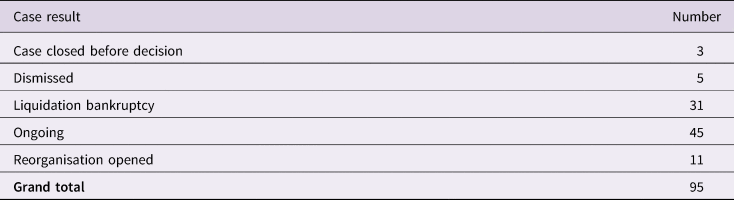
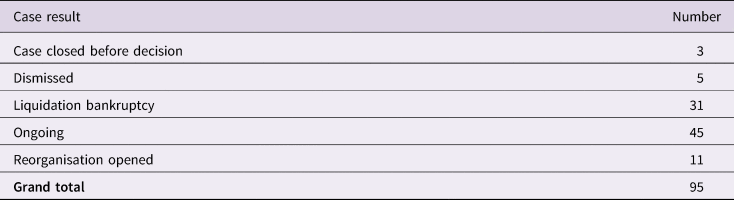
However, despite conforming to the WB's recommended best practices, the Postponement of Bankruptcy could not perform very well and was not effective in recovering debt and keeping the insolvents as going concerns. The statistics from the Turkish Ministry of Justice and the data I collected on the cases filed in Istanbul courts in 2015 (see Table 3) show large inefficiencies. First, the number of companies that filed for and were allowed to pursue a reorganisation bankruptcy was very high, which indicated an inability to filter out the unviable businesses in the early stages. Between 2009 and 2016, approximately 583 Postponement cases were filed and 533 cases were resolved each year, which corresponds to seven postponements for ten liquidations. This ratio is much higher than in economies like the US (2.4 in 2016 (Aacer data in 2017)) and the UK (1 in 2015 (The Insolvency Service data in 2017)) and suggests that a typical insolvent company in Turkey is more likely to be allowed to file for reorganisation than its peers in a developed economy.Footnote 8 Second, the courts approved the reorganisation plans of only very few companies, which shows that, for the majority of cases that were in reorganisation, the court's resources were spent inefficiently and ineffectively. In the same period, according to the state statistics, the courts nationwide approved only 24 per cent of the cases filed for Postponement.Footnote 9 The Postponement filings in Istanbul in 2015 show an even lower rate (see Table 3): among the ninety-five companies in the dataset, only eleven received Postponement and had an open case of reorganisation (11.6 per cent) and the courts decreed liquidation for most rejected companies (about 86 per cent). Furthermore, when these data were being collected (April 2017), the courts still had not made a final decision for forty-five of the cases (47 per cent), which shows how lengthy the trials were.
Case results from 2015 Istanbul Reorganization Bankruptcy Filings
The WB's own calculation of the Recovery Rate in Turkey confirms these findings. According to the WBDB survey, the Recovery Rate in Turkey stood at 18.5 per cent in 2017, which is much lower than the OECD high-income economies (73 per cent). The WBDB survey reports two observations on the Turkish bankruptcy-law system explaining this poor performance, which matches the findings from locally collected data: first, the outcome is almost always ‘piecemeal sale in liquidation after an attempt at reorganization’ and, second, the litigation is on average very lengthy (4.5 years) (World Bank Doing Business 2017 data). The recovery rates are low in Turkey's bankruptcy-law regime because liquidation after a failed reorganisation attempt is less efficient for the creditors than a direct liquidation, since the delays deplete the company's resources and the longer the reorganisation case, the costlier it is for the creditors (Thorburn, Reference Thorburn2000). It is no surprise, then, that the Turkish banking sector has been so strongly critical of the Postponement of Bankruptcy that it demanded substantive changes to the law (The Bank Association of Turkey press conference 2017, read at ANKA, 2007) and that it frequently called Postponement ‘one of the most serious problems for the banking sector’ (Interview with the Participation Banks Association of Turkey Secretary Osman Akyüz, read at T24, 2008).
According to my interviews with the experts in Turkish bankruptcy law,Footnote 10 there are many potential causes for the poor performance of reorganisation bankruptcy laws in Turkey. For example, the underlying economy is not conducive to reorganisation implementation; the banks and the debtor companies can hardly ever successfully negotiate a substantial reorganisation on the debt, due to both parties’ insufficient funds; banks insist on collateral for debt agreements and prefer confiscating their collateral over saving their loans. Furthermore, the Turkish courts are inefficient, slow and run a large backlog, and judges are generally not trained in detecting and differentiating viable businesses. The interim trustees are similarly untrained in managing businesses, or they are corrupt. While these factors contribute to the reorganisation bankruptcy's inefficiency, they also eliminate the beneficial effects that could be attained from having good-quality bankruptcy procedures.
Even more tragically, the best practices promulgated for the bankruptcy laws further deteriorate the situation. In fact, there are common complaints that the quality improvements in the Turkish bankruptcy law caused the debtors’ misuse. While the Turkish insolvent debtors gained greater access to bankruptcy procedures with the reform, they often used this right to empty the companies’ remaining assets while holding off their creditors, in the absence of a sufficient court overview of the process. They also used the liquidity tests to show solvent companies insolvent, which serves towards pushing those companies’ creditors into renegotiating the debt in more favourable terms to the debtors. The rehabilitation plans can similarly be used to paint a more optimistic assessment of the future prospects of the company by exaggerating its past achievements and the viability of its future plans. Lastly, interim protective measures, and especially the interim moratorium, were detrimental to the success of the Postponement of Bankruptcy. Almost every company that applied for the reorganisation bankruptcy law received an interim moratorium at the beginning of the process in order to protect it from its creditors. A company could easily get three to four years of interim moratorium while awaiting the decision of the court and use this period to pressure their creditors.
As a result of this large-scale misuse and inefficiencies, the Turkish reorganisation bankruptcy law was annulled in 2018. Turkey today uses its more outdated reorganisation bankruptcy procedure, ‘Concordat’, which is stricter in terms of the rights of the debtors and obligations of creditors. For example, it demands that a large number of creditors consent to the reorganisation of the debtor's assets before any protection can be issued (Eroğlu, Reference Eroğlu2005). These restrictions are contrary to the current recommendations of the WB to improve the quality of bankruptcy laws. While there are also efficiency problems with this current law (especially in the current economic crisis that Turkey is going through), the country's reversal of its WB-led reform in the quality of bankruptcy laws suggests that such reforms are not always beneficial to the implementing developing economies.
4 Discussion and conclusion
What is the lesson from this investigation on the 2014 reform in the DB project? First of all, this paper showed that, although it was packaged as an improvement to the DB legal indicators, expanding their narrow scope and ‘going beyond efficiency’, the new quality-of-law measures did not overcome the essentially narrow utilitarian point of view on laws and legal systems, assessing their importance only in relation to economic outcomes. However, this paper also underlined a conceptual distinction between the quality- and performance-of-law measurement. The new quality-of-law indicators rely on an older utilitarian perspective that investigates laws’ benefits in terms of distributing legal rights and obligations, which shapes economic incentives and relationships. Unlike the previous performance-of-law indicators, these new indicators are not concerned with the economic efficiency of the legal procedures and their immediate economic costs. Thus, one benefit of this expansion for the DB project is to promote new ‘best-practice’ laws that reorganise and manage legal rights and duties, rather than just procedural recommendations.
Second, this paper also inquired into the scientific accuracy of the WB's claim that the quality and performance of law are positively correlated. Even if we accepted the construct accuracy of the performance- and quality-of-law indicators individually, this claimed connection between them might still lack empirical accuracy. In order to test this claim, this paper focused on a specific set of legal indicators from the DB dataset: Resolving Insolvency Indicators. The empirical tests in this paper showed that the macro-level evidence for the claimed positive correlation is very weak and can easily be disproved by adding more controls or checking group effects while running the statistical tests for this correlation. Furthermore, the case-study on Turkey complemented these macro-level tests by showing the types of local factors that can lead to a disjuncture between the performance and quality of law in bankruptcy. Even though Turkey improved the quality of its bankruptcy-law system by following the recommendations of the WB, the efficiency of its system regressed even further with these improvements because of the local inefficiencies in courts, judicial bureaucracy and the widespread abuse by the debtors. This was also an important counterexample to the country case-studies provided as evidence inside the DB reports.
If the empirical evidence for this correlation is very weak, why did the DB project reports make this claim? Unfortunately, this paper does not have any empirically supported explanation, and further research on the DB indicators must inquire into the real reasons behind this argument with new empirical data. But it is possible to speculate what might have led to this correlation claim after the 2014 data revision. First, since the creation of the new performance-of-law indicators coincided with this new correlation claim, we can argue that it was simply a rhetorical devise to legitimate and substantiate why the new indicators were created. This claim can help to sustain the DB project's image of internal consistency with its new legal indicators. It may have also had the additional political effect of encouraging policy-makers to adopt the DB project's ‘best-practice’ laws and legal-reform recommendations as a whole, as a single package, rather than a list of discrete reform suggestions that countries can select from.
A second potential reason can be derived from the previous research on how national policy-makers receive and implement legal ‘best practices’ that change the legal rights and duties of economic actors. The sociological analysis of bankruptcy laws by Carruthers and Halliday (Reference Carruthers and Halliday1998) can provide us with some clues. It suggests that bankruptcy
‘lays bare simultaneously many of the power relations and economic interest that surround a firm. Since bankrupt firms cannot meet all their liabilities, there is a shortfall that must be distributed among claimants whose interests are consequently in conflict. One creditor's loss is another one's gain.’ (Carruthers and Halliday, Reference Carruthers and Halliday1998, p. 30)
When changes are made to the creditors’ and debtors’ rights in bankruptcy law, the losses of bankruptcy are distributed differently among the different economic actors involved in the process, namely the creditors, managers, shareholders, workers, etc. Therefore, these changes have large-scale consequences in reshuffling the power relations between lenders and borrowers in all parts of the economy. Consequently, the WB promoted best practices in bankruptcy law that include, for example, an increase in the rights of the debtors over their remaining assets or a decrease in their obligations towards their creditors can invoke opposition from the creditors and can be vetoed by the local politicians who represent these financial interests.
The procedural reform recommendations, on the other hand, may be easier to politically digest. For example, the WB's recommendations on how to improve the procedures of bankruptcy laws include reductions in the bankruptcy courts’ fees for debtors and creditors, giving judges new procedural ways to fast-track the evaluation of cases, using more accounting experts and expertise, and creating special bankruptcy courts that can process bankruptcy cases more efficiently. These are easier to formally comply with than the legal-right- and obligation-revision recommendations, since they are possibly less politically divisive. Furthermore, developing countries can make these procedural reforms as ‘symbolic adoptions’ to satisfy the IOs’ demands.
Indeed, this hypothesis is supported by Halliday and Carruthers’ further research (Reference Halliday and Carruthers2007) on bankruptcy-law reforms in Asian countries due to external pressures from international financial organisations (IFIs) including the WB. When pressured to reform bankruptcy laws, countries can be selective and only adopt the performance reforms that involve procedural changes, while holding off on the changes to legal rights and obligations. After the Asian financial crisis, most Asian countries were willing to create new specialised bankruptcy courts and procedures, out-of-court restructuring agencies and even specialised professionals to handle bankruptcy cases to increase the efficiency of case handling when they were pressured for these adoptions by the IOs. However, they were not so willing to adopt the legal-rights and duties recommendations. For example:
‘Korea did not adopt several provisions strongly recommended by the International Financial Institutions (IFIs) …. It did not include full debtor-in-possession, following the U.S. model. Nor did it provide a special “super-priority” for new financing while a company was in bankruptcy. Its protection of creditors’ assets in bankruptcy was less comprehensive than the World Bank standards.’ (Halliday and Carruthers, Reference Halliday and Carruthers2007, p. 237)
Therefore, the correlation between the quality and performance of law might have also played a role in attaching the less politically popular legal-rights and obligation ‘best practices’ onto procedural reform recommendations by the WB. If this correlation was true, then countries would receive fewer benefits from solely implementing procedural reforms. This can discourage national policy-makers from selectively adopting the WB's recommendations, as was the case in the Asian countries. Further empirical research on the DB legal indicators should inquire whether this was indeed the intention of the DB team when they claimed that ‘quality and efficiency go hand in hand’.
Conflicts of Interest
None
Acknowledgements
I thank Bruce Carruthers, Leonard Seabrooke, Stephen Nelson, Charles Camic, Mark Ebers, Mathias Siems, Laura Garcia and Onur Özgöde for comments, and the Northwestern University Sociology Department and Keyman Turkish Studies Program at the Buffett Institute for Global Studies for funding this research.
Appendix
Breakdown of Resolving Insolvency Indicators