Mass population movements of deportees, evacuees, refugees, soldiers, and others are a characteristic feature of early Soviet history. Some forms of migratory violence peaked during the experience of total war in the 1940s, but others continued beyond the cessation of wartime hostilities. This was the case in the South Caucasus, which narrowly avoided German occupation, and some of the widespread civilian upheaval that stalked other parts of the Soviet Union during World War II, but nonetheless hosted successive wartime and postwar forced migrations that disrupted local communities.
The region was on the frontline of the Soviet-German encounter in the North Caucasus, the Allied occupation of Iran, and escalating tensions with Turkey. In one way or another, most mass migrations in the South Caucasus at this time were linked to these three factors. From the late 1930s through the 1940s, Soviet officials framed some targeted nationalities in the South Caucasus—Greeks, Meskhetian Turks, Kurds, Germans, and others—as potentially untrustworthy or uncooperative and deported them in part or in whole to Siberia and Central Asia.Footnote 1 Developments abroad, meanwhile, brought thousands of others to the region. For example, the Iranian Crisis of 1946 drove people from Iran to the Caucasus after the Soviet government ended its support for the Azerbaijan People's Government and Kurdish Republic of Mahabad in Iran. Approximately 100,000 diaspora Armenians also moved to Soviet Armenia from the Middle East, United States, and Europe in the late 1940s.Footnote 2 Iosif Stalin sanctioned their repatriation to help rejuvenate postwar Soviet Armenia, but the scheme was also intertwined with the declining Soviet-Turkish relationship and Soviet pretensions to Turkish territory.
These nationality-driven migrations, and national deportations in particular, have rightly attracted significant popular and scholarly attention. Deportations tended to be swift, violent, and decisive, with deportees finding themselves exiled to areas hundreds, if not thousands, of miles away from home. They help us understand the essentializing way in which the Soviet leadership defined nationality, its widespread use of forced migration as a policy solution, its remarkable ability to violently uproot and relocate hundreds of thousands of people in a matter of days, and processes of minoritization in the Soviet Union.
The case of Georgia demonstrates the active role that local elites there and elsewhere in the Soviet Union could play in crafting expulsion policies and the way in which republic leaderships could exploit Moscow's mistrust of borderland populations to rid their republics of unwanted peoples. In 1944, for example, the Georgian leadership advocated expanding wartime deportation orders targeting minoritized national communities in the republic. Meskhetian Turks, Kurds, and Khemshins were officially singled out for deportation, but thousands of Azeris were also caught up in these operations. Michael Westren argues that Georgian officials “use[d] the operation against the Meskhetian groups as a cover to rid their republic of other undesirable groups.”Footnote 3 The Georgian leadership also overperformed during Operation Volna in 1949, which targeted so-called Dashnak Armenians, former and current Turkish and Greek citizens, and stateless Turks and Greeks in the three republics of the South Caucasus and Black Sea coastal areas of the Ukrainian and Russian republics. Then, later that year, Georgian Communist Party First Secretary Kandid Charkviani led the expulsion of several thousand people with a history of Iranian citizenship, including ethnic Armenians, Azeris, Iranians, and others on the grounds that they were poorly acculturated to the Soviet way of life and posed a security threat due to their borderland residences and foreign connections.Footnote 4
The resettlement of approximately 45,000 Azeris from Armenia to Azerbaijan between 1948 and 1953 overlapped with the deportations and repatriations that were remaking the South Caucasus and exacerbating local anxieties.Footnote 5 A number of historians, politicians, and commentators have even characterized this resettlement as a national deportation similar to, if not worse than, what happened to Balkars, Chechens, and others.Footnote 6 This position is popular in Azerbaijan, where histories of the resettlement are often entangled in enduring discursive contestations tied to the long-running conflict over Nagorno-Karabakh. In this context, histories of Armenian-Azeri relations take center stage and are brandished—on both sides—as evidence of one another's historical wrongdoing.Footnote 7
At a time when security and military forces were expelling hundreds of thousands of people from the Caucasus on the basis of their nationality, many Azeris in Armenia suspected that they too were being targeted and pushed out of their homes because of who they were and how they were identified by others. They often endured an uncomfortable journey to Azerbaijan and were exposed to inhumane conditions once they arrived at their destinations. In short, when they evaluated their experiences, many resettled Azeris recognized similarities between what happened to them and the deportations that were being carried out around them.
State officials used the term “resettlement” (pereselenie) when referring to a variety of migration regimes, including deportations and economic resettlements. The use of force was a defining feature of Soviet national deportations, but deportations did not hold a monopoly on state violence. As Rebecca Manley argued in her study of Soviet evacuations during World War II, there was a “vast gray zone dividing forced from unforced migration in Soviet society under Stalin.”Footnote 8 Nationality and state violence were signal features of the Kura-Araks migration, and it took place against a backdrop of widespread national deportations, but interpreting it as such flattens the complex decisions and actions that comprised it. As Lewis Siegelbaum and Leslie Page Moch have noted in their study of Soviet migration, from the 1930s onward, the state aimed “to align the population with natural resources” through resettlement and other migration practices.Footnote 9 The resettlement of Azeris to Armenia had a clear national component, but it also advanced transformative social and economic objectives that aimed to maximize the region's agricultural potential by expanding its irrigation infrastructure, creating new arable lands for valuable crops like cotton, and moving highland communities to kolkhozes in these newly irrigated lowland areas.
The planning and execution of this resettlement help us better understand what postwar rebuilding looked like in the Soviet Caucasus, as well as the interplay of economic and national interests in state resettlements. It also tells a perhaps unexpected story about popular agency. Some Azeris in Armenia embraced this opportunity to move to Azerbaijan while many others exhibited a remarkable ability to resist, and ultimately to derail, government plans that, at one point, involved moving nearly all Azeris in Armenia to Azerbaijan. Azeris in Armenia were also more than their nationality; many were agricultural workers who performed essential labor for Armenia's postwar economic development. Some officials in Azerbaijan and Armenia joined resettlers in subverting state migration plans, rendering high-level resettlement targets unattainable despite the continued commitment of other officials from the two republics and Moscow to this resettlement scheme. Many Azeris in Armenia were compelled to resettle in Soviet Azerbaijan and suffered immensely as a result, but state officials ultimately proved unwilling to force en masse compliance with their resettlement plans. There were imbricated features of migration in the Soviet Union, and state violence and nationality targeting carried across many of them, but different migration regimes also had their own defining characteristics.
The Resettlement
From Proposal to Decree
In December 1947, Azerbaijan Communist Party First Secretary Mir Jafar Bagirov and Armenian First Secretary Grigor Arutiunov submitted a migration proposal to “Comrade Stalin,” calling for the resettlement of Armenia's Azeri population—said to number 130,000 people—to Azerbaijan's Kura-Araks lowlands.Footnote 10 This proposal laid the groundwork for a Council of Ministers decree in late December, which called for the resettlement of kolkhozniks and other Azeris from the Armenian SSR to the Kura-Araks region of the Azerbaijan SSR, and a subsequent Council of Ministers decree in March 1948. As head of the Council of Ministers, Stalin authorized in these decrees the “voluntary” resettlement of 100,000 Azeris from Armenia to the Kura-Araks region of Azerbaijan—10,000 in 1948, 40,000 in 1949, and 50,000 in 1950. Corresponding decrees issued in Baku and Yerevan included extensive instructions about state financing for this resettlement and migrant benefits.
The Council of Ministers decree that formalized the state's resettlement plan in late December was slightly different in scope from the Bagirov-Arutiunov proposal submitted earlier that month. Echoing 1939 census data, Bagirov and Arutiunov had indicated that there were 130,000 Azeris in Armenia who potentially could be resettled to Azerbaijan, but the decree called for the resettlement of 100,000 Azeris.Footnote 11 Although this figure potentially left room for some Azeris to remain in Armenia, state officials clearly conceived of this as a mass resettlement and anticipated limited future demand in Armenia for Azeri national resources. On July 1, 1948, for example, the Council of Ministers in Azerbaijan decreed that, “in connection with the impending resettlement of the Azerbaijani population from the Armenian SSR to the Azerbaijani SSR,” the Azerbaijani Ministry of Education would merge Azerbaijani sectors of some higher education institutes in Armenia with their Azerbaijan SSR equivalents, find teaching jobs in Azerbaijan for the instructors who moved, and relocate the Azerbaijani pedagogical training school (uchilishche) from Armenia to Khanlar, Azerbaijan (itself a recent site of German deportation).Footnote 12
The Bagirov-Arutiunov proposal is controversial in Azerbaijan today because it implicates Bagirov (and the Azerbaijani leadership more generally) in the resettlement plan. Some scholars have simply left the proposal—and other evidence of local complicity—out of their histories of this migration.Footnote 13 Others acknowledge the existence of the Bagirov-Arutiunov proposal but downplay Bagirov's role in writing and approving it. Atakhan Pashayev, long-time head of the Azerbaijan National Archives, attributes the deportation to Armenian “cunning, deceit, and treachery,”Footnote 14 while historian El΄dar Ismailov speculates that the proposal from Bagirov and Arutiunov was staged to justify a decision that Stalin had already made to compensate, in part, for failed plans to expand Soviet Armenia.Footnote 15 Jamil Hasanli, meanwhile, constructs a timeline of Bagirov, Arutiunov, and Stalin's activities in December 1947 to juxtapose a weak Bagirov with a calculating Arutiunov, but this timeline relies on several assumptions to minimize Bagirov's agency in this process.Footnote 16 In general, contemporary Azerbaijani historiography elides the active role that some politicians and state officials from Azerbaijan played in this resettlement.
The incomplete declassification of Politburo archival records leaves many questions unanswered on this front, but, as it stands now, there is no evidentiary reason to think that Bagirov was as ineffective as he has been portrayed in these accounts. He was a powerful Party leader who was close to Lavrentii Beriia and in recent years had coordinated the Soviet occupation of northern Iran and parried Arutiunov and Charkviani's respective attempts to annex the Nagorno-Karabakh and Saingilo regions of Azerbaijan. Bagirov was hardly subservient to or a pawn of his Armenian and Georgian peers.
Indeed, it is quite possible that elites in both Azerbaijan and Armenia thought that they had something to gain from this resettlement. As Bagirov and Arutiunov explained in their joint proposal, new areas of Azerbaijan were being irrigated thanks to the construction of the Mingachevir Dam in the republic, but Azerbaijan did not have the requisite labor force to maximize this infrastructural development and increase its cotton yield. The Bagirov and Arutiunov proposal, which, no doubt was shaped by Stalin's input, posited that the resettlement (pereselenie) of Armenia's Azeri population could solve this problem. They additionally speculated that it would “facilitate conditions for the reception and establishment (ustroistvо) of Armenians returning to their homeland from foreign countries.”Footnote 17
A salient national component is at play here, but the economic concerns articulated in the proposal and decree also demand consideration. Azerbaijan was an essential part of the Soviet cotton harvest, which Stalin had categorized as a strategic sector of the economy (along with metals, fuels, and grains).Footnote 18 Numerous measures to transform the landscape by building dams and expanding the irrigation system in areas suitable—or potentially suitable—for cotton and grain cultivation thus assumed a central role in Soviet postwar economic planning, including in the fourth Five-Year Plan, which was launched in 1946. The Mingachevir Dam, Hydroelectric Station, and Reservoir project on the Kura River in Azerbaijan and related expansion of irrigated areas in the Kura-Araks lowlands were essential components of development plans in the South Caucasus. Construction work at the Mingachevir site had been put on hold during the war, but resumed as the conflict drew to a close. Soviet officials believed that if they brought additional human and water resources to the vast Kura-Araks region of Azerbaijan, then they could cultivate high yields of quality cotton and other products there.Footnote 19
Local officials discovered, however, that this was easier said than done. Given postwar labor shortages, irrigation construction project leaders in Azerbaijan faced immense pressure from Moscow as they struggled to staff various work sites. Kura-Araks infrastructure projects had been relying in part on workers from central Russia and elsewhere, for example, but this option was closing as contracts were expiring and workers leaving for other sites. In the late 1940s and early 1950s, hundreds of thousands of people were moving (or being moved) around the country for initiatives designed to reshape the postwar Soviet economy and landscape. They were going to Arkhangel΄sk and Karelia to work in the forestry and paper industry; to Sakhalin to labor in fisheries; to the Volga region to construct the Volga-Don Canal and related infrastructure such as new bridges, highways, and railways; and out of “unproductive” mountain settlements to lowland areas cultivating a variety of prioritized crops. In the summer of 1947, Kura-Araks development agency leaders thus emphasized in their reports that, since they also could not count on forced “special contingent” (spetskontingent) or local prison labor, it was necessary to find other labor pools closer to home and noted that kolkhozniks performed irrigation work in other republics.Footnote 20
Another problem was looming on the horizon. Agencies were struggling to staff infrastructure jobs in the Kura-Araks region and facing criticism from Moscow inspectors about missing development targets, but they also had to figure out who was going to grow and pick the cotton and other crops that were supposed to be cultivated in these soon-to-be irrigated areas. Large-scale migrations like the one that Bagirov and Arutiunov proposed are what helped the Soviet state transform steppes into blooming fields that bolstered the all-Union economy.Footnote 21 Uzbekistan, Tajikistan, and other republics under pressure to increase cotton yields and make use of newly irrigated areas carried out similar mass resettlements in coordination with the Main Resettlement Administration in the postwar period, sometimes drawing on internal labor and other times participating in interrepublic migration arrangements.Footnote 22 Taking this into consideration, it is important to note that this migration proposal—and the Stalin-endorsed Council of Ministers decree—targeted not just Azeris in Armenia, but Azeri kolkhozniks in particular. The plan was to resettle these migrants specifically in the Kura-Araks region of Soviet Azerbaijan, a prospective cradle of the Soviet cotton industry.
Resettlement plans
The design of this resettlement mirrors the typology that Siegelbaum and Moch have described for economic resettlements in the USSR.Footnote 23 At the start of the process, the wartime Department for the Economic Organization for the Evacuation and Relocation of Collective Farms of Azerbaijan was reorganized into the Azerbaijan Soviet Socialist Republic Resettlement Administration and developed its presence on the ground in Yerevan. The Azerbaijani branch of the Resettlement Administration subsequently worked with its Armenian counterpart and Moscow to coordinate and execute this interrepublic migration arrangement.
Resettlement offices across the USSR used pamphlets, posters, brochures, and other materials to recruit migrants in the late Stalinist period.Footnote 24 This was also the case here, with the All-Union Ministry of Agriculture, Azerbaijan Council of Ministers, the Administration of the Development of Irrigated Land in the Kura-Araks Lowland, and other agencies collaborating on campaigns to promote awareness of and migration to the Kura-Araks zone. In 1948, republic officials in Azerbaijan printed Azerbaijani- and Russian-language copies of the 1937 All-Union Central Executive Committee (TsIK) and Sovnarkom decree about agricultural privileges for resettlement authorities to distribute, as well as an Azerbaijani-language brochure about the national economic significance of the Kura-Araks region.Footnote 25
State officials at times referred to the Kura-Araks zone as a barren or hungry steppe in private, but a brochure developed for public consumption in 1948 carefully cultivated the opposite impression. Crafted by a Kura-Araks development agency and issued in the name of the Soviet Ministry of Agriculture and Azerbaijan Council of Ministers, this brochure directly tied Kura-Araks migration to the construction of the Mingachevir hydroelectric complex and described the economy and climate in the region, the process of migration, and financial assistance for resettlers in glowing terms. In the opening pages, the authors appeared to speak directly to one of the target populations of the resettlement—Azeris living in mountainous areas of Armenia. Portraying high elevation settlements as cold, snow-bound, and yielding minimal arable land and crops, they then praised the low-lying steppes of the Kura-Araks lowlands. Blessed with both mild winters and exceptionally fertile and abundant land, the lowlands are positioned as the ultimate contrast to less productive and harsh highlands.Footnote 26
The resettlement initially targeted highlanders because it was thought that their labor would be better utilized in high-productivity agricultural kolkhozes and sovkhozes. This reflected an All-Union effort to “repurpose” highlanders, disrupting remote communities and better integrating their inhabitants into the Soviet way of life, culture, and society. We see this occurring in mountainous communities throughout the Soviet Union at this time, including in Armenia, Azerbaijan, Georgia, North Ossetia, Dagestan, Tajikistan, and elsewhere.Footnote 27 For example, between 1952 and 1955, more than 14,000 people were moved to the Kura-Araks lowlands from the mountainous Lerik, Lankaran, Yardimli, Astrakhan-Bazar, and Astara regions of Azerbaijan that bordered Iran, most of which had a large population of ethnic Talyshes, a minoritized nontitular nationality in the republic.Footnote 28
Having sold potential migrants on the natural benefits of the region, the authors extolled its technical and infrastructural achievements, including new irrigation systems, abundant machine tractor stations, and the powerful Mingachevir Hydroelectric Station that made so much of this possible.Footnote 29 To counteract concerns that this might be a hostile, undeveloped, and uninhabited place, they described a veritable wonderland with new roads and bridges for vehicles, homes for migrants, and electrification systems for new and old kolkhozes. With this infrastructure still under development, prospective resettlers were assured that stipends, transportation, medical and veterinary assistance, and other benefits including tax breaks and credits would ease their transition.Footnote 30 Finally, the authors appealed to the migrants’ patriotism, imploring:
Our country must have as much cotton as possible. Cotton is widely used throughout the national economy and is necessary to strengthen the military power of the country. Comrade Stalin, as is known, put cotton on par with grain, fuel, and metal
In the regions of the Kura-Araks lowland, most collective farms have no surplus labor. They have a lot of land, crops are produced over a large area, and kolkhozniks barely have enough time to take care of the crops and cope with their households
That means there is only one possible solution: in order to use the vast and fertile land of the Kura-Araks lowland it is necessary to resettle thousands of kolkhozniks there.Footnote 31
According to this brochure, the Kura-Araks lowland was simply waiting for migrants whose labor would transform the local economy but also contribute to a higher purpose—the defense of a beloved Motherland still rebuilding from a devastating war.
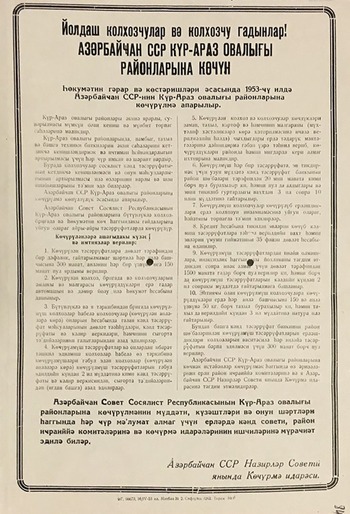
Azerbaijani resettlement officials also collaborated on posters like the Azerbaijani-language one below, which boasted that the fertile, irrigated land of the Kura-Araks region would be ideal for growing cotton and wheat but also for cattle breeding (Figure 1). Officials emphasized that the resettlement was voluntary and carried out according to the rules and regulations of the Azerbaijan Soviet Socialist Republic. Finally, they advertised the benefits that would be bestowed upon people who agreed to be resettled to this area, including one-time payments; free transportation of livestock and moveable property; short-term tax exemptions; plans for infrastructural development in the migration zone; crops, seed, and livestock to replace those left behind and credit to acquire more; as well as financial assistance to build houses in the Kura-Araks zone.Footnote 32
Kura-Araks resettlement poster targeting potential Azeri resettlers (RGAE, f. 5675 op.1 d. 413 ll. 5–6).

Some historians who study this resettlement have tied the 1937 decree on agricultural migrant privileges to deportations in order to argue that this was also a deportation.Footnote 33 It is important to note, however, that this decree and similar benefits were broadly applied to different migrations, including resettlements to the Kura-Araks region that exhibited varying levels of compulsion. When more than 400 households (2,267 people) were moved from the Talysh-majority Lerik region of Soviet Azerbaijan to the Kura-Araks zone in 1952 by decree of the republic's Council of Ministers and Bureau of the Central Committee, for example, they received benefits not unlike those given to other agricultural migrants. Resettlement officials characterized their migration as voluntary, but, like their Azeri counterparts relocated to the area from Armenia, some of these migrants later begged to return home or, if that was not possible, to be moved to more climatically and topographically familiar regions.Footnote 34
After republic officials negotiated interrepublic migration plans, Armenian and Azeri resettlement agents visited targeted communities. They were tasked with familiarizing Azeris in Armenia with the resettlement decree, the Kura-Araks region, migration benefits, and the principle of “voluntary migration.” Some villages subsequently sent scouts to proposed resettlement regions in Azerbaijan to assess relocation sites and report back to their community. Kolkhozniks would then submit their documents to their village council, which coordinated the migration with regional executive committees and resettlement offices. Once applications for resettlement were approved, resettlement authorities were instructed to generate resettlement tickets and stipends, help migrants sell their homes, and provide compensation for immovable property.Footnote 35
Migration officials frequently missed resettlement targets. Sometimes, this happened because kolkhozniks who the state wanted to resettle refused to move. In these cases, a variety of alternative plans could be put into place. When only part of a kolkhoz community consented to relocation, for example, local officials, along with representatives from the agricultural ministries, restructured changing kolkhoz communities. Resettlement officials also sometimes adjusted their migration plans to replace people who refused to move with willing migrants who lived in areas outside those initially designated for resettlement.
Azeri resettlers were sometimes transported to Azerbaijan in repurposed freight cars. This made for a difficult journey, but as Siegelbaum and Moch have pointed out, this mode of transportation was common for mass population movements in the Russian empire and Soviet Union, where differentiation among categories of migrants frequently broke down in the process of relocation.Footnote 36 Advance work was supposed to be carried out in receiving villages so migrants would be greeted after their long, hard journeys with food, tea, and comrades ready to welcome them to their new homes.
The Reality of Migration to the Kura-Araks Zone
The experience of this mass migration frequently contradicted state plans and promises. At nearly every step along the way, migrant rights were willfully disregarded or violated, sometimes purposefully but also because of central, regional, and local government ineptitude and conflict. In this way, the Kura-Araks resettlement resembles many other large-scale resettlements in the USSR, where the grand ambitions of policymakers resulted in inhumane experiences for many of the Soviet citizens caught in the planners’ crosshairs. It also reveals, however, ways in which Soviet citizens were able to resist, and even change, state resettlement aspirations.
Indeed, many people understood how they could defend their interests within the confines of late Stalinist politics and society. This migration provides ample evidence of compulsion and suffering, but also of people asserting their rights and desires in a tumultuous landscape. The plan to relocate 100,000 Azeris from Armenia to Azerbaijan fell far short of this goal because of state mismanagement, but also because many Azeris who were resettled—or who were supposed to be resettled—to Azerbaijan repeatedly forced officials to revise their plans.
The 1947 decree mandated that the migration take place between 1948 and 1950, but the resettlement lasted several more years. The decree also called for a rapid escalation of Azeri migration in this period—10,000 people in 1948, 40,000 in 1949, and 50,000 in 1950—but the Resettlement Administration missed every single target. In terms of this measurement, resettlement officials achieved the most success in 1948, when they facilitated the migration of 9,681 Azeris to the Kura-Araks region of Azerbaijan. Even though the Administration resettled more Azeris (11,824) in 1949, the goal of moving 40,000 Azeris from Armenia to Azerbaijan that year proved illusory. According to Azerbaijan's Resettlement Administration, there was basically no migration plan that year because officials in Baku and Yerevan believed the targets were unattainable.Footnote 37
By 1950, state officials had revised resettlement objectives and extended the resettlement timeline, perhaps in stark recognition that there was no way for them to meet the targets detailed in the original decree. The initial goal of moving 50,000 Azeris to Azerbaijan in 1950 was reduced to 15,000, but even this proved too ambitious: only 12,932 Azeris were resettled from Armenia to Azerbaijan that year.Footnote 38 By the end of 1950, resettlement authorities had fulfilled approximately 35% of the 1947 plan to relocate 100,000 Azeris in three years. A year later, the total number of Azeris moved from Armenia to the Kura-Araks region was only slightly higher—39,870 people (8,948 households), less than 40% of the planned 100,000 migrants.Footnote 39 Other Soviet resettlements at this time also fell short of their stated targets, but the failure rate in the Kura-Araks case was high.Footnote 40
From the start, Azeris targeted by these resettlement plans were skeptical about the “principle of voluntariness.” People living in the Caucasus knew about forced deportations in the broader region, and Azeris in Armenia were aware that Armenians and others often equated them with Turks and Turkey, an equivalency that had become increasingly dangerous. An Azeri university student from Yerevan, for example, complained to Comrade Stalin that people in Yerevan were talking about how they were going to “expel” the “Tiurks.” He wanted to make it clear to Stalin that Azeris in Armenia were “Azerbaijanis” and distinct from Turks.Footnote 41 Some Azeris were also concerned that the Soviet government did not trust their loyalty if the USSR went to war with Turkey. Given ongoing deportations of other Muslims, including some Azeris, from the Soviet-Turkish borderlands, some Azeris in Armenia thought that they too would be forcibly removed from their homes. As one Azeri man in Kuzukend village reportedly told his fellow kolkhozniks: “They say that the resettlement will be on a voluntary basis. This is not true. They will do the same to us as they did to the Azerbaijanis in Akhalkalaki [Georgia]: they will put us in railway cars and go to Kazakhstan. In order to not be taken by surprise, you need to be prepared.” Others feared that they had no choice but to leave Armenia given the potential for anti-Azeri violence there if the Soviet Union went to war with Turkey.Footnote 42
Some Azeris expressed both anger and fear at their potential relocation to Azerbaijan. Hearing rumors that they were being moved to make way for repatriated Armenians, some Azeris destroyed their orchards, homes, and other buildings to keep them out of repatriate hands, stopped going to work, sold or killed their livestock, and visited family graves to pray that they would not be removed from their homes.Footnote 43 Others, like Mukhtar Darvishali oglu Guliev, an 80-year-old kolkhoznik from Urut village, reflected on the recent history of Armenian and Azeri interethnic violence and dreaded what might be coming their way. In a desperate letter he sent to Stalin, Guliev recalled that he fled to Azerbaijan thirty years earlier when “Dashnak bands” drove Azeris out of Armenia and recounted the subsequent death of highlanders like himself who could not countenance the climatic conditions where they sought refuge in Azerbaijan. In closing, he asked his “dear and beloved leader (vozhd΄)” to help them stay in Armenia.Footnote 44
Many Azeris like Guliev feared they would be compelled to move and, indeed, this was sometimes the case. For example, a kolkhoznik from Sabunchi village in the Kamarlin region of Armenia complained to Azerbaijan's Council of Ministers that his community had moved to Azerbaijan because resettlement agents, Balabek Martirosyan and Usein Mamedov, came to their village and told them that “the Azerbaijani population must be resettled to the AzSSR (Azerbaijan Soviet Socialist Republic).” That is, the Council of Ministers decree was presented as a directive rather than an opportunity. As a result, he and his fellow kolkhozniks relocated, losing livestock and other resources along the way. Villagers from Abilkyand and Guludzhan in Armenia's Echmiadzin region told a similar story in their collective complaints. Although they had since returned home to Armenia, they were struggling to reestablish themselves. In a series of letters sent in 1956 to Baku, Moscow, and Yerevan after Nikita Khrushchev's denunciation of Stalin and his terror, they incorporated this discourse into their petitions and alternately claimed that they had been “evacuated” and “forcibly” (nasil΄no) resettled.Footnote 45 State officials also noted that Azeri villagers in Armenia were known to feign enthusiasm in meetings with resettlement officials, but express displeasure with the migration scheme in private conversations. Their unwillingness to articulate a critical position in the presence of state officials illustrates the compromised nature of “voluntariness” in this migration and the generally repressive environment in which they lived.Footnote 46
This is not unique to this resettlement, however. Resettlement officials throughout the USSR were known to pressure people into compliance without using physical force or strictly violating the principle of voluntariness included in resettlement decrees. For example, the migration of several hundred households from the Bandasar sel΄sovet in the Astara region (a Talysh-majority area of Azerbaijan bordering Iran) to the Kura-Araks zone was folded into compensated republic resettlement plans, but these Bandasar migrants had little choice but to leave their homes: in 1953, the Azerbaijan Minister of Security S. Emel΄yanov noted in a top-secret report that physical distance had to be put between them and their relatives in Iran.Footnote 47 Similarly, when highlanders “voluntarily” moved from Tajikistan's upper Zeravshan Valley to the Nau and Proletarsk cotton-growing districts in the 1950s, the authorities “persuaded” them to relocate by closing local grocery stores and starving them out of their home villages.Footnote 48 That is, although resettlement decrees often described such migrations as voluntary, this was not necessarily a defining component of these migrations.Footnote 49
While it is clear that many Azeris were compelled to leave Armenia, archival sources also show that others successfully undermined resettlement plans and stayed in their homes. This accounts, at least in part, for why Armenian authorities increasingly informed their counterparts in Moscow and Baku that resettlement plans were unattainable because not enough Azeris were willing to resettle in Azerbaijan. Rumors were spreading among Azeris in Armenia about mismanaged moves and poor conditions in the Kura-Araks zone, discouraging further migration to the region. In 1951, for example, Armenian resettlement authorities informed their Moscow colleagues that they had received only 127 resettlement applications for the fall resettlement from the Kalinsky, Krasnosel΄sky, and Vedi regions. They further noted that Azeris were reluctant to migrate because they had good material conditions in Armenia, disliked climatic differences between the mountains of Armenia and the Kura-Araks lowlands, and were discouraged by the return of many Azeris to Armenia.Footnote 50
What was so bad about moving to the Kura-Araks region in Azerbaijan? Well, for some people just about everything. The journey itself was often pockmarked with delays, mistakes, and mismanagement. Sometimes cattle died in transit or upon arrival because trains were overloaded, feedings were disorganized, or conditions simply were too harsh.Footnote 51 Furthermore, local officials in Azerbaijan often did not know when migrants were arriving from Armenia because resettlement authorities in the two republics frequently failed to coordinate transportation plans. The consequence, of course, was that Azeris found themselves stranded on train platforms in Armenia but also upon arrival in Azerbaijan, with no one on hand to meet, transport, and accommodate them when they reached the Kura-Araks region.Footnote 52
Living conditions in the resettlement zone were perhaps the worst part of this experience for many migrants. Resettlement officials boasted about Kura-Araks infrastructural development, but migrants were lucky if they had a house to move into or received the personal plot promised to them. In 1949, only 53% of the households that moved to Azerbaijan as part of this migration scheme acquired their own homes. This percentage improved with time, but slowly. As of January 1, 1952, 6,783 homes had been built for the 8,759 households (37,387 people) that had moved to the Kura-Araks region from Armenia since 1948. That is, nearly a quarter of migrant households were still homeless or sharing accommodations with other migrants and/or local villagers.Footnote 53 Indeed, there was an abysmal home construction completion rate in the migration zone, and particularly in the early years. Corruption seeped into infrastructure work and authorities frequently failed to coordinate home construction with migration plans, but infrastructure developers also were under enormous pressure from Moscow. Resettlements began before the region was prepared for such rapid population growth, forcing Kura-Araks development officials to constantly play catch up.
Accommodation shortfalls suppressed migration and created problems for those who did take the journey. For example, in 1951, the entire village of Chiva (103 households) relocated from Armenia's Azizbekov region to the Azerbaijani region of Barda. When they arrived in the late fall, they found that homes had not yet been built for them. With winter rapidly approaching, they crafted dugouts to protect themselves from the elements. In 1954, many of them were still living in these dugouts. That year, an inspector from the Resettlement Administration of the All-Union Ministry of Agriculture, V.I. Nesterovich, reported to the Azerbaijani Minister of Agriculture, G.A. Seidov, that he was disturbed by the “blatantly callous attitude” that officials were demonstrating toward these migrants. Imploring Seidov to do something, he wrote, “Comrade Minister! I fear that continuing to live in the damp, dark dugoutsmay have grave consequences for the health of the Soviet people and especially for the young children.”Footnote 54 In another case, when a community of Azeris arrived at their destination in Azerbaijan from Armenia, the regional executive committee changed their kolkhoz assignment. This violated resettlement procedures and angered the migrants, who stayed on the train in protest. When they finally exited the train, they discovered that even with three to four families moving into each existing house, there simply were not enough homes to house everyone.Footnote 55
The environment in the Kura-Araks region only compounded these problems. The resettlement brochure advertising the region portrayed it as “climatically blessed,” but the heat was so extreme in the summer that many resettlers could not tolerate it. Countless migrants fell ill and some reportedly died.Footnote 56 This was a problem particularly for highlanders relocated to the Kura-Araks lowlands. Migrants from the predominantly ethnic Talysh borderland region of Astara, for example, petitioned to move back to mountainous or foothill regions in Masalli, Lankaran, or Astara because they could not handle the climate and poor drinking water in the Kura-Araks region where they had been resettled.Footnote 57 Indeed, in addition to unrelentingly hot weather, these migrants also battled malaria and a host of other easily preventable diseases because of bad water supplies, a lack of sanitation, and poor medical care.Footnote 58 Parents were additionally concerned about their children's health and poor access to schools and hospitals in new settlements. Many of these shortcomings were chronic in Soviet mass resettlements because housing construction consistently lagged behind the rate of migration and conditions were often worse than expected, but this contextualization likely would have provided little comfort to people experiencing these inhumane conditions.
In grievances sent to Moscow, Baku, and Yerevan, resettlers complained about Kura-Araks climatic, living, and work conditions. They also criticized the mismanagement of their resettlement, including the failure to compensate them both for immovable property left behind in Armenia and the days they worked before departing for Azerbaijan; the discrimination they experienced in Armenia and pressure put on them to leave; the lengthy delays that some experienced in their moves to Azerbaijan; and even the limited scope of the resettlement that meant Azeris who independently moved to Azerbaijan from Armenia were excluded from the benefits set aside for people officially included in the resettlement plan for the Kura-Araks region.Footnote 59
The state response to migrants varied. Some local officials downplayed the human cost of this resettlement by focusing instead on how it enabled advancements in Azerbaijan's cotton economy.Footnote 60 Other officials tried to resolve known inadequacies. Early on, for example, the Council of Ministers in Baku, recognizing both that Kura-Araks infrastructure work was behind schedule and that highlander Azeris would struggle in lowland areas of Azerbaijan, tried to get permission from Moscow to redirect migration from Armenia to other areas of Azerbaijan.Footnote 61 Some officials seemed genuinely worried about the well-being of Azeri migrants, but others were clearly more concerned that resettler frustration might hamper attempts to recruit more migrants.
Officials in Armenia and Azerbaijan also often blamed the other side for problems that occurred. One of the larger disputes at the time is particularly significant. Although some historians have argued that this resettlement was an Armenian-led effort to push Azeris out of Armenia, Azerbaijani officials at the time frequently complained about Armenian officials who were preventing Azeris from moving to Azerbaijan. Indeed, economic variables frequently trumped national interests during this resettlement, encouraging us to expand our view beyond the myopic lens of interethnic conflict. Azerbaijan's resettlement authorities were under immense pressure to maximize the Mingachevir Dam project and convert the Kura-Araks region into a thriving economic zone. Armenian officials, meanwhile, were similarly concerned about maintaining and developing their irrigation networks and economy. Proficient laborers were valuable in the context of postwar shortages. Removing kolkhozniks laboring in fertile farming regions thus was a low priority for some Armenian officials and especially for district and kolkhoz leaders who faced a potential loss of tax revenue and labor production when resettlement plans targeted their region.
Resettlement officials initially prioritized the relocation of highlander Azeris in Armenia, but it was increasingly difficult to find willing migrants from these communities. Resettlement officials from Azerbaijan grew frustrated with the low number of people being resettled and pushed to include lowland Azeri kolkhozniks in resettlement plans. The head of the Azerbaijan Resettlement Administration, N.D. Allakhverdiev, touched on this issue in 1949, describing problems with the migration in a way that challenges recent histories of this event. In a letter sent to Bagirov and Teymur Kuliev, the head of Azerbaijan's Council of Ministers, Allakhverdiev complained that his Armenian colleagues were violating the principle of voluntariness by blocking the resettlement of lowland kolkhozniks who wanted to move to Azerbaijan. Allakhverdiev surmised that Armenian interest in relocating only mountainous communities stemmed from already-existing labor shortages in lowland areas that they did not want to exacerbate with further outmigration. The problem with this, according to Allakhverdiev, was that highlander Azeris were uninterested in moving to the Kura-Araks region and only wanted to be resettled in mountainous areas of Azerbaijan, which was not possible within the boundaries of this migration.Footnote 62 Armenian resettlement authorities, meanwhile, criticized Azerbaijani “interference” in migration planning because they wanted to control which Azeris in Armenia would and would not be included in resettlement plans. In 1952, for example, the head of the Armenian Resettlement Administration, K. Mutafyan, complained to Armenia's Council of Ministers about Azerbaijani migration agents recruiting in lowland Azeri communities in Armenia despite migration plans directing them elsewhere.Footnote 63
This was a frequent battle between representatives from the two republics, and especially in the later years of the resettlement. Moscow officials frequently intervened on the side of Azerbaijan, pushing Armenian migration authorities to integrate more lowland communities into the migration plans. Some villagers in the Zangibasar village Randzhbar, for example, had been asking to move for several years before the head of the Soviet Resettlement Administration, S. Cheremushkin, ordered the Armenian Council of Ministers to include them and other interested communities in the spring 1952 migration. According to Cheremushkin, Azeris in the Ararat Valley cotton-growing kolkhozes of Armenia wanted to move and were well-suited for the Kura-Araks region, but were not being given the opportunity to join the resettlement.
Addressing economic concerns on the Armenian side, Cheremushkin suggested that Armenia compensate for agricultural labor loss by repopulating emptied lowland Azeri villages with kolkhozniks from mountainous areas of the republic.Footnote 64 The initial decree had linked Azeri resettlement to Armenian repatriate migration and officials early on sought to move repatriates to some emptied Azeri villages, but circumstances had since changed in the republic.Footnote 65 By the end of 1949, thousands of these repatriates had either been deported from Armenia as accused Dashnak nationalists in Operation Volna or involuntarily resettled to interior areas of the republic out of concern that they might try to flee abroad.Footnote 66 This left highlander Armenians the most likely replacements for departing lowland Azeris and reinforced once again the all-Union initiative to depopulate mountainous settlements.Footnote 67
Bureaucrats in Armenia obstructed the resettlement in myriad ways. Migrant complaints and official reports recount numerous examples of Azeris who were excluded from the resettlement later independently moving to Azerbaijan, applying after the fact for resettlement benefits, and being denied on the grounds that they were not part of the official resettlement and thus ineligible for assistance.Footnote 68 In other cases, investigating officials found that people who were approved for resettlement and sold their homes in preparation for the move were left waiting on train station platforms in Armenia for days or weeks at a time because no one arranged their transportation to Azerbaijan. In some of these cases, the migrants took the resettlement stipends that they had already received and stayed in Armenia or used the money to move to more desirable areas of Georgia or Azerbaijan.Footnote 69 Some of these moving delays can be attributed to inept and unsympathetic state officials, but in other instances, local Armenian officials with their own economic concerns and agricultural labor shortages purposefully thwarted outmigration from their areas of influence. It has to be kept in mind that resettlement plans negotiated in Yerevan and Baku did not necessarily consider the desires or concerns of lower-level bureaucrats in the regions.Footnote 70
We have already seen how Azeris pushed state officials to adjust resettlement plans by complaining about their experiences, refusing to leave Armenia, petitioning for the right to leave when they were excluded from resettlement plans, and, finally, moving themselves when they grew tired of waiting for someone else to do it. They were also known to abandon their sites of relocation, moving elsewhere in the Kura-Araks region or leaving it entirely.Footnote 71 Because archives are largely positivist and tell us more about what we find than what is obscured, it is easy to lose sight of Azeris who slipped away during this resettlement and difficult to pinpoint exactly how many returned to Armenia or moved to Georgia or other Azerbaijani regions. It is clear, however, that many Azeris evaded or abandoned their Kura-Araks relocation sites.
A number of historians have associated this phenomenon with Stalin's death, but resettlement authorities started battling defections much earlier.Footnote 72 By the end of 1950, some 2,000 Azeris (more than 400 households) had already returned to Armenia.Footnote 73 Between 1950 and 1956, the Armenian Council of Ministers documented 2000 returnee households in the republic.Footnote 74 Conservatively assuming an average of four to five people per family, this amounted to at least 9,000 returnees in this later period alone. In a comprehensive internal audit of Soviet resettlements that took place midway through this resettlement, central resettlement authorities documented myriad reasons why migrants from across the USSR were abandoning their places of settlement, including poor household, climactic, or economic conditions; delays in receiving support, including non-receipt of resettlement privileges; and non-observance of national compactness in resettlement, which disrupted native language preferences in schools. There are multiple sources detailing why Azeris returned to Armenia, but complaints about living conditions were most common. For example, Azeris who returned home to Abilkyand in Armenia's Echmiadzin region noted that they could not handle the Kura-Araks climate.Footnote 75 In the Barda village inspected by Nesterovich, meanwhile, twenty-two families abandoned their miserable dugouts and returned home to Armenia.Footnote 76
Many Azeri resettlers were unhappy in Azerbaijan, but they did not necessarily have an easy transition when they returned home to Armenia. Some of their villages had been converted into repatriate settlements in their absence. For example, after the Azeri residents of Mekhmandar village in Zangibasar region were moved en masse to Soviet Azerbaijan in July 1948, the deputy head of the Armenian Council of Ministers, V. Astvatsaturyan, proposed to Arutiunov that repatriate families should re-populate the village to preserve its collective farm. It was apparently “not possible” to move villagers from other regional kolkhozes to Mekhmandar and the repatriates, having initially settled in highland areas of the Basargechar and Dilijan regions, wanted to live at a lower elevation.Footnote 77
As time went on, Azeri villages were more likely to be repurposed or combined with neighboring kolkhozes.Footnote 78 This is what happened to the kolkhoz in Abilkyand and Guludzhan, which was combined with neighboring kolkhozes after its Azeri residents were moved to Azerbaijan. After these migrants returned home to Armenia, they displayed an astute understanding of the social contract, detailing in complaints sent to Yerevan and Moscow what they were missing and what they expected to be granted—the re-establishment of their community and local economy. They knew their rights and negotiated with those who had authority over them. They also tried to manipulate the tense Soviet-Turkish relationship to their advantage by highlighting the propaganda value of curating model socialist villages along the long Soviet border with the enemy capitalist Turks.Footnote 79
Resettlement Administration bureaucrats tried to stem the tide of reverse migration because they worried that returnees would negatively affect the recruitment of future migrants to Azerbaijan and that their presence would create an “abnormal” situation on the ground. In 1951, with the sanction of the Main Resettlement Administration, resettlement authorities from Azerbaijan and Armenia worked together to verify the number of returnees and take them back to Azerbaijan. After several months, however, they were only able to bring thirty-seven households (172 people) back to Azerbaijan because “all the [other] returnees categorically refuse[d] to return to their places of resettlement” due to the poor climate in the Kura-Araks zone and the inhospitable living conditions and infrastructure there. Following this unsuccessful effort, resettlement authorities attempted to recover the costs of resettlement and relocation stipends from returnees. This scheme sparked concerns in some government circles that it would legitimize the process of return and thus encourage more people to leave Azerbaijan without permission, but it also prompted a realistic assessment of the situation. In fact, many of the returnees could not pay because they had experienced economic losses during the resettlement.Footnote 80
In spring 1952, Allakhverdiev updated the deputy head of the Azerbaijan Council of Ministers and Cheremushkin on the state of the resettlement, focusing on the ongoing problem of Azeris leaving Azerbaijan for Armenia. Although he pledged that the Resettlement Administration of Soviet Azerbaijan would never stop working to return wayward Azeris to the republic, he also lamented that it was a one-sided battle and complained about loopholes that allowed Azeris to return to Armenia and about Azeris who joined the resettlement to take advantage of government resources rather than to work in the Kura-Araks region. Some migrants, for example, had apparently discovered that they could collect multiple resettlement payments by returning to Armenia and then applying to be resettled again.Footnote 81
Although conditions improved over time in the Kura-Araks region, Azeri resettlers continued to leave for Armenia. Since different government bureaucrats often worked against one another's interests to achieve their own priorities, these migrants could often find support in Armenia upon their return. In May 1956, for example, the head of the Barda regional executive committee in Azerbaijan informed the head of Azerbaijan's Council of Ministers, Sadiq Ragimov, that he traveled to Armenia to investigate why Azeris resettled in Barda had returned to Armenia. He claimed that authorities there encouraged defections by creating new kolkhozes for returnees, giving them long-term loans, letting them work without documentation, and loaning them cars to bring others back to Armenia.Footnote 82
Ragimov subsequently sent an indignant letter to his counterpart in Yerevan. He noted that poor conditions in the Kura-Araks region had caused migrants to return to Armenia early in the resettlement, but those shortcomings had since been resolved and thus could no longer be used to explain this phenomenon. According to Ragimov, people now were leaving Azerbaijan because they were given generous accommodations when they went back to Armenia. He argued that Azerbaijani officials in the Kura-Araks region repeatedly asked Armenian officials to return rebellious migrants to Azerbaijan, but Armenian district, kolkhoz, and machine tractor station officials instead continued to “encourage them, create favorable conditions, hire them without the necessary documents, provide them with parcels of land, and give them loans to build new houses.” Conditions were so good in Armenia, these returnees would then convince other resettlers in Azerbaijan to join them. Ragimov was concerned about losing the money that had been spent moving these Azeris to Azerbaijan, but he also worried about the broader economic consequences of their defections. Migrants from Armenia comprised more than 50% of the labor force in some Kura-Araks kolkhozes, so republic agricultural plans could collapse if those sites experienced high levels of migrant defection. He formally requested that the Armenian Council of Ministers order the Armenian Ministry of Agriculture, soviet authorities in the districts, and kolkhoz officials to stop employing returnee Azeris and to take them back to their settlements in Azerbaijan.Footnote 83
Armenian officials generally answered complaints from Azerbaijani officials by arguing that they could not help it if these Azeris preferred to live in Armenia. Ultimately, the Council of Ministers in Yerevan used the issue of Azeri returnees to end this interrepublic migration initiative. In January 1952, the deputy head of the Armenian Council of Ministers, A. Charchoglyan, sent a classified dispatch to his Azerbaijani counterpart, M.F. Amiraslanov, explaining that 39,870 Azeris had been resettled from Armenia to Azerbaijan since the December 1947 decree, but the Armenian Council of Ministers “could not give consent” to the resettlement of 3,800 Azeri households in 1953–54. Why not? Charchoglyan explained that the decrees mandated voluntary resettlement, but an inconsequential number of Azeris wanted to move to Azerbaijan and hundreds of households previously resettled had since returned to Armenia.Footnote 84
Azerbaijani resettlement authorities only started hitting—and even exceeding—Kura-Araks migration targets in 1952. What changed? Well, for one, they reduced interrepublic resettlement plans. Between 1951 and 1952, joint Armenia-Azerbaijan migration targets were lowered from 1100 to 500 households and officials in Azerbaijan developed a more complex plan, incorporating both inter- and intra-republic migration for the Kura-Araks region. In fact, internal migrants comprised the majority of Kura-Araks resettlers in 1952 and 1953 and came from two primary communities: people from mountainous areas of Azerbaijan, including the Talysh-majority southern borderlands, and those whose homes were flooded—or were going to be flooded—by the Mingachevir project. For example, the Azerbaijani resettlement plan in 1953 called for the resettlement of 500 households from Armenia and 1400 households from within Azerbaijan to the Kura-Araks lowlands. By October of that year, they had relocated 10,072 people in total to this area of the republic per this plan: 493 households from Armenia and 1,405 households from Azerbaijan. Furthermore, an additional 1,366 people were moved to the Kura-Araks region because their homes were in the flood zone of the Mingachevir project. Although they once again came up short regarding resettlements from Armenia, Azerbaijan's Resettlement Administration transplanted a total of 11,438 people to the Kura-Araks zone in 1953, achieving a 117.4% completion rate mostly thanks to internal resettlement efforts.Footnote 85
The South Caucasus experienced myriad mass migrations in the postwar period, including an influx of refugees during the Iranian Crisis, successive deportations of condemned nationalities, the repatriation of diaspora Armenians, and resettlements, including that of approximately 45,000 Azeris from Armenia to the Kura-Araks region of neighboring Azerbaijan. In many cases, these migrations were interconnected. This resettlement, for example, was formulated in part as a response to the repatriation of diaspora Armenians. It also took place against a backdrop of widespread deportations, with Azeris in Armenia fearing that the resettlement decree presaged their forced removal from Armenia after tens of thousands of Muslims, including Azeris, were deported from the Georgian-Turkish borderlands. It seemed quite possible that postwar deportations would extend to them given the way that others associated them with “Turks” and Turkey in Armenia amid rising Soviet-Turkish tensions.Footnote 86 The deportation of thousands of repatriate Armenians during Operation Volna in 1949 also altered the course of this resettlement by changing the demographic situation in Armenia. This increased the value of existing kolkhozniks in the republic and likely reduced support among some Armenian officials for Azeri resettlement to Azerbaijan.
Nationality targeting played an important role in this migration to the Kura-Araks region, but what happened during this resettlement was much more complicated than the story told to date. Resettlement authorities in the Soviet Union aimed to align the population with natural resources, infrastructure projects, and strategic economic plans. In this period of postwar rebuilding, this included shifting highlanders to lowland agricultural communities, where they could farm strategic resources like cotton in newly irrigated areas. Although the term “deportation” is a weighty signifier that immediately conveys a sense of injustice, a person did not have to be deported in the Soviet Union to experience trauma or force in their migration. Rather, coercion extended across a range of migrations there and resettlements were far from a benign practice.
Resettlers in the Soviet Union were recruited for economically driven migrations like the Kura-Araks project, but they were sometimes also compelled to move. This migration was officially referred to as a voluntary migration, and Azeris in Armenia were offered benefits to encourage their participation, but many Azeris were also forced out of their communities, told that they had to leave, or otherwise made to feel unwelcome in Armenia. Contemporaneous resettlements of highlanders in Tajikistan and in the Iranian-Azerbaijani borderlands included similar uses of coercion. The Kura-Araks example also shows, however, that, despite battling various sources of pressure and coercion, Azeris who were the focus of this resettlement found myriad ways to oppose and ultimately derail this ambitious state plan.
Ethnic enmity and violence are often foregrounded in histories of Armenia and Azerbaijan because of the ongoing conflict over Nagorno-Karabakh and surrounding territories in Azerbaijan. It is important to remain sensitive to the interethnic dynamics involved here, but framing these migrants solely as victims of Armenian machinations and violence masks important nuances and minimizes imperatives, like economic policies, labor shortages, and planning directives from Moscow that influenced not only Soviet daily life but policymaking. It also erases the active role that many Soviet Azerbaijan officials played in this resettlement and the ways in which interests could align across the two republics.