Introduction
The island of Tasmania, located at 42°S in the Southern Ocean, south of the Australian continent, has a remarkable lichen biota that has gradually been collected, documented and described, especially over the last three decades. Its major biogeographic affinities are, not surprisingly, with nearby landmasses (Galloway Reference Galloway, Nimis and Crovello1991; Kantvilas Reference Kantvilas1996a). Thus many species are shared with or related to those of other austral cool temperate regions with which Tasmania was conjoined in geological history, viz. New Zealand and southern South America, or with Australia, with which it has been connected during the Pleistocene by a landbridge across the Bass Strait. The Tasmanian lichen biota also displays significant cosmopolitan and pan-temperate elements, as well as being the southernmost outpost of some essentially tropical species that extend from equatorial regions down the eastern Australian coast. Studying lichens in Tasmania inevitably brings many remarkable discoveries, as evidenced by the large number of new genera, new species and regional new records that have been found there [for example, see Henssen & Kantvilas (Reference Henssen and Kantvilas1985), Henssen et al. (Reference Henssen, Döring and Kantvilas1992), Kantvilas (Reference Kantvilas1996b), Kantvilas et al. (Reference Kantvilas, Elix and James1992, Reference Kantvilas, Hafellner and Elix1999), Kantvilas & Vězda (Reference Kantvilas and Vězda2000), Kantvilas & Lumbsch (Reference Kantvilas and Lumbsch2009) as well as various additional papers by these and other authors].
The island's alpine regions in particular have long been a source of interesting discoveries, especially the remote, rugged, south-west region composed mainly of Precambrian, highly siliceous rocks such as quartzites and where rainfall may exceed 3000 mm per year (Kantvilas Reference Kantvilas1995). The central and eastern mountains, where Jurassic dolerite prevails, also support a diverse lichen biota. Here one of the most common and attractive species is a thick, pale lemon-yellow crust that forms extensive patches on rock outcrops and boulders. This species, which often comprises the attractive foreground in the alpine wilderness photographs for which Tasmania is well-known, has long been a mystery to the author who has observed it very frequently, although collected it only occasionally, because of its predilection for the largest, hardest rock surfaces, in areas where carrying the necessary heavy rock-splitting equipment is injudicious or impossible. The few collections made have invariably seemed sterile, and no lichenologist who has been offered a specimen for study in the past has ever been prepared to accept it in their specialist group.
Although superficially resembling a species of Pertusaria or Lecanora, it has been deemed not to belong to these or to any other obvious choice of genera.
Recently, the author made a more determined attempt to elucidate the relationships of this lichen. Persistent anatomical study located asci and spores, but these characters were equivocal, and efforts to accommodate the taxon in any known lichen genus proved fruitless. The discovery of a second, clearly related species from similar habitats on Precambrian metamorphosed rocks led to the decision to erect a new lichen genus for these species. These new taxa are described here.
Material and Methods
The study is based on herbarium collections housed in the Tasmanian Herbarium (HO) and on the field observations made by the author. Anatomical studies were based on thin, hand-cut sections of the thallus, mounted in water, 10% KOH, ammoniacal erythrosin, Trypan Blue in lactophenol, ammoniacal Congo Red and Lugol's iodine. Reactions in Lugol's are given in the text as I or K/I, the latter referring to pre-treatment with dilute KOH; terminology follows Baral (Reference Baral2009). Dimensions of ascospores are given in the format: lowest value–mean–highest value and are based on 30 observations each. The presence of calcium oxalate was investigated using 25% sulphuric acid following the method of Thor (Reference Thor1997).
Routine chemical analyses using thin-layer chromatography followed standard methods (Culberson Reference Culberson1972; Elix & Ernst-Russell Reference Elix and Ernst-Russell1993). The determination of critical compounds was undertaken by Professor J. A. Elix using high-performance liquid chromatography (Elix et al. Reference Elix, Giralt and Wardlaw2003).
The Species
Cameronia Kantvilas gen. nov
MycoBank No.: MB 561950
Genus fungorum lichenisatorum, thallo crustaceo, algas chlorococcaleas continenti. Ascomata perithecioidea, in thallo profunde immersa, excipulo debiliter effecto inclusa, paraphysoidibus abundis, guttis olei et cellulis algarum inspersis. Asci tetraspori, late obovati, pariete exteriore intense hemiamyloideo, tholo bene evoluto, non-amyloideo. Ascosporae hyalinae, non-halonatae, muriformes. Pycnidia immersa, conidiis bacilliformibus vel ossiformibus.
Typus: Cameronia pertusarioides Kantvilas.
Thallus crustose, ecorticate; photobiont an unidentified green alga with irregularly roundish cells, 3–6 µm wide.
Ascomata perithecioid, deeply embedded in the thallus, enclosed by a rudimentary, poorly differentiated excipulum and densely packed with branched and anastomosing paraphysoids inspersed with oil droplets and scattered photobiont cells; periphyses absent. Asci 4-spored, broadly obovate, with outer coat hemiamyloid (I+ reddish, K/I+ intensely blue), and tholus well-developed, I−, K/I− or very weakly pale blue; ocular chamber lacking. Ascospores hyaline, non-halonate, highly muriform with irregularly rhomboid cells.
Pycnidia immersed in the thallus; conidia bacilliform to bone-shaped.
Etymology. The genus is named in honour of Jan Cameron in appreciation of her contribution to nature conservation in Tasmania.
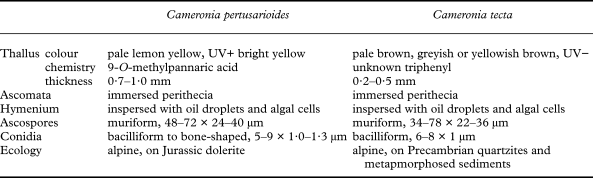
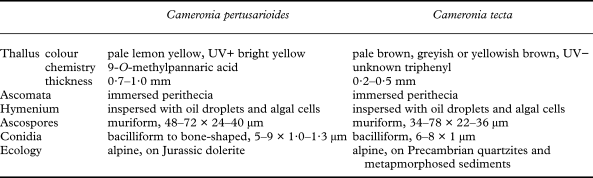
The genus contains two species, C. pertusarioides and C. tecta, both described for the first time below. Salient features of the two taxa are given in Table 1.
Salient features of the species of Cameronia
Cameronia pertusarioides Kantvilas sp. nov
MycoBank No.: MB 561951
Species insignis, saxicola, thallo 0·7–1 mm crasso, pallide citrino, acidum 9-O-methylpannaricum continenti, ascosporis late ellipsoideis, muriformibus, 48–72 µm longis, 24–40 µm latis, et conidiis bacilliformibus vel ossiformibus, 5–9 µm longis, 1–1·3 µm latis.
Typus: Australia, Tasmania, Hartz Mountains Plateau near Lake Osborne, 43°13′S 146°46′E, on dolerite roche moutonnée in alpine heathland, 890 m altitude, 30 January 2007, G. Kantvilas 2/07 & J. Jarman (HO—holotypus; BM—isotypus).
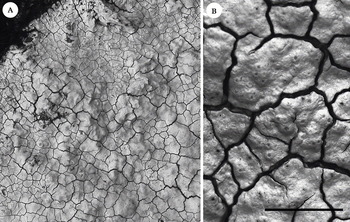
Cameronia pertusarioides, morphology (holotype). A, deeply cracked, actively advancing thallus; B, thallus detail; the minute, crater-like pits mark the location of the asci within the medulla. Scale = 2 mm.

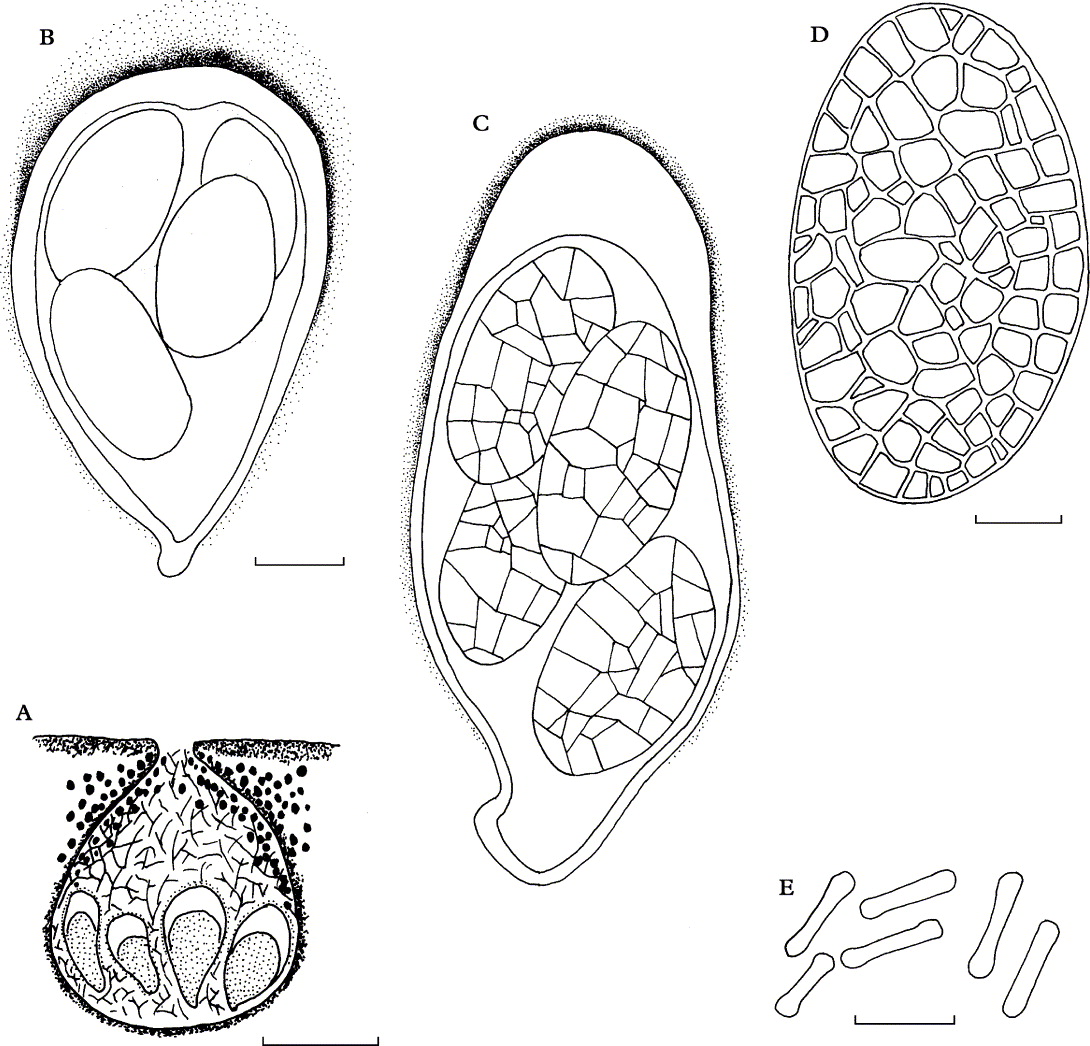
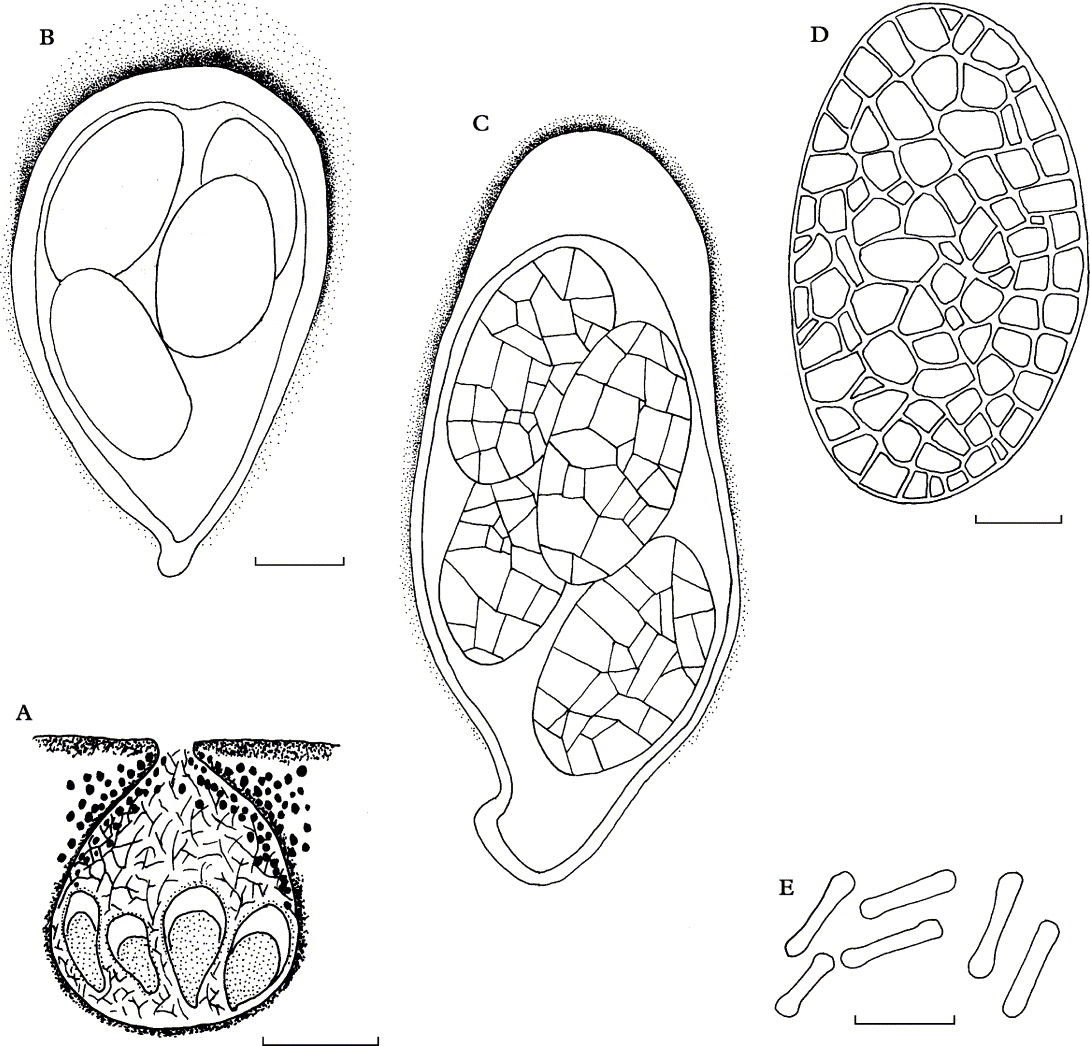
Cameronia pertusarioides, anatomy. A, schematic view of section through thallus and ascus-bearing chamber, showing four asci, encased in anastomosing paraphysoids (holotype); B & C, asci with K/I+ blue tissues stippled, mature ascus on right (Kantvilas 73/05), young ascus on left (holotype); D, mature ascospore (Bratt 71/827); E, conidia (Kantvilas 73/05). Scales: A = 100 µm; B & C = 20 µm; D = 10 µm; E = 6 µm.
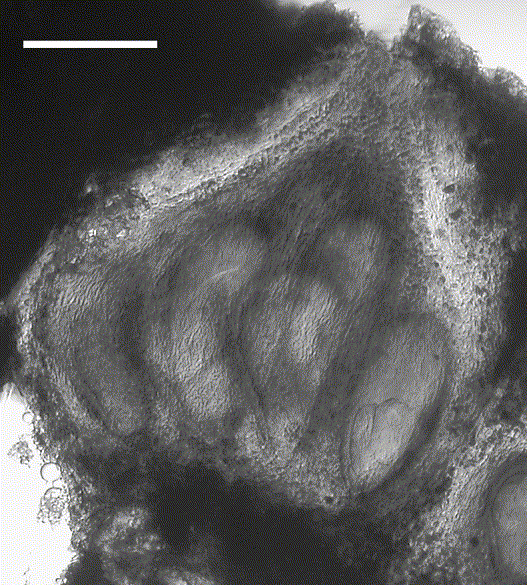
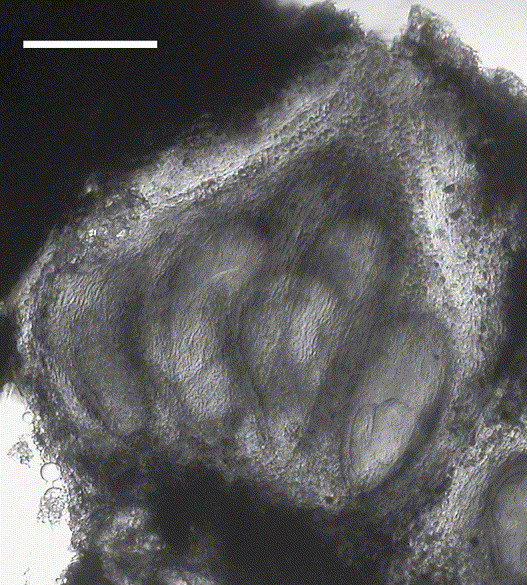
Cameronia pertusarioides, section through an ascus-containing chamber(holotype). Scale = 100 µm.
Thallus pale lemon-yellow, forming extensive, irregular thalli to 50 cm or more wide, mostly smooth, a little glossy, usually deeply cracked, 0·7–1 mm thick, sometimes delimited by a blackish prothallus but more commonly not delimited and with actively growing margins usually a little thickened, plicate-placodioid and at times somewhat blackened or greyish; epinecral layer hyaline, 5–20 µm thick; medulla white, rather cretaceous, densely inspersed with minute crystals that fluoresce in polarized light and dissolve slowly in KOH, composed of compact, indistinct hyphae, patchily I+ violet, K/I+ violet.
Perithecia ± subglobose, c. 200–300 µm wide, usually detected by minute, 0·05–0·08 mm wide, greyish to flesh-coloured depressions or perforations in the thallus surface; excipulum hyaline to pale brownish, 10–20 µm thick; surrounding medullary tissue I+ blue, K/I+ blue; involucrellum absent. Paraphysoids 1–1·5 µm thick; oil droplets scattered, to 10 µm diam.; hymenial photobiont cells globose to ellipsoid, 4–9 × 4–7 µm. Asci in clusters of 3–7 or more, 110–170 ×50–80 µm. Ascospores broadly ellipsoid to ovate, 48–57·8–72 × 24–30·7–40 µm.
Pycnidia scattered, immersed in the thallus within scattered swellings or roundish verrucae, mostly 0·5–0·8 mm wide, with age becoming more prominent and to 1·5–2 mm wide, initially pierced apically by 1–4 minute, black ostioles, at length becoming apically cracked, in part somewhat blackened and abraded; individual chambers 200–250 µm wide. Conidia bacilliform to ± ‘bone-shaped’, 5–9 × 1–1·3 µm.
Chemistry. Containing 9-O-methyl pannaric acid (major), pannaric acid (minor), porphyrilic acid (trace), pannaric acid 2-methyl ester (trace) and methyl porphyrilate (trace); thallus K+ yellow, C+ pale yellowish, KC+ pale yellowish, P−, UV+ bright lemon-yellow. The major compound appears as a pale grey spot on developed TLC plates.
Etymology. The epithet ‘pertusarioides’ refers to the startling morphological similarity of the new taxon (with its thick, yellowish thallus and often very prominent verrucae pierced by a central ostiole-like hole) to verruciform species of the genus Pertusaria.
Remarks. Cameronia pertusarioides is known only from Tasmania, where it occurs exclusively on Jurassic dolerite at alpine altitudes. It is one of the most conspicuous and common lichens in such areas, forming extensive, roundish or irregular colonies up to 50 cm wide on the exposed tops of boulders and rock plates, a very harsh habitat exposed to abrasive winds, driving rain, snow and ice as well as to direct, baking sun, especially in the summer months. It may also occur on sheltered vertical rock faces. The combination of habitat and morphology means that this species has no confusing taxa in the Tasmanian biota. Its bright yellow colour produces an attractive mosaic with several other large, attractively coloured crustose species, including Trapelia lilacea Kantvilas & Elix (± pale violet), Lecanora farinacea Fée and L. cf. demersa (Kremp.) Hertel & Rambold (white), and an unidentified, bright orange species (belonging to the Hymeneliaceae; G. Kantvilas, unpublished data). Other associated lichens include Hypogymnia lugubris (Pers.) Krog, Poeltiaria coromandelica (Zahlbr.) Rambold & Hertel, Ramboldia petraeoides (Nyl. ex C. Bab. & Mitt.) Kantvilas & Elix, Rhizocarpon geographicum (L.) DC., Stereocaulon caespitosum Redinger, Umbilicaria umbilicarioides (B. Stein) Krog & Swinsc. and species of Paraporpidia and Placopsis; the moss genus Andreaea is also prominent.
Fertile material of C. pertusarioides is very uncommon. For example, of the approximately 25 specimens available for study, only five yielded fertile asci, which were found in only very occasional thallus sections. The locations of the asci are typically marked by shallow, crater-like, greyish depressions or by minute swellings with a tiny perforation (Fig. 1), but the latter structures may also mark the location of pycnidia, which in general are far more common. Although some thalli or sections of thalli may be covered with large, Pertusaria-like verrucae, typically with prominent black ‘ostioles’, such verrucae are inevitably sterile and densely packed with hyphae and crystals. At length these verrucae become abraded and ultimately excavate. Mature asci are particularly uncommon and rather fragile. The measurements given in the description above may well be biased towards younger, developing asci. With pre-treatment in KOH, staining and placing under a cover slip, mature asci tend to burst and the intensely amyloid outer jacket ruptures and tears away.
The thallus is very thick, tightly adnate to the substratum and distinctly hydrophobic. In nature, water ‘beads’ on the thallus surface, and during anatomical study it was very difficult to moisten thin sections of the thallus, pycnidia or perithecia. These all tend to be rather densely inspersed with crystals that require clearing (typically with dilute KOH or ammoniacal erythrosin) before observation. These crystals probably contribute to the lichen's hydrophobic nature. In 25% H2SO4 (Thor Reference Thor1997), there is minimal formation of needle-like crystals, suggesting the crystals are not calcium oxalate; their identity is unknown.
Selected specimens examined. Australia: Tasmania: summit area of Mt Cuvier, 42°02′S 146°02′E, 1350 m alt., 2005, G. Kantvilas 73/05 (HO); summit of Mt Lot, 42°57′S 146°27′E, 1260 m alt., 2000, G. Kantvilas 473/00 (HO); Mt Wellington plateau, 42°54′S, 147°14′E, 1180 m alt., 1980, G. Kantvilas 400/80 (BM, HO); Wylds Craig summit, 42°28′S 146°23′E, 1330 m alt., 1998, G. Kantvilas 274/98 (HO); Blue Peaks, northern summit, 41°43′S 146°22′E, 1350 m alt., 2006, G. Kantvilas 528/06A (HO); Mt Eliza summit, 42°58′S 146°24′E, 1290 m alt., 1971, G. C. Bratt & M. A. Cutliffe 71/827 (HO); c. 1 km N of Lake Ironstone, 41°42′S 146°28′E, 1190 m alt., 2005, G. Kantvilas 338/05 (HO); Mt Mueller, western peak, 42°46′S 146°28′E, 1240 m alt., 1998, G. Kantvilas 258/98 (HO); un-named lake 1 km S of Pindars Peak, 43°31′S 146°41′E, 920 m alt., 1990, G. Kantvilas 99/90 (HO); Sandbanks Tier, 41°51′S 146°52′E, 1969, G. C. Bratt 69/198 (HO); Mt Thetis, 41°52′S 146°00′E, 1380 m alt., 1992, G. Kantvilas 289/92 (HO); Hartz Mountains summit area, 43°15′S 146°46′E, 1255 m alt., 1963, G. C. Bratt 706 (HO).
Cameronia tecta Kantvilas sp. nov
MycoBank No.: MB 561952
Species inconspicua, saxicola, thallo 0·2–0·5 mm crasso, pallide brunneo, plerumque paulum substantiae ignotae continenti, ascosporis late ellipsoideis, muriformibus, 34–78 µm longis, 22–36 µm latis, et conidiis bacilliformibus, 6–8 µm longis, 1 µm latis.
Typus: Australia, Tasmania, Sentinel Range summit, 42°52′S 146°15′E, in sheltered crevices and overhangs on alpine quartzite boulders, 880 m altitude, 3 November 2007, G. Kantvilas 346/07 (HO—holotypus).
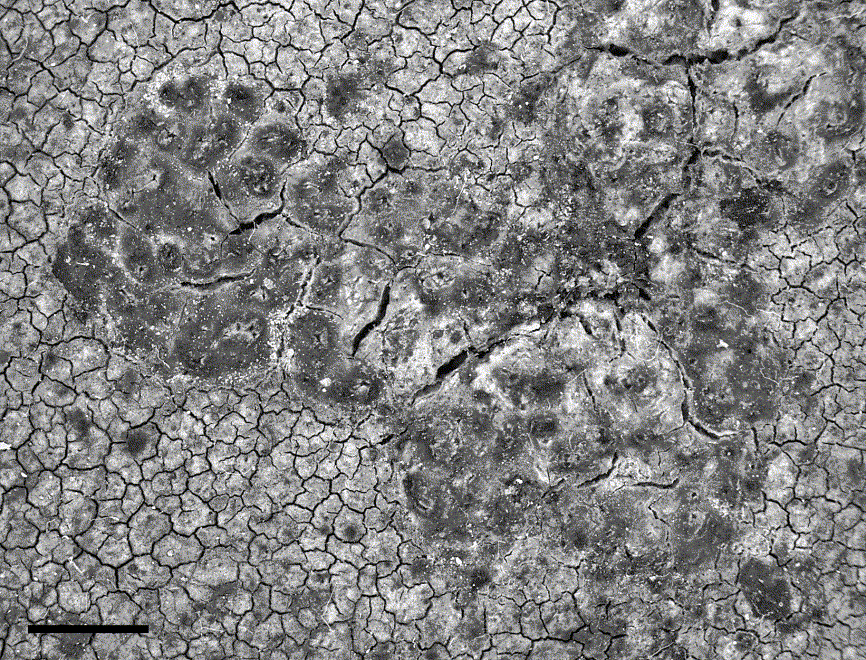
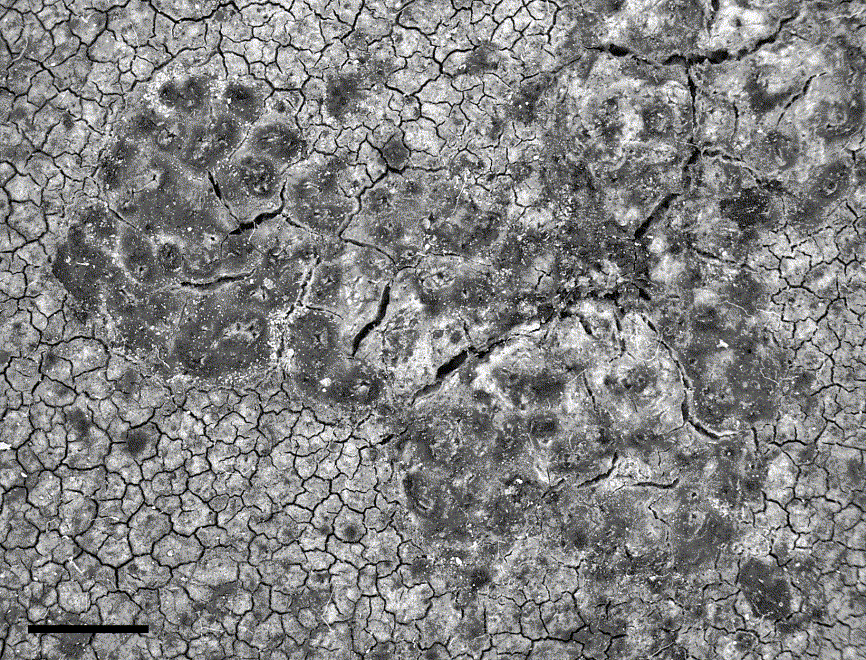
Cameronia tecta, morphology (Kantvilas 498/06). Scale = 2 mm.
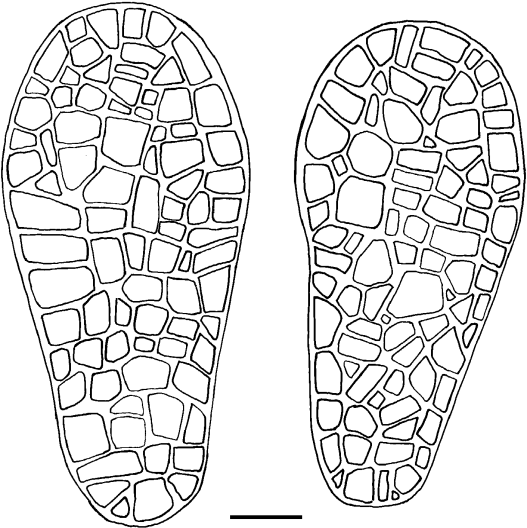
Cameronia tecta, ascospores (Kantvilas 498/06). Scale = 10 µm.

Thallus pale beige-brown to mottled greyish or yellowish brown, forming irregular thalli up to 10 cm wide, mostly smooth, usually deeply cracked, 0·2–0·5 mm thick, typically not delimited or at most with a blackish, prothallus-like leading edge; epinecral layer discontinuous, 5–20 µm thick; medulla white or discoloured orange-brown, cretaceous, inspersed with minute crystals that fluoresce in polarized light but do not dissolve completely in KOH, composed of compact, indistinct hyphae, patchily I+ violet, K/I+ violet.
Perithecia located in the thickest parts of the thallus, frequently clustered together, ± globose, (120–)160–280 µm wide, detected by minute, 0·05–0·1 mm wide, greyish black depressions or ostiole-like perforations with a rather ragged, elevated rim; excipulum brownish, 10–20 µm thick; surrounding medullary tissue I+ blue, K/I+ blue; involucrellum absent. Paraphysoids 1–2 µm thick; oil droplets scattered, to 16 µm diam.; hymenial photobiont cells globose to ellipsoid, 5–8 × 3–5 µm. Asci in clusters of 4–7, 90–140 × 35–60 µm. Ascospores broadly ellipsoid to ovate, often a little tapered at one end, 34–59·9–72(–78) × (22–)24–30·9–36 µm.
Pycnidia scattered, c. 200–250 µm wide, immersed in the thallus and sometimes forming irregular swellings or roundish verrucae, typically detected by their minute, black or brownish, speck-like ostioles. Conidia mostly bacilliform, 6–8 × 1 µm.
Chemistry. Unknown substance, appearing as a slow-moving, colourless spot on developed TLC plates. Professor J. A. Elix (in litt.) observes that “its UV spectrum and chromatographic behaviour closely resembles that of deacetylbutlerin A”.
Etymology. The specific epithet means ‘concealed’ and refers to the habitat of this lichen in clefts and underhangs.
Remarks. Cameronia tecta is an uncommon (or overlooked) species restricted to the south-west of Tasmania where it occurs on highly siliceous, very hard Precambrian quartzite. It typically grows in deeply shaded, sheltered, moist underhangs in alpine heathland, a habitat with few specialist lichens, although a notable exception is Rimularia umbricola Kantvilas & Coppins. One unusual collection was from shaded, seasonally inundated rocks from the edge of an alpine lake.
This is a most enigmatic lichen, and one that proved technically challenging to examine and describe. The thallus is extremely brittle and filled with crystals of an unknown identity, but which do not dissolve in either KOH or H2SO4. Fertile material is extremely rare, as are pycnidia, and although several specimens are abundantly sprinkled with ostiole-like holes, sectioning revealed only an incipient ‘chamber', presumably an incipient ascoma or pycnidium; the fact that the tissue is typically non-amyloid suggests the latter. The single specimen from inundated rocks displayed abundant, semi-emergent, brown ‘perithecia’ but these contained no fertile tissues at all. Fertile asci were located by sectioning thicker parts of the thallus that were ± ‘lifting’ from the substratum and had scattered, rather ragged, ostiole-like perforations (Fig. 4).
The chemical composition of the species was also very difficult to ascertain. The thallus is thin and difficult to remove from its substratum, and the concentration of the unknown compound is low; hence most TLC analyses revealed no substances, at least initially. Lobaric acid was detected occasionally, but this is attributed to the thallus of Rimularia umbricola with which the new species is often closely associated.
Specimens examined. Australia: Tasmania: Crater Peak, 41°39′S 145°56′E, 1200 m alt., 1984, G. Kantvilas 408/84 & P. James (BM, HO); Mt Sprent, 42°48′S 145°58′E, 1000 m alt., 1987, G. Kantvilas s.n. (HO); Lake Cygnus, 43°08′S 146°14′E, 880 m alt., 2006, G. Kantvilas 498/06 (HO); Schnells Ridge, 43°01′S 146°25′E, 1070 m alt., 2007, G. Kantvilas 316/07 (HO); same locality, 1050 m alt., 2009, G. Kantvilas 432/09 (HO).
Systematic position
The systematic position of Cameronia is uncertain and there is no doubt that in time it will prove to be a fascinating subject for a molecular study. For now, its classification was explored by comparison of its salient features (such as thallus morphology, anatomy and chemistry, ascomatal anatomy, ascus and ascospore structure) with those of other known lichens. This work was complicated by technical difficulties posed by the new taxon: well-developed fertile material is very uncommon, and all structures are very cretaceous and brittle. Literally hundreds of sections were required simply to compile the data necessary for a formal description and consequently not every aspect of the species (e.g. ascus dehiscence) could be examined in detail. The chemistry of the new genus is unusual but offers few clues. In C. pertusarioides, it consists of dibenzofuranes, and similar substances have been recorded in Lepraria (in species previously referred to Leproloma) (Stereocaulaceae, Lecanorales) and in Roccella capensis Follman (Arthoniales) (Elix et al. Reference Elix, Naidu and Laundon1992). In C. tecta, the unknown substance is a triphenyl; this group of substances occurs sporadically in non-lichenized and lichenized fungi, including the Parmeliaceae (J. A. Elix, pers. comm.).
Initially a placement in the Arthoniales was considered. Characters that seemed to support such a classification were the crustose thallus with a patchily I+ blue or violet medulla, the ascus type, in particular the well-developed, non-amyloid tholus and the hemiamyloid wall, together with the anastomosing periphysoids and muriform ascospores (Grube Reference Grube1998). However, the asci of Cameronia lack the well defined ‘foot’ and ocular chamber that is common in many Arthoniales asci, and the photobiont, whilst unidentified, is certainly not Trentepohlia. In the Arthoniales, all groups have Trentepohlia except for the Chrysotrichaceae (Ertz & Tehler Reference Ertz and Tehler2010) to which Cameronia is certainly unrelated. In addition, no member of the Arthoniales is known to produce perithecia, although some genera, such as Chiodecton and its allies, produce perithecioid ascomata aggregated in stroma-like structures (Thor Reference Thor1990).
Amongst perithecioid lichens, the inclusion of photobiont cells in the hymenium is reminiscent of Staurothele (Verrucariaceae, Chaetothyriomycetidae), a genus which shares several other characteristics with Cameronia, including the overall morphology of the thallus, a hemiamyloid hymenial gel and muriform ascospores. However, the ascomata of Staurothele and other Verrucariales lack interascal filaments and the asci are of the Verrucaria-type, with a pronounced ocular chamber. Another perithecioid genus that was considered (at the suggestion of an anonymous referee of an earlier version of this paper) was Thelenella (Ostropomycetidae). However, despite many similarities, this genus is clearly unrelated as well: its asci are cylindrical and display no amyloid reactions (Mayrhofer Reference Mayrhofer1987).
Nevertheless, the Ostropomycetidae appears to offer a reasonable, tentative systematic position for the new genus. In this class, there are genera with a range of ascomatal forms, including perithecia. Asci are variable, but cases of large-spored taxa with asci with a well-developed non-amyloid tholus are not uncommon (e.g. Megaspora, Aspicilia, many taxa of the Gomphillaceae), nor are examples of asci with a hemiamyloid wall (e.g. Trapelia). Futhermore, the Ostropomycetidae display a range of photobiont types that include small-celled coccoid species (e.g. in the Gomphillaceae). The ecology of many taxa of the Ostropomycetidae is also not inconsistent with that of Cameronia.
It could be argued that, given the incomplete information on the taxonomy of Cameronia, its description should have been delayed pending more extensive investigations, including molecular studies. However, given how dominant and conspicuous this lichen is in the Tasmanian landscape and, in particular, the degree to which it characterizes the wild places for which the island is famed, it is my opinion that it requires a valid name, even if its systematic position is yet to be resolved.
I thank Professor Jack Elix for determining the chemistry of the new species and Dr Jean Jarman for the photographs and for preparing the line drawings for publication. I am particularly indebted to Drs Göran Thor and Robert Lücking, and to several anonymous referees, for many very helpful comments and suggestions on earlier versions of this paper.