Introduction
Purpose in life, defined as the capacity to find meaning and direction in one's experiences, as well as to create and pursue goals in living (Ryff and Singer, Reference Ryff, Singer, Aspinwall and Staudinger2003: 277), underlies a great deal of human endeavour. ‘He who has a why to live can bear with any how’ was said to be a quote of Nietzsche frequently referenced by Frankl ([1963] Reference Frankl1985). In his classic account of surviving Auschwitz concentration camp, Frankl notes that the purpose of his writing was to find meaning in life and that the values of an active life can be realised through creativity. He further theorises that people can cultivate purpose in life through three routes in his formation of logotherapy (Frankl, [1963] Reference Frankl1985: 162; Yalom, Reference Yalom1980): (a) through various activities, including artistic creativity, imbued with meaning, (b) through engagement in deep experience, such as aesthetical appreciation of beauty and nature or being a loving person who allows others to actualise their potentialities, and (c) through suffering; in Frankl's words, ‘turning suffering into human achievement and accomplishment’ (Frankl, [1963] Reference Frankl1985: 162), which involves a form of creativity to make adaptive sense of unfixable problems.
The three routes can be mapped on to a cognitive-behavioural model grounded in existential-humanistic psychology. The first route involves behavioural engagement tapping into one's imaginative skills; the second, experiential engagement to savour encounters in life; and the third, creative thinking to facilitate attitudinal changes for turning human predicament into achievement. Central to the three routes is the will to meaning with a commitment to care and an instruction of openness to experience, suggesting the courage to continue one's involvement with life despite the fact that ‘what's the point’ type of questions can appear to be unsolvable on subjects related to existential frustration.
Ageing is one subject that warrants such an existential-humanistic approach for problem solving. The lifespan theory on ageing (e.g. Staudinger et al., Reference Staudinger, Marsiske and Baltes1993; Baltes et al., Reference Baltes, Lindenberger, Staudinger, Damon and Lerner1998) posits that, as people transit through a flux of life changes towards life's finitude, one's allocation of functional development gradually shifts from biologically to culturally based resources, i.e. meaning systems. Further, scholars (e.g. May, [1953] Reference May2009; Reker, Reference Reker and Novak1995) suggest that ageing well calls for a capacity to wonder and a creative consciousness to maximise the advantage of actualising one's human potential. Following this line of reasoning, this paper postulates that artistic creativity across different disciplinary domains, characterised by openness to experience (e.g. Feist, Reference Feist1998; Nusbaum and Silvia, Reference Nusbaum and Silvia2011; Ivcevic and Brackett, Reference Ivcevic and Brackett2015), can be used as a process for generating meaning in life. The making and appreciating of art has been linked with a concern for discovery (Csikszentmihalyi and Getzels, Reference Csikszentmihalyi and Getzels1970), as well as experiencing life with the senses and the thinking mind (Rosch, Reference Rosch2001) and integrating one's past, present and future (Kaufman, Reference Kaufman2018). All of this could potentially contribute to ageing well creatively. Hence, artistic creativity may gain in importance through the day-to-day transitioning of the ageing process.
It should be noted that the idea of ageing well through the arts is nothing new among artists; for instance, the poet George Eliot in 1904 maintained that ‘Art is the nearest thing to life; it is a mode of amplifying experience and extending our contact with our fellow-men beyond the bounds of our personal lot’ (Eliot, Reference Eliot1904: 125). That being said, art is not life. Placing the emphasis on the engagement of creativity, artistic creativity is viewed as the connection between ‘the nearest thing to life’ and the vitality of real human endeavour. Drawing on humanistic-existential psychology, this paper proposes that the engagement of artistic creativity can broaden and deepen human experience, thus contributing to a sense of purpose and meaning in life in the context of ageing.
Drawing meaning from artistic creativity to generate meaning in life
The engagement of artistic creativity without effortful mental regulation or a particular intentionality based on a well-integrated, internalised or intrinsic value, as hypothesised, may have little merit for purpose in life. To the best of the author's knowledge, the affordance (Gibson, [1979] Reference Gibson2014) of drawing meaning from artistic creativity to generate meaning in life has not been studied quantitatively. Most studies discussing meanings in the arts have been qualitative by nature. As no scale exists to measure this affordance, the scale Artistic Creativity as a Source for Meaning in Life (ACASMIL) was developed to gauge this psychological attribute of drawing meaning from artistic creativity to generate meaning in life, which is measured as the extent to which one has a sense of meaning in life that is fulfilled through one's own artistic creativity. Grounded in humanistic-existential psychology's ideas of will to meaning and courage to create (e.g. May, [1953] Reference May2009; Frankl, [1963] Reference Frankl1985), the construct was conceptualised as an intentionality and a specific attitude towards meaning in life among individuals with varying degrees of interests in the arts. This construct is not used for identifying artists or artworks or art activities; rather, it is a measure of the affordance of mental regulation by which an artist can discover new things and invent.
Gap in the literature
Can artistic creativity contribute to the cultivation of purpose in life? If so, through what mechanisms? As previously mentioned, Frankl ([1963] Reference Frankl1985) suggests that artistic endeavour and creative work give meaning to human existence amidst suffering. Pertinently, Schnell (Reference Schnell2011) finds that general creativity as a source of meaning in life predicts a sense of meaningfulness in a representative sample of German adults with an age range from 16 to 85. Nevertheless, a review of the literature suggests that research on the engagement and meanings of artistic creativity among ageing adults is largely qualitative by nature; quantitative evidence is scant. This article seeks to fill this gap. Because of the growing proportion and absolute number of older people in populations around the world (World Health Organization, 2015) as well as the evidence suggested by the literature that lacking a sense of purpose in life is detrimental to health and developmental trajectories (e.g. Loevinger, Reference Loevinger1976; Erikson et al., [1986] Reference Erikson, Erikson and Kivnick1994; Park, Reference Park and Kumar2017; Alimujiang et al., Reference Alimujiang, Wiensch, Boss, Fleischer, Mondul, McLean, Mukherjee and Pearce2019), it is important to identify factors contributing to purpose in life in the second half of the human lifespan.
Ageing and purpose in life
Termed as ‘a psychological resource for ageing’ (Burrow et al., Reference Burrow, Sumner and Ong2014; Windsor et al., Reference Windsor, Curtis and Luszcz2015), purpose in life has been found to be a factor contributing to better biopsychosocial and behavioural health (e.g. buffering the effects of negative affect, Burrow et al., Reference Burrow, Sumner and Ong2014; reduced risk of cardiovascular event and mortality, Cohen et al., Reference Cohen, Bavishi and Rozanski2016; more activity engagement, Hill and Turiano, Reference Hill and Turiano2014; Lewis and Hill, Reference Lewis and Hill2020; better self-regulation, Lewis, Reference Lewis2020; fewer depressive symptoms, Kim et al., Reference Kim, Sun, Park, Kubzansky and Peterson2013; Windsor et al., Reference Windsor, Curtis and Luszcz2015; Lewis and Hill, Reference Lewis and Hill2021; enhancement of resilience, Lewis and Hill, Reference Lewis and Hill2021; and reduced risk for developing sleep disturbances, Kim et al., Reference Kim, Hershner and Strecher2015). Although purpose in life has been found to decline from middle to later life, a few studies suggest otherwise. For instance, Steger et al. (Reference Steger, Oishi and Kashdan2009) found a positive correlation between purpose in life and age, Ko et al. (Reference Ko, Hooker, Geldhof and McAdams2016) found that purpose in life remains stable from middle to older adulthood, while other studies show that purpose in life declines with age (e.g. Ryff and Keyes, Reference Ryff and Keyes1995; Pinquart, Reference Pinquart2002; Hill and Weston, Reference Hill and Weston2019). Several scholars point out that age itself may not be the direct cause for the changes in purpose in life; rather, it is a proxy factor that modifies the effects induced by other psychosocial factors (e.g. Pinquart, Reference Pinquart2002; Hill and Weston, Reference Hill and Weston2019). This view may be supported by the Cumulative Advantages/Disadvantage (CAD) theory (Dannefer, Reference Dannefer2003): CAD theory posits that, because of individual differences in temperaments, characteristics and motivations, and complicated by cumulative social inequality and intuitional systematic renderings, divergence in individual trajectories become larger and larger through the passage of time. Because of the inconsistency of literature data, one hypothesis of this present study draws on CAD theory to assume a moderation role of subjective social economic status (SSES). This paper hypothesises that as one of the indicators of socio-environmental factors, SSES modifies the relationship between age and purpose in life; and subsequently, age and SSES are used as covariates for the testing of the proposed theoretical models of ACASMIL.
Purpose in life versus meaning in life
When used interchangeably with meaning in life, purpose in life refers to a broader sense that life is worthy of living (e.g. meaning in life is conceptualised as purposefulness in life; Reker et al., Reference Reker, Peacock and Wong1987; Ryff and Singer, Reference Ryff and Singer1998). Yet, in psychology of meaning literature, meaning in life refers to a multi-dimensional construct with at least three dimensions: (a) coherence, referring to the comprehensibility of life; (b) purpose, referring to direction in life; and (c) significance, referring to meaningfulness, the evaluative component of meaning in life (Martela and Steger, Reference Martela and Steger2016). So purpose in life can be seen as one of the three dimensions of meaning in life in the way that purpose in life connotes a salience in directedness and proactivity, whereas meaning in life includes the additional evaluative and orderly components (Martela and Steger, Reference Martela and Steger2016; Czekierda et al., Reference Czekierda, Banik, Park and Luszczynska2017). Further, purpose in life is more closely aligned with eudaimonic philosophy rather than hedonic as it is considered the hallmark of wellbeing that distinguishes psychological Eudaimonia from psychological Hedonism through a sense of goal-directedness (Disabato et al., Reference Disabato, Goodman, Kashdan, Short and Jarden2016). In other words, purpose in life requires self-regulation and effortful discipline that may be at odds with the pursuit of a fleeting, short-living sense of hedonic happiness (Ryff and Keyes, Reference Ryff and Keyes1995; Lewis, Reference Lewis2020).
Scope of artistic creativity
There are many ways to define what artistic creativity is or ought to be; discussion of these questions belongs in a different line of inquiry. Readers of such interests are encouraged to read work written by Csikszentmihalyi (Reference Csikszentmihalyi2015) and Danto ([1997] Reference Danto2014). In this paper, following Lunke and Meier (Reference Lunke and Meier2016), artistic creativity is operationalised as the interest, ability, involvement and performance in various imaginative domains through modes of visual, linguistic, musical and kinesthetic expression. Further, informed by creativity scholars' claims that the transition from personal creativity to professional creativity is not a locked-step stage development (Kaufman and Beghetto, Reference Kaufman and Beghetto2009) and that personal creativity can be experienced by everyone (Richards, Reference Richards, Kaufman and Sternberg2010), no distinction is made between personal and professional artistic creativity. Although multi-disciplinary and cross-disciplinary practices are common among artists, artistic creativity is considered domain-specific (Lunke and Meier, Reference Lunke and Meier2016). For the purpose of adhering to the scientific principle of parsimony, this study primarily focuses on visual arts.
Present study
The overarching goal of the study is to identify factors associating with purpose in life among individuals in the second half of the human lifespan in the hope of contributing to the future development of healthy ageing psychosocial interventions. Informed by the attitude–behaviour relation literature (e.g., attitude and behaviour are correlated when the confidence for the attitude is high, Glasman and Albarracín, Reference Glasman and Albarracín2006; behaviour can provide information for people to behave more consistently with their attitudes, Harmon-Jones et al., Reference Harmon-Jones, Armstrong, Olson, Harmon-Jones, Armstrong and Olson2018), it is expected that artistic creativity will contribute to purpose in life through ACASMIL. Along the same lines, it is hypothesised that a global self-concept in creativity may serve as a moderator to enhance the effect of artistic creativity on purpose in life through ACASMIL. As such, creative self-concept (i.e., a cognitive and affective judgement about one's general creative ability, Beghetto and Karwowski, Reference Beghetto, Karwowski, Karwowski and Kaufman2017), defined as a self-belief covering personal identity and self-efficacy in the domain of creativity (Karwowski, Reference Karwowski2015), is included in the proposed conceptual model (Figure 1) as a moderator that plays a reinforcing role enhancing the conditional effect of artistic creativity on purpose in life through ACASMIL. Because the literature suggests that women tend to rate themselves higher on visual-artistic creativity than men (Kaufman, Reference Kaufman2006) and that people residing in different countries may have different understandings and values attached to the study variables, in this present study, gender and country of residence will be entered as covariates for all analyses. Three hypotheses were formed based on the literature reviewed:
• Hypothesis 1: SSES, conceptualised as an indicator of psychosocial factor contributing to ageing health, is a moderator between age and purpose in life, controlling for country of residence and gender.
• Hypothesis 2: Artistic creativity contributes to purpose in life through ACASMIL, controlling for country of residence, gender, SSES, and age.
• Hypothesis 3: The enhancement of creative self-concept strengthens the effect of artistic creativity on purpose in life through ACASMIL, controlling for country of residence, gender, SSES, and age.
The proposed conceptual model of the ACASMIL theoretical assumption—Hypothesis 3
Note: The four covariates are not illustrated.

Method
Participants and procedures
The analyses were based on secondary data examining the broader psychological impacts of artistic creativity among individuals aged 40 and above. The original data collection was approved for a study on factors contributing to resilience among artistically inclined individuals using a convenient sampling technique by posting online invitations to the arts communities. To increase the generalisability of the results, the inclusion criteria were purposely liberal: age and a working comprehension of English. The data were de-identified and anonymised. The sample (N = 224) consisted of a majority of participants residing in the United States of America (USA; 72%) with a minority scattered among Canada (4.5%), Germany (2.7%), United Kingdom (2.2%), Australia (2.2%), Belgium (0.4%), Brazil (0.4%), France (0.4%), Greece (0.4%), Ireland (0.4%), Norway (0.4%), Singapore (0.4%) and Taiwan (0.4%). The minority countries of residence were collectively coded as ‘country of residence–other’. The sample consisted of men (28.1%) and women (57.1%), with an additional 0.4 per cent endorsing non-binary, 0.9 per cent preferring not to say, and 0.4 per cent preferring to self-describe (collectively coded as ‘gender–other’). Participants ranged in age (range = 40–84 years, mean = 54.08, standard deviation = 10.08) and education (doctorate/professional degree: 12%; master's degree: 27%; bachelor's degree: 27%, associate degree: 8%; high school diploma or equivalency: 13%).
Measures
The MacArthur Scale of Subjective Social Status (Adler and Stewart, Reference Adler and Stewart2007) was used to assess subjective (perceived) social economic status. This one-item instrument requires individuals to self-place on a graphic of a ladder with ten rungs, with 1 indicating the lowest and 10 the highest perceived social hierarchy. The scale was developed by health psychologist Nancy Adler and has been found to be a solid indicator of perceived social hierarchy among a wide range of populations in the USA (Adler et al., Reference Adler, Epel, Castellazzo and Ickovics2000) and various nations worldwide (e.g. Singh-Manoux et al., Reference Singh-Manoux, Marmot and Adler2005; Goldman et al., Reference Goldman, Cornman and Chang2006).
The Artistic Creativity Domains Compendium (ACDC; Lunke and Meier, Reference Lunke and Meier2016) was used to assess the levels of involvement (interest, ability and performance) in artistic creativity based on the domains of visual arts, literature, music and performing arts) on a Likert scale ranging from 1 (strongly disagree/never) to 4 (strongly agree/frequently). Only the subscale on the domain of visual arts was used in the study. The scale has demonstrated a high reliability for the domain of visual arts in a German-speaking sample recruited from the general public (Lunke and Meier, Reference Lunke and Meier2016). The internal consistency ω was 0.85 in this sample.
The Artistic Creativity as a Source for Meaning in Life Scale–9 Item Version (ACASMIL-9; Author) was used to assess to what extent people draw meaning from their artistic creativity to meaning in life. The content validity of the nine items was validated through the feedback from two art education scholars experienced with adult learners, one scholar in counselling psychology, and four seasoned professional artists. Three negatively worded items and six positively worded items were included to minimise the effect of response acquiescence. Respondents were asked to indicate how much they agreed with each statement on a Likert scale ranging from 1 (disagree strongly) to 5 (agree strongly). Sample items include ‘To what extent does your artistic creativity facilitate your comprehension of your experiences?’, ‘To what extent does your artistic creativity make you feel that you have a life aim and that you are working towards fulfilling it?’ and ‘To what extent does your artistic creativity foster meaningfulness in your life?’ The internal consistency ω was 0.90 in this sample. Inspection of the correlation matrix revealed that most of the coefficients were of 0.3 or above. The analysis of the psychometric properties using principal component analysis with a combination of an eigenvalue and scree plot yielded a single factor solution with eigenvalues exceeding 1, explaining 56.49 per cent of the variance. Further, the results of parallel analysis showed only one factor with an eigenvalue exceeding the corresponding criterion value. The factor loadings ranged from 0.523 to 0.819 on the single component.
The Purpose in Life Subscale of the Psychological Well-Being Scale (Ryff et al., Reference Ryff, Almeida, Ayanian, Carr, Cleary, Coe, Davidson, Krueger, Lachman, Marks, Mroczek, Seeman, Seltzer, Singer, Sloan, Tun, Weinstein and Williams2007) was used to assess the extent to which participants felt a sense of directedness and meaningful directedness in living. It is a seven-item instrument (e.g. ‘I have a sense of direction and purpose in life’, ‘Some people wander aimlessly through life, but I am not one of them’) that requires individuals to self-rate on a seven-point scale ranging from 1 (strongly disagree) to 6 (strongly agree). The internal consistency ω was 0.80 in this sample.
The Short Creative Self-Concept Scale (SSCS; Karwowski, Reference Karwowski2012) was used to assess participants' self-conviction about their personal identity and self-efficacy in the global domain of creativity. SSCS is an 11-item instrument (sample item: ‘Ingenuity is a characteristic which is important to me’, ‘I am sure I can deal with problems requiring creative thinking’, ‘My imagination and ingenuity distinguishes me from my friends’) that requires individuals to self-rate on a five-point Likert scale ranging from 1 (definitely not) to 5 (definitely yes). The internal consistency ω was 0.89 in this sample.
Data analyses
Preliminary analyses were first conducted to obtain descriptive and correlational information among the study variables. Heteroscedasticities were estimated by multiple regression procedures using SPSS prior to PROCESS macro analyses. The scatterplots of regression standardised predicted values against the regression standardised residuals for Hypotheses 2 and 3 indicated heteroscedasticity; therefore, the decision of using a heteroscedasticity-consistent standard error estimator (Hayes and Cai, Reference Hayes and Cai2007) was made for testing both hypotheses. Missing data were handled with listwise deletion for testing all three hypotheses, resulting in the analytical sample size of 195.
A moderation model (PROCESS macro; Hayes, Reference Hayes2018) was used to test Hypothesis 1. Next, a simple mediation model (PROCESS macro; Hayes, Reference Hayes2018) was used to test the indirect effect of artistic creativity on purpose in life through ACASMIL with the covariates of country of residence, gender, age and SSES for Hypothesis 2. The PROCESS modelling program for use with SPSS (Hayes, Reference Hayes2018) generated non-parametric 5,000 percentile bootstrapping resamples to produce a 95 per cent confidence interval (CI) for the indirect effects. If the CI of such does not contain zero, the result is considered significant (Hayes, Reference Hayes2018). To test Hypothesis 3, a moderated mediation model (PROCESS macro; Hayes, Reference Hayes2018) was used to test the conditional effect of artistic creativity on purpose in life through ACASMIL moderated by creative self-concept, controlling for the effects of country of residence, gender, age and SSES. The PROCESS modelling program for use with SPSS generated non-parametric 5,000 percentile bootstrapping resamples to produce 95 per cent CI estimation for the index of moderated mediation. If the confidence interval of such does not include zero, the result is considered significant (Hayes, Reference Hayes2018).
Results
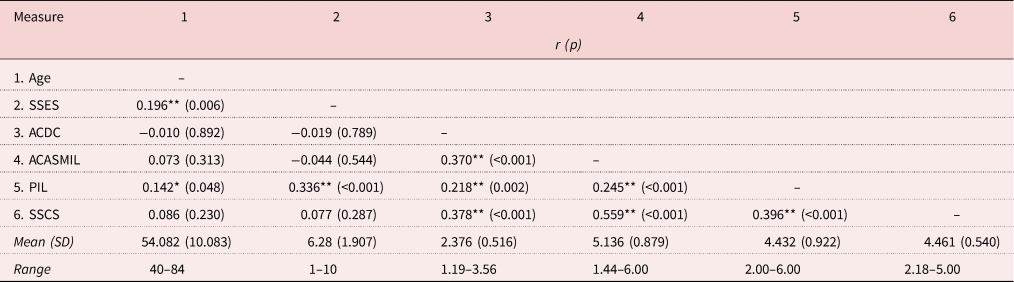
Table 1 displays the descriptive and correlational information of the study variables. As expected, participants scoring higher on ACASMIL also reported higher levels of artistic creativity and purpose in life.
Means, standard deviations, bivariate correlations, and p values of study variables

Notes: SSES = subjective social economic status (Adler and Stewart, Reference Adler and Stewart2007); ACDC = The Artist Creativity Domains Compendium−Visual Arts domain (Lunke and Meier, Reference Lunke and Meier2016); ACASMIL = The Artistic Creativity as a Source for Meaning in Life Scale–9 Item Version (scale in development by the author); PIL = Purpose in Life Scale (Ryff et al., Reference Ryff, Almeida, Ayanian, Carr, Cleary, Coe, Davidson, Krueger, Lachman, Marks, Mroczek, Seeman, Seltzer, Singer, Sloan, Tun, Weinstein and Williams2007); SSCS = The Short Creative Self-Concept Scale (Karwowski, Reference Karwowski2012). SD: standard deviation.
Significant correlations are indicated with asterisks (*p < 0.05, **p < 0.01).
Hypothesis 1
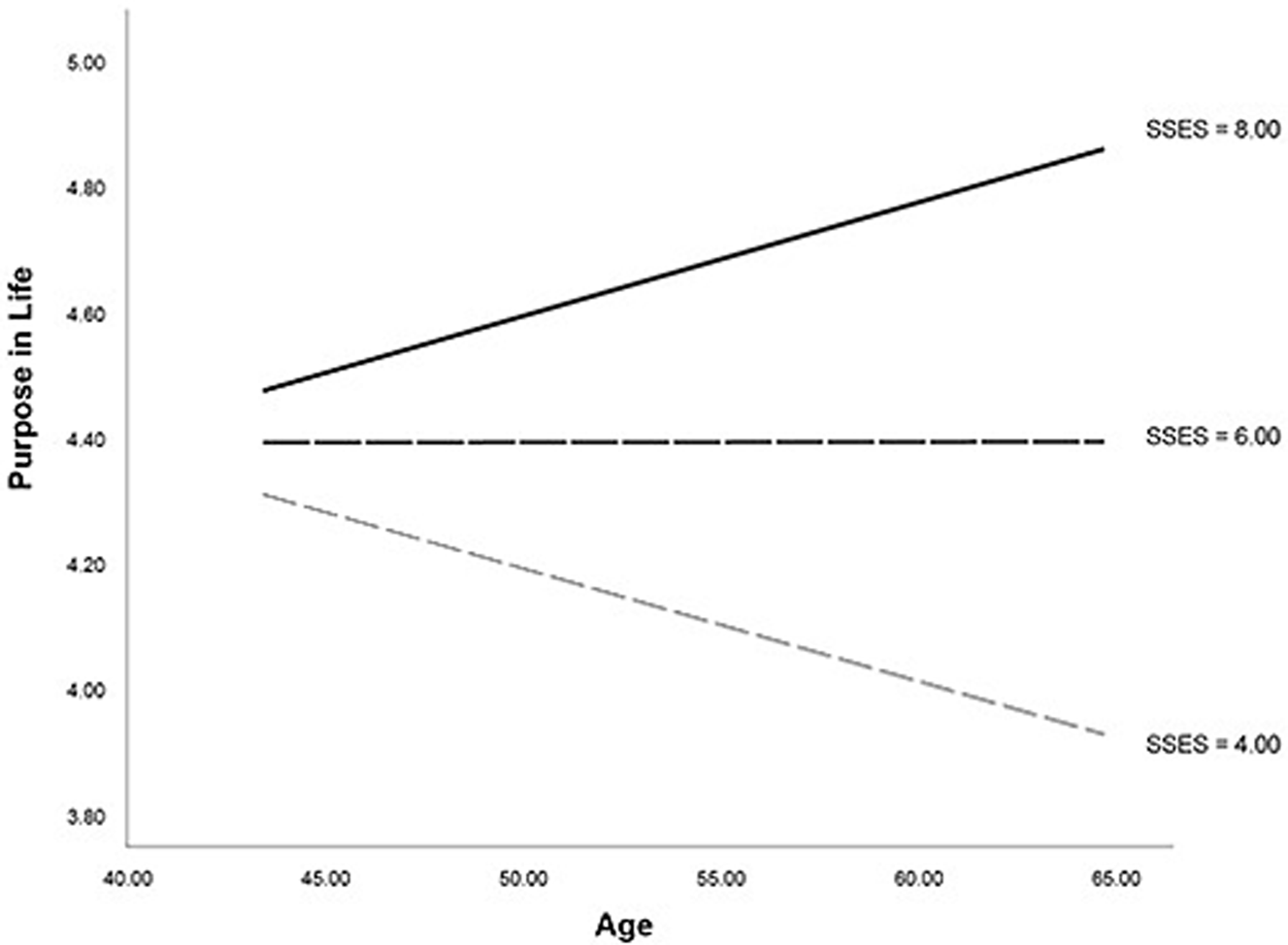
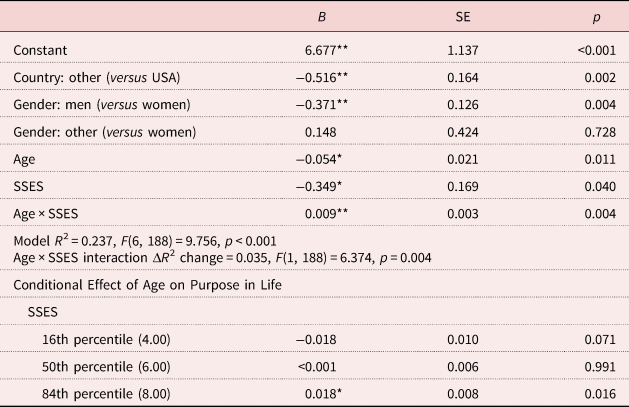
It was hypothesised that SSES would moderate the relationship between age and purpose in life, controlling for country of residence and gender. As seen in Table 2, the interaction term between age and SSES was statistically significant. Therefore, Hypothesis 1 was supported. The interaction was probed by testing the conditional effect of age on purpose in life by three levels of SSES, as illustrated in Figure 2. The results showed that the relationship between age and purpose in life differs among people with different levels of SSES. Specifically, the slopes become more negative as the level of SSES decreases. Figure 2 shows that the conditional effect of purpose in life among people with higher SSES (SSES = 8) was more positive and larger compared to those with moderate (SSES = 6) and lower SSES (SSES = 4). Among those with lower SSES, the conditional effect of purpose in life decreases as age increases.
The conditional effect of age on purpose in life by subjective social economic status (SSES), controlling for country of residence and gender

Regression model estimating age and subjective social economic status on purpose in life

Notes: SSES = subjective social economic status (Adler and Stewart, Reference Adler and Stewart2007); USA = United States of America.
Significance levels: * p < 0.05, ** p < 0.01.
Hypothesis 2
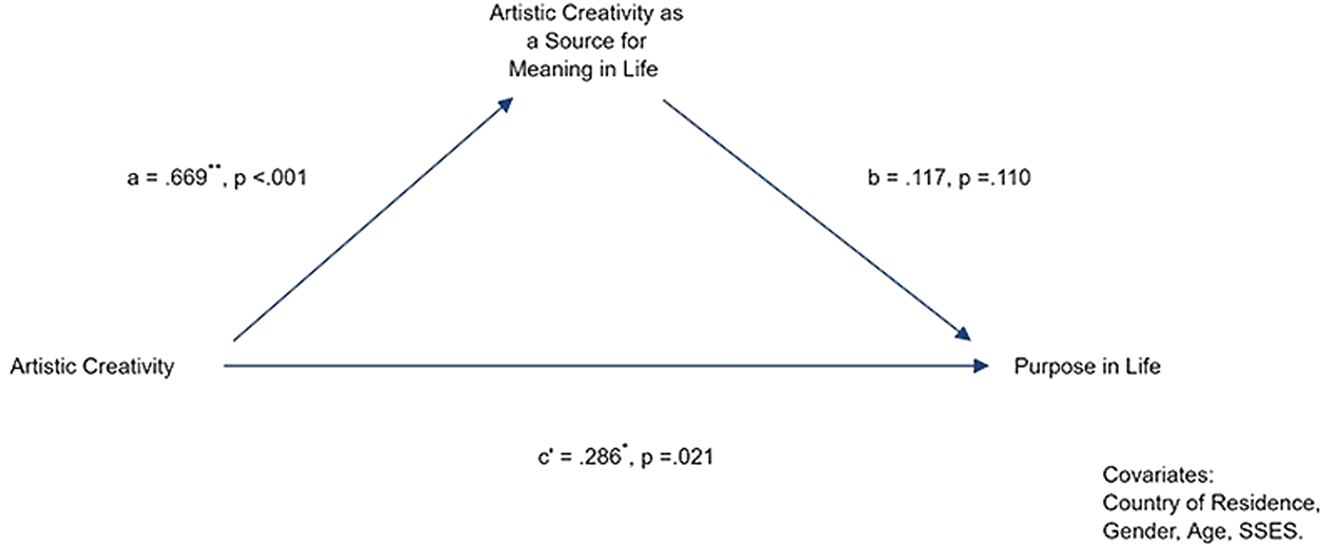
It was hypothesised that artistic creativity would contribute to purpose in life through ACASMIL, controlling for country of residence, gender, age and SSES. The results (Figure 3) showed that, controlling for the four demographic covariates, artistic creativity was positively associated with ACASMIL (a = 0.669, 95% CI = 0.447, 0.891, p < 0.001); and independent of artistic creativity, ACASMIL was positively associated with purpose in life though the effect was not statistically significant (b = 0.117, 95% CI = −0.027, 0.260, p = 0.110). The indirect effect of artistic creativity on purpose in life through ACASMIL was positive but not statistically significant, indicated by ab = 0.78, 95% CI = −0.027, 0.189. Therefore, Hypothesis 2 was not supported.
Simple mediation model depicting Hypothesis 2 results
Notes: The values presented are unstandardised coefficients; SSES = subjective social economic status.
Significant correlations are indicated with asterisks (*p < 0.05, **p < 0.01).

Hypothesis 3
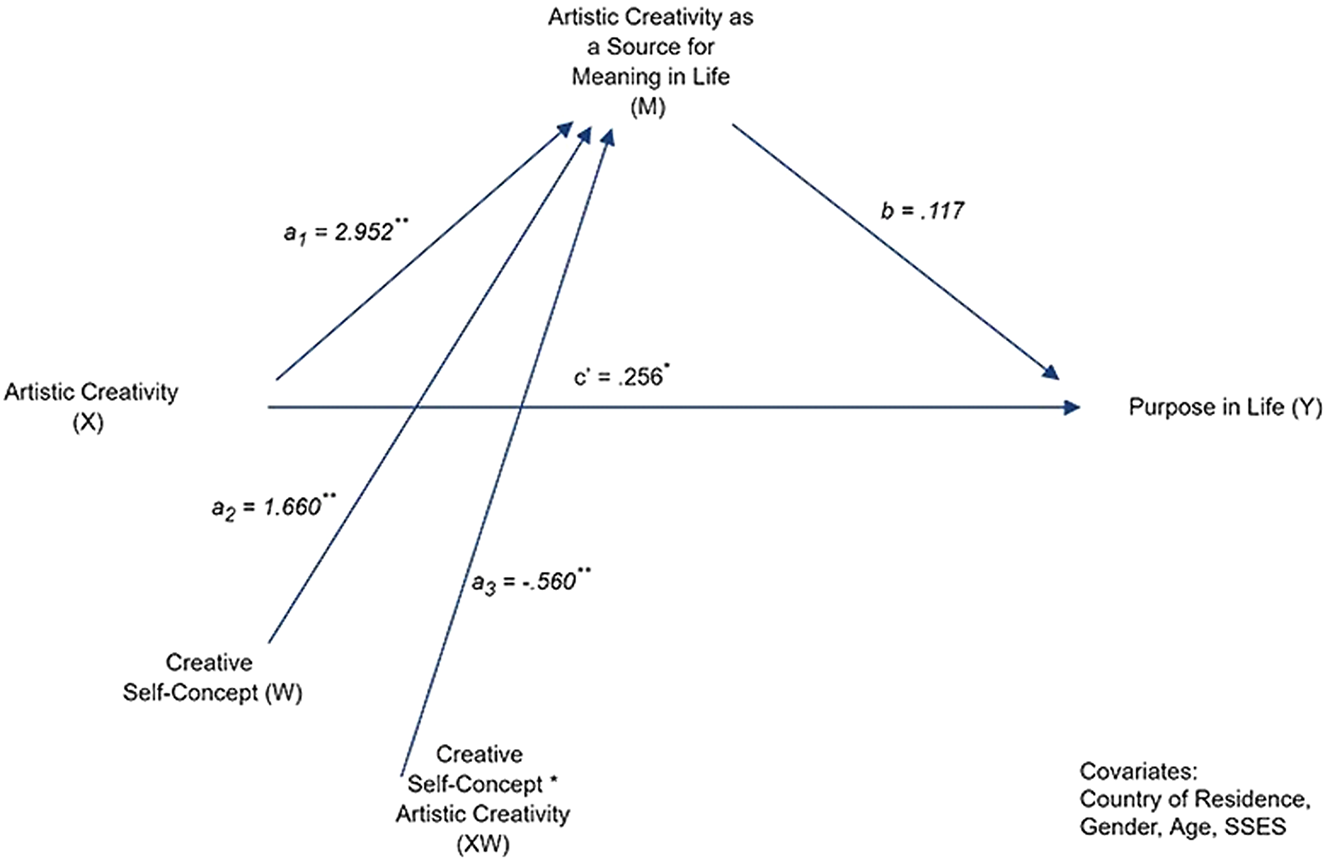
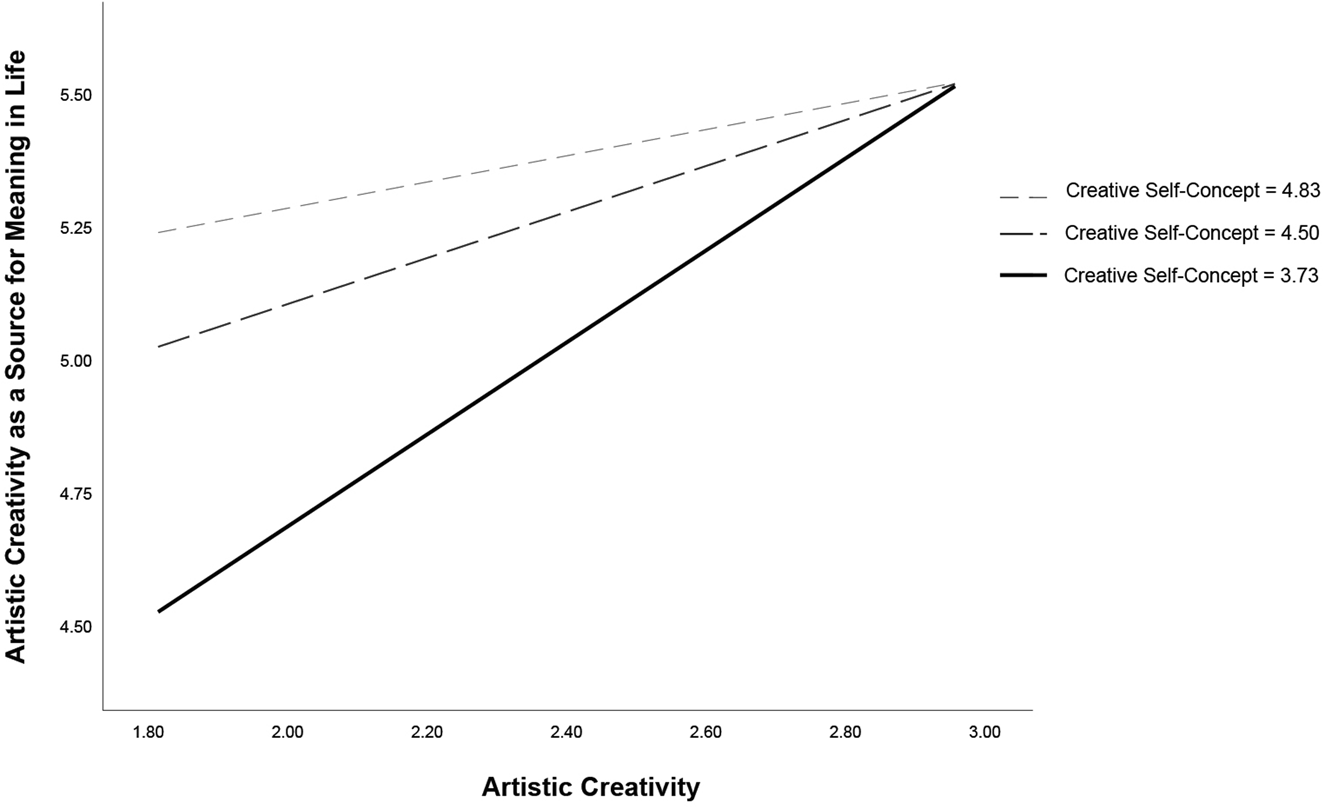
It was hypothesised that artistic creativity would contribute to purpose in life through ACASMIL, and creative self-concept would enhance this mediation effect on ACASMIL through artistic creativity, controlling for country of residence, gender, SSES, and age. A moderated mediation model with creative self-concept as the moderator for the mediation effect of artistic creativity on purpose in life through ACASML, with the four demographic covariates, was tested. Figure 4 depicts the results; holding constant the four covariates and artistic creativity, individuals with higher levels of ACASMIL reported higher levels of purpose in life yet the effect was not statistically significant (b = 0.117, 95% CI = −0.053, 0.387, p = 0.176). Importantly, it was found statistically significant that artistic creativity directly contributed to purpose in life independent of ACASMIL (c′ = 0.286, 95% CI = 0.035, 0.536, p = 0.026). A test of moderation of the effect of artistic creativity on ACASMIL conditioned by creative self-concept yielded a significant result (a 3 = −0.560, 95% CI = −0.926, −0.193, p = 0.003) though the direction of the moderation effect was the opposite from what was predicted – the results indicated that creative self-concept as a moderator attenuated the strength of the connection between artistic creativity and ACASMIL. The entire mediation model was not moderated by creative self-concept: the moderation effect of creative self-concept was not statistically significant, indicated by the index of moderated mediation = −0.065, 95% CI = −0.158, 0.024. Thus, Hypothesis 3 was not supported. Contrary to what was expected, Figure 5 shows that the slope of the conditional effect decreased as the level of creative self-concept increased; the conditional effect of artistic creativity on ACASMIL was the lowest among those scored above the 84th percentile of creative self-concept (CSC = 4.83) in the sample. The Johnson–Neyman technique (Hayes, Reference Hayes2018) showed that this conditional effect of artistic creativity on ACASMIL was statistically significant until the score of creative self-concept reached 4.827 (see Figure 6).
Statistical model of Hypothesis 3 presented with the results of unstandardised coefficients
Notes: The values presented are unstandardised coefficients.
Significant correlations are indicated with asterisks (*p < 0.05, **p < 0.01).

Artistic Creativity as a Source for Meaning in Life (ACASMIL) as a function of artistic creativity and creative self-concept

Johnson–Neyman region of significance for the conditional effect of ACASMIL at values of creative self-concept
Note: ACASMIL = Artistic Creativity as Source for Meaning in Life

Discussion
This study contributes to the knowledge of artistic creativity's potential psychological implications among ageing individuals with varying degrees of interest and involvement in visual arts. The current work incorporates previous research findings on age and purpose in life and uses creativity-related factors to better understand how artistic engagement may contribute to ageing well.
By expanding on previous work, the findings revealed that there was a weak, positive correlation between age and purpose in life among this sample of individuals recruited from the arts communities. Inconsistent with literature data (e.g. Pinquart, Reference Pinquart2002) showing an age-associated decline of purpose in life, this difference may be partially explained by the sample characteristics because the current sample was collected through arts communities, in which most individuals presumably have higher levels of artistic interests and involvement in comparison to the general public. What is more, further moderation analysis indicated that, when subjective social economic status entered the model, a different picture emerged: the positive relationship between age and purpose in life only applied to those with a relatively high subjective social economic status, supporting the idea that age is a proxy factor rather than a direct cause of changes in purpose in life.
There was not enough evidence indicating that artistic creativity would contribute to purpose in life through drawing meaning from artistic creativity to meaning in life. Although the ACASMIL construct was not found to be a statistically significant mediator between the engagement of artistic creativity and purpose in life, it is speculated that this could be attributed to the limitation of the study as potential delayed effects might not have been captured by the cross-sectional design. Alternatively, it is possible that purpose in life, like hedonic pleasure (i.e. ‘But happiness cannot be pursued; it must be ensued’; Frankl, [1963] Reference Frankl1985: 162), cannot be pursued directly (i.e. ‘The question of meaning in life is, as the Buddha taught, not edifying. One must immerse oneself in the river of life and let the question drift away’; Yalom, Reference Yalom1980: 483). The same paradox might as well apply to drawing meaning from artistic creativity to generate meaning in life–one who seeks to draw meaning from artistic creativity to generate meaning in life may need to likewise look away from the question ‘what is the point of my artistic creativity’. In other words, the engagement in artistic creativity without a direct intention to draw meaning from artistic creativity to generate meaning in life, as the results suggested, can lead to higher levels of purpose in life.
The results of Hypothesis 3 contradicted the expected direction for the effect of creative self-concept. After controlling for the effects of country of residence, gender, age, and subjective social economic status, the results of Hypothesis 3 hinted that the enhancement of creative self-concept had a slightly detrimental effect for those who sought to draw meaning from artistic creativity to generate meaning in life. Reflecting upon the results, two routes of explanation for the surprising finding are proposed, as follows.
First, it is possible that two hidden opposing forces were in play and at odds with the moderated mediation model, namely the plasticity dimension versus the stability dimension of the Big-Two personality (Feist, Reference Feist2019). Historically in personality literature, creativity-related factors, including creative self-concept, have been more strongly linked to exploration, curiosity, preferences for novel experiences, imagination and excitement-seeking, all of which are more aligned with the plasticity dimension of personality rather than the stability dimension (e.g. Karwowski and Lebuda, Reference Karwowski, Lebuda, Feist, Reiter-Palmon and Kaufman2017; Feist, Reference Feist2019). In contrast, by speculation, the construct of ACASMIL may be predicted more by the stability aspect of the Big-Two personality than the plasticity aspect, as ACASMIL correlates to some degree with purpose in life. Particularly, because purpose in life has been found to be predicted by conscientiousness (e.g. Ryff, Reference Ryff2014; Ko et al., Reference Ko, Hooker, Geldhof and McAdams2016; Hill and Weston, Reference Hill and Weston2019; Meléndez et al., Reference Meléndez, Satorres, Cujiño and Reyes2019), which maps onto the stability aspect of personality (Feist, Reference Feist2019), it is reasonable to surmise that ACASMIL and purpose in life share some overlap in conscientiousness.
Second, it is possible that participants' self-evaluation of creative self-concept was biased by inflated self-image. The detrimental effects of having an inflated self-image or a rigid self-identity have been explained elsewhere with various labels and mechanisms, such as self-as-object versus self-as-process (Ryan and Brown, Reference Ryan and Brown2003), noisy ego versus quiet ego (Campbell and Buffardi, Reference Campbell, Buffardi, Wayment and Bauer2008), and fragile self-esteem (Jordan and Zeigler-Hill, Reference Jordan, Zeigler-Hill and Zeigler-Hill2013). It can be argued that people who scored high in self-reported creative self-concept, to a certain degree, may have a tendency towards a constant need to maintain and defend their self-image for being creative, paradoxically limiting the possibility of generating meanings through their artistic creativity for meaning in life. Notice that the score of creative self-concept defining the Johnson–Neyman region of significance indicates that the transition point in this study is 4.827, meaning that for those who scored less than 4.827 in creative self-concept, their engagement of artistic creativity had an impact on ACASMIL; yet as the scorein creative self-concept increased, the impact of the engagement of artistic creativity on ACAMIL decreased. This impact continued to decrease, and as the creative self-concept score reached the point of 4.827 and beyond, the effect attenuated to become statistically indistinguishable from zero, and the effect was no longer statistically significant.
It is inconclusive why creative self-concept attenuated the effect of artistic creativity on ACASMIL in this study. Nevertheless, it is inefficacious and unethical to challenge people's conviction about their own creative self-concept because an authentic sense of creative self-concept is valuable in predicting creative achievements (e.g. Karwowski and Lebuda, Reference Karwowski, Lebuda, Feist, Reiter-Palmon and Kaufman2017) and can be beneficial in certain circumstances, as positive illusions and beliefs can serve as a psychological resource for coping with traumatic or life-threatening events (Taylor et al., Reference Taylor, Kemeny, Reed, Bower and Gruenewald2000).
Limitations
The findings of this study should be interpreted with limitations. First, the study is cross-sectional; no causality can be inferred. Moreover, the age effects shown in the study are based on between-person comparison and could be attributed to cohort effects. Future research may benefit from longitudinal designs. Second, conventional sampling always contains self-selection biases, thus generalisability is limited. Additionally, because country of residence, age, and gender were coded as covariates, researchers who are interested in considering how larger sociocultural structural forces can complicate the findings may consider using ecological approaches linking environmental, demographic, cultural (such as adherence to chosen cultural values), and sociological factors pinpointing the identified cruxes affecting the intra-individual factors. Third, the measure of subjective social economic status was based on individuals' self-reported and subjective perception; future research may include other objective measures. Fourth, in this sample of artistically inclined individuals, the magnitude of the correlation between ACASMIL and creative self-concept was moderate. Considering that within this study sample, the visual artistically inclined individuals may have a conflated view of the relationship between artistic creativity and global creativity in general, future research could extend the sample collections to include the general public or use a domain-specific creative self-concept measure tailored for a certain population of interest. Finally, because the self-reported ACASMIL may be influenced by self-impression management and that the self-reported creative self-concept involves one's ability to accurately assess one's own creative strengths and weaknesses (Beghetto and Karwowski, Reference Beghetto, Karwowski, Karwowski and Kaufman2017), measuring the two constructs by using a single scale for each may not be sufficient. Future research may include measures to control potential effects influenced by social desirability and inflated self-esteem.
Conclusion
This study underscores the need to increase awareness of how subjective social economic status serves as a modifier in the relationship between age and purpose in life; efforts to reduce social disparities should be a continuing endeavour at multiple levels and may be delivered through expanding access to artistic engagement in healthy ageing programmes. It is noteworthy that the results suggest that purpose in life, for those within the visual art communities, could be realised through engagement in artistic creativity.
In sum, the findings of this study uniquely contribute to the literature in the domain of artistic creativity and purpose in life among the ageing population. The preliminary findings highlight the utility of engaging artistic creativity to cultivate purpose in life. The study further identifies the potential need to find a balance between plasticity and stability in creative endeavour. This paper concludes with an invitation for future considerations towards adopting a social justice lens for designing healthy ageing programmes, bearing in mind that purpose in life was found to increase with age only among people on the higher rungs of the social economic hierarchy.
Acknowledgements
Writing this manuscript would have been impossible without the mentoring of Dr Keith Morran and Dr Meg Leimkuhler. The author is indebted to Dr Keith Morran's compassionate moral support and insightful research conversations; and to Dr Meg Leimkuhler, who carefully reviewed the manuscript and offered numerous helpful writing suggestions and advice.
Financial support
The writing of this manuscript received no specific grant from any funding agency in the public, commercial or not-for-profit sectors.
Competing interests
The author declares no competing interests.
Ethical standards
The writing of this manuscript used secondary data, therefore ethical approval was not required.