Introduction
The large number of refugees entering Europe will challenge the European Union (EU) to reconcile its multilevel structure with the integration of asylum seekers into its economy. This article uses a historical case to analyse how the interplay of politics, problems and inherited policy paths affects whether asylum seekers are granted access to the labour market. It employs the multiple streams approach (MSA; Kingdon Reference Kingdon1984) to study the respective implementation strategies of Swiss member states (cantons). Even though “Kingdon did not attempt to provide a framework that explained the dynamics of subsequent stages in the policy process (Zahariadis and Allen Reference Zahariadis and Allen1995; Zahariadis Reference Zahariadis1995, Reference Zahariadis2007)” (Howlett et al. Reference Howlett, McConnell and Perl2015, 421), we argue that the MSA can be fruitfully used for the study of member state implementation. Whereas Zahariadis and Exadaktylos (Reference Zahariadis and Exadaktylos2016) focus on entrepreneurial strategies to understand implementation decisions, we show that the MSA is also well suited to understand implementation decisions in federalist systems. Switzerland is an extreme case of decentralised member state implementation of federal law (Ehrler and Sager Reference Ehrler and Sager2011; Sager and Zollinger Reference Sager, Thomann, Zollinger and Mavrot2011). This makes it a paradigmatic case, which can inform our understanding of how the MSA explains implementation decisions. Similar to Zahariadis and Exadaktylos (Reference Zahariadis and Exadaktylos2016, 62; also Ridde Reference Ridde2009), we “view policy outputs as constituting implementation windows”. The federal policy decision thus opens an implementation window that implies additional political decision-making processes at the level of the constituent states when transposed into cantonal law. This process embraces fundamental adjustments that result in a substantial diversity of cantonal implementation strategies.
We analyse a setting in which the federal law granted the cantons the possibility to integrate asylum seekers into their labour markets. High refugee rates, anti-immigrant attitudes and “welfare chauvinism” (see e.g., Freitag and Rapp Reference Freitag and Rapp2013) can trigger competition for scarce resources and challenge solidarity with asylum seekers (Boräng Reference Boräng2015). Yet, not granting asylum seekers the right to work may not mediate that competition: Hatton (2009, F209) shows that “the policies that deter [asylum] applications are those that limit access to territory and those that reduce the proportion of claims that are successful (…). Policies that diminish the socioeconomic conditions of asylum seekers evidently have little deterrent effect and they may even contribute to the subsequent deprivation that many asylum seekers experience” (see also Keogh Reference Keogh2013). Asylum seekers are likely to inflict burdens on the welfare state (Boräng Reference Boräng2015) as “new migrants and refugees especially constitute a category with particular problems in accessing the labor market” (Hagelund and Kavli Reference Hagelund and Kavli2009, 259). Asylum seekers’ early integration into the labour market can be decisive for a successful subsequent integration into other societal spheres as well. This integration is hence one of the major challenges that destination countries face today (Toshkov and de Haan Reference Toshkov and de Haan2013).
Previous analyses of Swiss asylum policy “unambiguously support the contention that decentralised implementation might be linked to the unequal treatment of individuals” (Holzer et al. Reference Holzer, Schneider and Widmer2000, 270; Spörndli et al. Reference Spörndli, Holzer and Schneider1998). We compare the restrictions imposed by 24 Swiss cantons to integrate pending asylum seekers into the labour market between 2000 and 2003, using both existing and newly collected data. To understand the considerable cantonal differences in the cantonal integration strategies, we propose two refinements of the MSA.
First, as Knaggård highlights, “the MSF would benefit from further development of the problem stream (…) [P]roblem framing as a separate process (…) affects (…) agenda setting and decision making” (Reference Knaggård2015, 450). In this vein, this article argues that policy problems are fundamentally a matter of perception, which in turn may differ between bureaucratic and political party actors. Elected officials grant target groups – in this case, asylum seekers – greater or fewer rights (e.g., access to the labour market), depending on how the social construction of this target group within the constituency shapes their perception of the policy problem and appropriate solutions (Schneider and Ingram Reference Schneider and Ingram1993; Steinacker Reference Steinacker2006; Herweg et al. Reference Herweg, Huß and Zohlnhöfer2015). Asylum seekers as noncitizens without a right of residence might not be considered as deserving to get access to the labour market (Steinacker Reference Steinacker2006; Boräng Reference Boräng2015). Responsive governments may then choose not to grant asylum seekers access to the labour market. The solutions adopted depend on these actors’ power to influence policymaking. Second, policy inheritance in the form of existing welfare institutions affects solidarity with migrants (Boräng Reference Boräng2015). We hence follow Spohr (Reference Spohr2016) in complementing the MSA with historical institutionalism. Inherited policy paths impact and interact with the actors’ problem perception. This implies that a focus on the combined effects of problem-related factors, politics (actor constellations) and policy paths is needed to understand how a policy problem is perceived and what solution is adopted. Fuzzy-set qualitative comparative analysis (fsQCA) (Ragin Reference Ragin2008), combined with formal theory evaluation (Schneider and Wagemann Reference Schneider and Wagemann2012; Thomann Reference Thomann2015), is an especially appropriate method for analysing the theorised joint effects of these different streams (Sager and Rielle Reference Sager and Rielle2013).
We now embed our test case in this discussion before deriving explanations for (non)restrictions of labour market integration and theoretical expectations on the interaction of the streams. On the basis of the results, we then evaluate these propositions. Our results underscore how existing welfare institutions and the social construction of target groups influence the solidaristic treatment of vulnerable populations. The findings reveal, first, that bureaucratic actors are more relevant than political parties for enabling the labour market integration of asylum seekers. Second, institutionalised policy paths dominantly contribute to explaining why the state grants asylum seekers the right to access the labour market. Conversely, and third, constellations entailing political factors and a negative problem social construction of asylum seekers contribute to restrictions of this access.
The late Stein Rokkan recommended that “anyone wishing to study the dynamics of European politics should immerse him or herself in the study of Switzerland” (Freitag and Rapp Reference Freitag and Rapp2013, 440). We correspondingly conclude by discussing the results’ scope, drawing parallels to the EU multilevel system and discussing possible lessons for the current refugee situation in Europe.
The Swiss case
Switzerland has a fairly long tradition of granting asylum to political refugees, with the significant exception of during World War II. In the 1970s, when the composition of asylum seekers changed and their number grew, asylum policy became a major public issue. A host of revisions to the first asylum law from 1981 to date has consisted essentially in the constant increase of the threshold for granting asylum recognition (Lavenex Reference Lavenex2007, 632–635). Although asylum proceedings are regulated at the federal level, the pending asylum seekers are allocated to the cantons, proportionate to population size. The cantons organise housing, allocate social assistance, foster integration and, if the asylum decision is negative, are responsible for expulsion. “The tightening of the Asylum Law has led to a shift of the financial burden of the asylum system towards the cantons, which in turn has resulted in the increased politicization of the topic. The cantons are thus responsible on the one hand for the often protracted implementation of the removal of rejected asylum seekers, and, on the other hand, for the additional costs caused by rejected applicants (…)”(Lavenex Reference Lavenex2007, 635).
Until 2004, the federal government bore the costs of social assistance in the asylum system. In 1995, flat-rate contributions were introduced. To make the cantons reduce their spending on social assistance for asylum seekers, the revised Federal Decree on measures to decrease spending on the asylum system introduced severe cutbacks in the flat rates in 1999. This instrument was in force until 2004, when a federal austerity programme again tightened the law. Since then, rejected asylum seekers are no longer entitled to statutory social assistance except for “emergency assistance” (Nothilfe).
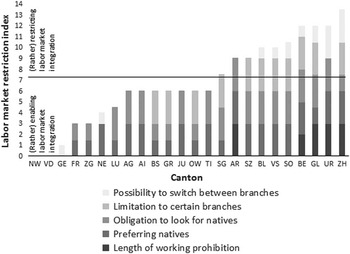
We study the time between 2000 and 2003, when the federal government covered limited per diems for asylum seekers in need of social benefits. In this particularly politicised policy field, the cantons had two options for reducing social spending on refugees: the expulsion of asylum seekers with a negative decision, or enabling the integration of pending asylum seekers into the labour market (Schenkel 2005). The asylum law allowed for the gainful employment of pending asylum applicants after a period of three months. However, the cantons were not obliged to apply this rule. As high expulsion rates do not indicate restrictions of asylum seekers’ labour market integration and vice versa, we focus only on the integration measure.Footnote 1 Labour market integration denotes the openness of cantonal regulation to the integration of asylum seekers into the labour market. It is measured using Piguet and Misteli’s (Reference Piguet and Misteli1996) labour market restriction index as applied in the study by Spörndli et al. (Reference Spörndli, Holzer and Schneider1998). The index encompasses the following:
-
a. the cantonal regulations regarding the length of the working prohibition,
-
b. the principle of preferring natives for open jobs,
-
c. the obligation for employers to actively look for native job candidates,
-
d. working permit limitation for certain industries and
-
e. the possibility for asylum seekers to switch between different industries.
The data were newly collected for this study on the basis of a written survey of all responsible cantonal authorities in 2004 (return rate 100%) (Schenkel 2005). The original survey in German is indicated in the online appendix. Piguet and Misteli (Reference Piguet and Misteli1996) define three degrees of restriction – namely, low restriction (1–5.5), medium restriction (6–8.5) and high restriction (9–15). Low restrictiveness indicates that cantonal policies enable the labour market integration of asylum seekers (INT); high restrictiveness indicates that cantonal policies impose restrictions on labour market integration (int). We consider cantons with a labour market restriction index of less than 7.25 – that is, exactly in the middle of the “medium restriction” category – as cases that enable integration.
In comparing how Swiss cantons implement the same policy, we employ a “most similar systems” design that holds most institutional and macroeconomic contextual conditions constant (Rihoux and Ragin 2009). This enables us to focus on selected possible explanations for the different degrees to which some cantons chose to give asylum seekers access to the job market, while others did not (Figure 1).
Labour market restriction index, 2000–2003. Note: Restriction index=sum of cantonal scores in length of working prohibition according to art. 21 AsylG (six months=3, three months=0), the principle of preferring natives for open jobs (allover=3, partly=1.5, none=0), the obligation of employers to actively look for native job candidates (general obligation=3, obligation for certain branches=1.5, no obligation=0), working permit limitation to certain branches (existent=3, inexistent=0) and the possibility for asylum seekers to switch between different branches (not possible=3, possible after 24 months=1.5, possible after 12 months=1, no restriction=0). AG=Aargau; AI=Appenzell Innerrhodes; AR=Appenzell Outerrhodes; BE=Berne; BL=Basel Land; BS=Basel City; FR=Fribourg; GE=Geneva; GL=Glarus; GR=Grisons; JU=Jura; LU=Lucerne; NE=Neuchâtel; NW=Nidwald; OW=Obwald; SG=St Gall; SO=Solothurn; SZ=Schwyz; TI=Ticino; UR=Uri; VD=Vaud; VS=Valais; ZG=Zug; ZH=Zurich.

Conditions for integration
We consider the Federal Decree on measures to decrease spending on the asylum system from 1999 as opening an implementation window (Ridde Reference Ridde2009; Zahariadis and Exadaktylos Reference Zahariadis and Exadaktylos2016) within which the cantons had to choose their implementation strategies. The MSA allows us to model different constellations of actors, problem perceptions and policy contexts to understand the respective decisions. This framework conceives of policy decisions as the result of a simultaneous conjunction of three different streams at a given time: problems, policies and politics are independent, exogenous streams flowing through a system (Zahariadis Reference Zahariadis2014, 31). Policy decisions are not necessarily a rational reaction aimed at resolving functional problems (Sager and Rielle Reference Sager and Rielle2013, 6). “More often solutions search for problems. People work on problems only when a particular combination of problem, solutions, and participants in a choice situation make it possible” (Kingdon Reference Kingdon1984, 91). Along with Spohr (Reference Spohr2016), this article argues that the MSA analysis should integrate inherited policy paths, which distribute decision power and coin actors’ identities and interpretations of situations (Olsen Reference Olsen2001; Boräng Reference Boräng2015). Although the implementation window was present in all cantons between 1999 and 2004, what differs between the cantons is the interplay of actor constellations (politics stream), problems and the policy inheritance (policy stream).
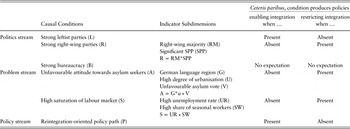
To address the “many variables, few cases” issue, we analyse six causal conditions, which are composed, overall, of 10 indicators. If two indicators represent the same theoretical reasoning, then we consider them as functionally equivalent secondary-level dimensions of one basic-level condition. Such factors are combined using the logical operator “OR”, denoted by +. When several indicators need to be observed in combination, this is expressed with the logical operator “AND”, denoted by * (Goertz Reference Goertz2006, 40, 41). Adopting QCA notation, we use capital letters if a feature is present and lowercase letters if the feature is absent.
Politics stream
The politics stream encompasses the broader environment within which policy is made, in terms of specific actor constellations (Ackrill et al. Reference Ackrill, Kay and Zahariadis2013, 873). We consider two sets of actors with different approaches to policy problem solving. First, party political actors are responsive to electorates (Schneider and Ingram Reference Schneider and Ingram1993). Conversely, and second, the public administration pursues goals that are mainly problem driven – that is, technical (Sager Reference Sager2007a, 432, Reference Sager2007b, 236; Sager and Rielle Reference Sager and Rielle2013). If they are powerful enough to influence policymaking, then these actors’ responses to their divergent problem definitions will shape whether asylum seekers are granted the right to access the labour market. “MSA places policy entrepreneurs and their strategies at the heart of policy change” (Zahariadis and Exadaktylos Reference Zahariadis and Exadaktylos2016, 62). However, our main analytic interest lies in the configurations of conditions under which the streams are coupled, rather than the actual coupling processes. We hence do not include the policy entrepreneurs in our comparison, but discuss their role in the process in our analysis of deviant cases.
According to the “parties-do-matter” view (Castles Reference Castles2000) and the literature on party ideology and migration (Lavenex Reference Lavenex2004, Reference Lavenex2007; Manatschal Reference Manatschal2015), cantons with a strong major party of the left (L) in the executive are more willing to integrate asylum seekers (INT). Conversely, strong right-wing parties (RM) propose a restrictive asylum system, and may hence oppose integration (int). This holds especially for the populist Swiss Peoples Party (SPP) – the radicals dominantly oppose a strong welfare state, and could hence be in favour of enabling integration (Lavenex Reference Lavenex2004; Manatschal Reference Manatschal2015). Thus, we only consider the cantonal executive to have a strong right-wing majority (R) if the SPP also holds at least 50% of the right-wing seats (SPP):
 $${\rm R\,{\equals}\,RM{\asterisk}SPP}$$
Bureaucracy is a political actor in its own right (Sager and Rielle Reference Sager and Rielle2013, 1). Hence, we expect that the coupling of the politics and problem stream may depend on the strength of the bureaucracy. In highly professionalised public administrations, vertical epistemic community effects can lead to converging problem analyses, regardless of the political circumstances (Sager Reference Sager2005). We use the size of a cantonal bureaucracy as a proxy for its political strength. The larger the bureaucracy (B), the higher its degree of professionalisation and specialisation tend to be (Sager Reference Sager2003).
Traditionally, another aspect of the politics stream is the national mood, meaning that a fairly large number of individuals in a given country tend to think along common lines (Zahariadis Reference Zahariadis2014, 34). As we study member state implementation, the relevant group of voters is the cantonal electorate. In the following, however, we propose to conceptualise the attitudes of the electorate as part of the social construction of asylum seekers that defines the problem stream. We do so because “work from psychology (…) has shown how common decision heuristics can influence (…) the saliency of the problem and evaluation of the possible policy solutions” (Steinacker Reference Steinacker2006, 460).
Problem stream
The problem stream refers to conditions that policymakers, interest groups and other policy actors believe warrant attention (Ackrill et al. Reference Ackrill, Kay and Zahariadis2013, 873). However, what decisionmakers conceive to be the relevant problem that requires a solution is not exogenously given: problems do not exist but have to be defined by someone (Knaggård Reference Knaggård2015, 452). Although the MSA has always highlighted this (Kingdon Reference Kingdon1984; Herweg et al. Reference Herweg, Huß and Zohlnhöfer2015, 436), Knaggård (Reference Knaggård2015, 451) also emphasises that “studies using the MS[A] hide the power present in defining public problems. Public problems are here seen as those understood as being in need of political action”.
Party political actors seek to comply with voters’ preferences because of the need to be re-elected (Sager Reference Sager2007a, 435). “Parties are interested in promoting issues they own, and care about how much their proposals impact their chances of re-election” (Herweg et al. Reference Herweg, Huß and Zohlnhöfer2015, 441). Voters’ preferences are influenced by “the cultural characterisations or popular images of the persons or groups whose behaviour and well-being are affected by public policy” (Schneider and Ingram Reference Schneider and Ingram1993, 334). Therefore, the problem perceptions of responsive politicians are to a large extent influenced by the social construction of the relevant target groups, which “indicate whether the problems of the target population are legitimate ones for government attention, what kind of game politics is (…), and who usually wins” (Schneider and Ingram Reference Schneider and Ingram1993, 340). Hence, the population defines the problem by social construction, which in turn influences public judgements of problem saliency and of the preferred policy approaches (Steinacker Reference Steinacker2006, 460). This resonates with Herweg et al. (Reference Herweg, Huß and Zohlnhöfer2015, 438) who also argue that the relevance of problems in the problem stream is related to public opinion: “policy makers will start to perceive a condition as a relevant problem if they believe that its persistence threatens their re-election”. Thus, we expect the social construction of the target group “asylum seekers” to be the relevant problem definition for the implementation decision of political parties in need of re-election.
Although asylum seekers are per definition powerless, the political attitudes of the population indicate their social image as being deserving or undeserving (Lenschow et al. Reference Lenschow, Liefferink and Veenman2005; Lavenex Reference Lavenex2007). The main indicator for political attitudes in Switzerland is language. German-speaking regions (G) have a less liberal attitude towards asylum seekers than many cantons in the Latin cultural settings, and urbanised regions (U) are generally more liberal than rural regions (Christin et al. Reference Christin, Hug and Sciarini2002). We further consider the cantonal results in the public vote on the SPP’s popular initiative “Against asylum abuse” on 24 November 2002, which called for a further tightening of the asylum law. An attitude that is unfavourable towards asylum seekers (A) is observed in two instances: first, if a canton is both German-speaking (G) AND rural (u), OR, second, if a high share of the population voted for the “Against asylum abuse” initiative (V). The canton Ticino, for instance, is not German speaking, but still displays an unfavourable attitude because of the high share of anti-immigration votes:
 $${\rm A}\,{\equals}\,{{\rm G^{\asterisk}u}} {\plus}{\rm V}$$
According to Steinacker (Reference Steinacker2006), if asylum seekers are perceived as deserving (a; dependents), then the choice of policy is likely to be beneficial, in our case, enabling integration (INT). Conversely, if asylum seekers are constructed negatively (A; deviants), then party politicians seek to claim credit for being tough on the unworthy group (int).
Conversely, we posit that cantonal bureaucracies define the problem functionally in view of the labour market situation: “public administration (…) will seek the technically best policy design, that is, the solution most adequate to the problem under discussion” (Sager Reference Sager2007a, 436). If the labour market is already highly saturated, then it would constitute a contradiction to integrate a fresh workforce. High cantonal unemployment rates (UR) may indicate high saturation. Yet, most asylum seekers with work permits concentrate only on the hotel and restaurant industry, where a varying share of seasonal workers obtain their permits from the cantons (SW).Footnote 2 The labour market is too saturated to facilitate the integration of asylum seekers (S) if either the rate of unemployment is high (UR) OR there are already many seasonal workers (SW):
 $${\rm S\,{\equals}\,UR{\plus}SW}$$
Policy stream
In his conceptualisation of the policy stream, Spohr (Reference Spohr2016, 252) employs historical institutionalism by claiming that “ideas have to fulfil the criteria of technical feasibility and value-acceptability to win acceptance in policy-networks. Technical feasibility means that policies have to be implementable to be chosen, which involves compatibility with existing institutional or organisational structures (…). Thus, the institutional setting is important for the criterion of technical feasibility”. Accounting for existing policies means rejecting “the traditional postulate that the same operative forces will generate the same results everywhere in favour of the view that the effect of such forces will be mediated by the contextual features of a given situation often inherited from the past” (Hall and Taylor Reference Hall and Taylor1996, 941; see also Thomann and Manatschal Reference Thomann and Manatschal2015).
The need to make an implementation decision – in this case, the choice between enabling or restricting integration – was present in all cantons between 1999 and 2004. What differs between the cantons is the policy inheritance within which this decision was made. Cantonal policy paths characterise the implementation of unemployment law (Battaglini and Giraud Reference Battaglini and Giraud2003). A reintegration-oriented implementation strategy is directed towards improving placement capability, filling gaps in the qualifications of the unemployed, and diminishing the negative consequences of unemployment (Battaglini and Giraud Reference Battaglini and Giraud2003, 288).
Inherited policy paths can be expected to play an important role in the MSA framework, because the problem perceptions of policymakers may partly be based on a sense of identity that is known, accepted and anticipated (Olsen Reference Olsen2001). Especially in migration policy, existing welfare state institutions impact the boundaries of social solidarity, enhance generalised trust, and influence citizens’ views of how the state can and should protect individuals (Boräng Reference Boräng2015). If this is true, inherited policy paths defining the policy stream can “rule out” and replace the prevailing problem perceptions (attitudes or labour market saturation). Existing, integration-oriented welfare institutions are hence functionally equivalent to an integration-prone problem stream; it takes either of the two for policies that grant asylum seekers the right to access labour markets. For both political party actors and bureaucratic actors, a reintegration-oriented policy path (P) can equally produce a tendency towards enabling integration (INT).
Table 1 reports the six conditions that result from these 10 indicators and their expected impact on both enabling and restricting integration. The MSA implies that theoretical expectations must be formulated on the combined, instead of isolated, effects of these factors. In terms of method, we take this causal complexity into account by employing fsQCA. In terms of theory, we now derive theoretical expectations on the interplay of politics, problems and institutional path dependencies.
Conditions for labour market integration and directional expectations

Note: SPP=Swiss Peoples Party.
Hypotheses
We have outlined four assumptions:
-
1. Policy choices are made only when a particular combination of actor constellations (politics), problems and solutions in a choice situation makes it possible (Sager and Rielle Reference Sager and Rielle2013, 6). Politics, problems and policies are a necessary part of different conjunctions, which only jointly are sufficient for (→) enabling or restricting integration.
-
2. Different social constructions of asylum seekers provoke different problem assessments of political party actors seeking re-election.
-
3. The cantonal bureaucracies act according to the salience of the technical (functional) problem of labour market saturation.
-
4. Both political and bureaucratic actors refer to cantonal policy paths, which can replace the problem stream in the MSA.
We can hence hypothesise two alternative explanations for policies enabling integration and two additional restrictions on integration.
First, a strong political left will favour enabling integration if the population’s attitude is favourable towards asylum seekers or the canton has an integration-friendly policy path. Generally, party political actors are only clearly dominant when the cantonal bureaucracy is weak. Formally, we can write this as follows:
 $${\rm H1\colon\, L{\asterisk}b{\asterisk}}\left( {{\rm a{\plus}P}} \right)\to{\rm INT}$$
Second, however, if the cantonal bureaucracy is strong, then it favours enabling integration if either the labour market is not too saturated or the canton has an integration-friendly policy path. For the cantonal bureaucracy to dominantly favour enabling integration, the political right must be weak:
 $${\rm H2\colon\, B{\asterisk}r{\asterisk}}\left( {{\rm s{\plus}P}} \right)\to{\rm INT}$$
Third, in the absence of a strong bureaucracy, a strong political right achieves restrictions of integration if the attitude of the population is unfavourable towards asylum seekers and the canton has an integration-averse policy path:Footnote 3
 $${\rm H3\colon\, R{\asterisk}b{\asterisk}A{\asterisk}p}\to{\rm int}$$
Finally, fourth, if no dominant political left pushes for integration, then a strong bureaucracy will favour restrictions of integration when the labour market is already saturated and when the canton has an integration-averse policy path:
 $${\rm H4\colon\,B{\asterisk}l{\asterisk}S{\asterisk}p}\to{\rm int}$$
The combined effects of these factors are evaluated using the research strategy currently presented.
Data and methods
To account for the interaction of the politics stream, the problem stream and inherited policy paths, we employed fsQCA (Ragin Reference Ragin2000; Rihoux and Ragin Reference Rihoux and Ragin2008). On the basis of Boolean algebra and its fuzzy extension, the core interest of the QCA method lies in identifying the necessary or sufficient conditions for a certain outcome.Footnote 4 QCA allows for the causal complexity behind a given phenomenon. This entails, first, the assumption of conjunctural causality, meaning that the effect of a single condition unfolds in combination with other conditions (subsequently called configurations or paths), as the MSA assumes. The notion of equifinality then captures that integration may have several, mutually nonexclusive, context-dependent explanations. The assumption of causal asymmetry entails that enabling integration can be explained differently than restrictions of integration (Schneider and Wagemann Reference Schneider and Wagemann2012, 78).
fsQCA (Ragin Reference Ragin2000) translates variables into sets – for example, the set of “cantons enabling labor market integration”. During the “calibration” process, the cases’ set membership is determined on the basis of substantive and theoretical knowledge. Set membership may vary from the thresholds for full and nonmembership with a crossover point (neither in nor out). For example, a canton may fully enable integration (1) or fully restrict integration (0). The decisive crossover point above which integration policies are more enabling than restricting (INT) and below which integration is more restricted than enabled (int) is 0.5. As the numerical distances between the scores do not continuously have the same qualitative meaning (see Figure 1), we calibrate labour market integration using the indirect method of calibration, which involves an initial grouping of cases into previously defined set-membership scores (Schneider and Wagemann Reference Schneider and Wagemann2012, 35). Owing to limited space, the measurement, descriptive statistics and calibration of the sets are discussed in depth in online appendix A. Lacking information on policy paths led to the dropout of the cantons Schaffhausen and Thurgau (Battaglini and Giraud Reference Battaglini and Giraud2003).
After calibration, all logically possible combinations of conditions are listed in a “truth table”. Each case belongs to a configuration (row). The following logical minimisation process identifies the shortest possible causal expression for those configurations, implying the outcome (the solution term). The basic idea is that if an outcome, for example, INT, is found in a canton displaying conditions L, B and P, as well as in another case displaying L and B, but not P, then the presence or absence of P obviously does not make a difference for the occurrence of INT. Formally, we can write this as L*B*P+L*B*p→INT and minimise it accordingly to L*B→INT.
To evaluate the results, consistency indicates the degree to which the empirical evidence at hand is in line with the statement of sufficiency or necessity. Furthermore, the proportional reduction in inconsistency (PRI) indicates the degree to which a given causal configuration is not simultaneously a subset of both the occurrence and the nonoccurrence of the outcome. Coverage indicates how much of the empirical information has been explained (Schneider and Wagemann Reference Schneider and Wagemann2012, 128, 139, 235–239).
The choice of appropriate levels for these measures is research specific. Consistency sufficiency should not fall below 0.75. For necessary conditions, a lower consistency threshold of 0.9 applies; coverage expresses their empirical relevance in terms of the condition set not being much larger than the outcome set, and the relevance of necessity (RoN), in terms of the condition being close to a constant (Schneider and Wagemann Reference Schneider and Wagemann2012, 143, 147). When deciding upon the raw consistency threshold for sufficient truth table rows, we considered “gaps” in the consistency values and low PRI scores. A further criterion was then the absence of deviant cases consistency in kind with qualitatively different membership scores in the condition and outcome sets (Schneider and Rohlfing Reference Schneider and Rohlfing2013). The prioritisation of consistency and differing calibration methods produce low coverage values that do not adequately reflect the solution’s acceptable explanatory power: approximately two-thirds of all cases are explained.
We tested the robustness of our results against different calibration thresholds; see online appendix B (Skaaning Reference Skaaning2011; Schneider and Wagemann Reference Schneider and Wagemann2012, 285–293). Applying the enhanced standard analysis procedure, we resort to the intermediate solution, make theoretically informed directional expectations (Table 1) and ensure that the results of necessity and sufficiency are coherent with each other (software: R packages QCA and SetMethods; Quaranta Reference Quaranta2013; Duşa and Thiem Reference Duşa and Thiem2014). The raw data, prime implicants, alternative solution terms, truth tables, indications on limited diversity and untenable and simplifying assumptions are reported in online appendix C (Schneider and Wagemann Reference Schneider and Wagemann2012, 167ff, 200ff).
Results
We now briefly present the results before discussing them further in depth. We first assessed the presence of necessary conditions for enabling and restricting integration (Table C1 online appendix). We find that the absence of a strong political left in the cantonal executive is needed for restrictions of integration (int). The only canton where integration was restricted despite the presence of a strong political left is Berne, where the unique situation of a political deadlock between a strong left (L) and an even stronger right (R) in the Bernese government rendered the executive virtually hamstrung. Although the left was formally strong, it had a limited capacity to act, thus being de facto weak.
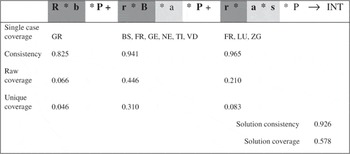
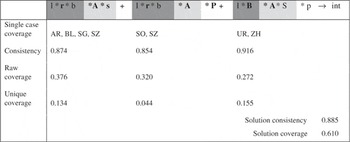
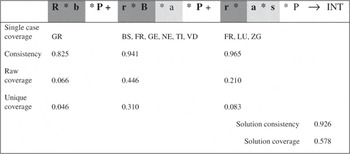
Three scenarios are sufficient for enabling integration (Table 2). The consistency of single paths and of the whole solution term is indicated below, together with the cantons that display them. Raw coverage expresses how much of the outcome is covered by a single path, and solution coverage does the same for the solution term, whereas unique coverage indicates how much a path uniquely covers (Schneider and Wagemann Reference Schneider and Wagemann2012, 127, 128, 139, 143ff).
Sufficient conditions for enabling integration
Note: Dark shade: politics stream, grey shade: problem stream, white shade: policy stream.
Bold: enhanced causal interpretability (parsimonious solution).
Raw consistency threshold 0.824.
Key: cf. Figure 1
It catches the eye that an integration-friendly policy path (P) is always part of the story for enabling integration – although this is not enough on its own. Inherited policy paths defining the policy stream hence have a high empirical relevance. Conversely, the picture is not theoretically consistent regarding the presence or absence of the relevant actor constellations of the politics stream – in particular, the presence of a strong left seems causally irrelevant. Thus, policy paths ace out politics for enabling the labour market integration of asylum seekers.
In the first configuration, covering Grisons (GR), the actor constellation of a strong political right (R) with a weak bureaucracy (b) and an integration-friendly policy path (P) implied that cantons enabled integration. In this case, the policy path seems to have guided the political right’s decisions. It is worth noting that the SPP in Grisons has always been considerably more liberal than other branches of the party. In addition, workers from abroad play an important role in Grison’s highly tourism-oriented economy and its agriculture, which is reflected in low restrictions to work in different branches. The second configuration is empirically most relevant in covering six cases. In this case, the political right was weak (r), but the bureaucracy was dominant (B). Together with a positive construction of asylum seekers (a) and an integration-friendly policy path (P), this implied policies enabling integration. A typical case is Basel city (BS), whose close proximity to Germany and France nourishes a very international and generally liberal self-concept of the population. Owing to its high share of immigrants, BS has almost by necessity taken on a lead role in innovative integration concepts for foreigners. The third configuration comprises three cantons in which the political right was weak (r). As attitudes were favourable (a), the labour market was not saturated (s) and as the policy path was pronouncedly integration friendly (P, maximum value in all three cantons), asylum seekers’ integration into the labour market was enabled. These three cantons are not known as particularly liberal, but traditionally dominated by Christian Democratic parties that promote altruistic values. These cantons do have policies that prefer natives over asylum seekers, but no other restrictions.
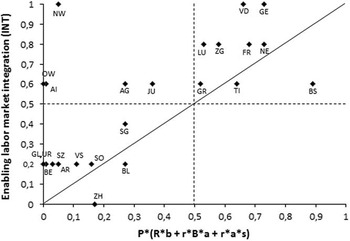
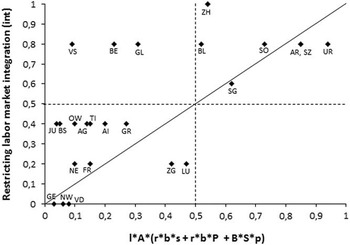
Figure 2 illustrates the good consistency of this solution. In the upper left quadrant, five (out of 14) cases of enabling integration appear, which cannot be explained by this solution.
Sufficient conditions for enabling integration. Note: The cases situated above the diagonal are fully consistent. Deviant cases for coverage are in the upper left quadrant, and deviant cases for consistency in kind are in the lower right quadrant. The cases in the lower left quadrant are not directly relevant (Schneider and Wagemann Reference Schneider and Wagemann2012, 308, 67ff). The case memberships are calculated with rounded scores (two decimals). Key: cf. Figure 1.

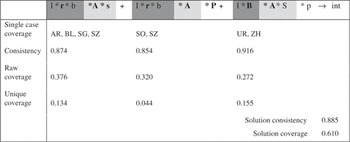
Three different configurations are sufficient for restricting integration (int) (Table 3). Unfavourable attitudes towards asylum seekers are always present, although they must combine with other factors. Hence, the combination of a negative construction of asylum seekers with a weak political left proves to be an essential part of the story about why the former are restricted access to the labour market. Conversely, policy paths play an empirically less prominent (relevance only in four cases) and theoretically inconsistent role. Thus, for restricting integration, politics and attitudes defining the problem stream ace out inherited policy paths of the policy stream.
Sufficient conditions for restricting integration
Note: Dark shade: politics stream, grey shade: problem stream, white shade: policy stream.
Bold: enhanced causal interpretability (parsimonious solution).
Raw consistency threshold 0.844. Key: cf. figure 1.
The first two configurations cover six cases that share the actor constellation of weak political parties and an equally weak bureaucracy (l*r*b). Furthermore, the population has a negative image of asylum seekers (A). Unexpectedly, in the first configuration, this combines with low levels of labour market saturation (s), and in the second configuration with an integration-friendly policy path (P), to imply restrictions of integration. These paths represent German-speaking cantons dominated by centrist parties such as Schwyz, relatively unaffected by immigration in practice but with a population that is highly mobilised on anti-immigration issues. These cantons tend to restrict asylum seekers’ labour market integration to specific branches, and have a pronounced “natives first” policy. The third configuration captures two cases where the left was weak (l) and the bureaucracy strong (B). As expected, in this case, the joint effect of a negative attitude towards asylum seekers (A), a highly saturated labour market (S), and an integration-averse policy path (p) was that asylum seekers were restricted access to the labour market. Uri, for instance, is one of the oldest, traditionally conservative and demarcation-oriented, Swiss cantons with a highly agriculture-oriented economy characterised by an already high share of seasonal workers. Zurich is Switzerland’s largest city, a target of commuting workers from all over the country and the stronghold of the SPP.
As Figure 3 shows, this solution, too, has good consistency and covers no fewer than nine cases. Three cases of restricting integration remain unexplained.
Sufficient conditions for restricting integration. Note: The cases situated above the diagonal are fully consistent. Deviant cases for coverage are in the upper left quadrant, and deviant cases for consistency in kind are in the lower right quadrant. The cases in the lower left quadrant are not directly relevant (Schneider and Wagemann Reference Schneider and Wagemann2012, 67ff, 308). The case memberships are calculated with rounded scores (two decimals). Key: cf. figure 1.

We now discuss deviant cases for coverage as part of the explorative logic of QCA, which aims at going beyond a mere testing of theories to improve and refine the concepts and frameworks applied (Rihoux and Ragin Reference Rihoux and Ragin2009; Schneider and Rohlfing Reference Schneider and Rohlfing2013). Nidwald is the “most deviant case coverage” for enabling integration. The canton Glarus has the same constellation of explanatory factors as Nidwald, but restricts integration, and, indeed, Glarus is also one of the three “unexplained” cases of restricting integration. What factor made the difference here, which was neglected in our study?
The MSA concept of policy entrepreneurs helps us understand these cases. Zahariadis and Exadaktylos (Reference Zahariadis and Exadaktylos2016) highlight the crucial role of policy entrepreneurs to couple the streams in order to enact and implement policy changes. The main difference between the two cantons lies in the personalities of the individual members of the executive responsible for asylum policy as policy entrepreneurs. In Nidwald, the respective minister, Leo Odermatt, was a member of a local green party (Demokratisches Nidwalden) that stood for a very liberal and social progressive asylum policy. His counterpart in Glarus, Willy Kamm, was a member of the centre-right liberal party (FDP). In 2002, the voters in Glarus decided to reduce government seats from seven to five as per 2004, which led to an intensification of the competition for re-election. Distinguishing himself through high expulsion rates saved an absolute majority for Kamm in the next elections. These case analyses suggest that short-term political considerations are significant for explaining the labour market integration policy for asylum seekers. This makes perfect sense, given the high politicisation of the issue. It also confirms that, in addition to general party positions and actor strengths, policy entrepreneurs play an important role in the processes that define the politics stream.
Theory evaluation
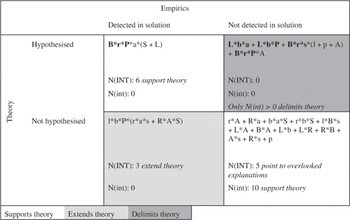
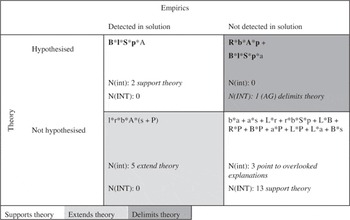
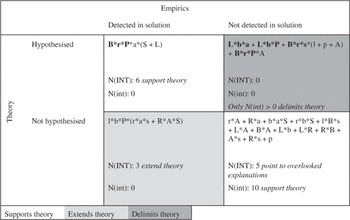
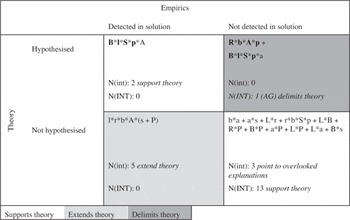
We now discuss our hypotheses following Ragin’s principles of theory evaluation, as extended by Schneider and Wagemann (Reference Schneider and Wagemann2012, 295–305). The scenarios expected and those not expected in the hypotheses are compared with the scenarios that were empirically (not) observed to answer three questions: first, which parts of the theory are supported by the findings? These are the areas shaded white in Tables 4 and 5. Second, in which direction should theory be expanded (grey areas)? Third, which parts of the theory need to be dropped (dark areas)? We computed the intersections of the theoretical expectations with the conservative solutions and their logical complements. The formal details are presented in online appendix D.
Theory evaluation for enabling integration (INT)
Note: Bold: hypothesised combinations.
Hypotheses: L*b*a+L*b*P+B*r*s+B*r*P → INT.
Source: Based on Schneider and Wagemann (Reference Schneider and Wagemann2012, 301).
Theory evaluation for restricting integration (int)
Note: Bold: hypothesised combinations. Hypotheses: R*b*A*p+B*l*S*p → int.
Source: Based on Schneider and Wagemann (Reference Schneider and Wagemann2012, 301).
The upper left quadrant of Table 4 provides no empirical support for our first hypothesis on the role of a dominant political left in combination with an integration-prone problem stream. In contrast, our second hypothesis is, in fact, partly reflected in the results. If the politics stream encompasses no strong political right-wing force pursuing an opposite policy (r), then a strong bureaucracy (B) opts for enabling the integration of asylum seekers into the labour market, sticking to the integration-friendly policy path (P). However, H2 was too bold in two respects: first, the bureaucracy also refers to the problem stream in terms of a positive construction of the target group in this situation (a). Hence, second, our results do not support the assertion that the bureaucracy is the actor primarily guided by technical problems. We observed H2 both in cantons with a highly saturated labour market (S) and in cantons with a strong left (L). These two factors only become irrelevant if we introduce counterfactual reasoning (Table 2).
The lower left quadrant of Table 4 turns our attention to alternative, unexpected explanations of why cantons grant asylum seekers access to the labour market. Two cases reveal that even if none of the three types of actors dominate the politics stream (l*b*r), this can imply enabling integration if the problem stream (a*s) and integration-friendly policy paths (P) unambiguously point to integration. Another case suggests that even when the political right is the dominant actor (R*l*b) and the problem stream points to low integration (A*S), asylum seekers are given the right to work if the policy path is integration friendly (P).
The right half of Table 4 indicates a low empirical relevance to delimit theory and confirms that we overlooked possible explanations for enabling integration (Schneider and Wagemann Reference Schneider and Wagemann2012, 302–303). As we argued above, such factors include a more differentiated conception of the politics stream – namely, the personalities of policy entrepreneurs and short-term political considerations in electoral campaigns.
Table 5 neither shows evidence for hypothesis three nor any relevance of a strong political right for restricting access to the labour market in general. In fact, the upper right quadrant reveals that contrary to all of our expectations, the actor constellation of a dominant right with a weak bureaucracy (R*b), a negatively constructed target group (A) and an integration-averse policy path (p) can still imply enabling integration.Footnote 5 The case of Aargau, where this happened, is indeed a Sonderfall. The population is unusually split, and there is a strong group of activists who actively support the integration of asylum seekers (Schmidt Reference Schmidt2014).
Conversely, the upper left quadrant of Table 5 provides some support for our fourth hypothesis – namely, that a dominant bureaucracy (B*l) will opt for restricting asylum seekers’ access to the labour market if the latter is too saturated (S) and the policy path is integration averse (p). H4 needs refinement as, again, the assumption that the negative construction of the target group (A) is irrelevant for the bureaucracy was misleading.
Similar to the results for enabling integration, we failed to hypothesise that a politics stream with no dominant actor can imply restricting integration if asylum seekers are constructed as undeserving (l*r*b*A) (lower left quadrant of Table 5). Interestingly, in this situation, the attitudes of the population seem to dominate the problem stream and to somewhat “rule out” the fact that either the labour market is still receptive (s) or the policy path is integration friendly in principle (P).
In summary, we have found no empirical support for our two hypotheses, which stated that an interplay of party political actors seeking re-election with the social constructions of the target group “asylum seekers” in the population and/or policy inheritance would matter for integration. This is somewhat surprising, given the high politicisation of this policy issue. Yet, party politics did matter. First, the absence of a dominant political left favouring integration was a necessary condition for policies restricting the labour market integration of asylum seekers. Second, the issue was instrumentalised in electoral campaigns. Conversely, we did find empirical support that a strong bureaucracy acts according to inherited policy paths. The results highlight the usefulness of complementing the MSA with policy inheritance. Existing welfare institutions sometimes “replaced” the problem stream in the MSA. However, the public administration referred less to technical problems than was expected; the social construction of target groups does matter for the bureaucracy. We conclude by discussing the implications of these findings.
Conclusions
Member state implementation within federal systems can lead to distributive injustice and – in the case of asylum law – unequal treatment of individuals. The present study corroborates this finding for the labour market integration of pending asylum seekers by the cantons (Spörndli et al. Reference Spörndli, Holzer and Schneider1998; Holzer et al. Reference Holzer, Schneider and Widmer2000). Considering the MSA, refined with inherited policy paths and socially constructed problems, the use of fsQCA has generated a number of important insights for explaining why Swiss member states do or do not grant asylum seekers the right to access the labour market.
Our results illustrate that complex combinations of factors are decisive for such implementation choices. Partly as a consequence, the adoption of an implementation strategy has reasons that differ from the reasons for non-adoption of the same strategy. Whether Swiss member states enable asylum seekers’ access to the labour market is largely, although not exclusively, a question of institutionalised policy paths (Olsen Reference Olsen2001; Battaglini and Giraud Reference Battaglini and Giraud2003; Boräng Reference Boräng2015): policy paths trump politics. Conversely, in explaining restrictions of labour market integration, the problem and politics streams ace out the policy path (Lenschow et al. Reference Lenschow, Liefferink and Veenman2005; Lavenex Reference Lavenex2007). Whether member states choose to restrict asylum seekers’ access to the labour market very much depends on constellations entailing unfavourable political constellations and attitudes (Steinacker Reference Steinacker2006). In this case, the social construction of the target group “asylum seekers” as undeserving, in combination with the absence of a strong left defending the welfare state, plays a pivotal role (Schneider and Ingram Reference Schneider and Ingram1993; Hagelund and Kavli Reference Hagelund and Kavli2009).
At a theoretical level, our results confirm that it makes sense to include historical institutionalism theory in order to fully grasp multiple stream dynamics in comparative research (Spohr Reference Spohr2016). Decisionmakers act not only “arbitrarily” in conjunction with problems, solutions and opportunities, but also according to inherited policy logics, as expressed in cantonal policy paths (Hall and Taylor Reference Hall and Taylor1996; Olsen Reference Olsen2001; Battaglini and Giraud Reference Battaglini and Giraud2003). Once such logics become institutionalised, they feed back with actors’ problem perceptions and might even replace the problem stream (Spohr Reference Spohr2016). This supports recent findings that more comprehensive existing welfare institutions are, via norms in society and politics, positively associated with a solidaristic treatment of asylum seekers (Boräng Reference Boräng2015).
Our results also confirm that it is relevant to account for the socially constructed nature of policy problems (Schneider and Ingram Reference Schneider and Ingram1993; Steinacker Reference Steinacker2006). The way policymakers frame policies to become a “problem” interacts with the prevailing perceptions amongst constituencies of the target group’s deservingness (Herweg et al. Reference Herweg, Huß and Zohlnhöfer2015; Knaggård Reference Knaggård2015). However, our expectation that this particularly holds for party political actors that are held accountable by the electorate has only found partial empirical support. Our results suggest an important role for a strong bureaucracy (Sager and Rielle Reference Sager and Rielle2013). In fact, despite the high politicisation of the asylum issue and contrary to the “parties-do-matter” view (Castles Reference Castles2000), findings indicate a somewhat higher relevance of the absence of political parties than of their presence for the policy decisions under study. Notwithstanding this, popular attitudes towards the target group were a decisive part of the explanation, particularly for restrictions to labour market integration. Indeed, bureaucracies neither only nor mainly refer to technical problems, but also define the problem according to the social construction of target groups (Sager Reference Sager2007a, Reference Sager2009).
Can we derive lessons from the Swiss case after the turn of the millennium for the current refugee situation in the EU? In other words, are EU member states today likely to act in similar ways to Swiss member states then (Emmenegger 2011)? Indeed, the two cases display important analogies regarding the diverse and multilevelled nature of the systems, the relevant political context and the problem pressure.
Owing to its cultural, linguistic, religious and regional diversity, Switzerland represents a microcosm of Europe (Freitag and Rapp Reference Freitag and Rapp2013, 440). Switzerland’s highly decentralised federalist system also grants similarly high levels of discretion to member states as the EU’s multilevel governance structure, with a continuous balancing act between effective political representation and efficient policymaking that often results in the “levelling out” of centralised decisions during their implementation (Börzel and Hosli Reference Börzel and Hosli2003; Sager et al. Reference Sager and Zollinger2014; Thomann Reference Thomann2015). Politically, the turn of the millennium marked the sharp rise of a right-wing populist party – the SPP – based on the mobilisation of anti-immigrant and anti-Europe attitudes in Switzerland, which is now, 15 years later, also taking place (to varying degrees) in the rest of Europe (Mudde Reference Mudde2013; Manatschal Reference Manatschal2015). The “asylum problem” triggered by the Kosovo war was perceived as extremely pressing in Switzerland 15 years ago, and is very salient now in Europe due to the war in Syria. Switzerland only signed the Dublin Regulation in 2004 (entry into force in 2008), and hence constituted a second external frontier and possible place of refuge for asylum seekers whose application was rejected in the Common European Asylum System (CEAS) (Toshkov and de Haan Reference Toshkov and de Haan2013).
EU asylum policy today is also comparable with the Swiss federal asylum policy back then. Toshkov and de Haan (Reference Toshkov and de Haan2013, 661) found that, despite the upscaling of EU asylum politics, the formulation and design of national asylum legations still matters. The EU has had only a limited impact on the changes in asylum policy outcomes, and there is no sign that burden-sharing has increased between member states over the last decade. Although some reforms by EU member states have aimed to bring their asylum policy in line with EU legislation, “for the most parts policy reforms were country-specific responses to political pressures and alleged deficiencies in the existing system” (Hatton 2009, F199).
Clearly, this comparison across historical and country contexts has limits (Rihoux and Ragin 2009; Emmenegger 2011). The EU is less politically integrated and covers a much larger territory than Switzerland, with a significantly higher variation in historical and cultural backgrounds, institutional, administrative and economic capacities and political systems. The current refugee situation also arguably has an extreme scope both regarding the number of people seeking refuge and the complexity and trans-boundary nature of its catalysts. Overall, this variation points towards persistent national differences despite some convergence (Toshkov and de Haan Reference Toshkov and de Haan2013).
Thus far, the CEAS has not proved to be resilient to crisis and no distribution mechanism of asylum-related welfare costs is in sight. Our historical case tentatively suggests that, if the role of institutionalised policy paths persists in the European context, then asylum seekers in the current refugee situation might primarily be integrated into the labour markets of certain countries with an already access-friendly tradition (Thielemann and Hobolth Reference Thielemann and Hobolth2016). Conversely, many countries with strong anti-immigrant perceptions and a weak political left may deny asylum seekers access to their labour markets if they are given the opportunity. Simultaneously, these differences are unlikely to guide refugees’ immigration decisions (Hatton 2009; Keogh Reference Keogh2013). The long-term consequences of unequal labour market integration strategies for the common challenge that the overall integration of refugees and associated welfare costs represents are yet to materialise.
Acknowledgements
The authors thank David Kaufmann, Benoît Rihoux, Ellen Mastenbroek, Martino Maggetti, Yannis Papadopoulos, the editors of the Journal of Public Policy, and the anonymous referees for their valuable comments.
Supplementary Material
To view supplementary material for this article, please visit http://dx.doi.org/10.1017/S1047951115000724