INTRODUCTION
This study investigated the relationship between statistical sequential learning and two aspects of lexical ability, lexical-phonological and lexical-semantic, in children with and without specific language impairment (SLI). Children with SLI have difficulty learning and using language in the absence of hearing, intellectual, emotional, or neurological impairments (Leonard, Reference Leonard1998). Although recent accounts of SLI have focused on whether the language impairments in SLI are restricted to the domain of language (Rice & Wexler, Reference Rice and Wexler1996) or are caused by cognitive processing impairments (e.g., Leonard, Ellis, Miller, Francis, Tomblin & Kail, Reference Leonard, Ellis, Miller, Francis, Tomblin and Kail2007), Ullman and colleagues recently proposed an alternative perspective that, for at least some children with SLI, the profile of the language deficits suggests abnormalities of brain structures that constitute the procedural memory system but intact brain structures that support the declarative memory system (Ullman & Gopnik, Reference Ullman and Gopnik1999; Ullman & Pierpont, Reference Ullman and Pierpont2005).
Procedural deficit account of SLI
This procedural deficit account of SLI derives from Ullman and colleagues' (Ullman & Gopnik, Reference Ullman and Gopnik1999; Ullman & Pierpont, Reference Ullman and Pierpont2005) declarative–procedural (DP) model of normal language acquisition, which is also consistent with Nicolson and Fawcett's framework of conceptualizing neural underpinnings of learning disabilities including dyslexia, SLI, developmental coordination disorder, and attention deficit hyperactivity disorder (Nicolson & Fawcett, Reference Nicolson and Fawcett2007). The DP account, similar to other dual-system accounts of language (Chomsky, Reference Chomsky1955; Pinker, Reference Pinker1994), assumes a categorical distinction between lexical and grammatical knowledge. Unlike other dual-system accounts, the DP account directly links language functions to specific brain structures. In particular, the DP model assumes that lexical and grammatical knowledge are acquired by the brain structures that support the declarative and procedural memory systems, respectively, and that these memory systems play analogous roles in their non-linguistic and linguistic functions (Eichenbaum & Cohen, Reference Eichenbaum and Cohen2001; Squire, Reference Squire1992). Accordingly, the declarative memory system is viewed as responsible for the acquisition, representation, and use of the mental lexicon, specifically, the arbitrary, idiosyncratic, and form–meaning associated aspects of language, such as knowledge about facts and events and word-specific knowledge, including word meanings. Procedural sequential memory, in contrast, is assumed to support the computation and use of rule-based procedures, specifically, the concatenation of the sequential representations that are characteristic of syntax, morphology, and phonology (Ullman, Reference Ullman2001; Reference Ullman2004; Ullman & Gopnik, Reference Ullman and Gopnik1999; Ullman & Pierpont, Reference Ullman and Pierpont2005).
Similarly, Gupta and Dell (Reference Gupta, Dell and MacWhinney1999) conceive of spoken language as consisting of two fundamental properties. The first property is the temporal and sequential structure of words and sentences, including sequences of articulatory movements and auditory sounds in spoken language form. The second property is the arbitrary link between this serially ordered form and the semantic meaning of the words and sentences. These two properties are also represented in most models of lexical access, which contend that when accessing words, activation spreads through a neural network consisting of architecturally separate semantic units and phonological units (e.g., Dell & O'Seaghdha, Reference Dell and O'Seaghdha1992). An important property of these models is that during lexical access, activation spreads to other linked representations creating competition between lexical representations organized on their phonological properties. These competing activations are referred to as lexical cohorts. The cohort competition is defined by distributional language regularity, which can be operationalized, for example, by measures of word frequency and neighborhood density. Both children and adults access high- as opposed to low-frequency words with more ease (Metsala, Reference Metsala1997; Vitevitch & Luce, Reference Vitevitch and Luce1998). The concept of neighborhood density, the number of similar-sounding words in a language, has been shown to also define lexical access. Low neighborhood density has a facilitative impact on word recognition (Garlock, Walley & Metsala, Reference Garlock, Walley and Metsala2001; Luce & Pisoni, Reference Luce and Pisoni1998). Words with few similar-sounding neighbors are accessed faster and more accurately, and words with many similar-sounding neighbors are accessed slower and less accurately. Consistent with this literature, but perhaps parting from Ullman's original DP model, which assumes rule-based phonological representations (Ullman, Reference Ullman2001; Reference Ullman2004; Ullman & Gopnik, Reference Ullman and Gopnik1999; Ullman & Pierpont, Reference Ullman and Pierpont2005), in this paper, we conceive of ‘lexical-phonology’ as competing phonological cohort activations.
By linking language functions to the brain systems that support these distinct memory systems, the DP model not only predicts associations between the semantic aspects of lexicon and declarative memory, and aspects of grammar and procedural memory, but it also predicts specific disassociations between semantic and structural acquisition and use that parallel the two memory systems. Based upon an extensive review of SLI research, Ullman and Pierpont (Reference Ullman and Pierpont2005) posit that the pattern of syntactic, morphological, and phonological deficits seen in children with SLI, coupled with their poor motor sequencing abilities, reduced verbal working memory capacity, and poor mental rotation abilities are consistent with neuropsychological data that implicates damage to brain structures that support procedural sequential memory. Sequential procedural memory is an aspect of the implicit memory system that is implicated in the learning of new, and the control of long-established, motor and cognitive sequential habits and skills in real time (Squire & Knowlton, Reference Squire, Knowlton and Gazzaniga2000). While Ullman and Pierpont (Reference Ullman and Pierpont2005) do not specify exactly how the procedural memory would represent phonological rules, in this paper, consistent with work by Gupta and Dell (Reference Gupta, Dell and MacWhinney1999) highlighting the temporal and sequential structure of articulatory movements and auditory sounds in spoken language form, we conceived of procedural learning as the learning of sequences of units that regularly follow each other in time, for example learning that the syllable ba is followed by the syllables na and na in the word banana, learning that subjects are followed by verbs in many English sentences, or that when buttoning a shirt one first lines up a button with a hole and then slips the button through the hole. However, learning the arbitrary association between the temporal sequential string banana with the semantic meaning would not be supported by the sequential procedural system. This pairing does not involve a representation of temporal sequence of articulatory movements or auditory sequences as the production or recognition of the word form banana does.
Ullman and colleagues argue that, although sequential learning is impaired in SLI, declarative memory function is intact (Ullman, Reference Ullman2004; Ullman & Pierpont, Reference Ullman and Pierpont2005). In particular, they argue that while the rule-based aspects of language acquisition and use should be problematic for children with SLI, semantic–conceptual representations should be similar to that of unimpaired peers.
Findings from recent sequential learning studies suggest that sequential learning is impaired in children with SLI (Evans, Saffran & Robe-Torres, Reference Evans, Saffran and Robe-Torres2009; Plante, Gomez & Gerken, Reference Plante, Gomez and Gerken2002; Tomblin, Mainela-Arnold & Zhang, Reference Tomblin, Mainela-Arnold and Zhang2007). Plante et al. (Reference Plante, Gomez and Gerken2002) studied sensitivity to artificial grammar in adults with and without SLI. Participants listened to an artificial language that contained sequences of novel words. The strings followed a finite set of combination rules. After exposure, typical adults could reliably classify novel test sequences as either following the combination rules or not. By contrast, adults with SLI were significantly less accurate at classifying the test sequences.
Tomblin et al. (Reference Tomblin, Mainela-Arnold and Zhang2007) presented adolescents with and without SLI with a visual–spatial task, in which participants were exposed to a repeating deterministic sequence of visual–spatial locations. In this serial response-time task, participants saw an object in four spatial locations and pushed a button associated with the location as soon as they saw the object. Response times for adolescents both with and without SLI improved in patterned trial blocks, suggesting that both groups were capable of procedural sequential learning. However, the adolescents with SLI showed slower learning rates than did the age-matched controls. Because the only apparent similarity across language and the serial response-time task is the sequential structure of the stimuli, it is reasonable to hypothesize that individual differences in language ability and difficulties in children with SLI may stem from difficulty with domain-general sequential learning. Further, the study by Tomblin et al. provides direct support for the procedural deficit hypothesis (PDH) prediction that procedural sequential learning abilities are related to grammatical deficits, but not to vocabulary deficits. Adolescents with grammar impairments exhibited slower learning rates on the serial response-time task, but adolescents with vocabulary deficits did not.
Lexical-phonological and lexical-semantic deficits in SLI
The relative sparing of lexical-semantic knowledge in children with SLI who have impaired implicit procedural learning is a key component of the PDH (Ullman, Reference Ullman2004; Ullman & Pierpont, Reference Ullman and Pierpont2005). Nevertheless, Ullman and colleagues argue that those aspects of lexical acquisition and use that rely on the brain structures that support procedural memory, such as learning phonological rules that support accessing and learning words, will be impaired for these children (Ullman, Reference Ullman2004; Ullman & Pierpont, Reference Ullman and Pierpont2005).
Consistent with the PDH, children with SLI exhibit deficits in accessing lexical-phonological forms. The speed with which children with SLI recognize and produce lexical-phonological forms is slower as compared to those of peers (Lahey & Edwards, Reference Lahey and Edwards1996; Leonard, Nippold, Kail & Hale, Reference Leonard, Nippold, Kail and Hale1983). Recent studies have indicated that lexical-phonological access in children with SLI is characterized by excess activation of lexical-phonological competitor words. Mainela-Arnold, Evans, and Coady (Reference Mainela-Arnold, Evans and Coady2008) studied lexical-phonological access in these children using the forward gating task. On the gating task, children's lexical activations are investigated by manipulating the temporal aspect of acoustic-phonetic information children hear, allowing testing of the hypothesis that temporal sequential aspects of acoustic phonological representations are learned using procedural memory. Children listen to acoustic chunks (i.e., gates) of words, starting from the beginning and increasing in length. They must guess the word after each gate. In the Mainela-Arnold et al. study, children began by listening to 120 ms chunks from the beginning of stimulus words and made a guess. The children then heard larger chunks, 180 ms from the beginning of stimulus words and again made a guess. The gates increased in duration until the child heard the entire word. Compared to their peers, children with SLI needed comparable amounts of acoustic information to first activate the target words, suggesting that they did not differ from their peers in the ability to perceive initial sounds and activate the target words in their lexicons. However, the groups were significantly different in their ability to commit to correctly identified target words. Children with SLI changed their word guesses when they heard larger acoustic chunks of the words and produced significantly more non-target competitors overall. As a hypothetical example, consider a child responding to progressively larger gates of the word big as follows: (1) will, (2) bear, (3) big, (4) bit, (5) big, (6) big, (7) big, (8) big, (9) big, and (10) big. In this example, the child's first identification of the target word big was after the third gate. Children with SLI did not differ from peers for this count. However, the example child changed his guess after hearing a larger chunk of the word big by responding bit after the fourth gate and in total produced three non-target competitor words for this stimulus word (will, bear and bit). Children with SLI differed significantly from peers on these two measures, the gate after which they did not change their guesses and the number of non-target competitors. This indicates that children with SLI exhibit difficulty managing lexical cohorts, but not with initial activation of words in their lexicons.
McMurray, Samelson, Lee, and Tomblin (Reference McMurray, Samelson, Lee and Tomblin2010) reported similar results using a visual world eye-tracking paradigm. When listening to words, adolescents with SLI exhibited fewer looks to pictures depicting the target words and more looks to pictures of phonological competitor words, with both competitors sharing initial sounds and rhymes with the target words. This further supports the idea that lexical-phonological access in children with SLI is characterized by excess activation of phonological competitor words.
Children's lexical access in the Mainela-Arnold et al. (Reference Mainela-Arnold, Evans and Coady2008) study was further influenced by the distributional regularity of the lexical-phonological structure of the words to be accessed. Lexical access in children with and without SLI was facilitated when accessing more common high-frequency words. In addition, children's lexical access in both groups was affected by neighborhood density. In the case of high-frequency words, children's lexical access was facilitated by low neighborhood density. In the case of low-frequency words, lexical access was facilitated by high neighborhood density. This indicates that children with and without SLI utilize knowledge of the distributional regularity of lexical-phonology when accessing words.
Even though PDH predicts spared lexical-semantic abilities in SLI, recent studies suggest that lexical-semantic deficits in children with SLI may have been underestimated in past research. A meta-analysis of twenty-eight novel word learning studies indicated that children with SLI have significant difficulty in coupling novel phonological forms with referents when compared to age-matched peers (Kan & Windsor, Reference Kan and Windsor2010). Children with SLI make semantic naming errors (e.g., foot for shoe; McGregor, Newman, Reilly & Capone, Reference McGregor, Newman, Reilly and Capone2002), and their word definitions reflect poor understanding of the meanings of common words (Mainela-Arnold, Evans & Coady, Reference Mainela-Arnold, Evans and Coady2010; Marinellie & Johnson, Reference Marinellie and Johnson2002). Naming errors in children with SLI are associated with fewer semantic details in their word definitions and drawings (McGregor & Appel, Reference McGregor and Appel2002; McGregor et al., Reference McGregor, Newman, Reilly and Capone2002). Children with SLI encode fewer semantic features when learning novel words (Alt & Plante, Reference Alt and Plante2006; Alt, Plante & Creusere, Reference Alt, Plante and Creusere2004). Children with SLI also produce significantly fewer semantically related words on a word association task when compared to both age-matched and younger vocabulary-matched controls, suggesting unique deficits in lexical-semantic organization (Sheng & McGregor, Reference Sheng and McGregor2010). While it is clear that lexical-semantic deficits are present at least in some children with SLI, a finding that is inconsistent with Ullman and Pierpont's (Reference Ullman and Pierpont2005) conceptualization of the PDH, this study focused on the PDH prediction that sequential learning is important for learning lexical-phonological aspects of lexicon, such as managing lexical competitor activations, but not for learning lexical-semantic aspects of the lexicon, such as semantic knowledge.
The role of statistical learning in lexical development
Research shows that statistical learning is evident in both infants and adults and it is hypothesized to account for various language-learning phenomena. With statistical learning, we refer to a form of implicit learning in which learners extract probabilistic properties of the input. It may be a guide to discovering words within the continuous stream of speech (Saffran, Aslin & Newport, Reference Saffran, Aslin and Newport1996), or learning grammatical structures (Gomez & Gerken, Reference Gomez and Gerken1999), phonetic categories (Maye, Werker & Gerken, Reference Maye, Werker and Gerken2002), and semantic categories (Younger, Reference Younger1985). In a recent discussion, Hsu and Bishop (Reference Hsu and Bishop2011) note that while some ‘statistical learning’ is ‘procedural’, not all statistical learning is procedural or sequential in nature. For example, statistical learning that has been proposed to guide semantic category learning may involve the extraction of clusters of correlated perceptual features that are not sequential in time (Plunkett, Hu, & Cohen, Reference Plunkett, Hu and Cohen2008; Samuelson, Reference Samuelson2002; Younger, Reference Younger1985).
However, learning transitional probabilities, a form of statistical learning hypothesized to underlie the segmentation of speech, does involve learning temporal sequences. A fundamental problem in explaining how speech is segmented into words is the lack of consistent acoustic cues on which a learner could rely. Saffran and colleagues (Saffran et al., Reference Saffran, Aslin and Newport1996) hypothesized that a learner can solve this problem by tracking sequential co-occurrence statistics called transitional probabilities. Speech segments that are heard together with high transitional probability are likely to be words, but speech segments that are heard together with low transitional probability are likely to be associated with word boundaries. Both infants and adults can parse an artificial language into words based on transitional probabilities. Since the initial studies, it has been shown that humans can extract probabilities between sequential elements across different modalities, including auditory tones (Saffran, Johnson, Aslin & Newport, Reference Saffran, Johnson, Aslin and Newport1999), sequentially presented visual stimuli (Fiser & Aslin, Reference Fiser and Aslin2002), and sequential motor movements (Hunt & Aslin, Reference Hunt and Aslin2001).
Most of the evidence for humans as statistical learners, however, comes from artificial language-learning paradigms, with little attempt to link statistical learning abilities with children's existing language abilities and individual differences in language abilities. To begin to fill this gap in the literature, Evans et al. (Reference Evans, Saffran and Robe-Torres2009) studied statistical learning abilities in children with and without SLI aged six to fourteen. Children completed the statistical word segmentation task, in which participants extracted words from an artificial stream of syllables. Compared to typically developing children, children with SLI required more than twice the exposure to the input sequences before they could successfully discriminate words from non-words on a post-test. Contrary to findings by Tomblin et al. (Reference Tomblin, Mainela-Arnold and Zhang2007) that sequential learning abilities are related to grammatical deficits but not to vocabulary deficits in children with SLI, Evans et al. found that the ability to track sequential regularities among syllables was related to children's expressive and receptive vocabulary knowledge, as measured by standardized vocabulary tests for both children with SLI and normal language controls. This suggests that procedural learning impairments may also result in vocabulary impairments, not only grammar impairments. One possible explanation for the difference between the Tomblin et al. and Evans et al. findings is that vocabulary in the two studies was measured using different standardized measures, the vocabulary subtests of the Test of Language Development-2: Primary (Newcomer & Hammill, Reference Newcomer and Hammill1988) in the Tomblin et al. study, and the Peabody Picture Vocabulary Test, 3rd ed. (Dunn & Dunn, Reference Dunn and Dunn1997) and the Expressive Vocabulary Test (Williams, Reference Williams1997) in the Evans et al. study. These tests are not designed to differentiate between lexical-phonological and lexical-semantic aspects of lexical abilities. It remains unclear if sequential learning deficits are associated with children's vocabularies, and particularly if sequential learning deficits are associated with lexical-phonological skills, but not with lexical-semantic skills.
According to the PDH, those aspects of lexical acquisition and processing that rely on procedural sequential memory – namely the organization and processing of lexical-phonological information – should be impaired in children with SLI. The relationship between statistical sequential learning abilities and vocabulary knowledge observed by Evans et al. (Reference Evans, Saffran and Robe-Torres2009) is consistent with this prediction; however, this aspect of the PDH has not been examined directly. If the procedural memory system supports the learning and acquisition of the sequential aspects of language, then children's ability to use sequential probabilities to discover word boundaries within a stream of speech (e.g., statistical sequential learning abilities) should be evident in the organization of the lexical-phonological system.
Current study
The current study asked whether statistical sequential learning abilities are associated with those aspects of the acquisition and use of the mental lexicon that rely on procedural memory, such as lexical-phonological access, but not on those aspects of the mental lexicon that rely on declarative memory, such as lexical-semantic knowledge. We hypothesized that, due to the inherently sequential structure of lexical-phonology, phonological aspects of the lexicon are closely related to the ability to extract statistical regularities in children with and without SLI, but semantic aspects are not. In this study we asked: ‘Do statistical learning abilities predict lexical-phonological and lexical-semantic abilities in children with and without SLI?’
METHODS
Participants
A total of forty children, with ages ranging from 8;5 to 12;3, participated in the study. Of the participants, twenty had SLI and twenty were typically developing (TD). The children were recruited from schools in a mid-sized town in the US Midwest.
Both children with SLI and those with typical development were required to meet the following inclusion criteria: (a) to have a Performance Intelligence Quotient above 85, as measured by the Leiter International Performance Scale (LIPS; Roid & Miller, Reference Roid and Miller1997); (b) to pass a pure tone hearing screening at 500, 1000, 2000, and 4000 Hz and 20 dB HL; (c) to have normal oral and speech motor abilities, as observed by a certified speech–language pathologist; and (d) to live in a monolingual, English-speaking home environment. Children were excluded if they had (a) neurodevelopmental disorders other than SLI; (b) emotional or behavioral disturbances; (c) motor deficits or frank neurological signs; or (d) seizure disorders or use of medication to control seizures. Parental report confirmed that the children had not been diagnosed with any of these conditions. Even though presence of attention deficit hyperactivity disorder (ADHD) was not considered an exclusionary criterion for this study, parents reported no current use of medication to treat ADHD in any of the participating children.
All children completed a battery of standardized language tests. Expressive and receptive language skills were assessed using the Clinical Evaluation of Language Fundamentals-3 (CELF-3; Semel, Wiig & Secord, Reference Semel, Wiig and Secord1995). Receptive vocabulary was assessed using the Peabody Picture Vocabulary Test, Third Edition (PPVT-III; Dunn & Dunn, Reference Dunn and Dunn1997), and expressive vocabulary was assessed using the Expressive Vocabulary Test (EVT; Williams, Reference Williams1997). The results for the standardized testing are presented in Table 1.
Means, standard deviations, and ranges for ages and standardized test scores

notes: Standard scores have a mean of 100 and a standard deviation of 15.
a Leiter International IQ: Standard Score.
b Clinical Evaluation of Language Fundamentals 3: Expressive Language Score.
c Peabody Picture Vocabulary Test: Standard Score.
d Expressive Vocabulary Test: Standard Score.
* p < ·05.
All children with SLI received a score of 1·25 SD or more below the mean on one or more of the following tests: CELF-3 Expressive Language Score, CELF-3 Receptive Language Score, PPVT-III standard score, and EVT standard score. All typically developing children received standard scores higher than 1·00 SD below the mean on all of the following: CELF-3 Expressive Language Score, CELF-3 Concepts and Following Directions, PPVT-III, and EVT. Further, all children with SLI and none of the typically developing children had a reported history of services to treat speech, language, or learning disabilities. Of the children, thirty-one were White, seven African-American, and two biracial.
The current study was a combined analysis of data from two previous, originally independent projects: a project focusing on lexical abilities in children with and without SLI (Mainela-Arnold et al., Reference Mainela-Arnold, Evans and Coady2008; Reference Mainela-Arnold, Evans and Coady2010) and a project investigating statistical learning in children with and without SLI (Evans et al., Reference Evans, Saffran and Robe-Torres2009). All children who participated in both projects and completed the gating, word definition, and statistical learning tasks were included in the current combined analysis.
Stimuli
Words: gating and definition tasks
Lexical-phonological access was measured using a forward gating task, and lexical-semantic abilities were measured using a word definition task. A set of 48 target words was used for both the gating and word definition tasks. The stimuli words are described in detail in previous work (Mainela-Arnold et al., Reference Mainela-Arnold, Evans and Coady2008; Reference Mainela-Arnold, Evans and Coady2010). The words consisted of monosyllabic nouns, verbs, and adjectives with varying initial sounds. Word frequency and neighborhood density were manipulated, resulting in four distributional regularity categories each including 12 words: (1) high word frequency, high neighborhood density, (2) high word frequency, low neighborhood density, (3) low word frequency, high neighborhood density, and (4) low word frequency, low neighborhood density (Mainela-Arnold et al., Reference Mainela-Arnold, Evans and Coady2008). A female speaker with an upper Midwestern accent recorded the words in a sound-attenuated chamber. Words were digitally recorded to a Windows-based program at a 44·1-kHz sampling rate, with 16-bit resolution. For the gating task, the Sound Edit program was used to create the gated stimuli. Stimuli that included gates at 120, 180, 240, 300, 360, 420, 480, 540, 600, and 660 ms duration were created. A duration blocked format was used to present the gates to the children, i.e., particular gate durations for all words were presented temporally adjacent. For example, all 120 ms gates for several words were presented before moving to 180 ms gates. For the definition task, the words were recorded in a carrier question (e.g., ‘What is a nest?’).
Artificial language: statistical learning task
Statistical learning was measured using an artificial language and test stimuli created by Saffran, Newport, Aslin, Tunick and Barrueco (Reference Saffran, Newport, Aslin, Tunick and Barrueco1997) and used by Evans et al. (Reference Evans, Saffran and Robe-Torres2009). The language comprised 12 consonant–vowel syllables that included the sounds p, t, b, d, a, i, and u. These syllables were combined into trisyllabic artificial words (dutaba, tutibu, pidabu, patubi, bupada, and babupu). The transitional probabilities between syllables (the probability with which a syllable is followed by another) was manipulated such that the within-word transitional probabilities were high and the probabilities between syllables across word boundaries were low. The artificial words had transitional probabilities that ranged from ·37 to 1·0, and the word boundaries had transitional probabilities across that ranged from ·1 to ·2.
A MacinTalk speech synthesizer was used to create an artificial speech stream that was comprised of the six words. The words were combined in a quasi-random sequence with the constraint that a word would not occur twice in a row. This resulted in a 4536-syllable speech stream. Because a synthesizer was used, it was possible to create a sequence that was monotone, containing no acoustic cues to word boundaries, such as prosodic cues, pauses, or coarticulatory cues. The rate was set at 216 syllables per minute.
A MacinTalk speech synthesizer was also used to create six nonwords, words that were made of three syllables that never occurred together in the speech stream and thus had transitional probabilities of zero. These words were batipa, bidata, dupitu, pubati, tapuba, and tipabu. These six nonwords were paired with the six words, using all possible combinations to create a two-alternative forced-choice test with thirty-six trials.
Procedure
All children completed the standardized testing and the statistical learning task during the first three visits to the Child Language and Cognitive Processes Laboratory. The gating task was completed on a subsequent visit, and the word definition task on a final visit.
Gating task
Children were told that they would be playing a guessing game for which they would hear pieces of words and would try to guess the word after each piece. Children's guesses were recorded and transcribed orthographically. The number of non-target competitor words that children produced, i.e., words that were not the same as the gated stimuli words, were determined. As a hypothetical example, consider a child who would respond to progressively larger gates of the word big as follows: (1) will, (2) bear, (3) big, (4) bit, (5) big, (6) big, (7) big, (8) big, (9) big, and (10) big. In this example, the number of non-target competitor words is three: the words will, bear, and bit. This measure was used in the current analysis because it best defined the differences between children with SLI and TD in lexical access in our previous study (Mainela-Arnold et al., Reference Mainela-Arnold, Evans and Coady2008).
Definition task
Children were told that they would be explaining what different words mean as they would to a person who did not know what the words meant. Children's responses were recorded and transcribed. Children's responses were then rated for semantic detail on a scale from 0 to 4, with 0 corresponding to ‘This would not make me think of the target at all’ and 4 corresponding to ‘This directed me to the target’ (Astell & Harley, Reference Astell and Harley2002). For example, a response ‘Eggs’ to a stimulus ‘What is a nest?’ received a score of 0. A response ‘Birds make them when they are gonna have babies’ received a score of 4. Each child's word definitions were rated by five students who were majoring in communication disorders. A detailed description of the word definition procedure can be found in Mainela-Arnold et al. (Reference Mainela-Arnold, Evans and Coady2010).
Statistical learning task
The procedure established by Saffran et al. (Reference Saffran, Newport, Aslin, Tunick and Barrueco1997) was followed. Children drew pictures using the Kid Pix 2 coloring program while the speech stream was playing in the background. This exposure to the speech stream lasted 21 minutes. After the exposure, children completed the forced-choice test that included pairs consisting of artificial words and nonwords. Children were instructed to pick the sound that sounded more like the sounds that they heard while drawing. The percentage of correct responses was determined. For example, the correct response in a trial presenting the word dutaba, and then the nonword batipa, would be the child indicating having heard the first one before. More information on the statistical learning task procedure can be found in Evans et al. (Reference Evans, Saffran and Robe-Torres2009).
RESULTS
Relationship between statistical learning, lexical-phonological and lexical-semantic abilities
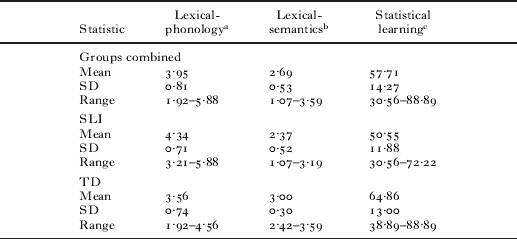
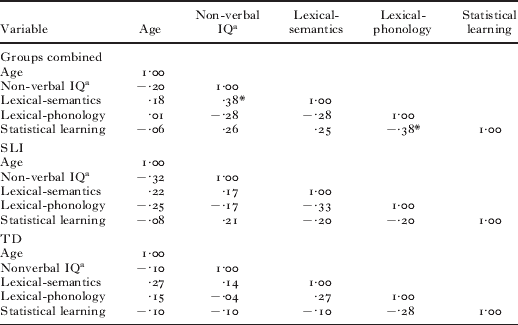
Descriptive statistics and Pearson correlations between the experimental variables are presented in Tables 2 and 3. As can be seen in Table 3, the two correlations that reached significance were between nonverbal IQ and lexical-semantics and statistical learning and lexical-phonology for the two groups combined.
Means, standard deviations, and ranges for the experimental variables
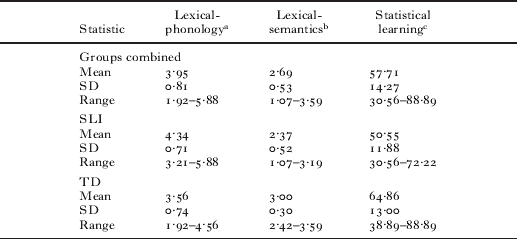
notes:
a Average number of competitor words produced during the gating task.
b Rating of semantic accuracy of word definitions on the scale of 0 to 4.
c Percentage correct answers to post-exposure forced-choice test that included pairs comprised of artificial ‘words’ and ‘non-words’.
Pearson correlations between the experimental variables
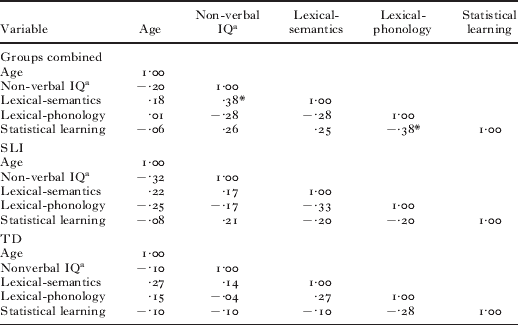
notes:
a Leiter International IQ: Standard Score.
* p < ·05.
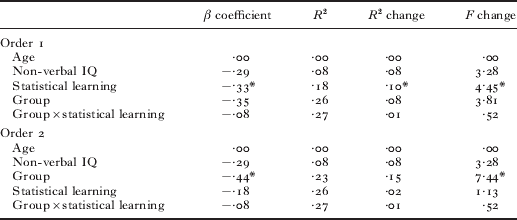
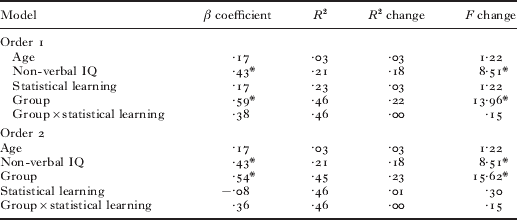
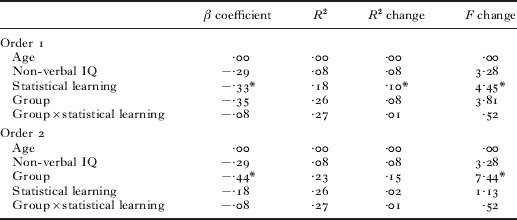
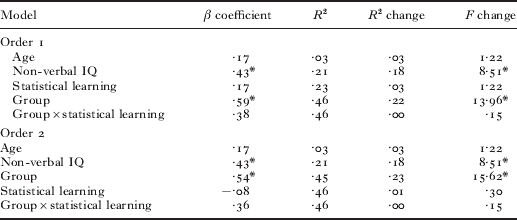
We used multiple regression analyses to investigate the possible relationships between statistical learning, lexical-phonology, and lexical-semantics. Inspection of histograms and normal P-P plots of residuals suggested that the analyses described below met the assumptions of linear regression. We considered two models. For the first model, the dependent variable was lexical-phonology, i.e., the number of non-target competitors produced in the gating task. For the second model, the dependent variable was lexical-semantics, i.e., the semantic richness score in a word definition task. For both models, we considered two orders of independent variable entry in order to inspect independent variances accounted by statistical learning and group membership (SLI and TD). The independent variables were entered in the following two orders: (1) age, nonverbal IQ, statistical learning, group, and group × statistical learning interaction; and (2) age, nonverbal IQ, group, statistical learning, group × statistical learning interaction. Age and nonverbal IQ were entered first, because these two variables were considered variables to be controlled for. Although one might propose that IQ is affected by a domain-general learning mechanism such as statistical learning, we chose to include it as a control variable due to the long tradition of ensuring that performance profiles in SLI are not explained by limitations in nonverbal IQ. The entry order of factors group and statistical learning was altered in order to inspect the independent and shared variances associated with statistical learning and group assignment. The group × statistical learning interaction was entered last to inspect if the two main effects, group and statistical learning, were qualified by a significant interaction between the two variables. If this interaction accounted for significant independent variance beyond the main effects, the conclusion would be that the association between statistical learning and lexical-phonology or lexical-semantics is significantly different between the two groups (e.g., that the association between lexical-phonology and statistical learning is significantly stronger in one group than the other group). Tables 4 and 5 present the results of the regression analyses.
Summary of multiple regression analyses predicting lexical-phonology
note:
* p < ·05.
Summary of multiple regression analyses predicting lexical-semantics
note:
* p < ·05.
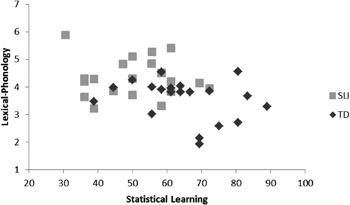
In the first model, the control variables did not reach significance as predictors of lexical-phonology, as indicated by β-coefficients for age and nonverbal IQ, and the significance tests for R 2 change. Both statistical learning and group were significant predictors of lexical-phonology independent of age and nonverbal IQ. This was indicated by significant R 2 change resulting from adding statistical learning and group to the model following age and nonverbal IQ. The β-coefficients for group (t = − 2·73, p = ·01) and statistical learning (t = − 2·11, p = ·04) were also significant. Children with SLI produced more lexical competitors than children with typical development. Critically, children who were more proficient statistical learners had lower lexical-phonology counts, i.e., activated fewer competitor words during the gating task (see Figure 1). However, neither group nor statistical learning reached significance as predictors independent of one another as indicated by non-significant R 2 change and β-coefficients associated with adding group after statistical learning and adding statistical learning after group to the model. Finally, associations between statistical learning and lexical-phonology were not significantly different in the two groups as evidenced by non-significant R 2 changes and β-coefficients associated with entering the group × statistical learning interaction to the model.
Lexical-phonology as a function of statistical learning.

In the second model, the control variable age did not reach significance as a predictor of lexical-semantics, but nonverbal IQ did, as indicated by a significant R 2 change associated with adding non-verbal IQ to the mode and β-coefficient (t = 2·92, p = ·01). Children with higher non-verbal IQs had higher scores on our lexical-semantic measure, i.e., gave more content detail in the word definition task. The R 2 changes associated with adding statistical learning to the model after non-verbal IQ and group were not significant, indicating that statistical learning did not reach significance as a predictor of lexical-semantics, independent of age, IQ, and group. The β-coefficients for statistical learning were also not significant. However, group membership was a significant unique predictor of lexical-semantics independent of age, IQ, and statistical learning, as evidenced by a significant β-coefficient for group (t = 3·74, p = ·001) and a significant R 2 change associated with adding group to the model after age, IQ, and statistical learning. Finally, the group × statistical learning interaction did not reach significance as a predictor of lexical-semantics, as indicated non-significant by R 2 changes and β-coefficients. This shows that the significant main effect of group was not qualified by a statistical learning × group interaction, which means that differences in lexical-semantic skills were not explained by statistical learning abilities in either group, SLI or TD.
To ensure that controlling for non-verbal IQ did not account for the pattern of results, we also considered the models with lexical-semantics as a dependent variable without non-verbal IQ entered. Even without IQ entered, the F-change associated with entering statistical learning was not significant, and neither was the β-coefficient for statistical learning. This indicates that the finding of no significant relationship between lexical-semantics and statistical learning was the same, whether or not non-verbal IQ was controlled. Finally, since the number of variables entered (5) was large relative to the sample size (40), each of the four models was inspected without age as a control variable, because age was not a significant predictor of either lexical-semantics or lexical-phonology. The pattern of significant and non-significant F-changes and β-coefficients associated with the remaining four variables was the same without age included, indicating that the observed pattern was not an artifact of lacking power associated with entering many variables relative to the sample size.
Relationship between statistical learning and effects of distributional regularity structure
Since statistical learning and SLI/TD group membership were both significant predictors of lexical-phonology, but since neither reached significance as a predictor independent of one another, we further examined these associations. Statistical learning correlated significantly with the number of non-target words activated during lexical access for high-frequency high neighborhood density words (r = − ·34, p < ·05), and low-frequency low neighborhood density words (r = − ·46, p < ·01), but not with high-frequency low neighborhood density and low-frequency high neighborhood density words. To further examine these interaction-like associations, a word frequency × neighborhood density × group repeated measures analysis of variance (ANOVA) with non-target words as a dependent variable was conducted, first without statistical learning as a covariate and then with statistical learning as a covariate.
Similar to previously reported results, the ANOVA without statistical learning as a covariate yielded significant effects of word frequency (F(1, 38) = 29·44, p < ·05, ηp2 = ·44), and neighborhood density (F(1, 38) = 10·10, p < ·05, ηp2 = ·21). Children produced more competitor words when accessing low- as opposed to high-frequency words and when accessing high as opposed to low neighborhood density words. The word frequency × neighborhood density also reached significance (F(1, 38) = 31·85, p < ·05, ηp2 = ·46). In the case of high-frequency words, children activated more competitors when accessing high density (mean = 4·11, SD = ·90) words as opposed to low density words (mean = 3·35, SD = ·86). In the case of low-frequency words, children activated more competitors when accessing low density words (mean = 4·32, SD = 1·07) as opposed to high density words (mean = 4·03, SD = ·93). Furthermore, the effects of group were significant. Similar to previous analyses, children with SLI produced more competitors than TD peers, as evidenced by a main effect of group (F(1, 38) = 11·41, p < ·05, ηp2 = ·23). The three-way interaction group × word frequency × neighborhood density interaction also reached significance (F(1, 38) = 5·70, p < ·05, ηp2 = ·13). In the case of high-frequency words, both the SLI group and the TD groups activated more competitors when accessing high density words as opposed to low density words. However, the finding that, in the case of low-frequency words, children activated more competitors when accessing low density words as opposed to high density words was more pronounced in the SLI group. The group × word frequency and group × neighborhood density interactions did not reach significance.
Critically, the ANCOVA with statistical learning as a covariate yielded no significant effects. The main effects of neighborhood density, word frequency, and neighborhood density × word frequency interaction no longer reached significance, indicating that differences in accessing words with different distributional regularities were accounted for by statistical learning ability. The main effect of group and the group × word frequency × neighborhood density interaction did not reach significance, confirming that all group differences in competitor word activation on the gating task were accounted by statistical learning.
DISCUSSION
Ullman and colleagues' (Ullman, Reference Ullman2001; Reference Ullman2004; Ullman & Pierpont, Reference Ullman and Pierpont2005) PDH account of SLI assumes that: (a) the lexical-semantics and rule-based aspects of language are separable cognitive systems; (b) the acquisition and use of the form–meaning associated aspects of language (e.g., lexical-semantics) are memorized directly by declarative memory; (c) the acquisition and use of language rules are learned via procedural memory; (d) procedural learning is impaired in children with SLI; and (e) declarative memory is intact in children with SLI (Ullman & Pierpont, Reference Ullman and Pierpont2005). Consistent with these assumptions, Tomblin et al. (Reference Tomblin, Mainela-Arnold and Zhang2007) found that sequential learning abilities are related to grammatical deficits but not to vocabulary deficits in children with SLI. However, a recent study indicted that sequential statistical learning abilities are associated with vocabulary as measured by standardized vocabulary tests (Evans et al., Reference Evans, Saffran and Robe-Torres2009). In the current study, we attempted to refine the PDH with regard to lexical abilities. Specifically, we studied whether statistical sequential learning abilities are associated with those aspects of the mental lexicon that rely on procedural memory, namely lexical-phonological access, but not those aspects of the mental lexicon that rely on declarative memory, such as lexical-semantic knowledge. Gupta and Dell (Reference Gupta, Dell and MacWhinney1999) conceive of spoken word activations as consisting of information about (1) the temporal and sequential structure of words, including sequences of articulatory movements and auditory sounds in spoken language form and (2) the arbitrary link between this serially ordered form and the semantic meaning of the words and sentences. Therefore, we hypothesized that, due to the inherently sequential structure of lexical-phonology, phonological aspects of lexicon are more closely related to the ability to extract statistical regularities than are semantic aspects. The results supported our hypothesis. Children who were poor at the statistical learning of sequential transitional probabilities in the novel-word boundary paradigm were also poor at managing excess activation of lexical-phonological competitors during a lexical access task (i.e., had high lexical-phonology accounts). This indicates that the procedural sequential memory system appears to be crucial to the acquisition of phonological aspects of the lexicon. Statistical learning of transitional probabilities, however, was not a significant predictor of the ability to provide semantically rich word definitions (i.e., high lexical-semantics scores). This indicates that statistical learning abilities predicted lexical-phonological abilities, but not lexical-semantic knowledge in children with and without SLI. The ability to track statistical sequential regularities and use this information to extract word boundaries within a stream of speech may be an important ability in learning lexical-phonological aspects of the mental lexicon but not as important in the acquisition and use of lexical-semantic knowledge.
This finding is consistent with the notion that the brain networks associated with the two types of learning may have different learning properties. Learning phonological forms presents the learner with statistical probabilities that are sequential in nature, such as sequences of sounds and syllables with varying transitional probabilities. Interestingly, we also found that the effects of distributional language regularity in the form of word frequency and neighborhood density on lexical-phonological access were no longer significant when statistical learning was covaried, suggesting that effects of distributional language regularity and the ability to learning transitional probabilities are closely related. This establishes a link between sequential statistical learning in artificial learning situations and processing the distributional structure of word forms. It is also consistent with the view that learning lexical forms is primarily driven by children's ability to track frequencies of sounds and sound combinations (Coady & Aslin, Reference Coady and Aslin2003), and indicates that a defining ability in resolving competition among lexical neighborhood activations may involve using statistical information about distributional probabilities.
An alternative interpretation for these findings is that a third variable, such as limited attentional ability, mediated the relationship between lexical competitor activation and statistical learning. Perhaps primary limitations in attention or inhibition resulted in both poor suppression of lexical-phonological competitor activations and poor statistical learning. However, this interpretation is not consistent with the finding that statistical learning was not a significant predictor of semantic abilities. In our previous work, we have shown that the ability to inhibit responses was a significant unique predictor of semantic content expressed in children's word definitions (Mainela-Arnold et al., Reference Mainela-Arnold, Evans and Coady2010). If statistical learning ability was largely defined by limitations in attention or inhibition, we would expect it to predict both lexical-semantic and lexical-phonological abilities.
We further considered effects of group membership, SLI or TD, in the regression analyses. The effects of group reflected the previously reported results indicating that children with SLI produced more competitors in the lexical access task (Mainela-Arnold et al., Reference Mainela-Arnold, Evans and Coady2008). Unique to current analyses, we found that the variance accounted for by group membership and statistical learning in competitor activation was largely shared. Both accounted for significant variance beyond age and IQ, but neither variable reached significance above and beyond one another; statistical learning did not account for variance beyond SLI/TD classification and SLI/TD classification did not account for variance beyond statistical learning. This suggests that group differences in lexical competitor activation are perhaps explained by ability to track sequential statistics. Furthermore, our additional analysis showed that group differences in effects of distributional language regularity and group differences in the activation of lexical-phonological competitors were both no longer significant when statistical learning was added as a covariate. This additional analysis suggests that group differences between children with SLI and TD peers in resolving competition among lexical neighborhood activations are perhaps in part explained by the ability to track statistical information about distributional probabilities.
The effects of group in the semantic content analysis also reflected the previously reported results indicating that children with SLI expressed fewer content details in defining word meanings (Mainela-Arnold et al., Reference Mainela-Arnold, Evans and Coady2010). Unique to current analyses, we discovered that SLI/TD grouping was a significant predictor of semantic abilities independent of age, IQ, and statistical learning. This suggests that factors not considered in this study contributed towards group differences between children with SLI and TD peers in semantic abilities. These group differences in semantic abilities are not consistent with the PDH as formulated by Ullman and Peirpoint (Reference Ullman and Pierpont2005). Reformulating the PDH to account for these findings requires acknowledging that semantic deficits are clearly present in children with SLI, but postulating that the mechanisms underlying semantic deficits are different from the deficits in language form. It is possible that learning semantic categories may rely on a different type of statistical learning, namely, extracting correlations among attributes that are not sequential in time (Younger, Reference Younger1985; Plunkett et al., Reference Plunkett, Hu and Cohen2008). However, in our view, this type of statistical learning should not be considered ‘procedural’ as it does not involve representations of temporal sequences of acoustic phonological information or articulatory movements. We propose that reformulating the PDH requires hypothesizing that semantic deficits have different neural developmental origins than deficits in language form and learning transitional sequential statistics. It is possible that lexical-semantic deficits in SLI are a result of a completely different factor, such as differences in the language learning environment, or perhaps deficits in attention or inhibition as we have proposed in our previous work (Mainela-Arnold et al., Reference Mainela-Arnold, Evans and Coady2010). The current practice of defining SLI as the low end of a normal distribution on standardized broad language tests, albeit the most objective and evidence-based method available, is likely to result in a heterogonous group of children with poor language abilities, which are a result of multiple different factors.
The difference in learning properties associated with lexical-phonological and lexical-semantic abilities is consistent with the historical division between declarative and non-declarative memory. The declarative memory system appears to be responsible for the encoding of arbitrary (episodic and semantic) relations about facts, events, ‘episodes,’ and experiences (Eichenbaum & Cohen, Reference Eichenbaum and Cohen2001; Tulvig, Reference Tulvig, Squire, Lynch, Weinberger and McGaugh1991). Learning via the declarative memory system is rapid, precise, and detail-specific, and knowledge acquired via the declarative memory system is readily available to intentional or conscious recollection, and easily accessed and expressed verbally.
Non-declarative memory is a heterogeneous collection of skills that are involved in the extraction of regularities in the input. Non-declarative memory is often referred to as implicit memory, as knowledge acquired by this system is not available to conscious recollection or verbal expression, manifesting instead as changes in performance or behavior (Squire, Reference Squire1992; Squire & Knowlton, Reference Squire, Knowlton and Gazzaniga2000). Procedural memory is one aspect of a non-declarative memory system that is implicated in the learning of new, and the control of long-established, motor and cognitive sequential habits and skills in real time (Perruchet & Pacton, Reference Perruchet and Pacton2006; Squire & Knowlton, Reference Squire, Knowlton and Gazzaniga2000; Squire & Zola, Reference Squire and Zola1996), such as the motor sequences for typing or tying one's shoes (Knowlton & Squire, Reference Knowlton and Squire1996; Poldrack, Desmond, Glover & Gabrieli, Reference Poldrack, Desmond, Glover and Gabrieli1998).
Non-declarative memory is poor at encoding the details of either the stimulus or the context within which the stimulus occurred. Learning via non-declarative memory occurs gradually and incrementally, on an ongoing basis, across multiple trials, exposures, or exemplars. This incremental, multiple-trial, generalized learning style makes non-declarative memory poorly suited to retain episodic or semantic representations, but makes it ideally suited to discover patterns in the input. Thus, representations that emerge from non-declarative memory are abstractions across features in the input that are reliably present in the stimuli or events, with the resulting representations containing probabilistic information about patterns in the environment.
The results of this study are further compatible with recent investigations that have established neural and genetic mechanisms that are common to language and sequential learning. Advances have been made in identifying FOXP2, a gene that is known to play a role in language and speech impairments (Lai, Fisher, Hurst, Vargha-Khadem & Monaco, Reference Lai, Fisher, Hurst, Vargha-Khadem and Monaco2001). Studies that used mice and humans have shown that FOXP2 is expressed in particular areas of the brain, including basal ganglia and the striatum, regions associated with procedural sequential learning (Lai, Gerrelli, Monaco, Fisher & Copp, Reference Lai, Gerrelli, Monaco, Fisher and Copp2003; Takahashi, Liu, Hirokawa & Takahashi, Reference Takahashi, Liu, Hirokawa and Takahashi2003). In mice, disrupting this gene impairs sequencing actions during grooming (Teramitsu & White, Reference Teramitsu and White2008). Future studies should investigate potential links between these advances in neural development and genetics as well as particular profiles of language abilities, such as lexical-phonological, grammatical, and statistical sequential learning abilities in children with and without SLI.
In conclusion, the ability to track statistical sequential regularities in the speech stream may be critical to the acquisition of lexical-phonological knowledge but less important in the acquisition of lexical-semantic knowledge. Brain networks associated with these different aspects of the lexicon suggest that they may require different learning mechanisms. Learning phonological forms presents the learner with statistical probabilities that are sequential in nature (e.g., sequences of sounds and syllables with varying transitional probabilities), whereas acquisition of semantic–conceptual knowledge may not rely on sequential procedural memory.
This study established a link between the extraction of sequential transitional probabilities and deficits in lexical-phonological access. Future studies need to examine the relationship between different learning and memory systems and the acquisition and use of lexical-phonological and semantic–conceptual knowledge in children. Future research should also examine links between the development of brain networks associated with procedural memory, genes associated with development of procedural memory networks, and sequential statistical learning deficits. These studies are needed to refine the definition of what is meant by procedural learning in the context of individual differences in language learning, and to determine which language deficits in SLI are defined by procedural memory impairments and if impairments in structural and semantic aspects of language have different neural developmental origins.