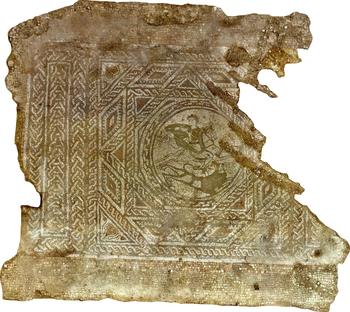
Michael Dawson and David Neal write: In 1991 part of a mosaic floor depicting Bellerophon slaying the Chimaera was exposed on land belonging to the Rowler Estate at Croughton, Northants.Footnote 1 The pavement was photographed and reburied and the site subsequently assessed by English Heritage prior to scheduling in 1995. During the course of investigation, geophysical survey and trial-trenching established that the mosaic had been laid in a stone-built house, which was part of a more extensive settlement first occupied in the late second century. In 1998 the Rowler Estate changed hands and the potential to place the mosaic on display beneath a cover building was discussed by the new owner with English Heritage.Footnote 2 In 2002 proposals to create a cover building were accepted in principle as the basis for a Scheduled Monument Consent application. As a result the Bellerophon pavement was fully excavated (fig. 1), together with an adjacent area to identify possible locations for stanchions and building foundations,Footnote 3 where estate staff also believed a second mosaic had been discovered during the 1990s. The excavations indeed revealed the fragmentary remains of a second, probably figured pavement.
The Bellerophon mosaic at Croughton.
(Orthophotograph by English Heritage; Andrews et al. 2005)

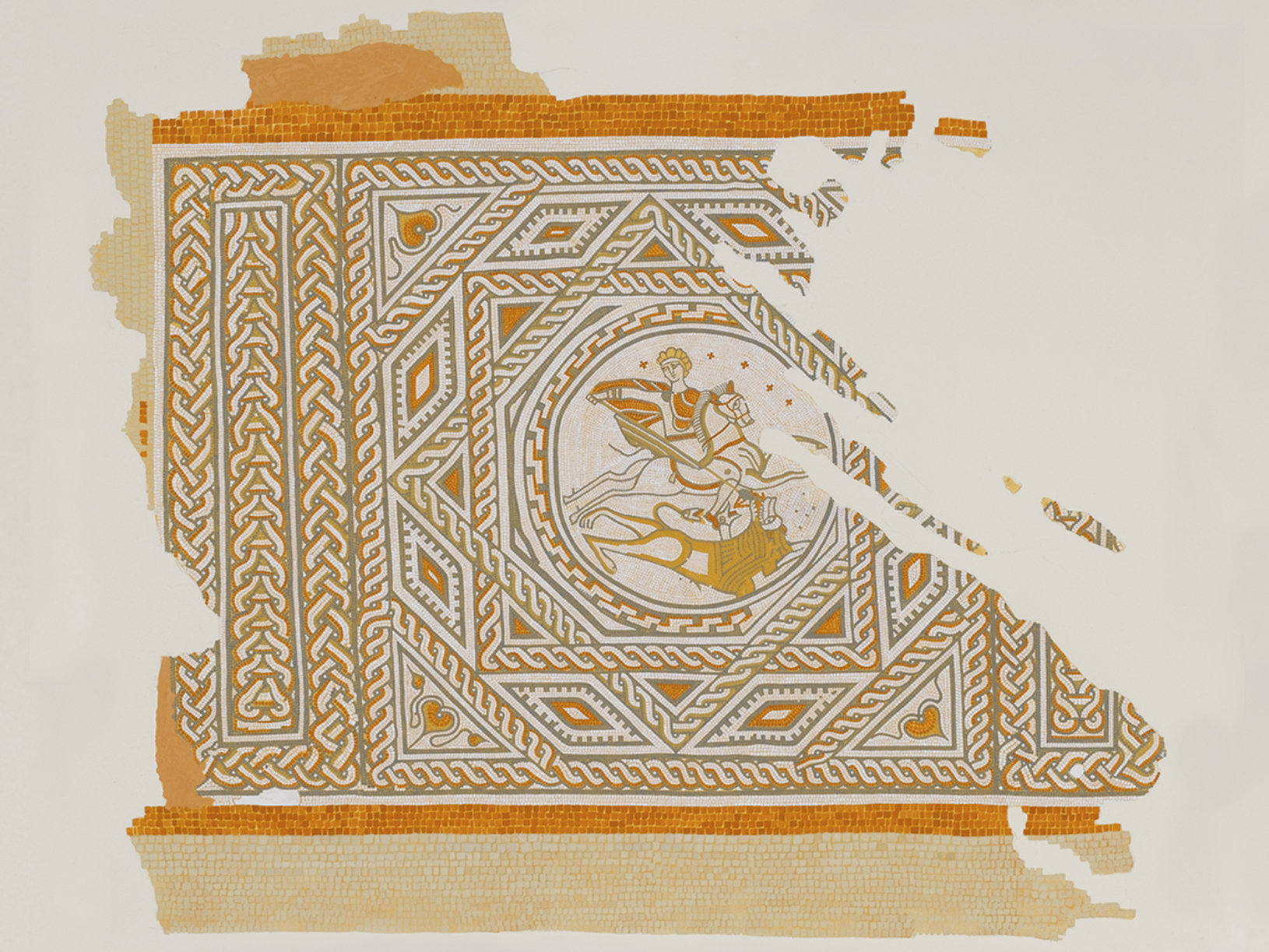
The Bellerophon mosaic was first described (summarised here) and illustrated by Neal and Cosh.Footnote 4 This note brings that description up to date, with the revised painting (fig. 2). The scheme of the mosaic comprises three panels, a central square (Panel A) flanked on the east and west sides by long rectangles (Panels B and C respectively). Panel A is a square defined by simple guilloche, with oblique bands of guilloche across the corners to create an octagon. Within, and tangential to, the sides of the octagon is a pair of interlaced squares in simple guilloche. In the spaces created by the interlaced squares are red triangles, and between the interlaced squares and the octagonal panel are grey and red lozenges with white centres outlined by grey dentilled bands. Three triangular panels at the corners of the panel survive and all contain a red heart-shaped leaf with curving stems.
The Bellerophon mosaic at Croughton. (Painted by David Neal)

The central circle contains Bellerophon, viewed from the south, riding the winged horse Pegasus and slaying the Chimaera, all worked in a linear style. Bellerophon, shown looking behind him, holds a spear in his outstretched right hand. He wears a white tunic and breeches and across his chest and over his right shoulder is a red cloak, possibly fixed by a rounded grey brooch or clasp on his right shoulder. Pegasus is depicted with his hind legs stretched out behind him and, although damaged, the front legs also appear to have been extended originally as if flying. His wing passes in front of Bellerophon and its top edge is confused with, and parallel to, the spear. The Chimaera, with its feline head facing upwards, spits fire as a spear threatens to pierce its mouth. The mane is clearly represented on the front of the beast. From the back of the Chimaera rises the head of a goat, with its open mouth breathing fire. The tail, turned across the back of the animal, bears the head of a serpent. In front of the Chimaera are nine single grey tesserae on a field of white, which may be an attempt to represent water as a reference to Pegasus’ spring-making qualities.Footnote 5 To the right and left of Bellerophon’s head are five red crosses, perhaps intended to represent stars in the sky as an allusion to the apotheosis of Pegasus as he rose into the heavens.Footnote 6
Much of Panel B, on the east side, has been destroyed by ploughing, but what survives is almost identical to Panel C. The latter is bordered by a band of simple guilloche, outlined grey with red and white strands, and in places the double white strands are conventionally shaded red, white and yellow ochre. The panel surrounds a broad strip of straight-tongued double guilloche in the same shades as the simple guilloche and with similar inconsistencies in the colouring.
Although the figured panel has been executed in a lively linear style, the geometry and workmanship elsewhere is decidedly poor. The radial point of the central panel in relationship to the pair of surrounding interlaced squares is misaligned, resulting in the circular right-angled Z-pattern border ‘around’ Bellerophon being absent on the east side. The style of the guilloche is unusual; in places, particularly in the surround of Panel A, the outer edges of the guilloche are drawn as single or double fillets with little or no attempt to link the grey outline of the braids and, in places, white tesserae are set between them as if the mosaicist was trying to create the impression of the braids being on a white background. The guilloche on the western side of Panel C is more crudely drawn as if by a separate hand; the grey outlines to the braids do not curve, as is conventional, but are treated as a series of straight lines.
There are three other examples of Romano-British mosaics with scenes of Bellerophon killing the Chimaera: Lullingstone, Kent, and Frampton and Hinton St Mary in Dorset. In the case of the examples from Frampton and Hinton St Mary, the mosaics were almost certainly laid by the same mosaicist, but placing the Croughton mosaic within the genre of mosaic workshops is problematic because of its inept layout and workmanship. The method of laying the guilloche recalls the workmanship on the mosaic from Thenford, also in Northamptonshire. It should also be noted that the use of Pennant stone tesserae for the hair, a material not indigenous to the area and only used sparingly, also occurs in the hair of Venus at Thenford. Figured mosaics are rare in Northamptonshire, the only other example occurring at Whittlebury, also in the west of the county. For this reason the mosaics have been assigned to the Northamptonshire Figured GroupFootnote 7 and attributed to the late fourth century.
Although it was intended to display the Rowler mosaic, the sale of the estate in 2005 has meant that the pavement remains preserved in situ beneath protective layers of terram, sand and topsoil and is presently grazed rather than ploughed.Footnote 8
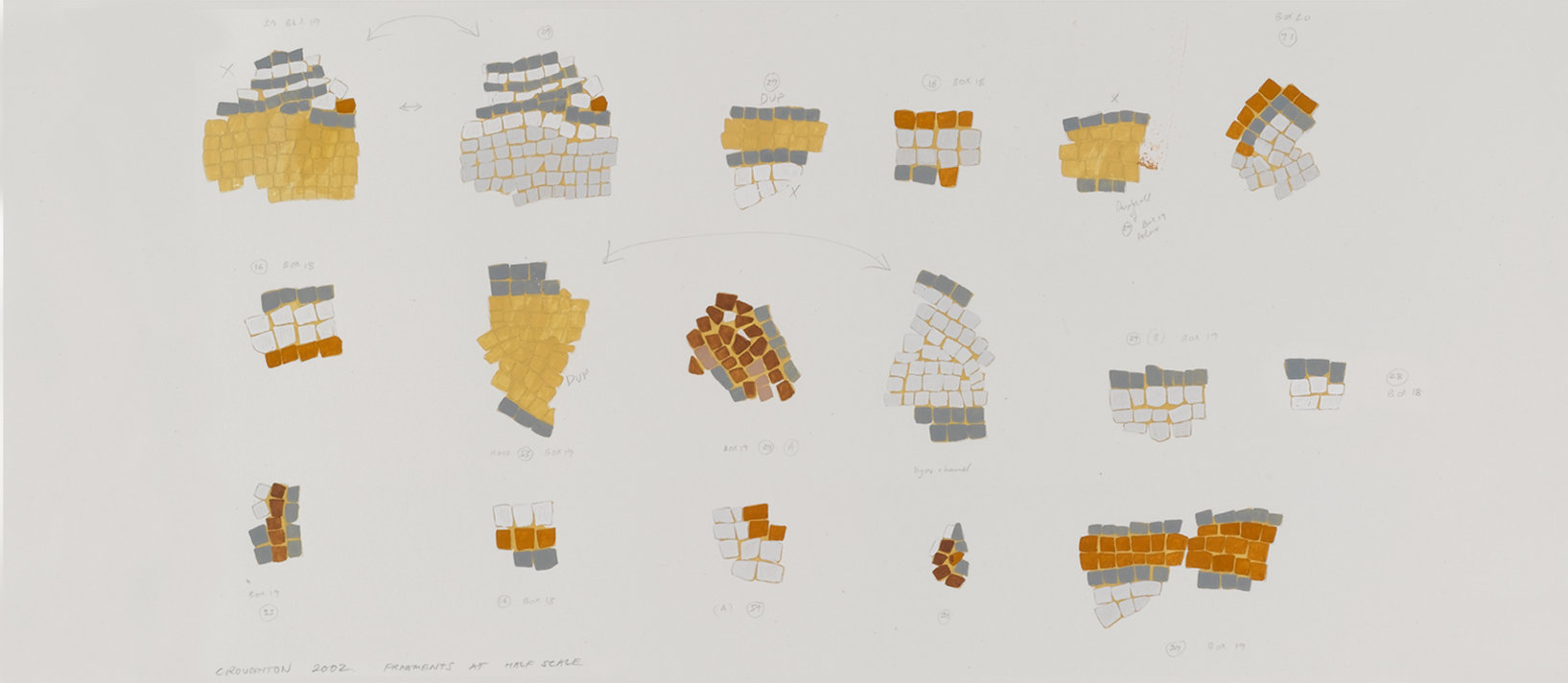
The fragmentary remains of a second figured mosaic lay in a room to the north of the Bellerophon pavement (fig. 3). The room, 5.10 m by 6.50 m, was characterised by a rock-cut hypocaust covered by building debris, amongst which tesserae in grey, red, white, off-white, buff, yellow ochre, very pale blue-grey and dark wine red were found.
The Bellerophon mosaic at Croughton. (Painted by David Neal)

It is impossible to determine the scheme of this mosaic. One fragment may be part of a lozenge and, therefore, part of a lozenge-based design, whilst several other fragments indicate that the mosaic was probably figured. Two fragments, which almost certainly joined, show two grey fillets separating an area of red, which may have belonged to an arm or leg. It is not part of a conventional motif. Another fragment has a series of sinuous grey and white lines against a pale yellowish-grey background, perhaps representing hair. However, there is insufficient evidence to determine whether the figure was human or animal.
The materials used for the tesserae in this mosaic differ from those in the Bellerophon pavement. They have a wider palette of colour and the background tesserae are off-white rather than white. The fillets forming the lozenges are of a blue-grey oolitic limestone similar to Raunds or Stanwick ‘marble’, and there is greater use of Pennant sandstone. At least five fragments from this second mosaic include this material. A chevron-shaped design on a fragment, which may be from a variant of round-tongued guilloche, is Pennant sandstone shaded grey and deep red/brown. The workmanship of the second mosaic is superior to that of the Bellerophon pavement. The tesserae are more closely set, and tesserae as small as 5 mm are occasionally used for detail. The use of off-white background tesserae, rather than white, also suggests that the work was by a different hand.