Introduction
Systemic lupus erythematosus (SLE) is an autoimmune disease that affects various organs and systems and may also affect the central nervous system leading to diverse neuropsychiatric symptoms. The disease burden of SLE is hard to estimate due to its complexity and variability. A recent estimation of the incidence and prevalence of SLE in a heterogeneous population of Southeastern Michigan found an overall age-adjusted incidence and prevalence rate (per 100 000) of 5.5 and 72.8, respectively, higher than most previous estimates (Somers et al. Reference Somers, Marder, Cagnoli, Lewis, DeGuire, Gordon, Helmick, Wang, Wing, Dhar, Leisen, Shaltis and McCune2014).
The neuropsychiatric involvement of lupus includes neurologic disorders of the central, peripheral and autonomic nervous systems along with psychiatric disorders.
The pathophysiology for these complex manifestations has yet to be clarified. It may be partially mediated by several mechanisms that result in neurological affliction, such as an immune reaction that crossed the brain–blood barrier, direct injury by autoantibodies binding to neuronal tissue, vasculitis within the neuronal tissue or enhanced atherosclerosis and thrombosis (Zardi et al. Reference Zardi, Taccone, Marigliano, Margiotta and Afeltra2014; Ho et al. Reference Ho, Thiaghu, Ong, Lu, Ho, Tam and Zhang2016). Psychiatric disorders reported in SLE include depression, psychosis and anxiety. It is often difficult to determine whether these are neuropsychiatric manifestations secondary to SLE, psychological adaptive reactions to the stress or perhaps a deleterious effect of the immunosuppressive therapy such as corticosteroids.
According to the DSM-V, schizophrenia is defined as a primary disorder and cannot be used to classify SLE psychosis (Urowitz et al. Reference Urowitz, Gladman, Ibañez, Sanchez-Guerrero, Romero-Diaz, Gordon, Bae, Clarke, Bernatsky, Fortin, Hanly, Isenberg, Rahman, Wallace, Ginzler, Petri, Bruce, Merrill, Nived, Sturfelt, Dooley, Alarcón, Fessler, Steinsson, Ramsey-Goldman, Zoma, Khamashta, Manzi, van Vollenhoven, Ramos-Casals, Aranow and Stoll2014; Wolfe et al. Reference Wolfe, Walitt, Katz and Häuser2014; Zardi et al. Reference Zardi, Taccone, Marigliano, Margiotta and Afeltra2014; Hanly et al. Reference Hanly, Su, Urowitz, Romero-Diaz, Gordon, Bae, Bernatsky, Clarke, Wallace, Merrill, Isenberg, Rahman, Ginzler, Petri, Bruce, Dooley, Fortin, Gladman, Sanchez-Guerrero, Steinsson, Ramsey-Goldman, Khamashta, Aranow, Alarcón, Fessler, Manzi, Nived, Sturfelt, Zoma, van Vollenhoven, Ramos-Casals, Ruiz-Irastorza, Lim, Kalunian, Inanc, Kamen, Peschken, Jacobsen, Askanase, Theriault, Thompson and Farewell2015). In addition, neither the SLICC classification nor the American College of Rheumatology nomenclature and case definitions for neuropsychiatric lupus syndromes define schizophrenia per se as a criterion for neuropsychiatric SLE (Petri et al. Reference Petri, Orbai, Alarcón, Gordon, Merrill, Fortin, Bruce, Isenberg, Wallace, Nived, Sturfelt, Ramsey-Goldman, Bae, Hanly, Sánchez-Guerrero, Clarke, Aranow, Manzi, Urowitz, Gladman, Kalunian, Costner, Werth, Zoma, Bernatsky, Ruiz-Irastorza, Khamashta, Jacobsen, Buyon, Maddison, Dooley, van Vollenhoven, Ginzler, Stoll, Peschken, Jorizzo, Callen, Lim, Fessler, Inanc, Kamen, Rahman, Steinsson, Franks, Sigler, Hameed, Fang, Pham, Brey, Weisman, McGwin and Magder2012; Inês et al. Reference Inês, Silva, Galindo, López-Longo, Terroso, Romão, Rúa-Figueroa, Santos, Pego-Reigosa, Nero, Cerqueira, Duarte, Miranda, Bernardes, Gonçalves, Mouriño-Rodriguez, Araújo, Raposo, Barcelos, Couto, Abreu, Otón-Sanchez, Macieira, Ramos, Branco, Silva, Canhão and Calvo-Alén2015). On the other hand, these two classification systems consider psychosis as a criterion for SLE (Zardi et al. Reference Zardi, Taccone, Marigliano, Margiotta and Afeltra2014; Hanly et al. Reference Hanly, Su, Urowitz, Romero-Diaz, Gordon, Bae, Bernatsky, Clarke, Wallace, Merrill, Isenberg, Rahman, Ginzler, Petri, Bruce, Dooley, Fortin, Gladman, Sanchez-Guerrero, Steinsson, Ramsey-Goldman, Khamashta, Aranow, Alarcón, Fessler, Manzi, Nived, Sturfelt, Zoma, van Vollenhoven, Ramos-Casals, Ruiz-Irastorza, Lim, Kalunian, Inanc, Kamen, Peschken, Jacobsen, Askanase, Theriault, Thompson and Farewell2015).
Nevertheless, previous studies point to similarities between the pathophysiology of SLE and schizophrenia related to activation of the immune system and brain inflammation, particularly in schizophrenia. Evidence of microglia activation and an inflammatory process in the brain as well as immune dysfunction is postulated to contribute to the disease process (Réus et al. Reference Réus, Fries, Stertz, Badawy, Passos, Barichello, Kapczinski and Quevedo2015; Laskaris et al. Reference Laskaris, Di Biase, Everall, Chana, Christopoulos, Skafidas, Cropley and Pantelis2016). In addition there is evidence of immune dysfunction in patients with schizophrenia, suggesting that autoimmunity contributes to the pathophysiology of the disorder (Goldsmith & Rogers, Reference Goldsmith and Rogers2008). Recent data show that certain antibodies against glutamate receptors are present in subpopulations of both patients with SLE and patients with schizophrenia, indicating common pathophysiology (Levite, Reference Levite2014). These findings trigger questions regarding comorbid schizophrenia and SLE; investigating the association of SLE and schizophrenia may improve the understanding of the pathogenic pathways of these two illnesses, and facilitate their diagnosis. Much data are known regarding the comorbidities of patients with SLE (Asano et al. Reference Asano, Coriolano, Asano and Lins2013), but there is significantly less analysis evaluating the epidemiologic association between SLE and schizophrenia.
The objective of the current study was to investigate an association between SLE and schizophrenia using a large medical database of Clalit Health Services (CHS), which is the largest health maintenance organisation in Israel. Furthermore, this study presents statistical adjustment of the association between SLE and schizophrenia by gender, age and socioeconomic status (SES).
Subjects and methods
Our study was designed as a cross-sectional study using data-mining techniques utilising the CHS database. CHS is the largest healthcare provider organisation in Israel, serving a population of over 4 400 000 enrolees. CHS has a comprehensive computerised database with continuous real-time input from pharmaceutical, medical and administrative computerised operating systems.
In the CHS database, the diagnoses of chronic diseases such as SLE and schizophrenia are based on data from hospital and primary care physicians’ reports. The diagnoses are validated by systematic methodology. CHS performs validation by logistic checks (such as comparing diagnoses from various sources) and through direct validation of the diagnoses by the treating physicians of each patient. The validity of the diagnoses in the registry has been corroborated before and has shown to be of high quality and validity (Bieber et al. Reference Bieber, Cohen, Freud, Agmon-Levin, Gertel and Amital2013; Farhi et al. Reference Farhi, Cohen, Shovman, Comaneshter, Amital and Amital2016; Houri Levi et al. Reference Houri Levi, Watad, Whitby, Tiosano, Comaneshter, Cohen and Amital2016; Watad et al. Reference Watad, Cohen, Comaneshter, Tekes-Manova and Amital2016a , Reference Watad, Mahroum, Whitby, Gertel, Comaneshter, Cohen and Amital b ).
Patients were defined as having SLE when there was at least one documented diagnosis of SLE in the medical records between the years registered by CHS physicians. The control group was randomly selected from CHS enrolees, excluding patients with SLE and thus representing the general population. Five control patients were selected for each SLE patient, and were frequency-matched regarding sex and age. Data available from the CHS database included age, gender, SES and diagnosis of chronic diseases such schizophrenia and smoking status. The distribution of sociodemographic and clinical factors was compared between patients with and without SLE using χ 2 test for categorical variables and t-test for continuous variables. The interaction between schizophrenia and SLE was examined separately across strata of categorical variables. Odds ratios (ORs) as well as 95% confidence intervals (CIs) are presented. A logistic regression model was fitted to estimate the association between SLE and schizophrenia in a multivariate analysis. Statistical analysis was performed using R Statistical Software (version 3.2.2; R Foundation for Statistical Computing, Vienna, Austria).
The study was approved by the institutional review board of the CHS at the Soroka Medical Center in Beer-Sheva, Israel.
Results
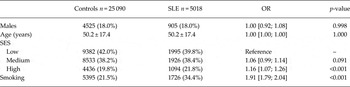
The study included 5018 patients with SLE and 25 090 subjects in the control group, matched by age and gender. Characteristics of SLE patients and controls are presented in Table 1.
Descriptive characteristics of the study population

SES, socioeconomic status; SLE, systemic lupus erythematosus; OR, odds ratio.
Patients with SLE had a clear female predominance, an average age of 50 years old, and were more likely to smoke than controls (34.4 v. 21.5%, respectively, p < 0.001) (Table 1). Distribution of SES among SLE patients was statistically different with no evident clinical significance.
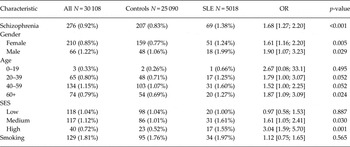
Table 2 describes ORs for schizophrenia in patients with SLE and controls across the entire study sample; it is also stratified by age, sex and SES. The association between SLE and schizophrenia was prominent in all groups except low SES, but the strength of association was much higher and statistically significant among males, elderly subjects and with high SES (Table 2). We found 276 schizophrenia patients in our study sample (Table 2). The proportion of schizophrenia in patients with SLE was increased compared with the proportion in controls (1.38% and 0.83%, respectively, p < 0.001) (Table 2).
Proportion of Schizophrenia across strata of study covariates

SES, socioeconomic status; SLE, systemic lupus erythematosus; OR, odds ratio.
A positive interaction was found between medium and high SES to the occurrence of coexistent schizophrenia and SLE. This is in line with the fact that such comorbidity is different by nature than ordinary cases of schizophrenia.
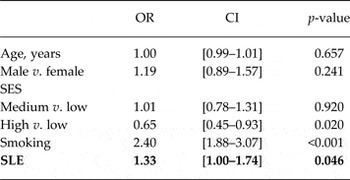
Multivariate analysis by logistic regression found SLE to be independently associated with schizophrenia (OR = 1.33, p = 0.046) even following controlling for age, gender, SES and smoking (Table 3). Alongside SLE, high SES was found to be inversely associated with schizophrenia comparing with low SES (OR = 0.65, p = 0.020). Smoking was also found to be significantly associated with schizophrenia (OR = 2.40, p < 0.001).
Multivariate logistic regression of covariates associated with schizophrenia

SES, socioeconomic status; SLE, systemic lupus erythematosus; OR, odds ratio.
Discussion
In the current study, a positive association between SLE and schizophrenia was observed. In a multivariate analysis, the association between SLE and schizophrenia remained significant even after controlling for gender, age, SES and smoking. Thus, the mentioned demographic parameters are unlikely to be confounders in the association between SLE and schizophrenia.
We believe that the observed association between SES and schizophrenia reflects the heavy impact that such a severe mental disease has on function, as well as the significant socioeconomical implications on an individual's life (Dickinson et al. Reference Dickinson, Bellack and Gold2007). The observed strong association between schizophrenia and smoking has been well described and provides an additional indication regarding the validity of our data (Tandon et al. Reference Tandon, Keshavan and Nasrallah2008; Adams et al. Reference Adams, Knight and Ebringer2012; Benros et al. Reference Benros, Mortensen and Eaton2012). The association between SLE and smoking that was observed in this sample has been discussed by us previously (Houri Levi et al. Reference Houri Levi, Watad, Whitby, Tiosano, Comaneshter, Cohen and Amital2016).
SLE and schizophrenia share clinical patterns; e.g., a remitting-relapsing course, a young age of onset and possible infectious, traumatic or drug-related triggers and brain inflammation (Tandon et al. Reference Tandon, Keshavan and Nasrallah2008). In addition, several studies have found elevated titres of autoantibodies in patients with schizophrenia. These include anti-nuclear antibodies, anti-cardiolipin and organ-specific antibodies, including anti-neuronal antibodies (Goldsmith & Rogers, Reference Goldsmith and Rogers2008; Watad et al. Reference Watad, Mahroum, Whitby, Gertel, Comaneshter, Cohen and Amital2016b ). Autoimmune responses against neurotransmitter receptors in the brains of patients with schizophrenia have also been described (Jones et al. Reference Jones, Mowry, Pender and Greer2005, Reference Jones, Holliday, Mowry, McLean, McGrath, Pender and Greer2009, Reference Jones, Mowry, McLean, Mantzioris, Pender and Greer2014). In addition, elevated cytokine levels such as interleukin-2 (IL-2) and tumor necrosis factor alpha (TNF-α) were also found in schizophrenia patients compared with controls (Strous & Shoenfeld, Reference Strous and Shoenfeld2006).
Current pharmacotherapy for schizophrenia focuses on neurotransmitters and their binding to specific receptors. Recognition of the role of autoimmunity in the pathophysiology of schizophrenia warrants for research into immune-modulating treatment for this disease (Rogers & Goldsmith, Reference Rogers and Goldsmith2009).
Our study highlights a subgroup of SLE patients with comorbid schizophrenia. In this subgroup, it is of interest to investigate changes in schizophrenia manifestations under treatment with immune-modulating therapy.
This study explores the association between SLE and schizophrenia using ‘real life data’ covering the entire population medically insured by CHS. The main strength of our study is the large sample size for both study and control groups. Another advantage of this study is that it stems directly from the CHS database, which provided the elaborate demographic information included in our analysis. This allowed us to control for possible confounders.
Our study has some limitations. The observational design and lack of temporal relationship between SLE and schizophrenia diagnosis in the study is an inherent limitation that precludes discussion about causality. Another possible limitation in the current study design is that due to the large sample size, the researchers did not directly validate diagnosis of SLE and schizophrenia. This is characteristic of big data analyses. In addition, in contrast to randomised clinical controlled studies, our subjects have not been approved on an individual basis according to classification criteria. Misclassification therefore cannot entirely be ruled out. However, previous studies of this database have ascertained the high quality of this medical source as well as the relatively minimal effect that misclassifications have on the interpretation on the data analysis (Bieber et al. Reference Bieber, Cohen, Freud, Agmon-Levin, Gertel and Amital2013; Guy et al. Reference Guy, Tiosano, Comaneshter, Tekes-Manova, Shovman, Cohen and Amital2016; Houri Levi et al. Reference Houri Levi, Watad, Whitby, Tiosano, Comaneshter, Cohen and Amital2016; Watad et al. Reference Watad, Cohen, Comaneshter, Tekes-Manova and Amital2016a , Reference Watad, Mahroum, Whitby, Gertel, Comaneshter, Cohen and Amital b ). Based on the high quality of our database it is acceptable to assume that any diagnostic misclassification had only a marginal effect, occurring both in patients with SLE and the control group.
In conclusion, the findings of this study shed light on the epidemiological association between SLE and schizophrenia. The proportion of schizophrenia among patients with SLE was higher than that appearing in controls across different age groups, gender, SES and smoking status. The diagnosis of either SLE or schizophrenia has a major impact on a patient's life in terms of disability, socio-occupational dysfunction, economic burden and pharmacotherapy (and the pharmacotherapy's adverse reactions). Acknowledging the association between SLE and schizophrenia contributes to the research of the pathophysiology of the two diseases. It may also have implications regarding diagnosis and treatment, which can directly affect patients’ prognosis and consequent quality of life.
Acknowledgements
None.
Financial support
This research received no specific grant from any funding agency, commercial or not-for-profit sectors.
Conflicts of interest
None.
Ethical standards
The authors assert that all procedures contributing to this work comply with the ethical standards of the relevant national and institutional committees on human experimentation and with the Helsinki Declaration of 1975, as revised in 2008.
Availability of data and materials
Data for this article were drawn from Clalit Health Services – the largest HMO in Israel. Analysis was performed on an anonymised file, but unfortunately we are unable to share it in order not to expose the personal health records of dozens of thousands of persons. Moreover, ethics committee's approval for the study was pending that the data would not be distributed.