In the United States, it is estimated that more than 5,500 undocumented immigrants have end-stage renal disease (ESRD).Reference Campbell, Sanoff and Rosner 1 In many states, these patients can only get emergent hemodialysis, which is defined as the practice of dialyzing a patient only when there is a life-threatening need for this treatment.Reference Raghavan 2 – Reference Raghavan and Nuila 4 This practice contrasts with patients who receive dialysis 3 times per week (ie, scheduled hemodialysis). Patients on emergent hemodialysis often have a tunneled catheter for dialysis, which can complicate with catheter-related bloodstream infections (CRBSIs). The pooled mean incidence of CRBSI in patients with tunneled catheters was estimated to be 1.6 per 1,000 catheter days,Reference Maki, Kluger and Crnich 5 but rates can range between 0.8 and 5.5 per 1,000 catheter days.Reference Beathard 6 – Reference Marr, Sexton and Conlon 8
At our institution, attention was drawn to the relatively frequent occurrence of CRBSI in patients on emergent hemodialysis, particularly with unusual Gram-negative rods (GNR).Reference Ali, Kuo and Quinones 9 Therefore, we wanted to elucidate the epidemiology of CRBSI in these patients by investigating the following: (1) whether the long-term dialysis catheters used in emergent hemodialysis are colonized with bacteria and (2) whether this colonization precedes episodes of bacteremia. Studies performed in other patient groups have indicated varying rates of colonization and have suggested that certain bacterial species, if present, may predispose the patient to bacteremia, while other relatively avirulent species, such as coagulase negative staphylococci, may not.Reference Tenney, Moody and Newman 10 – Reference Nielsen, Kolmos and Rosdahl 15
We initiated a retrospective study of infections in patients on emergent hemodialysis and compared outcomes between those dialyzed via tunneled catheter and those dialyzed via arteriovenous fistula. These studies in turn suggested investigations including only patients with a tunneled catheter that led to cultures of the catheter heparin-lock in patients prior to emergent dialysis in comparison with a control population on scheduled hemodialysis.
METHODS
The study was conducted at Parkland Memorial Hospital, a 770-bed public, county-tax-supported, academic tertiary hospital. All patients were dialyzed in the Acute Dialysis Unit of the hospital. Approximately 70% of patients dialyzed in this unit receive only emergent hemodialysis. The remaining 30% are hospitalized for a variety of indications and receive dialysis according to their outpatient schedule. The University of Texas Southwestern Medical Center Institutional Review Board approved this study.
Retrospective Observational Study (Epidemiological Analysis)
We identified 147 patients with ESRD who underwent emergent hemodialysis between January 2011 and May 2011. We reviewed electronic medical records to screen each of these subjects for prior evidence of bacteremia for up to 5 years before enrollment. The maximum time that a patient was studied was 5 years, and most of the patients were studied for 1–4 years. A crude mortality rate was calculated 2 years after enrollment.
Prospective Study (Catheter Heparin-Lock Culture Analysis)
We enrolled 62 patients with a tunneled dialysis catheter between June 2012 and August 2012: 48 patients received emergent hemodialysis and 14 patients received scheduled hemodialysis during the enrollment period. A total of 83 cultures were obtained from the 48 emergent hemodialysis patients and 14 scheduled hemodialysis controls at the time of enrollment. There were no dropouts. A total of 44 patients were cultured once and the rest were cultured ≥2 times in subsequent dialysis sessions (16 patients had 2 cultures, 1 patient had 3 cultures, and 1 patient had 4 cultures). The culture procedures were performed as follows: With standard aseptic technique to access the dialysis catheter, we cultured approximately 3 mL of the heparin-lock solution as a surrogate for endoluminal catheter colonization.Reference Rodriguez-Aranda, Alcazar and Sanz 16 This solution would otherwise be discarded before each dialysis session. Samples were processed as sterile fluids and incubated for 72 hours. The positive cultures were identified to the species level. We compared the rates of colonization between the emergent hemodialysis group and the scheduled hemodialysis group. To evaluate whether endoluminal colonization could correlate with prior or subsequent CRBSI, we compared the number of episodes of CRBSI between emergent hemodialysis and scheduled hemodialysis groups and the number of episodes between colonized and noncolonized emergent hemodialysis patients in the year prior to the date of the culture and for 6 months afterward.
In both the retrospective and prospective studies, all patients with CRBSI had a clinically consistent illness (bloodstream infection in a patient with a catheter in place after exclusion of sources other than the catheter) and 2 sets of positive blood cultures in which each set of cultures was derived from a different site. Usually the sets were drawn from the catheter and from a peripheral vein. Blood culture contamination was assessed based on guidelines.Reference Mermel, Allon and Bouza 17 , Reference Hall and Lyman 18 Rates are reported per 1,000 catheter days or an equivalent number of days of functioning arteriovenous fistula.
Statistical Analysis
Groups were compared using a 2-tailed χ2 test or Fischer’s exact test for categorical variables, and the Mann-Whitney test was used for differences in CRBSI rates. P<.05 was considered statistically significant. Pearson correlation coefficients with subsequent 95% CIs and P values were calculated. Data were analyzed using GraphPad Prism 6 for Windows (GraphPad Software, La Jolla, CA) in the retrospective study and SPSS for Windows (SPSS, Chicago, IL) in the prospective study.
RESULTS
Epidemiological Analysis
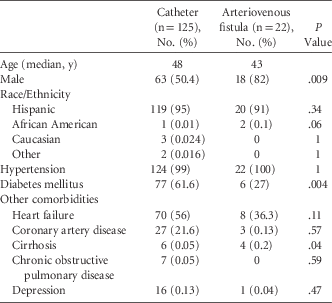
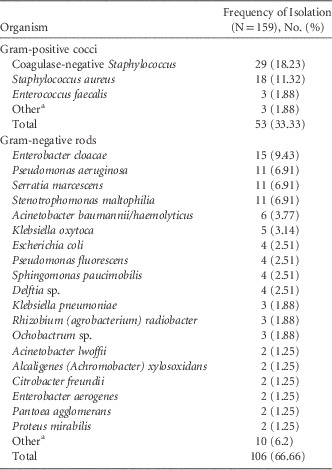
A total of 147 patients were included in this study. The demographic characteristics of the emergent hemodialysis and arteriovenous fistula patients did not differ significantly by age or race/ethnicity (Table 1). Among the 125 patients on emergent hemodialysis via tunneled catheter, there were 134 episodes of CRBSI in the study period for a rate of 2.61 CRBSI per 1,000 catheter days. A total of 25 episodes were polymicrobial (18.6%). The percentage of episodes by specific pathogen showed a large variety of bacteria including Gram-negative rods and Gram-positive cocci, but Gram-negative rods were twice as common (Table 2). In contrast, the 22 patients on emergent hemodialysis via arteriovenous fistula only had 5 episodes of bacteremia in the study period, for a calculated rate of 0.25 per 1,000 dialysis days (P<.02). Because patients on emergent hemodialysis were being dialyzed less often, we also calculated rates by 1,000 dialyses performed (15.3 vs 1.4; P<.03). We detected a strong positive correlation (Pearson correlation r=0.6029; 95% CI, 0.4795–0.7029, R2=0.3635) between catheter days and the number of CRBSIs a patient contracted. This correlation was statistically significant (P<.0001). In other words, the longer the catheter remained in place, the higher the number of bloodstream infections. The 2-year crude mortality rate of patients receiving emergent hemodialysis via tunneled catheter was 22%, with no significant difference between those with CRBSI and those without a history of CRBSI (73.7% vs 80.9%; P=.26). We constructed histograms of bacteremia onset due to Pseudomonas aeruginosa (9 isolates), Serratia marcescens (7 isolates), Enterobacter cloacae (14 isolates), and 9 other bacteria and could find no temporal or spatial clustering of isolates.
Demographic and Clinical Data (Retrospective Analysis)

Organisms Causing CRBSI in the Emergent Hemodialysis Population

a Organisms that were each responsible for 1 recorded blood stream infection: group B Streptococcus, group A Streptococcus, Enterococcus faecium. Other Gram-negative organisms included Citrobacter koseri, Delftia acidovorans, Morganella morganii, Ochrobactrum sp., Proteus penneri, Providencia stuartii, Pseudomonas putida, Pseudomonas stutzeri, Ralstonia sp., Serratia liquefaciens, Sphingobacterium sp., and an unidentified nonfermenting GNR.
Catheter Heparin-Lock Culture Analysis
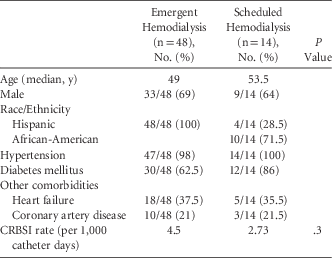
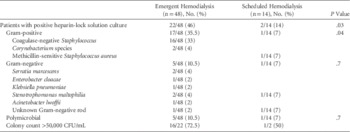
In total, 62 patients were included in the study: 48 in the emergent hemodialysis group and 14 in the scheduled hemodialysis group. The demographic characteristics of the groups are summarized in Table 3. In the year prior to the culture, the CRBSI rate in the emergent hemodialysis patients was 4.5 episodes per 1,000 catheter days and in the scheduled hemodialysis group the CRBSI rate was 2.7 (P=.3). A total of 24 participants (38.7%) had a positive culture of the heparin-lock solution. Of these participants, 22 were in the emergent hemodialysis group (46%) and 2 were in the scheduled hemodialysis group (14%) (P=.03). Of the 24 positive cultures, 19 (79.2%) had a Gram-positive organism, with coagulase-negative Staphylococcus (CoNS) being the most commonly isolated organism (84.2%). The heparin-lock solution culture contained Gram-negative organisms in 5 of 48 patients in the emergent hemodialysis group and in 1 of 14 patients in the scheduled hemodialysis group (P=.7). In the majority of cultures (70.8%) the colony count of the cultured fluid was >50,000 CFU/mL (Table 4). A total of 18 patients had >1 sample of the heparin-lock solution cultured on different days. Of those patients, 14 had a consistent result in all the samples, either with colonization or without colonization (7 patients with positive culture all times and 7 patients with negative culture all times). The other 4 patients had positive and negative cultures at different culture times.
Demographic and Clinical Data (Prospective Analysis)
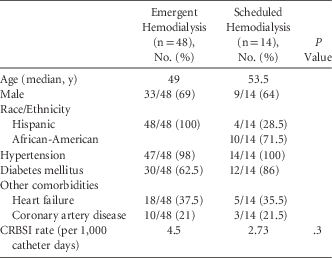
NOTE. CRBSI, catheter-related bloodstream infection.
Culture of the Heparin-Lock Solution

NOTE. CFU/mL, colony-forming units per milliliter.
When analyzing the emergent hemodialysis group only, we found that he median duration of catheter in days was 110.5 in those colonized and 87 days in noncolonized patients (P=.39). Of 22 colonized patients, 10 had at least 1 episode of CRBSI in the 6-month follow-up period, compared with 7 of 26 among the noncolonized patients (45.5% vs 27%; P=.18). Only those with colonization had a polymicrobial CRBSI, and they had more CRBSIs caused by GNR than those without colonization. Notably, in the year prior to the heparin-lock culture, patients with colonization had more episodes of CRBSI than patients without colonization (68.2% vs 38.5%; P=.04).
If both hemodialysis groups (emergent and scheduled) are considered together, patients with colonization due to Gram-negative bacteria or Staphylococcus aureus (7 patients in both groups) had a higher rate of subsequent CRBSI (6 of 7; 85.7%) than patients who had colonization with only nonvirulent organisms, such as coagulase-negative staphylococci and Corynebacterium species (4 of 18; 22.2%; P=.007), as well as patients with no colonization (9 of 38; 23.6%; P=.004).
DISCUSSION
The higher rate of bloodstream infections in patients on emergent hemodialysis with tunneled dialysis catheters compared with patients with arteriovenous fistula was expected, but the predominance of unusual GNR and the frequency of polymicrobial cultures was not anticipated. The origins of Gram-negative bacteria in hemodialysis systems and home healthcare settings has been discussed and has been thought to be related to different water sources.Reference Do, Ray and Banerjee 19 We did not identify sites that might have served as a source of contamination in our dialysis unit, nor did we detect any clustering of isolates by time or location within the unit. Therefore, an unrecognized common source transmission mode is unlikely. Furthermore, intensified infection control measures had no effect on bacteremia rates.Reference Ali, Kuo and Quinones 9 We reasoned that dialysis catheters became colonized and eventually led to the occurrence of bacteremia. However, the significance of colonization of the catheter has been debated.Reference Tenney, Moody and Newman 10 – Reference Nielsen, Kolmos and Rosdahl 15
In this study, we demonstrated that the catheters are indeed colonized; 46% of patients on emergent hemodialysis had positive catheter heparin-lock cultures. Patients on scheduled hemodialysis had significantly lower rates of colonization of the catheter. The difference was driven mainly by the higher colonization with Gram-positive organisms in the emergent hemodialysis group. Based on our retrospective analysis, we expected catheters to be colonized with Gram-negative organisms more frequently, but this was not the case. We followed colonized and noncolonized patients for 6 months after obtaining the cultures. Overall, there was no significant difference in the rates of incident CRBSI. This may be partially explained by the fact that colonization was mainly caused by Gram-positive, relatively avirulent bacteria, when Gram-negative organisms mainly cause CRBSI in the emergent hemodialysis population. We did find that patients with heparin-lock cultures positive for Staphylococcus aureus or GNR developed CRBSI more frequently than those with cultures positive for CoNS or Corynebacterium species or those with negative heparin-lock cultures.
We are aware of some limitations of our study. In most instances, we obtained only 1 sample of the heparin-lock solution per patient. We did not exclude patients who recently had a catheter placement, which might have not given enough time to the catheter to become colonized, as endoluminal colonization of catheters may increase with time.Reference Raad, Costerton and Sabharwal 11 We followed patients for 6 months after culture of the heparin-lock solution, which may not have been sufficient time for follow-up of CRBSI. Finally, in dialysis patients the outer surface of the extravascular segment of the catheter, rather than the endoluminal surface, may have a higher microbiological yield.Reference Ramanathan, Riosa and Al-Sharif 20
In conclusion, patients receiving hemodialysis through tunneled catheters at irregular intervals on an emergent basis and not in scheduled fashion are at risk of CRBSIs, which are more frequently caused by GNR or are polymicrobial. Endoluminal colonization, however, did not predict the incidence of CRBSI at 6-month follow-up in this study, except for patients who had heparin-lock cultures positive for Staphylococcus aureus or GNR. Further research is needed to investigate the mechanisms of CRBSI in this population to establish preventive strategies. We postulate that the main problem with infection in the emergent hemodialysis population may be the prolonged maintenance of the catheter and infrequent dialysis leading to prolonged exposure to uremic toxins. The use of arteriovenous fistula instead of tunneled catheters may be the best solution for these patients.
ACKNOWLEDGMENTS
We received support from the Acute Dialysis Unit of Parkland Memorial Hospital, particularly from Valsala Jacob, and from the Microbiology Laboratory staff, including Linda Byrd, Dr. Paul Southern, Dr. Dominick Cavuoti and Dr. Rita Gander.
We also thank Dr. Roger Bedimo for reviewing the first draft of the manuscript and providing valuable feedback.
Financial support: The administration of Parkland Health and Hospital System partially sponsored the prospective component of this study.
Potential conflicts of interest: All authors report no conflicts of interest relevant to this article.